Today, in God’s Lavish Mercy, our first reading shows Paul shepherding in the very early days of Christianity. His ministry throughout the Mediterranean basin guided early Christians as the Church planted its first harvest.
Paul lets us know that this ministry of leadership is not easy – that he relies on the good will of the communities he serves:
You were, of course, concerned about me but lacked an opportunity. Not that I say this because of need, for I have learned, in whatever situation I find myself, to be self-sufficient.
Paul seems to refer specifically to material help, but certainly he values even more the spiritual and moral loyalty of his followers.
In our Gospel, Jesus offers us a sermonette that can, at first, seem a little confusing. His tone, as he speaks to a group of Pharisees, is somewhat ironic. But his bottomline message is this: loyalty to God, not to material things.
The thread running through all these passages? The work of the Church needs both our spiritual and material loyalty to thrive – whether in Paul’s time, or Christ’s, or our own.
The Pharisees pretended such loyalty, but Jesus challenged them:
You justify yourselves in the sight of others, but God knows your hearts …
A sobering challenge against which to measure ourselves!
Poetry: All Your Secrets – Omar Khayyam
All thy secrets are known to the wisdom of Heaven
God knows them hair by hair and vein by vein.
I admit that by power of hypocrisy you may be able
to deceive men, but what will you do before Him who
knows your misdeeds one by one in every detail?
Music: Thank You for Giving to the Lord – Ray Boltz
Today, in God’s Lavish Mercy, we pray with Psalm 122, one of the Psalms of Ascent prayed as the community of Israel prepared to worship.
Let us go rejoicing to the house of the Lord.
The community was happy to be able to gather at the Temple/Jerusalem which was more than a physical place of worship. The Temple/Jerusalem was a stable symbol of God’s power and faithful presence to Israel. It was so significant a symbol that, even when destroyed, its power sustained the community of believers.
The “Temple” became much more than a building; Jerusalem much more than a city. The very concepts grew into living realities with which the believer formed a dynamic relationship. Within that relationship, the believer could meet and explore the mystery of God.
“Temple/Jerusalem” became an icon of one’s faith relationship with God.
As the psalm indicates, the believer must go out of oneself to dwell within this icon, to grow in this relationship. It is a place of full spiritual integration achieved through a lifting of the spirit into the joyful discipline of grace.
Jerusalem, built as a city with compact unity. To it the tribes go up, the tribes of the LORD.Psalm 22:3-4
The essence of this graceful transformation is to respond with profound gratitude to God’s invitation to love and mercy. Such a response raises our hearts to a new understanding of God’s Presence in every aspect of our lives.
According to the decree for Israel, to give thanks to the name of the LORD. In it are set up judgment seats, seats for the house of David.Psalm 22:4-5
The psalm verses not included in today’s reading tell us that once we begin to live this sacred relationship, we become a force for peace and justice among our sisters and brothers.
For the peace of Jerusalem pray: “May those who love you prosper! May peace be within your ramparts, prosperity within your towers.” For the sake of my brothers and friends I say, “Peace be with you.” For the sake of the house of the LORD, our God, I pray for your good.Psalm 22: 6-9
These verses seem like such a good prayer today.
Poem: from Rumi
Remember, the entrance door to the sanctuary is inside you.
Music: Fill This Temple Once Again – Don Moen and Benny Hinn
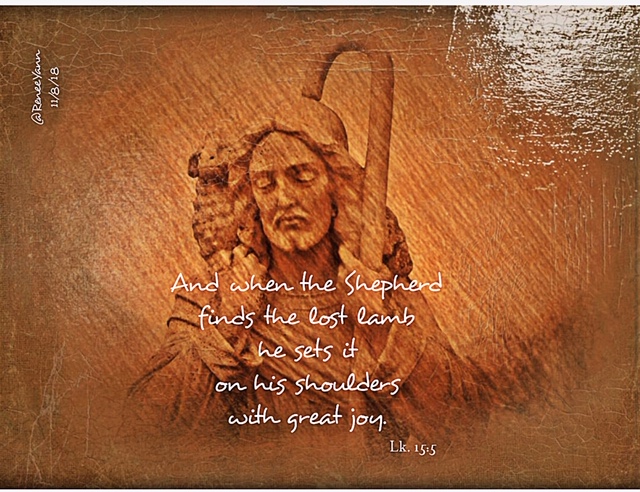
Today, in God’s Lavish Mercy, we meet the Shepherd bringing the lost lamb home. Haven’t we all, at sometime in our lives, been carried on those sacred shoulders?
Whether by our own prayers, or the prayers of those who love us, have we not been rescued from sorrow, foolishness, isolation or fear?
This beautiful Gospel assures us of the one thing we most deeply need – we are cherished, irrevocably, by God.
Today, if we need to ride those shoulders, let us trust ourselves to them in prayer.
If, by grace, we are already home, let us pray for those feeling most lost or abandoned – those most beset by a hostile world. May our merciful action help lift them to peace and the sweet scent of God so close beside them.
Poetry: The Good Shepherd – Brian Yapko
I enjoyed this poem which imagines Jesus still as a youngster experiencing a night as a shepherd. Mary and Joseph think it might not be the right vocation for him after his traumatic overnight!
My count of sheep was off as twilight fell And father’s friend, Ben Ezra’s lamb was gone! I had to find her! Searching past the well I climbed the rocks exhausted but pressed on. Delay could mean her life! She’d failed to heed My shepherd’s call and so risked being killed! Some wild beast might capture her and feed. I could not let her unstained blood be spilled!
Great danger filled that dark and craggy hill. My fear was deep! And then my torch went dim! Oh, why did I avoid my father’s will To one day be a carpenter like him? Because my father’s friend was gravely ill. I loved his sheep, so father made a plan For me to herd them just one year until I’m old enough to be declared a man.
I found the frightened lamb inside a cave Cornered by a wolf of knife-sharp claw. The fiercest wolf I’ve seen! How could I save This little sheep? I thrust my staff to draw Away the beast. He snarled, bit my wrist And mauled my side. In agony, I heard The wolf’s attack, too wounded to resist. But then, thank God, a miracle occurred!
I closed my eyes and with a trembling voice Said “Help me, father!” And the fierce wolf froze! He yelped, then fled as if he had no choice! I clutched the lamb and wept till the sun rose. Still shaking I then rose up on my feet. I kissed the lamb and said don’t be afraid For now you’re safe. She cried a grateful bleat. She knew I’d saved her and the price I paid.
My parents say I may no longer herd And must devote my life to nails and wood; But angels fill my dreams and leave me stirred To try to be a shepherd—one who’s good— Who shields his sheep from wickedness and strife. I love them all, the good ones and the lost; I’ll fear no evil that might take my life, For I think their salvation’s worth the cost.
Music: I Will Carry You – Sean Clive
I will carry you when you are weak. I will carry you when you can’t speak. I will carry you when you can’t pray. I will carry you each night and day.
I will carry you when times are hard. I will carry you both near & far. I’ll be there with you whenever you fall. I will carry you through it all.
My arms are wider than the sky, softer than a little child, stronger than the raging, calming like a gentle breeze. Trust in me to hold on tight because
I will carry you when you can’t stand. I’ll be there for you to hold your hand. And I will show you that you’re never alone. I will carry you and bring you back home.
Not pain, not fear, not death, no nothing at all can separate you from my love. My arms and hands will hold you close. Just reach out and take them in your own. Trust in me to hold on tight. I will carry you.
Today, in God’s Lavish Mercy, we celebrate all those canonized and uncanonized sisters and brothers who lived their lives in Christ with gusto and fidelity.
The feast of All Saints, on its current date, is traced to the foundation by Pope Gregory III by (731–741) of an oratory in St. Peter’s for the relics “of the holy apostles and of all saints, martyrs and confessors, of all the just made perfect who are at rest throughout the world”. (Wikipedia)
I’ve personally known many of these saints, whether I fully recognized their sanctity or not. They have lived in my family, school, neighborhood, parish, ministries, and workplaces. Some were clothed as nuns and some as beggars. Some taught me by words and some by silence. I knew some by name, others by grace. Now they have all joined the eternal family watching over us and cheering for us.
There they have formed communion with my more recognized and favorite holy friends like Mary, Joseph, Teresa of Avila, Catherine of Siena, Kateri Tekawitha, Anna the Prophet, John XXIII, and of course Catherine McAuley.
What a wonderful day to know that these beloveds of God are our sisters and brothers, who pray with and for us that we may one day rejoice with them in eternal light.
Who are the saints that speak especially to your heart? Take time to have a nice conversation with them on this glorious feastday!
If you are interested in learning more about the saints, this is a wonderful book by Father James Martin, SJ.
Poetry: All Saints Day – Ada Cambridge, (1844 – 1926), later known as Ada Cross, was an English-born Australian writer. She wrote more than 25 works of fiction, three volumes of poetry and two autobiographical works. Many of her novels were serialized in Australian newspapers but never published in book form.
“But they are at peace.”
Never to weary more, nor suffer sorrow,— Their strife all over, and their work all done: At peace—and only waiting for the morrow; Heaven’s rest and rapture even now begun.
So tired once! long fetter’d, sorely burden’d, Ye struggled hard and well for your release; Ye fought in faith and love—and ye are guerdon’d, O happy souls! for now ye are at peace.
No more of pain, no more of bitter weeping! For us a darkness and an empty place, Somewhere a little dust—in angels’ keeping— A blessèd memory of a vanish’d face.
For us the lonely path, the daily toiling, The din and strife of battle, never still’d; For us the wounds, the hunger, and the soiling,— The utter, speechless longing, unfulfill’d.
For us the army camp’d upon the mountains, Unseen, yet fighting with our Syrian foes,— The heaven-sent manna and the wayside fountains, The hope and promise, sweetening our woes.
For them the joyous spirit, freely ranging Green hills and fields where never mortal trod; For them the light unfading and unchanging, The perfect quietness—the peace of God.
For both, a dim, mysterious, distant greeting; For both, at Jesus’ cross, a drawing near; At Eucharistic gate a blessed meeting, When angels and archangels worship here.
For both, God grant, an everlasting union, When sin shall pass away and tears shall cease; For both the deep and full and true communion, For both the happy life that is “at peace.”
Music: All Saints Day – featuring “Lifesong” by Casting Crowns (lyrics below)
Empty hands held high Such small sacrifice Now joined with my life I sing in vain tonight
May the words I say And the things I do Make my lifesong sing Bring a smile to you
Let my lifesong sing to you Let my lifesong sing to you I want to sign your name To the end of this day
Lord led my heart was true Let my lifesong sing to you Lord I give my life A living sacrifice To reach a world in need To be your hands and feet
So may the words I say And the things I do Make my lifesong sing Bring a smile to you
Let my lifesong sing to you Let my lifesong sing to you I want to sign your name To the end of this day
Knowing that my heart was true Let my lifesong sing to you Hallelujah, Hallelujah let my lifesong sing to you Hallelujah, Hallelujah let my lifesong sing to you
Hallelujah,… Let my lifesong sing to you Let my lifesong sing to you I want to sign your name To the end of this day
Knowing that my heart was true Let my lifesong sing to you Let my lifesong sing to you Let my lifesong sing to you I want to sign your name To the end of this day Lord led my heart was true Let my lifesong sing to you
Today, in God’s Lavish Mercy, we have three wonderful readings to enrich our prayer.
In our passage from Wisdom, we can picture the pray-er sitting down with God to express admiration, thanks and love.
Before the LORD the whole universe is as a grain from a balance or a drop of morning dew come down upon the earth. But you have mercy on all, because you can do all things; and you overlook people’s sins that they may repent. For you love all things that are and loathe nothing that you have made; for what you hated, you would not have fashioned.
In his letter to the Thessalonians, Paul prays a beautiful blessing over the community – a blessing which, by grace, transcends through time to us:
We always pray for you, that our God may make you worthy of his calling and powerfully bring to fulfillment every good purpose and every effort of faith, that the name of our Lord Jesus may be glorified in you, and you in him, in accord with the grace of our God and Lord Jesus Christ.
In Luke’s Gospel, Jesus meets a height-challenged scribe who is intensely interested in seeing the rumored Messiah:
Zaccheus ran ahead and climbed a sycamore tree in order to see Jesus, who was about to pass that way. When he reached the place, Jesus looked up and said, “Zacchaeus, come down quickly, for today I must stay at your house.”
Notice that Jesus doesn’t just wave or look at Zacchaeus with a wry smile at his perch. Jesus incorporates Zacchaeus into the embrace of salvation.As Wisdom says, Jesus “loves all things that are..” And as Paul says, “powerfully brings to fulfillment every good purpose and every effort of faith…”
I think there are times in every life when we need to stretch to find God. We may need to climb faith’s tree and dangle over the confusions of life in the hope of grasping grace. Friends, all of us, no matter how tall we might be, have been Zaccheaus! Am I right? When we are, let”s listen for the One Who calls our name!
Poetry: Zacchaeus – George Macdonald (10 December 1824 – 18 September 1905) was a Scottish author, poet and Christian minister. He was a pioneering figure in the field of modern fantasy literature and the mentor of fellow writer Lewis Carroll.
To whom the heavy burden clings, It yet may serve him like a staff; One day the cross will break in wings, The sinner laugh a holy laugh.
The dwarfed Zacchaeus climbed a tree, His humble stature set him high; The Lord the little man did see Who sought the great man passing by.
Up to the tree he came, and stopped: “To-day,” he said, “with thee I bide.” A spirit-shaken fruit he dropped, Ripe for the Master, at his side.
Sure never host with gladder look A welcome guest home with him bore! Then rose the Satan of rebuke And loudly spake beside the door:
“This is no place for holy feet; Sinners should house and eat alone! This man sits in the stranger‘s seat And grinds the faces of his own!”
Outspoke the man, in Truth‘s own might: “Lord, half my goods I give the poor; If one I’ve taken more than right With four I make atonement sure!”
“Salvation here is entered in; This man indeed is Abraham’s son!” Said he who came the lost to win- And saved the lost whom he had won.
Music: He Called Me by My Name – Fr. Christopher Cuelho, OFM
Today, in God’s Lavish Mercy, we celebrate the feast of the Apostles Simon and Jude.
Not much is really known about either of these men. One tradition suggests that after the Ascension, they went together to carry the Gospel to Persia where they were eventually martyred.
Since we have so few facts, many legends and interpretations have grown up around these two men. Probably the strongest and most familiar of these is of St. Jude as the patron of hopeless cases.
There are probably very few of us who haven’t asked at least one favor from St. Jude in our lifetimes. This probability begs the question of why and how do we pray with the saints.
Our tradition holds that we exist in the Communion of Saints with all of God’s creatures, and that we inspire and support one another by the sharing of our lives. This sharing is not limited by time, nor is it constricted by death.
When we pray with the saints, we draw on their faithful witness to inspire, motivate and sustain us in our lives.
Today, we might pray within the spirit of these two great Christians whose witness, though historically muted, transcends time. May they inspire in us the passion and joy to speak Christ in our lives.
Poetry: All Saints – Malcolm Guite
Though Satan breaks our dark glass into shards
Each shard still shines with Christ’s reflected light,
It glances from the eyes, kindles the words
Of all his unknown saints. The dark is bright
With quiet lives and steady lights undimmed,
The witness of the ones we shunned and shamed.
Plain in our sight and far beyond our seeing
He weaves them with us in the web of being
They stand beside us even as we grieve,
The lone and left behind whom no one claimed,
Unnumbered multitudes, he lifts above
The shadow of the gibbet and the grave,
To triumph where all saints are known and named;
The gathered glories of His wounded love.
Music: Apostles’ Creed – sung here by Rebecca Gorzynska, a beautiful and talented artist (Latin and English text below.)
Credo in Deum Patrem omnipotentem, Creatorem caeli et terrae,et in Iesum Christum, Filium Eius unicum, Dominum nostrum,qui conceptus est de Spiritu Sancto, natus ex Maria Virgine,passus sub Pontio Pilato, crucifixus, mortuus, et sepultus,descendit ad ínferos, tertia die resurrexit a mortuis,ascendit ad caelos, sedet ad dexteram Patris omnipotentis,inde venturus est iudicare vivos et mortuos.Credo in Spiritum Sanctum,sanctam Ecclesiam catholicam, sanctorum communionem,remissionem peccatorum,carnis resurrectionem,vitam aeternam.Amen
I believe in God, the Father Almighty, Creator of heaven and earth. And in Jesus Christ, his only Son, our Lord: who was conceived by the Holy Spirit, born of the Virgin Mary, suffered under Pontius Pilate, was crucified, died, and was buried; he descended into hell; the third day he rose again from the dead; he ascended into heaven; sits at the right hand of God the Father Almighty; from thence he shall come to judge the living and the dead. I believe in the Holy Spirit, the holy Catholic Church, the communion of Saints, the forgiveness of sins, the resurrection of the body, and life everlasting. Amen. (Apostles’ Creed – Roman Ritual)
Wednesday of the Thirtieth Week in Ordinary Time October 26, 2022
Today, in God’s Lavish Mercy, Jesus sets out a stringent formula for entrance into the Kingdom of Heaven.
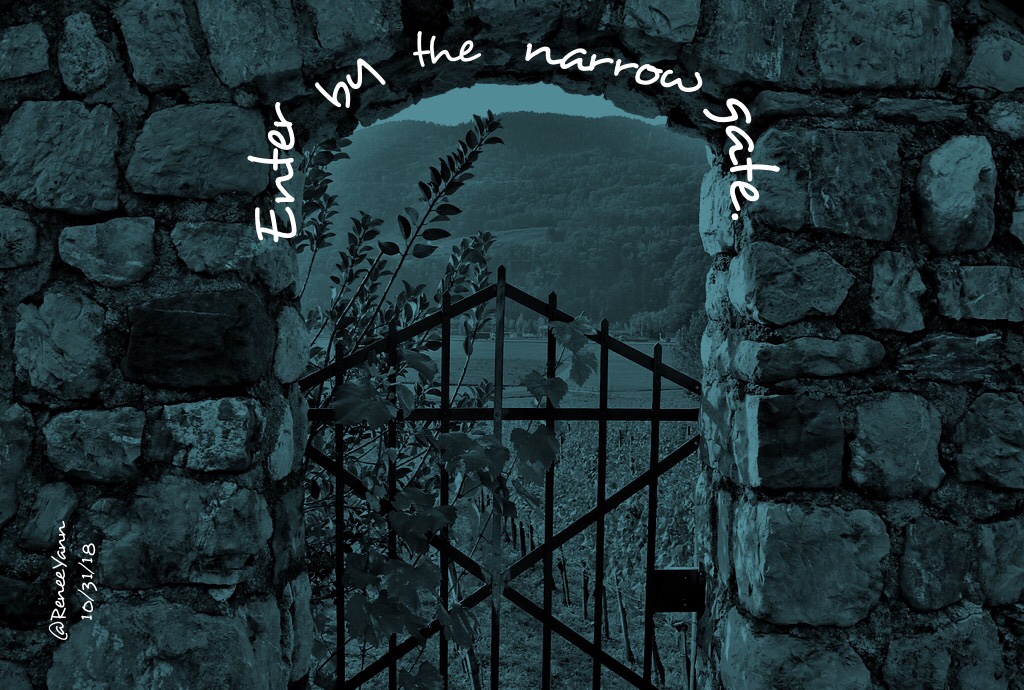
Strive to enter through the narrow gate, for many, I tell you, will attempt to enter but will not be strong enough.
Jesus goes on to say that some will get to the threshold of the kingdom and be denied entrance because they are not recognized. These petitioners will be shocked, saying, “But we ate and drank in your company and you taught in our streets.”
The passage teaches us that there is more to faith than religion, more to prayer than words, more to relationship than ritual. We may be the most observant Catholic, Lutheran, or Jew. We may stay praying in church longer than anyone else. We may know the catechism by heart. But if our deep heart hasn’t touched God’s, we will not be recognized at the narrow gate.
Where will we find God’s heart? The Gospel seems to suggest that we would do best to look among those who are considered “last” – those who are poor, humble, suffering, marginalized. At “the gate”, they will be “first” – so they must have the secret to that stringent formula.
There is little or nothing between these blessed ones and the touch of God – no power, pride or wealth. Their strength lies in their utter dependence on God – God knows them in that dependence.
It is hard for us to reach that place of trust and unity with God. Our possessions and accomplishments get in the way. Our independence and self-reliance get in the way. Our pride and penchant for control get in the way. It is a very narrow gate through these things that lets us find God – our God Who is not far … Who waits in the spaces between our self-importance.
Poetry: The Narrow Way – Anne Bradstreet
Believe not those who say
     The upward path is smooth,
Lest thou shouldst stumble in the way,
     And faint before the truth.
It is the only road
     Unto the realms of joy;
But he who seeks that blest abode
     Must all his powers employ.
Bright hopes and pure delights
     Upon his course may beam,
And there, amid the sternest heights
     The sweetest flowerets gleam.
On all her breezes borne,
     Earth yields no scents like those;
But he that dares not grasp the thorn
     Should never crave the rose.
Arm—arm thee for the fight!
     Cast useless loads away;
Watch through the darkest hours of night,
     Toil through the hottest day.
Crush pride into the dust,
     Or thou must needs be slack;
And trample down rebellious lust,
     Or it will hold thee back.
Seek not thy honor here;
     Waive pleasure and renown;
The world’s dread scoff undaunted bear,
     And face its deadliest frown.
To labor and to love,
     To pardon and endure,
To lift thy heart to God above,
     And keep thy conscience pure;
Be this thy constant aim,
     Thy hope, thy chief delight;
What matter who should whisper blame,
     Or who should scorn or slight?
What matter, if thy God approve,
     And if, within thy breast,
Thou feel the comfort of His love,
     The earnest of His rest?
Music: Enter the Narrow Gate! – John Michael Talbot
Enter the narrow gate The gate that leads to life His yoke is easy and His burden is light. Pray for your enemies Those who abuse you Love them and do not hate And love will follow you. Enter the narrow gate The gate that leads to life His yoke is easy and His burden is light. Forgive those who offend And seek their forgiveness And when you bring your gift You will be forgiven. Enter the narrow gate The gate that leads to life His yoke is easy and His burden is light. His yoke is easy and His burden is light.
Today, in God’s Lavish Mercy, Paul proclaims his mission to the Gentiles, announcing that through the Gospel, salvation is offered to all people. He says that, by grace, he became a minister of this Gospel – called to preach “the inscrutable riches of Christ”.
And Paul certainly did an extraordinary job. He had been given much by God, and he gave it back wholeheartedly.
In the Gospel, Jesus talks about that same kind of investment. In answer to Peter’s confusion about the call to be ready for God, Jesus tells the story of wily steward.
This servant had been given much: trust, responsibility, power and probably higher pay. But when the master is away, the trusted servant fails him, acting cruelly and greedily in his own interest.
Jesus ends the story with a pronouncement that has always shaken me a little:
For unto whomever much is given, much will be required.
I know I’ve been given a stunning abundance by God: faith, family, friends and a thousand other graces. But my will and ability to give back sometimes feels as fragile as a decaying leaf. Ever feel like that?
It turns out that even Paul, great Apostle to the Gentiles, felt that way too. He says so in his letter to the Corinthians. Paul asks God to remove his fragility.
But He said to me, “My grace is sufficient for you, for my power is made perfect in weakness.”
Let’s pray today to be good stewards of the amazing riches God has given us – in Creation, Faith, Grace and Community. Let us invite God’s power to perfect our weakness, all for the sake of God’s glory.
Even a lacy leaf can be beautiful when it is filled with Light.
Poetry: To Autumn – John Keats
Season of mists and mellow fruitfulness,
  Close bosom-friend of the maturing sun;
Conspiring with him how to load and bless
  With fruit the vines that round the thatch-eves run;
To bend with apples the moss'd cottage-trees,
  And fill all fruit with ripeness to the core;
    To swell the gourd, and plump the hazel shells
  With a sweet kernel; to set budding more,
And still more, later flowers for the bees,
Until they think warm days will never cease,
    For summer has o'er-brimm'd their clammy cells.
Who hath not seen thee oft amid thy store?
  Sometimes whoever seeks abroad may find
Thee sitting careless on a granary floor,
  Thy hair soft-lifted by the winnowing wind;
Or on a half-reap'd furrow sound asleep,
  Drowsed with the fume of poppies, while thy hook
    Spares the next swath and all its twined flowers:
And sometimes like a gleaner thou dost keep
  Steady thy laden head across a brook;
  Or by a cider-press, with patient look,
    Thou watchest the last oozings, hours by hours.
Where are the songs of Spring? Ay, where are they?
  Think not of them, thou hast thy music too,--
While barred clouds bloom the soft-dying day,
  And touch the stubble-plains with rosy hue;
Then in a wailful choir the small gnats mourn
  Among the river sallows, borne aloft
    Or sinking as the light wind lives or dies;
And full-grown lambs loud bleat from hilly bourn;
  Hedge-crickets sing; and now with treble soft
  The redbreast whistles from a garden-croft,
    And gathering swallows twitter in the skies.
Music: My Grace is Sufficient for You – Keith and Amy Amano
Today, in God’s Lavish Mercy, we celebrate the Feast of St. Luke, evangelist, writer of the Gospel and the Acts of the Apostles, and devoted missionary companion of Paul.
Luke’s Gospel is unique in several ways.
Six miracles appear only in Luke:
the miraculous catch of fish
the raising of the widow’s only son
healing a possessed, crippled woman
healing a man with dropsy
cleansing of ten lepers
healing the man’s ear in Gethsemane
Eighteen parables are unique to Luke, including the beloved stories of the Good Samaritan and the Prodigal Son.
Van Gogh’s Good Samaritan
While both Matthew and Luke contain the story of Christ’s birth, only Luke includes those beautiful passages which now comprise the joyful mysteries of the rosary: Annunciation, Visitation, Nativity, Presentation, and Finding in the Temple.
Only Luke gives us the Magnificat and the cherished words of the Hail Mary.
Think of all that we would not be able to visualize without Luke’s blessed writings. No Gabriel. No Elizabeth, Zachary, Anna or Simeon. No tender Samaritan or merciful loving Prodigal Father to show us God’s face.
Rembrandt’s Prodigal Son
Maybe some of your favorite passages are among these Lucan treasures. You might want to choose one to accompany you throughout your day.
Poetry: A Sonnet for St. Luke – Malcolm Guite
His gospel is itself a living creature
A ground and glory round the throne of God,
Where earth and heaven breathe through human nature
And One upon the throne sees it is good.
Luke is the living pillar of our healing,
A lowly ox, the servant of the four,
We turn his page to find his face revealing
The wonder, and the welcome of the poor.
He breathes good news to all who bear a burden
Good news to all who turn and try again,
The meek rejoice and prodigals find pardon,
A lost thief reaches paradise through pain,
The voiceless find their voice in every word
And, with Our Lady, magnify Our Lord.
The music today is a country song, not really about St. Luke’s Gospel, but certainly reflecting its love and respect for those who are poor.
Today, in God’s Lavish Mercy, we encounter readings that are probably not among anyone’s favorites. In the epistle, Paul is trying to demonstrate to the Galatians how blessed they are to have inherited the promise given to Abraham.
In the Gospel, there is a lot of talk about evil spirits, divided kingdoms, and good old Beelzebub. It’s not really a day when you’ll say, “Gosh, those readings inspired me!”
Is it worth sticking with the daily readings in such a case? I think so.
There is always a string lying among these sacred words that we can tie to our own hearts. For me today, that string is wrapped around the Responsorial Psalm:
I will give thanks to the Lord with all my heart.
Just as the Galatians have inherited God’s promise, so have we. Just as the Kingdom of God has come upon Jesus’ followers, it has come upon us. God’s fidelity remains with us through all the “demons” that might annoy or threaten us. God’s graciousness has already redeemed us for an eternal life beyond their reach.
So let’s have intentionally grateful hearts today. Everything – yes, everything – in our lives is a gift, if we but have the grace to unwrap it with humility, openness and gratitude.
On this day when we pray in a special way to Our Lady of the Rosary, we can take the opportunity, while fingering our beads, to relive her life with her. We talk with her about the major mysteries of our own lives which have invited us to birth Christ into our own times and experiences.
Poetry: Theotokos – Malcolm Guite
You bore for me the One who came to bless
And bear for all and make the broken whole.
You heard His call and in your open ‘yes’
You spoke aloud for every living soul.
Oh gracious Lady, child of your own child,
Whose mother-love still calls the child in me,
Call me again, for I am lost, and  wild
Waves suround me now. On this dark sea
Shine as a star and call me to the shore.
Open the door that all my sins would close
And hold me in your garden. Let me share
The prayer that folds the petals of the Rose.
Enfold me too in Love’s last mystery
And bring me to the One you bore for me.











 Lavish Mercy