Who Would I Be?

January 5, 2022
Wednesday after the Epiphany
Memorial of Saint John Neumann, Bishop

Today, in God’s Lavish Mercy, we have a few references to fear — and to its perfect antidote, Love.

John continues to instruct us in prose that stuns us with its sacred clarity:

There is no fear in love,
but perfect love drives out fear
because fear has to do with punishment,
and so one who fears is not yet perfect in love.

1 John 4:18

In our Gospel, we meet some pretty fearful disciples. First of all, they are still spinning from the avalanche of loaves and fishes gushing forth from the perfect faith of Jesus.

Jesus Walks on Water- William Brassey Hole

Today, they are rowing a storm-tossed lake in the pitch of night. Enough to strike fear into even a crusty fisherman’s heart! But wait a minute! As if all these scary things are not enough, here comes a ghost across the threatening waves!

And how about Jesus in this passage? A little nonchalant, or what? 

About the fourth watch of the night,
he came toward them walking on the sea.
He meant to pass by them.
But when they saw him walking on the sea,

they thought it was a ghost and cried out.

Jesus wasn’t worried about the waves.
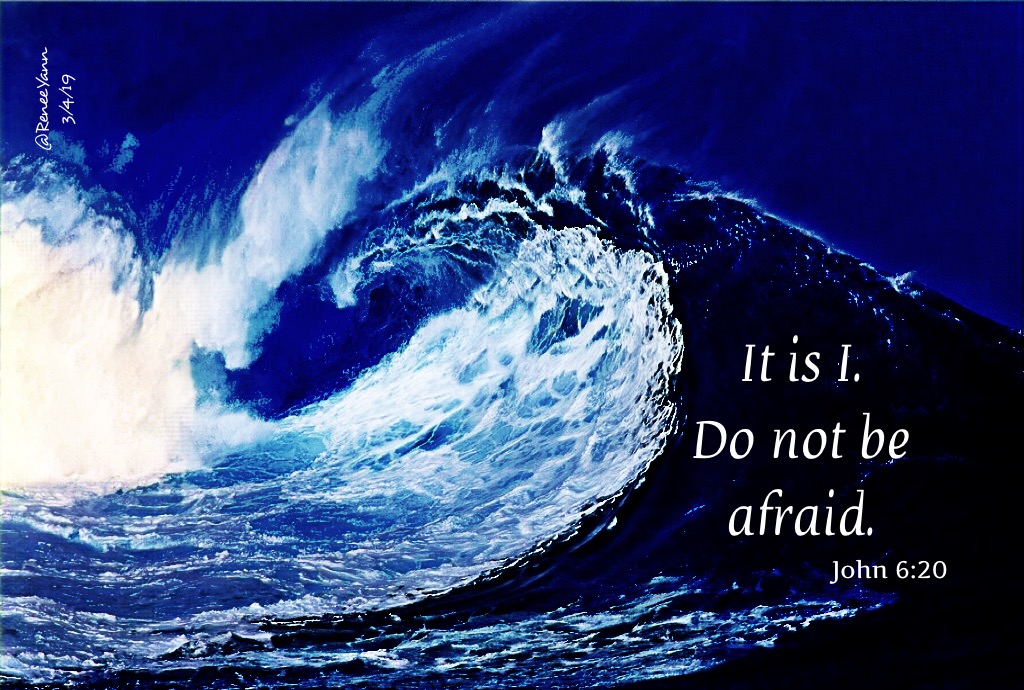
Jesus, full of Love, and eternally perfected in the Creator’s Presence, has no need or place for fear. He lives in the accomplished wholeness of God where, as Julian of Norwich says, “All manner of things shall be well.”


Like me, you may not think about your fears very often. But when I read this line from Paula D’Arcy, I consider that there are all kinds of unrecognized fears inhibiting us:

Who would I be, 
and what power
would be expressed in my life, 

if I were not dominated by fear?

Paula D’Arcy

Fears. What are some that we may not recognize:

  • Fear of feeling unimportant, overlooked, naive.
  • Fear of failure, loss, death, loneliness, dependence.
  • Fear of looking foolish, of making a mistake
  • Fear of getting old, being sick, losing my comfort zone.
  • Fear of meaninglessness, unusefulness, of being held responsible?

Could we go on and on?

But what about the biggest fear – of being unloved, and maybe even unlovable.

Dear God, as we pray today, 
help us to grow into your amazing love for us. 
Help us to recognize the fears that limit our love,
to cast them out upon the choppy waters of our life
and to live in your perfect freedom and joy.

Music:  All Shall Be Well – Michelle Sherliza

Begin Again…

January 3, 2022
Monday after Epiphany

Today, in God’s Lavish Mercy, in this week after the Epiphany, we continue with John’s inspirational readings. They are intended to deepen us in love, truth and simplicity.

And we also have several Gospels this week that take us with Jesus as he begins his public ministry.


Today’s Gospel opens with a tinge of sadness. Jesus has just heard that John had been arrested. Reality dawns on them both that theirs will be no easy missionary journey. Wouldn’t it have been wonderful if these cousins could have teamed up, gone about preaching unhindered by the fears and bullying of the powerful?

But a free and easy story is not the one God chose to tell us, because our own stories are not always free and easy. Some, yes, more so than others. But all people suffer in some way and we all need a God who understands and shares that suffering.

So, “hearing that John had been arrested”, Jesus bravely begins. He goes to the Capernaum lakeshore where the common people gather to refresh themselves. He will find them hungry, confused, sinful, questioning, bereft, and battered. And he will begin by feeding and soothing them.


Where would Jesus begin with you? If you sat along that seashore in those first days, what would you lay before his tender mercy? Perhaps the need does not belong precisely to you, but to someone you love, someone who needs love in a harsh world.

Photo by Taryn Elliott on Pexels.com

Picture yourself there this morning. The sun begins to warm the salty edges of the sea. The crowd is large but quiet, as if they think themselves in church. Jesus looks out over all the gathered. But for one moment, his eyes meet yours, and that moment is enough to begin.


Poetry: To the Sea of Galilee – Benjamin Waugh (1839-1908)
(It’s not a great voice of literature, but I think this little poem is charming.)

O PEARL of seas! how fairly set, thou lovely Galilee!
Well may all waters of the world for beauty envy thee.

For more than beauty! On thy shores heaven’s purest feet have trod;
And in thy face, as now yon sun, was mirrored once my God.

He loved to walk with thee beside; He gazed into thy face; 5
Thy troubled moods He calmed for thee; thou seem’st His child of grace.

But yet why envy thee, fair sea, by Jesus favoured thus?
Far more than He hath favoured thee hath Jesus favoured us.

Not for thy waters Jesus came His precious work to do;
’Twas not to give thy troubles peace that Him from glory drew. 10

Thine was a brief, a passing joy, as transient as thy flowers;
Thy side He left, and went away—He never leaveth ours.

Yet, sea of seas, I envy thee, thou small, but greatest deep
For on thy bosom Jesus found the place where He might sleep.

His weary frame, His heavy heart were pillowed on thy breast. 15
As John on Him, so He on thee found place where He might rest.

Jesus, if thou, by work or wrong, should’st sad or weary be,
Come seek within my heart the place once found on Galilee.


Music: Lord, You Have Come to the Seashore

No More Tears

December 4, 2021
Saturday of the First Week of Advent

Today, in Mercy, Isaiah – in glorious prophecy – promises God’s People better times.

Thus says the Lord GOD,
    the Holy One of Israel:
O people of Zion, who dwell in Jerusalem,
    no more will you weep;
GOD will be gracious to you when you cry out,
    answering as soon as you are heard.
The Lord will give you the bread you need
    and the water for which you thirst.
No longer will your Teacher be hidden,
    but with your own eyes you shall see your Teacher,
While from behind, a voice shall sound in your ears:
    “This is the way; walk in it,”
    when you would turn to the right or to the left.

Isaiah 30: 19-21

Oh my, don’t we all long for the fulfillment of that promise! So much in both our larger and smaller worlds longs for healing!


Perhaps we can use our prayer within these readings today to call on God for the promised healing.

It is a healing that requires our cooperation. Isaiah says that we must name our pain to God – for ourselves and for all who suffer in our world:

The Lord will be gracious to you when you cry out,
answering as soon as you are heard.


The prophet says that this crying out will change us. We will see the Lord with us in our suffering. God will lead us through that suffering by our acts of faith, hope, love, justice and mercy:

No longer will your Teacher be hidden,
but with your own eyes you shall see your Teacher,
While from behind, a voice shall sound in your ears:
“This is the way; walk in it,”
when you would turn to the right or to the left.


Our Gospel tells us that we are called to be Christ’s disciples, and that disciples are healers. By letting our lives become sources of healing in the world, Isaiah’s prophecy is fulfilled for our time.

Jesus sent out these twelve after instructing them thus,
“Go to the lost sheep of the house of Israel.
As you go, make this proclamation: ‘The Kingdom of heaven is at hand.’
Heal the sick, raise the dead, cleanse lepers, drive out demons.

Without cost you have received; without cost you are to give.”

Matthew 10:5-8

How we do these wondrous deeds in the world is an ongoing revelation. When I was very young, I took the proclamation quite literally. But I soon lost the expectation that I would ever help “cure” anyone of anything!

Life has blessed me with the realization that there is a difference between “curing” and “healing” – and that there are many degrees of healing.

  • There are many ways in which living people are caught in deadly lives.
  • There are all kinds of “lepers” in our society, rendered so by the prejudices of others.
  • Certainly, many of us carry all sorts of crippling demons.

All these situations, and others like them, invite us to offer the gift of sacred healing implanted in us at our Baptism.

Acknowledging the pain in ourselves and others,
and trusting that God wants us to be healed and whole,
is the work of true discipleship.

Let’s draw strength from Isaiah’s promise in order to find a generous, merciful courage for our call to be “healed healers”.


Poetry: The Cure of Souls – Denise Levertov

The pastor
of grief and dreams

guides his flock towards
the next field

with all his care.
He has heard

the bell tolling
but the sheep

are hungry and need
the grass, today and

every day. Beautiful
his patience, his long

shadow, the rippling
sound of the flocks moving

along the valley.


Music: Your Healing Touch – Joe Bongiorno

The Heart’s Temple

November 19, 2021
Friday of the Thirty-third Week in Ordinary Time

Today, in God’s Lavish Mercy, we pray with a passage from Chronicles as our Responsorial Psalm:

Yours, O LORD, are grandeur and power,
    majesty, splendor, and glory.
For all in heaven and on earth is yours.

1 Chronicles 29:11

This passage inclines us to worship God whose “temple” is all of Creation.


Both readings today speak about the “Temple”. After the victory of Judas Maccabeus, the Jewish people restore their physical Temple with exuberant celebration, recognizing it as a symbol of God’s Presence with them.


In today’s Gospel. Jesus also “restores” the Temple by driving out the merchants who have diverted the Temple’s purpose as representative of God’s Presence.


Our bodies too are temples of the Holy Spirit. Paul, in his letter to the Corinthians tells us:

Do you not know
that your bodies are temples of the Holy Spirit,
who is in you, whom you have received from God?
You are not your own; you were bought at a price.

1 Corinthians 6:19

Through our Baptism into the Passion, Death and Resurrection of Christ, the Holy Spirit dwells in us. We are called to be transformed by this Indwelling. As in any relationship, this transformation is accomplished through transparency, communication, listening and acting on behalf of the Beloved.


Poetry: Go Not to the Temple – Tagore

Go not to the temple to put flowers upon the feet of God,
First fill your own house with the Fragrance of love…

Go not to the temple to light candles before the altar of God,
First remove the darkness of sin from your heart…

Go not to the temple to bow down your head in prayer,
First learn to bow in humility before your fellowmen…

Go not to the temple to pray on bended knees,
First bend down to lift someone who is down-trodden. ..

Go not to the temple to ask for forgiveness for your sins,
First forgive from your heart those who have sinned against you.


Music: In the Temple Garden – Aaron Kenny

Beyond Measure

Wednesday of the Thirty-third Week in Ordinary Time
Memorial of St. Elizabeth of Hungary
November 17, 2021

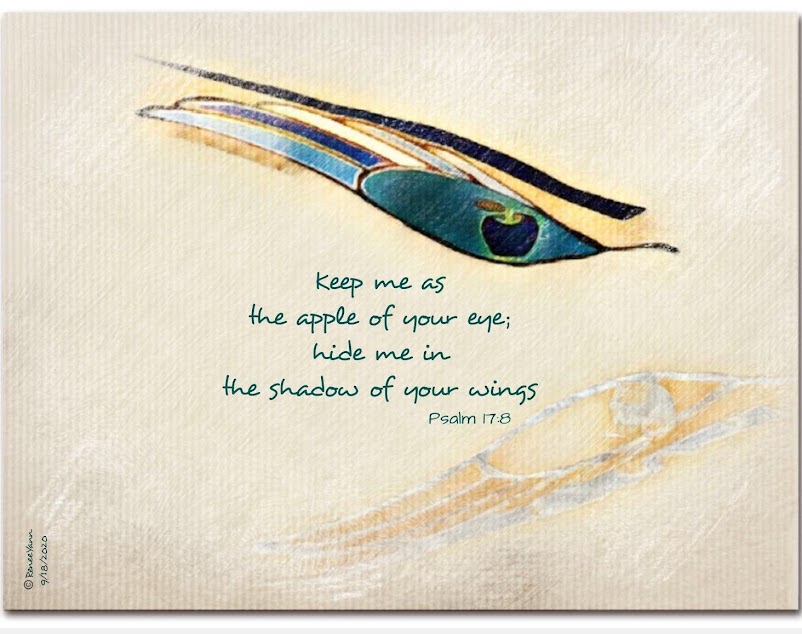
Today, in God’s Lavish Mercy, we pray a lovely verse of Psalm 17:

The psalm is a gentle plea which might serve to soften our two dramatically intense readings.

Who can read the story of the Maccabean Martyrs without a mix of horror, empathy, and astonishment?

And don’t we all feel a pang of pity for the poor, fearful servant who hid his talent in a handkerchief much to the King’s displeasure?

The two stories, (one based in fact, the other a parable), paint a contrasting picture of courageous faith against fearful subservience. The difference between the actors lies in their capacity, or lack there of, to look beyond themselves toward eternal life.

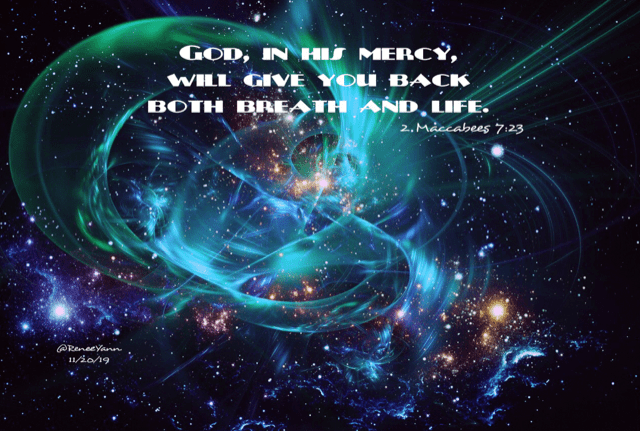
Mother Maccabee bolsters her sons with her faith in a life beyond their current circumstances:

… the Creator of the universe
who shapes each man’s beginning,
as he brings about the origin of everything,
he, in his mercy,
will give you back both breath and life,
because you now disregard yourselves
for the sake of his law.

2 Mc 7:23

The poor soul in Jesus’s parable doesn’t have that faith and vision. His perception of God, represented by the King, is one of only harsh judgement. His fear causes him to bury not only his talent, but also his openness to the possibilities of grace and transformed relationship with God.

Jesus told his parable because indeed the Kingdom was at hand. He and his disciples were near Jerusalem where the Passion, Death and Resurrection events would begin.

He wants his followers to realize the challenging gift they have been given in their call to be his disciples. He wants them to see that it is now on them to magnify his message courageously and generously until he returns to perfect the Kingdom.

Jesus wants us to understand that too.


Poetry: Sonnet 19: When I consider how my light is spent – John Milton
Milton became blind in later life. The poem reflects his concerns about all that he has left undone in his life. Ultimately, Milton expresses the confidence that God has no need of his “talent”, only his steadfast faith.

When I consider how my light is spent, 

   Ere half my days, in this dark world and wide, 

   And that one Talent which is death to hide 

   Lodged with me useless, though my Soul more bent 

To serve therewith my Maker, and present 

   My true account, lest he returning chide; 

   “Doth God exact day-labour, light denied?” 

   I fondly ask. But patience, to prevent 

That murmur, soon replies, “God doth not need 

   Either man’s work or his own gifts; who best 

   Bear his mild yoke, they serve him best. His state 

Is Kingly. Thousands at his bidding speed 

   And post o’er Land and Ocean without rest: 

   They also serve who only stand and wait.”


Music:   Be Not Afraid – written by Bob Dufford, SJ, sung here by Cat Jahnke

Stretching to See God

November 16, 2021
Tuesday of the Thirty-third Week in Ordinary Time

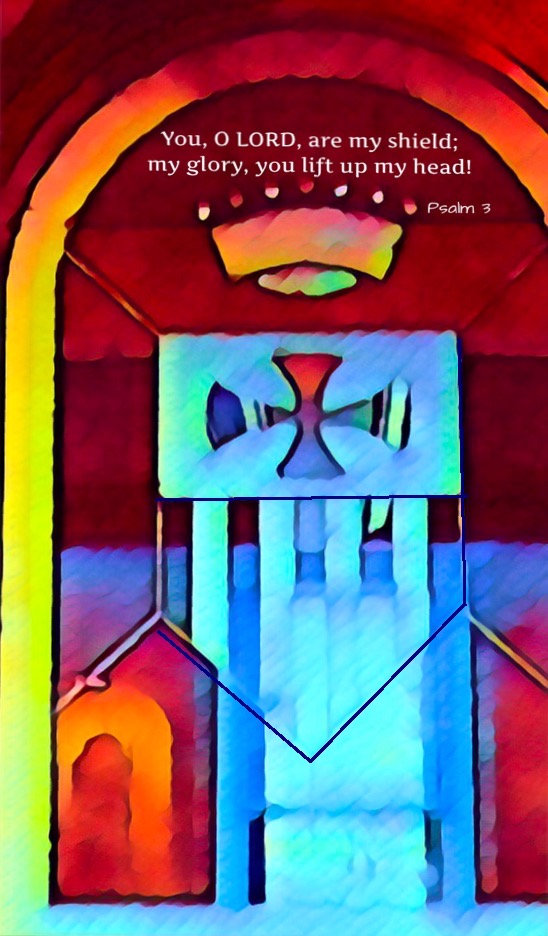
Today, in God’s Lavish Mercy, we pray with Psalm 3 which well might reflect the prayer of noble Eleazar from our first reading:

You, O LORD, are my shield;
    my glory, you lift up my head!
When I call out to the LORD,
    he answers me from his holy mountain.
R.    The Lord upholds me.
When I lie down in sleep,
    I wake again, for the LORD sustains me.
I fear not the myriads of people
    arrayed against me on every side.

Psalm 3: 4-7

Eleazar’s faithful character is so strong that he can look beyond his present circumstance to:

… leave in his death a model of courage
and an unforgettable example of virtue
not only for the young but for the whole nation.

2 Mc 6:31

Both Eleazar’s story and Zaccheus’s are about living in the big picture of God’s vision for us. These stories invite us to stretch beyond ourselves to see God in our circumstances.

Eleazar was a giant in the virtues necessary to “see beyond the trees” of his current circumstances. A more spiritually short-sighted person might have succumbed to the temptation to save himself at the cost of his faith and witness.

But Eleazar’s faith was long, both in years and in depth. He kept the eyes of his heart focused on that faith and was delivered beyond any short-sighted choices.


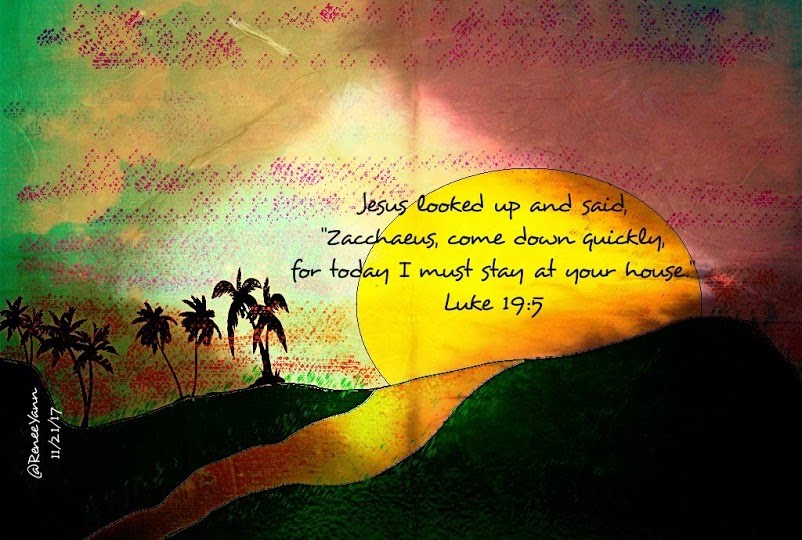
In our Gospel, we meet Zaccheus who, due to his short stature, was unable to get a glimpse of Jesus walking nearby. He wasn’t getting the whole picture – but he desperately wanted to!


Sometimes we miss Christ in our midst, don’t we? It may be because we’re “short” on time, patience, faith, attention, courage, peace, desire … you name it.

Zaccheus may have been physically short, but he was tall in will and intention to see Jesus. The trees became his tools not his obstacles.


It’s hard sometimes to see the forest beyond the trees – to direct our choices, attitudes and actions by a vision we glimpse only on the tippy toes of faith and prayer.

Perhaps these two God-seekers can inspire us today, by their courage, steadfastness and faith, to always live within God’s long eternal vision for us.


Poetry: Walking on Tiptoe by Ted Kooser

Long ago we quit lifting our heels
like the others—horse, dog, and tiger—
though we thrill to their speed
as they flee. Even the mouse
bearing the great weight of a nugget
of dog food is enviably graceful.
There is little spring to our walk,
we are so burdened with responsibility,
all of the disciplinary actions
that have fallen to us, the punishments,
the killings, and all with our feet
bound stiff in the skins of the conquered.
But sometimes, in the early hours,
we can feel what it must have been like
to be one of them, up on our toes,
stealing past doors where others are sleeping,
and suddenly able to see in the dark.

Turn Your Eyes Upon Jesus – written in 1922 by Helen Lemmel, sung here by Michael W. Smith

O soul are you weary and troubled
No light in the darkness you see
There's light for a look at the Savior
And life more abundant and free

Turn your eyes upon Jesus
Look full in his wonderful face
And the things of earth will grow strangely dim
In the light of his glory and grace

His word shall not fail you he promised
Believe him and all will be well
Then go to a world that is dying
His perfect salvation to tell

Turn your eyes upon Jesus
Look full in his wonderful face
And the things of earth will grow strangely dim
In the light of his glory and grace

O soul are you weary and troubled
No light in the darkness you see
There's light for a look at the Savior
And life more abundant and free

Turn your eyes upon Jesus
Look full in his wonderful face
And the things of earth will grow strangely dim
In the light of his glory and grace

Be Generous Stewards

November 6, 2021
Saturday of the Thirty-first Week in Ordinary Time 

Today, in God’s Lavish Mercy, we pray with Psalm 145, the only psalm to be designated as “praise” in its superscription: A psalm of praise. Of David.

This is an intriguing psalm to be chosen for today’s readings which, at first glance, have little to do with “praise”.


Our reading from Romans is the closing chapter of Paul’s letter in which is listed a catalogue of early Christians movers and shakers. The names are of influential and generous people who joined Paul and used their resources to foster the Gospel. They were the stewards of our nascent faith and are accorded a timeless memorial in the epistle’s final chapter.(Notably, many of them are women who obviously played significant roles in the blossoming of the early Church.)


In our Gospel, Jesus explains the parable about the dishonest steward. The steward has been accused of squandering his master’s goods and is about to be fired. In order to rectify accounts, the steward rewrites customer receipts, balancing with his own commissions. That way, his master doesn’t prosecute him and his customers like him enough to consider him for the job he now needs.

The parable is about how to use our wealth of blessings in order to respond to God’s goodness to us. By our generosity for others, we also serve God.


So how does Psalm 145 fit in? When the core attitude of our life is one of thanksgiving and praise:

  1. we have the insight to recognize our true wealth, the blessings God has given us

Every day will I bless you,
and I will praise your name forever and ever.
Great is the LORD and highly to be praised;
Whose greatness is unsearchable.

2. we look to our ancestors in faith as inspiration for generosity (people like those of 

Romans 16)

Generation after generation praises your works
and proclaims your might.
They speak of the splendor of your glorious majesty
and tell of your wondrous works.

3. we draw grace from their example and from the eternal beauty of Creation

Let all your works give you thanks, O LORD,
and let your faithful ones bless you.
Let them discourse of the glory of your Reign
and speak of your power.


Poetry: Hymns for the Amusement of Children – Hymn 21. Generosity by Christopher Smart, 1722 – 1771) a talented and controversial English religious poet. 

Christopher Smart’s poetry is notable for its visionary power, Christian ardor, and lyrical virtuosity from The Poetry Foundation: https://www.poetryfoundation.org/poets/christopher-smart

That vast communicative Mind, 
That form'd the world and human kind, 
And saw that all was right; 
Or was Thyself, or came from Thee, 
Stupendous Generosity, 
Above all lustre bright.
 
" Not for themselves the bees prepare 
" Their honey, and the fleecy care, 
" Not for themselves are shorn: 
" Not for themselves the warblers build, 
" Not for themselves the lands are till'd, 
" By them that tread the corn." 

The Lord shed on the Holy Rood 
His infinitely gen'rous blood, 
Not for himself, but all; 
Yea e'en for them that pierc'd his side, 
In patient agony he died, 
To remedy the Fall. 

O highly rais'd above the ranks 
Of Angels — he cou'd e'en give thanks 
Self-rais'd, and self-renew'd — 
Then who can praise, and love, and fear 
Enough? — since he himself, 'tis clear, 
Is also Gratitude.

Music: Generous Giver – Vintage Worship

Becoming Saints

Monday, November 1, 2021
Feast of All Saints

Synaxis of All Saints – Anonymous Russian icon

Today, in God’s Lavish Mercy, we pray with Psalm 24, an exultant song of praise and celebration whose opening lines leave no doubt of God’s overarching Supremacy

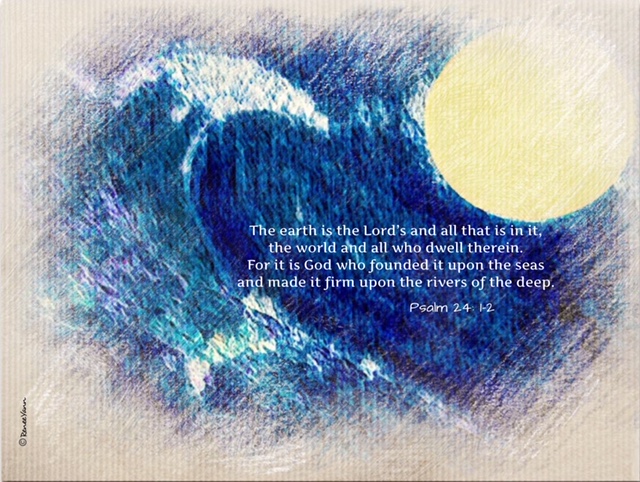
The earth is the Lord’s and all that is in it, 
the world and all who dwell therein.
For it is God who founded it upon the seas
and made it firm upon the rivers of the deep.

Psalm 24: 1-2

The psalmist then asks and answers the burning question of all spiritual seekers: who may come into the presence of this Omnipotent Being? Who may live in Eternal Love?

Who can ascend the mountain of the Lord,
and who can stand in the holy place of God?
Those who have clean hands and a pure heart, 
who have not pledged themselves to falsehood, 
nor sworn by what is a fraud.
They shall receive a blessing from the Lord
and a just reward from the God of their salvation.

Psalm 24: 3-5

It is these successful seekers whom we celebrate today,
the ones already embraced in everlasting glory.

As we consider their lives, we might ask the further question: how did they do it; how did they achieve holiness.

John, in our second reading, says the key to holiness is to honor the gift already given to each of us at our creation and confirmed in our Baptism:

Beloved:
See what love God has bestowed on us
that we may be called the children of God.
Yet so we are.
The reason the world does not know us
is that it did not know God.
Beloved, we are God’s children now;
what we shall be has not yet been revealed.
We do know that when it is revealed we shall be like God
for we shall see God as God truly is.
Everyone who shares this hope seeks a heart purified in God.


We honor all the Saints today, especially the multitudes whose names are unknown to us. They are the ones who lived lives of Beatitude among us, as our Gospel teaches. May they help us to learn the lessons of:

  • a liberated spirit
  • an unpretentious persistance
  • a hopeful endurance
  • a thirst for righteousness
  • a merciful and pure heart
  • a gentle peace-making
  • and a courageous pursuit of justice

These are the keys that will lift up the gates of Heaven for us, allowing the Holy One to make us holy:

Lift up your heads, O gates;
lift them high, O everlasting doors;
and the One who reigns in glory shall come in.

Psalm 24:7

Poetry: In Whom We Live and Move and Have Our Being – Denise Levertov 

Birds afloat in air’s current,
sacred breath? No, not breath of God,
it seems, but God
the air enveloping the whole
globe of being.
It’s we who breathe, in, out, in, the sacred,
leaves astir, our wings
rising, ruffled—but only saints
take flight. We cower
in cliff-crevice or edge out gingerly
on branches close to the nest. The wind
marks the passage of holy ones riding
that ocean of air. Slowly their wake
reaches us, rocks us.
But storm or still,
numb or poised in attention,
we inhale, exhale, inhale,
encompassed, encompassed.

Music: two songs for the big feast🤗

Psalm 24: Lift up your heads, ye gates – Georg Friedrich Handel
Sung by the Gramophone Chorus – Ghana


Give Us Clean Hands – Charlie Hall

Declare God’s Glory

October 28, 2021
Feast of Saints Simon and Jude, Apostles

Photo by my talented Sister-in-Law

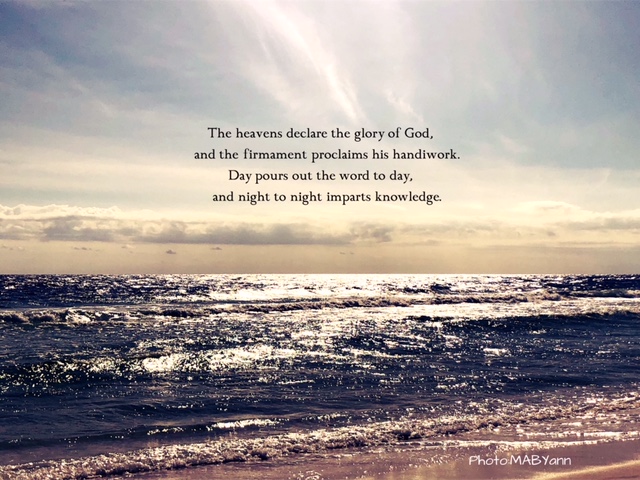
Today, in God’s Lavish Mercy, we pray with Psalm 19. Today’s beautiful verses alert us to the magnificence of the Heavens as a testament to God’s Glory:

The heavens declare the glory of God,
    and the firmament proclaims God’s handiwork.
Day pours out the word to day,
    and night to night imparts knowledge.

Psalm 19: 2-3

We might picture the psalmist, perhaps burdened, confused, or exhausted by the exigencies of daily life, walking outside under an October sky such as the ones we are given this time of year. The walk may have happened in a crystal blue Noon, or late under a black canopy sprayed with October’s meteor showers.

Photo by my talented Niece

Whatever the hour, that ancient psalmist’s heart is stilled in nature’s constant, silent yet resounding adoration of our Creator:

Not a word nor a discourse
    whose voice is not heard;
Through all the earth their voice resounds,
    and to the ends of the world, their message.

Psalm 19: 4-5

Psalm 19, after today’s introductory stanzas, compares nature’s elegant and eternal balance to the perfection of God’s Law…

The law of the LORD is perfect,
refreshing the soul.

Psalm 19:8

… Psalm 19
where the searching and cleansing sun
becomes an image of
the searching and cleansing Law.

C. S. Lewis: Reflections on the Psalms

On this Feast of Saints Simon and Jude, the Church uses Psalm 19 to describe the work of an Apostle. Like the heavens whose beauty and constancy declare God’s glory, the Apostle lives and preaches that Divine Elegance – that Law of Love perfected in Jesus Christ.

Paul, in our first reading from Ephesians, says that these Apostles lay the foundation for all of us to become – like Sacred Creation – “a dwelling place of God in the Spirit.”

Our Gospel recounts the calling of the first twelve of these “foundation builders”. But the call continues eternally. It comes to each of us.


Under the constant sun and other stars, that call to witness and declare God’s glory summons us to live a life that sings:

We praise you, O God,
we acclaim you as Lord;
with the glorious company of Apostles,
we praise you.

Today’s Alleluia Verse taken from the Te Deum

Poetry: Pied Beauty- Gerard Manley Hopkins

Glory be to God for dappled things – 
   For skies of couple-colour as a brinded cow; 
      For rose-moles all in stipple upon trout that swim; 
Fresh-firecoal chestnut-falls; finches’ wings;
 
   Landscape plotted and pieced – fold, fallow, and plough; 
      And áll trádes, their gear and tackle and trim. 
All things counter, original, spare, strange; 
   Whatever is fickle, freckled (who knows how?) 

      With swift, slow; sweet, sour; adazzle, dim; 
He fathers-forth whose beauty is past change: 
                                Praise him.

Music: Benedictus – Karl Jenkins

Our Tender God

October 25, 2021
Monday of the Thirtieth Week in Ordinary Time

Today, in God’s Lavish Mercy, we pray with Psalm 68 which pictures a triumphant God, rising like the sun over the darkness of evil.

Arise, O God, and let your enemies be scattered;
let those who hate you flee.
Let them vanish like smoke when the wind drives it away; 
as the wax melts at the fire,
so let the wicked perish at your presence.

Psalm 68: 1-3

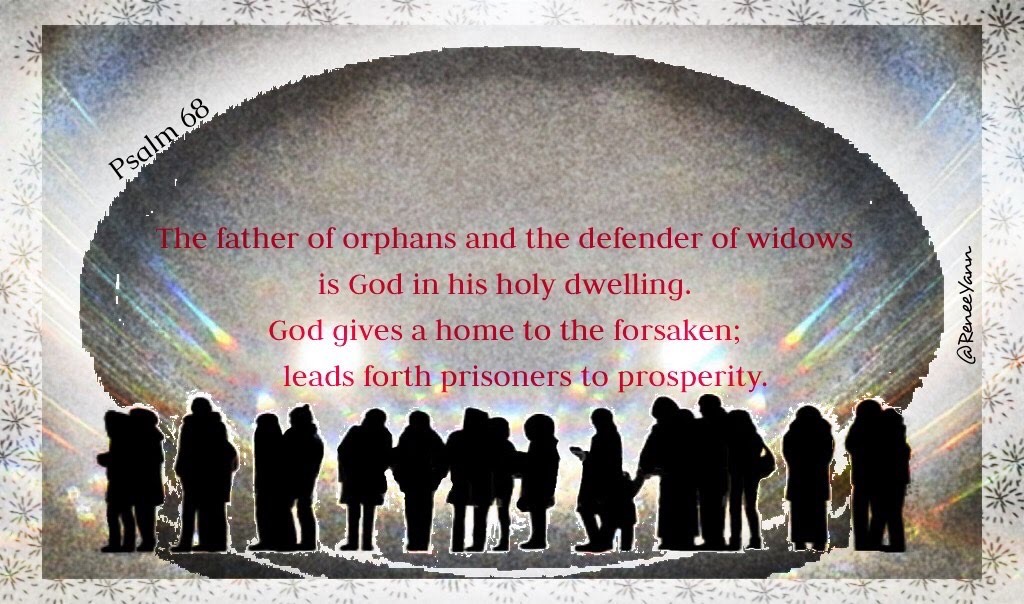
This psalm comforts us with a tender picture of God:

Protector of orphans, defender of widows,
the One who dwells in holiness,
who gives the solitary a home
and brings forth prisoners into freedom;
but the rebels shall live in dry places.

Psalm 68: 5-6

It is the same tenderness Paul presents in our first reading:

For those who are led by the Spirit of God are children of God.
For you did not receive a spirit of slavery to fall back into fear,
but you received a spirit of adoption,
through which we cry, “Abba, Father!”
The Spirit bears witness with our spirit
that we are children of God,
and if children, then heirs,
heirs of God and joint heirs with Christ…

if only we suffer with him
so that we may also be glorified with him.

And there we have the key line:
we are to live a life aligned with
the Passion, Death, and Resurrection of Christ.

And what will that kind of life look like? It will look like our merciful Jesus of today’s Gospel – who stepped out to see, comfort, and heal the suffering around him.

Jesus recognized the crippled woman as “an heir of God, and joint heir with him” to the fullness of life in God. We are called recognize ourselves and all of our sisters and brothers in the same way.


Poetry: WOMAN UN-BENT (LUKE 13:10–17) – by Irene Zimmerman, OSF

That Sabbath day as always
she went to the synagogue
and took the place assigned her
right behind the grill where,
the elders had concurred,
she would block no one’s view,
she could lean her heavy head,
and (though this was not said)
she’d give a good example to
the ones who stood behind her. 

That day, intent as always
on the Word (for eighteen years
she’d listened thus), she heard
Authority when Jesus spoke. 

Though long stripped
of forwardness,
she came forward, nonetheless,
when Jesus summoned her.
“Woman, you are free
of your infirmity,” he said. 

The leader of the synagogue
worked himself into a sweat
as he tried to bend the Sabbath
and the woman back in place. 

But she stood up straight and let
God’s glory touch her face.

Video: Jesus Heals the Bent-over Woman

If you’d still like a little music, this one seems to fit: Spirit Touch by Joseph Akins