Today, in God’s Lavish Mercy, as we pray with Psalm 34, our Sunday readings present us with spiritual ultimatums.
In our first reading, sensing his impending death, Joshua gathers the tribes on the Great Plains of Shechem – the land of their father Abraham. Joshua requires a commitment from the people:
“If it does not please you to serve the LORD, decide today whom you will serve … As for me and my household, we will serve the LORD.”
Joshua 24:15
In other words, “fish or cut bait” – you’re either with God, or you’re not. And your lives should reflect the choice.
In our Gospel, Jesus too feels death’s approach. His teachings have become more intense and direct, particularly regarding the Eucharist. This intensity has caused some of his listeners to waver. They’re not sure they can accept his words. Some drift away.
Jesus challenges the Twelve, those on whom he depends to carry his message after his death.
“Do you also want to leave?
These readings talk about the big choices, the soul’s orientation, either:
to seek and respond to God in our daily interactions
to be indifferent toward God’s Presence in our lives
Jesus’s question is before us all the time? Do we hear it?
(As for the unfortunate and contested second reading from Ephesians, this long but superb article from Elizabeth Johnson is worth your time.)
You see, I want a lot.
Perhaps I want everything:
The darkness that comes with every infinite fall
And the shivering blaze of every step up.
So many live on and want nothing
And are raised to the rank of prince
By the slippery ease of their light judgments
But what you love to see are faces
That do work and feel thirst…
You have not grown old,
And it is not too late to dive
Into your increasing depths where life
Calmly gives out its own secret.
Today, in God’s Lavish Mercy, we pray with Psalm 128. It describes the blessed scene that might ensue from the kind of hopeful and just community described in yesterday’s reflection. Because of its final verse, I like to think of it as a “Grandparents’ Blessing”.
Happy are they all who fear the Lord, and who follow in the ways of God! You shall eat the fruit of your labor; happiness and prosperity shall be yours. Your beloved shall be like a fruitful vine within your house, your children like olive shoots round about your table. The one who fears the Lord shall thus indeed be blessed. The Lord bless you from Zion, and may you see the prosperity of Jerusalem all the days of your life.
May you live to see your children’s children; may peace be upon your household.
In our Gospel, Jesus tells us that we achieve such blessedness by actions, not simply by words.
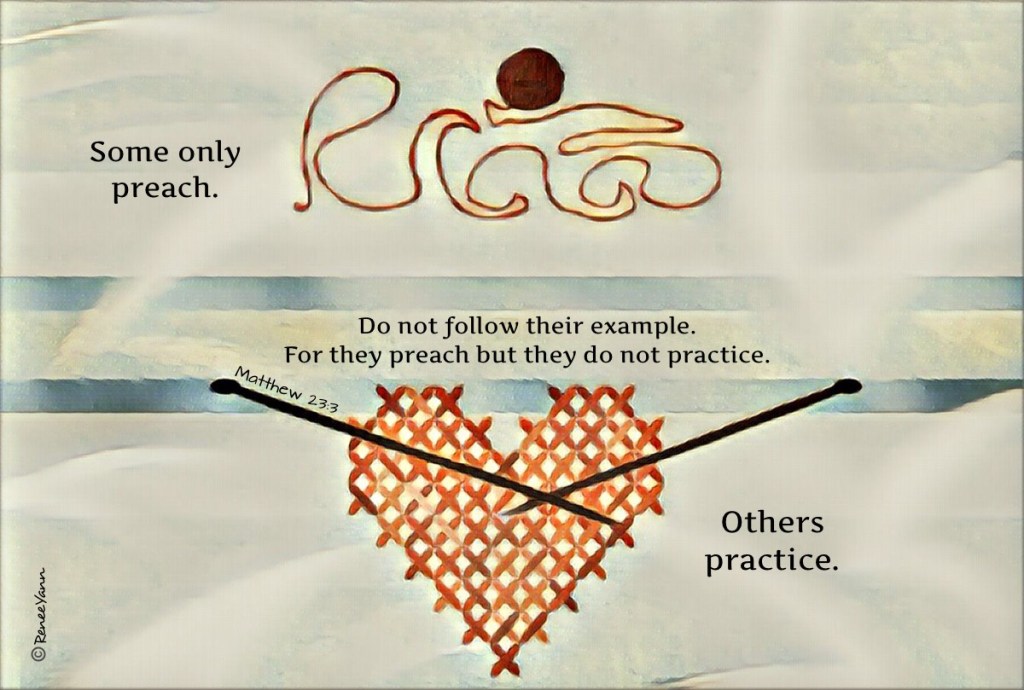
Jesus spoke to the crowds and to his disciples, saying, “The scribes and the Pharisees have taken their seat on the chair of Moses. Therefore, do and observe all things whatsoever they tell you, but do not follow their example. For they preach but they do not practice.
Matthew 23: 1-3
I took that admonition to heart today. I do a lot of “preaching” on these pages. Following the example of Jesus, I need to see if those words come to life in my actions.
Are you with me?
Poetry: The Words We Speak – Hafiz
The words
We speak
Become the house we live in.
Who will want to sleep in your bed
If the roof leaks
Right above
It?
Look what happens when the tongue
Cannot say to kindness,
“I will be your slave.”
The moon
Covers her face with both hands
And can’t bear
To look.
Music: Without Words – Bethel Music
Just a pretty cool instrumental to reflect with today.
Today, in God’s Lavish Mercy, we pray with Psalm 21, a companion piece to Psalm 20. In these verses, the king asks for victory, receives it, and rejoices in domination over his enemies. The psalm follows our first reading from Judges which is a parable that criticizes Abimelech’s seizure of kingship over Israel by treacherous means.
Without getting too deep into the complex exegesis of these passages, suffice it to say that they invite us to consider the nature of leadership – its source, exercise, and meaning relative to our spiritual and moral life.
St. Augustine, in his commentary on the Psalms, teaches that Psalm 21 foretells the kingship of Jesus. This kingship (as opposed to that of Abimelech) is marked by humility, mercy, and obedience to the Creator.
We see a wide and confusing range of “leadership” in our world today, from figures like Pope Francis to Kim Jong-Un. But in our prayer today, we are given a very clear picture of what true leadership looks like.
A perfect leader is to God like the moon is to the sun. The leader only reflects the True Light given to them as a gift.
Recognizing fruitful leadership as a gift, they dispense it graciously to others as in our Gospel parable, imparting mercy even to those considered last in line for it.
In various circumstances, we can be either leader and follower. How do we invite Grace to inform us in either case?
Poetry-Prayer: A Leader’s Prayer – from xavier.edu
Leadership is hard to define.
Lord, let us be the ones to define it with justice.
   Leadership is like a handful of water.
   Lord, let us be the people to share it with those who thirst.
Leadership is not about watching and correcting.
Lord, let us remember it is about listening and connecting.
   Leadership is not about telling people what to do.
   Lord, let us find out what people want.
Leadership is less about the love of power,
and more about the power of love.
   Lord, as we continue to undertake the role of leader let us be
   affirmed by the servant leadership we witness in your son Jesus.
Let us walk in the path He has set and let those who will, follow.
Let our greatest passion be compassion.
   Our greatest strength love.
   Our greatest victory the reward of peace.
In leading let us never fail to follow.
In loving let us never fail.
Today, in God’s Lavish Mercy, we pray with Psalm 85, a prayer celebrating what God will accomplish through a listening heart:
I will listen to what you, Lord God, are saying, for you are speaking peace to your faithful people and to those who turn their hearts to you. Truly, your salvation is very near to those who fear you, that your glory may dwell in our land.
Psalm 85: 8-9
Our psalm flows naturally from our first reading in which Gideon listens to God’s messenger who has a nice visit with him under a terebinth tree. In scripture, many great revelations and conversions happen under trees and bushes – for example, consider the stories of Moses, Jacob, and Ezekiel.
Gideon and the Angel of the Lord by Julius Schnorr Von Carolsfeld
Gideon’s Angel is patient, lingering in the shade while Gideon lets the lamb (and the angel’s suggestion) stew a while in the quiet. It’s like that sometimes when we are trying to listen to God. We need a little time to hear through our circumstances to the real Word God is whispering to us.
It helps sometimes to go among the trees where angels always seem to nestle. It helps sometimes to mull over grace as we simmer a fragrant stew. It helps sometimes to quietly work a knitting needle or finger a rosary’s cool beads.
It helps to take a little time, a little silence and let God speak to us.
The range of Divine sound may be as gentle as a soft kiss, so that we must listen with a delicate heart. Or it may be as loud as an exploding volcano, so that we must resist the temptation to hold our ears:
Kindness and truth shall meet; justice and peace shall kiss. Truth shall erupt from the earth, and justice shall look down from heaven.
Psalm 85: 11-12
However God wants to speak in our lives today, let’s invite that transforming Word. And let’s not only hear, but listen.
Poetry: God’s Word – Hildegard of Bingin
The Word is living,
being,
spirit,
all verdant greening,
all creativity.
This Word
manifests itself
in every creature.
Today, in God’s Lavish Mercy, we meet the rich young man of Mark 19. Since the first reading and psalm would be challenging to pray with, I would like to offer this homily I wrote some years ago on our Gospel for today
Christ and the Rich Young Man by Heinrich Hoffmann
Most had come to the rolling hills beyond the Jordan because of the miracles: the crippled walking, the dead raised, the demons cast out. Who wouldn’t take an afternoon hike to witness such amazing things? They came with their blankets and lunch baskets. They came to see.
But today, Jesus is not about miracles. He is about teaching. And it is hard to listen to him. The words are gentle but incisive. Like small scalpels, they deftly strip away the listeners’ harbored illusions. He says things like this:
Become humble like a child.
The last will be first and the first last.
If your hand or foot causes you to sin, cut it off.
Forgive seventy times seven.
His words challenge everything they had learned, believed, based their lives on! Nobody got anywhere in life by behaving the way he described! Jesus can see their consternation. What they had relied on – all that had justified their self-satisfied successes – lay now at his feet like a sculptor’s remnants.
Jesus pauses to allow a long silence to envelop their startled hearts. Quietly, he retires to a shaded grove to let his own heart settle. On the hillside, it is lunchtime. The large crowd bundles into small neighborly bands. They open their baskets and uncork their water-skins while the curative words begin the hard transformation of their souls.
But one man is not hungry – at least not for earthly food. He slowly approaches Jesus in his solitude, perhaps with a shy glance that asks, “May I come closer?” Jesus nods for the young man to join him. Settling beside Jesus, he asks, “Master, what must I do to gain eternal life?”
There is no lack of directness in this man. He comes bluntly to the point. But there is, nonetheless, a blindness in him. Jesus has already taken its measure even as the young man approached. His garments distinguish him from the rest of the crowd. His robe is fine linen not rude camel hair. He is not unshod, but rather wears sandals of expertly tooled leather. He carries no basket; it is held by a servant standing off at a modest but ready distance. He is so accustomed to his privilege that he is unaware of his difference from all those who surround him. He no longer sees his wealth, just as he no longer sees their poverty.
Commemorative Cross for the 150th Anniversary of the Philadelphia Sisters of Mercy, featuring the Works of Mercy. Designed by the late Robert McGovern
Jesus at once pities his obliviousness yet loves his sincerity. He tests the young man even though he already reads his heart. The questions are not intended to derail the man. Instead, Jesus leads him by a rabbinical path through the levels of spiritual commitment.
Do you understand true goodness?
Do you then keep the commandments?
Do you then seek perfection?
Will you then give everything you have to embrace it?
At this final question, the young man goes away sad, “for he had many possessions”.
Here Jesus defines for us the ultimate sticking point for a nearly committed person: “All you possess”. In other words, can we give everything in Christlike love?
The Christian ethic teaches us that this kind of self-donation is the only path to joy and salvation. Yet, it is a perfection few achieve. This failure in achievement leads to broken marriages, fractured families, rescinded vows and unfulfilled hopes. What is the secret to meeting its challenge?
Jesus may have given an answer two chapters earlier in Matthew’s Gospel. A desperate father has brought his possessed son to the disciples, but they are unable to cast out the demon. Jesus is frustrated with their impotence, saying, “How long must I be with you (before you learn)?” What is it that these disciples have yet to learn? Jesus goes on to tell them that if their faith were even the size of a tiny mustard seed, they would have the power, not only to cast out this demon, but to move mountains.
To live fully by faith is to live in the understanding that we possess nothing. Everything we think we have, including life itself, is a pure gift of God’s mercy to us. Abandonment to such understanding makes us truly rich and renders us divinely powerful. This is the continuing lesson Jesus is teaching his beloved disciples. This is the secret of eternal life to which Jesus tries to lead the rich young man. This is the daily invitation God places before us within the circumstances of our lives. Will we embrace it or will we go away sad?
Today, in God’s Lavish Mercy, we pray with Psalm 112, particularly chosen for the Feast of St. Lawrence
Blessed the one who fears the LORD, who greatly delights in God’s commands. That one’s posterity shall be mighty upon the earth; the upright generation shall be blessed. Well for the one who is gracious and lends, who conducts all affairs with justice; That person shall never be moved; the just one shall be in everlasting remembrance.
After the martyrdom of Pope Sixtus II in 258 AD, the prefect of Rome demanded that Lawrence turn over the riches of the Church. St. Ambrose is the earliest source for the narrative that Lawrence asked for three days to gather the wealth. He worked swiftly to distribute as much Church property to the indigent as possible, so as to prevent its being seized by the prefect. On the third day, at the head of a small delegation, he presented himself to the prefect, and when ordered to deliver the treasures of the Church he presented the indigent, the crippled, the blind, and the suffering, and declared that these were the true treasures of the Church. One account records him declaring to the prefect, “The Church is truly rich, far richer than your emperor.” This act of defiance led directly to his martyrdom.
Wikipedia
There are many lessons for us in the life of St. Lawrence. The most striking for me is his gift for seeing the most vulnerable people as the Church’s greatest treasures.
Praying Psalm 112 today, we might ask God to deepen that gift of sublime generosity which imitates God’s own Mercy to us:
Lavishly they give to the poor, Their generosity shall endure forever; Their name shall be exalted in glory.
Poetry: Khalil Gibran- On Giving
You give but little when you give of your possessions.
It is when you give of yourself that you truly give.
For what are your possessions but things you keep
and guard for fear you may need them tomorrow?

And tomorrow, what shall tomorrow bring
to the over-prudent dog burying bones in the trackless sand
as he follows the pilgrims to the holy city?

And what is fear of need but need itself?
Is not dread of thirst when your well is full,
the thirst that is unquenchable?

There are those who give little of the much which they have–
and they give it for recognition and their hidden desire
makes their gifts unwholesome.

And there are those who have little and give it all.
These are the believers in life and the bounty of life,
and their coffer is never empty.

There are those who give with joy, and that joy is their reward.
And there are those who give with pain, and that pain is their baptism.
And there are those who give and know not pain in giving,
nor do they seek joy, nor give with mindfulness of virtue;
They give as in yonder valley the myrtle breathes its fragrance into space.

Through the hands of such as these God speaks,
and from behind their eyes He smiles upon the earth.
It is well to give when asked,
but it is better to give unasked, through understanding;

And to the open-handed
the search for one who shall receive is joy greater than giving.
And is there aught you would withhold?
All you have shall some day be given;
Therefore give now, that the season of giving
may be yours and not your inheritors’.

You often say, “I would give, but only to the deserving.”
The trees in your orchard say not so, nor the flocks in your pasture.
They give that they may live, for to withhold is to perish.
Surely he who is worthy to receive his days and his nights,
is worthy of all else from you.

And he who has deserved to drink from the ocean of life
deserves to fill his cup from your little stream.
And what desert greater shall there be,
than that which lies in the courage and the confidence,
nay the charity, of receiving?

And who are you that the poor should rend their bosom and unveil their pride,
that you may see their worth naked and their pride unabashed?
See first that you yourself deserve to be a giver, and an instrument of giving.

For in truth it is life that gives unto life
while you, who deem yourself a giver, are but a witness.

And you receivers… and you are all receivers…
assume no weight of gratitude,
lest you lay a yoke upon yourself and upon him who gives.
Rather rise together with the giver on his gifts as on wings;
For to be overmindful of your debt, is to doubt his generosity
who has the freehearted earth for mother, and God for father.
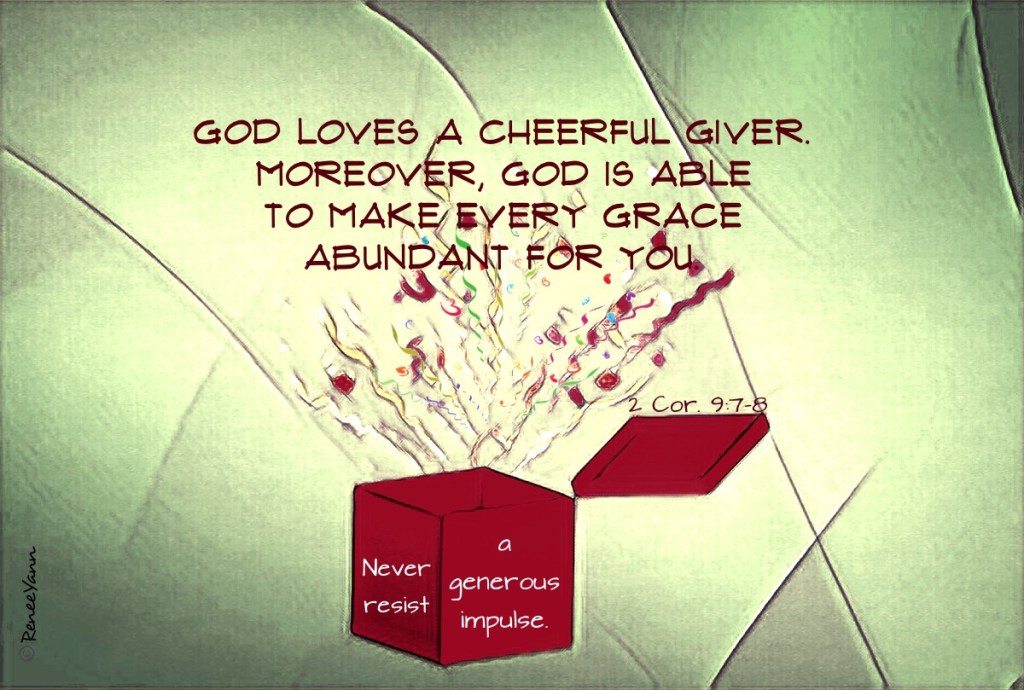
Music: God Loves a Cheerful Giver – Steve Green has fun with the kids. I hope you do too!🤗
Today, in God’s Lavish Mercy, our readings capture the essence of life in God through Christ.
The first reading from Kings tells how Elijah, after eating the food God had provided him, was able to endure the long journey to God’s mountain. There, the sweetest whisper carried to Elijah the voice of God!
In today’s Gospel passage, Jesus makes clear that no one makes that journey into the heart of God unless God calls us. But Jesus says that the invitation is given to all who believe. He says that, just as with Elijah, the Father gives us food – Jesus himself – the bread of life.
The second reading from Ephesians says that we have already “been sealed for the day of redemption through the Holy Spirit.” Paul says that, given this amazing gift, we have only one job:
So be imitators of God, as beloved children, and live in love, as Christ loved us and handed himself over for us as a sacrificial offering to God for a fragrant aroma.
We are so accustomed to hearing these astounding passages that we may miss how astounding they really are. But Macrina Wiederkehr says:
When Jesus’ words begin to sound naive to our 21st century minds, let us look through the words, in between the words, underneath for a deeper truth.
Macrina Wiederkehr, OSB
Pierre Teilhard de Chardin, the great Jesuit mystical theologian, upon reading these passages, saw the mystery of the Body of Christ. He saw our call to be the heart of Christ in the world. He saw Christ’s promise to become one with us in Eucharist. He saw that, through this Infinite Love played out in our ordinary lives, God continues to redeem Creation.
In each soul, God loves and partly saves the whole world which that soul sums up in an incommunicable and particular way.
The Divine Milieu
Poetry: Love after Love by Derek Walcott
The time will come when with elation you will greet yourself arriving at your own door, in your own mirror and each will smile at the other’s welcome and say, sit here, eat. You will love again the stranger who was your self
Give wine, give bread. Give back your heart to itself, to the stranger who has loved you all your life whom you ignored for another who knows you by heart
Take down the love letters from the bookshelf, the photographs, the desperate notes, peel your own image from the mirror. Sit. Feast on your life.
Music: Quintessence – Spencer Brewer
May this lovely instrumental piece help take us to a deeply prayerful place as we contemplate God’s gift in Jesus.
Today, in God’s Lavish Mercy, we pray with Psalm 18 which is a detailed poetic account of David’s jubilation at his victory as reported in 2 Samuel 22:
David sang to the Lord the words of this song when the Lord delivered him from the hand of all his enemies and from the hand of Saul.
2 Samuel 22:1
I’m not a fan of modern “action movies”. When I see their trailers on TV, I feel overwhelmed by their “Bang! Bang!”, “Blow ‘em Up” special effects. And I felt a little bit like that when I read all of Psalm 18.
The scenes described in both Samuel and Psalms are tumultuous! David has had one heck of a time trying to be king!
But reflecting on his deliverance from those times causes David to exclaim, “I love You, Lord, my God.”
As you read Psalm 18, notice that a significant word is missing: BECAUSE.
David never says that he loves God BECAUSE of all the magnificent things God has done for him.
David simply loves God. And loving God, David see all experience as held in God’s hand.
Love, for God or for God’s creatures, isn’t a barometer. It doesn’t rise or fall according to life’s pressures.
Love is a magnet. It is a pulling into the life of the other which gives balance to my own being. Without that balance, it isn’t love.
We see this beautiful balance in David’s relationship with God:
He knows God through deep and constant relationship
I love you, Lord, my strength
He stays faithful throughout his trials.
… my shield, the horn of my salvation, my stronghold!
He gives glory to God, not himself.
Praised be the Lord, I exclaim Extolled be God, my savior!
He asks God’s continued blessing on those for whom he is responsible.
You have shown kindness to me and my posterity forever.
Poetry: A Rondeau for Leonard Cohen – Malcolm Guite wrote this poem thinking of Leonard Cohen as a modern day David. Leonard Cohen (September 21, 1934 – November 7, 2016) was a Canadian singer-songwriter, poet, and novelist. His work explored religion, politics, isolation, depression, sexuality, loss, death and romantic relationships. He is the composer of the very popular song “Hallelujah”.
Like David’s psalm you named our pain, And left us. But the songs remain To search our wounds and bring us balm, Till every song becomes a psalm, And your restraint is our refrain;
Between the stained-glass and the stain, The dark heart and the open vein, Between the heart-storm and the harm, Like David’s psalm.I see you by the windowpane, Alive within your own domain, The light is strong, the seas are calm, You chant again the telling charm, That names, and naming, heals our pain, Like David’s psalm.
Today, in God’s Lavish Mercy, we pray with Psalm 63, a prayer of both longing and fulfillment.
O God, you are my God whom I seek; for you my flesh pines and my soul thirsts like the earth, parched, lifeless and without water.
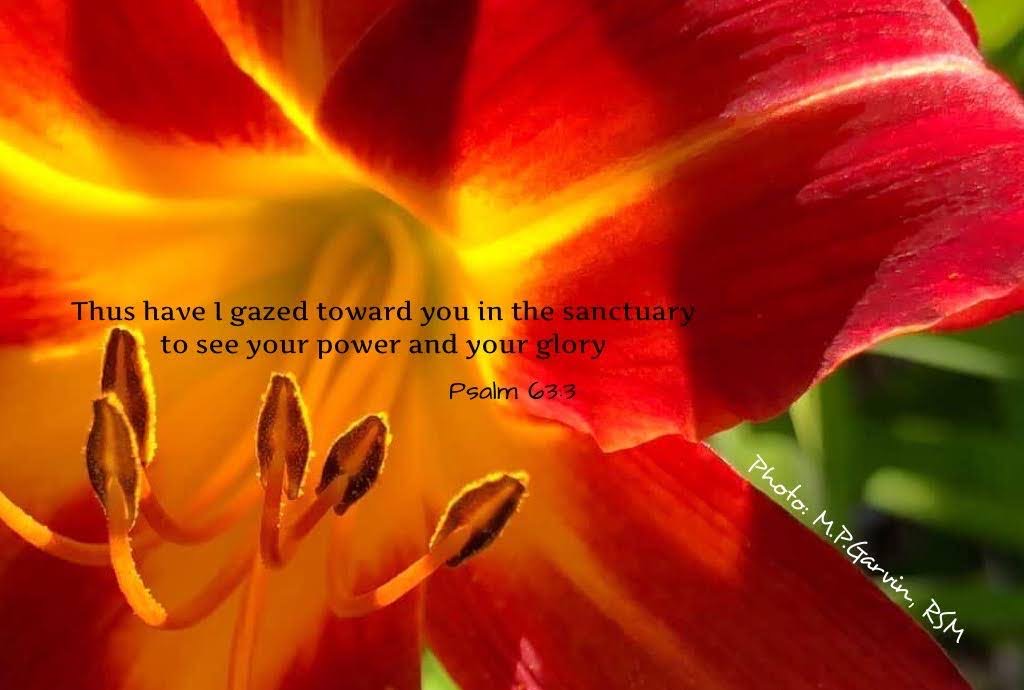
Thus have I gazed toward you in the sanctuary to see your power and your glory, For your kindness is a greater good than life; my lips shall glorify you.
Psalm 63: 2-4
And isn’t our spiritual life exactly like that? We feel our lives caressed by God, and yet we long for greater oneness with Infinite Love.
Mary Magdalen is the embodiment of that longing and embrace. And so the Church applies to her the powerful intimacy of our first reading:
The Bride says: On my bed at night I sought him whom my heart loves– I sought him but I did not find him. I will rise then and go about the city; in the streets and crossings I will seek Him whom my heart loves. I sought him but I did not find him. The watchmen came upon me, as they made their rounds of the city: Have you seen him whom my heart loves? I had hardly left them when I found him whom my heart loves.
Song of Songs 3:1-4
Within each one of us is a sacred mystic who longs for and seeks God’s embrace. Perhaps that mystic hibernates like a little bear hidden under all the distractions of our lives. But if we give ourselves to silence and holy waiting, the sleeping hermit will awake! 😴
We might pray with beautiful Mary Magdalen today to let that seeker in us reach for God Who is also waiting.
Poem: Song of the Soul That Is Glad to Know God by Faith – St. John of the Cross
English version by Antonio T. de Nicolas Original Language Spanish
Well I know the fountain that runs and flows, though it is night!
This eternal fountain is hidden deep. Well I know where it has its spring, Though it is night!
In this life’s dark night, Faith has taught where this cold fountain lies, Though it is night!
Its origin I cannot know, it has none, And I know all origins come from it, Though it is night!
And I know there can be nothing more fair, The heavens and earth drink there, Though it is night!
And I know it has no bed, And I know no one can cross its depths, Though it is night!
Its clarity is never clouded, And I know all light shines from it, Though it is night!
I know her streams swell so abundantly, They water people, heaven and even hell, Though it is night!
The current born of this fountain I know to be wide and mighty, Though it is night!
And from these two another stream flows, And I know neither comes before, Though it is night!
I know Three in only one water live, And each the other feeds, Though it is night!
This eternal fountain is hiding from sight Within this living bread to give us life, Though it is night!
He calls all creatures to this light, And of this water they drink, though in the dark, Though it is night!
This living fountain I desire, I see it here within this living bread, Though it is night!
Music: I Found My Beloved – John Michael Talbot
So I found my beloved in the mountains On the lonely and far distant isles O’er resounding waters I heard the whispering of love’s breezes To heal my broken heart Oh tranquil evening, silent music And the sounding solitude of the rising dawn It is there that I hear You There that I taste of You In love’s banquet to fill my heart Chorus: And I found Your footprints In the sands by the sea And like Your maiden I ran along the way to a secret chamber And there you gave to me There you taught me, O so well And I drank of your sweet spiced wine The wine of God And there I gave to You Keeping nothing for myself And I promised You forever To be your bride (Repeat Chorus) So I have abandoned All I ever sought to be And in dying My spirit has been released
Today, in God’s Lavish Mercy, we pray with Psalm 105 which depicts a “Remembering God” who calls us to respond as a “Remembering People”.
“Forever” is a word whose true meaning can be found only in an Eternal God. In Exodus, and in our Psalm 105, we see God inviting us to that fullness.
Our first reading recounts the Abrahamic covenant renewed with Moses. God, flaming out of a bush, tells Moses that God sticks by agreements.
God spoke further to Moses, “Thus shall you say to the children of Israel: The LORD, the God of your fathers, the God of Abraham, the God of Isaac, the God of Jacob, has sent me to you. “This is my name forever; this my title for all generations.
Exodus 3:15
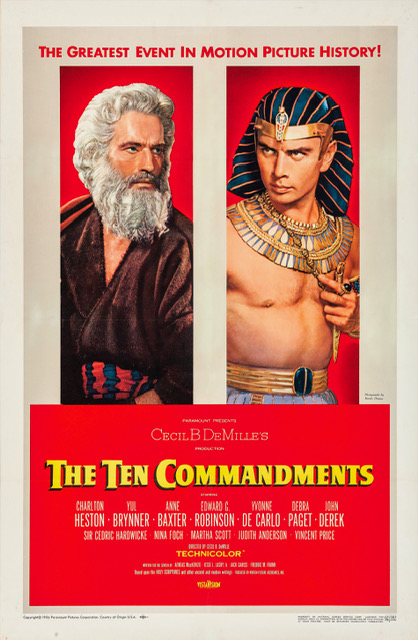
(I don’t know about you, but I’ve flashbacking all week to to Cecil B. DeMille’s 1956 classic, The Ten Commandments.)
Our psalm reinforces the Exodus commitment:
God remembers forever the covenant made binding for a thousand generations entered into with Abraham and by the oath to Isaac.
Psalm 105: 8-9
Our brief but beautiful Gospel shows us what God’s promise looks like in the tender person of Jesus:
Jesus said: “Come to me, all you who labor and are burdened, and I will give you rest. Take my yoke upon you and learn from me, for I am meek and humble of heart; and you will find rest for yourselves. For my yoke is easy, and my burden light.”
Matthew 11: 28-30
Throughout the ages, God’s reiterated fidelity calls us to obedience – that “heart-listening” which hears the invitation to Love.
Poetry: Everything That Was Broken – Mary Oliver
Everything that was broken has
forgotten its brokenness. I live
now in a sky-house, through every
window the sun. Also your presence.
Our touching, our stories. Earthy
and holy both. How can this be, but
it is. Every day has something in
it whose name is Forever.













 Lavish Mercy