Love or Hate? Huh?

Wednesday of the Thirty-first Week in Ordinary Time

November 6, 2019
Click here for readings

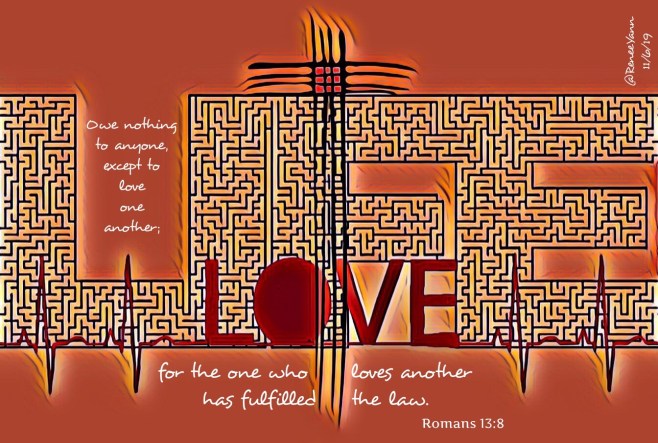
Roman13_8 owe nothing

Today, in Mercy, Paul and Jesus seem to give us contradictory messages. Paul talks about love, and Jesus tells us what we must “hate” – a bit of a challenge to untangle the core message.

Here’s one way.

We don’t like Jesus telling us to hate anything, as in:

If anyone comes to me without hating his father and mother,
wife and children, brothers and sisters,

and even his own life,
he cannot be my disciple.

Come on, Jesus! You don’t mean that do you – my sweet mom, my precious kids???

No, the scholars say, Jesus doesn’t mean “hate” the way we interpret it in modern English. He is using the common, hyperbolic language of the ancient East which, in this circumstance, would mean “love less”.

So what is Jesus really saying? 

This.

We love many people and things in our lives. But we must love God, and God’s dream for all people, above and within all things. 

And that’s not easy! Life is a maze of relationships and situations that can get us very confused about what is most important. That’s why Jesus uses such strong language to remind us that there is only one way through the maze: to love as God loves. This is the heartbeat of our life in God!

Paul says this too, indicating as well how to negotiate the maze by keeping Love’s commandments.

If we love with God’s love, of course we will love those we cherish. But we will love them selflessly, with an infinite generosity that always chooses their eternal good. And we will try always to love all Creatures in the same way. This is the kind of love Jesus taught us on the Cross. May God give us the courage to learn.

Music: Ubi Caritas performed by Stockholm University Choir (texts below)

Latin Text

Ubi caritas et amor, Deus ibi est.
Congregavit nos in unum Christi amor.
Exsultemus, et in ipso jucundemur.
Timeamus, et amemus Deum vivum.
Et ex corde diligamus nos sincero.
Ubi caritas et amor, Deus ibi est.
Simul ergo cum in unum congregamur:
Ne nos mente dividamur, caveamus.
Cessent iurgia maligna, cessent lites.
Et in medio nostri sit Christus Deus.
Ubi caritas et amor, Deus ibi est.
Simul quoque cum beatis videamus,
Glorianter vultum tuum, Christe Deus:
Gaudium quod est immensum, atque probum,
Saecula per infinita saeculorum. Amen.

English Translation
Where charity and love are, God is there.
Love of Christ has gathered us into one.
Let us rejoice in Him and be glad.
Let us fear, and let us love the living God.
And from a sincere heart let us love one.
Where charity and love are, God is there.
At the same time, therefore, are gathered into one:
Lest we be divided in mind, let us beware.
Let evil impulses stop, let controversy cease.
And in the midst of us be Christ our God.
Where charity and love are, God is there.
At the same time we see that with the saints also,
Thy face in glory, O Christ our God:
The joy that is immense and good,
Unto the World without end. Amen.

With Honor, Prevent One Another

Tuesday of the Thirty-first Week in Ordinary Time

November 5, 2019

Readings: Click here for today’s readings

Today, in Mercy, Paul gives us one of his most heartfelt and beautiful passages, and Jesus offers us a puzzling parable about the kingdom.

Rms12_10 honor

Paul’s exhortation to sincere holiness is a passage that warrants frequent reading. At any given point in our lives, one or another of its encouragements will seem to ring profoundly true with our circumstances.

One of the lines that I particularly cherish goes like this in the old Douay-Rheims version, which is where I first encountered it as a young girl:

Love one another with fraternal charity:
with honor preventing one another.

The bolded phrase fascinated me. I didn’t understand what it meant. From what were we to prevent one another?

It was not until I came to the convent that I begin to discern the power of this verse. At the time (during the Dark Ages, of course), the Sisters lived under the 1952 Constitutions of the Sisters of Mercy, an adaptation of the ancient Rule of St. Augustine. As postulants, we each received a 4×6, 128 page copy of the Rule. In direct and intentional language, it set the frame for our whole lives.

I nearly memorized it, especially Chapter 14 on Union and Charity. Right in the middle of the Chapter, I found this precious line:

They (the Sisters) shall sincerely respect one another. The young shall reverence the old and all shall unceasingly try in true humility to promote constant mutual cordiality and deference, “with honor preventing one another”.

Sister Inez, our dear early instructor, explained that this meant to anticipate the needs of our beloved sisters, especially the elderly; to do for them what might be difficult for them before they had to ask. In other words, to prevent their need. She said that this anticipatory charity should mark our service toward everyone, especially the poor, sick and ignorant whom we would vow to serve.

The more all of us can live together with this mutual love and respect, the closer we come to the kingdom of God, to the banquet table described in today’s Gospel. Jesus came to gather us all around this table. Pity on those who resist his invitation because their lives are entangled in self-interested endeavors. Their places are taken by “the poor, the crippled, the blind and the lame” and all those on the margins of society.

As we join our sisters and brothers at the banquet of life, may we love and serve one another sincerely, always with honor preventing one another.

Music: a little motion mantra this morning. Maybe you might want to get up outta’ that chair and join in🤗

Pray for Priests

Memorial of Saint Charles Borromeo, Bishop

November 4, 2019

Click here for readings

Romans11_33 depth of wisdom

Today, in Mercy, we remember the life of a good priest, Charles Borromeo who refused the perks of status and wealth in preference for the poor. Praying with him today, we may include all the good priests who have kindled our faith throughout the years.

I unexpectedly encountered one such priest yesterday after a hiatus of nearly forty years. He had come to McAuley Convent, our health and retirement facility, to visit his longtime assistant. She is now a stately 96 years old, but living with the compromises of advanced years. Himself in his late eighties, he walked very slowly down the corridor toward me, and I paused to see if I could help.

Greeting him, I recognized something about his eyes, but could not really place him. He paused, catching some labored breaths, and studied my eyes. “Give me a minute,” he said, quickly following it with “Nathaniel”, my old religious name.

He had the advantage over me, so I just honestly requested, “Help me out with your name.” He simply replied, “Maginnis”. As a wealth of memory and understanding opened in my mind, I smiled and said, “How good to see you again, Maginnis, after all these years.”

You see, this was: Robert Patrick Maginnis, an American prelate of the Roman Catholic Church who served as Auxiliary Bishop of the Archdiocese of Philadelphia from 1996 to 2010. (Wikipedia)

But who I saw, as soon as he said his name, was a humble, good man who had served God’s people with generosity and grace. I hadn’t seen him face to face since he was simply “Father”- when I was green with youth and he was just a shade or two deeper! 

But I knew, the way a local Church knows its shepherds, that he had never abandoned his gentle simplicity for the exalted trappings of episcopacy. He had remained a man who fulfilled Pope Francis’s best hopes for priests:

“Always have before your eyes the example of the Good Shepherd, who did not come to be served, but to serve and to seek and save what was lost…

Conscious of having been chosen among men and elected in their favor to attend to the things of God, exercise in gladness and sincere charity the priestly work of Christ, solely intent on pleasing God and not yourselves or human beings, other interests.”
(Pope Francis in a homily before the ordination of 16 priests during Mass in St. Peter’s Basilica April 22, 2018)

And here “Maginnis” was last Saturday, having endured his own challenges with aging, making the effort necessary to visit his faithful friend. As I left them in the warm light by her window, my spirit was confirmed by a grace neither one of them realized they were continuing to give, so natural was their witness to Christian love and service.

Let’s pray for all our priests today. These troubled times have been so hard on good priests like this beloved bishop. May they be strengthened and confirmed in their desire to serve Christ through serving his People. May the aged among them realize how grateful we are for the gift they have given.

Music: Who Has Known – John Foley, SJ ( Lyrics below)

O the depth of the riches of God;
and the breadth of the wisdom and knowledge of God!

For who has known the mind of God?
To God be glory forever.

A virgin will carry a child and give birth,
and his name shall be called Emmanuel.

For who has known the mind of God?
To God be glory forever.

The people in darkness have seen a great light; f
or a child has been born; his dominion is wide.

For who has known the mind of God?
To God be glory forever.

The Souls We’ve Loved

The Commemoration of All the Faithful Departed
(All Souls)

November 2, 2019

Click here for readings

Today, in Mercy, we remember.

Romans6_4 souls

“Remember” is a word with a great depth of meaning. Most usually we think of it as a calling to mind. But it can also be thought of as kind of reconstructing – a restoring of the “members” to their rightful place in the whole.

Paul uses the word “members” in this way when he talks about the Body of the Church:

For just as the body is one and has many members, and all the members of the body, though many, are one body, so it is with Christ. For in one Spirit we were all baptized into one body—Jews or Greeks, slaves or free—and all were made to drink of one Spirit.
1 Corinthians 12: 12-13

When we pray a prayer of “remembering”, we consciously bring into the circle of eternal life all those whom time has hidden from us. We affirm the faith that, in Christ, death has already been conquered for all of us. In prayer, we lift the human veil that separates us from those who have died. We “remember” the Resurrected Body of Christ living in, and uniting, all of us beyond time.

through a veilJPG

The feast of Holy Souls is a day to give thanks for all those whose physical or spiritual DNA lives in us. It is a time to bless what is good and forgive what was lacking. It is a day to connect the generations by telling the stories that have graced us, passing into the next generation’s hands the unbroken line of salvation history.

Today, we pray with and for all the holy souls who have touched our lives, even from a distance. May they, and we, be continually “remembered” into God’s eternal heart.

Music: Remember Me- Mark Schultz

Inseparable

Thursday of the Thirtieth Week in Ordinary Time

October 31, 2019

Click here for readings

Today, in Mercy, Paul exults in God’s love and Jesus suffers the full burden of his impending passion. And the two are tied tightly together.

Romans8_

Let me tell you a story that symbolizes that tight knot.

It was in the late 1960s. A group of us had traveled to Atlantic City for the National Catholic Education Convention. Weather forecasting was not so advanced in those days, or at least, we were not so attuned to it. We went to our various sessions early one morning, only to come out of them a few hours later into a hurricane!

I remember walking, obliviously, up to the boardwalk, on my way to the next session in another hotel. The wind became so heavy that I was blown, motionless, against the boardwalk railing. A plexiglass window pane blew by me, cutting me just below the eye. For a short while, that seemed very long, I feared for my life. A strong, young man actually pulled me into a nearby lobby where I tried to calm my fears.

rowboat

But the next morning, there was a beautiful rainbow and a brilliant, calm sky. I walked back to the bay to survey the previous day’s damage. It was significant. But one image remains in my mind these fifty years later: the front quarter of a battered boat still attached to a half-sunken dock by a thick, sodden rope that wouldn’t let go in the storm.

I think that, in today’s Gospel, Jesus might have felt a little bit like that boat. He has been battered by the resistance of his enemies. He knows it is an ill wind for his message.

Jerusalem, Jerusalem,
you who kill the prophets and stone those sent to you,
how many times I yearned to gather your children together
as a hen gathers her brood under her wings,
but you were unwilling!

Still, like that strong, unrelenting rope, he is held sure by the love of God:

But I tell you, you will not see me until the time comes when you say,
“Blessed is he who comes in the name of the Lord.”

Paul, through his baptism, inherited that faith, hope and love purchased for us all by the Passion, Death and Resurrection of Christ.

Whenever a storm rises up around your soul, whether expected or not, remember that knot which ties you to the steady and enduring love of God:

No, in all these things we conquer overwhelmingly
through him who loved us.
For I am convinced that neither death, nor life,
nor angels, nor principalities,
nor present things, nor future things,
nor any other creature will be able to separate us
from the love of God in Christ Jesus our Lord.

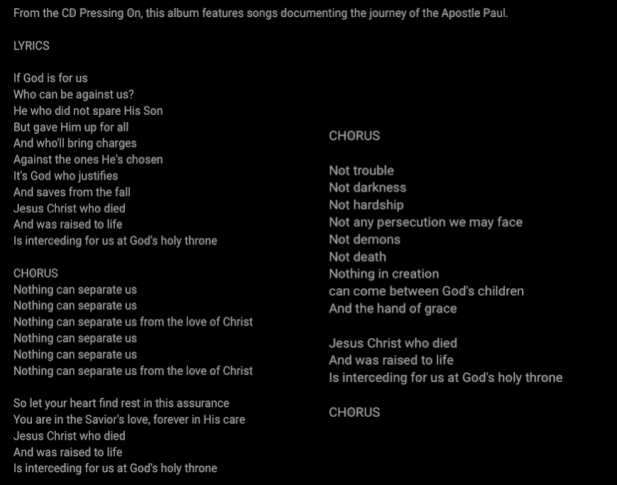
Music: Nothing Can Separate Us – First Call (Lyrics below)


lyrics

Let the Spirit Pray in Your Heart

Wednesday of the Thirtieth Week in Ordinary Time

October 30, 2019

Click here for readings

Today, in Mercy, our Gospel tells us that our life is about getting to know God ever more intimately. Otherwise, when we come to our final moments, we may not be recognized by our Lord and Master.

Could this be possible? Could God not recognize the work of his own hands, the one made in God’s own image?

Probably not. But what I think the Gospel suggests is that if, throughout our whole lives, we have never prayed or drawn closer to God, God’s own image in us may be quite obscured after that disconnected lifetime.

Sometimes we might hear a person say that they don’t know how to get started talking with God in prayer. They seem to feel it’s kind of like a blind date where you end up realizing you have nothing in common with each other.

St. Paul says no, wait a minute. God is already within you simply by the nature of your creaturehood . You are made of the very stuff of God. In fact, the Spirit of God deep within our souls is like the fiery magma from a volcano. It erupts from our love and prays for us to the Creator – if we will only let it.

Rm8_26 groanings

Let us give the Spirit the space, time and invitation to rise up in our hearts, praying with us and through us. In the deep love of that relationship, we will know ourselves to be recognized and loved. We can trust that all things are working together for our good.

Music: Spirit Seeking Light and Beauty – by Janet Erskine Stuart, interpreted here by the Daughters of St. Paul (Lyrics below)

Spirit seeking light and beauty,
Heart still longing for your rest
In your search for understanding,
Only thus can you be blest,

Through the vastness of creation,
Though your restless thought may roam,
God is all that you can long for,
God is all creation’s home.

Taste and see God, feel and hear God,
Hope and grasp the unseen hand;
Though the darkness seem to hide you,
Faith and love can understand.

Loving Wisdom, guiding Spirit,
All our hearts are made anew.
Lead us through the land of shadows
‘Til we come to rest in you.

Hope

Tuesday of the Thirtieth Week in Ordinary Time

October 29, 2019

Readings:  http://www.usccb.org/bible/readings/102919.cfm

Today, in Mercy, Paul blesses us with some of his most powerful words:

I consider that the sufferings of this present time are as nothing
compared with the glory to be revealed for us.

How often, over the ensuing centuries, have these words uplifted and embravened a struggling heart! Paul reminds us of what he so passionately believed – that we are not here for this world alone; that we, with all Creation, are being transformed for eternal life in God.

Jesus too reminds us that our life in faith is so much bigger than we perceive. We see a tiny mustard seed, but God sees the whole tree of eternal life blossoming in us.  We see a fingertip of yeast, but God sees the whole Bread of Life rising in us.

Rm8_24 Hope

Paul tells us to be People of Hope who do not yet expect to see the object of their hope but who, nonetheless, believe and love with all their hearts.

May we pray this today for ourselves, and for anyone burdened by suffering or hopelessness at this time in their lives.

Music:  Living Hope – Phil Wickham

Praying with Saints

Feast of Saints Simon and Jude, Apostles

October 28, 2019

Click here for readings

Today, in Mercy, we celebrate the feast of the Apostles Simon and Jude. Not much is really known about either of these men. One tradition suggests that after the Ascension, they went together to carry the Gospel to Persia where they were eventually martyred.

simon_Jude

Since we have so few facts, many legends and interpretations have grown up around these two men. Probably the strongest and most familiar of these is of St. Jude as the patron of hopeless cases.

There are probably very few of us who haven’t asked at least one favor from St. Jude in our lifetimes. This probability begs the question of why and how do we pray with the saints.

Our tradition holds that we exist in the Communion of Saints with all of God’s creatures, and that we inspire and support one another by the sharing of our lives. This sharing is not limited by time, nor is it constricted by death.

When we pray with the saints, we draw on their faithful witness to inspire, motivate and sustain us in our lives.

Today, we might pray within the spirit of these two great Christians whose witness, though historically muted, transcends time. May they inspire in us the passion and joy to speak Christ in our lives.

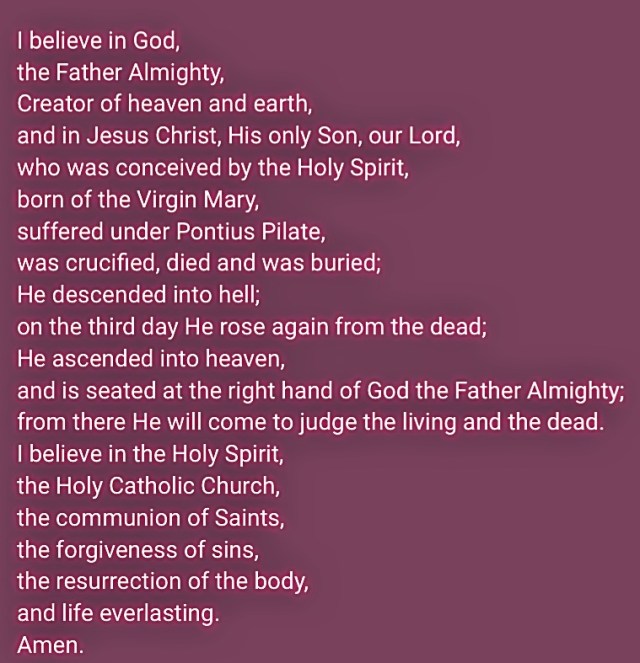
Music: Apostles’ Creed – sung here by Rebecca Gorzynska, a beautiful and talented artist (Latin and English text below.)


latin creed


apos creed

That Fish Was Sooo…..

Thirtieth Sunday in Ordinary Time

October 27, 2019

Click here for readings

Today, in Mercy, in our readings:

  • Sirach assures us that the prayer of the humble reaches the ear of God
  • Paul readies himself for death
  • Jesus gives us one of his most memorable parables. 

The thread running through all of these? Humility- that beautiful virtue which allows us to be who we truly are before God and humanity.

Oh my goodness friends, how many times have we been with “the Pharisees”, such as Jesus describes, at a meeting or dinner? They are so unsure and unaware of their true value in God, that they begin to create an illusion to protect their fear.

We know the statements (or attitudes) by heart. Sometimes, they’re harmless; sometimes not. We may be guilty of a few of them ourselves:

fish

But there are other statements, such as the Pharisee’s, that can certainly make us question a person’s self- perception: 

  • There has never been a better leader, CEO, deal-maker, neighbor, human being
  • I am smarter than the generals, the lawyers, the financiers, the scientists
  • Nobody does things better than me
  • I am the smartest person of all time

Certainly, it’s angering, but more than that, it’s sad. It’s really sad to miss the whole point of one’s true greatness: that we are beloved and redeemed by God – just like every Creature! That we are called, in that belovedness , to serve God in our sisters and brothers. Knowing this inalienable truth is the source of all humility, courage, joy, and perseverance in faith. It is the whole reason we were created. What a tragedy to, like the Pharisee, miss the whole point!

Let us pray with Paul and the humble tax collector today. “O God, be merciful to me a sinner – a redeemed, grateful, and joyful sinner.”

Music: Miserere Mei – Gregorio Allegri 

Zap Time?

Saturday of the Twenty-ninth Week in Ordinary Time

October 26, 2019

Click here for readings

Today, in Mercy, our Gospel takes on some difficult themes.

lightening

Jesus gives a parable which, at first, appears to say, “Get your act together fast, or God might zap you.” From Jesus’s words, we can assume that some public disasters have recently occurred. The gathered crowd are unnerved by these events.

Jesus uses that nervousness to talk about repentance. He tells the people that tragedy can make us wake up to the fact that life is fragile and fleeting. That awareness should make us want to use our time on earth well, to give glory to God.

The repentance Jesus encourages is not just a contrition, or turning from sin. It is an opening of the soul’s eyes to see our lives and circumstances as God sees them.

Is God going to zap us if we don’t have that kind of repentance? No.

With the parable of the fruitless fig tree, Jesus assures us that God is with us, giving us every grace and opportunity to bear spiritual fruit. God is patient and nurturing. But, in every human life, there is a limit to the time we have to respond.

Music: Calm the Soul – Poor Clares Galway