Do Your Best. Leave the Rest.

Memorial of Saint Vincent de Paul, Priest

Friday, September 27, 2019

Click here for today’s readings

Today, in Mercy, we celebrate the feast of St. Vincent de Paul, a name some of us know only by the writing on the side of the charity pick-up truck. But there’s a reason that name was chosen.

St. Vincent de Paul
St. Stephen’s Cathedral Saint Vincent establishing Daughters of Charity by Jean-François Faure (Toulouse Cathedral [CC BY-SA 4.0 (https://creativecommons.org/licenses/by-sa/4.0)%5D)
Vincent was a French priest, recognized for his deep compassion, generosity, and love for poor persons. He founded two religious orders dedicated to these values: the Congregation of the Mission (Vincentians) for priests and brothers, and (with the assistance of St. Louise de Marillac) the Daughters of Charity for women religious. He and the men and women who followed him have blessed the world with immeasurable Christian charity.

Vincent encountered many seemingly insurmountable obstacles in his ministry pursuits. But he continued on. He wrote this in one of his letters:

Let us allow God to act;
God brings things to completion
when we least expect it.


Vincent’s advice is not very different from the encouragement Haggai offers the Israelites in today’s reading. They have taken up the task of rebuilding the Temple. But it’s hard, and it looks like their results will pale when compared to the glory of the First Temple. Some of their elders remember that glory and they are crestfallen at the currents efforts. Discouragement begins to overwhelm them.

Haggai2_5JPG

But Haggai refocuses the community, reminding them that this is God’s work, not theirs.

And take courage, all you people of the land,
says the LORD, and work!
For I am with you, says the LORD of hosts.
This is the pact that I made with you
when you came out of Egypt,
And my spirit continues in your midst 
do not fear!

In striking poetic symbolism, God then promises to fill the house with glory!

As good people, we try throughout our lives to do things right and well for God. Sometimes our efforts disappoint ourselves and others. We get discouraged. We think the work belongs to us and that we have done it poorly.

Today’s passage is for us. As Haggai speaks in God’s voice: Take courage and work. Leave the rest in God’s accompanying hands.

Music: In God’s Safe Hand – Skjulte Skatter

Mercy Day – 2019

Tuesday of the Twenty-fifth Week in Ordinary Time

September 24, 2019

Click here for readings

Today, in Mercy, Sisters of Mercy throughout the world will commemorate the date on which, in 1827, Catherine McAuley opened the House of Mercy in Dublin, Ireland. We count this day as our Founding Day, the day thousands and thousands of souls – for that time and for the future – would be anchored to God in a special way – the way of Mercy.

Lk8_21 Mercy

The experiences of Catherine’s life led her to touch the heart of God in a unique and transformative manner. She imagined, with God, a resurgence of mercy in a harsh, painful and selfish world. She believed that God could effect change through the generous service of her life.

Her holy imagination was so infectious that others caught her fire. Together they began to believe new possibilities into the lives of those who were poor, sick, uneducated and abandoned.

Over these nearly two centuries, Catherine’s invitation to Mercy has caught the hearts of tens of thousands of women, all over the world, who call her their Sister. It has impelled the spirits of millions more women and men who live and are changed by her mission.

Catherine has shown us a particular pathway into the Lavish Mercy of God. She heard the word of God and acted on it with the fullness of her being. By grace, she became Mercy for the world.

That Divine Word, spoken to her in the faces of her poor and suffering sisters and brothers, speaks to us still. As we give thanks for her witness today, may we open our hearts to hear and act on the call of Mercy for our time.

Happy Mercy Day to all our Sisters, Associates, Companions, Co-ministers and Family of Mercy throughout the World!
We praise and thank God together
for the gift of Mercy in our lives!

Music: The Circle of Mercy – Jeanette Goglia, RSM

Radicals for God

Memorial of Saint Pius of Pietrelcina, Priest

September 23, 2019

Click here for readings

Luke8_17 hiddenJPG

Today, in Mercy,  we’re dealing with a few names we might not be familiar with.

Pius of Pietrelcina whose Feast we celebrate. Ever heard of him?

Oh, wait a minute, maybe you have. This holy man is more popularly known as “Padre Pio”. Still no clue? How about this?

Padre Pio was a Capuchin Franciscan friar who has become one of the most popular saints in the Church. While it was his receiving of the stigmata that distinguished him for many, his real saintliness lay in his love for sinners and his work for their redemption.

Pope Paul VI said this shortly after Padre Pio’s death: “Look what fame he had, what a worldwide following gathered around him! But why? Because he was a philosopher? Because he was wise? Because he had resources at his disposal? No – because he said Mass humbly, heard confessions from dawn to dusk and was–it is not easy to say it–one who bore the wounds of our Lord. He was a man of prayer and suffering.”

Ezra is our other maybe unfamiliar character. His book in the Old Testament doesn’t get a lot of play. It’s only ten chapters and lacks the exultant poetry of an Isaiah or a Jeremiah.

But Ezra’s, and his buddy Nehemiah’s, contribution to Judeo-Christian spirituality are critically important. These two Hebrew leaders accompanied the People back to their Promised Land after the Babylonian Captivity. But more than that, they fostered and admonished the People to return to their original relationship with God – a relationship rooted in the Promise given to Abraham.

Luke, who gives us today’s Gospel, we know well. Even today’s passage, we might know by heart. Let your lamp shine.  Let your life be truth. Do we live that message?

All the individuals mentioned in today’s celebrations and readings were radicals. The Word and Promise of God were everything to them. Through all the challenges of their lives, they kept coming back to their immutable relationship with the God of Love and Fidelity. They kept inviting others into the circle of that faith.

Praying with them today, may we have the same strong and resolute hearts.

Music: Hymn of Promise – Hope Publishing 

You May Not Want to Hear This…

Twenty-fifth Sunday in Ordinary Time

September 22, 2019

Click here for readings

Today, in Mercy, our readings make one thing very clear: we cannot serve both God and “mammon”.

The problem is that we have a hard time figuring out what mammon is. Experience tells us that it’s a lot more than just money, because there are people with money who do a good job serving God.

It seems to me that “mammon” is more the illusion that we are only our money … our possessions, and that we – or anybody else- is nothing without them. 

This misperception is so fundamental to our inability to live the Gospel that it cripples our souls. The love of “mammon” becomes an overwhelming, incurable addiction that feeds on the well-being of our neighbor.

As our first reading tells us, living by this addiction invokes God’s eternal anger:

The LORD has sworn by the pride of Jacob:
Never will I forget a thing they have done!

Our Gospel tells us that we can’t have it both ways. We either live within the generosity and inclusivity of God, or we’re outside it:

No servant can serve two masters.
He will either hate one and love the other,

or be devoted to one and despise the other.

This is a challenging but fundamental teaching of the Gospel. It is essential that we consider how we live it.

Walter Bruggemann, in his book Money and Possessions says this:

Jesus said it … succinctly. You cannot serve God and mammon. You cannot serve God and do what you please with your money or your sex or your land. And then he says, “Don’t be anxious, because everything you need will be given to you.” But you must decide. Christians have a long history of trying to squeeze Jesus out of public life and reduce him to a private little Savior. But to do this is to ignore what the Bible really says. Jesus talks a great deal about the kingdom of God—and what he means by that is a public life reorganized toward neighborliness. . . .

Let’s have the courage to pray with that thought today.

Music: a simple mantra, but powerful if we can live it: Love God, Love Neighbor by Dale Sechrest

At the Table of Mercy

Feast of Saint Matthew, Apostle and evangelist

September 21, 2019

Click here for readings

Today, in Mercy, we celebrate the feast of St. Matthew. The Gospel chosen for the day is Matthew’s own account of his call and the subsequent event lodged in his memory – the first meal he shared with Jesus.

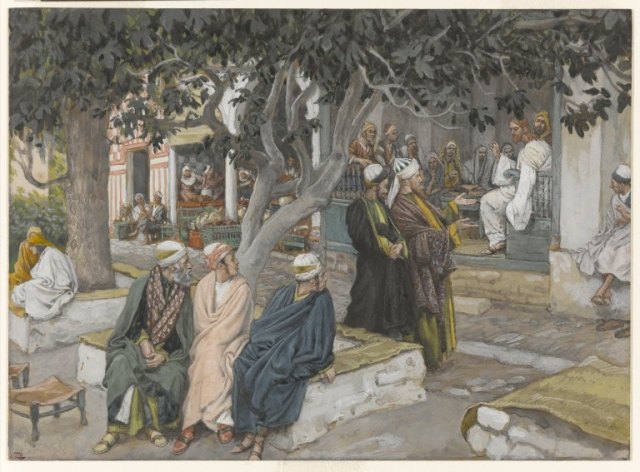
tissot
The Meal in the House of Matthew by James Tissot from the Brooklyn Museum

Apparently Matthew’s house was a do-drop-in kind of house. Matthew’s friends easily gathered at the meal. Even the Pharisees got a view of his table. 

I doubt that Matthew did the cooking. Perhaps his wife or mother, though never mentioned, were the true authors of his hospitality. She may have been that type of cook who lifts the sweet and savory scent of spices into the air, capturing in their welcome all who pass by.

Mt9_10 table

Jesus settles in to that welcome as do his table companions – disciples, tax collectors and sinners. They seem comfortable in their shared humanity. But today, with Jesus, they are invited to the perfection of that humanity in his abundant grace. They too receive a call this day.

We know only how some of these guests responded to this amazing invitation in their lives.

  • Matthew became an apostle and a saint.
  • The Pharisees retreated to their self-protective criticisms and condemnations.

How the others embraced or rejected this graceful moment is left unspoken.

With every Eucharistic moment of our lives, Jesus invites us to humanity’s table – a table transformed by his becoming one of us. His presence changes us all from sinners, tax collectors, or however else we are categorized. With Jesus, we are simply God’s children, fed and replenished by mercy, changed by a sacred invitation.

May we be aware of our “eucharists ” today, every encounter with another human being. The table may or may not be visible in the everyday circumstances around which we gather. Jesus will not be visible either – unless we have the eyes to see him in ourselves and those with whom we share life.

Music:  Come to the Table – Sidewalk Prophets

Lay Hold of Eternal Life

Memorial of Saints Andrew Kim Tae-gŏn, Priest, and Paul Chŏng Ha-sang, and Companions, Martyrs

Friday, September 20, 2019

Click here for readings

Today, in Mercy, we celebrate the feast of the Korean Martyrs. Their astounding faith stood against excruciating suffering but did not waver.

Korean_martyrs
Vatican [GFDL (http://www.gnu.org/copyleft/fdl.html)
A brief, inspiring story of the Korean Church is available here.


Today’s readings carry a common theme of resources, both material and spiritual, and how we use them.

Paul tells Timothy:

we brought nothing into the world,
just as we shall not be able to take anything out of it.

Still…

the love of money is the root of all evils,
and some people in their desire for it
have strayed from the faith

and have pierced themselves with many pains.

Our Psalm tells us that those who are poor in spirit realize that they possess nothing, that all they have is a gift from God. This realization is the source of their blessing.

Luke’s Gospel lists several women who supported Jesus’s ministry out of their resources. They, and no doubt the men depending them, had been touched and changed by Jesus.

1 Tim6_12 call

Each of our readings reminds us that deepened relationship with God releases in us those God given gifts of our Creation – the gifts of which Paul reminds Timothy:

But you, beloved of God,
… pursue righteousness, devotion,

faith, love, patience, and gentleness.
Compete well for the faith.
Lay hold of eternal life,
to which you were called
when you made the noble profession of faith

in the presence of many witnesses.

By the inspiration of the Korean Martyrs, may we hear and respond.

Music: a real foot tapper today – Hear the Call of the Kingdom – Kristyn Getty

Anoint Your Life

Thursday of the Twenty-fourth Week in Ordinary Time

September 19, 2019

Click here for readings

Today, in Mercy, I would like to share a piece from a book I am (slowly….) writing:

Lk7_17 jar

The scene is heavy with color, sounds, scents and movement.  The summer sun has begun its long descent through the western sky, filling the garden with orange light and umber shadows. Simon and his household make final preparations for the arrival of Jesus. The dining area is meticulously set in the arbored courtyard, the klinai or dining couches angled so that Simon may have the full consideration of Jesus once the supper begins. The scent of roasting lamb drifts from a nearby spit, incensing the entire space with heightened appetite. Slowly, the scene fills with the ancient Gospel characters, each carrying his or her own hungers to the table.

What is it that Simon the Pharisee most craves from this momentous opportunity to capture Jesus’ attention? He is a man of intellect who rationalizes that Jesus should respond in a certain way to the approaches of a sinful woman. Would his hunger have been satisfied had Jesus met this prediction? Or was a deeper hunger challenged when Jesus defied Simon’s expectation, inviting him to a fresh relationship with his own heart?

1112px-Albrecht_Bouts-Jesus_chez_Simon_le_Pharisien_IMG_1407
By Aelbrecht Bouts – Own work, CC BY-SA 2.0 fr, https://commons.wikimedia.org/w/index.php?curid=4234098

What spectrum of hungers comes with the many guests at this dinner? Are the disciples longing for Jesus to successfully argue his theology with this prominent Pharisee?  Are the other guests hoping to have their allegiances – whatever they may be – proven by the evening’s conversation? And Jesus himself, what hunger does he carry to the diverse gathering of his Father’s children? What yet unmet hopes for his ministry might he long to feed on this special evening?

But there is one among the many whose hunger is obvious.  At first unnoticed by the party, she slips in through the open hedge, advancing toward Jesus with a natural grace even the greatest wealth cannot bestow.  Her lustrous hair falls freely down her long, slender back.  She is bejeweled and bangled with the ornaments of her trade. Her face, though beautiful, reflects the weight of her desperate loneliness and forced self-sufficiency.

She is a woman no longer with pretense. The entire town already has cast her in a mold she will never escape. She has come as she is to the feet of Jesus, presenting her unadorned hope in an alabaster jar.

As we begin our prayer today, what hungers do we take to the feet of Jesus? Let us lift the alabaster jar. Let us decant the ointment of our prayer.  Let us anoint our lives.

The Deeper Melody of Wisdom

Wednesday of the Twenty-fourth Week in Ordinary Time

September 18, 2019

Click here for readings

Today, in Mercy, Jesus speaks to us like a frustrated parent.

All of us have seen fussy children, needing a nap, twisting around noisily from toy to toy, satisfied only to swipe the toy another child is playing with.

Jesus compares his resistant listeners to such children. They were not convinced by the austere preaching of John the Baptist. They are not moved by the loving freedom of Christ’s message. They find in both teachings only theories to toy with and toss aside. Because their hearts are hardened by distraction, they cannot find the heart in the truth offered to them.

Oh my goodness! Are we not living in the midst of such hardening distractions? So much in our culture invites us to “play” rather than to relate with our environment, with our lives. Advertising tempts us to get as much as possible out of everything, but to give nothing back. Media thrives by convincing us that we are the center of the universe.

We make a lot of noise when we feel threatened by the quiet truth of our common creaturehood and its inherent demand that we live in reverence for one another and for the God who created us.

John preached a message of repentance from such sinful self-absorption. He lost his head over it. Jesus preached the Word of transcendent love and mutual service. He was crucified for it. Each was seen as a threat to the manipulated Law that had become the refuge of their hardened listeners.

We see the pattern repeated down the long corridors of history, filling its passage with martyrs. We see it in our own day wherever someone tells the truth about the demands of the Gospel.

In our own Church, we see Pope Francis persecuted – even by some of his own bishops – for his call for compassion, mercy, and reverence for every person, for all Creation.

Indeed, we still live in the frenzied marketplace where 

“We played the flute for you, but you did not dance.
  We sang a dirge, but you did not weep.”

Ps107_wisdom well

Luke’s final cryptic verse may suggest our deliverance from such frenzy:

“But wisdom is vindicated by all her children.”

Our hearts recognize the Wisdom figures in our world. They have heard the true melody of God in their lives. By steady reflection and good works, they have gone beyond the din of a sinfully distracting culture. The result is inner peace, joy, and salvation, like that of John and Jesus —- and Pope Francis.

May we have the courage to go deep into Christ’s Word to embrace this Truth.

Music: Perfect Wisdom of Our God – Keith and Kristyn Getty

Say But the Word

Memorial of Saints Cornelius, Pope, and Cyprian, Bishop, Martyrs

Monday, September 16, 2019

Click here for readings

Today, in Mercy, both our readings today offer us pivotal lessons about what nourishes true leadership: faith, humility, generosity, and inclusivity.

Many of us have been blessed, especially in our young lives, with the gift of wise and loving mentors. Certainly our parents, families and teachers are among the first and most critical.

A little later, our circle of mentors widens. We look for great coaches, wise employers, guiding trainers, caring councilors, trusted friends.

Paul’s letters to Timothy and Titus are biblical examples of such mentorship. In them, the author is guiding young ministers in the art and science of loving, Christ-like leadership.

Key to such leadership in today’s reading is a steadfast commitment to prayer which covers, blesses and includes all people.

In our Gospel, the centurion demonstrates that he is a leader who values these virtues.

The Jews urging Jesus to visit the centurion say that he deserves Christ’s attention because “he loves our nation and he built the synagogue for us.

 My guess is that Jesus wasn’t impelled by this argument, but solely by his splancha – his merciful gut response to the man’s plea.

When the centurion enters the story, his humility is immediately evident: 

Lord, do not trouble yourself,
for I am not worthy to have you enter under my roof.
Therefore, I did not consider myself worthy to come to you;
but say the word and let my servant be healed.

The miracle healing, of course, is granted but that is not the most important part of the story.

!Tim2_5 bridgeJPG

This civil leader’s acknowledgement of Christ’s sovereignty is an act of faith which serves as a model for all of us – to the extent that millennia later we echo his prayer as we prepare to receive Christ in communion.

His is a faith that places Christ at the center of all Creation, commanding the flow of grace and mercy to all creatures. That faith allows the centurion to care even for a suffering servant. It allowed him to support the worship even of a dominated people.

Timothy and Titus have shown that kind of faith. They are the next generation who will carry Christ’s legacy passed to them by Paul. He wants them to understand that humility, largeness of heart, kindness and steadfastness open the way for God’s life-giving will for all people.

Whether, in our current life state, we are leader, or protégé, or both, how do these readings help us to make a clearer way for God in the world? That’s what real leadership is all about. And, as Paul says, we learn it in prayer.

Video: a representation of Luke’s version of this Gospel story:

Faith of Centurion

By your Holy Cross, O Lord…

Feast of the Exaltation of the Holy Cross

Saturday, September 14, 2019

Click here for readings

Today, in Mercy, we turn our hearts to the mystery of the Holy Cross.

Let’s face it. Most of us would prefer a life without ANY suffering. So how does the Cross help us understand that we will never have that kind of life?

The mystery of suffering is integral to all life and transformation. The ability to live and deepen with that mystery doesn’t happen in the mind. It happens in the soul.

The desert Israelites in our first reading don’t get it. They think an angry God is fed up with their complaining and so sends snakes to bite them and cause them suffering.

Not really.

Indeed, snakes have bitten them. But a loving God tells them: Hold up a symbol of my love. It will strengthen you to pass through your suffering because I am always in relationship with you.

cross_mcauley
The deep love of the Holy Cross was the sacred gift of Catherine McAuley to her Mercy Family. Let us listen to her counsel.

Paul, in the powerful passage from Philippians, takes us much deeper into the heart of this mystery. He tells us how Jesus put on human suffering to show us how suffering is transformed by the love it attempts to overcome.

Paul says that by becoming obedient – by listening – to the deep mystery of suffering and death in his life, Jesus shows us how to hear the whisper within it … the whisper of eternal life that can only be found when we pass through that awesome mystery in transcendent and enduring faith.

John suggests to us that, in some way that we cannot here understand, the mystery of suffering reveals something of the nature of God. It is an overwhelming, incomprehensible revelation that the Father could convey to us only in the visible gift of Jesus Christ.

For God so loved the world that he gave his only Son,
so that everyone who believes in him might not perish
but might have eternal life.
For God did not send his Son into the world to condemn the world,
but that the world might be saved through him. 

Praying with these deep considerations, we are invited to enter “the mind of Jesus”. May we wholeheartedly respond with today’s Alleluia verse:

We adore you, O Christ, and we bless you,
because by your Cross you have redeemed the world.

Music: Philippians Canticle- John Michael Talbot (Lyrics below)

And if there be therefore any consolation
And if there be therefore any comfort in his love
And if there be therefore any fellowship in spirit
If any tender mercies and compassion

We will fulfill His joy
And we will be like-minded
We will fulfill His joy
We can dwell in one accord
And nothing will be done
Through striving or vainglory
We will esteem all others better than ourselves

This is the mind of Jesus
This is the mind of Our Lord
And if we follow Him
Then we must be like-minded
In all humility
We will offer up our love

Though in the form of God
He required no reputation
Though in the form of God
He required nothing but to serve
And in the form of God
He required only to be human
And worthy to receive
Required only to give

This is the mind of Jesus
This is the mind of Our Lord
And if we follow Him
Then we must be like-minded
In all humility
We will offer up our love
In all humility
We will offer up our love