Today, in Mercy, Paul again shows his great admiration for the commitment of the Thessalonians:
You have no need for anyone to write you about fraternal charity…
( in other words, you already live it.)
Don’t we all wish that line could be written, without reservation, to us?
In our Gospel, Jesus tells us the familiar parable of the talents which shows what God would look for in order to say as much to us.
On the surface this story looks like one about material goods or personal capabilities – about how we use our individual gifts to further God’s reign. Certainly that is one valuable interpretation.
But think about the talents in the story. They did not belong to the servants. They belonged to the master.
This parable is about God’s talents, God’s nature, and how we either frustrate or facilitate their effectiveness in God’s Creation.
We are the means by which God is present in the world.
God invests God’s own heartin us – Unconditional Love, Lavish Mercy, Infinite Hope, the Perfection of Compassion, Sacred Accompaniment, Abiding Fidelity.
If we tender these divine “talents” to others with care and generosity, we become good and faithful reflections of God’s own presence.
What about the poor soul who buried the talents under his own fear and small-mindedness? Sad, right? But that self-protective, parsimonious little burier hides in all of us.
We know the blockades we put up against God’s Grace. Let us look sincerely at them today, asking to be worthy of the trust invested in us to multiply God’s grace in the world.
Today, in Mercy, Paul describes for the Thessalonians how precious they are to God.
It is in a beautiful line of thought in today’s passage, but the thought is hidden in a thread through Paul’s sermon about marriage practices. It seems that some Thessalonians were playing a sort of “Bachelor/Bachelorette” game, devoid of the reverence marriage deserves.
But within Paul’s spousal instructions is this tender verse:
This is the will of God, your holiness.
God wants us to be blessed and completed with holiness. What is holiness?
Merriam-Webster has a few definitions, the most helpful of which is this:
devoted entirely to the deity or the work of the deity
But maybe we could think of holiness this way:
Seeing deeply through circumstances to the heart of God
Learning to beat with that Heart in a mutual rhythm of grace and trust
Singing that rhythm into a longing world by a life of mercy and love
Some of the world’s longing will always remain in us too. But Jesus tells us, in today’s Gospel, that our longing will be filled when the Bridegroom comes. Still, he cautions us to be ready – to have an abundance of oil to light our heart-lamps for God.
So today, let’s squeeze that precious oil out of every moment – every opportunity to find, love, and serve God in the people and circumstances of our lives.
Music: a little bit of a stretch today. But if you listen inside the lyrics, I think you’ll find connections to today’s reflection. (Besides, who can’t be uplifted by Neil Diamond? 🙂
Today, in Mercy, we commemorate the Passion of John the Baptist who, besides Mary, was the greatest saint embracing both the Old and the New Testaments.
When I was young, the memorial was simply referred to as “The Beheading of John the Baptist”. The term “passion” captures its meaning so much more clearly:
it inclines us to realize the similarities between John’s passion and death and that of Jesus.
it shifts the power of the event to John, who chose his fate by the courage of his witness, rather than to see Herod, the “beheader”, as the agent of the story.
John’s whole prophetic life was part of his “passion”. It inevitably led him to this ultimate confrontation with evil.
Walter Bruggemann, in his transformational book “The Prophetic Imagination” writes about prophets. He indicates that prophets emerge in the context of “totalism” – those paralyzing systems which attempt to control and dominate all freedom and possibility.
Totalism kills ideas, hope, freedom, choice, self-determination, and creativity for the sake of controlling reality for its own advantage. Totalism is the ultimate “abusive relationship “.
Brueggemann defines the prophet as one engaged in these three tasks:
the prophet is clear on the force and illegitimacy of the totalism.
the prophet pronounces the truth about the force of the totalism that contradicts the purpose of God.
the prophet articulates the alternative world that God has promised, and that God is actually creating within the chaos around us.
Every age requires prophets because every age is infected with “Herods” trying to thwart God’s reign of love, mercy, truth, freedom, and joy. In our own time, the poison of totalism is quite evident in those systems fueled by racism, militarism, financial duplicity, desecration of the earth, and the sad array of other ideologies that cripple humanity.
Today, as we pray with this great saint, may we be inspired to respond to our own prophetic call – to be prophetic signs of love, mutual reverence, joy, Gospel justice,and lavish mercy for our world.
Music: I think of this song by Simon and Garfunkel as the modern day song of John the Baptist.
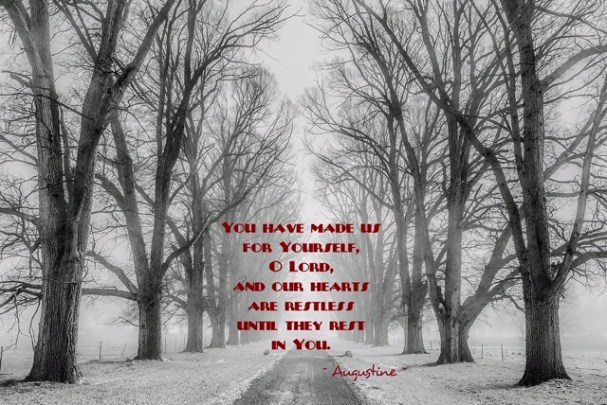
Today, in Mercy, celebrate the Feast of St. Augustine who gave us such beautiful quotes as these:
These quotes reflect a clarity of soul Augustine pursued all his life. He was a brilliant philosopher, intellectual, and poet. His early spiritual practice struggled for years to break through the shell of philosophy into the heart of true faith.
Eventually, through the prayers of his mother Monica and the gentle guidance of St. Ambrose, Augustine’s searching soul found God as reflected in today’s choice for a Responsorial Psalm:
Lord, you have searched me and known me; you understand everything I do; you are closer to me than my thoughts. You see through my selfishness and weakness, into my inmost self.
There is not one corner of my mind that you do not know completely. You are present before me, behind me, and you hold me in the palm of your hand.
Such knowledge is too awesome to grasp: so deep that I cannot fathom it. Where can I go from your spirit? Where can I flee from your presence?
If I take the wings of the morning and fly to the ends of the sea, even there your hand will guide me and your spirit will give me strength. ~ A Book of Psalms by Stephen Mitchell
Some of us , no matter how hard we try, have a tortuous path to spiritual peace. Augustine is a saint because he never abandoned that path.
Paul’s Thessalonians seemed to have had an easier way:
And for this reason we too give thanks to God unceasingly,
that, in receiving the word of God from hearing us,
you received it not as the word of men, but as it truly is, the word of God,
which is now at work in you who believe.
Jesus, in Matthew’s Gospel continues his tirade against those who only appear to seek that path to spiritual sincerity and whole-heartedness:
Woe to you, scribes and Pharisees, you hypocrites. You are like whitewashed tombs, which appear beautiful on the outside, but inside are full of dead men’s bones and every kind of filth. Even so, on the outside you appear righteous, but inside you are filled with hypocrisy and evildoing.
The etymological root of the word “hypocrisy” is to “under decide” – a kind of half-heartedness, a falsely comfortable pretense, a neither “here nor there” attitude that safeguards our worldly advantage but paralyzes us on the path to holiness.
Augustine lived in that limbo for a long time. He came late to true Beauty, Love and Clarity. Oh, but what a transformation!
Today, in Mercy, we begin eight days of Thessalonians, coupled with the final section of Matthew’s Gospel before the Passion, Death and Resurrection narrative.
First Thessalonians is a love note, a thank you note. In it, Paul speaks to the community with great affection and gratitude because they have caught fire with the Gospel he shared with them.
Paul’s words carry the loving, grateful voice of God to us who also try, with all our hearts, to give ourselves to the Gospel.
In today’s Gospel, Matthew gives us the sad counterpoint to Paul’s joy. Jesus thunders woe over the Pharisees who, unlike the Thessalonians, smother the ardent message he offers them.
They bind. They control. They peddle a religion rooted in parsimonious law rather than generous freedom. They promote a system that sustains their privilege.
Jesus tells us that Pharisaical religion sucks the soul from people, binding them in a self-serving, spiritless law – where power and material prosperity supersede truth, loving community, and sincere worship.
In Paul’s words, God blesses and thanks us for our true faith which – by generosity, hope, love, sacrifice and hopeful endurance – builds the Community of God.
Throughout history, some people have used the scripture to justify the kind of pharisaical selfishness bewailed in today’s Gospel. They isolate and demonize other human beings by the deceitful turning of the holy Word. They are clever and convincing. They appeal to our rationality rather than our souls.
Today’s readings remind us to take great care in discerning the Spirit. We will never find Her where there is no love, mercy, kindness, freedom, forgiveness, and joy.
Music: one of my favorite hymns. Though from Ephesians, it carries the same message as our reading from Thessalonians today. I pray this prayer for all of you, dear friends.
Ephesians 1 – by Suzanne Toolan, RSM
Blessed be the God and Father of our Lord Jesus Christ.
In him we were chosen to live through love in his light.
That is why I never cease to give thanks to God for you.
And pray that the God of our Lord Jesus Christ
will grant you the Spirit of wisdom
and knowledge of himself
that you may glory, glory in his goodness.
Today, in Mercy, we celebrate the Apostle Bartholomew, thought by some to be the same man as our Gospel’s Nathaniel. This Nathaniel has been my prayer companion since 1964 when I received his name at my Religious Reception.
Nathaniel Under the Fig Tree by James Tissot (1836-1902)
At first we were surface friends. I imagined what he might have been doing under the fig tree. I was a little shocked at his easy banter with Jesus. I thought about his skepticism, trying to discern how it could eventually yield his sanctity. I wondered if he ever achieved that vision of “angels of God ascending and descending ...”
But as the years passed, and I prayed beside him more often, we came to understand each other better. Nathaniel began to teach me about Jesus and, with that, Jesus began to teach me through Nathaniel.
It was all about being honest with God and opening my perspective to God’s vision.
You see, we are all under various “fig trees” at points in our lives, those small but confining perimeters of shadow which veil God. Sometimes the shadow consists of an event or experience that makes us says, “How can God possibly be in this?” Sometimes the shadow comes from all the obstacles we have placed in Light’s way. Sometimes it is simply the waning energy required by faith’s long journey.
Whatever its source, the shadow captures us in its incarcerating grasp, isolating us from the outrageous hope and possibility of God awaiting us in every circumstance.
Then a voice – our particular “Philip” – suggests we just step away from the umbra.A person, a book, a memory, a prayerful insight – A GRACE – invites us to “Come and see” more deeply, to let go of all that we thought secured us, to yield to hope, trust, and an incredible new vision.
It is an irreversible moment of unconditional love. It is the moment we make our own proclamation, not unlike Nathaniel’s:
Rabbi, you are the Son of God;
you are the King of Israel.
Nathaniel’s guileless, faith-filled surrender to Jesus opens the way for his transformation. Jesus tells him, “You will see greater things…”. In other words,
God is so much bigger than you think at this moment.
Open your heart and soul to that Infinity!
Your life in Christ is all about going deeper,
(as the Angel invites us in our first reading from Revelation).
We don’t hear much about Nathaniel after that day. Like many of the other Apostles, he lived out his ministry beyond written records. But we can trust that this man “without duplicity” deepened in his honest dialogue with the God he met and embraced on that amazing Judean afternoon.
Many things live, not just the plants, animals and humans that grace our world. Memories and promises live. Vows live. So do grudges and prejudices. Unlike our physical life, these less tangible realities become stronger with time. Tales of valor and achievement live, often becoming epic with the passing of the years.
Simple kindness lives too, blessing not only the current receiver, but the unseen generations to whom it is passed. Every morning, old fears and new hopes wake up within us all. They vie with each other to become the engines of our lives. The happy ones among us have learned to let hope win.
Mother Patricia near her death in 1915
On this date in 1861, a small group of just such happy, hopeful people came to Philadelphia. On that hot August afternoon, the first Philadelphia Sisters of Mercy, led by 26-year old Patricia Waldron, arrived at Broad Street Station in North Philadelphia. They carried no worldly possessions. They came with only a dream for Mercy. It was a dream so alive in them that it still inspires us today, over 150 years later.
Can’t you see them standing on the busy platform, the hissing steam trains encircling them in mist? They must have felt “be-misted” themselves, these mostly Irish country girls engulfed in a big city.
Union troops heading south crowded the platform. Busy Broad Street crackled with news of the burgeoning national strife. Lincoln himself would visit the city in the coming weeks.
And hidden within the seams of this bustling city’s garment lay the poor – the ones for whom they had come. How to reach them? How to help them change their lives?
Ranging from sixteen to twenty-seven years old, these brave young women had been charged with establishing a kind of “new nation” themselves – not of politics, but of mercy. I am sure they, like the young stout-hearted soldiers surrounding them, were also a little weak-kneed. They too had their battles to face. They too would see starvation, illness, attack and death – but they would endure for the sake of the Mercy dream, God’s dream for the poor.
Today we honor our beloved foremothers who led the way in faith and commitment.
Enduring dreams begin with small first steps. So, hailing a horse-drawn carriage, Mother Patricia Waldron led her young band to their new lives. Thus she began the grace-filled saga many of us know so well and of which we are a part today. Their dream lives in us who love Mercy:
in our continued effort to find those who are poor and sick in a world that ignores them
in our choice to be compassionate in a world that often chooses violence
in our commitment to care in a world of treacherous indifference
On that sultry August day 1861, and on this one 2019, people have choices to make. They have vows to keep. Some choices live forever. In the name of Mercy, what will you choose today?
Today, in Mercy, the Book of Judges offers us the story of Jephthat and his daughter – and it is a doozy!
The Daughter of Jephthat – Edgar Degas
Again, in a nutshell, Jephthat is recruited to lead an army against the Ammonites. He makes an obviously unconsidered vow that, if he is victorious, he will make a burnt offering to God of “whatever comes first out of his door” upon his return. Unfortunately, the first thing out his door is his only daughter. After giving his daughter the time she requests to “mourn her virginity”, Jephthat fulfills his vow.
Treatises have been written about how to interpret this troublesome passage – from St. John Chrysostom, to St. Ambrose, to modern Biblical scholars. No clear, single answer emerges. And for the purpose of prayer, it needn’t.
One thing the passage does make clear is that vows are critically important and have consequences.
Sisters of Mercy – Perpetual Profession of Vows
We make all kinds of “vows” in our lives. Some are foolish ones, like Jephthat’s, where we promise God something simply to get our way. We glorify such promises by calling them vows. They are really one-sided bargains we make to fuel our self-interested goals.
A true vow is the tying of our heart and soul to a Love, Truth, and Hope beyond ourselves.It is the binding of our life and future to a power we will understand only with the long fidelity of time and shared experience. It is a giving that, even if rescinded, still will change our character forever. It is a giving that, if sustained, will transform us into the very Love, Truth, and Hope which first embraced us.
Our Gospel makes clear that God takes our vows seriously.They are our invitations to the banquet, whether they come in the form of Baptismal vows, marriage vows, religious vows, or others forms of commitment to love and service.Once we have engaged these vows, we need to respond and to enflesh the Spirit of God within them. If we don’t, if we ignore the holy invitation within our life circumstances, we will end up in a “darkness” outside of God’s hope for us.
But if, as God hopes, we fully embrace the spirit and depth of God’s invitation, we become whole in God, “the chosen”, the beloved.
I have always loved this poem by Alice Meynell, “ The Neophyte”. It fills me with a holy awe and exuberant joy at the mysterious power of being in love with God
The Neophyte – Alice Meynell
Who knows what days I answer for to-day? Giving the bud I give the flower. I bow This yet unfaded and a faded brow; Bending these knees and feeble knees, I pray.
Thoughts yet unripe in me I bend one way, Give one repose to pain I know not now, One check to joy that comes, I guess not how. I dedicate my fields when Spring is grey.
O rash! (I smile) to pledge my hidden wheat. I fold to-day at altars far apart Hands trembling with what toils? In their retreat I seal my love to-be, my folded art. I light the tapers at my head and feet, And lay the crucifix on this silent heart.
(Appropriately, as we talk about faithfulness to vows, this date marks the anniversary of the arrival of the Sisters of Mercy in Philadelphia in 1861 – our Philadelphia Foundation Day. In a later post today, I will share a brief reflection of thanksgiving and challenge for this anniversary.)
Today in Mercy, on this feast of St. Bernard, the liturgy offers us a little bit more of the Books of Judges. The reading for today is about Gideon, warrior judge, who delivered the Israelites from the oppression of the Midianites.
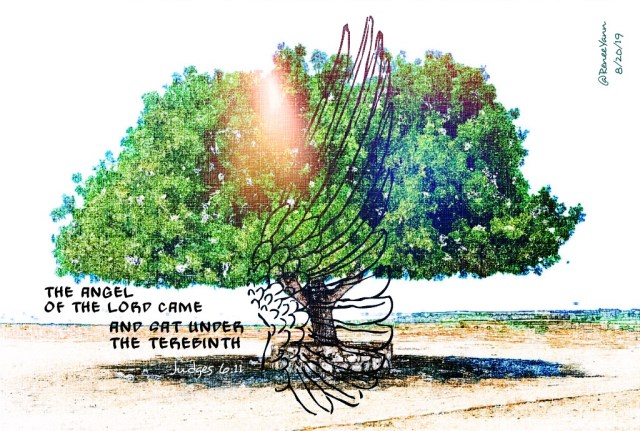
What the heck is a “terebinth” anyway? – a small southern European tree of the cashew family that was formerly a source of turpentine.
For me, these passages about wars and deliverers create conflict. Believing in Christ’s message of peace and mutual love, we have a spiritual abhorrence for war and a resistance to taking sides in confusing civil conflicts.
But as our wonderful retreat guide last week (Clare D’Auria, OSF) told us, with the Scriptures, as with writings from cultures not our own, we have to “get under the language” to find the deeper spiritual meanings.
Here’s what I find “under the language” of Gideon’s story.
A person unafraid of transparencywith God:
The angel of the LORD came and sat under the terebinth. Gideon said to the Lord, “My Lord, if the LORD is with us, why has all this happened to us?
A person open toGod’s Presencein his ordinary daily circumstances:
The angel of the LORD came and sat under the terebinth
… where Gideon was beating out wheat
A person who is unaware of God’s astounding power within him:
The LORD turned to him and said, “Go with the strength you have and save Israel from the power of Midian. It is I who send you.” But Gideon answered him, “Please, my lord, how can I save Israel?
A person whose faith continued to be shaky even in the presence of God:
Gideon answered the Lord, “If I find favor with you, give me a sign that you are speaking with me.
A person awestruck by God’s willingness to be personally present to him:
“Alas, Lord GOD, that I have seen the angel of the LORD face to face!”
A person who responds to God in loving worship and visible witness:
The LORD answered him, “Be calm, do not fear. You shall not die.” So Gideon built there an altar to the LORD and called it Yahweh-shalom.
God visits each one of us in our daily experiences. We want to be transparent with God in both our joys and sorrows, our needs and our abundance. We want to give over to God our hesitancies and fears as we respond wholeheartedly to God’s invitation to grace. By the witness of our faith and good works, we want to give God praise for being in our lives – under our terebinth.
Under the language, I found a lot of Gideon in myself. You?
Music: In honor of the great St. Bernard of Clairvaux, please enjoy this beautiful him attributed to him – Jesu, Dulcis Memoria (translation below)
The sweet memory of Jesus
Giving true joy to the heart:
But more than honey and all things
His sweet presence.
Nothing more delightful is sung,
Nothing more pleasing heard,
Nothing sweeter thought,
Than Jesus, the Son of God.
O Jesus, hope of the penitent,
How gracious you are to those who ask
How good to those who seek you;
But what [are you] to those who find?
No tongue may tell,
No letter express;
He who has experience of it can believe
What it is to love Jesus.
O Jesus, may you be our joy,
You who are our future reward.
May our glory be in you
Throughout all eternity.
Amen
Today, in Mercy, our readings are about possessions – in every sense of that word.
In today’s reading from Judges, the first of a few this week, we see Israel in the years between entering the Promised Land to the rise of Saul as king. During these four hundred years, a series of judges tries to keep Israel on track with God. It is a frustrating assignment!
As today’s passage describes, the Israelites get caught in an endlessly repeating cycle:
worship false gods
get zapped by true God
feel really bad, say sorry
be forgiven
repeat cycle
Hmm! I’ve seen this pattern somewhere before. Oh, yeah! It’s just like the one describing all my good intentions that never quite materialized!
Many of us can identify with the rich young man in the Gospel. We want to take our relationship with God up a notch. We would like to be better, holier people. But we may also, like the young man, like the ancient Israelites, be caught in a cycle of behaviors and choices which inhibit us.
Jesus tells this young man to get rid of his possessions, freeing him to really follow Jesus.
What possesses us, holding us back from that radical following?
It is not always material goods. They are easy to identify and dispatch. It is our tightly held and hidden illusions, resentments, prejudices, assumptions, entitlements, fears, jealousies, disappointments, angers. These are the heavy chains that cling to us as we try to move deeper into God.
May we be inspired by Matthew’s young man to recognize and break through the cycles that bind us by hearing God’s invitation to wholeness – an invitation always deep within our life circumstances.







 Lavish Mercy