Today, in God’s Lavish Mercy, we listen to both Jesus and Paul as they offer their farewell addresses to their beloved disciples.
It seems an appropriate time for these readings here as students close their educational years and move on to their future. The disciples of Jesus and Paul are doing the same thing. And their valedictorians are the beloved masters on whom they have come to depend.
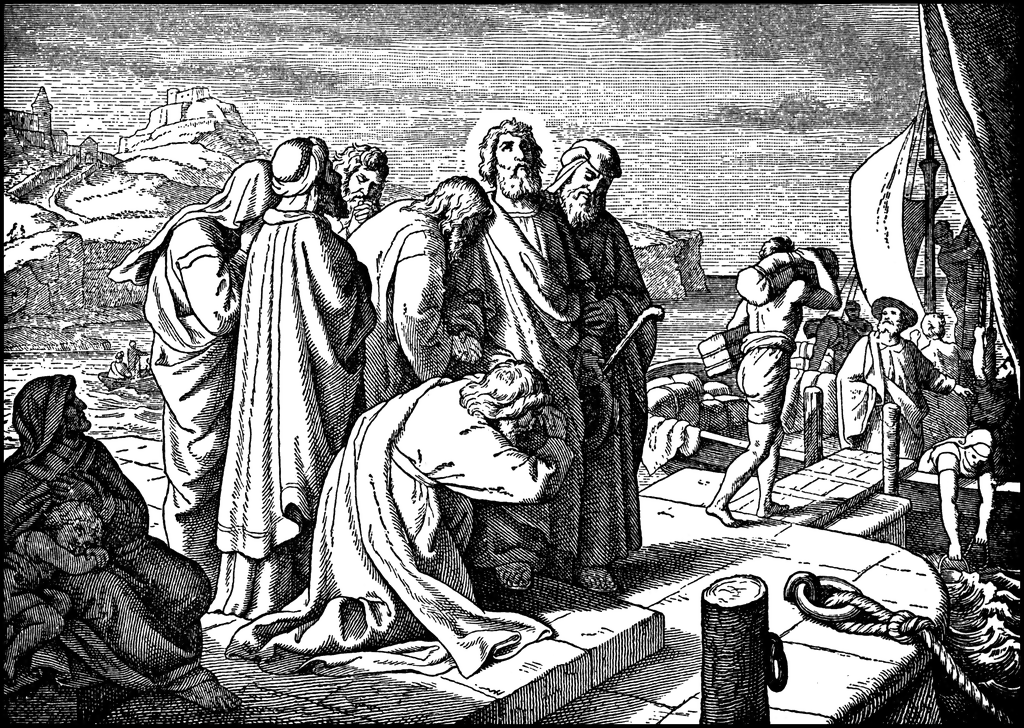
Paul and his disciples share a tearful good-bye as he departs for Rome
In Acts, Paul prepares to depart from Ephesus where he has lived for three years. It is his cherished community as we can assess from the beautiful letters Paul writes to the Church there. The disciples are heartbroken to see Paul leave, and he is quite emotional himself in his remarks:
I earnestly bore witness for both Jews and Greeks to repentance before God and to faith in our Lord Jesus. But now, compelled by the Spirit, I am going to Jerusalem. What will happen to me there I do not know…
But now I know that none of you to whom I preached the kingdom during my travels will ever see my face again. And so I solemnly declare to you this day that I am not responsible for the blood of any of you, for I did not shrink from proclaiming to you the entire plan of God.
Acts 20
Paul, declaring that he has done all that he can for the Gospel, sternly charges his followers to carry on the work of evangelization.
Jesus is a little gentler but no less dramatic in describing the charge to his disciples:
I pray for them. I do not pray for the world but for the ones you have given me, because they are yours, and everything of mine is yours and everything of yours is mine, and I have been glorified in them. And now I will no longer be in the world, but they are in the world, while I am coming to you
John 17
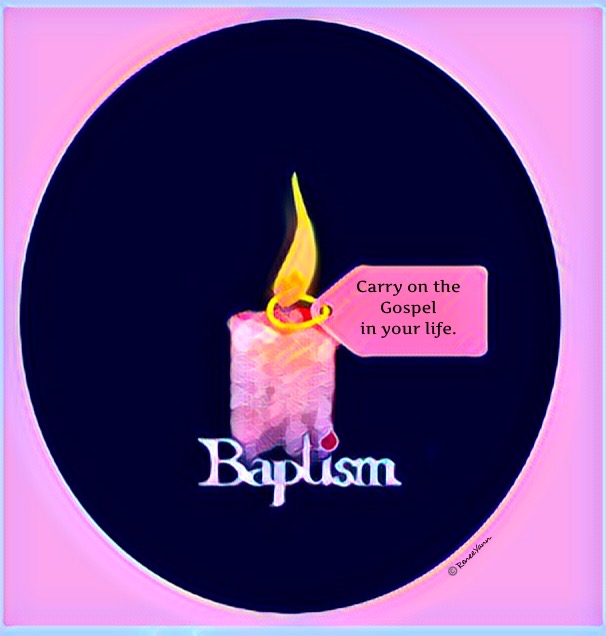
Both these readings speak to us, not only about the disciples’ experience of commissioning, but of our own. Our Baptismal incorporation into the faith came with a price tag — “Carry on the Gospel in your life.”
As we listen to the passion with which both Jesus and Paul advised their followers, let’s hear them speaking to us as well. Let’s listen for the unique call we are receiving through the circumstances of our particular life. Not everyone is called to be Paul, or Peter, or Lydia, or Apollos, or Silas or the others we have read about throughout Eastertide.
But we ARE called to be
_________________________________ (Fill in your name) a believer and doer in the Name of Jesus Christ
Poem: by Hafiz from Love Poems from God – Daniel Ladinsky
I am
a hole in a flute
that the Christ’s breath moves through—
listen to this
music.
Today, in God’s Lavish Mercy, our readings remind us that there are many ways to learn about and grow deeper in our relationship with God.
We can learn from teachers, each of whom has a different tincture to enrich the body of Christian teaching. Today, we meet a few of these very early teachers – Apollos, Priscilla, Aquila, and of course the Teaching Master, Jesus.
Apollos, Aquila and Priscilla
Apollos was a Jewish Christian from Alexandria, Egypt. He was brilliant, steeped in the knowledge of the Hebrew Scriptures. He was a compelling presenter and an exceptional logician. Luke tells us that Apollos had been instructed in the “Way of the Lord”. When he arrived in Ephesus, Apollos immediately began to “speak boldly” in the synagogue.
There was a problem though. Even though he knew the “Way” or the Gospel, Apollos hadn’t completed the whole course, so to speak. He knew only the baptism of John and not that of the Holy Spirit. So there were some gaps in his “curriculum”, gaps which were evident to two other excellent teachers – the husband and wife team of Priscilla and Aquila.
Priscilla was so kind. She took Apollos aside and quietly redirected some of his thinking. He must have been so grateful for her wise attention and gentle collegial wisdom. And Apollos deserves credit too. He was receptive to the fraternal correction, even that of a woman! Imagine!
This passage from Acts offers us so much food for thought. As we learn and share our faith and spiritual understanding, we must seek guiding input from well-grounded teachers. We should be willing to speak up when we hear the Gospel poorly interpreted or used inappropriately for the advancement of personal and political agendas.
Over the 2000-year evolution of Christianity, many suspect offshoots have arisen. In the early centuries, Christian teachers coped with various heresies which you may have studied in high school such as Arianism, Pantheism, Pelagianism, Gnosticism, etc.
In our modern world, major religions deal with such aberrations as the distortions of the “prosperity Gospel”, exaggerated fundamentalism, and abusive Sharia law.
In our Gospel, Jesus is clear that true faith resides in those who love him, and who love as He has loved. They live and teach in His Name. Without love like Christ’s at its core, any purported religious teaching is a mere shell of the true Gospel.
The hour is coming when I will no longer speak to you in figures of speech, but I will tell you clearly about the Father. On that day you will ask in my name, and I do not tell you that I will ask the Father for you. For the Father himself loves you because you have loved me and have come to believe that I came from God. I came from the Father and have come into the world. Now I am leaving the world and going back to the Father.
John 16:25-28
Prose: from Rabindranath Tagore
A teacher can never truly teach unless he too continues to teach himself. One lamp can never light another unless it continues to burn its own flames.
Similarly, the teacher who has come to the end of his subject, and has no living traffic with his knowledge but merely repeats his lessons to his students, can only burden their minds, he cannot inspire them.
Truth not only must inform but also inspire; if this inspiration dies out and information merely keeps on accumulating, then truth loses its infinity.
Music: Teach Us, Good Lord (The Prayer of St. Ignatius of Loyola – see below) – Music, David Ogden
Teach us, good Lord, to serve you as you deserve; to give, and not to count the cost, to fight, and not to heed the wounds, to toil, and not to seek for rest, to labor, and not to ask for reward, except that of knowing that we are doing your will.
Today, in God’s Lavish Mercy, we meet people who are deeply dedicated to their life commitments – sometimes for good, sometimes for woe.
In Acts, we meet the unnamed “jailer”. Paul and Silas have been manhandled and thrown into prison. Their jailer receives the instruction to “guard them securely” and he takes it very seriously, binding them in chains in the innermost dungeon.
This man revels in his job, to the degree that it is his only identification in the scriptures. We never know his real name.
His job gives him authority and power he would not have in his ordinary circumstances. Perhaps his job has even become his identity so that without it, he feels like little or nothing. When God decides to “earthquake” Paul and Silas out of their chains, the guard freaks. It’s more than an earthquake to him – his very identity is crumbling in the tumult.
And how about Paul? Is he cool in this reading, or what??? Paul’s power relies not on an assumed identity but on God’s centrality in his life.
When the jailer woke up and saw the prison doors wide open, he drew his sword and was about to kill himself, thinking that the prisoners had escaped. But Paul shouted out in a loud voice, “Do no harm to yourself; we are all here.”
The jailer’s awed response is full-hearted! He does a transformational flip which transfers all his past “job dedication” into his new spiritual conversion. Not only does he allow the disciples to go free, he guides them to his own house, ministers to them, and is baptised. No doubt, his past employers were not too happy with him!
In our Gospel, the disciples, who are deeply dedicated to their vocations, still demonstrate a bit of job-jitters.
Jesus has made it clear that he’s on his way to another dimension and that his disciples will to have to carry on the evangelization business on their own. He promises them all kinds of supernatural help but they can’t imagine functioning without him.
Finally Jesus tells them that, in his physical absence, the Spirit will give them an enhanced power to promulgate the Gospel:
But I tell you the truth, it is better for you that I go. For if I do not go, the Advocate will not come to you. But if I go, I will send him to you. And when he comes he will convict the world in regard to sin and righteousness and condemnation
Both our readings today remind us that it’s all about what really makes us tick. Do we really understand that it is God’s life with us that gives us “importance”, security and identity? Do we tap into that Infinite Power to give us hope, confidence and transformational resilience in life’s many earthquakes? If so, we like the disciples, will be “unchainable” — because it isn’t about us. It is about the God we love whose Spirit lives in us.
Poetry: Peter and the Angel – Denise Levertov
(This poem is not about Paul and Silas, but rather about Peter when he too was freed from prison by Divine intervention (Acts 12:5-17))
Delivered out of raw continual pain,
smell of darkness, groans of those others
to whom he was chained—
unchained, and led
past the sleepers,
door after door silently opening—
out!
And along a long street's
majestic emptiness under the moon:
one hand on the angel's shoulder, one
feeling the air before him,
eyes open but fixed . . .
And not till he saw the angel had left him,
alone and free to resume
the ecstatic, dangerous, wearisome roads of
what he had still to do,
not till then did he recognize
this was no dream. More frightening
than arrest, than being chained to his warders:
he could hear his own footsteps suddenly.
Had the angel's feet
made any sound? He could not recall.
No one had missed him, no one was in pursuit.
He himself must be
the key, now, to the next door,
the next terrors of freedom and joy.
Music: Love is the Only Way – from the film Paul, Apostle of Christ by Jan Kaczmarek
An extra treat to bless your day: this beautiful and powerful rendition of “Unchained Melody’
The Musikschau der Nationen invites army orchestras from almost a dozen countries the U.S. Army website classifies as “Europe’s biggest brass band music festival.” Though not always consecutive, the festival enjoys over 35 years of time-honored traditions. Some participants besides the U.S. included Vietnam, Russia, and Mexico, among others. In 2002, they performed an all-orchestra version of “Unchained Melody”. The performance represented the largest millitary orchestra in the world.
Today, in God’s Lavish Mercy, many of our readings this week prepare us for the Ascension event, a leave-taking with deep gifts and emotions attached.
Our readings from Acts assure us that the early Church, despite the physical absence of Jesus, burst into blossom throughout much of Asia Minor. Today’s passage notes this flowering even in Samaria, where the Jewish faith had been truncated ever since the reign of Jereboam a thousand years before Christ. We read today about the Samaritans receiving their Confirmation:
Now when the apostles in Jerusalem heard that Samaria had accepted the word of God, they sent them Peter and John, who went down and prayed for them, that they might receive the Holy Spirit, for it had not yet fallen upon any of them; they had only been baptized in the name of the Lord Jesus. Then they laid hands on them and they received the Holy Spirit.
Acts 8: 14-17
In our Gospel, we see Jesus preparing the disciples for their own Confirmation which will come on Pentecost. Jesus is tender yet intentional in his instruction of the disciples. He knows that it will be challenging for them to move the Gospel forward without him right beside them. But he assures them that the Holy Spirit will sustain them through that challenge.
Jesus said to his disciples: “If you love me, you will keep my commandments. And I will ask the Father, and he will give you another Advocate to be with you always, the Spirit of truth, whom the world cannot accept, because it neither sees nor knows him. But you know him, because he remains with you, and will be in you.
John 14:15-18
What about us – those charged with moving the Gospel forward today. We, like the disciples, must garner the courage to do this even though Jesus is not physically with us.
And we too have been given the amazing gift of the Holy Spirit! Do we ever think about our Confirmation? Or do we remember it only as a symbolic event that happened in our childhood?
How foolish we are if that’s the case! We have buckets of supernatural gifts to empower and nourish us if only we pay attention and ask. We, like the disciples, have not been left orphans of grace!
(Click on the buckets to enlarge if you wish.)
Poetry: God’s Grandeur – Gerard Manley Hopkins
The world is charged with the grandeur of God. It will flame out, like shining from shook foil; It gathers to a greatness, like the ooze of oil Crushed. Why do men then now not reck his rod? Generations have trod, have trod, have trod; And all is seared with trade; bleared, smeared with toil; And wears man’s smudge and shares man’s smell: the soil Is bare now, nor can foot feel, being shod.
And for all this, nature is never spent;
There lives the dearest freshness deep down things;
And though the last lights off the black West went
Oh, morning, at the brown brink eastward, springs —
Because the Holy Ghost over the bent
World broods with warm breast and with ah! bright wings:
Music: I Will Not Leave You Orphans – Carey Landry
Today, in God’s Lavish Mercy, our readings can serve to remind us that Christian discipleship is not always a smooth ride. There are “potholes” — as in all of life.
Pothole 1: Rejection in Lycaonia Paul, after being stoned, rejected and otherwise harassed, takes off for Derbe and Lystra to test the readiness of that community to receive the Gospel. There, Paul meets Timothy who would become a beloved friend and companion, traveling and ministering with Paul for the next decade.
Pothole 2: Sorry, Tim! But the relationship starts out with a problem. Timothy’s dad was Greek and, per custom, did not have Timothy circumcised at birth. Even though the Jerusalem apostles had adjudicated circumcision as unnecessary, Paul – who had been its main critic – requires the rite for Timothy. Paul was convinced that the Jews to whom they would be preaching would reject Timothy otherwise.
Pothole 3: Rejection in Asia They traveled through the Phrygian and Galatian territory because they had been prevented by the Holy Spirit from preaching the message in the province of Asia. (Acts 16:6)
Pothole 4: Bypassing Bithynia When they came to Mysia, they tried to go on into Bithynia, but the Spirit of Jesus did not allow them, so they crossed through Mysia and came down to Troas. (Acts 16:7)
When we see the massive success and widespread influence of the Church today, we might think it was easy to get this whole thing started – to light the fire of faith in the early years. It wasn’t! And it’s still not easy, despite some appearances.
Jesus counseled his disciples that it would be this way, and encouraged them:
Jesus said to his disciples: “If the world hates you, realize that it hated me first. If you belonged to the world, the world would love its own; but because you do not belong to the world, and I have chosen you out of the world, the world hates you. Remember the word I spoke to you, ‘No slave is greater than his master.’ If they persecuted me, they will also persecute you. If they kept my word, they will also keep yours. And they will do all these things to you on account of my name, because they do not know the one who sent me.”
John 15:18-21
That encouragement was enough for Paul and Timothy to keep going. May it be so for us, and for all who would lead the Church into the future Jesus desired for us..
Poetry: Portia Nelson, There’s a Hole in My Sidewalk from The Romance of Self-Discovery
I walk down the street. There is a deep hole in the sidewalk. I fall in. I am lost… I am helpless. It isn’t my fault. It takes forever to find a way out.
I walk down the same street. There is a deep hole in the sidewalk. I pretend I don’t see it. I fall in again. I can’t believe I am in the same place. But, it isn’t my fault. It still takes me a long time to get out.
I walk down the same street. There is a deep hole in the sidewalk. I see it is there. I still fall in. It’s a habit. My eyes are open. I know where I am. It is my fault. I get out immediately.
walk down the same street. There is a deep hole in the sidewalk. I walk around it.
I walk down another street.
Music: just for some pothole fun today – I Love My Juggernaut – an Irish lorry driver bemoans the pothole problem. Lyrics below.
This is an enjoyable Irish song highlighting a long-standing pothole problem in Cavan, a small city near the border with Northern Ireland. The town is located on the junction of two national routes, the N3 to Dublin and N55 to Athlone. Until recently there was no bypass around Cavan town to eliminate the heavy traffic passing through an already congested town –thus, the legendary pothole problem!
Oh believe it or believe it not, I love me Juggernaut !! I’ve been all over Ireland, to the North I’ve seen the lot. I’m hauling great big bales of hay, I’m heading for Mayo. With potholes all through Cavan, sure I’ll have to drive so slow.
In the morning I’m up early on the road at half past five. The air is fresh and crispy boy it’s great to be alive. I fall in behind a crawler put me foot down on the gas. But the roads are to bumpy for me Juggernaut to pass.
Chorus
Oh believe it or believe it not i love me Juggernaut !! I’ve been all over Ireland, to the North I’ve seen the lot. I’m hauling great big bales of hay, I’m heading for Mayo. With potholes all through Cavan, sure i’ll have to drive so slow.
(Johnny) “Breaker, Breaker, I’m looking for a copy” (Richie) “10/4…This is big Rich’ come back” (Johnny) “Ah, this is your auld pal Johnny” (Richie) “A, Johnny what’s your 20”
I’m in the County Offaly and I’m awfully sorry now. I broke the mirrors of me cab and I’d like to tell you how. With sceachs, bows and bushes rubbing of me load. I wish the county council would trim along the road.
Chorus
Oh believe it or believe it not I love me Juggernaut !! I‘ve been all over Ireland, to the North I’ve seen the lot. I’m hauling great big bales of hay, I’m heading for Mayo. With potholes all through Cavan, sure I’ll have to drive so slow.
(Richie) “Come back Johnny, come back”
Some people call us Juggernaut’s, Artic’s or big trucks. Some people even give us horrid dirty looks. I know you’ve got your reasons, sometimes for to frown. But did you ever try to drive a Scania through your town.
Chorus
Oh believe it or believe it not I love me Juggernaut !! I’ve been all over Ireland to the North, I’ve seen the lot. I’m hauling great big bales of hay, I’m heading for Mayo. With potholes all through Cavan, sure I’ll have to drive so slow.
(Richie) “Stay wut her Johnny, stay wut her” (Johnny ) “That’s right, that’s the truth, rev’er on the corners” (Richie) “And face her for Mount Leinster”
I know I swing me volvo all around your market square. I know that you think lorry drivers we just don’t care. But the streets are so narrow, built so many years ago. They were built for horses carts, not juggernauts you know.
Chorus
Oh believe it or believe it not I love me juggernaut!! I’ve been all over Ireland, to the North I’ve seen the lot. I’m hauling great big bales of hay, I’m heading for Mayo. With potholes all through Cavan, sure I’ll have to drive so slow.
(Richie) “Come back Johnny, come back, we’ll leave the last one to you”
I’m in the County Offaly and I’m awfully sorry now. I broke the mirrors off me cab and I’d like to tell you how. With sceachs, bows and bushes the council will not cut. When I get back to the depot, the boss will do his nut. Oh when I get back to the depot, the boss will do his nut.
Today, in God’s Lavish Mercy, Judas Barsabbas and Silas are chosen to deliver a letter from the Apostles to the Gentiles in Antioch. It’s a critical letter – containing the apostolic decision regarding how the Antiochan church must observe religious practice.
Have you ever waited for a “decision letter”, one for which you were not sure of the outcome? Maybe a college or job acceptance letter? A bid on a new house? Or maybe a contest you entered desperate to win?
I remember waiting for the letter announcing whether or not the Sisters of Mercy would accept me into their community. It was a nerve-wracking wait for many reasons. I really wanted to be a Sister of Mercy but, after the initial interview, I wasn’t sure I could fill the bill.
The ride to the interview had seemed so distant from where I lived – in many ways. I had never seen such beautiful houses as those in the neighborhood surrounding the Motherhouse. And the entrance to the convent itself was, and still is, breath-taking. My six-foot self felt extremely small.
Sister Mary Assisium, who interviewed my parents and me, was an icon of the pre-Vatican II religious. She was perfection in her beautiful habit, cultured speech, quiet gait, and ultra-serious tone of voice. Her eyes seemed like big lakes in a sacred monument.
She scared me to death! I was a lanky, loping, gum-chewing teenager who still dropped the “g”s on my “ing”s. As we drove home from the meeting, I was pretty sure there was no way these women were going to invite me to join them! I think my parents were pretty sure too.
That interview happened on April 7, 1963. On June 2nd, I came home from work at the neighborhood deli, carrying a pastrami sandwich, to find an unopened letter lying on our dining room credenza. About ten feet away, Mom sat in the kitchen staring back and forth from the letter to me. For a few minutes, I stared back and forth from the letter to Mom, then finally got the guts to open it. It was dated May 31, 1963, Feast of the Queenship of Mary. ( After 1969, that date became Feast of the Visitation)
It said this, but in a lot of different, more beautiful words:
But the letter also implied, although not stated, an understanding that reassured my doubts.
Judas Barsabbas and Silas carried the same kind of letter to the Chrisitan Gentiles in Antioch. “You’re in. Just as you are.” And our Gospel today, tells us why that is so – Love.
Love is the test which measures us for Christianity – not religious practice, rituals, or personaility traits. The apostolic decision-makers understood this and came to a conclusion based on Gospel love.
Jesus makes this clear in our reading today, and how blessed are we to receive his invitation:
This is my commandment: love one another as I love you. No one has greater love than this, to lay down one’s life for one’s friends. You are my friends if you do what I command you. I no longer call you slaves, because a slave does not know what his master is doing. I have called you friends, because I have told you everything I have heard from my Father. It was not you who chose me, but I who chose you and appointed you to go and bear fruit that will remain, so that whatever you ask the Father in my name he may give you. This I command you: love one another.
Poetry: Acceptance – Robert Frost
When the spent sun throws up its rays on cloud
And goes down burning into the gulf below,
No voice in nature is heard to cry aloud
At what has happened. Birds, at least must know
It is the change to darkness in the sky.
Murmuring something quiet in her breast,
One bird begins to close a faded eye;
Or overtaken too far from his nest,
Hurrying low above the grove, some waif
Swoops just in time to his remembered tree.
At most he thinks or twitters softly, 'Safe!
Now let the night be dark for all of me.
Let the night be too dark for me to see
Into the future. Let what will be, be.'
Music: The Letter – by the Boxtops: Well, the Sisters of Mercy didn’t exactly say they “couldn’t live without me no more”. But that’s the way I read it! 🙂
Today, in God’s Lavish Mercy, there’s a lot of clipping going on and being talked about.
In Acts, we read about the hubbub around circumcision of the Gentile Christians. Basically, early Christianity was an offshoot of Judaism. All the very earliest Christians were Jews. In many ways, they still thought with Jewish minds not new Christian ones.
The question of circumcision is one of their first wake-ups. Jews considered circumcision a sign of their covenant with God. Greeks on the other hand abhorred the practice. The Apostles were faced with the dilemma:
If our new faith is for all people, how will that change some of our practices? Which pratices are essential to Christian life, and which are not?
As today’s reading ends, the Apostles are still sequestered on the issue. But the eventual resolution around circumcision proved to be a key factor in the cultural separation of Christianity from Judaism.
In our Gospel, Jesus talks about another kind of pruning, but the parallels are interesting.
A healthy and vigorous life in Christ is one that is “cultured” by God’s grace. That grace serves to cut away the unholy accretions that sometimes surface in our lives – sin, temptation, spiritual indifference, rampant self-interest, religious ennui……
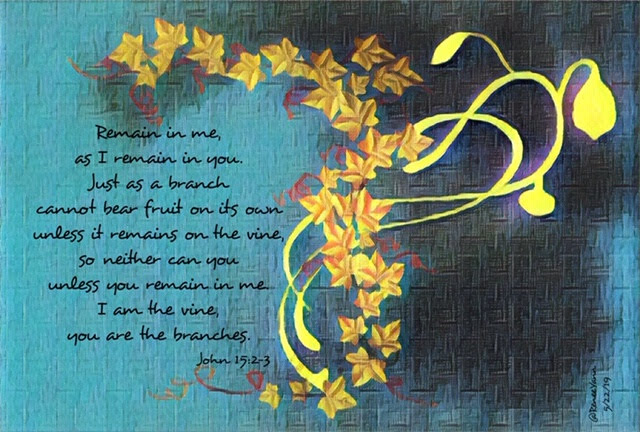
Jesus said to his disciples: “I am the true vine, and my Father is the vine grower. He takes away every branch in me that does not bear fruit, and everyone that does he prunes so that it bears more fruit. You are already pruned because of the word that I spoke to you.
John 15: 1-3
God’s Word touches us through scripture, through spiritual teaching, and through our reverent assimilation of our life experiences. We must listen to our lives to hear God’s Word. There is never a moment when God is not speaking to us in love – and often to a completely new understanding of what it means to be in covenant with God.
The Apostles finally come to the decision that one does not become a disciple by physical circumcision but rather by a grafting of one’s heart to God’s own heart. May we, the Church, learn from that openness for our own times. May we become more aware of those assumptions which cut off whole segments of humanity, relegating them to the ecclesiastical sidelines.
I am the vine, you are the branches. Whoever remains in me and I in him will bear much fruit, because without me you can do nothing…
If you remain in me and my words remain in you, ask for whatever you want and it will be done for you. By this is my Father glorified, that you bear much fruit and become my disciples.”
John 15: 5;7-8
Poetry: I Am the Vine – Malcolm Guite
How might it feel to be part of the vine? Not just to see the vineyard from afar Or even pluck the clusters, press the wine, But to be grafted in, to feel the stir Of inward sap that rises from our root, Himself deep planted in the ground of Love, To feel a leaf unfold a tender shoot, As tendrils curled unfurl, as branches give A little to the swelling of the grape, In gradual perfection, round and full, To bear within oneself the joy and hope Of God’s good vintage, till it’s ripe and whole. What might it mean to bide and to abide In such rich love as makes the poor heart glad?
Today, in God’s Lavish Mercy, the stone-throwers finally get to Paul, but their acted-out fear is ineffective:
In those days, some Jews from Antioch and Iconium arrived and won over the crowds. They stoned Paul and dragged him out of the city, supposing that he was dead. But when the disciples gathered around him, he got up and entered the city. On the following day he left with Barnabas for Derbe.
Acts 14:19-20
Paul is amazingly resilient. He just got the stuffing beaten out of him to the point of appearing DOA, but he departs on a preaching pilgrimage the very next day! So what’s the story?
I think it is unlikely that Paul just “got up and entered the city'” after the vicious assault upon him.
The supernatural presence of the Holy Spirit permeated that little Lycaonian alleyway. Note the “disciples gathered around him“. Imagine a reiki-like power eminating from these ardent believers. Visualize that power drawing Paul back to his full self in the Name of Jesus Christ.
We believers today are not unlike those gathered disciples. I’ll bet every one of us, after some devasting blow to our spirit, has had our heart put back by someone who loved and believed in us.
And I hope that every one of us has been that person who gathers with the fallen, failed, and frustrated to lift and remind them of Love’s Promise to those who believe.
That’s the kind of community Jesus wants us to be, drawing our strength for it from his awesome promise in today’s Gospel:
“Peace I leave with you; my peace I give to you. Not as the world gives do I give it to you. Do not let your hearts be troubled or afraid. You heard me tell you, ‘I am going away and I will come back to you.’
John 14:27-28
Jesus faced a very dismal future as he finished these consoling words at the Last Supper. Judas had already gone out to pursue his dark agenda. Jesus knew what would come next:
And now I have told you this before it happens, so that when it happens you may believe. I will no longer speak much with you, for the ruler of the world is coming. He has no power over me, but the world must know that I love the Father and that I do just as the Father has commanded me.”
John 14:29-31
We will face our own Gethsemane’s as we try to live and to share Gospel Truth. Sometimes, our lights will dim from both internal and external shadows. But Jesus has anointed us with his profound assurance that God, Creator-Redeemer-Spirit, hovers over us in eternal rekindling.
Poetry: The Peace of Wild Things – Wendell Berry
When despair for the world grows in me
and I wake in the night at the least sound
in fear of what my life and my children’s lives may be,
I go and lie down where the wood drake
rests in his beauty on the water, and the great heron feeds.
I come into the peace of wild things
who do not tax their lives with forethought
of grief. I come into the presence of still water.
And I feel above me the day-blind stars
waiting with their light. For a time
I rest in the grace of the world, and am free.
Today, in God’s Lavish Mercy, Paul and Barnabas get into a bit of a pickle – actually two pickles.
1- The passage from Acts opens with a planned attempt on their lives:
There was an attempt in Iconium by both the Gentiles and the Jews, together with their leaders, to attack and stone Paul and Barnabas.
Acts 14:5
2- They escape that attempt and flee to Lycaonia where the residents, rather than stoning them, want to idolize them:
When the crowds saw what Paul had done, they cried out in Lycaonian, “The gods have come down to us in human form.” They called Barnabas “Zeus” and Paul “Hermes,” because he was the chief speaker. And the priest of Zeus, whose temple was at the entrance to the city, brought oxen and garlands to the gates, for he together with the people intended to offer sacrifice.
Acts 14: 11-13
In both these situations, the listeners cannot accept the good news being preached to them – One Living God who indwells them and all Creation:
We proclaim to you good news that you should turn from these idols to the living God, who made heaven and earth and sea and all that is in them.
Acts 14:15
In our Gospel, Jude asks Jesus about this. He wants to know why he has received the gift of faith and others haven’t:
Jesus said to his disciples: “”Whoever has my commandments and observes them is the one who loves me. Whoever loves me will be loved by my Father, and I will love him and reveal myself to him.”” Judas, not the Iscariot, said to him, “”Master, then what happened that you will reveal yourself to us and not to the world?””
John 14:21-22
Jesus tells Jude that it’s pretty simple. You have to love God and do God’s work. If you don’t, no deal:
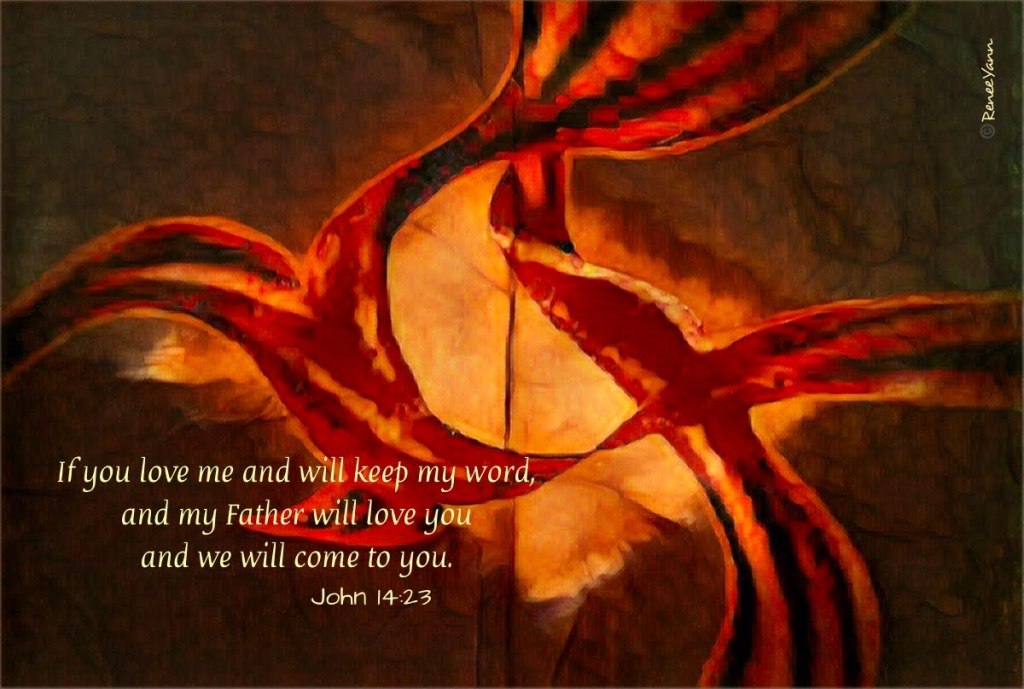
Jesus answered and said to him, “”Whoever loves me will keep my word, and my Father will love him, and we will come to him and make our dwelling with him. Whoever does not love me does not keep my words; yet the word you hear is not mine but that of the Father who sent me.
John 14:23-24
In Acts, the two resistant crowds resort to stones as means to reject the invitation to a Gospel life.
The gang from Iconium would use stones to kill the bearers of the Word.
The Lystra crowd wants to “idolize” Paul and Barnabas, a word which means “to convert to an image”, like a stone statue.
When we try to kill or to idolize something or someone, we distance ourselves from it. We make it “other”, unlike us, unattainable to relationship.
Jesus is real, not stone. He wants to live in us, not be enshrined.
The Gospel is real and needs to be expressed in our real lives – in our actions, choices and relationships.
We must look deep into ourselves for even the smallest place where we kill or petrify the Infinite Love that calls us to become Real within It’s Heart.
Prose: ― Margery Williams Bianco, The Velveteen Rabbit
“Real isn’t how you are made,’ said the Skin Horse. ‘It’s a thing that happens to you. When a child loves you for a long, long time, not just to play with, but REALLY loves you, then you become Real.’
‘Does it hurt?’ asked the Rabbit.
‘Sometimes,’ said the Skin Horse, for he was always truthful. ‘When you are Real you don’t mind being hurt.’
‘Does it happen all at once, like being wound up,’ he asked, ‘or bit by bit?’
‘It doesn’t happen all at once,’ said the Skin Horse. ‘You become. It takes a long time. That’s why it doesn’t happen often to people who break easily, or have sharp edges, or who have to be carefully kept. Generally, by the time you are Real, most of your hair has been loved off, and your eyes drop out and you get loose in the joints and very shabby. But these things don’t matter at all, because once you are Real you can’t be ugly, except to people who don’t understand.”
Music:What Is Real – adapted by Glyn Lehman form The Velveteen Rabbit by Margery Williams
Velveteen Rabbit What is real? What is real? And how does it feel? Does it happen all at once? Does it happen all at once, or bit by bit? What is real? What is real?
Skin Horse Real is when somebody cares And you feel alive for the very first time It won’t happen at once You will slowly become You will see yourself through their eyes See yourself through their eyes
Velveteen Rabbit What is real? What is real? And how does it feel? Does it hurt a little bit? Does it hurt a little bit to make that change? To be real To be real
Skin Horse Real is when somebody cares And you feel alive for the very first time Sometimes real can hurt But you really won’t mind If that’s what it takes to be real What it takes to be real
It’s like magic when you are loved Though you are worn, your seams are torn There’s a glow inside That is real
Today, in God’s Lavish Mercy, and as we come closer to the end of the Easter season, our Sunday readings repeat essential themes which invite us to the Beloved Community:
In Acts, the nascent Christian community grows, organizes, reflects and preaches the Good News.
In John’s Gospel, Jesus reiterates his enduring presence and love for all who live in his Word.
In his letter, Peter calls the growing community to recognize themselves as God’s dwelling place whose foundation has been secured in Christ.
This Sunday’s readings invite us, for the sake of the whole Church, to draw power for our Christian lives today:
They ask us to reflect on the experience of the early Church and to learn from the way these Christians grew in their understanding of faith and discipleship.
As the number of disciples continued to grow… the Twelve called together the community of the disciples…. The proposal was acceptable to the whole community… The word of God continued to spread, and the number of the disciples in Jerusalem increased greatly
Acts 6
They ask us to respond to the timeless call to be God’s Presence in the world.
Come to him, a living stone, rejected by human beings but chosen and precious in the sight of God, and, like living stones, let yourselves be built into a spiritual house… acceptable to God through Jesus Christ.
1 Peter 2:4-5
They assure us that Jesus indwells and blesses our faithful commitment to this call.
Do not let your hearts be troubled. You have faith in God; have faith also in me. In my Father’s house there are many dwelling places…
Amen, amen, I say to you, whoever believes in me will do the works that I do, and will do greater ones than these, because I am going to the Father.
John 14:1-2;12
Let’s face it, we live a long way in time from that bubbling little faith community described in Acts. Peter’s and Jesus’ encouragement have to echo down two thousand years to reach us! It’s not easy to stay plugged in to the dynamic power offered in today’s readings. How do we do that?
We have these amazing gifts to draw on:
the capacity to pray
the indwelling of the Holy Spirit resident in our souls
the blessing of a sacramental life
the living Word of the scriptures
the rich legacy of spiritual writings stored up through history
the current library of spiritual and theological literature
the sacred gifts of poetry, music and art
the beauty of God’s Creation in nature
the witness of our surrounding faith communities both living and dead
How unfortunate if we fail to recognize these gifts, given as means to open our hearts to our shared call to holiness!
Poetry: Mysteries, Yes – Mary Oliver
Truly, we live with mysteries too marvelous
to be understood.
How grass can be nourishing in the
mouths of the lambs.
How rivers and stones are forever
in allegiance with gravity
while we ourselves dream of rising.
How two hands touch and the bonds will
never be broken.
How people come, from delight or the
scars of damage,
to the comfort of a poem.

Let me keep my distance, always, from those
who think they have the answers.

Let me keep company always with those who say
“Look!” and laugh in astonishment,
and bow their heads.










 Lavish Mercy