I will heal their defection, says the LORD, I will love them freely; for my wrath is turned away from them. I will be like the dew for Israel: he shall blossom like the lily; He shall strike root like the Lebanon cedar, and put forth his shoots. His splendor shall be like the olive tree and his fragrance like the Lebanon cedar. Again they shall dwell in his shade and raise grain; They shall blossom like the vine, and his fame shall be like the wine of Lebanon. Hosea 14:5-8
Hosea describes God’s love for Israel – and for us – in tender, lavish images. We can picture the droughty land longing for refreshment the way a human heart longs for ease in suffering. God promises Israel a turn toward new life, fresh hope, the rooted security of covenantal relationship.
Today, in God’s Lavish Mercy: God promises the same to us, pouring the dew of Lavish Mercy over our longing spirits. Our part is to open our hearts to that promise, to wait, and to receive.
Poetry: Inversnaid by Gerard Manley Hopkins
This darksome burn, horseback brown, His rollrock highroad roaring down, In coop and in comb the fleece of his foam Flutes and low to the lake falls home.
A windpuff-bonnet of fáwn-fróth Turns and twindles over the broth Of a pool so pitchblack, féll-frówning, It rounds and rounds Despair to drowning.
Degged with dew, dappled with dew Are the groins of the braes that the brook treads through, Wiry heathpacks, flitches of fern, And the beadbonny ash that sits over the burn.
What would the world be, once bereft Of wet and of wildness? Let them be left, O let them be left, wildness and wet; Long live the weeds and the wilderness yet.
Wednesday of the Fourteenth Week in Ordinary Time July 10, 2024
Jesus sent out these Twelve after instructing them thus, “Do not go into pagan territory or enter a Samaritan town. Go rather to the lost sheep of the house of Israel. As you go, make this proclamation: ‘The Kingdom of heaven is at hand.’” Matthew 10: 5-7
In this passage, Jesus is concerned with those who were offered faith in One God but have lost touch with it — “lost sheep of the house of Israel”. He wants these lost believers to be given the message, “The Kingdom of heaven is at hand.”
While the message conveys a sense of urgency (Hurry up and get your act together), it also offers a calming security. When something is “at hand”, we can touch it. We can hold on to it for balance. We can feel support and accompaniment as we we hold hands with a Loving Presence.
Today, in God’s Lavish Mercy: We may hear Jesus’s words either as a warning or an invitation to intimacy. Love is at hand for us, even if our faith has become distracted and our direction “lost”. We are invited to reach out to the God Who waits for us.
Poetry:
“The Beloved is with you in the midst of your seeking! God holds your hand wherever you wander.
Rumi
Music: Hold to God’s Unchanging Hand – Jennie Bain Wilson (1857) Sung here by Lynda Randle
Time is filled with swift transition, Naught of earth unmoved can stand, Build your hopes on things eternal, Hold to God’s unchanging hand. Refrain: Hold to God’s unchanging hand, Hold to God’s unchanging hand; Build your hopes on things eternal, Hold to God’s unchanging hand.
Trust in Him who will not leave you, Whatsoever years may bring, If by earthly friends forsaken Still more closely to Him cling.
When your journey is completed, If to God you have been true, Fair and bright the home in glory Your enraptured soul will view.
The disciples of John approached Jesus and said, “Why do we and the Pharisees fast much, but your disciples do not fast?” Jesus answered them, “Can the wedding guests mourn as long as the bridegroom is with them? The days will come when the bridegroom is taken away from them, and then they will fast. No one patches an old cloak with a piece of unshrunken cloth, for its fullness pulls away from the cloak and the tear gets worse. People do not put new wine into old wineskins. Otherwise the skins burst, the wine spills out, and the skins are ruined. Rather, they pour new wine into fresh wineskins, and both are preserved.” Matthew 9:14-17
Jesus tells the Baptist’s questioning disciples that his is a new world. The confines of the Old Law will no longer contain the new grace of the Paschal Mystery and the Gospel.
Old wineskins become brittle with overuse. The analogy is applicable to many realities in life. Often, as time passes, we pay less attention to some important things or people. We may take them for granted, over-depend on their effectiveness, fail to effectively communicate, surrender to that famous “contemptuous familiarity”.
Today, in God’s Lavish Mercy: Immobilizing constriction can affect our faith too. Jesus encourages us to keep faith “fresh” by prayer, communal reflection, and practice. Neither our personal nor our communal faith is static. Grace offers us the invitation to become ever deeper in our understanding of God. The current Synodal process within the Catholic Church is a wonderful example of openness to fresh, new “wineskins” for our faith.
Poetry: Wine Skins – Evelyn McNulta This is a simple poem with devout sentiments, but what struck me most about it is where I found it – in a public newspaper, The Atlanta Chronicle. The poem reminded me of a poet some of my older local readers might remember – James Metcalfe. His “Daily Poem Portraits” were published in The Philadelphia Evening Bulletin during the 1950s. They were a great favorite of my Dad.
My hands are uplifted in homage to Him, They're not empty. They hold loosely those sins that cause separation of His spirit and mine.
Dear Father, take them and fill me with new wine. The wine skins of my life are brittle and hard, They can't hold your new wine because they are marred. Please replace them with supple new skins
That can be distended again and again. These wine skins are vessels that hold Your concerns, Help me remember the things I have learned. The more I am emptied of selfish desires,
The more You can cleanse me with Your cleansing fire. You'll burn away malice, ill-temper and greed, And open my eyes to Your people in need. You'll put unforgiveness also in Your fire,
And fill my heart with the burning desire To worship, to honor, to praise Your dear name. Your new wine remakes hearts, they're never the same. Take mine, Holy Father, change what you will,
I'm nothing without You, I need You to fill Each crevice, and corner and nook of my heart. There's much to be changed, I'm asking, please start.
So the other disciples said to him, “We have seen the Lord.” But Thomas said to them, “Unless I see the mark of the nails in his hands and put my finger into the nailmarks and put my hand into his side, I will not believe.” John 20:25
There’s that tiny word for which, despite a magnanimously holy life, Thomas remains famous:
Unless …
At that particular moment in his life, Thomas’s faith was conditional. He would not believe Jesus was alive unless he saw and touched him.
I doubt that Thomas was alone in his “conditionality”. The faith of many of those scared disciples was probably a bit shaky. Thomas was just more forthcoming in his doubts and hadn’t, like some of them, already seen the Risen Lord.
Today, in God’s Lavish Mercy:
We all know what it’s like to have doubts – about big things, like our faith, and about little things like our appearance. It feels like we’re being dropped into a safety net that might have a hole in it. Will it hold, or will it fall through? And what happens to us in either case!
Decades ago, when I taught eighth grade, one of my brightest students asked me this: “Sister, you’ve dedicated your whole life for the faith. What if, in the end, there is no God or heaven?”
I’m not going to tell you my answer. I’m going to suggest that you consider what your own answer would be. Is your faith conditional or unconditional?
Poetry: St. Thomas the Apostle – Bishop Edward Henry Bickersteth (1825-1906)
The Paschal feast was ended. Multitudes, Unweeting what was done, that day had left The gates of Zion for their far-off homes; And there was silence, where but yesterday Had been the hum of thousands. Olivet Slept calmly underneath the waning moon, And darkening shadows fell across the steeps And hollows of Jerusalem. Deep night Had drench'd the eyes of thousands. But, behold, Within the upper room where Jesus broke The bread of life, and pour'd the mystic wine The night before He suffer'd, once again The little band of those who loved Him most Were gather'd. On the morrow morn they thought To leave the holy city, holier now Than ever in their eyes, and go to meet Their Lord upon the Galilean hill.
All bosoms swell'd with gladness, all save one; One heart amid that group of light and love Was desolate and dark: nine weary days Of doubt, which shadow'd all eternity, Had written years of suffering on his brow. The worst he fear'd to him was realized, Life quench'd, for ever quench'd, and death supreme. Jesus was dead. And vainly others told, How they had seen and heard their risen Lord; Himself had seen the lifeless body hang Upon the cross; and, till he saw like them And like them touch'd the prints in hands and side, He would not, for he could not, hope again.
But there has been enough of sorrow now For that true mourner, sorely tried but true: And as they communed of an absent Lord Jesus was there, though doors were shut and barr'd, There in the midst of them; and from His lips, Who is Himself our Peace, the words of peace Fell as of old like dew on every heart, But surely sweetest, calmest, tenderest On one most torn and tost. The waves were still; Day broke; the shadows fled: nor this alone, Love offer'd all which bitterest grief had ask'd, And laying bare the inly bleeding wound Heal'd it, which haply else had bled afresh In after years, till faith adoring claim'd In One, whom sense no longer sought to touch, The Lord of life, the everlasting God.
O Master, though our eyes have never look'd Upon Thy blessèd face and glorious form, Grant us to trust Thee with a perfect trust, And love Thee and rejoice in Thee unseen, And prove the heaven of Thy beatitude On those who, though they see Thee not, believe.
Music: When I Survey The Wondrous Cross – Keith & Kristyn Getty
A scribe approached and said to him, “Teacher, I will follow you wherever you go.” Jesus answered him, “Foxes have dens and birds of the sky have nests, but the Son of Man has nowhere to rest his head.” Another of his disciples said to him, “Lord, let me go first and bury my father.” But Jesus answered him, “Follow me, and let the dead bury their dead.” Matthew 8: 19-22
The scribe. What was Jesus driving home to this learned interpreter of the Law who now bursts with enthusiasm for discipleship? Perhaps Jesus looked up to a small nest in a nearby tree. Maybe he pointed to it and told the scribe, ” You have to spread your wings and fly with God if you follow me!”
Basically, I think Jesus is saying this:
Think about it. It’s a way very different from your present comfortable life.
We are itinerant preachers, going out to the whole world. We are not intrenched in the Law, commanding people to come to us.
Even the core responsibilities to which you are devoted will be secondary to your Gospel ministry.
The whole foundation of your life will be turned upside-down.
Today, in God’s Lavish Mercy:
We want to serve God by living the Gospel with a steadfast and enthusiastic heart. We pray for the grace and courage to do so, understanding clearly where our first responsibilities lie as a committed Christian.
Prose from: The Wisdom of the Carpenter by Ron Miller
Jesus walked the earth as a homeless vagrant and identified his disciples by their concern for the most marginalized people in the community. It’s such a simple criterion and yet one so easily forgotten. Daily Prayer: Help me to be especially attentive to You today in those who have so little of the world’s wealth.
Music: He Had Not Where To Lay His Head Score: Alison Willis Text:Frances Ellen Watkins Harper (1825 – 1911)
Everyone who listens to these words of mine and acts on them will be like a wise man who built his house on rock. The rain fell, the floods came, and the winds blew and buffeted the house. But it did not collapse; it had been set solidly on rock. Matthew 7:24-25
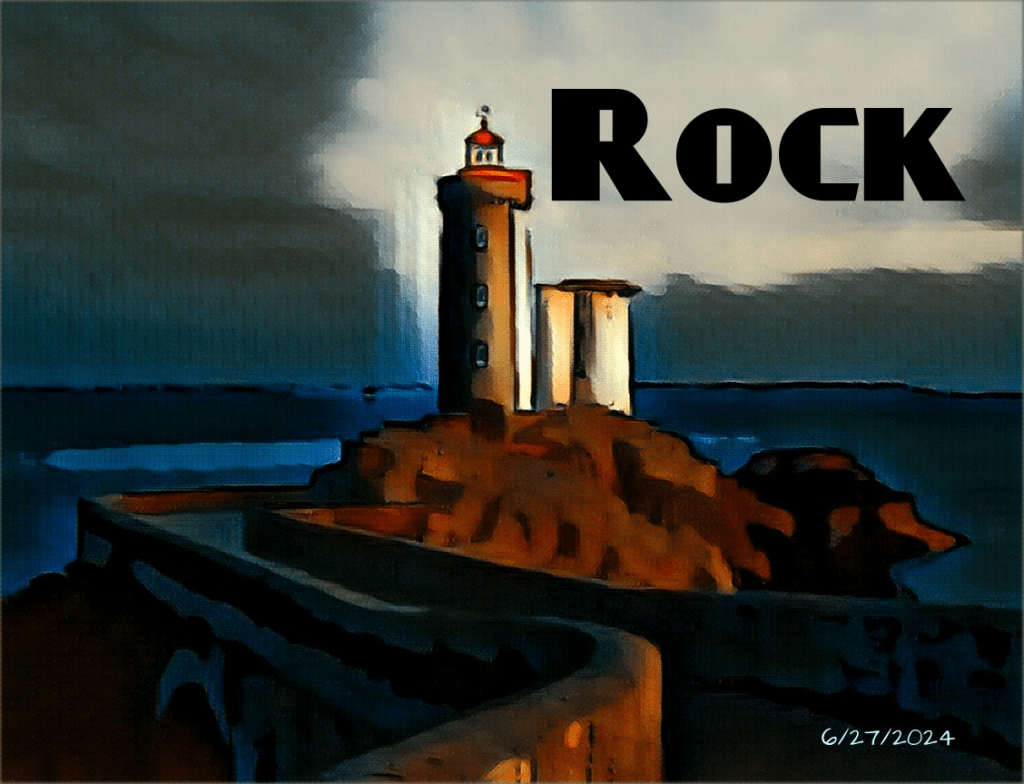
When the storm comes, who doesn’t want their house to be built on rock – steady, constant, imperturbable ROCK! But take a good look at the picture above. How hard do you think it was for the builders to:
penetrate that rock for a new foundation
transport and maintain building materials on to that precipice
Jesus recognizes that such commitment is not easy, but the rewards are incomparable. He teaches the people that empty proclamations will not sustain a spiritual life. Such stability is achieved only by committed “building” – by opening ourselves to God’s word and acting on it.
Today, in God’s Lavish Mercy:
We pray for the courage and vision to sincerely engage God’s word by our actions for mercy and justice.
Poetry: Psalm 18 – interpreted by Christine Robinson
I open my heart to you, O God for you are my strength, my fortress, the rock on whom I build my life. I have been lost in my fears and my angers caught up in falseness, fearful, and furious I cried to you in my anguish. You have brought me to an open space. You saved me because you took delight in me.
I try to be good, to be just, to be generous to walk in your ways. I fail, but you are my lamp. You make my darkness bright With your help, I continue to scale the walls and break down the barriers that fragment me. I would be whole, and happy, and wise and know your love Always.
Music: O Lord, My Rock and My Redeemer – Prayers of the Saints Alive
The just one shall flourish like the palm tree, like a cedar of Lebanon shall they grow. They that are planted in the house of the LORD shall flourish in the courts of our God. Psalm 92:13-14
This verse from Psalm 92 ties together all our readings for today.
In the passage from Exodus, God takes a tiny twig, protects and nourishes it, and it flourishes. The analogy describes God’s relationship with Israel and with us. We are called to flourish in the Kingdom of God.
In Corinthians, Paul expresses the conviction that we will receive our recompense according to how we flourish in response to God’s grace.
And in our Gospel, Jesus teaches that our faith – God’s gift to us – is the small seed that flourishes into eternal life, the fullness of life in God.
Today, in God’s Lavish Mercy:
We realize that each of these flourishings begins with a tiny hope – a twig, a courageous aspiration, a mustard seed.
Such is life. It is the small but consistent acts of faith, hope, and love that eventually yield abundant harvest. – embracing us with all Creation in God’s complete Love.
Poetry: Mustard Seed – Meister Eckhart
I.
In the Beginning High above understanding Is ever the Word. O rich treasure, There the Beginning always bore the Beginning. O Father’s Breast, From thy delight The Word ever flows! Yet the bosom Retains the Word, truly.
II.
From the two as one source, The fire of love. The bond of both, Known to both, Flows the All-Sweet Spirit Co-equal, Undivided The Three are One. Do you understand why? No. It best understands itself.
III.
The bond of three Causes deep fear. Of this circle There is no understanding. Here is a depth without ground. Check and mate To time, forms, place! The wondrous circle Is the Principle, Its point never moves.
IV.
The mountain of this point Ascend without activity. O intellect! The road leads you Into a marvelous desert, So broad, so wide, It stretches out immeasurably. The desert has, Neither time nor place, Its mode of being is singular.
V.
The good desert No foot disturbs it, Created being Never enters there: It is, and no one knows why.
It is here, it is there, It is far, it is near, It is deep, it is high, It is in such a way That it is neither this nor that.
VI.
It is light, it is clear, It is totally dark, It is unnamed, It is unknown, Free of beginning or end. It stands still, Pure, unclothed. Who knows its dwelling? Let him come forth And tells us what sort it is.
VII.
Become like a child, Become deaf, become blind. Your own something Must become nothing; Drive away all something, all nothing! Leave place, leave time, Avoid even image! Go without a way On the narrow path, Then you will find the desert’s track.
VIII.
O my soul, Go out, let God in! Sink all my something In God’s nothing. Sink in the bottomless flood! If I flee from You, You come to me. If I lose myself, Then I find You, O Goodness above being!
Music: The Ride of the Valkyries – Richard Wagner
I love to listen to this masterpiece when I imagine God opening heaven to all Creation at the end of time.
You are the light of the world. A city set on a mountain cannot be hidden. Nor do they light a lamp and then put it under a bushel basket; it is set on a lampstand, where it gives light to all in the house. Just so, your light must shine before others, that they may see your good deeds and glorify your heavenly Father. Matthew 5:14-16
Jesus tells us to let our light shine before others. Is this an invitation to show off or be prideful? Definitely not. It is a call to shine with “beatitudenal goodness” that gives glory to God.
We can take Jesus’s words as an invitation to spiritual transparency. We should, by our actions and choices, proclaim that we live in faith, hope, charity, and gratitude. The important part of the lampstand is the flame that it lifts up. So too with us – the important part of our faith is the witness it gives to the Gospel.
Today, in God’s Lavish Mercy:
We pray for the simplicity and integrity of soul that allows God to shine through us.
Poetry: Let Your Light Shine – Marianne Williamson
Our deepest fear is not that we are inadequate. Our deepest fear is that we are powerful beyond measure. It is our light, not our darkness, that most frightens us. We ask ourselves, who am I to be brilliant, gorgeous, talented, fabulous? Actually, who are you not to be? You are a child of God. Your playing small does not serve the world. There is nothing enlightened about shrinking so that other people won’t feel insecure around you. We were born to make manifest the glory of God that is within us. It is not just in some of us, it is in everyone. And as we let our own light shine, we unconsciously give other people permission to do the same. As we are liberated from our own fear, our presence automatically liberates others.
Music: We Are the Light of the World – Jean A. Greif
While they were eating, Jesus took bread, said the blessing, broke it, gave it to them, and said, “Take it; this is my body.” Then he took a cup, gave thanks, and gave it to them, and they all drank from it. He said to them, “This is my blood of the covenant, which will be shed for you. Mark 14: 22-24
Prose: Pierre Teilhard de Chardin – ‘The Priest’, in Writings in Time of War
Your life is so much stronger than ours that it dominates us, absorbs us, and assimilates us to itself…. Although I might have imagined that it was I who held the consecrated Bread and gave myself its nourishment, I now see with blinding clarity that it is the Bread that takes hold of me and draws me to itself.
Music: Ave Verum Corpus – attributed to Pope Innocent (13th century); set to music by Wolfgang Amadeus Mozart (18th century); performed here by The Romanian Foundation for Excellence in Music
Ave verum corpus, natum de Maria Virgine, vere passum, immolatum in cruce pro homine cuius latus perforatum fluxit aqua et sanguine: esto nobis praegustatum in mortis examine.
[O Iesu dulcis, O Iesu pie, O Iesu, fili Mariae. Miserere mei. Amen]
Hail, true Body, born of the Virgin Mary, having truly suffered, sacrificed on the cross for mankind, from whose pierced side water and blood flowed: Be for us a sweet foretaste in the trial of death!
[O sweet Jesus, O holy Jesus, O Jesus, son of Mary, have mercy on me. Amen.]
As Jesus was leaving Jericho with his disciples and a sizable crowd, Bartimaeus, a blind man, the son of Timaeus, sat by the roadside begging. On hearing that it was Jesus of Nazareth, he began to cry out and say, “Jesus, son of David, have pity on me.” Jesus stopped and said, “Call him.”
Bartimaeus threw aside his cloak, sprang up, and came to Jesus. Jesus said to him in reply, “What do you want me to do for you?” The blind man replied to him, “Master, I want to see.” Jesus told him, “Go your way; your faith has saved you.”
Bartimaeus wants to be healed. He wants to see. But Jesus tells him that he is not healed by his desire, or his begging, or his good fortune in running into Jesus. Bartimaeus is healed by his faith because that faith draws forth from Jesus the Divine Power which transforms.
Today, in God’s Lavish Mercy:
We can be blind in many ways.
Often we can’t see what’s right in front of us.
We can’t see why others may think differently from us
We can’t see the underlying reasons for our circumstances.
We can’t see the path to wholeness that may be obvious to others.
We can’t see the suffering world around us
We can’t see the invisible support that others give us, perhaps over our lifetime.
We can’t see the abiding presence of God in our lives
Like Bartimaeus may we call out to Jesus in faith so that he will be moved to help us SEE all that may bring us closer to the Divine Heart.
Poetry: Bartimaeus – John Newton
John Newton was an English Anglican clergyman, abolitionist, and hymn writer. He is best known as the author of the hymn “Amazing Grace,” one of the most beloved and widely sung hymns in the English language. Newton’s life was marked by a dramatic conversion experience, after which he abandoned his career in the slave trade and became an outspoken advocate for the abolition of slavery.
Mercy, O thou Son of David! Thus blind Bartimaeus prayed; Others by thy word are saved, Now to me afford thine aid: Many for his crying chid him, But he called the louder still; Till the gracious Saviour bid him Come, and ask me what you will.
Money was not what he wanted, Though by begging used to live; But he asked, and Jesus granted Alms, which none but he could give: Lord remove this grievous blindness, Let my eyes behold the day; Strait he saw, and won by kindness, Followed Jesus in the way.
O! methinks I hear him praising, Publishing to all around; Friends, is not my case amazing? What a Saviour I have found: O! that all the blind but knew him, And would be advised by me! Surely, would they hasten to him, He would cause them all to see.