Moses spoke to the people, saying: “This day the LORD, your God, commands you to observe these statutes and decrees. Be careful, then, to observe them with all your heart and with all your soul.
Deuteronomy 26:16
… you are to be a people peculiarly God’s own, as promised you; and provided you keep all his commandments,
Deuteronomy 26:18
… and you will be a people sacred to the LORD, your God, as he promised.”
Deuteronomy 26:19
Be perfect, just as your heavenly Father is perfect.
Matthew 5:48
In our readings today, God calls us to BE in the fullness of grace. For the people of the Old Testament, that path was found in the Law and Commandments. For Christians, that fullness is found in patterning our lives on Jesus. He showed us that God’s perfection is beyond Law. It is absolute Love and Mercy.
Today, in God’s Lavish Mercy:
In our prayer, we might ask for a deeper understanding of the “perfection” God asks of us – not a measurable, demonstrable alignment with subjective guidelines, but an unlimited openness to grace. God’s perfection is a Love without boundaries. Jesus is that Love made Flesh. In God, we are called to live in their example.
Poetry: Easy to Love a Perfect God – Shams-i of Tabrizi
Shams-i Tabrīzī (1185–1248) was a Persian poet who is credited as the spiritual instructor of Rumi and is referenced with great reverence in Rumi’s poetic collection. The tomb of Shams-i Tabrīzī was recently nominated to be a UNESCO World Heritage Site.
It’s easy to love a perfect God,
unblemished and infallible that God is.
What is far more difficult
is to love fellow human beings
with all their imperfections and defects.
Remember, only you can know
what you are capable of loving.
There is no wisdom without love.
Unless we learn to love God’s creation,
we can neither truly love
nor truly know God.
Just as Jonah became a sign to the Ninevites, so will the Son of Man be to this generation. At the judgment the queen of the south will rise with the men of this generation and she will condemn them, because she came from the ends of the earth to hear the wisdom of Solomon, and there is something greater than Solomon here.
Luke 11: 30-31
Just like the Ninevites in Jonah’s time, we are called to turn our hearts fully to God. Throughout the Hebrew Scriptures, many prophets were sent with this message. But we have been given One greater than any of these prophets. Jesus is the ultimate Sign of God’s desire for our faith, love, and hope. We are called to live according to his Word.
Today, in God’s Lavish Mercy,
We might ask ourselves how free we are of the need to demand signs from God. When we live in deep relationship with another person, we trust their good will and loving intention toward us. We don’t have to ask them every five minutes if they still love us. We don’t have to pick apart their actions to test their intentions. We trust that they want only the best for us. How much more we can trust God who sent God’s own Beloved Son to redeem us!
Music: Two hymns today.
Son of God – by Starfield
God’s Own Son, Most Holy – by Ryan Flanagan
Verse 1: (From Christian Worship: a Lutheran hymnal #17) God’s own son, most holy Came a servant lowly Came to live among us Came to suffer for us Bore the cross to save us Hope and freedom gave us
Verse 2: (From The 1982 Hymnal: Episcopal, #53) Still he comes within us Still his voice would win us From the sins that hurt us Would the truth convert us Not in torment hold us But in love enfold us
Chorus: (Derived from 4th verse Common Service Book Lutheran #10 and Lutheran Service Book ) Come, O come, Lord Jesus From our sins release us Let us here confess you God’s own Son
Verse 3 Thus, if we have known him Not ashamed to own him Nor have loved him coldly But will trust him boldly He will then receive us Heal us and forgive us
Chorus Come, O come, Lord Jesus From our sins release us Let us here confess you God’s own Son, most holy Keep our hearts believing That we, grace receiving Ever may confess you God’s own Son, most holy
Verse 4 (From: The Chorale Book for England #26, changed to new English first person plural) But through many a trial Deepest self denial Long and brave endurance Must we win assurance That his own he makes us And no more forsakes us
Thus says the LORD: If you remove from your midst oppression, false accusation and malicious speech; If you bestow your bread on the hungry and satisfy the afflicted; Then light shall rise for you in the darkness, and the gloom shall become for you like midday; Then the LORD will guide you always and give you plenty even on the parched land.
Isaiah 58:9-11
So many critical aspects of our lives hinge on the word “If”!
If not
If so
If only
If I had
If I hadn’t
If just
That critical “if” reminds us that all life is about relationship. It is about how we and the one with whom we are in relationship respond to each other. It is about choosing and deciding. And remember, as one of my early favorite theologians famous said:
Not to decide is to decide.
Harvey Cox in “On Not Leaving It To the Snake”
Today, in God’s Lavish Mercy:
We are in constant relationship with God Whose Breath is the source of our life. Our life should be an act of reverence for that gift, responding always to God’s hope for us. Isaiah puts some of those hopes into words for us today. In our prayer, we might hear God whisper special “ifs” to us as we open our life and heart before God’s love and mercy.
Poetry: If by Rudyard Kipling
I know this poem came to your mind as soon as you saw today’s picture – right? Well, here it is.
If you can keep your head when all about you
    Are losing theirs and blaming it on you,
If you can trust yourself when all men doubt you,
    But make allowance for their doubting too;
If you can wait and not be tired by waiting,
    Or being lied about, don’t deal in lies,
Or being hated, don’t give way to hating,
    And yet don’t look too good, nor talk too wise:
If you can dream—and not make dreams your master;
    If you can think—and not make thoughts your aim;
If you can meet with Triumph and Disaster
    And treat those two impostors just the same;
If you can bear to hear the truth you’ve spoken
    Twisted by knaves to make a trap for fools,
Or watch the things you gave your life to, broken,
    And stoop and build ’em up with worn-out tools:
If you can make one heap of all your winnings
    And risk it on one turn of pitch-and-toss,
And lose, and start again at your beginnings
    And never breathe a word about your loss;
If you can force your heart and nerve and sinew
    To serve your turn long after they are gone,
And so hold on when there is nothing in you
    Except the Will which says to them: ‘Hold on!’
If you can talk with crowds and keep your virtue,
    Or walk with Kings—nor lose the common touch,
If neither foes nor loving friends can hurt you,
    If all men count with you, but none too much;
If you can fill the unforgiving minute
   With sixty seconds’ worth of distance run,
Yours is the Earth and everything that’s in it,
    And—which is more—you’ll be a Man, my son!
 and you will be a Woman, precious one! (my addition, I think Rudyard would be grateful))
Today, in God’s Lavish Mercy, Lent is just a few days away. We will spend the intervening time in good company with insights from James, Peter and Mark. Today we begin the Epistle of James.
The Epistle of James- Chapter 1: Illustration provided to Wikimedia Commons by Distant Shores Media/Sweet Publishing as part of a cooperation project. Sweet Publishing released these images, which are taken from now-out-of-print Read’n Grow Picture Bible Illustrations (Biblical illustrations by Jim Padgett, courtesy of Sweet Publishing, Ft. Worth, TX, and Gospel Light, Ventura, CA. Copyright 1984.), under new license, CC-BY-SA 3.0
This letter is one of the very earliest of the New Testament. Scholars are mixed about exactly which “James” wrote it, but agree that it was one of several who were very close to Jesus – perhaps one of “the brothers of Jesus” mentioned in several New Testament passages:
Matthew 12:46-50
Mark 3:31
Luke 8:19
John 2:12
Acts 1:14
1 Corinthians 9:5
and specifically “the Lord’s brother James” in Galatians 1:19
James writes in the style of Wisdom Literature, those Old Testament books that give advice, proverbs, and insights for living a holy life. His immediate audience was a community of dispersed Christian Jews whose world was filled with increasing upheaval and persecution.
When I read the following description I thought how germane James’s letter could be for our world today. His themes echo the teachings of Pope Francis for our chaotic time:
The epistle is renowned for exhortions on fighting poverty and caring for the poor in practical ways (1:26–27; 2:1-4; 2:14-19; 5:1-6), standing up for the oppressed (2:1-4; 5:1-6) and not being “like the world” in the way one responds to evil in the world (1:26-27; 2:11; 3:13-18; 4:1-10). Worldly wisdom is rejected and people are exhorted to embrace heavenly wisdom, which includes peacemaking and pursuing righteousness and justice (3:13-18).
JIM REIHER, “VIOLENT LANGUAGE – A CLUE TO THE HISTORICAL OCCASION OF JAMES.”EVANGELICAL QUARTERLY. VOL. LXXXV NO. 3. JULY 2013
Here is the golden advice James gives us today:
Be joyful in trials.
Let trials increase your perseverance not discourage you.
Doing this is a sign of wisdom.
When your wisdom is depleted, ask God for more with an open and trusting heart.
Honor all people, high or low in circumstances
Don’t be fooled by riches. They fade away.
In our Gospel, Jesus is frustrated with the Pharisees who insincerely demand a magical sign from him. They demonstrate none of the spiritual wisdom and openness to grace that James describes.
When we think about our own faith, where does it fall on the scale of sincerity, on the spectrum joy, justice, and faithful perseverance?
Poetry: On Joy and Sorrow – Kahlil Gibran
Then a woman said, Speak to us of Joy and Sorrow.
And he answered:
Your joy is your sorrow unmasked.
And the selfsame well from which your laughter rises
was oftentimes filled with your tears.
And how else can it be?
The deeper that sorrow carves into your being,
the more joy you can contain.
Is not the cup that holds your wine
the very cup that was burned in the potter’s oven?
And is not the lute that soothes your spirit,
the very wood that was hollowed with knives?
When you are joyous, look deep into your heart
and you shall find it is only that which has given you sorrow
that is giving you joy.
When you are sorrowful look again in your heart,
and you shall see that in truth you are weeping for
that which has been your delight.
Some of you say, “Joy is greater than sorrow,”
and others say, “Nay, sorrow is the greater.”
But I say unto you, they are inseparable.
Together they come,
and when one sits alone with you at your board,
remember that the other is asleep upon your bed.
Verily you are suspended like scales
between your sorrow and your joy.
Only when you are empty
are you at standstill and balanced.
When the treasure-keeper lifts you
to weigh his gold and his silver,
needs must your joy or your sorrow rise or fall.
Today, in God’s Lavish Mercy, the Queen of Sheba visits Solomon. It’s another Solomon story worthy of the big screen where, in fact, it has been loosely fictionalized and adulterated many times.
Many trusted scripture scholars question the historicity of the story. Several agree that Solomon never rose to the kind of material glory described in the passage. The two books of Kings were written 500 years after Solomon lived. In many aspects, the writings offer a reflection on the meaning of his reign in Israel’s covenanted life rather than a strict account of his life.
So what might we glean from today’s passage on the mysterious queen. The story demonstrates that Solomon is so accomplished that a revered leader will come to learn from him. Once she arrives, she is overwhelmed by his material successes and strength. Solomon has constructed a dominant, rich and subservient culture.
But wait. Is there a bit of ironic judgement and, perhaps, prophetic reminder woven into the Queen’s accolades? Shifting the focus from an increasingly arrogant Solomon back to Israel’s God, she says:
Blessed be the LORD, your God, whom it has pleased to place you on the throne of Israel. In his enduring love for Israel, the LORD has made you king to carry out judgment and justice
1 Kings 10:9
In fact, the great wealth and power of Solomon’s kingdom was built, not on justice and judgement, but on the backs of the poor and excluded. For example, Walter Brueggemann says this:
(Solomon’s kingdom) … was an economy of extraction that regularly transferred wealth from subsistence farmers to the elite in Jerusalem, who lived off the surplus and the device and the strategy for that extraction was an exploitative tax system.
When the Biblical scribe puts the words judgment and justice into the Queen’s remarks, it may be intended to forecast the miserable end Solomon will meet because he has abandoned his responsibilities to care for all the people according the the Lord’s covenant.
This glorious, shining realm which so impressed the Queen is a kingdom built on corruption, greed, militarism, and manipulation of the poor.
The lessons for our world are obvious.
As Jesus tells us in today’s Gospel, it doesn’t matter whether we’re gilded in gold on the outside and spin our words in glorious promises. What matters are the true intentions of our hearts and the compassionate actions they inspire:
But what comes out of the person, that is what defiles him. From within, from the heart, come evil thoughts, unchastity, theft, murder, adultery, greed, malice, deceit, licentiousness, envy, blasphemy, arrogance, folly.
Mark 7:20-23
Ultimately, the great Solomon misses the boat on this. May his story help us not to do the same.
Poetry: The Queen of Sheba by Hadewijch English version by Mother Columba (Elizabeth) Hart, OSB Original Language Dutch
The Queen of Sheba
Came to Solomon;
That was in order to gain wisdom.
When she had found him, indeed,
His wonders streamed upon her so suddenly
That she melted in contemplation.
She gave him all,
And the gift robbed her
Of everything she had within --
In both heart and mind,
Nothing remained:
Everything was engulfed in love.
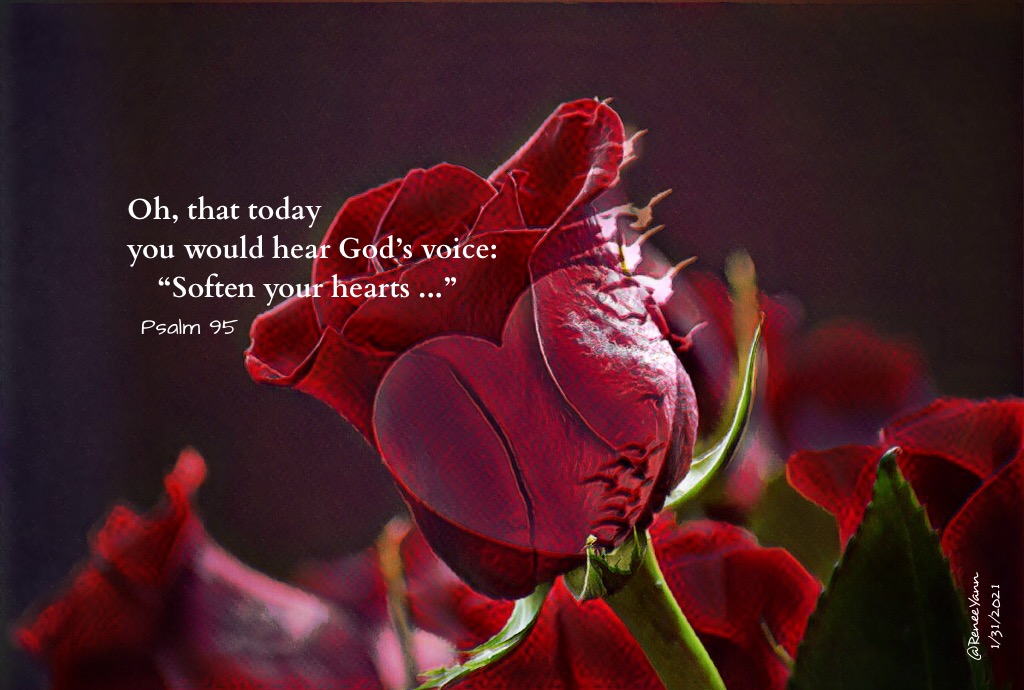
Today, in God’s Lavish Mercy, we pray with Psalm 95, once again a call to a holy tenderheartedness – that mix of love, discernment, and generosity that magnetizes us into dynamic relationship with God.
Oh, that today you would hear his voice: “Harden not your hearts as at Meribah, as in the day of Massah in the desert, Where your fathers tempted me; they tested me though they had seen my works.
Psalm 95: 7-9
Our other Sunday readings, which Psalm 95 anchors, clarify the reason we seek this tenderheartedness. It is so that we might not only hear, but really listen and respond to the Truth of God in our lives.
Those who will not listen to my words which a prophet speaks in my name, I myself will make them answer for it.
Deuteronomy 18:18
In our first reading from Deuteronomy, the people were confused. They were passing into a new land with lots of rivaling religions and spiritualities. Moses was nearing the end of his life and leadership over them. They wanted to know who to listen to and how to behave in order to stay in God’s favor.
God promises that God’s voice will come through a prophet like Moses:
I will raise up for them a prophet like you from among their kin, and will put my words into his mouth; he shall tell them all that I command him.
Deuteronomy 18:19
In our Gospel, we see Jesus – the fulfillment of the Deuteronomic Promise. The people witnessing his power are amazed. They struggle with whether they can believe in him when he seems just one of them, a Nazarene, Joseph’s son.
But some could believe – readily. Some, like the disciples, discerned quickly the Truth Jesus was. They heard, listened, believed and obeyed the Word.
Our psalm suggests that such readiness, such tenderheartedness comes from the consistent practice of relationship with God through praise, witness, thanksgiving, prayer, worship, humility, and obedience.
To me, it boils down to this:
let your life unfold in God’s Presence
be silent under God’s loving gaze
thank God for all you have been given
realize you are nothing without God
listen to your life as God speaks it to you
act on what you hear
Come, let us sing joyfully to the LORD;
    let us acclaim the rock of our salvation.
Let us come into God’s presence with thanksgiving;
    let us joyfully sing psalms to the Lord.
R. If today you hear God’s voice, harden not your hearts.
Come, let us bow down in worship;
    let us kneel before the LORD who made us.
For the Lord is our God,
    and we are the people God shepherds, the flock God guides.
Poetry: Rumi
I keep telling my heart,
“Go easy now.
I am submerged in golden treasure.”
It replies,
“Why should I be afraid of love?”
Today, in God’s Lavish Mercy, our readings say something about Divine Order, about Sacred Balance – and our ability to let go and trust.
Nathan Rebukes David – by James Tissot
In our first reading, the prophet Nathan confronts David regarding his relationship with Bathsheba. The beautiful Bathsheba was the wife of Uriah, an elite soldier in David’s army. From far away one day, David spies her bathing in a pool. Full of covetousness and lust, he engineers a heartless plot to have her as his own.
The story is complex, intriguing, and extremely dramatic. You can read it for yourself in 2 Samuel. But the point I would like to draw out for today is about covetousness. What is that, really, and does it play any part in my life?
“Covet” is an intransitive verb that we learned when we were taught the Ten Commandments. Like all the other sins, my six-year-old self decided I would try hard not to commit it … but I had no idea what it even meant! I was pretty sure I didn’t have to be worried about coveting my neighbor’s wife, but I did like Jimmy Clark’s bike enough to covet it. (But, I didn’t steal it.)
Honestly, I don’t think I’ve ever used the verb “covet” in a sentence before today. So I turned to Meriam-Webster who defines covetousness like this: to desire (what belongs to another) inordinately or culpably
Do we “covet” when we wish we had some of the great things others have? Material things like money, mansions, and limousines? Or immaterial things like talent, beauty, and popularity?
I don’t think so. We may have to deal with the concupiscence of jealousy or envy, but it’s not quite the same as coveting. As Merriam-Webster indicates, coveting implies an inordinance or culpability. In other words, we act on our jealousy or envy in some way, creating an imbalance in our moral life.
We resent, judge, or ostracize the person who has what we want.
We plot to take away the other’s prized possession or status.
We create a deficit in our own responsibilities by directing essential resources to our plot.
And what may be the worst and most likely situation, we use our power to indifferently usurp what belongs to others.
When I examine my conscience I remind myself that the world belongs to me, but it also belongs to others — all others. Peace, a decent level of sustenance, the goods of Creation, the right to life — these belong to me but also to others. I may not be aware of “coveting” these things to the detriment of others, but how do my choices and actions in any way limit that right for others?
It could be as simple as this:
Do I vote for leaders who continually foster negotiation over militaristic responses?
Do I support trade agreements that establish sustainable practices for producers as well as consumers?
Do I recognize that climate deterioration and refugee intensification are inextricably connected to abusive environmental practices and that I have a role in promoting change?
Do I have a single-issue or a holistic approach to life concerns for the unborn, impoverished, incarcerated, unhoused, immigrant, and medically needy populations?
When we find ourselves entangled in greed or covetousness, it’s not necessarily that we are bad people. We might be more like the disciples described in today’s Gospel – fearful people, so insecure that we amass material protections around us.
A violent squall came up and waves were breaking over the boat, so that it was already filling up. Jesus was in the stern, asleep on a cushion. They woke him and said to him, “Teacher, do you not care that we are perishing?” He woke up, rebuked the wind, and said to the sea, “Quiet! Be still!” The wind ceased and there was great calm. Then he asked them, “Why are you terrified? Do you not yet have faith?”
Mark 4: 37-40
Jesus calls us to live a life grounded in faith not material protections. Only faith is invulnerable to life’s storms. Within its eternal securities, we become more deeply aware of our sacred relationship to all creatures and to Creation Itself.
If David had exercised such faith, the taking of Bathsheba and murder of Uriah would have been incomprehensible to him. As we deepen in our faith, what awarenesses will awaken in us?
Quote: Wisdom from Ramana Maharshi (1879 – 1950) who is considered an Indian Hindu sage and “jivanmukta” (liberated being). He is regarded by many as an outstanding enlightened being and, as a charismatic person, attracted many devotees. I particularly value this quote which leads me to consider my oneness with all beings:
Questioner:How are we to treat others? Ramana Maharshi:There are no others.
Today, in God’s Lavish Mercy, each of our readings speaks to us of time.
The concept of time has always fascinated me. I remember being aware of the fascination as a very little girl walking beside my mother and aunt along the Wildwood boardwalk arcade.
Some of you who live locally may remember the spot, an extension of the seaside boardwalk at Oak Avenue. Its main attractions were bumper cars and a booth where little piglets ran along a path, picking a random door that, for a nickel, might earn you a stuffed animal.
On that particular summer day, about 1950, there was a new booth – Miranda, the Fortune Teller. Miranda read Tarot cards, an exercise Mom and Aunt Peg were unfamiliar with. Nevertheless, they decided to try it, and each went separately into the tiny veiled room to learn her future as I stood completely entranced by the piglet race.
Later, as the three of us sauntered side-by-side in the salted air, I heard Aunt Peg ask Mom, “Did she tell you how old you will be when you die?”. My ears leaped to attention! What? My mom could die???? And that lady knew when????
I heard my thirty-three year old mother answer, “She said when I am seventy-two.”
“Oh, God! How soon is that?”, I wondered. My little five-year-old mind tried to calculate the expanse of time but failed. However, the prediction planted itself inextricably in my heart.
Decades later, when Mom did pass away (just before her 72nd year) the memory returned to me. And the nearly forty years in between seemed compressed into an incomprehensible moment that had passed as quickly as that sweet seaside breeze.
How many times do we ask the Universe this unanswerable question, “Where did the time go?” It is a question that has a thousand answers and no answer, much like the question, “Who is God?”.
In our readings today, Jonah, Paul, and John the Baptist want us to think about time in relationship to God.
For Jonah, time is captured in the forty days of grace to seek repentance.
For Paul, time – in the worldly sense – is running out, requiring us to turn our attention to eternity.
For Jesus, it is the time of fulfillment – a fulfillment that can be achieved by living the Gospel.
Praying with today’s readings, we might ask ourselves, “What time is it for me?
Are there places in my life requiring “repentance“, a turning of my heart away from selfishness and toward the mercy of God?
Do I need to widen my perspective with a deeper awareness of eternal rather than worldly values?
Am I making a choice every day to live a life patterned on the Gospel?
Poetry: Endless Time – Rabindranath Tagore
Time is endless in thy hands, my lord.
There is none to count thy minutes.
Days and nights pass and ages bloom and fade like flowers.
Thou knowest how to wait.
Thy centuries follow each other perfecting a small wild flower.
We have no time to lose,
and having no time we must scramble for a chance.
We are too poor to be late.
And thus it is that time goes by
while I give it to every querulous person who claims it,
and thine altar is empty of all offerings to the last.
At the end of the day I hasten in fear lest thy gate be shut; but I find that yet, with you, there is always time.
Music: What’s It All About, Alfie? – written by Burt Bacharach, sung by Dionne Warwick this modern song seems to deal with the timeless questions.
What’s it all about Alfie Is it just for the moment we live
What’s it all about When you sort it out, Alfie Are we meant to take more than we give Or are we meant to be kind?
And if, if only fools are kind, Alfie Then I guess it is wise to be cruel And if life belongs only to the strong, Alfie What will you lend on an old golden rule?
As sure as I believe there’s a heaven above Alfie, I know there’s something much more Something even non-believers can believe in
I believe in love, Alfie Without true love we just exist, Alfie Until you find the love you’ve missed You’re nothing, Alfie
When you walk let your heart lead the way And you’ll find love any day Alfie, Alfie
Today, in God’s Lavish Mercy, our readings are laced together with a genealogy theme.
In our first reading, John describes our most fundamental and powerful lineage: we are children of God with the gift of eternal life.
And this is the testimony: God gave us eternal life, and this life is in his Son. Whoever possesses the Son has life; whoever does not possess the Son of God does not have life. I write these things to you so that you may know that you have eternal life, you who believe in the name of the Son of God.
1 John 5: 11-13
The Church offers alternative Gospels for reading today. One describes the Baptism of Jesus and one delineates his patriarchal lifeline.
Mark’s Gospel, which will most likely be read at Mass today, presents Jesus as the Son of God:
It happened in those days that Jesus came from Nazareth of Galilee and was baptized in the Jordan by John. On coming up out of the water he saw the heavens being torn open and the Spirit, like a dove, descending upon him. And a voice came from the heavens, “You are my beloved Son; with you I am well pleased.”
Mark 1: 9-11
Today’s alternative Gospel of Luke presents Jesus as the descendant of a long patriarchal line including Adam, David, and “as was thought” Joseph. It emphasizes Jesus’s place in the human family (In contrast to Matthew’s genealogy which emphasizes Jesus’s place in the Hebrew history.)
When Jesus began his ministry he was about thirty years of age. He was the son, as was thought, of Joseph, the son of Heli, the son of Matthat, the son of Levi, the son of Melchi, the son of Jannai, the son of Joseph, the son of Mattathias,……
Luke 3:23-38
What are we supposed to learn today from this impressive array of scriptures? This is where my prayer took me:
Jesus Christ, human and divine, took flesh to share eternal life with me through Baptism. Through him, I gain the sacred pedigree that reaches through time to God’s eternal womb.
Poetry: Jesus’s Baptism – Malcolm Guite
Beginning here we glimpse the Three-in-one;
The river runs, the clouds are torn apart,
The Father speaks, the Sprit and the Son
Reveal to us the single loving heart
That beats behind the being of all things
And calls and keeps and kindles us to light.
The dove descends, the spirit soars and sings
‘You are belovèd, you are my delight!’
In that quick light and life, as water spills
And streams around the Man like quickening rain,
The voice that made the universe reveals
The God in Man who makes it new again.
He calls us too, to step into that river
To die and rise and live and love forever.
Music: Epiphany on the Jordan – Steve Bell and Malcolm Guite
Steve Bell worked with Malcolm Guite converting the poem above into this inspiring song. As we approach the Season of Light, revealed in Epiphany and Baptism, this meditative song is a great companion to our prayer.
The heavens split and the water spilled
And streamed around the man like a quickening rain
A quickening rain
The Word behind all worlds revealed
That God in man makes everything new again
New again
This word of God to his beloved
Has settled on me like a dove…
He calls us too, to step into that river
To die and rise to life and love forever
And so graciously extends to me, a sinner
To tread the sacred waters of
The mystery of love
What can be said about a mystery
Except to say that the last word can never be said
Never said
Best leave that to poetry
Kindling words for quickening the dead
The living dead
Pure, single heart behind all things
Each to the other, by the spirit sing
Today, in God’s Lavish Mercy, our first reading offers us John’s perfect honesty and simplicity:
Whoever says, “I know him,” but does not keep his commandments is a liar, and the truth is not in him. But whoever keeps his word, the love of God is truly perfected in him. This is the way we may know that we are in union with him: whoever claims to abide in him ought to walk just as he walked.
1 John 1:3-6
Yes, it’s that simple and that hard!
Then, in our Gospel, we meet Simeon who speaks with the holy confidence of a long and well-lived life. His lifelong dream was that he might not die before seeing the Messiah. That dream now fulfilled, Simeon intones one of the most beautiful prayers in Scripture, the Nunc Dimittis:
Lord, now let your servant go in peace; your word has been fulfilled: my own eyes have seen the salvation which you prepared in the sight of every people, a light to reveal you to the nations and the glory of your people Israel.
Luke 2:29-32
If we live in the Light, we too will see the Messiah within our life’s experiences. We too will come to our final days confident and blessed by that enduring recognition.
For as John also assures us:
Whoever says he is in the light, yet hates his brother or sister is still in the darkness. But whoever loves his brother and sister remains in the light …
1 John 1:9-10
Let’s pray today for those who are dying, that they may know this kind of peace.
Let us pray for ourselves, that when our time comes, we too may experience this confidence.
Poetry: Song Silence By Madeleva Wolff, CSC
Yes, I shall take this quiet house and keep it With kindled hearth and candle-lighted board, In singing silence garnish it and sweep it For Christ, my Lord.
My heart is filled with little songs to sing Him— I dream them into words with careful art— But this I think a better gift to bring Him, Nearer his heart.
The foxes have their holes, the wise, the clever; The birds have each a safe and secret nest; But He, my lover, walks the world with never A place to rest.
I found Him once upon a straw bed lying; (Once on His mother’s heart He laid His head) He had a bramble pillow for His dying, A stone when dead.
I think to leave off singing for this reason, Taking instead my Lord God’s house to keep, Where He may find a home in every season To wake, to sleep.
Do you not think that in this holy sweetness Of silence shared with God a whole lifelong Both he and I shall find divine completeness Of perfect song?
Music: Nyne Otpushchayeshi ~Sergei Rachmaninoff (translated Nunc Dimittis, Now Let Your Servant Go). This was sung at Rachmaninoff’s funeral, at his prior request. (For musicians among you, point of interest: Nunc dimittis (Nyne otpushchayeshi), has gained notoriety for its ending in which the low basses must negotiate a descending scale that ends with a low B-flat (the third B-flat below middle C).
Church Slavonic text Ныне отпущаеши раба Твоего, Владыко, по глаголу Твоему, с миром; яко видеста очи мои спасение Твое, еже еси уготовал, пред лицем всех людей, свет во откровение языков и славу людей Твоих Израиля
English translation Now let Your servant depart in peace, Lord, by Your word; My eyes have seen Your salvation, Which You have prepared, In view of all the people, A light revealed to all tongues and to the glory of Your people, Israel









 Lavish Mercy