John, the Lover

Feast of Saint John, Apostle and evangelist
December 27, 2023

Today’s readings:

https://bible.usccb.org/bible/readings/122723.cfm


Today, in God’s Lavish Mercy, we begin a three-week immersion in John’s magnificent first letter. At the same time, our Gospels will take us on a somewhat random journey with Jesus through his very early years.

Today’s Gospel, however, differs from the expected pattern and – yes, right here in the Christmas season – gives us an account of the Resurrection!

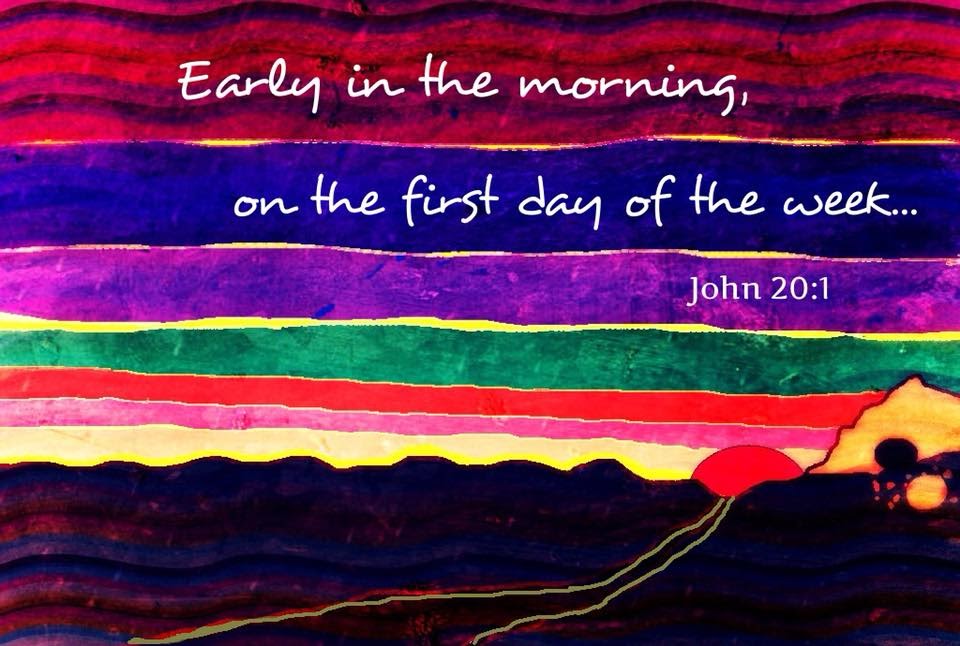
Early in the morning, on the first day of the week,
Mary Magdalene ran and went to Simon Peter
and to the other disciple whom Jesus loved, and told them,
“They have taken the Lord from the tomb,
and we do not know where they put him.”
So Peter and the other disciple went out and came to the tomb.
They both ran, but the other disciple ran faster than Peter
and arrived at the tomb first;
he bent down and saw the burial cloths there, but did not go in.
When Simon Peter arrived after him,
he went into the tomb and saw the burial cloths there,
and the cloth that had covered his head,
not with the burial cloths but rolled up in a separate place.
Then the other disciple also went in,
the one who had arrived at the tomb first,
and he saw and believed.

John 20: 1-8

Did somebody get mixed up? Did someone think it was the Octave of Easter, not Christmas! No, of course not. I think the choice of this Gospel, at this point in the Liturgical Year, serves at least two purposes:

  • From the start of Christ’s life, it establishes how his days will end. Therefore, throughout the ensuing year, we are to read and interpret all of the Gospel in the glorious light of the Resurrection.
  • Placing this Gospel here, to accompany our first reading, clarifies exactly who John is — the one who indeed saw, heard, and touched the Word of God made visible in Jesus Christ and therefore is eminently qualified to testify to Christ.

Beloved:
What was from the beginning,
what we have heard,
what we have seen with our eyes,
what we looked upon
and touched with our hands
concerns the Word of life —
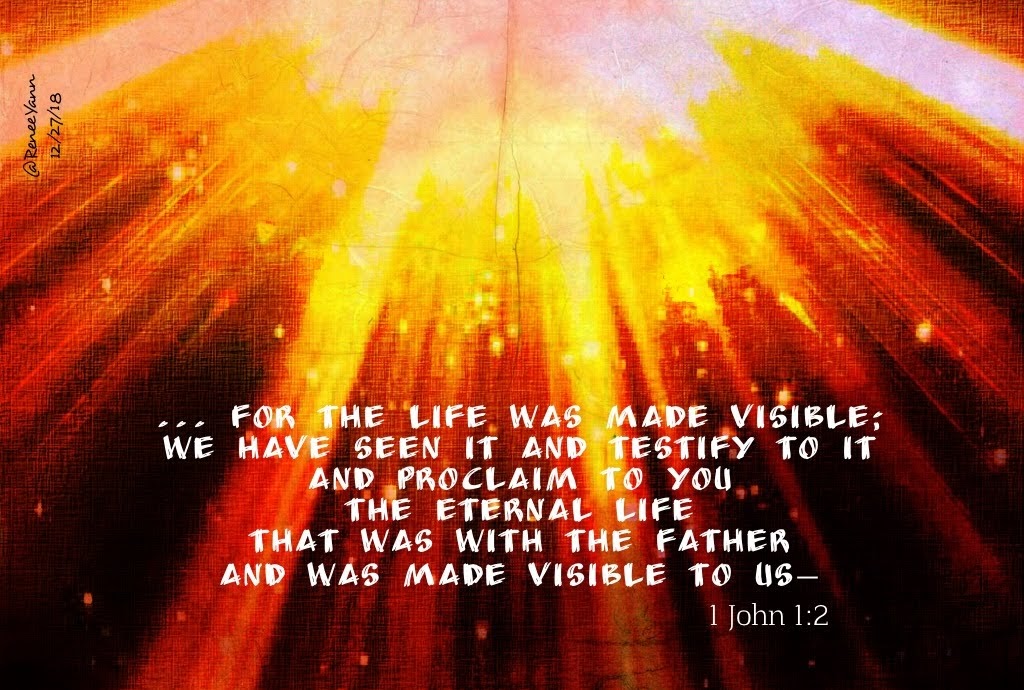
for the life was made visible;
we have seen it and testify to it
and proclaim to you the eternal life
that was with the Father and was made visible to us—

1 John 1:1-2

One very popular form of both fiction and non-fiction is the love letter. Some of the most wonderful books are in the genre. Three of my favorites fit the category:

  • 84, Charing Cross Road – Helene Hanff
  • The Love Letters – Madeleine L’Engle
  • A Green Journey – John Hassler

Reading such literature evokes a reverence for the lives we touch in the gathered words. We read what is said and imagine what is unsaid. We witness the depth of another’s self-donation and we ponder our own capacity for such a gift.


In 1 John, we are granted the privilege of reading John’s love letters to his God and to his community. John’s love is profoundly deep yet simply expressed. We might tend to skip through his rich but clipped phrases. But to truly plumb them requires us to suspend time and rest with his words until they open in us like flowers in sunlight.


Poetry: The Living Word – Herman Hesse

The sun speaks to us through light.
Flowers give voice to fragrance and colour.
The air communes through clouds, snow, and rain.
From the sacred center of the world
streams forth an irrepressible desire
to overcome the silence between things.
Art, the ever flowing fountain, reveals
the secret of life through word and gesture, colour and sound.

The world wants to be known to spirit
and find expression for timeless wisdom.
All life longs for a language.
Deep intuitions wish to surface,
find words and numbers, lines and tones,
always evolving forms of understanding.

The red and blue of flowers
and the verses of the poet
point to the inner workings of creation,
always pregnant with beginning and never-ending.
When word and sound marry,
where songs soar and art unfolds
all life is brimmed again with spirit.
And every melody and book
and every painting is a revelation,
is another fresh attempt
to unfold the harmony of life.
Poetry and music invite you
to understand the splendors of creation.
A look into a mirror will confirm it.
What disturbs us often as disjointed
becomes clear and simple in a poem:
Flowers start laughing, the clouds release their rain,
the world regains its soul, and silence speaks.

Music: Love Letter – Anthony Nelson

The First to Die for Christ

Feast of Saint Stephen, first martyr
December 26, 2023

Today’s Readings:

https://bible.usccb.org/bible/readings/122623.cfm


The Demidoff Altarpiece: Saint Stephen
Representation of St. Stephen
from The Demidoff Altarpiece
by Carlo Crivelli,
an Italian Renaissance painter
of the late fifteenth century.

Today, in God’s Lavish Mercy, we celebrate the Feast of St. Stephen, first martyr for the Christian faith. 

Stephen said,
“Behold, I see the heavens opened and the Son of Man
standing at the right hand of God.”
But they cried out in a loud voice, covered their ears,
and rushed upon him together.
They threw him out of the city, and began to stone him.
The witnesses laid down their cloaks
at the feet of a young man named Saul.
As they were stoning Stephen, he called out
“Lord Jesus, receive my spirit.”


The commemoration and readings are a drastic turn from singing angels and worshiping shepherds. The Liturgy moves quickly from welcoming a cooing baby to weeping at the death of innocence. Why?

One thought might be to keep us practical and focused on what life in Christ truly means.

Stephen, like Jesus, “was filled with grace and power, … working great wonders and signs among the people.” He, as Jesus would, met vicious resistance to his message of love and reconciliation. He, as Jesus would, died a martyr’s death while forgiving his enemies.


The Church turns us to the stark truth for anyone who lets Christ truly be born in their hearts. We will suffer as Jesus did – as Stephen did. The grace and power of Christ in our life will be met with resistance, or at least indifference.

Brother will hand over brother to death,
and the father his child;
children will rise up against parents and have them put to death.
You will be hated by all because of my name,
but whoever endures to the end will be saved.


We may not shed blood but, in Christ, we will die to self. When we act for justice for the poor and mercy for the suffering, we will be politically frustrated and persecuted. When we forgive rather than hate, we will be mocked. Powerful people, like the yet unconverted Saul in today’s second reading, may catalyze our suffering by their determined hard-heartedness.

Our Gospel confirms the painful truth:

“You will be hated by all because of my name,
but whoever endures to the end will be saved.”

Tomorrow, the liturgy picks up the poetic readings from John’s letters. These are delights to the soul. 

But for today, it is a hard look, with Stephen, at what Christmas ultimately invites us to.


Poetry: St. Stephen by Malcolm Guite

Witness for Jesus, man of fruitful blood,
Your martyrdom begins and stands for all.
They saw the stones, you saw the face of God,
And sowed a seed that blossomed in St. Paul.
When Saul departed breathing threats and slaughter
He had to pass through that Damascus gate
Where he had held the coats and heard the laughter
As Christ, alive in you, forgave his hate,
And showed him the same light you saw from heaven
And taught him, through his blindness, how to see;
Christ did not ask ‘Why were you stoning Stephen?’
But ‘Saul, why are you persecuting me?’
Each martyr after you adds to his story,
As clouds of witness shine through clouds of glory.

Music: Gabriel’s Oboe from the movie “The Mission”, played by Henrik Chaim Goldschmidt,  principal oboist of The Royal Danish Orchestra in Copenhagen, Denmark.

The Key Hidden in Plain Sight

Wednesday of the Third Week of Advent
December 20, 2023

Today’s Readings:

https://bible.usccb.org/bible/readings/122023.cfm


Today, in God’s Lavish Mercy, Isaiah foretells the conception and birth of the Messiah.

Therefore the Lord himself will give you this sign:
the virgin shall conceive and bear a son,
and shall name him Emmanuel.

Isaiah 7:14

Isaiah offered the prophecy to one of the bad guys of the Hebrew Scriptures – King Ahaz (who was, nevertheless, the 16th great-grandfather of Jesus in the long David line). But Ahaz refused to believe, subsequently pursuing his own agenda rather than God’s. Ahaz’s choice ended up in disaster for both the religious and social framework of Israel.

Isaiah had handed Ahaz the Key to believe
and to act in union with God’s Will,
but Ahaz remained closed to the grace.

About 700 years later, when an angel offers her the Key, a young girl opens her heart to the miracle Isaiah once prophesied.

In the sixth month,
the angel Gabriel was sent from God
to a town of Galilee called Nazareth,
to a virgin betrothed to a man named Joseph,
of the house of David,
and the virgin’s name was Mary.
And coming to her, he said,
“Hail, full of grace! The Lord is with you.”
But she was greatly troubled at what was said
and pondered what sort of greeting this might be.
Then the angel said to her,
“Do not be afraid, Mary,
for you have found favor with God.
Behold, you will conceive in your womb and bear a son,
and you shall name him Jesus.
He will be great and will be called Son of the Most High,
and the Lord God will give him the throne of David his father,
and he will rule over the house of Jacob forever,
and of his Kingdom there will be no end.”

Luke 1:26-33

The stark contrast between Ahaz’s and Mary’s responses encourages us to consider our own openness to God’s interventions in our lives. We live a series of experiences, learnings, mistakes, reminiscences, hopes, disappointments, and a thousand other turnings of circumstance and relationship. Each holds the potential to draw us closer to God if, by prayer and reverence, we can find the key hidden under human appearances.


We can hear Mary searching for that key in her question to the angel:

But Mary said to the angel,
“How can this be,
since I have no relations with a man?”

Luke 1: 34

The angel assures Mary that there is a world transcending our perceptions where God’s power holds sway beyond all human calculation.

And the angel said to her in reply,
“The Holy Spirit will come upon you,
and the power of the Most High will overshadow you.

Luke 1: 35

Expressing her profound faith and trust in God, Mary was able to suspend the limits of expectation and definition. Ahaz didn’t even try.

Mary said, “Behold, I am the handmaid of the Lord.
May it be done to me according to your word.”

Luke 1: 38

Poetry: Annunciation – Marie Howe

Even if I don't see it again—nor ever feel it
I know it is—and that if once it hailed me
it ever does—
And so it is myself I want to turn in that direction
not as towards a place, but it was a tilting
within myself,
as one turns a mirror to flash the light to where
it isn't—I was blinded like that—and swam
in what shone at me
only able to endure it by being no one and so
specifically myself I thought I'd die
from being loved like that.

Music: The Annunciation from Rosary Sonata – Heinrich Biber

Righteous Root

Tuesday of the Third Week of Advent
December 19, 2023

Today’s Readings:

https://bible.usccb.org/bible/readings/121923.cfm


Today, in God’s Lavish Mercy, we summon the Redeemer with the title, “O Root of Jesse”. Our readings, rich with biblical tradition, sculpt an image of Christ as an omnipotent radical Presence who alters the course of time.


To clarify that image for us, our readings first offer Samson, a prototype of Jesus in these ways:

  • surprising birth
  • announced by an angel
  • a Nazarite and righteous man
  • core figure in Israel’s deliverance
  • God-rooted strength

Samson by Norman Rockwell,
commissioned by Cecil B. Moore
for the film Samson and Delilah (1947)


The woman went and told her husband,
“A man of God came to me;
he had the appearance of an angel of God, terrible indeed.
I did not ask him where he came from, nor did he tell me his name.
But he said to me,
‘You will be with child and will bear a son.
So take neither wine nor strong drink, and eat nothing unclean.
For the boy shall be consecrated to God from the womb,
until the day of his death.'”

The woman bore a son and named him Samson.
The boy grew up and the LORD blessed him;
the Spirit of the LORD stirred him.

Judges 13: 6-9

The Church gives us this reading about Samson today so that we can focus on these characteristics of the Messiah whom Samson foreshadows.

Praying with those images, I remember an amazing tree I once saw in South Carolina. My friend Mike, a proud South Carolinian with a mellow drawl and a matching hospitality, suggested that we take a short ride from Charleston to visit a remarkable treasure (and to enjoy a Gullah dinner on the way home!).

The Angel Oak Park is located on Johns Island where you can find what is known as “A Lowcountry Treasure”. The Southern Live Oak tree is a historical site and focal point of one of the City of Charleston’s public parks. It is considered to be the largest Live Oak Tree east of the Mississippi estimated to be 300 to 400 years old. The Angel Oak receives approximately 400,000 visitors each year. The tree is 65 feet high with a circumference of 25.5 feet, shading an area of 17,000 square feet.

https://www.charleston-sc.gov/153/Angel-Oak

The tree is breathtaking. Being in its presence at once propels us back centuries while convincing us that life endures forever into the future. Standing in its expansive shade, we sense the immeasurable rootedness underfoot, and implacable steadfastness proven in storm.


The tree suggests, although it does not possess, the eternal steadfastness of God. With that suggestion, we are inspired to pray under its silent branches.

Such is the power of Samson in today’s reading. We are reminded and foretold, before Christmas Day, of the omnipotence of our longed-for Redeemer so that we may be more open to the surprising graces he will bring.


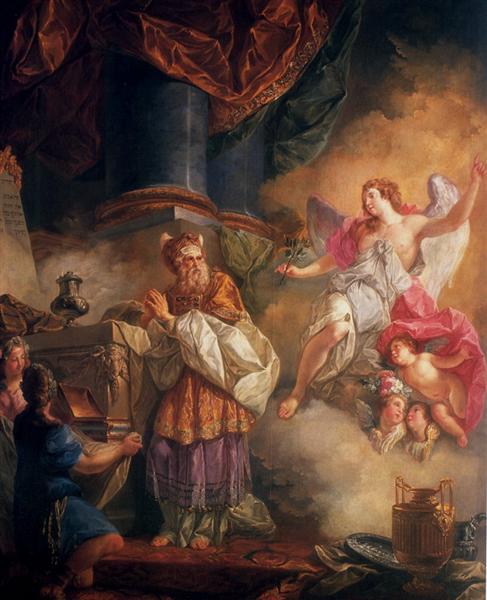
The Angel’s Visit to Zechariah – Luis Paret y Alcazar

Fittingly, our Gospel gives us another kind of angel, a real one – not a tree. This angel comes and nearly shocks the tonsils out of Zechariah, another good and righteous man. In his imposed silence, Zechariah hears a description of his son and of the coming Christ. The description is rich with images no doubt familiar from Zechariah’s long life of scripture study. Maybe, as he listens, he thinks of Samson and all the long lineage now tied into his own bloodline!


With the angel’s word Zechariah is given the gift of his own kind of nine-month spiritual pregnancy – one in which to let those images mature in him like the burgeoning of a faith-filled tree.

As we pray with these scriptures today, what angels and images visit us to prepare us for the rebirth of Christ in our hearts?


Poetry: Song of Zechariah (Luke 1:59-79) – Irene Zimmerman, OSF

At the circumcision of his son,
relatives and neighbors came
to speak for Zechariah of the tied
tongue. The child, they concurred,
would bear his worthy father's name.
But during her husband's silence,
old Elizabeth had found her voice.
"His name will be John," she said.

Why this strange, unprecedented choice,
the relatives and neighbors wondered.
Armed with writing instrument,
back they went to poor, dumb Zechariah.
But during the long confinement,
as young Mary and Elizabeth
spoke about the missions of their sons,
he had listened and grown wise.
Straightaway, he wrote, "His name is John."
he caught Elizabeth's smiling eyes,
felt his old tongue loosen, found his voice,
    sang of God's tender mercy,
    sang of the breaking dawn,
    sang of the prophet, their son,
    who would make straight the way
    for the long-awaited One.

Music: Sacred Silence – Lyrics by Tom Booth, Jenny Pixler, and Anthony Kuner

Incredible Things

Monday of the Second Week of Advent
December 11, 2023

Today’s Readings:

https://bible.usccb.org/bible/readings/121123.cfm


Today, in God’s Lavish Mercy, Isaiah speaks to a weary and forlorn people, a people captive in the desolate land of their conquers. He tells them that the brown dust of their lives will blossom like a magical garden. He tells the wobbly, weakened masses that they will be rejuvenated beyond their wildest dreams:

Strengthen the hands that are feeble,
make firm the knees that are weak,
Say to those whose hearts are frightened:
Be strong, fear not!
Here is your God,
he comes with vindication;
With divine recompense
he comes to save you.
Then will the eyes of the blind be opened,
the ears of the deaf be cleared;
Then will the lame leap like a stag,
then the tongue of the mute will sing.

Isaiah 35:3-6

In our Gospel, Jesus tells the crowd the same thing.

In that crowd, there is a dynamic mix of believers and unbelievers. On the one hand, we have the spiritually stodgy Pharisees who like rules better than miracles. On the other hand, we have these outrageously hopeful young men who are willing to blow the roof off to place their friend under Jesus’s miraculous gaze.

Then the scribes and Pharisees began to ask themselves,
“Who is this who speaks blasphemies?
Who but God alone can forgive sins?”
Jesus knew their thoughts and said to them in reply,
“What are you thinking in your hearts?
Which is easier, to say, ‘Your sins are forgiven,’
or to say, ‘Rise and walk’?
But that you may know
that the Son of Man has authority on earth to forgive sins”–
he said to the one who was paralyzed,
“I say to you, rise, pick up your stretcher, and go home.”

He stood up immediately before them,
picked up what he had been lying on,
and went home, glorifying God.

Luke 5:21-25

Wouldn’t you just love to have been a fly on the wall when that paralyzed kid got up and skipped home! The stunned expressions on the pharisaical faces! The grateful oohs and aahs of those who wanted to believe! The profound awe of his disciples as they realize more deeply who it is that they have come to love!


Throughout the centuries, those with a deep and sincere desire to believe have seen incredible things. The eyes of faith have allowed them to see beyond the dusty surface of appearances.. For those who refuse to believe, even the miracles right in front of them are invisible.


I think that seeing the miracles in our lives is a little bit like seeing a meteor shower. First of all, we have to go outside. We have to look UP! We have to keep our eyes open. And we have to wait.

All moments, maybe especially the dark ones, hold a heavenly cascade of grace. During this holy time, as we await the Infinite Miracle of Love, let’s focus our hearts on watching, waiting, and celebrating these incredible yet daily graces:

  • that we have been given the gift of life
  • that our minds and hearts have the insight to seek God in prayer
  • that we are capable of giving and receiving love
  • that we can hope and heal
  • that we have been touched and changed by Mercy
  • that we are infinitely loved by God

Each one of our lists goes on and on. Pray yours today with the scriptural encouragement of Jesus and Isaiah!


Poetry: The Lord Will Come and not be Slow – John Milton

The Lord will come and not be slow,
his footsteps cannot err;
before him righteousness shall go,
his royal harbinger.
Truth from the earth, like to a flower,
shall bud and blossom then;
and justice, from her heavenly bower,
look down on mortal men.
Surely to such as do him fear
salvation is at hand!
And glory shall ere long appear
to dwell within our land.
Rise, God, judge thou the earth in might,
this wicked earth redress;
for thou art he who shalt by right
the nations all possess.
The nations all whom thou hast made
shall come, and all shall frame
to bow them low before thee, Lord,
and glorify thy Name.
For great thou art, and wonders great
by thy strong hand are done:
thou in thy everlasting seat
remainest God alone.

Music: Miracles – Kari Jobe

Renewal Offer

Second Sunday of Advent
December 10, 2023

Today’s Readings:

https://bible.usccb.org/bible/readings/121023.cfm


Today, in God’s Lavish Mercy, our readings ask us, for an Advent moment, to disentangle ourselves from time and space, and to see the world as God sees it.


Isaiah, hearing God’s insistence in his prophet’s heart, assures us of God’s mercy and of our deliverance from the world’s confusions:

Handel: Messiah / Part 1 – “Comfort ye, My people… Ev’ry Valley shall be exalted”
Conducted by Sir Neville Mariner

Comfort, give comfort to my people,
says your God.
Speak tenderly to Jerusalem, and proclaim to her
that her service is at an end,
her guilt is expiated;
indeed, she has received from the hand of the LORD
double for all her sins.

Isaiah 40: 1-2

Isaiah analogizes these confusions in rich terrestrial metaphors: a desert, a wasteland, a depressed valley, a rough road. Probably most of us have been in one or two of these spots in the past year. Am I right?

A voice cries out:
In the desert prepare the way of the LORD!
Make straight in the wasteland a highway for our God!
Every valley shall be filled in,
every mountain and hill shall be made low;
the rugged land shall be made a plain,
the rough country, a broad valley.
Then the glory of the LORD shall be revealed,
and all people shall see it together;
for the mouth of the LORD has spoken.

Isaiah 40:3-5

But just how is our deliverance from these dead-end places to be accomplished? Peter offers an answer – it is accomplished through repentance.

Do not ignore this one fact, beloved,
that with the Lord one day is like a thousand years
and a thousand years like one day.
The Lord does not delay his promise, as some regard “delay,”
but he is patient with you,
not wishing that any should perish
but that all should come to repentance.

2 Peter 3:8-9

If we were lost in a desert or trapped in an unscalable valley, all we would want is to get out. We might not pause to ask ourselves, “How did I get here?”, or “How can I avoid a return?”. The same thing might be true of our spiritual deserts and valleys.

Isaiah, Peter, and Jesus tell us that it is our resistance to God’s vision, our sinfulness, that captures us in our desolations – and that “repentance” is the antidote.

Since everything is to be dissolved in this way,
what sort of persons ought you to be,
conducting yourselves in holiness and devotion,
waiting for and hastening the coming of the day of God,
because of which the heavens will be dissolved in flames
and the elements melted by fire.
But according to his promise
we await new heavens and a new earth
in which righteousness dwells.
Therefore, beloved, since you await these things,
be eager to be found without spot or blemish before him, at peace.

2 Peter 3:11-14

In our Gospel, John the Baptist also tells us to repent. And, honestly, when I first read his Advent proclamation every year, I find myself telling God something like this:

You know, dear God, I’m not really that bad off that I need to — well, you know…. like actually REPENT!!!! I’ve been doing the best I can. I’m one of the “Goodies” in this bad, bad world! You see that, don’t You?

Then Isaiah’s gentle Shepherd comes along, lifts me into those comforting arms, and convinces me that the world can be transformed if I will let myself see it as God sees it. All the normalized uncharities of my life — the judgments, the ungenerous hesitations, the excused prejudices, the unforgiven mistakes, the selfish expectations. Yes, all those deserts and valleys that we dismiss unresolved will just accumulate and stagnate in our listless spirits! It is from these crooked ways that God offers to deliver us once again in this year’s Advent reimagining.


So, what a wonderful invitation we receive in today’s readings! It is time to begin again – fresh, reinvigorated, and amazed at the power of grace in our lives!

Go up on to a high mountain,
Zion, herald of glad tidings;
cry out at the top of your voice,
Jerusalem, herald of good news!
Fear not to cry out
and say to the cities of Judah:
Here is your God!
Here comes with power
the Lord GOD,
who rules by his strong arm;
here is his reward with him,
his recompense before him.
Like a shepherd he feeds his flock;
in his arms he gathers the lambs,
carrying them in his bosom,
and leading the ewes with care.

Isaiah 40:9-11

On this Advent’s Second Sunday, let’s rest with that comforting but convincing Shepherd to learn where graceful change will free us for rebirth.


Poetry: Reminder – Mark Jarman

For God is in heaven, and you upon earth.
—Ecclesiastes 5:2

Don’t take your eyes off the road.
Accept nothing as given.
Watch where you put your hands.
You’re here and God’s in heaven.

Be careful where you step.
The drop-off’s somewhere near.
The fog won’t lift tonight.
God’s in heaven. You’re here.

That word you wish to say,
That score you’d like to even—
Don’t hurry either while
You’re here and God’s in heaven.

The earth says, “Take the wheel.
But no matter how you steer,
I’ll still go round in circles.
God’s in heaven. You’re here.”


Music: Like A Shepherd – John Foley, SJ

Eyes Unveiled

Wednesday of the First Week of Advent
December 6, 2023

Today’s Readings:

https://bible.usccb.org/bible/readings/120623.cfm


Today, in God’s Lavish Mercy, Isaiah tantalizes us with his vision of the sumptuous heavenly banquet:

On this mountain the LORD of hosts
will provide for all peoples
A feast of rich food and choice wines,
juicy, rich food and pure, choice wines.

Isaiah 25:6-7

I can picture myself at that table munching on a savory turkey leg washed down by a bottomless pilsner. But if I stop there in my meditation I will have missed the whole point! The menu is not even the tip of the treasures to be had when we gather on Isaiah’s “Parousia Mountain”.

On that mountain, the veil will be lifted from our perception. The tangly web of our stresses and confusions will be wiped away. We will see ourselves and all Creation with God’s clear and loving eyes. Death – the lurking intruder threatening every earthly table – will have been eradicated, dissolved into Eternal Being.

On this mountain God will destroy
the veil that veils all peoples,
The web that is woven over all nations;
God will destroy death forever.

Isaiah 25:7-8

In our first reading, Isaiah paints the picture of a mountain lifted from time and transformed with heaven. In our Gospel, Jesus too is on a mountain when he pulls heaven down to heal and feed the yearning crowd.

Jesus walked by the Sea of Galilee,
went up on the mountain, and sat down there. 
Great crowds came to him,
having with them the lame, the blind, the deformed, the mute,
and many others. 
They placed them at his feet, and he cured them. 

Matthew 15:29-30

No doubt the gathered people, cured of their nagging maladies, were stunned into an instant faith. But Jesus knows that they can not stay on this heaven-charged mountain forever. They have their life’s journey ahead of them, and the energy of nascent faith may wane on the long road. So he reinforces the healing miracles with the comfort and sustenance of common food:

My heart is moved with pity for the crowd,
for they have been with me now for three days
and have nothing to eat. 
I do not want to send them away hungry,
for fear they may collapse on the way.

Matthew 15:32

In this incident, which is another version of the miracle in Matthew 14, the simple common folk have with them only the merest provisions. It is these that Jesus uses to fuel an enduring faith in these earth-bound believers:

Jesus said to them, “How many loaves do you have?” 
“Seven,” they replied, “and a few fish.” 
He ordered the crowd to sit down on the ground. 
Then he took the seven loaves and the fish,
gave thanks, broke the loaves,
and gave them to the disciples, who in turn gave them to the crowds. 
They all ate and were satisfied. 
They picked up the fragments left over–seven baskets full.

Matthew 15:34-37

God uses our merest provisions too to charge our daily life with faith’s energy. But we must take the holy time to let any misleading webs and obstructive veils fall from our perceptions. Our godless culture layers the world with so many distractions and fallacies that we are hard-pressed to see what’s really essential to true life.

Especially at Christmas time, God is nearly buried in tinsel, hype, and commercialism. A good Advent, spent in the awe-filled silence of scriptural reflection, is the antidote to this malady. Let’s be committed to it.


Poetry: Adult Advent Announcement – by David A. Redding, (from If I Could Pray Again – 1965)

O Lord,
Let Advent begin again
In us,
Not merely in commercials;
For that first Christmas was not
Simply for children,
But for the
Wise and the strong.
It was
Crowded around that cradle,
With kings kneeling.
Speak to us
Who seek an adult seat this year.
Help us to realize,
As we fill stockings,
Christmas is mainly
For the old folks —
Bent backs
And tired eyes
Need relief and light
A little more.
No wonder
It was grown-ups
Who were the first
To notice
Such a star.

Music: When I Can Read My Title Clear – arranged by Tim Sharpe
This is an acapella version of the hymn text by Isaac Watts (1674 – 1748) interpreting Isaiah 25:8.It is set to the tune PISGAH, an American Folk Melody by the 19th-century composer Joseph C. Lowry

On the Edge

Saturday of the Thirty-fourth Week in Ordinary Time
December 2, 2023

Today’s Readings:

https://bible.usccb.org/bible/readings/120223.cfm


Today, in God’s Lavish Mercy, we finally stand at the edge of the diving board before our plunge into the sublime days of Advent!


Daniel, at the end of a daunting passage, closes with this conviction that foreshadows the Messiah’s reign:

Then the kingship and dominion and majesty
of all the kingdoms under the heavens
shall be given to the holy people of the Most High,
Whose Kingdom shall be everlasting:
all dominions shall serve and obey him.

Daniel 7:27

In our Gospel, Jesus uses a tone similar to Daniel to encourage our vigilance:

Jesus said to his disciples:
“Beware that your hearts do not become drowsy
from carousing and drunkenness
and the anxieties of daily life,
and that day catch you by surprise like a trap.
For that day will assault everyone
who lives on the face of the earth.
Be vigilant at all times
and pray that you have the strength
to escape the tribulations that are imminent
and to stand before the Son of Man.”

Luke 21:34-36

I take these words as an imperative to engage the days of Advent for what they are supposed to be – a time of thoughtful, prayerful preparation to receive the gift and mystery of Christ in all its splendor.

The Gospel seems to suggest that we might become too tired for such prayer during all our frenetic Christmas preparations, or that we might break out the spiked egg nog a little too early. We are admonished to be alert, sober, and unanxious. We are advised to “Be vigilant” – that is, to light the heart’s candle and to wait patiently for God.


Poetry: Tug and Sigh – May Sarton, from “The Silence Now”

Like the datura’s yellow trumpets
I am waiting for the breath of angels
to perfume the twilight
of this ordinary day
and play the vigil hymn
reminding me
that heaven and earth
wed long ago.

I too am married
to the unseen
sigh and scent,
filling and returning,
thus never full –
always longing,
often failing,
yet ever blessed
with heaven’s pull.

Music: Silent Vigil – Tony O’Connor

Forgeries?

Wednesday of the Thirty-fourth Week in Ordinary Time
November 29. 2023

Today’s Readings:

https://bible.usccb.org/bible/readings/112923.cfm


Today, in God’s Lavish Mercy, we have a fascinating passage from the Book of Daniel, a masterpiece in apocalyptic literature. I enjoyed imagining the scene described by the author in which a magical hand appears to execute “the handwriting on the wall”.

As King Balshazzar and his thousand guests drank sacrilegiously from the sacred Temple chalices, this fabulous thing happened:

Suddenly, opposite the lampstand,
the fingers of a human hand appeared,
writing on the plaster of the wall in the king’s palace.
When the king saw the wrist and hand that wrote, his face blanched;
his thoughts terrified him, his hip joints shook,
and his knees knocked.

Daniel 5:5-6

The image is so wonderful that it has peppered our language and imagination for over two thousand years!

Belshazzar’s Feast – Rembrandt


Morris Bender, an American neuroscientist, offered this clever quip:

A skeptic is a person who, 
when he sees the handwriting on the wall, 
claims it is a forgery.

After a little chuckle, I realized how wise and accurate Bender is. How many times have I not only missed, but actively ignored, the handwriting on the wall! Our minds, hearts, and spirits continually give us signs to direct us in life. How well do we do at discerning these gifts.


The fruit of a deep spiritual life is to become more attentive to the suggestions of grace, and to respond to them with faith and courage. In our Gospel, Jesus makes it clear to his followers that this kind of faithful response will cost them much — possibly even their lives.

Jesus said to the crowd:
“They will seize and persecute you,
they will hand you over to the synagogues and to prisons,
and they will have you led before kings and governors
because of my name.

Luke 21:12

Still, Jesus tells them not to be afraid, that their lives are “secured” by their faith:

You will even be handed over by parents,
brothers, relatives, and friends,
and they will put some of you to death.
You will be hated by all because of my name,
but not a hair on your head will be destroyed.
By your perseverance you will secure your lives.

Luke 21:16-19

The Church uses the apocalyptic stories from Daniel and the dire warnings from Jesus to remind us that we do not live for this world alone. The fullness of eternal life awaits us after the completion of our earthly journey. We have to keep ourselves aware that our life is infinitely larger than it may appear to us in any given moment.

Faith, prayer, and the practice of interior silence can help us to live in that infinite largeness even though we have limited vision of it in this world. The coming days of Advent offer us a dedicated time to renew ourselves in these practices.


Poetry: from Rumi

O love,
O heart,
Find the way to heaven.
Set your sights on a place
Higher than your eyes can see.
For it was the higher aim
That brought you here
In the first place.
Now be silent.
Let the One who creates the words speak.
He made the door.
He made the lock.
He also made the key.
How many men have found tragic ends
Running after beauty?
Why don’t they look for you? -
The heart and spirit of all beauty.

Music: Secrets and Dreams – Fairborn Lachini

… the Time Will Come

Monday of the Thirty-fourth Week in Ordinary Time
November 27, 2023

Today’s Readings:

https://bible.usccb.org/bible/readings/112723.cfm


Today, in God’s Lavish Mercy, we begin a series of readings from the Book of Daniel. It is the only time throughout the Liturgical Year that we get a good dose of Daniel. And it is well placed, coming in this final week before Advent.

Daniel is apocalyptic literature, a genre that conveys the author’s perception of the end times through dreams, visions, and prophecies. Like many of our readings of the past weeks, Daniel focuses us on God’s Final Coming into time by interpreting current circumstances in a spiritual light.


Today’s Gospel also focuses us on our “end times”, but in a little different way from Daniel. 

Jesus tells the story of the poor widow who gave everything she had for the sake of the poor. This widow, in a sense, already lives in the “end times”, a time when our only “possessions” will be the good we have done in our lives.

Jesus said, “I tell you truly,
this poor widow put in more than all the rest;
for those others have all made offerings from their surplus wealth,
but she, from her poverty, has offered her whole livelihood.”

Luke 21:3-4

Both these readings orient us to reflect on our lives and times as we approach Advent. This sacred season is the annual reenactment of Christ’s First Coming in order to prepare us for:

  • Christ’s daily revelation in our lives
  • Christ’s Final Coming at the end of time
Mt24_awake

All of Daniel’s complex visions and prophecies can feel a little confusing, but we can focus on this:

  • God is continually revealing the Face of the Trinity in the ordinary circumstances of time.
  • We can open ourselves to this revelation by our humble prayer and good works.
  • Staying awake like this in our hearts and souls will allow us to pass seamlessly into God’s Presence when the end times come.

Poetry: Psalm 96 – Isaac Watts (1674-1748)

Christ's first and second coming.
Sing to the Lord, ye distant lands,
Ye tribes of every tongue;
His new-discovered grace demands
A new and nobler song.
Say to the nations, Jesus reigns,
God's own almighty Son;
His power the sinking world sustains,
And grace surrounds his throne.
Let heav'n proclaim the joyful day,
Joy through the earth be seen;
Let cities shine in bright array,
And fields in cheerful green.
Let an unusual joy surprise
The islands of the sea:
Ye mountains, sink; ye valleys, rise;
Prepare the Lord his way.
Behold, he comes, he comes to bless
The nations as their God;
To show the world his righteousness,
And send his truth abroad.
But when his voice shall raise the dead,
And bid the world draw near,
How will the guilty nations dread
To see their Judge appear!

Music: Be Thou My Vision