Believe and Abide in Me

Friday of the Third Week of Easter
April 28, 2023

Today’s Readings:

https://bible.usccb.org/bible/readings/042823.cfm

Today, in God’s Lavish Mercy, we have two powerful and life-changing readings.

The Conversion of St. Paul – Nicolas Bernard Lepicie


Paul’s conversion is high drama. And Jesus’ invitation to “consume” him is both pivotal and a bit confounding. Both accounts make clear that living our faith is not a walk in the park. It is a wholehearted, dynamic commitment to render the vital presence of Jesus in our lives.


We can probably find ourselves rather easily in Paul’s story, so let’s take on Jesus’ more complex challenge in our prayer today.

The setting is after the miracle of the loaves and fishes. The crowd presses Jesus for another miracle. They like miracles and they like to eat. Hey, I understand!

But Jesus realizes that they’re missing the point. The tsunami of bread and fish was just a sign not the essence of Jesus’ message. His message was, “Now you must BELIEVE!”

The Jews quarreled among themselves, saying,
“How can this man give us his Flesh to eat?”
Jesus said to them,
“Amen, amen, I say to you,
unless you eat the Flesh of the Son of Man and drink his Blood,
you do not have life within you.

John 6:52-53

So Jesus tells them that it was not enough to eat the miracle bread. He says that now they must consume him, make him their source of sustenance, live in such a way that they cannot live without him


Just as food feeds our emptiness and becomes one with us, so Jesus nourishes our spirit and unites with us. And this happens, not by physical consumption, but by our deep and transcendent believing in Jesus.

Whoever eats my Flesh and drinks my Blood
has eternal life,
and I will raise them on the last day.
For my Flesh is true food,
and my Blood is true drink.
Whoever eats my Flesh and drinks my Blood
remains in me and I in them.

John 6:53-54

Jesus’ words threw a powerful challenge to the hungry crowd as they do to us. We can’t just make ourselves believe. Faith is a gift, and sometimes the channels that allow it to pour into our hearts get a little clogged with worldly junk. How can we open those channels up a bit to release the power of faith in our lives?

Perhaps a prayer like this might help:

I exist because of You and within You.
I have nothing and am nothing without You.
You breathe Your life into every moment of my own.
May I see You, trust You, hear Your loving hints to me.
May I make room for You in my heart 
by my choices, prayer, and generosity.
May I abide in You as You so completely abide in me.

Poetry: If Only – Rainer Maria Rilke

If only there were stillness, full, complete.
If all the random and approximate
were muted, with neighbors’ laughter, for your sake,
and if the clamor that my senses make
did not confound the vigil I would keep —
Then in a thousandfold thought I could think
you out, even to your utmost brink,
and (while a smile endures) possess you, giving
you away, as though I were but giving thanks,
to all the living.

Music: Abide – Aaron Williams

A Dynamic Faith

Wednesday of the Third Week of Easter
April 26, 2023

Today’s Readings:

https://bible.usccb.org/bible/readings/042623.cfm

Today, in God’s Lavish Mercy, our readings allow us to experience the dynamic nature of faith, as it was experienced in the early Church.And it wasn’t always pretty!

The Stoning of St. Stephen – Rembrandt

Acts tells us of a rising violence toward the Christians, especially those considered “Hellenistic Jews”. There was prejudice against them among the Pharisees even before these Jews converted to Christianity. They were “outsiders “:

The Hellenistic Jews are those who speak mainly Greek, and formerly lived outside of Judea and Galilee. But they had settled in Jerusalem — retired, as it were, to the homeland. Nevertheless, they still have affinities with lands of the Jewish dispersion from which they came. The Hebraic Jews are those who speak mainly Aramaic, and were born in Jerusalem or Judea.

Michael Morrison, PhD, professor of Biblical Studies at Grace Communion Seminary


Stephen, the first Christian martyr, was a Hellenist, as was Philip mentioned today as the first Christian missionary. He is a different Philip from the Apostle who remained in Jerusalem according to the passage.


As I picture the forces at work in the early Church, I am reminded of the ocean, ever-changing in its flow from peace to storm, yet ever-constant in its tides.

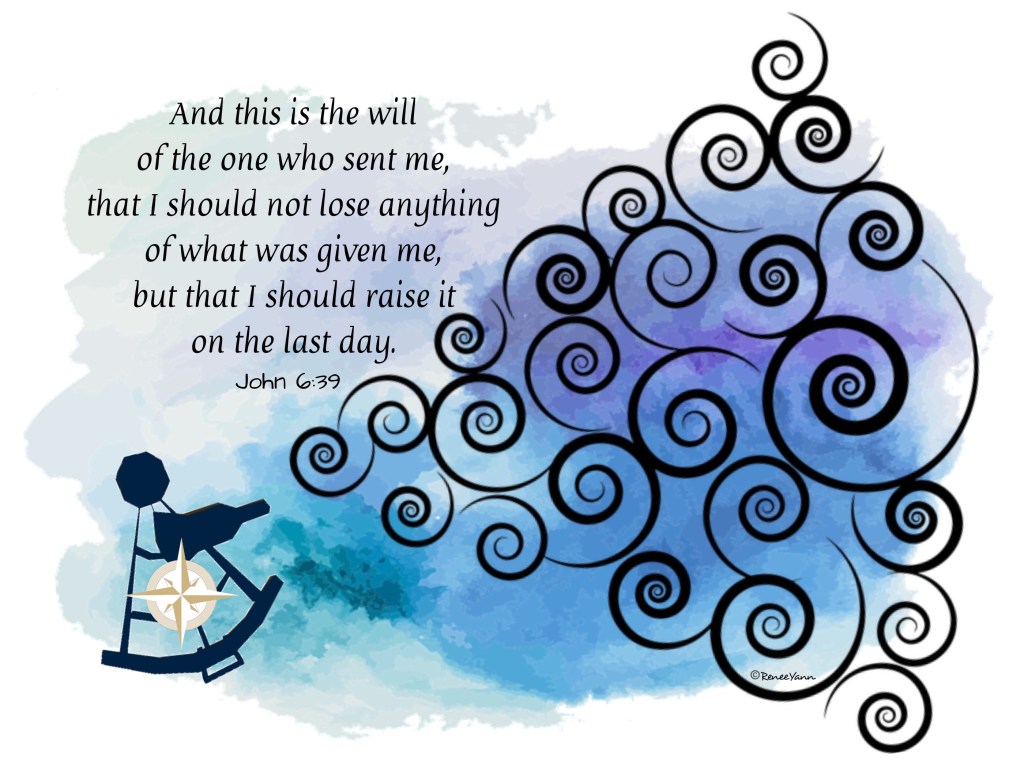
Faith is the anchor holding us steady in the waves, the sextant pointing us toward Christ’s Promise. As our Gospel says:

And this is the will of the one who sent me,
that I should not lose anything of what he gave me,
but that I should raise it on the last day.
For this is the will of my Father,
that everyone who sees the Son and believes in him
may have eternal life,
and I shall raise him on the last day.

John 6: 39-40

Stephen had this vital and tenacious faith, and died for it. Philip had it and shared it. The Apostles had it and held it steady for the rest of us.

How is the vital and dynamic faith living in me? How deeply do I believe and live the Promise? Let’s ask God today to strengthen our faith and to keep our focus on the Promise of eternal life.


Poetry: In Whom We Live and Move and Have Our Being – Denise Levertov 

Birds afloat in air's current,
sacred breath?  No, not breath of God,
it seems, but God
the air enveloping the whole
globe of being.
It's we who breathe, in, out, in, in the sacred,
leaves astir, our wings
rising, ruffled -- but only the saints
take flight.  We cower
in cliff-crevice or edge out gingerly
on branches close to the nest.  The wind
marks the passage of holy ones riding
that ocean of air.  Slowly their wake
reaches us, rocks us.
But storms or still,
numb or poised in attention,
we inhale, exhale, inhale,
encompassed, encompassed.

Music: The Promise – Marc Enfroy

God of Abundance

Friday of the Second Week of Easter
April 21, 2023

Today’s Readings:

https://bible.usccb.org/bible/readings/042123.cfm

Today, in God’s Lavish Mercy, our readings offer us two very human, accessible stories.

The first, from Acts, is about the Pharisee named Gamaliel. Gamaliel was a big deal. An esteemed authority in the powerful Sanhedrin, he was the son and grandson of highly respected Jewish teachers. He was wise, prudent, honest and practical. Gamaliel was the “real deal” himself, and he recognized it in others.

Gamaliel and Nicodemus Mourn the Death of Stephen – Carlo Saracini -1615 AD

In today’s reading, Gamaliel intervenes in the Sanhedrin’s relentless pursuit of the early disciples. He basically tells his colleagues, “Hey, wait a minute. If these guys are “the real deal”, there is nothing we can do to undermine them. If they are not, they will undermine themselves. So just cool it for a while.”

While there is scant verifiable evidence to the fact, tradition holds that Gamaliel converted to Christianity. He is venerated as a saint in both the Roman Catholic and the Orthodox traditions.


Our Gospel tells us the familiar yet still amazing account of the miracle of the loaves and fishes.

It’s a wonderful story. I mean just put yourself in this noisy, curious, hungry crowd of 5000 people! Picture Jesus going up the mountainside so they could – maybe – hear what he might say.

Imagine that you’re Philip when Jesus turns to him and asks,
“Where will we get enough food for this crowd?”

Do you see the unspoken answers written all over Philip’s face,
“How should I know? Why are you asking ME!!!!”

The passage says that Jesus was testing Philip, but it was more like a tease when I picture it. Can’t you see the mischievous little smile on Jesus’s face? Jesus knew what he was going to do about the crowd’s hunger. He wanted to be sure his disciples paid strict attention to what was about to happen. So he got them involved with his testing questions.


God wants us to pay attention, too, to what happens when we bring our hungers before God’s merciful goodness. Like the few fish and loaves, God takes the smallest parts of us and builds them up with the gift of grace. God finds the willing fragments of faith, hope and love in us and multiplies them with God’s own power.


With this miracle, Jesus shows his followers and all of us, that there is a sacred reality and Truth beyond the thin scarcities we at first perceive. Deep faith allows us to plumb that reality and to live in its expansive promise. Walter Brueggemann puts it this way:

The feeding of the multitudes … is an example of the new world coming into being through God. When the disciples, charged with feeding the hungry crowd, found a child with five loaves and two fishes, Jesus took, blessed ,broke and gave the bread. These are the four decisive verbs of our sacramental existence. Jesus conducted a Eucharist, a gratitude. He demonstrated that the world is filled with abundance and freighted with generosity. If bread is broken and shared, there is enough for all. Jesus is engaged in the sacramental, subversive reordering of public reality.

Walter Brueggemann, The Liturgy of Abundance, The Myth of Scarcity

Gamaliel opened his heart to this Truth,
as did the first disciples.
It’s our turn now.

(Insert your name), where will we get the food
to feed these hungers in our world?


Poetry: Miracles – Walt Whitman

Why, who makes much of a miracle?
As to me I know of nothing else but miracles,
Whether I walk the streets of Manhattan,
Or dart my sight over the roofs of houses toward the sky,
Or wade with naked feet along the beach just in the edge of the water,
Or stand under trees in the woods,
Or talk by day with any one I love, or sleep in the bed at night with any one I love,
Or sit at table at dinner with the rest,
Or look at strangers opposite me riding in the car,
Or watch honey-bees busy around the hive of a summer forenoon,
Or animals feeding in the fields,
Or birds, or the wonderfulness of insects in the air,
Or the wonderfulness of the sundown, or of stars shining so quiet and bright,
Or the exquisite delicate thin curve of the new moon in spring;
These with the rest, one and all, are to me miracles,
The whole referring, yet each distinct and in its place.
To me every hour of the light and dark is a miracle,
Every cubic inch of space is a miracle,
Every square yard of the surface of the earth is spread with the same,
Every foot of the interior swarms with the same.

To me the sea is a continual miracle,
The fishes that swim—the rocks—the motion of the waves—the
ships with men in them,
What stranger miracles are there?


Music: God of Abundance – Kat Mills

On the Road Together

Wednesday in the Octave of Easter
April 12, 2023

Today’s Readings:

https://bible.usccb.org/bible/readings/041223.cfm

Today, in God’s Lavish Mercy, we enfold ourselves in some of our favorite post-Easter stories. They warm our hearts with their humanness. They help us understand how people just like us processed the astounding news of the Resurrection.

Two of our beloved senior sisters … on the road together with Him…


In Acts, we find Peter and John, the same ones Mary had summoned to the empty tomb. Now, in place of their tentative searching, ministerial confidence pours out of them. The long-crippled man wants only a coin but Peter yearns to give the treasure he now knows he possesses. 

By faith, Peter’s heart has risen from death with Christ, and he is compelled to share that redemption with the world:

Peter said, “I have neither silver nor gold,
but what I do have I give you: 
in the name of Jesus Christ the Nazorean, rise and walk.”

Acts 3: 6-7

Listen, this is the same guy who, on the way to Jerusalem, begged Jesus not even to mention Calvary. This is the guy who, on Good Friday eve, cowered by the fire and denied he even knew Jesus. 

Look what Easter faith can do
for a doubtful, frightened heart!

ALLELUIA!

In our beautiful Gospel, a miracle dose of this faith was given to two journeying friends. Can’t you see them – perhaps two old men or women. Arm in arm, they trudge along the dusty road, gabbing their weary heads off. As evening falls, they are slowly wrapped in all kinds of inner and outer shadows:

  • Has this all really happened?
  • Wasn’t He the One we thought he might be?
  • Have our dearest hopes all been in vain?

When Jesus joins them, he wants to hear their mumbled questions. By his abiding, honest,and patient Presence, he walks them out of doubtful logic into faith’s freedom:

He asked them, 
“What are you discussing as you walk along?”
They stopped, looking downcast.
One of them, named Cleopas, said to him in reply,
“Are you the only visitor to Jerusalem
who does not know of the things
that have taken place there in these days?”….

And he said to them, “Oh, how foolish you are!
How slow of heart to believe all that the prophets spoke!
Was it not necessary that the Christ should suffer these things
and enter into his glory?”
Then beginning with Moses and all the prophets,
he interpreted to them what referred to him
in all the Scriptures.

Luke 24: 17-18; 25-27

Jesus is listening and walking with us too. He wants to give us the same confidence Peter had as we proclaim our faith by the merciful actions of our life. Just like the Emmaus friends, let’s invite him to stay with us as evening falls.


Poetry: The Servant Girl at Emmaus (A Painting by Velázquez) by Denise Levertov

The Kitchen Maid, Diego Velazquez, National Gallery of Ireland

She listens, listens, holding
her breath. Surely that voice
is his—the one
who had looked at her, once, across the crowd,
as no one ever had looked?
Had seen her? Had spoken as if to her?
Surely those hands were his,
taking the platter of bread from hers just now?
Hands he'd laid on the dying and made them well?
Surely that face—?
The man they'd crucified for sedition and blasphemy.
The man whose body disappeared from its tomb.
The man it was rumoured now some women had seen this morning, alive?
Those who had brought this stranger home to their table
don't recognise yet with whom they sit.
But she in the kitchen, absently touching
           the winejug she's to take in,
a young Black servant intently listening,
swings round and sees
the light around him
and is sure.

Music: I Can See (The Road To Emmaus) Steve Green

Day of Holy Emptiness

Holy Saturday
April 8, 2023

Today’s Readings:

https://bible.usccb.org/bible/readings/040823.cfm

Today, in God’s Lavish Mercy, we mark a Day of Holy Emptiness. The universe stands in stasis, balanced on the desperation of sorrow and the anguished hope for new life.

Our liturgy bids us to make vigil – to embrace the Darkness before the Light, to know its secrets, to face its fears, to listen for its hidden promise.


Our readings tells us that it is now, after Calvary, as it was in the Beginning, that all – even we – are being recreated in Christ:

In the beginning, when God created the heavens and the earth,
the earth was a formless wasteland, and darkness covered the abyss,
while a mighty wind swept over the waters.

Then God said,
“Let there be light,” and there was light.
God saw how good the light was.
God then separated the light from the darkness.
God called the light “day,” and the darkness he called “night.”
Thus evening came, and morning followed—the first day.


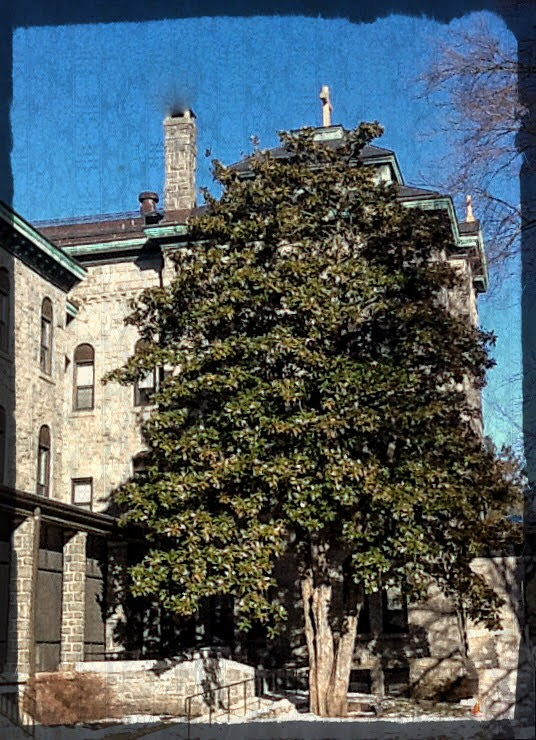
Outside my eastern window, the sky is still too dark to see the hearty Southern Magnolia that I know is only 30 feet away. Many years ago, it was gifted to the sisters in the hope of a northern blooming. And it has met that hope ever since.


Even though Southern Magnolias are evergreens, in spring, new leaves push off the old leaves – but not all at once.  Most deciduous trees lose their leaves in the fall, but Southern Magnolias will drop the older leaves in the spring – every spring.

-from NatureHills.com

Yesterday, I walked under it very carefully because it had aggressively begun to push its old pods off in preparation for its own Easter.


On this Holy Saturday, as we quiet our souls with our resting Jesus, let us be like the faithful magnolia. Let us search out and release all that is no longer life-giving in our spirits. 

This is a time to let go of internal clutter – perhaps old angers, grudges, prejudices that inhibit our joy.

It is a time to be honest about the junk we substitute for nourishment in our spiritual lives. Take a snapshot of your leisure time — how much of it is spent with things that can bring you closer to God?


The tomb where Jesus’s Body lay was empty, but for him it was full of Easter promise. For this day only, we are invited to be there with him in the pregnant emptiness and to listen to God’s promise of new life for us.

Therefore my heart is glad and my soul rejoices,
my body, too, abides in confidence;
because you will not abandon my soul to the netherworld,
nor will you suffer your faithful one to undergo corruption.

You will show me the path to life,
fullness of joys in your presence,
the delights at your right hand forever.

Psalm 16: 9-11

Poetry: Easter Night – Alice Meynell

All night had shout of men
And cry of woeful women filled his way;
Until that noon of sombre sky
On Friday, clamour and display smote him;
No solitude had He,
No silence, since Gethsemane.

Public was death;
But power, but Might,
But life again, but Victory,
Were hushed within the dead of night,
The shuttered dark, the secrecy.
And all alone, alone, alone,
He rose again behind the stone.

Music: Carlo Gesualdo: Tenebrae Responsories for Holy Saturday – Third Nocturn

Some of you may be interested in the content of these Holy Saturday texts. Here is the information from Wikipedia.

Responsories of the third nocturn of Holy Saturday

The three readings of the third nocturn of Holy Saturday are Hebrews 9:11–14, 9:15–18 and 9:19–22.

Astiterunt reges terrae

Aestimatus sum

Sepulto Domino

Sixth of Poulenc’s Sept répons des ténèbres

Law Yields to Love

Wednesday of the Second Week in Ordinary Time
January 18, 2023

Today’s Readings:

https://bible.usccb.org/bible/readings/011823.cfm

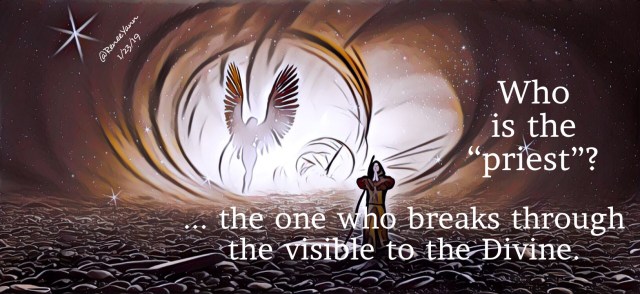
Today, in God’s Lavish Mercy,  the writer of Hebrews continues to shine light on the superior “priesthood” of Jesus Christ – that aspect of Christ’s ministry that breaks heaven open for us and reinstates us as God’s children.

heb2 priest

Hebrews calls Christ a priest “according to the order of Melchizedek” – an order above and beyond the priesthood of Aaron and Levi.

Although there are a few references to Melchizedek in scripture, only one narrative refers to him:

After Abram returned from defeating Kedorlaomer and the kings allied with him,
the king of Sodom came out to meet him in the Valley of Shaveh (that is, the King’s Valley).
Then Melchizedek king of Salem brought out bread and wine.
He was priest of God Most High, and he blessed Abram, saying,
“Blessed be Abram by God Most High,
    Creator of heaven and earth.
And praise be to God Most High,
    who delivered your enemies into your hand.”
Then Abram gave him a tenth of everything.

Genesis 14: 17-20

Melchizedek, whose priesthood preceded even Abraham, is offered in Hebrews as a prototype of Jesus who fulfills and perfects the Old Testament promises.

Does this matter to us modern day Christians who can barely say “Melchizedek “, let alone spell it? And if it does matter, how?

An answer may be revealed in our Gospel today. 

In it, Jesus challenges the old, pharisaical, law-bound way of thinking. As the new and perfect “priest”, Jesus breaks that way of thinking with the transformation of love. Jesus is the perfection of that which Melchizedek was only the forerunner.

Then he said to the Pharisees,
“Is it lawful to do good on the sabbath rather than to do evil,
to save life rather than to destroy it?”
But they remained silent.
Looking around at them with anger
and grieved at their hardness of heart,
Jesus said to the man, “Stretch out your hand.”
He stretched it out and his hand was restored.
The Pharisees went out and immediately took counsel
with the Herodians against him to put him to death.

Mark 3:3-6
  • This man with the withered hand is more important than the law. 
  • This act of healing and wholeness is more important than ritual adherence. 
  • The priesthood of Jesus is the breakthrough revelation of what God really desires – mercy, not sacrifice.

Poetry: Excerpt from John Berryman’s Eleven Addresses to the Lord

John Berryman (1914 – 1972) was an American poet and scholar. He was a major figure in American poetry in the second half of the 20th century and is considered a key figure in the “confessional” school of poetry. Eleven Addresses to the Lord describes, with an interplay of sincerity and irony, the poet’s struggle to believe. Section 10 below reveals love over law as a key factor in Berryman’s evolving faith.

10

Fearful I peer upon the mountain path
where once Your shadow passed, Limner of the clouds
up their phantastic guesses. I am afraid,
I never until now confessed.
I fell back in love with you, Father, for two reasons:
You were good to me, & a delicious author,
rational & passionate. Come on me again,
as twice you came to Azarias & Misael.
President of the brethren, our mild assemblies
inspire, & bother the priest not to be dull;
keep us week-long in order; love my children,
my mother far & ill, far brother, my spouse.
Oil all my turbulence as at Thy dictation
I sweat out my wayward works.
Father Hopkins said the only true literary critic is Christ.
Let me lie down exhausted, content with that.

Music: Love Broke Thru ~ Toby Mac

The Promise and Hope

Memorial of Saint Anthony, Abbott
January 17, 2023

Today’s Readings:

https://bible.usccb.org/bible/readings/011723.cfm

Today, in God’s Lavish Mercy, our passage from Hebrews is a strong encouragement to stay faithful to the hope that has been given us through our call.

eph1_17 call

Paul traces the evolution of that call by reminding his readers of Abraham who trusted God’s promise and patiently waited for its fulfillment. Paul says that God not only promised Abraham, God swore an oath to bless and multiply Abraham’s life.


This promise and oath of God’s faithful covenant is the root of our Christian hope, and the “anchor” of our life.

Green Rope

When we have been promised something by someone we trust, we are given the gift of freedom to move forward in confidence. I’ll give you a very simple and human example. When I had my first knee replacement, my very appropriately-named surgeon Dr. Good came and sat at my bedside immediately before surgery. He told me that he was going to perform the surgery himself and that he would support me until I was completely recovered. I can’t describe the freedom and confidence his promise gave me!

Now take that kind of promise up a notch — an infinite number of notches — to a promise made by God.

So when God wanted to give the heirs of his promise
an even clearer demonstration of the immutability of his purpose,
he intervened with an oath,
so that by two immutable things,
in which it was impossible for God to lie,
we who have taken refuge might be strongly encouraged
to hold fast to the hope that lies before us.
This we have as an anchor of the soul,
sure and firm, which reaches into the interior behind the veil,
where Jesus has entered on our behalf as forerunner…

Hebrews 6:17-18

Paul’s language might seem a little dense to us but basically he is saying that God has promised to be with us forever and to bring us to the fullness of eternal life. Thinking about that, the image of Dr. Good pops up in my memory.

In your own prayer, you might recall a circumstance that gave you the same kind of promised confidence and peace… perhaps a parent who consoled your young doubts, or a friend who promised support in a difficulty. Imagine that feeling multiplied infinitely by the loving promise of God to sustain us with Eternal Life.


Poetry: Anchored to the Infinite – Edwin Markham was popular American literary figure during the first half of the 20th century whose works espoused progressive social and spiritual beliefs.

The builder who first bridged Niagara’s gorge,
Before he swung his cable, shore to shore,
Sent out across the gulf his venturing kite
Bearing a slender cord for unseen hands
To grasp upon the further cliff and draw
A greater cord, and then a greater yet;
Till at the last across the chasm swung
The cable then the mighty bridge in air!
So we may send our little timid thought
Across the void, out to God’s reaching hands—
Send out our love and faith to thread the deep—
Thought after thought until the little cord
Has greatened to a chain no chance can break,
And we are anchored to the Infinite!

Music: Blessed Assurance – written by Fanny Crosby (1820 – 1915) an American mission worker, poet, lyricist, and composer. She was a prolific hymnist, writing more than 8,000 hymns and gospel songs, with more than 100 million copies printed. She is also known for her teaching and her rescue mission work. By the end of the 19th century, she was a household name. Crosby was known as the “Queen of Gospel Song Writers” and as the “Mother of modern congregational singing in America”, with most American hymnals containing her work.

Becoming Wine

Christmas Weekday
January 7, 2023

Today’s Readings:

https://bible.usccb.org/bible/readings/010723.cfm

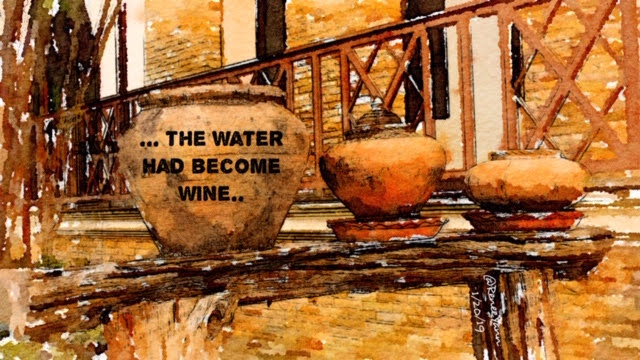
Today, in God’s Lavish Mercy, we have the belovedly familiar story of the Miracle at Cana.

There was a wedding at Cana in Galilee,
and the mother of Jesus was there.
Jesus and his disciples were also invited to the wedding.
When the wine ran short,
the mother of Jesus said to him,
“They have no wine.”

John 2: 1-3

Like all good stories, this one is engaging on so many levels:

  • We see Mary and Jesus enjoying a social event in the same way we would.
  • We see Mary extending her solicitude and influence for the sake of the hosting family.
  • We see Jesus needing a swift nudge from his mother to do the right thing!
  • We see the Apostolic tipsters slowly waking up to the fact that Jesus is not just the guy next door!

We can pray with this Gospel passage by entering it from any one of these, or other, perspectives. We can easily sit right down at one of the wedding tables and watch the slow, human revelation of God in the world. But I think our first reading makes a strong case for us to pray the Cana story as a perfect example of how we should make our prayers of petition.


If you’re like me, you ask God for a lot of things every single day. Some of them are big deal things like “Please move hearts to stop the war on Ukraine.” And some of them are little deals like, “Please don’t let it rain on my picnic!”

In our first reading, John tells us how to pray our needs to God – with the utter confidence that, within God’s Will, we are heard.

Beloved:
We have this confidence in God,
that if we ask anything according to God’s will, we are heard.
And if we know that God hears us in regard to whatever we ask,
we know that what we have asked for is ours.

1 John 5: 14-15

This is the way Mary offers her petition in our Gospel story. She knows that Jesus will hear her and do the right thing. She doesn’t niggle him to death to get it done. She knows that by her “prayer”, she is now present to God’s infinite awareness of our needs.

His mother said to the servers,
“Do whatever he tells you.”

John 2:5

In this case, that “right thing” was to turn huge vats of water into delicious wine. A very satisfying outcome! But what about when our prayer doesn’t result in a deluge of wine? What about when it seems like God paid no attention to our request? Can we still have the unyielding confidence which John encourages and Mary exemplifies?

Our faith calls us to believe that God is present with us in all things. Our prayer opens us to seek that Presence and to respond in faith to our circumstances knowing that even when the vessels seem empty, God abides. Ours is a life in God not limited to one petition, or one prayer. It is an incremental immersion into an Eternal Truth which transcends any particular circumstance. God is always with us and that alone is the source of our confident prayer.

We also know that the Son of God has come
and has given us discernment to know the one who is true.
And we are in the one who is true, in God’s Son Jesus Christ.
He is the true God and eternal life.

1 John 5:20

Poetry: Cana Wine – Irene Zimmerman, OSF

“The weather’s so hot
and no more wine’s to be bought
in all of Cana!
It’s just what I feared—
just why I begged my husband
to keep the wedding small.”

“Does he know?” Mary asked.

“Not yet. Oh, the shame!
Look at my son and his beautiful bride!
They’ll never be able
to raise their heads again,
not in this small town.” 
“Then don’t tell him yet.”
Mary greeted the guests
as she made her way
through crowded reception rooms.
“I must talk to you, Son,”
she said unobtrusively. 

Moments later he moved
toward the back serving rooms.
They hadn’t seen each other
since the morning he’d left her—
before the baptism
and the desert time. 

There was so much to tell her,
so much to ask.
But this was not the time!
They could talk tomorrow
on the way to Capernaum.
She spoke urgently, her words
both request and command to him:
“They have no wine.”
But he hadn’t been called yet!
He hadn’t felt it yet.
Would she send him so soon
to the hounds and jackals?
For wine? 

Was wine so important then? 

“Woman, what concern is that
to you and me?
My hour has not yet come.”

Her unflinching eyes reflected to him
his twelve-year-old self
telling her with no contrition:
“Why were you searching for me?
Did you not know I must be
in my Father’s house?” 

She left him standing there—
vine from her stock,
ready for fruit bearing—
and went to the servants.
“Do whatever he tells you,” she said. 

From across the room
she watched them fill water jars,
watched the chief steward
drink from the dripping cup,
saw his eyes open in wide surprise. 

She watched her grown son
toast the young couple,
watched the groom’s parents
and the guests raise their cups.

She saw it all clearly:
saw the Best Wine
pouring out for them all.

Music: od Hears Our Prayers – Mandy Lining

Cherish Your Baptism

Christmas Weekday
January 6, 2023

Today’s Readings:

https://bible.usccb.org/bible/readings/010623.cfm

Today, in God’s Lavish Mercy, we may be used to celebrating the Feast of the Epiphany. But those who generate the Church calendar have reserved that celebration for this coming Sunday.

We are blessed instead with dynamic readings, triumphant in tone, calling us to celebrate our life in Christ:

Beloved:
Who indeed is the victor over the world
but the one who believes that Jesus is the Son of God?
….
I write these things to you so that you may know
that you have eternal life,
you who believe in the name of the Son of God.

1 John 5: 5;13

In a way, John calls us to a personal epiphany — the realization of the indescribable gift of grace we have received through Baptism. He enjoins us to live audaciously within the power of that realization.


In our short but powerful Gospel, we see Jesus burst into that audacious living:

The Baptism Of Jesus is a painting by Jeff Haynie
For purchase, see:
https://fineartamerica.com/featured/the-baptism-of-jesus-jeff-haynie.html

It happened in those days that Jesus came from Nazareth of Galilee
and was baptized in the Jordan by John.
On coming up out of the water he saw the heavens being torn open
and the Spirit, like a dove, descending upon him.
And a voice came from the heavens,
“You are my beloved Son; with you I am well pleased.”

Matthew 1:9-11

In the power of Jesus
rising through the Baptismal waters,
may we too live each new day
in cascade of faith, hope and love.


Poetry: Variation on a Theme by Rilke from Breathing the Water by Denise Levertov


A certain day became a presence to me;
there it was, confronting me--a sky, air, light:
a being. And before it started to descend
from the height of noon, it leaned over
and struck my shoulder as if with
the flat of a sword, granting me
honor and a task, The day's blow
rang out, metallic--or it was I, a bell awakened,
and what I heard was my whole self
saying and singing what it knew: I can.

Music: Cherish by Aeoliah

Fig Trees and Ladders

Memorial of Saint John Neumann, Bishop
January 5, 2023

Today’s Readings:

https://bible.usccb.org/bible/readings/010523.cfm

Today, in God’s Lavish Mercy,  we celebrate the Memorial of Saint John Neumann. 

John Neumann was born in Bohemia on March 20, 1811. Since he had a great desire to dedicate himself to the American missions, he came to the United States as a cleric and was ordained in New York in 1836 by Bishop Dubois.

In 1840, John Neumann entered the Congregation of the Most Holy Redeemer (Redemptorists). He labored in Ohio, Pennsylvania and Maryland. In 1852, he was consecrated bishop of Philadelphia. There he worked hard for the establishment of parish schools and for the erection of many parishes for the numerous immigrants. Bishop Neumann died on January 5, 1860; he was beatified in 1963.
(catholicculture.org)


jn1_50 figjpg

In our first reading today, John tells us bluntly:

Whoever does not love remains in death.

1 John 3:14

This kind of statement is what one might both love and hate about John. We love it because it’s clear, unequivocal – tells us exactly what we need to do.

And we hate it because it’s clear and unequivocal – there’s no evading it, no back door. We must love – everybody- or we are as good as dead. Wow!


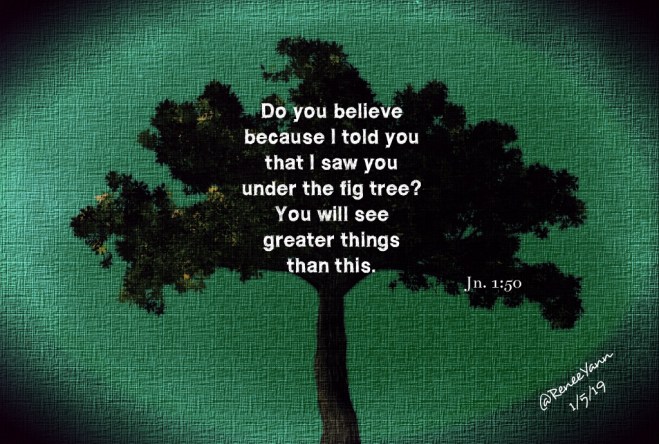
Was this the kind of either-or that Nathaniel struggled with under the fig tree? He sat there pondering some deep challenge or decision and Jesus saw him – and understood – from afar.

The miracle of that moment caused Nathaniel to believe. But Jesus says something like this to Nathaniel:

Hold up, you ain’t seen nothin’ yet! Your little wrestling under the fig tree was all about your own small world and vision. I invite you now to see the world with God’s eyes.


We all spend worrying time under the shadow our own little fig trees – most of the time worrying about ourselves – who hurt us, doesn’t like us, gets in our way, misunderstands or annoys us.

Today’s Gospel invites us to stop licking our wounds. It beckons us out of the shadows of our self-absorption to see what God might see today – the beauty, the needs, the challenges and possibilities of the world around us. We are invited to become lovers and healers like Jesus.

As John has said, we are invited to leave any shadow of death and to live in love:

The way we came to know love
was that he laid down his life for us;
so we ought to lay down our lives for our brothers.
If someone who has worldly means
sees a brother in need and refuses him compassion,
how can the love of God remain in him? 
Children, let us love not in word or speech
but in deed and truth.

1 John 3:16-18

Poem: In the following poem, Malcolm Guite compares the spiritual transformations of Jacob and Nathaniel.

Jesus called Nathaniel “a true Israelite” and tells him: “… you will see the sky opened and the angels of God ascending and descending on the Son of Man.” This is a clear reference to the story of Jacob’s Ladder from Genesis, where in a dream God transforms Jacob’s life to become the Patriarch of Israel.

Jacob left Beersheba and set out for Harran. When he reached a certain place, he stopped for the night because the sun had set. Taking one of the stones there, he put it under his head and lay down to sleep. He had a dream in which he saw a stairway resting on the earth, with its top reaching to heaven, and the angels of God were ascending and descending on it. There above it stood the Lord, and he said: “I am the Lord, the God of your father Abraham and the God of Isaac. I will give you and your descendants the land on which you are lying. Your descendants will be like the dust of the earth, and you will spread out to the west and to the east, to the north and to the south. All peoples on earth will be blessed through you and your offspring.

Genesis 28:10-15

Nathaniel’s Awakening – Malcolm Guite

A fugitive and exile, Jacob slept,
A man of clay, his head upon a stone
And even in his sleep his spirit wept
He lay down lonely and would wake alone.
But in the night he dreamt the Heavens parted
And glimpsed, in glory, as from Heaven’s core,
A ladder set for all the broken-hearted
And earth herself becoming Heaven’s door.
And when the nameless Angel named him Israel
He kept this gift, whose depth he never knew;
The promise of an end to all our exile,
For now a child of Israel finds it true,
And sees the One who heals the deep heart’s aching
As Jacob’s dream becomes Nathanael’s waking.

Music: Maybe Nathaniel sang a song like this in his heart as he came out from under his fig tree.

Love Like Jesus – Rhett Walker