Today, in God’s Lavish Mercy, Jesus and Paul continue their heart-wrenching farewell addresses.
We’ve become accustomed to the passages and may read them without much emotional investment, but honestly they are real “weepers” – like movies where you have to bite the edge of your popcorn cup to keep from sobbing out loud.
St. Paul Bids Farewell to the Ephesians
Look at Acts, for example, and put yourself in the scene:
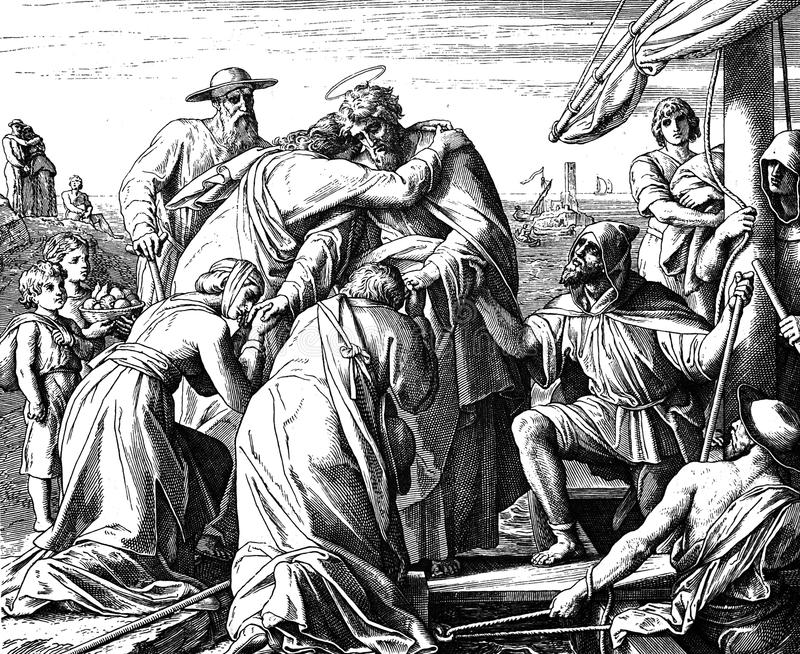
When Paul had finished speaking he knelt down and prayed with them all. They were all weeping loudly as they threw their arms around Paul and kissed him, for they were deeply distressed that he had said that they would never see his face again. Then they escorted him to the ship.
Acts 20: 36-38
The verses from John are not quite so emotional, but picture yourself being prayed over like this. You sense that this is really a final blessing. You know these may be some of Christ’s last words you will ever hear.
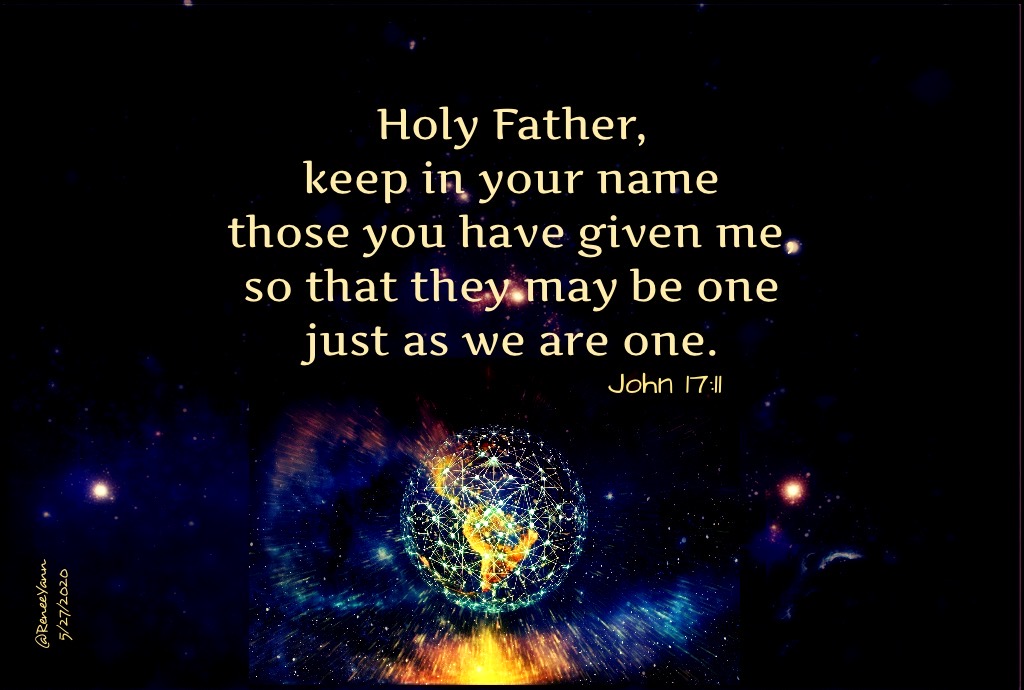
Holy Father, keep them in your name that you have given me, so that they may be one just as we are one.
John 17: 11
As we pray with today’s scriptures, we are reminded that goodbyes are awfully hard. We need to mourn them within a community of faith lest our hearts break from their weight.
So many of us, in these sorrowful times, feel the deep pain of those suffering senseless violence and unprovoked war. We can only imagine the loss of bereaved families in Buffalo, NY and devastated parents and children in Uvalde, TX. We feel anger and horror at the suffering of the Ukrainian people.
In the throes of such pain, we need to tell one another the stories of our loved ones, to sing together our belief in eternal life, to prove that we can still find joy in kept memories, to cry at the sight of one another’s tears, and to act for justice in the name of one another’s suffering. This is what Jesus did.
Let us find courage and sustaining hope in the core of Jesus’s message today:
Father, now I am coming to you. I speak this in the world so that those you have given me may share my joy completely.
All that we love, and may seem to have lost, is preserved and transformed – complete and joyful – in the infinite love of God.
We too can be there in our prayer. We may be shaken by loss, but we are confident in faith. We know and believe that we are all kept in God’s Name. That faith gives us the power to transform our wounded world.
Poetry: Hymn for the Hurting – By Amanda Gorman Ms. Gorman is a poet and the author of “The Hill We Climb,” “Call Us What We Carry” and “Change Sings.”
Everything hurts, Our hearts shadowed and strange, Minds made muddied and mute. We carry tragedy, terrifying and true. And yet none of it is new; We knew it as home, As horror, As heritage. Even our children Cannot be children, Cannot be.
Everything hurts. It’s a hard time to be alive, And even harder to stay that way. We’re burdened to live out these days, While at the same time, blessed to outlive them.
This alarm is how we know We must be altered — That we must differ or die, That we must triumph or try. Thus while hate cannot be terminated, It can be transformed Into a love that lets us live.
May we not just grieve, but give: May we not just ache, but act; May our signed right to bear arms Never blind our sight from shared harm; May we choose our children over chaos. May another innocent never be lost.
Maybe everything hurts, Our hearts shadowed & strange. But only when everything hurts May everything change.
Music: Aaronic Benediction – Misha and Marty Goetz
Today , in God’s Lavish Mercy, we read in Acts about Baptism in the Spirit and the powers it bestows. When Paul encounters some believers who have received the Baptist’s rite of repentance, he asks if they had received the Holy Spirit.
Their simple answer kind of amuses me:
We’ve never even heard of him!
Paul remedies the situation with a few quick sacramental steps and:
… they were baptized in the name of the Lord Jesus. And when Paul laid his hands on them, the Holy Spirit came upon them, and they spoke in tongues and prophesied.
When I read passages like this, I sometimes wonder what has happened in the millennia since those early Spirit-filled Baptisms… since the days when the Holy Spirit seems to have burst out all over in flames, wonders and eloquence.
Has the Holy Spirit changed? Diminished? Is Her battery running low? Or have we changed … the Church and we members who comprise it?
I guess we all know the answer, given our faith in a changeless God.
So why doesn’t the Holy Spirit blaze for us as She did for those twelve Ephesians in today’s reading?
I think it’s a matter of how we see, and listen.
Sir John Lubbock, a 19th century scientist and polymath wrote this: “What we see depends mainly on what we look for. … In the same field the farmer will notice the crop, the geologists the fossils, botanists the flowers, artists the colouring, sportmen the cover for the game. Though we may all look at the same things, it does not all follow that we should see them.”
John Lubbock, The Beauties of Nature and the Wonders of the World We Live In
Might not this wisdom apply as well to how we perceive the Spirit in our lives?
If in our daily experiences and interactions, we remain on a superficial, distracted relationship with what is sacred in all Creation, then we – like the fellows in our reading – may “never even hear” of the Holy Spirit.
But if, by prayer and contemplation, we open ourselves to what is holy in everything around us, then what we see and hear, what we feel and respond to begins to change — to catch fire.
During this week leading up to Pentecost, we might try this practice: let’s look more intensely for the Spirit in our daily lives by noticing the presence (or absence) of the Spirit’s gifts.
How are our choices, conversations, judgements, reactions reflective of these gifts?
In my experiences each day, what persons or circumstances have mirrored these gifts? What has overshadowed or eradicated them?
The Holy Spirit’s heart beats alive and well within all Creation. I might just need to dust off my stethoscope a bit to hear it! Maybe this beautiful poem will help.
God’s Grandeur- Gerard Manley Hopkins, SJ
The world is charged with the grandeur of God.
It will flame out, like shining from shook foil;
It gathers to a greatness, like the ooze of oil
Crushed. Why do men then now not reck his rod?
Generations have trod, have trod, have trod;
And all is seared with trade; bleared, smeared with toil;
And wears man’s smudge and shares man’s smell: the soil
Is bare now, nor can foot feel, being shod.
And for all this, nature is never spent;
There lives the dearest freshness deep down things;
And though the last lights off the black West went
Oh, morning, at the brown brink eastward, springs —
Because the Holy Ghost over the bent
World broods with warm breast and with ah! bright wings.
Meditation: God’s Grandeur- read so beautifully by Samuel West
( I’m going a little off the grid this morning because we get a double chance to celebrate the Feast of the Ascension with its recurrence this Sunday. So I will leave my scriptural reflection until then.)
For me, the celebration of Ascension will always be on a Thursday – and it will always belong especially to my Dad. Here’s why.
I was already a young nun in the early 1970s when I went home to visit my parents one beautiful May afternoon. We had a day off from school to commemorate the Feast of the Ascension.
That’s me in pink before nunhood
My Dad was sitting on the front steps contemplating a patch of pachysandra on our small front lawn, or so I thought. After initial hugs and greetings, Dad said, “I’m worried about something.” Worry bells starting ringing deep in my brain. Where was Mom!?!?
“Joe Brodski just walked by a little while ago”, Dad continued. I paused a moment to consider this seeming non-sequitor.
Now Joe Brodski never walked anywhere. He was our next-door neighbor whose only apparent activity was tumbling out of his house and into his car each morning to go to work. So I began to think that maybe the worry was about Joe Brodski, and not my Mom who had not yet appeared on the front steps.
“So what’s the worry, Dad?”, I asked.
“Well, I asked Joe why he was out walking and he told me he was coming back from church. Ren, I completely forgot it was Thursday – the Ascension – and now all the Masses are over!”
Dad was really distressed by this oversight and it took a little theologizing on my part to allay his concern. Still, his reaction was so sincere that it has stayed with me for nearly fifty years. I never fully appreciated my Dad’s deep spirituality – nor the embedded culture of faith in our home – until I had grown up and moved away.
Many years after that Thursday, I read David Foster Wallace’s famous graduation talk at Kenyan University. He opens the talk like this:
There are these two young fish swimming along and they happen to meet an older fish swimming the other way, who nods at them and says “Morning, boys. How’s the water?” And the two young fish swim on for a bit, and then eventually one of them looks over at the other and goes “What the hell is water?”
Wallace goes on to explain, “The point of the fish story is merely that the most obvious, important realities are often the ones that are hardest to see and talk about.”
We didn’t talk a lot about faith in my family, we just practiced it. And that practice was like fish swimming in water. We didn’t even realize that faith was the medium soaking our whole lives.
When Dad realized that he had forgotten to go to Mass that day, he felt like the proverbial “fish out of water”. The deep abiding faithfulness of his life had suffered a little fracture.
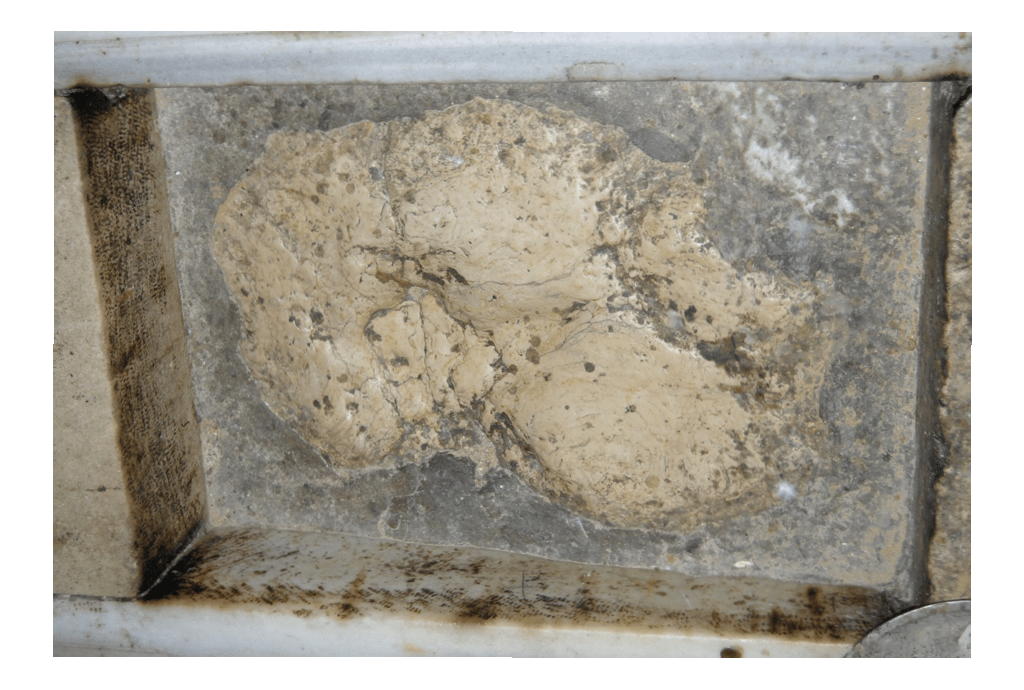
In Jerusalem, there is an ancient stone on a hillside. People venerate it as the site from which Jesus ascended into heaven. There is a deep indentation in the stone which is believed to be the last footprint of Christ on the earth as He lifted toward heaven. Whether it actually is the site isn’t important. What matters is that the life of Jesus has left an everlasting impression on our hearts and souls – a well of grace which continues to feed our spirits.
Stone as it is today.Outline of foot
My Dad’s unassuming holiness has left the same kind of impression on me. It is a touch point which I visit many times during the year, but especially on Ascension Thursday.
I tell the story today because this Feast might be a good time for all of us to consider the “water” we swim in – that culture of faith which nourishes our life – and the life of our family and loved ones.
You may want to bless the many sources that have inspired and fed your faith over your lifetime – perhaps in your family, and perhaps in others relationships. Doing so can be a recurring source of grace even if the “inspirer” has, like Jesus and like my Dad, made their way back to heaven.
And we all might want to consider who depends on us for the nurturing water of their faith!
Music: My Father’s Faith – Janice Kapp Perry
A father’s faith can bless his little children
And help them rise above life’s daily storms.
A father works each day to keep his dear ones
Ever protected, safe and warm.

My father’s praise can send my spirit soaring
And help me see the good I may achieve.
My father’s trust can fill my soul with courage
And help my doubting heart believe.

My father’s tears can somehow say, “I love you”
When words fall silent in his tender heart.
Through daily acts of service and of caring
His deepest feelings he imparts.

My father’s prayers can call down heaven’s blessings
And keep his children walking in the light.
His constant strength is steady as a lighthouse
That brings me safely through the night.

My father’s arms can offer consolation
When I, in sorrow, turn my heart toward home.
His loving voice resounds within my being
To help me know I’m not alone.

My father’s eyes can see past faults and failings
And still imagine all I may become.
And when I fall he’s there to walk beside me
To tell me I can overcome.

My father’s love will shine through generations –
A gentle force that guides me through the years.
My father’s faith will be my inspiration
And make my path to heaven clear.
Today, in God’s Lavish Mercy, Paul gives a magnificent oration at the Areopagus in Athens. It was a big deal billing!
St. Paul at the Areopagus by Raphael (c.1515)
Areopagus, earliest aristocratic council of ancient Athens. The name was taken from the Areopagus (“Ares’ Hill”), a low hill northwest of the Acropolis, which was its meeting place.
In pre-classical times (before the 5th century BC), the Areopagus was the council of elders of the city, similar to the Roman Senate. Like the Senate, its membership was restricted to those who had held high public office.
The Areopagus, like most city-state institutions, continued to function in Roman times, and it was from this location, drawing from the potential significance of the Athenian altar to the Unknown God that Paul is said to have delivered the famous speech, “Now what you worship as something unknown I am going to proclaim to you. The God who made the world and everything in it is the Lord of heaven and earth and does not live in temples built by hands.” (Wikipedia)
The sermon has so many beautiful lines, like glorious diamonds that can be turned over and over in prayer. Here are a few that glistened for me:
God … does not dwell in sanctuaries made by human hands (Instead, God dwells within us)
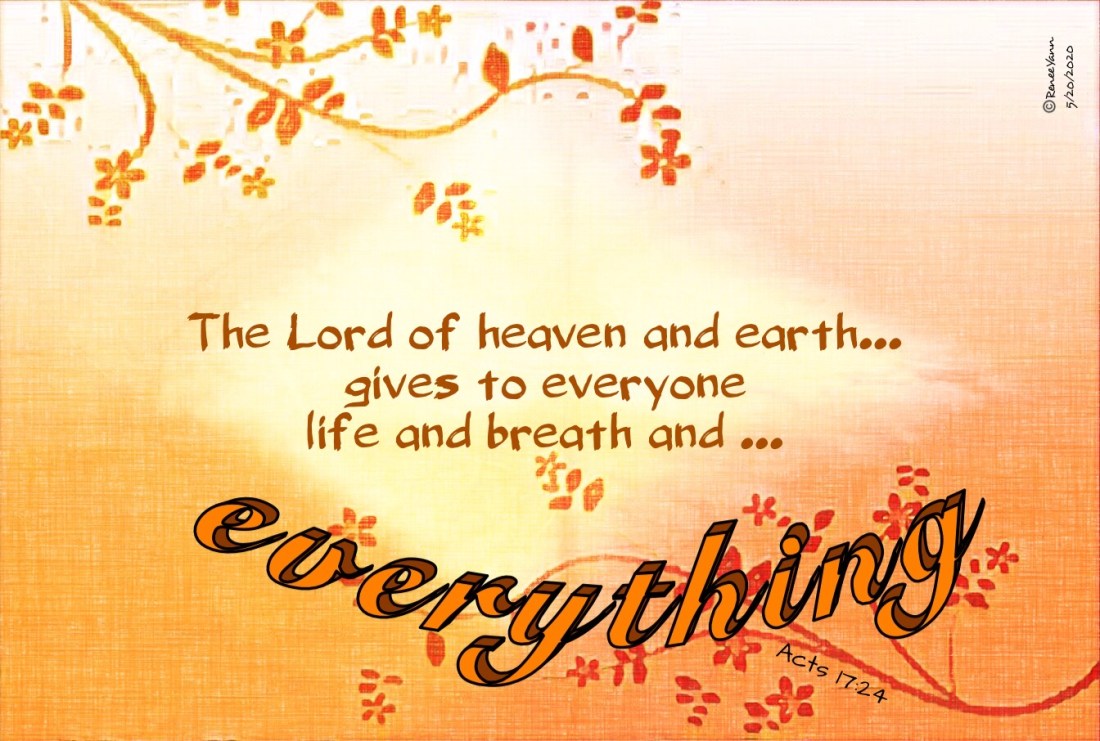
God is not served by human hands because God needs nothing. (Instead, our everything comes from God)
God made from one the whole human race to dwell on the entire surface of the earth. (We are all connected in the One Creation)
God fixed the ordered seasons and the boundaries of their regions, so that people might seek God, even perhaps grope for him and find him, though indeed he is not far from any one of us. (We do grope, sometimes in darkness.)
God has overlooked the times of ignorance, but now God demands that all people everywhere repent… (Without Christ, we were in shadows of unknowing. With Christ, we are in Light.)
And my favorite:
What is the “everything” that God is giving you today? What is the abundance of grace, or hope, or longing in your heart as you pray today? Let God’s fullness embrace any emptiness as you offer God your silence and waiting.
Poetry: Everything – Rumi
Love is
when God says to you
"I have created everything for you",
and you say
"I have left everything for You."
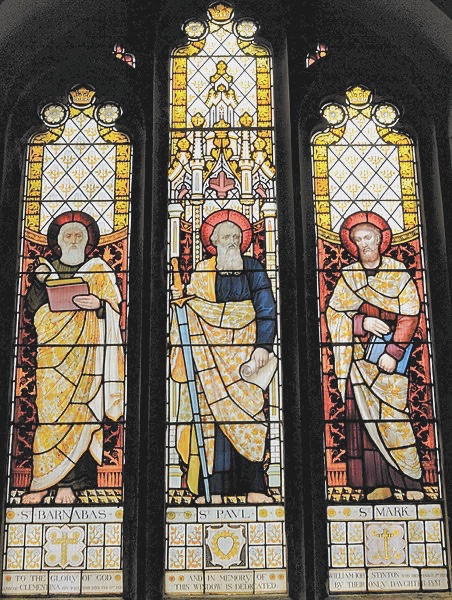
Barnabas, Paul and Mark window St. Patrick’s Church, Sussex, England
Today, in God’s Lavish Mercy, and for much of this and next week, we travel with Paul on his first missionary journey. Acts 13 and 14 make for some interesting historical reading, revealing how the early Church took form, how leadership emerged, and how various congregations sparked the spread of the Gospel.
These passages also offer at least two important thoughts to enrich our faith and spiritual life:
They recount a compact synthesis of Salvation History, the story of God’s faithfulness to Israel and, through Jesus Christ, to us. It is a truly marvelous story. Praying with it can make us amazed and grateful that we are now a living part of its continuing grace.
They clearly establish the Christian life as a missionary life – one meant to receive but also to share the Good News of the Gospel.
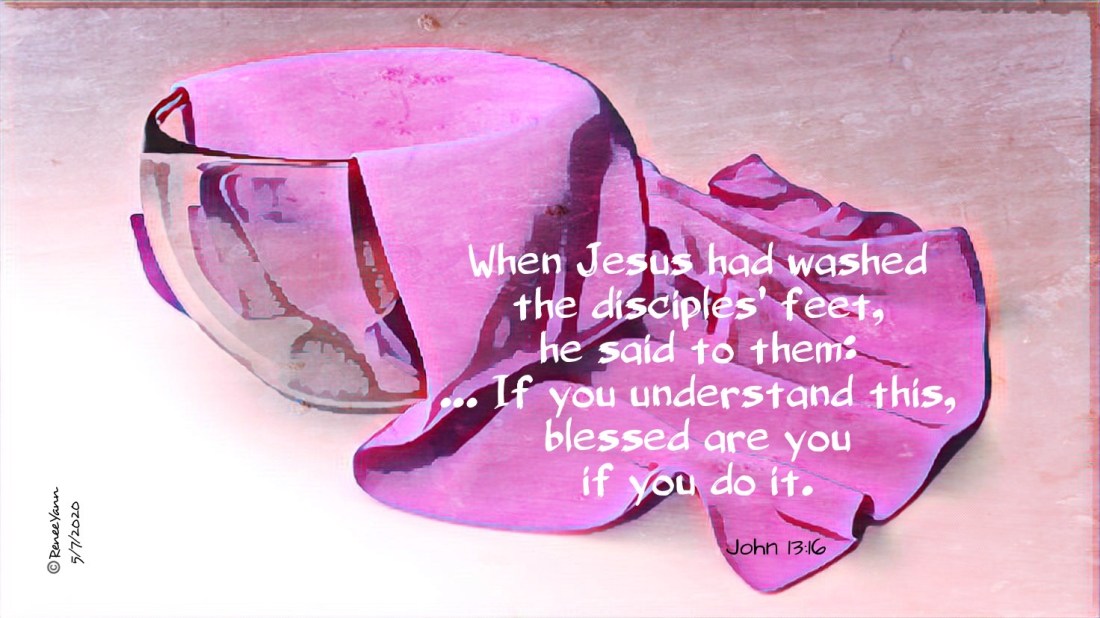
In our Gospel, Jesus, by washing the feet of his companions, clearly demonstrates the key characteristic of a true missionary disciple — sacrificial love rendered in humble service.
Amen, amen, I say to you, no slave is greater than his master nor any messenger greater than the one who sent him. If you understand this, blessed are you if you do it.
John 13: 16-17
Jesus commissions his disciples to imitate his love. He promises to be present with them as they minister in his name:
Amen, amen, I say to you, whoever receives the one I send receives me, and whoever receives me receives the one who sent me.
John 13:20
Jesus wasn’t just talking to a little dinner party gathered long ago. He was talking to us. For our time and place in history, we are the ones commissioned for Love.
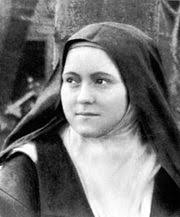
Our service of the Gospel may take us on exciting journeys like Paul. Or we may be missionaries of prayer and charity, like Thérèse of Lisieux who, though she never left her cloister, was declared Patroness of the Missions by Pope Pius XI.
“O Jesus, my Love, my Life … I would like to travel over the whole earth to preach Your Name and to plant Your glorious Cross on infidel soil. But O my Beloved, one mission alone would not be sufficient for me. I would want to preach the Gospel on all five continents simultaneously and even to the most remote isles. I would be a missionary, not for a few years only but from the beginning of creation until the consummation of the ages.”
Thérèse of Lisieux – Story of a Soul
In our prayer today, perhaps we might ask Paul, Barnabas, Thérèse or another of our favorite saints to help us see more clearly our own call to carry the mission in our lives.
Poetry: HERE I WILL STAY – Sister Carol Piette, M.M., also known as Sister Carla, entered Maryknoll Sisters in 1958. She was sent to Chile, where she was a teacher and a pastoral care worker and continued to serve the poor during Chile’s military coup in 1973. In 1980 she was assigned to El Salvador to accompany internal refugees who were fleeing violence. Piette died on August 24, 1980 while crossing a flooded river in an attempt to help a father return to his family. “Here I Will Stay” was published in her biography, Vessel of Clay: The Inspirational Journey of Sister Carla (2010), by Jacqueline Hansen Maggiore. (from https://vocationnetwork.org/en/articles/show/599-word-as-witness-to-the-word)
The Lord has guided me so far And in His guidance, He has up and dropped me here, at this time and in this place of history. To search for and to find Him; Not somewhere else, But here.
And so HERE I WILL STAY, Until I have found that broken Lord, in all His forms, And in all His various pieces, Until I have completely bound-up His wounds and covered His whole Body, His People, with the rich oil of gladness.
And when that has been done, He will up and drop me again— Either into His Promised Kingdom, or into the midst Of another jigsaw puzzle of His broken Body, His hurting People.
Today, in God’s Lavish Mercy, the image of God’s hands emerges in each of our readings.
There were some …. proclaiming the Lord Jesus. The hand of the Lord was with them and a great number who believed turned to the Lord.
Acts 11:21
I know them, and they follow me. I give them eternal life, and they shall never perish. No one can take them out of my hand.
John 10:28
My Father, who has given them to me, is greater than all, and no one can take them out of the Father’s hand.
John 10:29
Each of these images evokes and inspires our trust that God abides with and sustains us – that we are in God’s hands.
We all know what it’s like to place ourself in someone else’s hands. Sometimes we do it willingly, sometimes not. Sometimes it is an act of trust, sometimes fear.
This morning, as I pray, I remember two parallel but distinctly different incidents of being in someone else’s hands.
In the first, I went with friends on a drive to the top of Pike’s Peak in Colorado. It was before the serpentine road was paved in 1999. The driver was the young cowboy nephew of one of the passengers, and he thought it was really fun to scare us out of our wits. He took the many curves and switchbacks at headlong speed. I closed my eyes and started praying. It was uncomfortable being in his hands, so to speak.
The second memory is more recent. Just before my knee replacement surgery, as I lay slightly anesthetized in pre-op, my surgeon came to the bedside. He sat down, took my hand and said, “I want you to know that I will do the surgery myself and be with you the whole time. I am putting my initials on your knee so you can be certain I’ll fix the right one.” He smiled, and I again closed my eyes and started praying.
What different prayers they were! One was begging God to intervene and save me. The other was thanking God for putting me in trustworthy hands.
With God, we are always in trustworthy hands. Indeed, sometimes it may feel like God is flying over the edge of Pike’s Peak with us in the back seat. But here’s the thing: God is in the car with us – and God always lives! If we give ourselves completely to God in trust, we will live too.
Eventually, our practice of trust grows enough to comfort us in all things. We realize God is always sitting beside us, taking our hand, assuring us of that Loving Presence Who always abides.
A great freedom comes with that realization, steeped in years of trust and understanding that God’s Will for us is our eternal good. The preachers in Acts today, and the disciples in John rejoiced and acted in such trust. May we too be strengthened, blessed, and impelled by it.
Poetry: Reconciliation – Renee Yann, RSM
The hands of God love me when I cannot see God’s face. Like salve, they warmly run over, in, and out of me, pausing where my hurt is knotted, barbed to their approach… mother’s hands, lover’s, friend’s, my own hands held in God’s hands, healing self-estrangement.
I come to God’s hands like broken earth stretches for redeeming rain. Even in the deep night, where God will not speak, those loving hands are words which I answer in the darkness.
Music: Into Your Hands – Ray Rep
Into Your hands we commend our spirit –Ray Repp
Into Your hands we commend our spirits O Lord, Into Your hands we commend our hearts. For we must die to ourselves in loving You, Into Your hands we commend our love.
O God, my God, why have You gone from me, Far from my prayers, far from my cry? To You I call and you never answer me, You send no comfort and I don’t know why!
You’ve been my guide since I was very young, You showed the way, you brought relief; But now I’m lonely, nobody’s by my side: Take heed, my Lord, listen to my prayer.
Today, in God’s Lavish Mercy, our three readings make one thing very clear – we are ALL invited to membership in the Body of Christ. We are ALL welcome in the Beloved Community.
In our first reading, Paul and Barnabas preach to Jews, converts to Judaism and to Gentiles – to the effect that:
All who were destined for eternal life came to believe, and the word of the Lord continued to spread through the whole region.
Acts 13:48
In our second reading:
John, had a vision of a great multitude, which no one could count, from every nation, race, people, and tongue. They stood before the throne and before the Lamb.
Revelation 2:9
And in our Gospel, Jesus says:
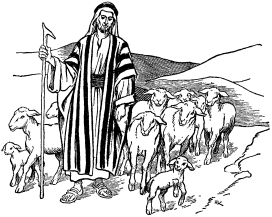
My sheep hear my voice; I know them, and they follow me. I give them eternal life, and they shall never perish.
John 10:27
These readings describe the family of God to which every human being has been given entrance through the Death and Resurrection of Christ.
Think about that:
when you look into people’s eyes today
when you see their stories on the news
when you people-watch at the airport or the mall
when you drive by a cemetery where lives are remembered in stone
when you look at your children, your friends, your foes
when you take that last look in the mirror tonight before you fall asleep
This person has been invited, with me, to the family of God. How might that thought influence my choices and actions each day?
All of us – ALL OF US- are welcome; all of us, equally loved.
Poetry: O Shepherd of Souls – Hildegard of Bingen (1098–1179)
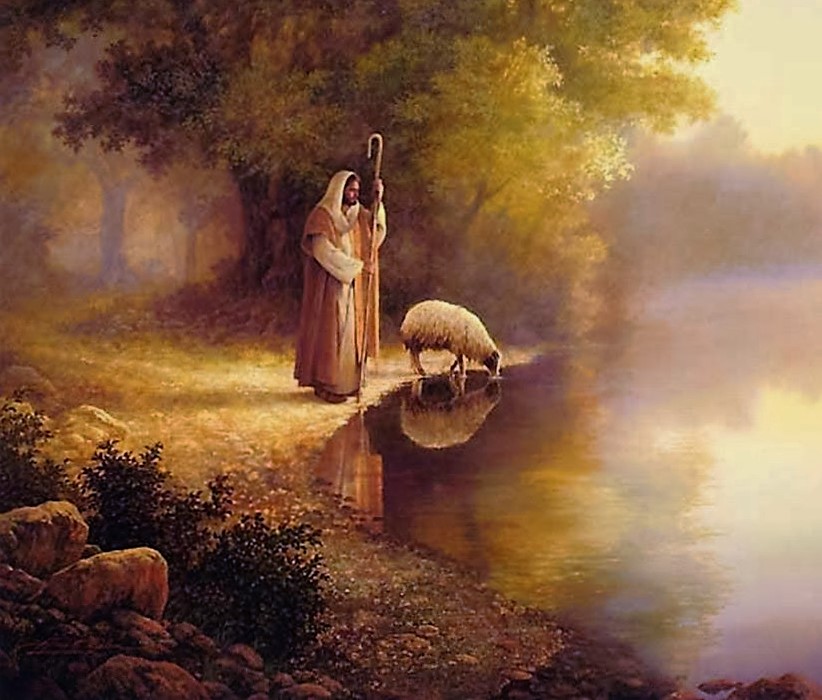
O Shepherd of souls
and o first voice
through whom all creation was summoned,
now to you,
to you may it give pleasure and dignity
to liberate us
from our miseries and languishing.
Music: Come Worship the Lord – John Michael Talbot
Come, worship the Lord For we are his people The flock that he shepherds Alleluia Come, worship the Lord For we are his people The flock that he shepherds Alleluia
And come, let us sing to the Lord And shout with joy to the rock who saves us Let us come with thanksgiving And sing joyful songs to the Lord
Come, worship the Lord For we are his people The flock that he shepherds Alleluia Come, worship the Lord For we are his people The flock that he shepherds Alleluia
The Lord is God, the mighty God The great King o’er all other gods He holds in his hands the depths of the earth And the highest mountains as well He made the sea, it belongs to him The dry land too, was formed by his hand
Come, worship the Lord For we are his people The flock that he shepherds Alleluia Come, worship the Lord For we are his people The flock that he shepherds Alleluia
Come, let us bow down and worship Bending the knee for the Lord our maker For we are his people We are the flock that he shepherds
Today, in God’s Lavish Mercy, Peter is a headliner in both our readings.
I really love Peter. Can’t we relate to him on so many levels as he stumbles and shines through his growing relationship with Jesus?
Some of my best prayers with Peter have been:
when he tries to walk on water to meet Jesus in the sea
And Peter answered him, “Lord, if it is you, command me to come to you on the water.” He said, “Come.” So Peter got out of the boat and walked on the water and came to Jesus. But when he saw the wind, he was afraid, and beginning to sink he cried out, “Lord, save me.” Mk.14:28
when he gets slammed for trying to stop Jesus from talking about his death
Peter took Him aside and began to rebuke Him. “Far be it from You, Lord!” he said. “This shall never happen to You!” But Jesus turned and said to Peter, “Get behind me, Satan! You are a stumbling block to me!” Mt. 13:41
when his name is changed to Rock and he’s foretold his future
And I tell you that you are Peter, and on this rock I will build my church, and the gates of Hades will not overcome it. Mt. 16:18
when he cowers in denial outside Jesus’s trial
Immediately the rooster crowed the second time. Then Peter remembered the word Jesus had spoken to him: “Before the rooster crows twice you will disown me three times.” And he broke down and wept. Mk. 14:72
when he recognizes the Resurrected Jesus on the shore and swims to him
Then the disciple whom Jesus loved said to Peter, “It is the Lord!” As soon as Simon Peter heard him say, “It is the Lord,” he wrapped his outer garment around him (for he had taken it off) and jumped into the water. Jn.21:7
In today’s first reading, we see Peter in his full authority as the Vicar of Christ.
In our Gospel, we see Peter’s unequivocal confession of faith, voiced for the Church, voiced for all of us:
Jesus then said to the Twelve, “Do you also want to leave?” Simon Peter answered him, “Master, to whom shall we go? You have the words of eternal life. We have come to believe and are convinced that you are the Holy One of God.”
Let’s take whatever piece of Peter is in us today and lay it at the feet of Jesus in our own confession of faith and hope.
Poetry: Simon Peter – John Poch
There are three things which are too wonderful for me, Yes, four which I do not understand. The way of an eagle in the air, The way of a serpent on a rock, The way of a ship in the heart of the sea, And the way of a man with a maid –Prov. 30:18, 19
I Contagious as a yawn, denial poured over me like a soft fall fog, a girl on a carnation strewn parade float, waving at everyone and no one, boring and bored There actually was a robed commotion parading. I turned and turned away and turned. A swirl
of wind pulled back my hood, a fire of coal brightened my face, and those around me whispered: You’re one of them, aren’t you? You smell like fish. And wine, someone else joked. That’s brutal. That’s cold, I said, and then they knew me by my speech. They let me stay and we told jokes like fisher- men and houseboys. We gossiped till the cock crowed, his head a small volcano raised to mock stone.
II Who could believe a woman’s word, perfumed in death? I did. I ran and was outrun before I reached the empty tomb. I stepped inside an empty shining shell of a room, sans pearl. I walked back home alone and wept again. At dinner. His face shone like the sun.
I went out into the night. I was a sailor and my father’s nets were calling. It was high tide, I brought the others. Nothing, the emptiness of business, the hypnotic waves of failure. But a voice from shore, a familiar fire, and the nets were full. I wouldn’t be outswum, denied this time. The coal-fire before me, the netted fish behind. I’m carried where I will not wish.
Today, in God’s Lavish Mercy, our Gospel is serious business. In it, Jesus reveals the lynchpin of our sacramental faith.
Amen, amen, I say to you, unless you eat the Flesh of the Son of Man and drink his Blood, you do not have life within you. Whoever eats my Flesh and drinks my Blood has eternal life, and I will raise him on the last day.
John 6: 53-54
It is a stark and shocking statement. The listening Jews “quarreled among themselves, saying, ‘How can this man give us his Flesh to eat?’.”
Down through the ages, struggling believers have grappled with the same question. Or, perhaps less preferable, complacent believers have never even considered it.
I think Jesus wanted us to consider it, absorb it, be changed by it, live within it, because “unless you eat the Flesh of the Son of Man and drink his Blood, you do not have life within you.”
As Catholics, we believe that Christ is truly and fully present in Eucharist and that, by Communion, becomes fully present in us, the Church.
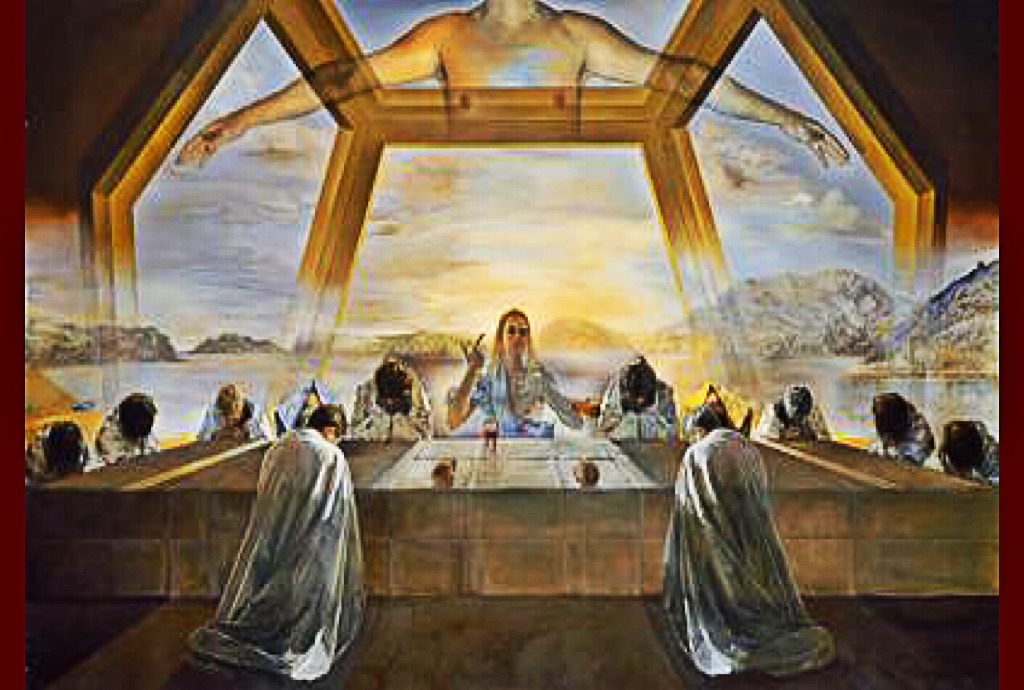
When the Church celebrates the Eucharist, the memorial of her Lord’s death and resurrection, this central event of salvation becomes really present and “the work of our redemption is carried out”. This sacrifice is so decisive for the salvation of the human race that Jesus Christ offered it and returned to the Father only after he had left us a means of sharing in it as if we had been present there. Each member of the faithful can thus take part in it and inexhaustibly gain its fruits. This is the faith from which generations of Christians down the ages have lived. (ECCLESIA DE EUCHARISTIA, Encyclical of John Paul II)
For me, it is a truth only appreciated when approached with more than the mind. It must be apprehended with the heart and soul. God so loves us in the person of Jesus Christ that God chooses to be eternally present with us, and in us, through the gift of Eucharist.
Praying with this truth over the years has led me to read authors like Edward Schillebeeckx (Christ the sacrament of the Encounter with God), Diarmuid O’Murchu (Quantum Theology), and Pierre Teilhard De Chardin (Hymn of the Universe).
Me in my First Communion Dress – and my handsome little brother
Still, despite all the Eucharistic theology, every time I receive the Eucharist, I let this simple hymn play in my heart – one I learned for my First Holy Communion. It still unites my heart to my desired faith which is, at once, both cosmic and intimate.
Poetry: “On the Blessed Sacrament of the Altar” by St Robert Southwell
Saint Robert Southwell (1561 – 1595) was an English Roman Catholic priest of the Jesuit Order. He was also a poet, hymnodist, and clandestine missionary in Elizabethan England. After being arrested and imprisoned in 1592, and intermittently tortured and questioned by Richard Topcliffe, Southwell was eventually tried and convicted of high treason for his links to the Holy See. On 21 February 1595, Father Southwell was hanged at Tyburn. In 1970, he was canonized by Pope Paul VI as one of the Forty Martyrs of England and Wales. (Wikipedia)
His poetry, written in Early Modern English, demonstrates deep devotion to the Eucharist. Although most of us can interpret the English of the 16th century, the translation below is modernized for convenience. It’s a long poem, but it is well worth your time.
“On the Blessed Sacrament of the Altar” by St. Robert Southwell From The Poems of Robert Southwell, S.J. (Oxford: Clarendon Press, 1967), edited by Fr James H. McDonald and Nancy Pollard Brown
In paschal feast the end of ancient rite
An entrance was to never ending grace,
Tips to the truth, dim glasses to the light,
Performing deed presaging signs did chase,
Christ's final meal was fountain of our good:
For mortal meat he gave immortal food.
That which he gave he was, O peerless gift,
Both God and man he was, and both he gave,
He in his hands himself did truly live:
Far off they see whom in themselves they have.
Twelve did he feed, twelve did their feeder eat,
He made, he dressed, he gave, he was their meat.
They saw, they heard, they felt him sitting near,
Unseen, unfelt, unheard, they him receiv'd,
No diverse thing though diverse it appear,
Though senses fail, yet faith is not deceiv'd.
And if the wonder of the work be new,
Believe the work because his word is true.
Here truth belief, belief inviteth love,
So sweet a truth love never yet enjoy'd,
What thought can think, what will doth best approve
Is here obtain'd where no desire is void.
The grace, the joy, the treasure here is such
No wit can with nor will embrace so much.
Self-love here cannot crave more than it finds,
Ambition to no higher worth aspire,
The eagerest famine of most hungry minds
May fill, yea far exceed their own desire:
In sum here is all in a sum express'd,
Of much the most, of every good the best.
To ravish eyes here heavenly beauties are,
To win the ear sweet music's sweetest sound,
To lure the taste the angels' heavenly fare,
To soothe the scent divine perfumes abound,
To please the touch he in our hearts doth bed,
Whose touch doth cure the deaf, the dumb, the dead.
Here to delight the wit true wisdom is,
To woo the will of every good the choice,
For memory a mirror shewing bliss,
Here all that can both sense and soul rejoice:
And if to all all this it do not bring,
The fault is in the men, not in the thing.
Though blind men see no light, the Sun doth shine,
Sweet cates are sweet, though fevered tastes deny it,
Pearls precious are, though trodden on by swine,
Each truth is true, though all men do not try it:
The best still to the bad doth work the worst,
Things bred to bliss do make them more accurst.
The angels' eyes whom veils cannot deceive
Might best disclose that best they do discern,
Men must with sound and silent faith receive
More than they can by sense or reason learn:
God's power our proofs, his works our wit exceed,
The doer's might is reason of His deed.
A body is endow'd with ghostly rights,
A nature's work from nature's law is free,
In heavenly Sun lie hidden eternal lights,
Lights clear and near yet them no eye can see,
Dead forms a never-dying life do shroud,
A boundless sea lies in a little cloud.
The God of Hosts in slender host doth dwell, Yea God and man, with all to either due: That God that rules the heavens and rifled hell, That man whose death did us to life renew, That God and man that is the angels’ bliss, In form of bread and wine our nurture is.
Whole may his body be in smallest bread,
Whole in the whole, yea whole in every crumb,
With which be one or ten thousand fed
All to each one, to all but one doth come,
And though each one as much as all receive,
Not one too much, nor all too little have.
One soul in man is all in every part,
One face at once in many mirrors shines,
One fearful noise doth make a thousand start,
One eye at once of countless things defines:
If proofs of one in many nature frame,
God may in stranger sort perform the same.
God present is at once in every place,
Yet God in every place is ever one,
So may there be by gifts of ghostly grace
One man in many rooms yet filling none.
Sith angels may effects of bodies shew,
God angels' gifts on bodies may bestow.
What God as auctor made he alter may,
No change so hard as making all of nought:
If Adam framed was of slimy clay,
Bread may to Christ's most sacred flesh be wrought.
He may do this that made with mighty hand
Of water wine, a snake of Moses' wand.
Today, in God’s Lavish Mercy, our Gospel gives us the sense of Jesus claiming his inheritance from the Father.
He makes it clear that the Father’s Will is the Redemption of all Creation. This is the divine charge given to Jesus. This is his mission.
Everything that the Father gives me will come to me, and I will not reject anyone who comes to me, because I came down from heaven not to do my own will but the will of the one who sent me.
John 6:37-38
Jesus continues to use the symbol of bread to teach the forming community.
Bread sustains life. God’s Word is eternal life.
Sharing bread is an act of community. In the Body of Christ, we are made One with God and with one another.
Bread can stale and disintegrate. Within the Body of Christ, we become eternal and will be raised up unto the Last Day.
These are such BIG thoughts, amazing teachings! I always wonder how simple shepherds, milk maidens, fishermen and housekeepers were supposed to understand! I wonder how we, in our human limitations, could begin to comprehend the infinitely loving design of God revealed in Jesus Christ!
And I think that’s just the thing — we will never comprehend the Mystery of Jesus’s Presence with us. And we don’t have to!
We will never comprehend a lot of things: love, suffering, time, death, kindness, beauty. Yet we live within and savor these mysteries when we open our hearts in vulnerability to them. They are the dynamisms that can sanctify us!
So it is with the mysteries of our faith. While we can use our minds to explore them, our minds will never comprehend them. Only our hearts and souls can fully receive these mysteries in trust and faith.
For this is the will of my Father, that everyone who sees the Son and believes in him may have eternal life, and I shall raise him on the last day.
John 6:40
Prose: The Legend of St. Augustine – from augnet.org
The scene is the seashore, where there is a small pool, a little boy with a seashell, and a sandy beach on which St. Augustine, clad in his religious robes, is walking, pondering with difficulty the mystery of the Most Holy Trinity. “Father, Son, Holy Spirit; three in one!” he muttered, shaking his head.
As he approached the little boy who was running back and forth between the sea and the pool with a seashell of water, Augustine craned his neck and asked him: “Son, what are you doing?” “Can’t you see?” said the boy. “I’m emptying the sea into this pool!” “Son, you can’t do that!” Augustine countered.
“I will sooner empty the sea into this pool than you will manage to get the mystery of the Most Holy Trinity into your head!” Upon saying that, the boy, who was an angel according to legend, quickly disappeared, leaving Augustine alone with the mystery of the Most Holy Trinity.



















 Lavish Mercy