The Epiphany of Our Lord

January 3, 2021

Today, in God’s Lavish Mercy, and on this glorious feast, we pray with Psalm 72.

It is a gorgeous psalm that fills our senses with lights, and scents, and the tactile experience of an ancient and sacred world:

  • we inhale the flower of justice
  • wrap ourselves in its profound peace
  • gaze on a distant, moonless universe
  • stretch our prayer from sea to sea,
  • and our praise to the ends of the earth

We see the ancient nations gather in homage,
carrying the gems, spices and bounty of their homelands.

We, too, kneel in astounded wonder that this vulnerable child, 
hidden in the far reaches of both geography and imagination,
carries to us the Promise of the Ages.

We, too, trust the star, rising in our own hearts.


Psalm 72 echoes our beautiful first reading from Isaiah, another masterpiece that, in itself, is enough simply to read and savor:

Rise up in splendor, Jerusalem!  
Your light has come,
the glory of the Lord shines upon you.
See, darkness covers the earth,
and thick clouds cover the peoples;
but upon you the LORD shines,
and over you appears his glory.

Isaiah 60: 1-2

In Isaiah, these magnificent verses follow two chapters of gloom and darkness. They break forth in true epiphany to say, “Your Light has come!” – now your life must begin to shine as well.

Epiphany is not simply about kings and camels. It is not simply about a  crèche and a star. 

It is about Divine Revelation hovering over our dailyness. It is about us, opening our eyes in faith and responsiveness to our ever-present God.

The feast of Epiphany reminds us:

Look at your life today.
The star did not pass you by.
Open your eyes and find it.
Once you have seen it,
live in its Light.

Poetry: The Journey of the Magi – T.S. Eliot

Eliot wrote the poem after his conversion to Anglicanism ( He had been a Unitarian.) The poem conveys his struggle to grow in the light of his new faith. The “journey” is life-long and demanding in a world that often  contradicts that faith.

“A cold coming we had of it,
Just the worst time of the year
For a journey, and such a long journey:
The ways deep and the weather sharp,
The very dead of winter.”
And the camels galled, sore-footed, refractory,
Lying down in the melting snow.
There were times we regretted
The summer palaces on slopes, the terraces,
And the silken girls bringing sherbet.
Then the camel men cursing and grumbling
And running away, and wanting their liquor and women,
And the night-fires going out, and the lack of shelters,
And the cities hostile and the towns unfriendly
And the villages dirty and charging high prices:
A hard time we had of it.
At the end we preferred to travel all night,
Sleeping in snatches,
With the voices singing in our ears, saying
That this was all folly.


Then at dawn we came down to a temperate valley,
Wet, below the snow line, smelling of vegetation;
With a running stream and a water-mill beating the darkness,
And three trees on the low sky,
And an old white horse galloped away in the meadow.
Then we came to a tavern with vine-leaves over the lintel,
Six hands at an open door dicing for pieces of silver,
And feet kicking the empty wine-skins.
But there was no information, and so we continued
And arrived at evening, not a moment too soon
Finding the place; it was (you may say) satisfactory.

All this was a long time ago, I remember,
And I would do it again, but set down
This set down
This: were we led all that way for
Birth or Death? There was a Birth, certainly,
We had evidence and no doubt. I had seen birth and death,
But had thought they were different; this Birth was
Hard and bitter agony for us, like Death, our death.
We returned to our places, these Kingdoms,
But no longer at ease here, in the old dispensation,
With an alien people clutching their gods.
I should be glad of another death.


Music: The People that Walk in Darkness – Bob Dufford, SJ

The people that walk in darkness 
 have seen, have seen a great light.
 And on those who dwell in endless gloom, 
 a light has shone.
 
Refrain: 
For a Child is born this day: 
Rejoice, rejoice.
Daughter of Zion, awake. 
The glory of God is born.
 
And they shall name Him counselor, 
shall call Him mighty God.
And He shall rule from age to age: 
Prince of Peace.
 
Refrain
 
Darkness covers the earth; 
thick clouds govern its pe0ple.
But the Lord will bring them light; 
the Lord will bring them light.
 
Refrain
 
The people that walk in darkness 
have seen, have seen a great light.
And on those who dwell in endless gloom, 
a light has shone.
 

Refrain

The Word

The Seventh Day in the Octave of Christmas

December 31, 2020

Today, in God’s Lavish Mercy, we pray with Psalm 96, which set the tone for us to more deeply appreciate our beautiful Gospel today on this New Year’s Eve.

The LORD comes,
comes to align the earth in Grace.
The LORD shall tender the world
with merciful justice
and the peoples with divine constancy.

Psalm 96: 13

Who is this Lord Who comes,
comes to each of us and all of us?

I think no one describes this mysterious, yet enfleshed, God more beautifully that the writer of John’s Gospel and Epistles.

For our prayer, let’s savor that beauty from today’s Gospel.

Click the little white triangle in the grey bar above to hear some lovely accompanying music
as you slowly move through the slides below by pressing the right arrow on the slide.

Poetry: a prayer from Hildegard of Bingen (1098–1179 – O Eternal Lord 

Dear Friends, perhaps we might pray Hildegard’s prayer for one another as we leave this painful year and move toward New Hope.

O eternal Lord,
it is pleasing to you
to burn in that same fire of love,
like that from which our bodies are born,
and from which you begot your Son
in the first dawn before all of Creation.
So consider this need which falls upon us,
and relieve us of it for the sake of your Son,
and lead us in joyous prosperity.

Psalm 31: Soak in the Graces

Feast of Saint Stephen, first martyr

December 26, 2020


Today, in God’s Lavish Mercy, as we celebrate the Feast of St. Stephen, we pray with Psalm 31.

The Stoning of St. Stephen – Giovanni Lucini

Even while the gentle lights of Christmas linger, the Church reminds us that life in Christ requires a complete self-donation. Like Stephen, we pray to embrace that cost with courage and faith:

Into your hands I commend my spirit;
you will redeem me, O LORD, O faithful God.
I will rejoice and be glad because of your mercy.

Psalm 31: 6-8

Liturgically, we will be in the Christmas and Epiphany Season until January 10th. We have plenty of time to soak up the heavenly lights and the angelic songs as we slowly step back into an often shadowy world.

And I think the Church puts Stephen’s martyrdom so starkly at this juncture to remind us to SOAK – to fill our tanks with Christmas grace so that we are ready to accompany Christ in his ministry.

Be my rock of refuge,
a stronghold to give me safety.
You are my rock and my fortress;
for your name’s sake you will lead and guide me.

Psalm 31: 3-4
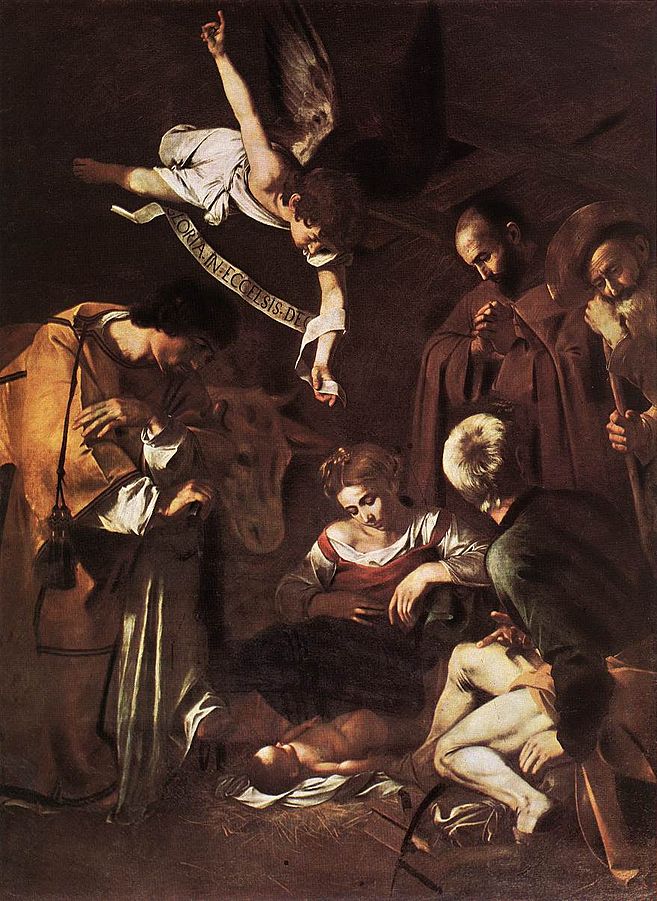
Nativity with San Lorenzo and San Francesco – Caravaggio

While your crèche is still enshrined in your home, take a morning to kneel beside Mary. Ask to learn her secrets for living fully in Christ. 

  • Do the same one morning with Joseph. Learn from his silent strength.
  • Learn from the shepherds who received astounding revelation with simple, unquestioning faith.
  • Learn from the animals who stand pure and guileless in the presence of God.
  • Ask to be ready, like Stephen, to give everything for what you learn.

I trust in you, LORD;
I say, “You are my God.”
My destiny is in your hands;
rescue me from any darkness,
from all pulls me away from you.
Let your face shine on your me
embrace me completely in your mercy.

Psalm 31: 16-17

Poem: THE STABLE by Sr. M. Chrysostom, O.S.B.

The winds were scornful,
Passing by;
And gathering Angels 
Wondered why
A burdened Mother 
Did not mind 
That only animals 
Were kind.
For who in all the world 
Could guess 
That God would search out 
Loneliness.

Music: Martyr Dei ( Martyr of God)

Martyr Dei, qui (quæ) unicum
Patris sequendo Filium,
victis triumphas hostibus,
victor (victrix) fruens cælestibus.
Tui precatus munere
nostrum reatum dilue,
arcens mali contagium,
vitæ repellens tædium.
Soluta sunt iam vincula
tui sacrati corporis;
nos solve vinclis sæculi,
amore Filii Dei.
Honor Patri cum Filio
et Spiritu Paraclito,
qui te corona perpeti
cingunt in aula gloriæ.

Martyr of God, whose strength was steeled
To follow close God’s only Son,
Well didst thou brave thy battlefield,
And well thy heavenly bliss was won!
Now join thy prayers with ours, who pray
That God may pardon us and bless;
For prayer keeps evil’s plague away,
And draws from life its weariness.
Long, long ago, were loosed the chains
That held thy body once in thrall;
For us how many a bond remains!
O Love of God release us all.
All praise to God the Father be,
All praise to Thee, eternal Son;
All praise, O Holy Spirit, to Thee
While never ending ages run.

Psalm 27: How to Wait!

Friday of the First Week of Advent

December 4, 2020


Today, in God’s Lavish Mercy, we pray with Psalm 27 with its glorious opening salvo:

The Lord is my light and my salvation.
Of whom should I be afraid?


 Psalm 27 reminds us that, amidst all the fluster of life, there is only one thing that matters:

One thing I ask of the LORD;
this I seek:
To dwell in the house of the LORD
all the days of my life,
That I may gaze on the loveliness of the LORD
and contemplate his temple.

Psalm 27:4

The hard part, as the psalmist tells us, is to wait – not just to wait for heaven at the end of it all – but to wait to discover God in each moment. 

I find waiting to be pretty challenging, especially when I’m waiting for something over which I have no control.

Sometimes God seems pretty buried in our lives and in the clamor of the world. It’s tough to wait with hope when we just can’t see the Beloved.


But our psalm charges us to practice hopeful waiting for the grace that comes to us in every moment.

May we wait with courage, hope, and confidence for the gift God eternally gives us.


Poem: from Awed to Heaven, Rooted to Earth by Walter Brueggemann 

In our secret yearnings
we wait for your coming,
and in our grinding despair
we doubt that you will.

And in this privileged place
we are surrounded by witnesses who yearn more than do we
and by those who despair more deeply than do we.

Look upon your church and its pastors
in this season of hope
which runs so quickly to fatigue
and this season of yearning
which becomes so easily quarrelsome.

Give us the grace and the impatience
to wait for your coming to the bottom of our toes,
to the edge of our finger tips.

We do not want our several worlds to end.
Come in your power
and come in your weakness
in any case and make all things new.
Amen.

Music: Waiting – by Isisip

Psalm 118: Inside the Gate

Memorial of Saint Francis Xavier, Priest

December 3, 2020


Today, in God’s Lavish Mercy,
we pray with Psalm 118
which describes the Lord’s strong city
and the gate which protects it.

Our opening passage from Isaiah exults in this Divine Strength, asking to be embraced  within its sacred space:

A strong city have we;
the Lord sets up walls and ramparts to protect us.
Open up the gates
to let in a nation that is just,
one that keeps faith.

Isaiah 26: 1-2

Jesus, in our Gospel, tells us that inclusion in the sanctuary must be merited by those who understand that God’s Will is for justice over all Creation:

Not everyone who says to me, ‘Lord, Lord,’
will enter the Kingdom of heaven,
but only the one who does the will of my Father in heaven.

Matthew 7: 21

Thus we, longing to be among the included, we pray this Advent psalm:

Open to me the gates of justice;
I will enter them and give thanks to the LORD.
This gate is the LORD’s;
the just shall enter it.
I will give thanks to you, for you have answered me
and have been my savior.

Psalm 118: 19-21

As I meditate on these thoughts, our Motherhouse property offers many “icons” to reflect upon the concept of the “gate”. The entire campus is enclosed by various types of fencing or walls. There are four gates through which one may pass into the complex.

early photo of Motherhouse main gate , Montgomery County Historical Society. The open gate is barely visible against the small pine tree on the left of the opening.

I imagine that, when first installed, these great gates offered a more formidable enclosure than they do today. Only the wrought iron hinges remain of the main gate’s  double swing panels. Yet these, driven into imposing stone pillars, still suggest the firm purpose to create a sacred space.

You will notice the open gate just under the right side of the big tree

Inside the property, another wrought iron enclosure surrounds the community cemetery. This fence’s two gates are usually open, demonstrating that their purpose too is not security but rather sacred designation.

These venerable gates, rather than castle-like ramparts, are more like torii, those traditional Japanese gates found at the entrance or within a Shinto shrine where they symbolically mark the transition from the mundane to the sacred.

The famous torii at Itsukushima Shrine, Hiroshima, Japan

During Advent, we slowly pass through such a sacred symbolic gate, once again entering the holy mystery who is Jesus Christ. We pray to be transformed, not simply by the retelling of his story, but by the Living Grace he is for us in our own lives.

With today’s powerful readings, we pray to enter more deeply into that Mystery.


Poetry: Endless Time – Tagore

Time is endless in thy hands, my lord.
There is none to count thy minutes.
Days and nights pass and ages bloom and fade like flowers.

Thou knowest how to wait.
Thy centuries follow each other perfecting a small wild flower.

We have no time to lose,
and having no time we must scramble for a chance.
We are too poor to be late.

And thus it is that time goes by
while I give it to every querulous person who claims it,
and thine altar is empty of all offerings to the last.

At the end of the day I hasten in fear lest thy gate be shut;
but I find that yet there is time.

Music: Huanqiutan Garden – Oliver Shanti 

Psalm 23: Awake to the Feast

Wednesday of the First Week of Advent

December 2, 2020


Today, in God’s Lavish Mercy, we pray with Psalm 23. On this first Wednesday of Advent, our psalm is set between two eloquent readings about the full satisfaction of our soul’s hungers.

Isaiah blesses us with his metaphor for Heaven’s abundance, when our souls will be filled to a divine capacity of grace.

In a world already redeemed, Isaiah’s vision has been fulfilled. We live our lives already seated at the banquet he describes.

But do we realize it? Do we partake every moment in the outpouring of grace given us by our Baptism into Christ?

Unaware, many of us sit at the table starving.

In our Gospel, Jesus sees the deeper hungers of the fatigued crowd. His miracle feeds their bodies but, more importantly, awakens their souls to see him as the fulfillment of God’s promise. Isaiah’s prophecy is accomplished in Jesus:

On that day it will be said:
Behold our God, to whom we looked to save us!
This is the LORD for whom we looked;
let us rejoice and be glad that he has saved us!”
For the hand of the LORD will rest on this mountain.

Isaiah 26:9-10

As we read Psalm 23 today, let’s allow its consoling verses to become our prayer of trust and gratitude for God’s “already presence” in our lives. Like the crowd awakened by Jesus’s miracle, let us open our eyes to the infinite grace spread before us, though wrapped sometimes in the mundane circumstances of our lives.


Poetry: Joy Harjo – Perhaps the World Ends Here

The world begins at a kitchen table. No matter what, we must eat to live.

The gifts of earth are brought and prepared, set on the table. So it has been since creation, and it will go on.

We chase chickens or dogs away from it. Babies teethe at the corners. They scrape their knees under it.

It is here that children are given instructions on what it means to be human. We make men at it, we make women.

At this table we gossip, recall enemies and the ghosts of lovers.

Our dreams drink coffee with us as they put their arms around our children. They laugh with us at our poor falling-down selves and as we put ourselves back together once again at the table.

This table has been a house in the rain, an umbrella in the sun.

Wars have begun and ended at this table. It is a place to hide in the shadow of terror. A place to celebrate the terrible victory.

We have given birth on this table, and have prepared our parents for burial here.

At this table we sing with joy, with sorrow. We pray of suffering and remorse. We give thanks.

Perhaps the world will end at the kitchen table, while we are laughing and crying, eating of the last sweet bite.

Music: Psalm 23 – Stuart Townend

Psalm 72: Justice Shall Flower

Tuesday of the First Week of Advent

December 1, 2020


Today, in God’s Lavish Mercy, we pray with Psalm 72 which sings with Advent expectation and hope. How beautiful to hear its tones once again and to realize that God has carried us through another year.

With Psalm 72, God tells us it is time to begin again – and this time, because of all the past year has taught us, to more fully abandon our hearts to the fidelity God promises. 

Our God and King comes eternally to us
in new waves of revelation.
God’s faithful promise continues
for whatever the coming year unfolds.

O God, with your judgment endow the king,
and with your justice, the king’s son;
He shall govern your people with justice
and your afflicted ones with judgment.

Psalm 72: 1-2

Our psalm invites us to see Creation as God sees it, an eternal relationship which endures in peace even beyond the moon’s final setting. That eternal promise brings profound peace. God, who is Infinite Mercy, loves us beyond boundaries, beyond circumstance, beyond time.

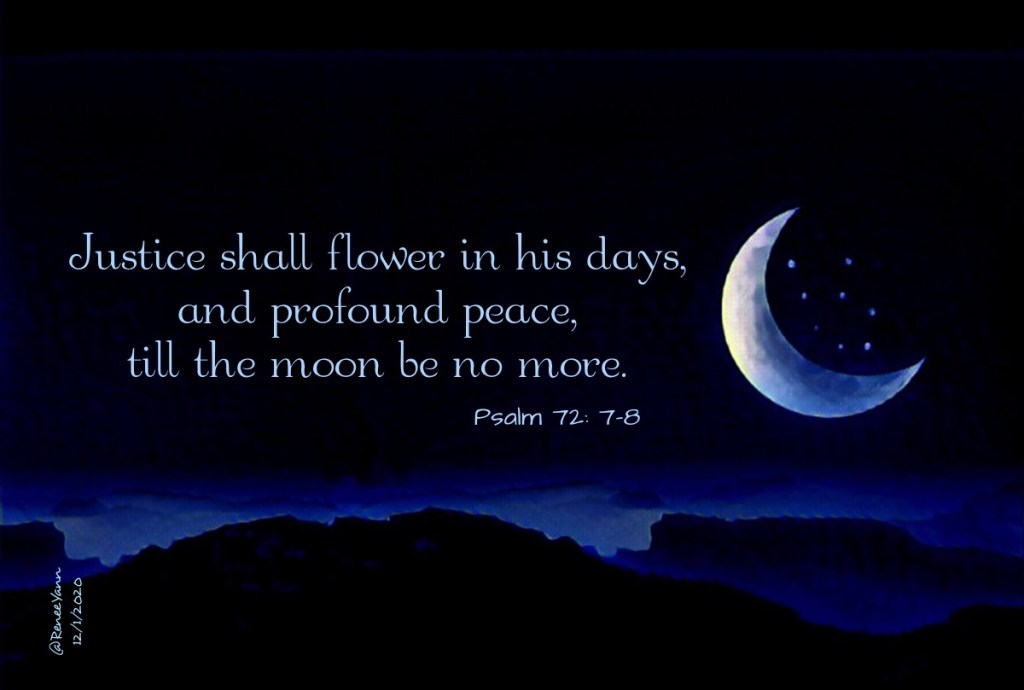
Justice shall flower in his days,
and profound peace, till the moon be no more.
May he rule from sea to sea,
and from the River to the ends of the earth.

Psalm 72: 7-8

Jesus is the Promise Fulfilled. In him, Infinite Mercy enfleshes justice for the humble and poor.

He shall rescue the poor one who cries out,
and the afflicted when there is no one to help.
He shall have pity for the lowly and the poor;
the lives of the poor he shall save.

Psalm 72: 12-13

Advent patiently teaches us to recognize such salvation and peace. It is not revealed in miracles, but rather in the enduring power of hope, trust and gratitude. Jesus is our salvation and peace. The cyclic retelling of his life, death and resurrection invites us to deepen our own journey once again this Advent.

May his name be blessed forever;
as long as the sun his name shall remain.
In him shall all the tribes of the earth be blessed;
all the nations shall proclaim his happiness.

Psalm 72: 17

Poetry: Advent Calendar by Rowan Williams, a Welsh Anglican bishop, theologian and poet. He was the 104th Archbishop of Canterbury, a position he held from December 2002 to December 2012.

He will come like last leaf’s fall.
One night when the November wind
has flayed the trees to bone, and earth
wakes choking on the mould,
the soft shroud’s folding.
He will come like frost.
One morning when the shrinking earth
opens on mist, to find itself
arrested in the net
of alien, sword-set beauty.
He will come like dark.
One evening when the bursting red
December sun draws up the sheet
and penny-masks its eye to yield
the star-snowed fields of sky.
He will come, will come,
will come like crying in the night,
like blood, like breaking,
as the earth writhes to toss him free.
He will come like child.

Music: O Come, Divine Messiah
Words: Abbé Simon J. Pellegrin, 1663-1745
English Translation of French Carol “Venez Divin Messie”
Translator: Sister Mary of St. Philip, SND
Melody: 16th Century French Carol

The English translation of “Venez, divin Messie” beginning “O come, divine Messiah” is by Sister Mary of St. Philip, SND, the name in religion of Mary Frances Lescher (1825-1904). She was one of the first English members of the Sisters of Notre Dame de Namur when they established their training college at Mount Pleasant in Liverpool, England, in about 1850. She and at least one other SND sister wrote both translations and original hymns and songs over the course of their long professional lives.

from John Uhrig’s letter to Douglas D. Anderson, Founder of the website “The Hymns and Carols of Christmas”

Psalm 98: Joy!

Wednesday of the Thirty-fourth Week in Ordinary Time

November 25, 2020


Today, in God’s Lavish Mercy, we pray with Psalm 98. If it sounds familiar as you read it today, no wonder. It looks like Mr.98 might have peeked and copied from Ms. 96 whose verses we read yesterday!🤗

Still, there are some new lovely thoughts to consider this morning as we pray just one month from Christmas. The psalm’s melodic, celebratory tone offers a welcome contrast to the other two rather daunting readings today.

Psalm 98 describes God’s redemption of Israel and the rejoicing that will ensue. It also features many expressions and instruments of music and song. The psalm’s exultant and joyful character inspired Sir Isaac Watts, in 1719, to compose an interpretation we all love: Joy to World. Watts’s poem was set to the music of George Frideric Handel.

Although this glorious song is normally preserved for Christmas, it describes the condition of grace we actually live within every day. Christ already has come into time, already has been born in our hearts.

Our liturgical year is a commemoration and celebration of a salvation already achieved.

So let’s have a bit of early Christmas today. Let’s reach for the full joy of our “Christing” by praying Psalm 98 as Isaac Watts prayed it.

Joy to the World; the Lord is come!
Let earth receive her King!
Let ev'ry heart prepare Him room,
And Heaven and nature sing.

Joy to the earth, the Savior reigns!
Let men their songs employ;
While fields & floods, rocks, hills & plains
Repeat the sounding joy.

No more let sins and sorrows grow,
Nor thorns infest the ground;
He comes to make his blessings flow
Far as the curse is found.

He rules the world with truth and grace,
And makes the nations prove
The glories of His righteousness,
And wonders of His love.

Today is a good day, as we are about to begin our Advent journey this Sunday, to remind ourselves of exactly where that journey takes us – to the humble center of our hearts where, in every moment, God desires to take flesh for the world.


Poetry: Into the Darkest Hour by Madeleine L’Engle

It was a time like this,
War & tumult of war,
a horror in the air.

Hungry yawned the abyss-
and yet there came the star
and the child most wonderfully there.

It was time like this
of fear & lust for power,
license & greed and blight-

and yet the Prince of bliss
came into the darkest hour
in quiet & silent light.

And in a time like this
how celebrate his birth
when all things fall apart?

Ah! Wonderful it is
with no room on the earth
the stable is our heart.

Music: John Rutter – The Falcon – first movement based on Psalm 98

Psalm 119: Promises, Promises

Friday of the Thirty-third Week in Ordinary Time

November 20, 2020


Today, in God’s Lavish Mercy, we pray once again with our longest Psalm 119. 

This morning, we take one little morsel from its long string of reflections :


The word “promise” can evoke a range of responses from us. Indeed, they are sweet as the psalmist says. But they can also be elusive, ephemeral, and easily broken. I know I’ve have made a few promises in my lifetime that have fizzled away unfulfilled. Haven’t you?

On the other hand, there are some promises, kept, that have rooted and defined my life. These, made in the bud, have blossomed in a long, tendered fidelity. They have dug the deep roots of trust for the essential relationships of my life with God, beloved neighbor, and all Creation.


Such vital promises can be made and kept when we act in the image of God, the loving and faithful Promiser described in Psalm 119:

Your word, LORD, stands forever;
it is firm as the heavens.
Through all generations your truth endures;
fixed to stand firm like the earth.

Psalm 119: 89 – 90

Like the psalmist, we pray:

  • to be imitators of God who is always faithful.
  • to be promise-keepers in response to the trust God has placed in us by the gift of our creation.
  • to meditate on, and understand in our hearts, the divine order of God’s immutable Law of Love

Poetry: Psalm 119 – Christine Robinson

Dear God, The seed of your love is deep within
every molecule of the universe, and it abides through time.
The laws of the cosmos serve your purpose to the end.
If I remember this, I can abide all manner of trouble.
If I delight in this, it gives me life.
I belong to you to my very core.
Holding firm to that knowledge, I can live my life in love.
All things will come to and end.
And in the end all will be One
My mind is filled with your Way
Making me wise like a teacher or an elder.
Mastering my life in your way gives me purpose.
Many times I use it to guide my steps.
My mouth waters and my heart softens to consider your Way.

Music: God Hath Not Promised – Annie Johnson Flint

This charming 19th century hymn captures the faithful spirit of it composer whose life, though beset by suffering, radiated faith and joy. 

Psalm 15: Camping with the Beloved

Memorial of Saint Elizabeth of Hungary, Religious

November 17, 2020


Today, in God’s Lavish Mercy, we pray with Psalm 15 which often is called an ‘entrance liturgy’, where a worshipper asks the conditions of entering the worship place and a priest answers.

The psalm’s first line, not included in today’s verses, asks that question of the Lord:

LORD, who may abide in your tent?
Who may dwell on your holy mountain?

Psalm 15:1

Reading this line immediately reminded me of Jesus’s first encounter with his chosen twelve. Upon meeting Jesus, and obviously struck with his unique charisma, the disciples ask, “Lord, where do you live?”. They want to be with him, to learn about him. We do too.


It’s a gift to be invited to someone’s home – to see where and how they live, to share their dailyness. It is a first portal to the intimacy of friendship, a gift beyond price when it proves mutual and true.

In today’s Gospel, in a sort of reverse proposal, Jesus invites himself to dinner at Zaccheus’s home. Throughout all the Gospels, we often see Jesus inviting and accepting invitations which prove to be conversions and calls for his followers.

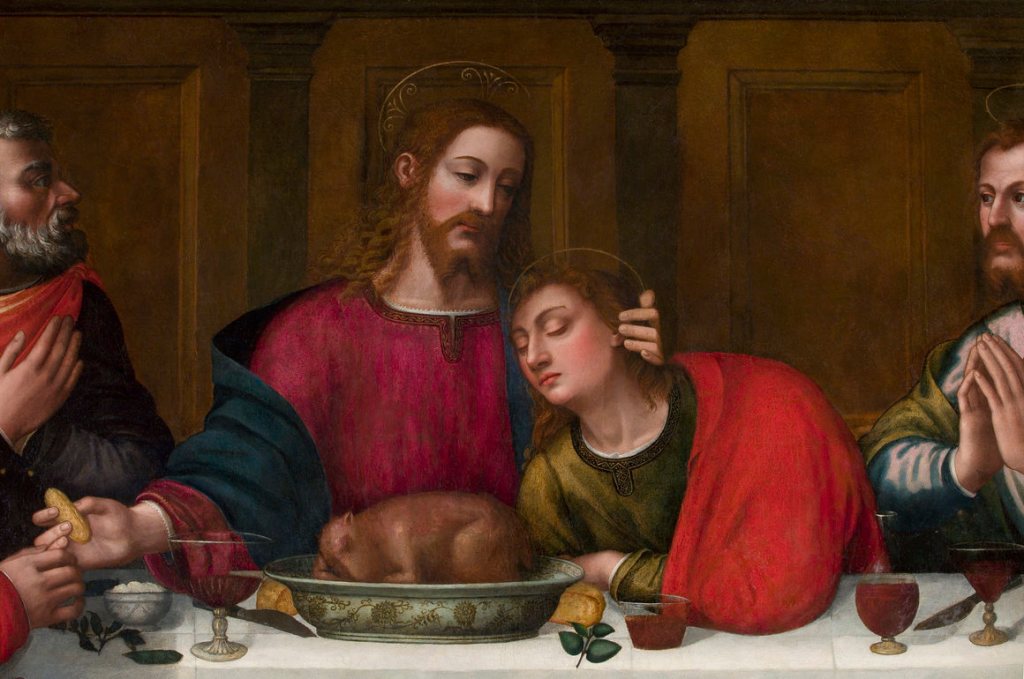
by Plautilla Nelli, an Italian nun who is said to have taught herself to paint in the 16th century. This is a section of her “Last Supper,” painted around 1568, and now newly installed in the old refectory of the Santa Maria Novella Museum. Of course, it shows Jesus with the “beloved” disciple.

In the reading from Revelation, the invitation takes an apocalyptic and corrective tone, but its heart is the same. In essence, God invites us to an intimacy of which we are capable only under certain conditions, i.e. “if you hear my voice“:

Behold, I stand at the door and knock.
If you hear my voice and open the door,
then I will enter and dine with you,
and you with me.
I will give the victor the right 
to sit with me on my throne,
as I myself first won the victory
and sit with my Father on his throne.


Today’s segment from Psalm 15 tells us what some of those conditions look like. It says to be someone who:

  • walks blamelessly and does justice 
  • thinks the truth in your heart
  • slanders not with your tongue.
  • harms not your fellow human beings,
  • takes up no reproach against your neighbor
  • despises not the reprobate
  • honors those who fear the LORD
  • lends not your money at usury
  • accepts no bribe against the innocent

Our challenge from the psalm is to meditate on that list to see what such behavior looks like in modern terms. Beneath the psalmist’s ancient language, we might discover our attitudes and examine our conscience toward issues like:

  • criminal justice
  • capital punishment
  • war
  • poverty
  • immigration policy
  • refugee resettlement
  • propagandist media
  • economic equity
  • felon rehabilitation
  • respect for other religions
  • political oppression
  •  – just to suggest a few.

Psalm 15 tells us, and our other readings affirm, that the one who gets these things right not only gets invited, but gets to remain in God’s house, God’s “tent”.

The one who does these things
shall never be disturbed.

I know that’s Who I want to go eternally camping with! How about you?


Poem: Rainer Maria Rilke, Poems from the Book of Hours

You, neighbor God, if sometimes in the night
I rouse you with loud knocking, I do so
only because I seldom hear you breathe
and know: you are alone.
And should you need a drink, no one is there
to reach it to you, groping in the dark.
Always I hearken. Give but a small sign.
I am quite near.

Between us there is but a narrow wall,
and by sheer chance; for it would take
merely a call from your lips or from mine
to break it down,
and that without a sound.

The wall is builded of your images.

They stand before you hiding you like names.
And when the light within me blazes high
that in my inmost soul I know you by,
the radiance is squandered on their frames.

And then my senses, which too soon grow lame,
exiled from you, must go their homeless ways.

Music: Dwelling Place – John Foley, SJ