In our first reading, three young men stand convinced of God. Even the threat of a fiery death cannot shake them from that conviction.
And their faith is not a quid pro quo – a case where they say to God, “I’ll believe if you do ‘X’ for me.” No, their commitment is unqualified and complete:
If our God, whom we serve, can save us from the white-hot furnace and from your hands, O king, may he save us! But even if he will not, know, O king, that we will not serve your god or worship the golden statue.
When Shadrach, Meshach, and Abednego are cast into the furnace, a fourth figure appears with them, an angel of God who delivers them safely through their trial.
In our Gospel, even “the Jews who believed” in Jesus begin to quibble with him. They stand with him at the threshold of his Passion and Death, the great fire that will test them all. Like the three young men at the furnace, they face the ultimate choice:
Who do you really believe in?
What God will you give your life to?
Jesus challenges them to follow him into the fire that faces him:
Jesus answered them, “Amen, amen, I say to you … … if the Son frees you, then you will truly be free. I know that you are descendants of Abraham. But you are trying to kill me, because my word has no room among you. I tell you what I have seen in the Father’s presence; then do what you have heard from the Father.
Throughout our lives, our faith will be tested many times. That’s why it’s called “faith” and not “certainty ”. Our life circumstances will ask us, again and again, if our faith is strong enough to stand in the fire, to walk the Calvary road with Jesus.
Let the testimony of the ages inspire us with courage. We know the fire hid an angel. We know the road continued past the bloody hill and on to the Resurrection. We know that every storm will pass and leave us washed anew in grace if we make that ultimate choice to be faithful.
Today, in Mercy, we end the month of March in a very different place from where we began it.On March 1st, I didn’t expect to be in midst of the Corona Desert did you?
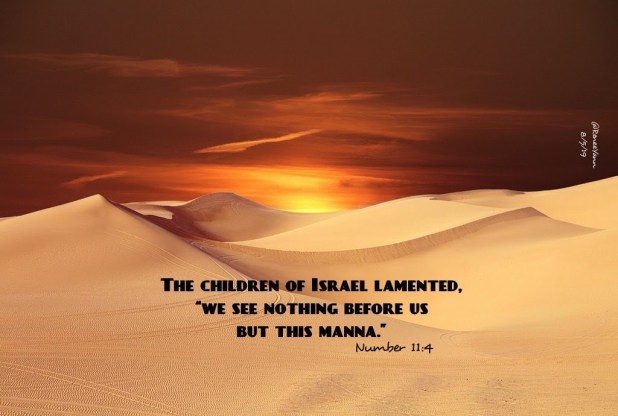
Neither did the Israelites in today’s first reading expect to be in their particular desert. They had left the oppressions of Egypt with no certainties, but nonetheless with expectations. Now, after decades wandering the desert, those expectations turned into some typical complaints:
Why have you brought us up from Egypt to die in this desert, where there is no food or water? We are disgusted with this wretched food!
They even go so far as to blame a coincidental snake infestation on God, demanding that Moses get God to fix it.
What’s going on here with our wandering ancestors? I think that, in our current circumstances, it might be worthwhile to consider that question. Our Gospel reading points us toward an answer.
Jesus has invited his community to a journey too – a journey away from the oppressions of injustice, selfishness, and lovelessness; to a place where “law” is not used as an excuse for domination; to a new community where all Creation shares equally in the Bread of Life.
But the Pharisees don’t get it. They are lost in a desert of their own illusions, needs, and fears. They can’t see past the sandstorms of their own construction.
That’s why Jesus tells them:
I am going away and you will look for me, but you will die in your sin. Where I am going you cannot come.
…. because you just can’t trust enough, let go enough to see that the journey is so much deeper than your present concerns. It is a journey of the soul from oppression to freedom, from selfishness to love, from blindness to light.
Jesus invites us too, even as we negotiate our desert journeys, to release our hearts to a world beyond appearances.
You belong to what is below, I belong to what is above. You belong to this world, but I do not belong to this world.
Indeed, we must pay attention to the exigencies of our earthly journey, but today’s readings remind us that the true journey is infinitely deeper. That faith should inspire our hope, choices, and attitudes in what certainly seems like an awfully big desert.
Deserts can make us desperate, if we let them. Or they can shear us of everything that blocks our soul’s sight.
We may not see clearly beyond this momentary desert, but we are the children of an eternal and merciful God. May we trust our journey to that Immutable Loving Presence and allow ourselves to be made new.
Music: Everything is Holy Now – Peter Mayer
(Thanks to Sister Michele Gorman for sharing this beautiful song on Facebook)
Today, in Mercy, our first reading from the Ezekiel seems so pertinent to our times:
Thus says the Lord GOD: O my people, I will open your graves and have you rise from them, and bring you back to the land you love…
Indeed, our times do carry a funereal feeing — a sense of loss, confinement, and death. The way one does with sudden death, we ask ourselves what happened! We long to see the light of God’s promise breaking over the stormy horizon.
photo by Yousef Espanioly
Our readings this Fifth Sunday of Lent are about just such transformation. They are about passing through the valley of bereavement to new life.
In this unprecedented time, each one of us and all of us are being called forth from old graves to a new understanding of life… called from a universal blindness to a new light. Our Gospel story of the raising of Lazarus invites us to think about our own tombs, our own darknesses from which the Lord summons us to “Come forth!”
Our rising is not easy, because this deadly blindness is deceptive. It is like someone walking through the Louvre, staring into a mirror. It is the blindness of self-absorption despite a surrounding sea of miracles.
When we exist within such blindness, we are as good as dead. We are Lazarus lost in a tomb. We become buried in all the manifestations of such egotism: greed, denial worry, obsession, anxiety, self-righteousness, regret and their myriad companions.
These are illusions we nurture that the world exists only as we choose to see it; that we are the universal center; that all depends on our preferences; that should we fail, the world ends.
When we operate under these illusions, all life’s energy turns inward where it fizzles in a cyclonic vacuum. The world of “me” is a tomb sealed off from the world of “us”. Ultimately, it is we who bind ourselves in its sepulchral wrappings.
But Jesus calls, “Come out!” He tells us to leave the mirror in the tomb as we walk into the true light. We are called to new life together in Him. We are released now to see the world through God’s eyes.
Having known a deadly darkness, how precious the light of new life was to Lazarus! How profound his appreciation, given a renewed vision!
What would it be like for us to live our lives with this second sight? How might we love people differently, as Lazarus must have newly treasured his sisters? How might the fabricated walls between us disappear within the grace of a second understanding? How might we see creation anew, apprehend time in eternal dimensions, embrace ourselves and others as Divine children?
Caught in our mirrors, we disregard the sacred dust around us, failing to recognize it as the stuff of stars. May we turn toward the brilliant call of Jesus. “Look”, he says. “Look at what I have given you!” May we seek the Lazarus moment in every experience – even the stunning shock of pandemic. May the grace of Jesus’s summons unbind us with resurrected joy!
Music: Lazarus, Come Forth – The Bishops (Lyrics below)
Please see second post today for a poem I like about this story.
Heartbroken, tears falling
Martha found Jesus
She questioned why Lazarus had died.
When she had thus spoken, her doubts were then silenced.
He walked toward the body and cried.
Lazarus, come forth.
Awake like the morning.
Arise with new hope, a new life is born.
Lazarus, come forth.
From death now awaken.
For Jesus has spoken.
Death’s chains have been broken.
Lazarus, come forth.
The tomb now was empty.
Martha stopped crying.
Her brother now stood by her side.
The Pharisee’s wondered about what had happened.
How could one now live who had died?
The reason this story gives hope to so many
Is although we know we must die.
Our bodies won’t stay there
In cold and dark silence.
We’ll hear Jesus cry from on high.
Children come forth
Awake like the morning.
Arise with new hope, a new life is born.
Children come forth.
From death now awaken.
For Jesus has spoken.
Death’s chains have been broken.
Children come forth.
For Jesus has spoken.
Death’s chains have been broken.
My Children come forth.
Children come forth.
Children, come forth.
Today, in Mercy, our reading from the Book of Wisdom clearly describes the machinations and motivations of an evil heart. We see fear, jealousy, control, and greed all strangling the described plotters.
Wisdom also shows us the characteristics of the good heart: justice, holy knowledge, purity, gentleness, patience, strength and perseverance.
The struggle between these two dimensions has defined human interactions ever since Eden.
Our Gospel tells us that these forces met their ultimate contest in the Passion and Death of Jesus Christ. And the Victor has been revealed in the triumph of the Resurrection.
These beliefs are the foundation of our faith, bedrocks we can live by when life’s circumstances test our resolve and courage.
We face such a test right now. Some people ask if God is punishing us, or has God abandoned us. Some people wonder if there is really a God at all who could let this happen to his people.
Today’s readings might help us rebalance our faith and dig deeper into its mysteries – because faith is a relationship, not a handbook. No matter how hard we search, pat answers don’t exist … just the daily learning to which the Gospel invites us.
In the life of Jesus, the Father neither caused evil nor removed it. The Father simply remained one with Jesus – living, loving, suffering with him. God does that with us too.
So when we pray, do we pray for miracles? Sure we do! Some miracles would be really great right now. Even Jesus prayed for that kind of intervention in Gethsemane:
Father, if you will, take this cup from me.
But when that didn’t happen, Jesus stayed the faithful course, trusting that he was already safe in his Father, no matter what swirled around him.
We may want to pray our poignant Responsorial Psalm today, asking God to help us faithfully abide in its promise. Here is a beautiful translation by Steven Mitchell from his book, A Book of Psalms:Reflections Adapted from the Hebrew (Available on Amazon – C)lick here for Amazon
I will bless the Lord at all times; my lips will sing out his praise. I will thank him for the love he has shown me and the clarity that gladdens my heart.
Sing out with me and thank him; be grateful for all his gifts. Turn to him; let your soul feel his presence; oh taste and see that the Lord is good; happy are those who trust him.
You who desire true life and wish to walk on God’s path: Depart from evil; do good; seek peace with all your soul.
The Lord cares for the righteous and watches over the merciful.
He is near when their hearts are broken; when their spirits are crushed, he is with them. And though they may undergo hardships, he fills them with blessings in the end.
Music:The Poor Man Cries – Marty Goetz (Lyrics below)
Lyrics
The Lord On High is very near
To all who call on Him
This poor man cries and He hears
And delivers him from all his fears
For the Lord is nigh to them that fear Him
The contrite will have light never dim
The righteous cry and He hears
And delivers them from all their fears
From all their fears
“Gad-lu l’Adonai ee’ti,
Oon’ ram’ma sh’mo yach-dau”
I will bless Him all my days
His praise shall continually be in my mouth
To the King I sing with pride
And the humble hear
And the sad, are glad in Him
His angels fly ’round those near
If you ever listen close you might hear
You just might hear
“Gad-lu l’Adonai ee’ti,
Oon’ ram’ma sh’mo yach-dau”
I will bless Him all my days
His praise shall continually be in my mouth
He brings good things so I know
He’s always here
Never denied I’m supplied by Him
For He has his eyes on those He holds dear
And He delivers them from all their fears
From all their fears
This Poor Man Cries, and He hears
And delivers him from all his fears, from all his fears
Today, in Mercy, all I can think is, “This passage from Isaiah could not have come at a more perfect time!”
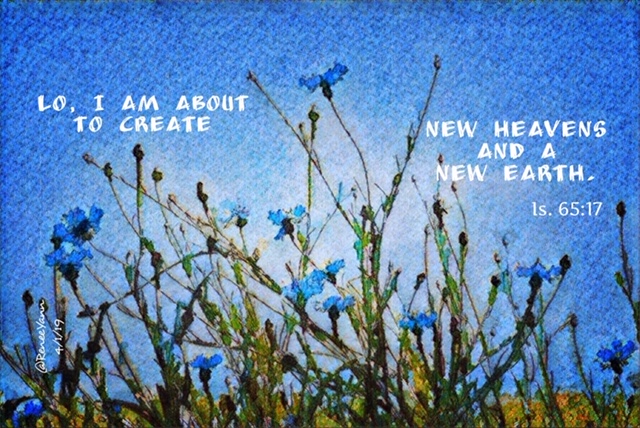
Walter Brueggemann calls Isaiah 65 “a glorious artistic achievement”. Indeed, these images confirm his statement:
a new heavens and a new earth;
constant rejoicing and happiness
people will be a delight
no weeping or crying;
long life for all
everyone with a home
enough for all to eat
As we pray with this passage today, we may experience a longing for a return to our beautiful, safe world. During this pandemic, we all pray from a place of anxiety, loss, constrainment, or some degree of suffering.
Isaiah’s community prayed from the same place. All the beautiful images were a promise not yet realized. The prophetic poetry of Isaiah is a call to courageous hope, not a description of current circumstances.
Faith invites us, even as we experience a bittersweet longing, to trust that God is with us, teaching us and leading us deeper into the Divine Understanding. Even as circumstances turn our world upside down, God will guide the falling pieces to a blessed place if we commit to find God in the tumbling.
I don’t think many of us would deny that the world before Corona needed fixing. The systems we have built have left many in deficit long before 2020, and we have failed to address the wound.
Corona has laid that failure bare.
Now that some of that deficit is universally shared, may we be opened to an irrevocable awareness of our common humanity and responsibility for one another.
Only by such an outcome will we move closer to Isaiah’s peaceful Kingdom. Only by our courage to embrace it, can God fulfill the Promise in us.
Today, in Mercy, water flows through all our readings, inviting us to God’s refreshing Mercy.
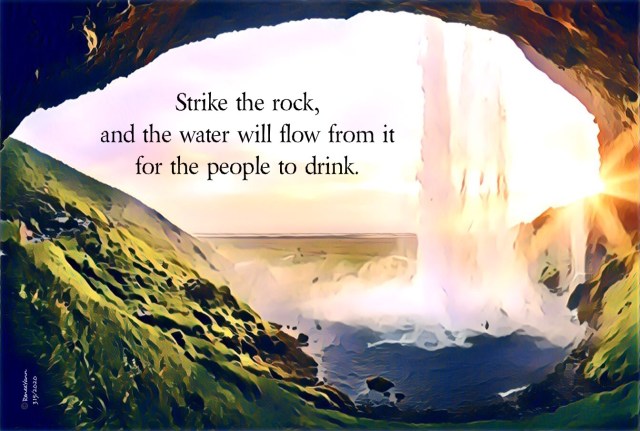
For the thirsty and testy Israelites, the water flows from the rock of their hopelessness. Wandering in the desert for days on end, they are exhausted and bewildered. Each sunrise seems to push their destination farther away rather than bring it closer. They are thirsty … but for a lot more than a cool drink.
And God gives everything they need – not only water, but surprised hope and renewed confidence as they witness the mighty rock split at Moses’ touch.
Paul points out that it is, indeed, that hope which truly slakes the deeper thirst.
And hope does not disappoint, because the love of God has been poured out into our hearts through the Holy Spirit who has been given to us.
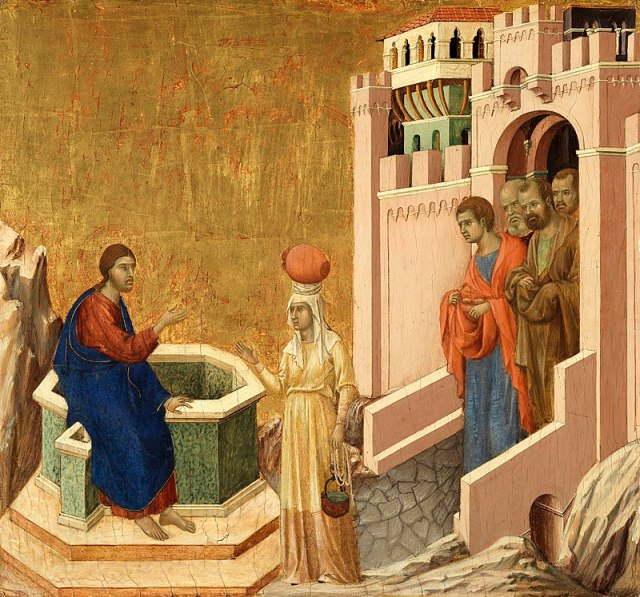
In our Gospel story, Jesus awakens in the Samaritan woman a thirst and hope she didn’t know she had. The layers of her tangled life had formed an impervious rock around her, insulating her from her own soul’s needs.
Christ and the Samaritan Woman by Duccio di Buoninsegna
Jesus, “tired from the journey”, expressed his own need to her. This simple request unleashes a cascade of searching from the woman. Jesus, seeing her readiness for grace, catches all that pours out from her. He transforms it into a challenge for conversion:
Jesus answered and said to her, “If you knew the gift of God and who is saying to you, ‘Give me a drink, ‘ you would have asked him and he would have given you living water.”
And she accepts the challenge:
Sir, give me this water,
so that I may not be thirsty again.
As we pray today, we may sense a desert within us. Or we may feel that our soul’s journey has become frustratingly circuitous. We may be like the Samaritan woman, sitting beside a well that seems slowly drying out. Maybe the juices have dwindled in our souls.
In these readings, as we listen to the Ancients call out for flowing grace, we may find a way to ask God for the refreshment we need just now.
Moses spoke to the people, saying: “This day the LORD, your God, commands you to observe these statutes and decrees. Be careful, then, to observe them with all your heart and with all your soul.
Today, in Mercy, Moses tells us this:
Be careful, then …
Be careful of what? Does he mean be careful like,”Don’t fall down the steps!”. Or does he mean be careful like, “Hold tenderly to love in your life.”?
In this passage from Deuteronomy, Moses goes on to say one of my favorite biblical phrases:
… today the LORD is making this agreement with you:
you are to be a people peculiarly his own, as he promised you…
Since the 17th century, the word “peculiar” has taken on the meaning of “odd” or “unusual”.But the original sense comes from the Latin peculiaris meaning “of private property”
Moses is reminding us that we belong to God and God to us in a covenant similar to, but far exceeding, the mutuality of a marriage.
So we should “be careful”, full of care, in appreciation for this infinite love.
In our Gospel, Jesus tells us how to take this exquisite care of our precious relationship with God:
But I say to you, love your enemies, and pray for those who persecute you, that you may be children of your heavenly Father, for God makes the sun rise on the bad and the good, and causes rain to fall on the just and the unjust. … Be compassionate as your Heavenly Father is compassionate.
So, let’s be careful of love today when we find this precious God in our sisters and brothers and in all God’s Creation. Let us be compassionate.
Today, in Mercy, our readings could confuse us with their threads of legalistic logic. We see several examples of “if-then” admonitions that can make us picture God as an accountant measuring every choice we make.
If the wicked man turns, … then he shall surely live
If the virtuous man turns, … then none of his good deeds shall be remembered.
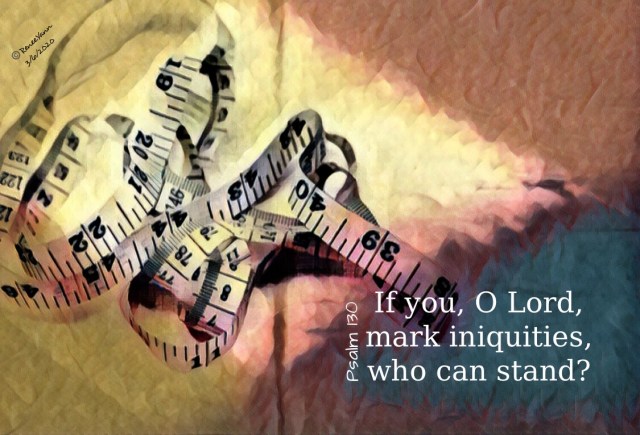
If you, O Lord, Mark iniquities … then who can stand.
If you go to the altar unreconciled … then leave and be reconciled.
Sometimes, we can get obsessive about the “if-then” aspects of religion. And IF we do, THEN we probably miss the whole point. Because folded in today’s “if-then” seesaws is the truth of these passages: that the Lord does NOT sit miserly in Heaven to mark our iniquities.
The Lord measures the righteousness of love.
“Thus says the LORD, “Let not a wise man boast of his wisdom, and let not the mighty man boast of his might, let not a rich man boast of his riches; but let him who boasts boast of this, that he understands and knows Me, that I am the LORD who exercises lovingkindness, justice and righteousness on earth; for I delight in these things,” declares the LORD.—Jeremiah 9:23-24
Today’s Responsorial Psalm offers us a beautiful prayer for this morning as we pray in the embrace of God’s Lavish Mercy:
I trust in the LORD; my soul trusts in his word. My soul waits for the LORD more than sentinels wait for the dawn. Let Israel wait for the LORD. For with the LORD is kindness and with him is plenteous redemption; And he will redeem Israel from all their iniquities.
Let’s wait for the Lord today to see where God’s Grace invites us to the righteousness of Love.
Music: Everlasting Love – Mark Hendrickson & Family (Lyrics below)
Chorus
With an everlasting love
I love you I love you
With an everlasting love
a love that’ll never end
a love that’ll never end
I love you.
Till the stars lose their way
In the heavens up above
And the oceans all run dry
Till the clouds in the sky
Keep the rain all to themselves
Even longer I’ll love you
This I promise I’ll love you
My word I give it’s true
I love you
Till the morning sun ceases to arise
And the moon forgets to shine
Until heaven’s blue is erased from the sky Even longer I’ll love you
This I promise I’ll love you
My word I give it’s true
I love you
Today, in Mercy, one line from our readings hit me like a lightening bolt:
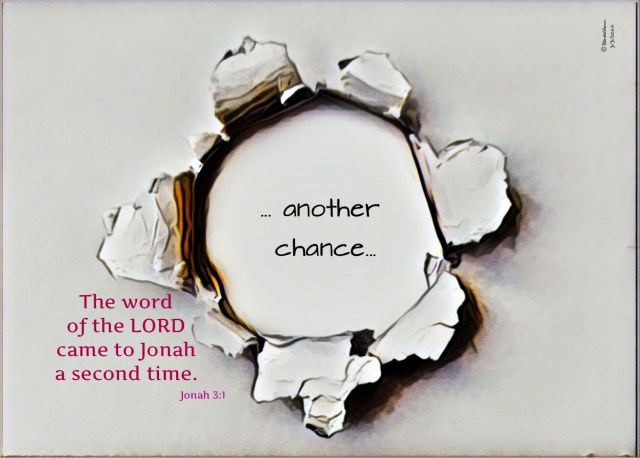
The word of the LORD came to Jonah a second time.
Yes, it’s the truth! God will keep coming back again and again to encourage us to hear his true message for our lives.
Our Gospel gives us a hint about how resistant we sometimes are to this deep listening:
This generation is an evil generation; it seeks a sign, but no sign will be given it, except the sign of Jonah.
What is the sign of Jonah anyway?
To put it simply, it is the witness of the Resurrection – that overarching event that changed everything for believers. For just as Jonah was able to return from certain death in the whale’s belly, so Christ conquered death and rose to new life, promising us the same power.
This is the central, life-changing belief for Christians. It should make a difference in how we live.
By our Lenten repentance, we can be like Jonah, grasping the second chance God always gives us to respond to our life circumstances with faith, hope, and love.
I would bet there is something in your life right now that is calling you to such a response. Someplace in your life, you may be caught in a bit of a “whale’s belly 🐳” about some issue, am I right?
God makes us ask ourselves questions most often when He intends to resolve them. He gives us needs that He alone can satisfy, and awakens capacities that He means to fulfill. Any perplexity is liable to be a spiritual gestation, leading to a new birth and a mystical regeneration.”― Thomas Merton, The Sign of Jonas
Today’s readings remind us that we already have the glorious sign of the Resurrection to inspire us to leap from that dark “belly” into God’s hope for us!
Music:a fun song “In the Belly ofWhale” – The Newsboys
The LORD said to Moses, “Speak to the whole assembly of the children of Israel and tell them: Be holy, for I, the LORD, your God, am holy.
Our first reading goes on to tell us how: be a decent person.
Don’t steal, lie, or cheat
Pay just wages
Respect and help those physically burdened
Be impartial and just
Defend life
Don’t slander, hate, take revenge, or hold a grudge
Basically, the message is about kindness … deep kindness, the type that comes from realizing how infinitely kind God is to us.
Leviticus, after a long list of practical examples, sums it up:
You shall love your neighbor as yourself.
I am the LORD.
Our Gospel tells us what happens when we make the choice to take the Old Testament advice — or not.
We are all familiar with the parable of the sheep and the goats. And we all hope our scorecard gets us in the right herd “When the Son of Man comes in his glory, and all the angels with him …”
Basically, in this parable, Jesus puts the advice of Leviticus into practical form for his followers. But he adds one dynamic element that not only invites but impels our wholehearted response:
Amen, I say to you, what you did not do for one of these least ones, you did not do for me.
Leviticus invites us to become holy as God is holy. But Jesus reveals the secret that this Holy God lives in the poor, hungry, homeless, imprisoned and sick. By embracing these most beloved of God, we find the pattern of Holiness.









 Lavish Mercy