Witness for the …

Sunday, February 10, 2019

Click here for readings

I bet I know the first word that popped into your mind when you read today’s headline:  PROSECUTION!

Agatha-Christies-Witness-for-the-Prosecution-set-for-BBC-One-remake-767x421

Today, in Mercy, our readings invite us to consider WITNESS — not for the prosecution, but for the RESURRECTION!
Is6_8 witness

In our first reading, we see Isaiah dramatically commissioned to WITNESS to the vision of faith in his heart. He responds wholeheartedly:

Then I heard the voice of the Lord saying,
“Whom shall I send?  Who will go for us?”
“Here I am,” I said; “send me!”

Our second reading, Paul describes how Christ appeared to him and commissioned him, “the least of the Apostles” to be his WITNESS. Paul, too, responds wholeheartedly:

He appeared to me.
Therefore, … so we preach and so you believed.

In our Gospel, Simon Peter, James and John are awed by the miraculous power of Jesus as their nets pull hundreds of fish from the otherwise unproductive sea. Jesus tells them that, by their WITNESS, they will attract hundreds of souls to his message. They also respond wholeheartedly:

When they brought their boats to the shore,
they left everything and followed him.


For the Word of God to live,
WITNESS is everything.


Macrina Wiederkehr, OSB, in her beautiful book, “Seven Sacred Pauses”, describes the level of WITNESS in the first disciples:

They were impelled to continue proclaiming the Gospel in the face of opposition. They were zealous in preaching because they felt passionate about being entrusted with the sacred message.

Think of this often-heard philosophical conundrum:

If a tree falls in the forest,
and no one is there to hear it,
does it make a sound?

Logic tells us that it does. But what does it matter if no one hears it?

If the Resurrection happened, and no one bears witness to it, what does it matter? That is the importance of our call to WITNESS –   just like Isaiah, Paul, Peter, James, John, and two millennia of believers who carry on the sound of that tomb bursting open to eternal life.

How will we witness to our faith today – not by preachy words or empty opinions, but by our active passion for justice and mercy in the world, and in our own choices?

Music: I Will Stand as a Witness for Christ
Merciful Jesus – Piè Jesu

Saturday, February 9, 2019

Click here for readings

rgular shepherd

Today, in Mercy,  our readings refer to Christ’s infinite compassion by using the image of a shepherd.

It is an image that, while not completely lost on us, is removed from our daily experience. Within the image, though, are elements which transcend time and culture. These elements become clear as we pray with our Responsorial Psalm 23:

Just as Jesus looked at the crowd with pity – (pietàs – a devoted, compassionate love), so he looks on us. It is love like that conveyed in Michaelangelo’s Pietà, where Mary looks on Jesus with a love we cannot imagine.

rome pieta

Psalm 23
(Jesus sees that we need rest from the things that harass our spirits.)

The LORD is my shepherd; I shall not want.
In verdant pastures he gives me repose.
Beside restful waters he leads me;
he refreshes my soul.
R. The Lord is my shepherd; there is nothing I shall want.

(Jesus sees that we need guidance in our complex and morally bereft world.)
He guides me in right paths
for his name’s sake.
Even though I walk in the dark valley
I fear no evil; for you are at my side
With your rod and your staff
that give me courage.
R. The Lord is my shepherd; there is nothing I shall want.

(Jesus sees that we are hungry for deeply spiritual nourishment.)
You spread the table before me
in the sight of my foes;
You anoint my head with oil;
my cup overflows.
R. The Lord is my shepherd; there is nothing I shall want.

(Jesus sees that we need to be assured that we are deeply loved and protected.)
Only goodness and kindness follow me
all wthe days of my life;
And I shall dwell in the house of the LORD
for years to come.
R. The Lord is my shepherd; there is nothing I shall want

What assurance, what pietàs, do we most need from God today?
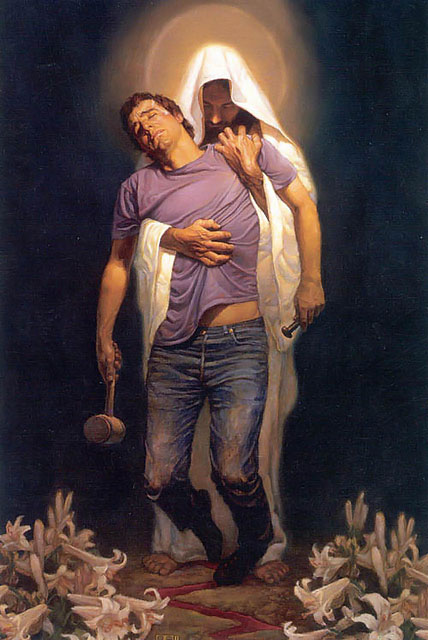
Perhaps these modern images of Pietà will help us with our prayer.

pieta modern
Modern Pietà – Michael Belk
standing piets
Christ Holds the Beloved – Thomas Blackshear

Music: Piè Jesu – Andrew Lloyd Webber
sung here by Lea Salonga & Daniel Rodriguez
(note English translation in lower right)

The Bitter Root

Wednesday, February 6, 2019

Click here for readings

Today, in Mercy, we taste the “bitter root”. 

Heb12_15 bitter root

Paul writes to the Hebrews:

See to it that no one
be deprived of the grace of God,

that no bitter root spring up and cause trouble,
through which many may become defiled.

In our Gospel, Luke writes to his community

So Jesus was not able to perform any mighty deed in his hometown,
… He was amazed at their lack of faith.

So what is this bitter root that robs a heart of faith, forgiveness, trust, hope and love?

Think of the things we humans bury deep in our souls, before they can be seen, named and confronted. Naïvely, we think that hiding them will make them disappear.
We bury our:

word cloud

These buried irritants never disappear. They thicken under the surface, choking the possibility of new life — of Grace. These “bitter roots” steal our spiritual health and cripple the Holy Spirit within us. They deprive the community of our vigor and life. 

It is so necessary and important for us to bring these tangled undergrowths to light! It is so necessary and important for us to be the loving community that offers understanding, healing, listening and love.

How do we uncover and release these hidden poisons? Prayer, of course, can help us, and the gentle discipline of honesty with ourselves; the natural self-revelation of a trusted friendship, the insights of spiritual direction and retreat, and, sometimes, the professional accompaniment of a counselor.

Mary Oliver, beloved poet, describes a buried darkness in her own life in this poem “The Uses of Sorrow”:

Someone I loved once gave me a box full of darkness.
It took me years to understand that this too, was a gift.

As part of the faith community, we need to contribute to that place of trust and friendship that invites others to work through their darknesses. Healing is not magic. It comes through the tenderness, patience, honesty, awareness and encouragement of the surrounding community, as well as through our own courage. We need that community ourselves, and we need to be that community for others.

Music: Ubi Caritas (Where Charity and Love prevail, there is God.)


Prayer to Honor a Beautiful Sunset

(Because the sunset was so magnificent tonight,
I thought I might share this prayer I wrote many, many years ago.)

sunsetJPG

Degreeing Prayer
(To Yield Graciously to Life by Degrees – Like the Sun)

O God, my Beginning and my End,
I do not choose to “rage into the night”.
I choose to bleed into it,
graciously, as
Jesus bled…

by willing peace in face of curdled power,
by willing love in face
of irrational hate,
by willing acquiescence in the face of
time’s inexorable demand.

I want to be that strong…
to be so gentle, because
I think that
Jesus looked into the Dark
and saw Your Face
to learn antithesis of violence.

You are the Yielding One,
eschewing power for the sake of love.

You are Creator, granting
freedom in the will of those to whom
You bind Yourself by love.

You are the Contradiction
of control.

You are the Silent Source
of all
ennobled dying,
by those grafted to your Mystery
in the constant dark.

Absorb me,
as I near the forward edge of night.

Grade me,
like the colors of a yielding spectrum,
to softly welcome Your deepest darkness.

Music: Beyond the Sunset

Walk the Bridge

Sunday, February 3, 2019

Click here for readings

Today, in Mercy,  we begin our readings with God’s stern but magnificent commission to the prophet Jeremiah: 

… stand up and tell them
all that I command you.

What Jeremiah had to tell the Israelites was not good news. He prophesied that if they didn’t repent from their idolatry, Jerusalem would fall into the hands of foreign oppressors. Nobody wanted to hear it. They led Jeremiah a life, to the point that he is often referred to as “The Weeping Prophet”. Over the course of forty years and reign of five Judean kings, Jeremiah’s message continues until, in the end, it comes to fulfillment in the Babylonian Captivity.

How did Jeremiah sustain such confrontational preaching in the face of intractable resistance?

love is the bridgeJPG

Perhaps the answer lies in our second reading. He did it out of love.

Arthur Cundall, a British scripture scholar writes:

“God wanted a person
with a very gentle and tender heart
for this unrewarding ministry of condemnation.
Jeremiah’s subsequent career shows that
he had this quality in full measure.”

Jeremiah is a living example of the loving, humble, truth-seeking, hope-impelled soul described in 1 Corinthians, our second reading.

In Luke’s Gospel today, we see Jesus rejected in the same manner as Jeremiah. Jesus’s message asks his listeners for deep conversion of heart in order to be redeemed. Like the ancient Israelites, they don’t want to hear it. They cannot break through their comfortable existence to acknowledge its emptiness.

The message for us today? Is there an emptiness somewhere in our hearts that we have not yet given over to God? Are we filling it with “false gods”, rather than the loving virtues described in Corinthians?

We know where our “dead spaces” are, and we deeply intend them to come alive again. Today, let’s begin to walk the bridge from intention to practice.

Music:  Can’t help it. I love it.

Ears to Hear

Wednesday, January 30, 2019

Click here fro readings

Today, in Mercy,  we hear the very familiar parable of the sower and the seed, teaching us that God’s grace needs to fall on a fertile heart in order to bear fruit.

It seems like a pretty straightforward lesson although, according to the passage, many listeners missed the point. The situation begs the question of why Jesus used parables if some people wouldn’t understand them.

ears

A parable is like a poem. Both say so much more than the words that comprise them.

Jesus is teaching his listeners truths that go beyond language. Each parable will live beyond its time to bring fresh insights down through the generations.

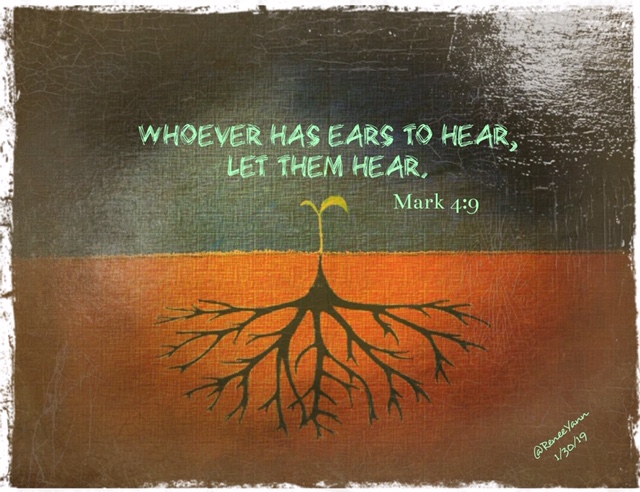
But the key is having the “ears to hear”.

These are ears of the heart and soul, ears that listen always for God’s silent conversation running under all reality. These “ears” are a metaphor for the contemplative spirit which trains itself in wordless prayer to find the Word in all experience.

We will have innumerable conversations today with ourselves and others. We use the many languages of human interaction: business jargon, friendly banter, diplomatic dialogues, lover’s whispers, profound heart-to-hearts, body language, and even pregnant silence. 

Running under each exchange is a level of divine engagement where God speaks, revealing the true meaning of our human experience.  Our whole life – every moment of it – is a parable of God’s infinite love for us and all Creation. Our whole life is a conversation with God!

Let those who have ears to hear, hear!

(Speaking of “words” and “poems” today, I thought I would share a few of my poems on occasion for those who might enjoy them.  I have chosen two that are about contemplative prayer. They will come in a separate email. I hope you enjoy them)

Music: Will You Not Listen?~ Michael Card

Fan the Love into Flame

SATURDAY, JANUARY 26, 2019

Click here for readings

Today, in Mercy, we have the beautiful letter from Paul to Timothy, filled with tenderness, encouragement, hope and the sweet suggestion of loving memories.

2 tim1_6 fan to flame

When we travel life’s road, what an indescribable blessing to have even one companion who loves us the way Paul loved Timothy — to care for our whole life,  our whole soul, and our whole “forever”.

In his letter, Paul reveals that Timothy has been immensely blessed with such love.  Timothy’s mother and grandmother, Eunice and Lois have already – for many years –  tendered Timothy in the faith.

In this lovely letter, Paul notes that he prays for Timothy daily.

Do we pray for those who have blessed us and loved us in our lives? Do we tell them so, if they are living? Do we thank and remember them if they have gone home to God?

Paul closes this part of his letter with such beautiful words to Timothy:

For this reason,
I remind you to stir into flame
the gift of God that you have
through the laying on of my hands.

Many people have rested their hands on your spirit, on your heart.  Be filled with love and gratitude for them today and everyday. For those who have done otherwise, forgive them and let them go.

I remember in a special way today my mother who died on this date thirty-one years ago.  In a separate email, I share a poem I wrote after Mom’s death.  It is a little sad in tone, but it may touch and help some of you, my readers, who are experiencing grief.

Stay with your grief, beloveds, long enough to find the blessing within it.

Some meditative music: for your remembering prayerJames Last – Coulin

Jesus Breaks Through

Wednesday, January 23, 2019

Click here for readings

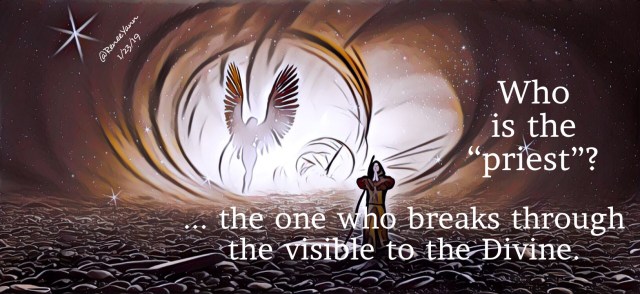
Today, in Mercy,  the writer of Hebrews continues to shine light on the superior  “priesthood” of Jesus Christ – that aspect of Christ’s ministry that breaks heaven open for us and reinstates us as God’s children.

heb2 priest

Hebrews calls Christ a priest “according to the order of Melchizedek” – an order above and beyond the priesthood of Aaron and Levi.

Although there are a few references to Melchizedek in scripture, only one narrative refers to him:

After Abram returned from defeating Kedorlaomer and the kings allied with him, the king of Sodom came out to meet him in the Valley of Shaveh (that is, the King’s Valley).
Then Melchizedek king of Salem brought out bread and wine. He was priest of God Most High, and he blessed Abram, saying,
“Blessed be Abram by God Most High,
    Creator of heaven and earth.
And praise be to God Most High,
    who delivered your enemies into your hand.”
Then Abram gave him a tenth of everything.
Genesis 14:17-20

Melchizedek, whose priesthood preceded even Abraham, is offered in Hebrews as a prototype of Jesus who fulfills and perfects the Old Testament promises.

Does this matter to us modern day Christians who can barely say “Melchizedek “, let alone spell it? And if it does matter, how?

An answer may be revealed in our Gospel today. 

In it, Jesus challenges the old, Pharisaical, law-bound way of thinking. As the new and perfect “priest”, Jesus breaks that way of thinking with the transformation of love. 

  • This man with the withered hand is more important than the law. 
  • This act of healing and wholeness is more important than ritual adherence. 
  • The priesthood of Jesus is the breakthrough revelation of what God really desires – mercy, not sacrifice.

Music: Love Broke Thru ~ Toby Mac

Jesus Prayed

Wednesday, January 16, 2019

Click here for readings

Today, in Mercy, Mark’s Gospel allows us to spend a day with Jesus during his early ministry. 

After “church”, so to speak, Jesus and his buddies go to Simon’s house for a meal. Where Simon’s wife was we’re not told, but his mother-in-law seems to have been chief cook and bottle washer. Unfortunately, on that day, she’s not feeling well. However, with but a touch from Jesus, she’s restored and begins waiting on the guys. 

It seems like Jesus and his friends hung out through the heat of the day. As evening cool descends, neighbors begin arriving with their sicknesses and troubled spirits. Jesus cures many of those gathered. Can you just imagine the scene!

pray

The next morning, even before dawn, Jesus goes off to a quiet place to pray. No doubt he wants to discern, with his Father and the Holy Spirit, the things that are happening in his life. Again can you imagine that conversation!

We know that, when asked, Jesus gave us the human words of the “Our Father” to teach us to pray. But how did Jesus himself pray in the solitude of his heart? 

Three Persons of the Blessed Trinity
focused in relationship to one another
and yielding a Love
too immense for description!

In our own humble prayer today, may we lean against the heart of Jesus as he immersed himself in the Presence of the Creator and Spirit. May we pray in Christ’s pregnant silence.

Music: a very simple, yet very profound hymn: Father, I Place into Your Hands

The Path through Suffering

Tuesday, January 15, 2019

Click here for readings

Today, in Mercy, we again read from the epistle to the Hebrews and the Gospel of Mark. We will be doing this for the next month or so.

heb2_10 sufferingjpg

Hebrews is unique in that it was written rather specifically for Jews who had become Christians. They were people who were steeped in the spirituality and expectations of the Old Testament. They had been waiting for a militant Messiah who would deliver them from earthly suffering by a display of power and might.

During the first century of Christianity, as the nascent Church experienced persecution, that hope for delivery re-emerged. Although they had accepted a Resurrected Christ, the community’s own present suffering fixated them on the Passion and death of Jesus. They questioned how that anguished man could really be the One foretold in their Hebrew Scriptures, and how he could transform their lives.

Can’t we empathize with those early Judea-Christians? The mystery of suffering and death still haunts us. Don’t we sometimes question why Jesus had to die like that – why we have to die, why the people we love have to die? Don’t we feel at least some resistance to this overwhelming mystery?

The author of Hebrews tries to address those doubts by showing that the majesty of Christ resides not just in his divine nature, but in his loving willingness to share our human nature. By doing so, Jesus demonstrated in his flesh the path we must take to holiness. He leads the way through our doubts if we put our faith in him.

This is the core mystery of our faith: that God brings us to eternal life not by a path outside our human experience. Rather, Jesus shows us how to pattern our lives on the profound sacrificial love which is the lavish Mercy of God. The path to eternal life is not around our human frailties but through them.

Mark gives us just one Gospel example of that love today in the healing of the man with the unclean spirit. That spirit was one of resistance to the Word of God, screaming out as Jesus began to preach a Gospel of love, faith, and forgiveness.

As we pray these scriptures today, let us put before God’s healing touch any resistance in our hearts to Jesus’s call to be merciful love in the world.

Music:  Crown Him with Many Crowns, an 1851 hymn with lyrics written by Matthew Bridges and Godfrey Turing and sung to the tune ‘Diademata‘ by Sir George Job Elvey.

This majestic hymn reflects how mid-19th century theology attempted to embrace the Redemptive mystery. Still, many of its suggestions, though cast in an earlier idiom, are well worth reflection.