A New Day Awaits

Sunday, March 31, 2019

Click here for readings

1 Cor new creation

Today, in Mercy,  halfway through Lent, we see in our readings glimpses of new life.

The captivity in Egypt had been TOUGH on Israel. During those many decades, they had appeared to be abandoned and forgotten by God.  It was a harsh reckoning for them … hard to be forgotten. Even then, when they thought they had found freedom, they still wandered for forty years in the desert.

But now Israel stands at a new horizon.  Moses has died and Joshua has become Israel’s leader.  God tells him that it is a new day:

“Today I have removed the reproach of Egypt from you.”

In our second reading, Paul tells us:

Whoever is in Christ is a new creation:
the old things have passed away;
behold, new things have come.

And in our revered Gospel story of the Prodigal Son, Jesus tells us:

This beloved child of mine was dead, and has come to life again;
was lost, and has been found.

All of these passages speak to us in our Lenten journey, and in our Life journey.  We have experienced our own “Egypts”, times when we felt disconnected, even abandoned, by God.  We have sometimes felt we were journeying aimlessly toward an unknown goal. We have at times wandered, like the prodigal son, from the path of God’s love. We have darknesses in our memories that still long for Light.

This poem from Mary Oliver might capture the feeling for us:

Someone I loved once gave me
a box full of darkness.
It took me years to understand
that this, too, was a gift.
~ Mary Oliver ~

In today’s readings, God is reminding us that the Light awaits us. Forgiveness, reconciliation, new energy and grace are the gifts of Easter – the gifts where we must keep our eyes focused as we journey.

So let us do as e.e.cummings encourages us in this poem:

Let It Go – e.e. cummings

let it go – the
smashed word broken
open vow or
the oath cracked length
wise – let it go it
was sworn to
go

let them go – the
truthful liars and
the false fair friends
and the boths and
neithers – you must let them go they
were born
to go

let all go – the
big small middling
tall bigger really
the biggest and all
things – let all go
dear

so comes love


Music: Remember Not the Things of the Past – Bob Hurd
(Lyrics below)

Remember not the things of the past;
now I do something new,
do you not see it?
Now I do something new, says the Lord.

In our distress God has grasped us by the hand,
opened a path in the sea, and we shall pass over,
we shall pass over, free at last.

In our parched land of hypocrisy and hate,
God makes a river spring forth,
a river of mercy, truth and compassion; come and drink.

And who among us is sinless in God’s sight?
Then who will cast the first stone, when he who was sinless
carried our failings to the cross?

Pressing ahead, letting go what lies behind,
may we be found in the Lord, and sharing his dying,
share in his rising from the dead.

Mercy, like spring rain…

Saturday, March 30, 2019

Click here for readings

Hosea6_3 rainJPG

Today, in Mercy, our two readings encourage us to be humble and repentant.

In the reading from Hosea, God is very clear:

For it is love that I desire, not sacrifice,
and knowledge of God
rather than burnt offerings.

In our Gospel, Jesus tells us the parable of the proud Pharisee and the humble tax collector. The Pharisee’s prayer shows his judgmental self-satisfaction with all the sacrifices he’s made:

O God, I thank you that I am not like the rest of humanity —
greedy, dishonest, adulterous — or even like this tax collector.

I fast twice a week,
and I pay tithes on my whole income.’

On the other hand, we have the scorned tax collector ( a status we can understand this time of year:-)  who admits his weakness and need for God’s mercy.

Oh God, have mercy on me, a sinner!

The readings are really about seeing ourselves in the light of God’s truth, while knowing that our merciful God loves us infinitely, even in our weakness. They are about being open to that mercy so that we can know the fullness of God’s grace.

Music: Humble – Audrey Assad

To See As God Sees

Tuesday, March 26, 2019

Click here for readings

Today, in Mercy, our readings describe God’s lavish mercy and the expectation for our reciprocity.

love one another

The passage from the Book of Daniel, written in lilting prose, quotes the prayer of Azariah. It gives us several phrases to savor in our own prayer, depending on the particular disposition of our heart on any given day:

To whom you promised …. like the stars of heaven, or the sand on the shore of the sea.
What has God promised you to give you hope in your life? Can you call on those promises today in your prayer?

For we are reduced, O Lord, beyond any other nation…
Are you feeling sad, disconnected, humiliated or depressed? Can you give these feelings to God and open your heart to healing?

We have in our day no prince, prophet, or leader,
no burnt offering, sacrifice, oblation, or incense,
no place to offer first fruits, to find favor with you.
Do you ever feel abandoned by the institutions we all once depended on, whether Church, government, law etc.? Can we pray for the courage to depend only on God in all things?

Now we follow you with our whole heart…
Have our life circumstances brought us to the point of placing ourselves totally in God’s care? Can we pray with that peaceful and holy abandonment?

Deliver us by your wonders, and bring glory to your name, O Lord.Can our prayer be one of giving glory to God for all the blessings in our lives?

God has been so good to us! Our Gospel enjoins us to be reciprocally good to others.

Music: Give Me Your Eyes – An interesting song by rock singer Brian Heath. As his plane is landing one night, he receives a grace to pray for new eyes — eyes that see and love  all humanity as God does.

This One’s Pretty Difficult!

Monday, March 18, 2019

Click here for readings

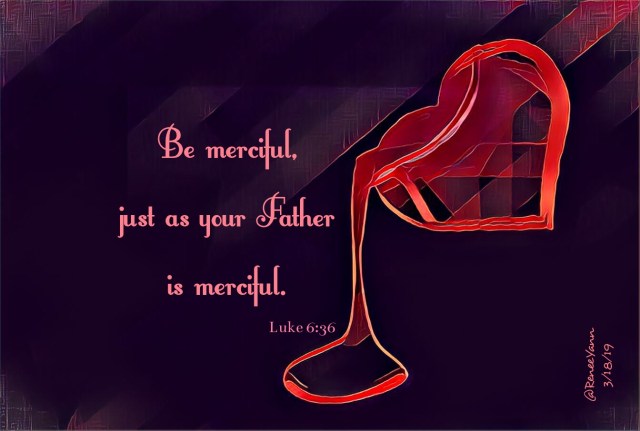
Today, in Mercy, Jesus tells us to be merciful, as God is merciful.

I think that’s really hard.

Lk6_36 be merciful

Being merciful is not too hard with poor, unfortunate souls for whom life is one tragedy after another.

It’s not too hard when someone innocent is suffering unjustly.

But, gosh, it’s difficult to be merciful in the face of meanness, stupidity, selfishness and arrogance.

Yet God is merciful to me when I’m like that.

The Gospel’s message is painfully straightforward. It calls me to examine all my judgmental thoughts and actions and to reverse them.

I don’t know about you, but I’m going to be busy for a while working on this one.

Music: The Mercy Song – Paul Alexander

Take It Up a Notch

Friday, March 15, 2019

Click here for readings


Mt5_24 brother
Today, in Mercy, Jesus tells us to take it up a notch. It’s not good enough, he says, not to kill people.

You have heard that it was said to your ancestors,
You shall not kill; and whoever kills will be liable to judgment.
But I say to you …

When we first read this, we might think we’re pretty safe. After all, how many of us actually kill people?!?! 

But let’s check that, Jesus says:

  • Don’t remain angry with your sister/brother
  • Don’t call them  “empty head” (raqa)
  • Don’t call them fools 

Jesus seems to be telling us that there are many ways to kill!

  • We can kill the possibility of relationship by our unresolved angers, grudges, sustained hatred of people.
  • We can kill hope in someone by labeling them stupid or foolish.
  • We can easily kill someone’s reputation by a false or injudicious word.
  • We can kill joy by our indifference.
  • We can kill love with ingratitude.
  • We can kill innocence with any of the seven deadly sins

It takes vigorous spiritual attention to live at the level Jesus is asking of us. Let’s give our souls that particular attention, especially during our Lenten journey.

Music: The Servant Song – Maranatha

A Covenant of Love

Sunday, February 24, 2019

Click here for readings

Today, in Mercy, our reading from 1 Samuel tells the intriguing tale of David’s magnanimity toward Saul. Saul is enraged and jealous of David whom Samuel has anointed as king to replace Saul. David is continually in Saul’s crosshairs.

But one night, David stealthily enters Saul’s camp. Even though he has a chance to kill Saul, David spares his life out of respect for his kingship.

While it’s not exactly “love for his enemies”, David does demonstrate a largeness of spirit that foretells today’s Gospel. This gracious spirit demonstrates that David is in right relationship (covenant) with God.

Our Gospel is part of Jesus’s Great Sermon in which he restates and renews the covenant of right relationship. If our spirits are true to God, we will love as God loves. We are to be merciful as God is merciful.

Lk6_38 measure

This Law of Love is the essence of life in Christ. It is a profoundly challenging call.

How hard it must have been for David as he stood, spear in hand, over his sleeping enemy – over the one trying to kill him!

How hard it is for us not to be vengeful, retaliatory, and parsimonious when we feel threatened or exploited.

But we are called, in Christ, to the New Covenant of love. By that call, we are endowed with a right spirit.

Today, Jesus asks us to love, forgive, and judge all others as we ourselves would want to be treated. He asks us to live with a divinely magnanimous heart.

Let us pray for the strength to respond.

Music: O Mercy – Stu Garrard, Matt Maher and Audrey Assad

Power of the Keys

Friday, February 22, 2019

Click here for readings

Peter_keys

Today, in Mercy, we celebrate  the Feast of the Chair of Saint Peter, Apostle. It seems both fitting and painfully ironic that this feast should coincide with the Pope’s Summit on Protection of Minors in the Church. When He handed the “keys” to Peter, could Christ ever have foreseen that his beloved church would descend to this shame?

Factions in the Catholic Church argue over where to place the blame for this horror. Some point to the entitlements of clericalism. Some point to more liberal stances on sexuality. The most vocal factions use their voices to blame others rather than look to their own faults. 

But today’s Gospel suggests that none of these explanations goes to the root of the crisis.

What Christ handed Peter was POWER. Our Gospel says that this power was to be used to map the journey to heaven for the rest of us – appropriately “binding” and “loosening” the guidelines of that journey.

That’s a lot of power!

Unfortunately, the famous quote of John Dalberg-Acton, a 19th century Catholic writer, too often proves true. He said:

Power tends to corrupt.
And absolute power corrupts absolutely.

What was it that Jesus saw in Peter to give him hope for Peter’s incorruptibility?

  • Peter, who abandoned his livelihood in full devotion to the call. 
  • Peter, who tried to protect his beloved Lord from the wrath of the Pharisees
  • Peter who, defending Jesus in the Garden, cut off the ear of Malchus
  • Peter, who recognized and begged forgiveness for his weakness
  • Peter, who chose an inverted crucifixion because he deemed himself unworthy to die as his master did.

Power fueled by this kind of single-hearted devotion and humility is the true “Power of the Keys”. It suffers no shadow of greed, self-importance, domination, or lust. It is always “power for” not “power over” others.

Until our church structures foster this kind of mutual, non-exclusionary power in our leaders AND members, we have little hope of transformation.

Let us pray for true insight and courage for those gathered in Rome.

Music: (Maybe the Cardinals could sing this song in their hearts on the way to their meetings? Maybe we could sing it too sometimes?)

Lay It Down – Moxie Gibson

Does God Love Theodore McCarrick?

I can’t imagine why, can you? McCarrick has lived a reprehensible life hidden in the cloak of ecclesiastical superiority. His sins are disgusting, wrought upon the innocence of children and vulnerable young men. His pretense enrages us, rendering us fools for the honor and respect paid him.

McCarrick_shame

McCarrick has become a symbol for the ghastly swath of sexual scandal running through the institutional Church’s core. He represents a misplaced faith, the distortion of clericalism, the corruption of trust, and the poisonous fruit of chauvinistic sexism in our culture.

He is a pathetic man with a failed life. But does God love him?

The answer is so important:

  • because we hate in McCarrick what we hate in our Church – the institutionalized distortion of power in the name of faith.
  • because if God does not love him, we have no need to forgive him
  • because if God does love him, and forgive him, so must we
  • because if we forgive him, we must forgive our Church
  • because we must work to redeem and rebuild what we have forgiven

I don’t know Theodore McCarrick. I never met him or even thought of him. But when his crimes surfaced, I lost sleep over him. In this one man, all my mortal disappointment in our Church took flesh. All my heartbroken anger found a face to glare at, a life to scorn.

And then I looked at his picture. By some unexpected grace, I saw him for what he is – a broken, pitiable, failed old man whom God still loves. Seeing this, I saw our fractured, corrupted Church in a different light … the pale light of hope that it, too, might be redeemed.

If Theodore McCarrick’s life counts for anything positive among us, perhaps this is it.