Out of the Depths

Tuesday of the Twenty-seventh Week in Ordinary Time 
October 5, 2021

Today, in God’s Lavish Mercy, we pray with Psalm 130, a “Psalm of Ascents” in which the whole community joined in a prayer of intense supplication as they gathered at the Temple.
Although prayed as a community, the psalm is written in an individual voice, helping us to connect our times of personal desperation to the prayer.

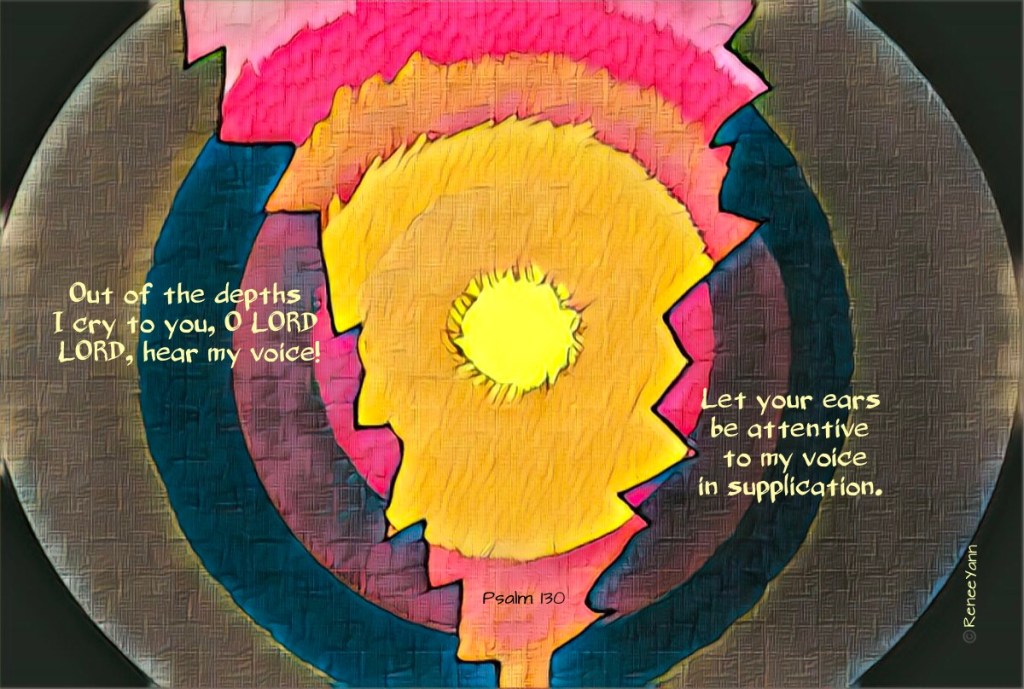
Out of the depths I cry to you, O LORD
    LORD, hear my voice!
Let your ears be attentive
    to my voice in supplication.

Psalm 130: 1-2

Jonah, in the chapter before today’s first reading, gives us a graphic image of what “the depths” feel like.  Not only is Jonah swallowed by the sea, but also by a whale which carries him – imprisoned – to the very bottom of the ocean!

Jonah prayed to the LORD, his God, from the belly of the fish:
Out of my distress I called to the LORD,
Who answered me;
From the womb of Sheol I cried for help,
and you heard my voice.

Jonah 2:2-3

Sheol” is a Hebrew term which could be translated as “place of the dead spirits”. It is different from the grave, which harbors the body. In other words, “Sheol” is a place where our spirits can die before we physically die.


We can experience this kind of spiritual death in so many ways. Some come upon us not by our own choice. Certainly in the illness of depression we feel this darkness. Profound bereavement and debilitating sickness can overwhelm us as well. Praying Psalm 130 may help at such times. But they also call for reaching out to friends, counselors, and professional support to help in our healing.


But the psalm more specifically addresses those times when we get caught in a deadly spiral due to our own sinful and selfish choices – by allowing prejudice, hate, willful ignorance or any of the seven deadly sins to overtake us.

Lord, hear my cry!
May your ears be attentive
to my cry for mercy.
If you, LORD, keep account of sins,
Lord, who can stand?
But with you is forgiveness
and so you are revered.

Psalm 130: 2-4

Psalm 130 tells us that God is present to us in both situations- whether our suffering is brought on by our own choices or not. God will walk us through to the Light when we open ourselves to Grace:

Let us wait patiently 
to discern God’s way,
For with God is kindness
    and plenteous redemption;
God will restore us
    from every darkness;
God’s way is mercy.

Psalm 130: 7-8

Let’s pray for that kind of faith in our hearts, and the hearts of those we love, especially for anyone suffering “the depths” right now.


Poetry: De Profundis – Christina Rossetti 

Oh why is heaven built so far, 
Oh why is earth set so remote? 
I cannot reach the nearest star 
That hangs afloat. 
I would not care to reach the moon, 
One round monotonous of change; 
Yet even she repeats her tune 
Beyond my range. 
I never watch the scatter'd fire 
Of stars, or sun's far-trailing train, 
But all my heart is one desire, 
And all in vain: 
For I am bound with fleshly bands, 
Joy, beauty, lie beyond my scope; 
I strain my heart, I stretch my hands, 
And catch at hope. 

Music: Out of the Deep – John Rutter

Psalm 130, ‘Out of the deep have I called unto thee O Lord’ begins darkly with an unaccompanied cello solo in C minor, later giving way to a more positive C major at the words ‘for with the Lord there is mercy, and with him is plenteous redemption’.

Out of the deep have I called unto thee, O Lord; Lord, hear my voice.
O let thine ears consider well the voice of my complaint.
If thou, Lord, wilt be extreme to mark what is done amiss, O Lord, who may abide it?
For there is mercy with thee: therefore shalt thou be feared.
I look for the Lord; my soul doth wait for him; and in his word is my trust.
My soul fleeth unto the Lord before the morning watch; I say, before the morning watch.
O Israel, trust in the Lord; for with the Lord there is mercy, and with him is plenteous redemption.
And he shall redeem Israel from all his sins.
Tuesday of the Tenth Week in Ordinary Time

June 8, 2021

Today, in God’s Lavish Mercy, we pray with Psalm 119, a repeated favorite on the blog – you might like to re-visit any of the 13 entries:


Today, let’s pray with 119 in the light of Paul’s words to the Corinthians:

For the Son of God, Jesus Christ, … 
was not “yes” and “no,” but always “YES”.
God’s promises … find their “Yes” in him.

2 Corinthians 1:19-20

Here’s what those slightly cryptic but profoundly meaningful phrases mean to me.

No doubt, sometime in your life you have heard someone powerful say “No” to you. Or perhaps life itself has said it with some insurmountable limitations.

It is in those moments that we truly understand what “Yes” means because it has eluded us!

That meaning takes various forms depending on our circumstances. “Yes” can mean freedom, love, mercy, forgiveness, renewal, possibility, hope, fulfillment.

And “Yes” is always a beginning … a mystery that longs to be unfurled, unpeeled – like this beautiful red onion ( that I bought yesterday for a salad that turned into a reflection!)


Psalm 119 “unpeels” the layers of our relationship with God. Here’s how I hear it in my prayer:

O Lovely God,
You are wonderful.
You are my Light.
You amaze me
by the “Yes” of your Love.
You fire my spirit
to love You in return.

Lavish Mercy, turn to me
because I love You.
Steady me in my shadows.
Draw my “yes” 
into the Light 
of your beautiful Face.

based on Psalm 119:129-135

Poem: love is a place – e.e.cummings 

love is a place
& through this place of
love move
(with brightness of peace)
all places

yes is a world
& in this world of
yes live
(skillfully curled)
all worlds

Music: The Beauty We Love

Wednesday of the Third Week of Easter

April 21, 2021

Today, in God’s Lavish Mercy, we pray with Psalm 66, the exuberant prayer of those who recognize the beauty of God in their lives. They can see Love’s sacred thread, even when it is woven in subtle tones through the fabric of their lives.

I want to be one of those people, don’t you?

But sometimes, life might not look so beautiful. Surely it didn’t for some of the persecuted  Christians in today’s first reading. And yet they remained faithful and found joy.

Now those who had been scattered went about preaching the word. …
Thus Philip went down to the city of Samaria and proclaimed the Christ to them.
With one accord, the crowds paid attention to what was said by Philip
when they heard it and saw the signs he was doing…
There was great joy in that city.

Acts 8:4-8

Joy is not dependent on circumstances. It is a foundational disposition of those convinced of God’s loving and faithful presence in our lives and in all Creation. It is a gift that accompanies faith, nurtures hope, and impels charity.

It is what our soul looks like when it shouts “Wow!” to God.

Say to God: “How awesome your deeds!
Before your great strength all contradiction cringes.
All the earth falls in worship before you;
they sing of you, sing of your name!”

Psalm 66: 3-4

We can’t just WILL ourselves into this kind of joy. But we can ask for it, pray for it, plead for it.  Such a prayer will turn and open our hearts toward our generous God Who longs to bless us with joy.


Poetry: Joy and Woe – William Blake

Joy and woe are woven fine,
A clothing for the soul divine,
Under every grief and pine,
Runs a joy with silken twine.
It is right it should be so,
We were made for joy and woe,
And when this we rightly know,
Through the world we safely go.

Music: Ode to Joy – Ludwig van Beethoven

Psalm 79: Prisoners

Monday of the Second Week in Lent

March 1, 2021


Today, in God’s Lavish Mercy, we pray with Psalm 79, marked in some translations as “A Prayer for Jerusalem”. The psalm is also considered one of the “Sad Songs of Zion” which lament the destruction of the Temple and the ensuing Babylonian Captivity.

We might compare the context for Psalm 79 to what Americans felt on 9/11 or Pearl Harbor. All serenity, confidence, and trust were shattered. The world was broken and we didn’t know if it could be mended.


Praying Psalm 79, I think of the experience of prisoners – prisoners of all kinds. I think of those whose bodies are in jail, and of those whose minds, hearts and souls are similarly confined. Their worlds have been broken, as has their victim’s, even if the victim was themselves.

Let the prisoners’ sighing come before you;
    with your great power free those doomed to death.

Psalm 79:11

I think how our crimes, or addictions, or hateful prejudices – or whatever shape our sinfulness takes – eventually incarcerate us.

And I think of James.


I remember being presented with the “opportunity”. I was about 12 years old and I hero-worshipped my 7th grade teacher, Sister Helen Carmel, SSJ. But I wasn’t so sure about what she was inviting us to do.

Sister had a list of prisoners in Eastern State Penitentiary. She painted a picture of them as lonely and often abandoned people who needed prayers and kindness. She wondered if some of us might like to take a prisoner as a pen pal.

Now, I’ll be honest, the last thing I wanted was a prisoner pen pal! I was becoming a teenager! I wanted new ice skates, an A on my math test, and Jimmy Danvers to hold my hand and treat me to pizza some Friday night.

But because I loved Sister Helen Carmel like a second mother, I got a pen pal. And, maybe because she loved me like a daughter, she gave me a doozie: James, who was on death row.

James and I corresponded occasionally for about three years until he wrote to say there would be no more letters. He didn’t say why, but I knew his time had come either for release or execution. I never learned which. I didn’t want to.


Around the time that James and I corresponded, a teenage girl was brutally raped and murdered, her ravaged body left in the mud of Fairmount Park. 

She went to Catholic high school like I did! She was a teenager like I was! She liked movies and friends and Friday nights like I did! I realized that what had happened to her could have happened to me! Her name, Mary Anne, was perpetually sealed in my mind. When her killer was apprehended and eventually sentenced to death, I was glad. 

But because of James, my gladness was conflicted. These two men have fought a tug of war in my soul ever since. 

Does a human being ever really forfeit the right to life because of their heinous actions? Does society ever have the right to take a life in retribution for crime? I still struggle with the feelings these questions generate. I have spent decades trying to learn how to change my heart from a retributive to a restorative model of justice.

It doesn’t just happen. It takes prayer, education, and right choices. It has taken me the help of more enlightened spirits like St. Joseph Sister Helen Prejean  and Mercy Sister Mary Healy.


Today we state clearly that ‘the death penalty is inadmissible’ and the Church is firmly committed
to calling for its abolition worldwide.

Pope Francis

The Pope has revised the Catechism
of the Roman Catholic Church to state that, 
“The death penalty is an attack
on the inviolability and dignity of the person
that is inadmissible in all cases.”

As we pray with Psalm 79 today, may we have the charity and courage to pray for condemned prisoners, their victim’s beloveds, and for a society that can create effective reform to heal the root causes of major crime.

Help us, O God our savior,
    because of the glory of your name;
Deliver us and pardon our sins
  for your name’s sake.

Psalm 79:9

No poem today. Some music though: The Prisoners’ Chorus from Beethoven’s opera “Fidelio”

Psalm 32: Forgiveness

Friday of the Fifth Week in Ordinary Time

February 12, 2021

Today, in God’s Lavish Mercy, we pray with Psalm 32, a classic penitential psalm.

It is an uncomplicated description of repentance and forgiveness which, nevertheless, discloses profound insights into the human spirit.

Blessed is the one whose fault is taken away,
    whose sin is covered.
Blessed the one to whom the LORD imputes not guilt,
    in whose spirit there is no guile. 

Psalm 32:1-2

This relational sequence of confession and forgiveness is probed in depth in Psalm 32 (where) the speaker describes his silence and his consequent bodily disability (vv. 3–4). One can observe in the psalm an inchoate theory of repression that became definitive for Sigmund Freud. Repression immobilizes, says the psalmist! The abrupt move in verse 5 concerns the process of making his sin known, saying it aloud, confessing it.

It is confession that makes forgiveness possible. It is denial that precludes assurance and that immobilizes the perpetrator.

Walter Brueggemann, From Whom No Secrets Are Hid

Praying with Psalm 32 this morning reminded me of a story I wrote a few years ago.

The Earring

Young Emma, skewered by indecision, had stared into her mother’s jewelry box. She had always loved those silver earrings, a gift to her mother from her grandmother—an heirloom now, a treasure beyond price. She wanted so to wear them on this special date, but they were “hands off” and she knew it. Still, her mother at work and unaware of her desire, Emma had succumbed to temptation.

The dance had been wonderful, a whirlwind of such delight that Emma had not noticed when her left earring had brushed against her partner’s shoulder, tumbling hopelessly under the dancers’ trampling feet. Only at evening’s end, approaching her front door exhausted and dreamy, had she reached up to unclip the precious gems.

Her mother sat waiting for her in the soft lamplight, having already noticed the earrings missing from her dresser. Awaiting retribution, Emma knelt beside her mother and confessed the further sacrilege of loss. But her mother simply cupped Emma’s tearful face in her hands, whispering, “You are my jewel. Of course I forgive you.”  Though accustomed to her mother’s kindness, this act of compassion astonished Emma, filling her with an indescribable, transformative gratitude.

As we pray Psalm 32, there may be a great forgiveness we are thankful for, or just the small kindnesses that allow us to rise each morning with joy and hope. Perhaps there is a memory of compassion, like Emma’s, that we treasure—one that in turn has made us kinder and more honest.

But maybe, on the other hand, there is a “lost earring”, never acknowledged. With time, that unacknowledgement burrows deeper into the spirit restricting our capacity to love.

Psalm 32 reminds us that God is our Mother waiting in the lamplight to cup our face with love, to receive our joyful thanks for divine mercies. 

For this shall every faithful soul pray to you 
    in time of stress.
Though deep waters overflow,
    they shall not reach us. 

Psalm 32:6

Like Emma, we may be astonished at the graciousness that has been given to us. We may respond by pouring out our thanks to God in a silent act of prayer.

May we also have the courage to become like our merciful God, anticipating the other’s need for our forgiveness. May we seek the strength not to harbor injury, but too release it to make room for further grace in our hearts.


Poetry: FIRST FORGIVENESS - Irene Zimmerman
The usually mild evening breeze
became a wailing wind
when the gates clanged shut behind them. 
They shivered despite their leathery clothes
as they searched for the fragrant blossoms
they’d grown accustomed to sleep on,
but found only serpentine coils
that bit and drew blood from their hands. It was Eve who discovered the cave.
When she emerged, she saw Adam
standing uncertainly at the entrance. A river of fire flooded her face
as she remembered his blaming words—
“The woman you gave me,
she gave me fruit from the tree,
and I ate.”

“Spend the night wherever you choose,”
she told him bitterly.
“You needn’t stay with me.” Long afterwards, when even the moon’s
cold light had left the entrance
and she’d made up a word
for the hot rain running from her eyes,
she sensed Adam near her in the dark. His breath shivered on her face.
“Eve,” he moaned,
“I’m sorry. Forgive me.” In the darkness between them
the unfamiliar words
waited, quivering.
She understood their meaning
when she touched his tears.

Music: Father, I Have Sinned – Eugene O’Reilly

Our story above was about a “prodigal daughter”. Our music is about a “prodigal son”.

Psalm 78: Don’t Forget

Friday of the First Week in Ordinary Time

January 15, 2021

Today, in God’s Lavish Mercy, we pray with Psalm 78, a call to learn from experience and to teach its lessons to our posterity.

What we have heard and know,
and what our parents have declared to us,
we will declare to the generation to come
The glorious deeds of the LORD and his strength.

Psalm 78: 3-4

And the teaching is this:

That they too may rise and declare to their progeny
that they should put their hope in God,
And not forget the deeds of God
but keep God’s commands.

Psalm 78: 6-7

Though stern, the message seems obvious and simple, right?

But the last verses of our psalm today reveal a more complex historical reality:

And not be like their fathers,
a generation wayward and rebellious,
A generation that kept not its heart steadfast
nor its spirit faithful toward God.

Psalm 78: 8

In later verses of Psalm 78, Israel’s rebellion finally becomes the last straw. God rejects Israel (the northern kingdom) and chooses the southern kingdom to carry on the Promise. It was BIG!

But they tested and rebelled against God Most High,
whose decrees they did not observe.
They turned disloyal, faithless like their ancestors;
they proved false like a slack bow.
They enraged God with their high places,
and with their idols provoking God to jealous anger.
God heard and grew angry;
rejecting Israel completely.

Psalm 78: 56-59

Praying with the psalm today, my soul still swirling in our country’s current events, I ask myself a few questions:

  • how is God speaking in our political reality
  • what “forgetfulness” are we called to recognize
  • what role does acknowledgement and repentance have in redeeming our integrity
  • what has our experience taught us that we must safeguard for the future
  • how can we unite as a faith community to respond to grace

This commentary by Tom Roberts, former editor of the National Catholic Reporter, enlightened my prayer. I found it disturbing, compelling, and necessary to think on these things. I pray for the courage and discipline to act on them.


Poem: excerpt from “ON THE PULSE OF MORNING” by Maya Angelou
Presidential Inauguration Ceremony, January 20, 1993.
(It is a long, powerful poem. I will post it in a second posting for those who would like to read it in full.)

A Rock, A River, A Tree
 Hosts to species long since departed,   
 Marked the mastodon,
 The dinosaur, who left dried tokens   
 Of their sojourn here
 On our planet floor,
 Any broad alarm of their hastening doom   
 Is lost in the gloom of dust and ages.
 

 But today, the Rock cries out to us, clearly, forcefully,   
 Come, you may stand upon my
 Back and face your distant destiny,
 But seek no haven in my shadow,
 I will give you no hiding place down here.
 

 You, created only a little lower than
 The angels, have crouched too long in   
 The bruising darkness
 Have lain too long
 Facedown in ignorance,
 Your mouths spilling words
 Armed for slaughter.
 

 The Rock cries out to us today,   
 You may stand upon me,   
 But do not hide your face.
 

Music: Learn Your Lessons Well from Godspell

Psalm 95: Tender Your Heart

Thursday of the First Week of Ordinary Time

January 14, 2021

Today, in God’s Lavish Mercy, we pray with Psalm 95. It’s a very popular psalm and we have prayed with it several times.

Today, Paul quotes it in his letter to the Hebrews, following up with this warning:

Take care, brothers and sisters,
that none of you may have an evil and unfaithful heart,
so as to forsake the living God.

Hebrews 3:12

Our psalm suggests that God was pretty fed up with the hard-heartedness of the folks following Moses through the desert.

Forty years I was wearied of that generation;
    I said: “This people’s heart goes astray,
    they do not know my ways.”
Therefore I swore in my anger:
    “They shall never enter my rest.”

Psalm 95: 10-11

Praying with these thoughts, we might ask ourselves where our own hard-heartedness lies. Though some of my readers may be perfect 😉, I’m not – and there may be a few of you like me. I have been, and still am sometimes, a chilly heart, an indifferent heart, an arrogant heart, even a vengeful heart.

We are even, at times, resistant to God as God is revealed in our life challenges.

Our psalm invites us, as both Paul and the psalmist invited their people, to humbly trust God’s ability to soften our hearts – even through what we may perceive as a desert.

We are asked to yield to God and let God’s mysterious grace blossom in us.

Come, let us bow down in worship;
    let us kneel before the LORD who made us.
For this is our God,
    and we are the people God shepherds and guides.

Psalm 95: 6-7

Poetry: Listen – Paul J. Willis

A lake lies all alone in its own shape. 
It’s not going anywhere. 
A lake can wait a long time 
for a hiker to come 
and camp on its shore. 
It will reflect the moonlight, 
give him a drink of pale silver. 
Toward dawn, the wind might ruffle 
it a little, and the water 
will have words with the granite. 
Once the hiker goes away 
through October meadows, 
the lake will sparkle by itself. 
You’ll never see it. There is
so much you will never see.

Music: Tender Hearted – Jeanne Cotter

Psalm 27: Can We Love Like This?

Wednesday after Epiphany

January 6, 2021

Today, in God’s Lavish Mercy, as we once again pray with Psalm 27, we do so in the light of our seminal first reading from John:

God is love, 
and when we remain in love 
we remain in God 
and God in us.

1 John 4:16

How can we love like that?

Psalm 27 tells us how God does it:

For the Lord rescues the poor who cry out,
and the afflicted who have no other help.
The Lord has pity for the lowly and the poor;
and saves the lives of the poor.

Psalm 27: 12-13

Our psalm gives us the measure for love in our lives. Who are the suffering ones in the circle of our experience? How are we widening that circle to offer loving mercy with greater energy and fidelity?


The Spiritual and Corporal Works of Mercy can be our guide as we seek to stretch our love in ever-widening circles.

The Corporal Works of Mercy

To feed the hungry
To give water to the thirsty
To clothe the naked
To shelter the homeless
To visit the sick
To visit the imprisoned, and ransom the captive
To bury the dead


The Spiritual Works of Mercy

To instruct the ignorant.
To counsel the doubtful.
To admonish sinners.
To bear patiently those who wrong us.
To forgive offenses.
To comfort the afflicted.
To pray for the living and the dead.


Poetry: Widening Circles – Rainer Maria Rilke

I live my life in widening circles
that reach out across the world.
I may not complete this last one
but I give myself to it.
I circle around God, around the primordial tower.
I’ve been circling for thousands of years
and I still don’t know: am I a falcon,
a storm, or a great song?

Music: The Mercy Song – Paul Alexander

Psalm 128: Pray It with the Holy Family

The Holy Family of Jesus, Mary and Joseph

December 27, 2020


Today, in God’s Lavish Mercy, as we celebrate the Feast of the Holy Family, we pray with Psalm 128.

Blessed is everyone who lives in awe of the LORD,
who walks in God’s ways!
For you shall eat the fruit of your handiwork;
blessed shall you be, and favored.


Throughout Christmas Day, I spent much time realizing and thanking God for how blessed I am by my family, and by my extended families.

It can be a great blessing to grow old in one’s family. I now claim the matriarchy within my own. 

I am the oldest, the only one to have known all my bloodline as babies. I can even reminisce over all my young in-laws with codgy phrases that claim my elder experience. 


I try to make that elderhood a blessing to them by my prayers and unconditional love, and by carrying to them the tremendous devotion with which my parents and grandparents long ago blessed this family.

But so many times, it is I who am blessed by these “youngsters”. 

On Christmas, through digital miracles like FaceTime, I could watch my younger and only brother and sister-in-law continue our family benediction over their grown children and young grandchildren.

I saw my millennial nieces and nephews pour that long-rooted caring over the next “grand” generation, their own beautiful children.

The caretaking of such a legacy is never automatic or guaranteed in a family. It requires the intentional choice of a maturing love and a deliberate generosity in each member as they grow in responsibility. It demands engagement, trust, and – at times – forgiveness and reconciliation.

Such a heritage thrives where each member provides their degree of mutual example, encouragement and support for the whole family. I think of Peg, my aunt by marriage not blood. I knew she loved and nurtured me and my brother with the same vigor that she loved her own children. That’s the kind of power that holds a family together over generations.


No family is perfect. We need to step in for each other sometimes. Sometimes, we need to call each other to our best selves. 

The Holy Family helps us through those times. They had their trials: unexpected pregnancy, town gossip, refugee status, widowhood, and a son arrested and executed by the government – just to cite the challenges we know of. Yet they model for us the grace-generating love God has for us as a human family.

As we deepen in years and grace, we learn that “family” can be defined by more than blood. In fact, it must be. And the greater our hearts, the wider our sense of family will be – until we might be fully enriched to realize that every person is our brother or sister.

As we pray and strive to learn from the Holy Family, may we be blessed according to Psalm 128:

Behold, thus are we blessed
who live in awe the LORD.
The LORD bless us from on high:
may we see grace and well-being
together, all the days of our lives.


Poetry: Family Court- Ogden Nash, whose light verse always had a point to it 😉

One would be in less danger 
From the wiles of a stranger 
If one's own kin and kith 
Were more fun to be with.

Reading with Music:

Psalm 119: Come, Sweet Mercy!

Tuesday of the Twenty-eighth Week in Ordinary Time

October 13, 2020


Today, in God’s Lavish Mercy, we pray with Psalm 119 whose refrain is beautiful to the ears of those who love Mercy.


We can invite Mercy in many ways.

One way is to ask Mercy to heal the fractured circumstances of our lives – the outside of the cup, if we would borrow an image from today’s Gospel:

  • to strengthen us against any pain or fear in our own lives
  • to deliver us and those we love from all that overwhelms
  • to forgive our inexcusable retreats into selfishness
  • to repair that which seems irrevocably broken 

But another, deeper way is to invite Mercy to the inside of our “cup”:

  • to indwell our hearts
  • to transform, within us, the place where we encounter life
  • to inspire us to respond always with the heart of Jesus
  • to flow from us in continual witness to God’s Mercy

Today, in our prayer, let’s spend some time with Mercy, the most beautiful Face of God.


Poem:  Blest are the undefiled in heart (Psalm 119)
by Isaac Watts (1674 – 1748) was an English Christian minister (Congregational), hymn writer, theologian, and logician. He was a prolific and popular hymn writer and is credited with some 750 hymns. He is recognized as the “Godfather of English Hymnody”; many of his hymns remain in use today and have been translated into numerous languages.

Blest are the undefiled in heart,
whose ways are right and clean;
who never from your law depart,
but flee from every sin.

Blest are the ones that keep your word,
and serve you with their hands;
with their whole heart they seek you, Lord,
obeying your commands.

Great is their peace who love your law;
how firm their souls abide!
Nor can a bold temptation draw
their steady feet aside.

Then shall my heart have inward joy!
I’ll keep my steps from shame;
your statutes help me to obey,
and glorify your name.

Music- Sanctuary by Secret Garden