Good Ground for Hope

Sixteenth Sunday in Ordinary Time
July 23, 2023

Today’s Readings:

https://bible.usccb.org/bible/readings/072323.cfm


Today, in God’s Lavish Mercy, our readings revolve around the dynamic of hope – God’s hope planted in our spirits and our hope entrusted to God’s Mercy.

As we pray with these passages, it helps to remind ourselves of the true definition of “hope”. It is a word that many of us use carelessly to the point that we may have lost the power of its meaning – as in when we say things like, “I hope it doesn’t rain”. What we really mean is that we wish it wouldn’t rain.

Hope is not the same as wishing. Wishing is a mental activity that has no power to make its object come true. Hope, on the other hand, is a resident condition of our spirits that frees us to live with enthusiasm and gratitude despite whatever outcome may arise.

Wishing dissapates when conclusions pass. Hope is eternal because it draws its energy from faith in God’s Infinite Mercy and the promise of eternal life.


The Book of Wisdom’s author understood the Source from which hope springs:

Though you are master of might, you judge with clemency,
and with much lenience you govern us;
for power, whenever you will, attends you.
And you taught your people, by your deeds,
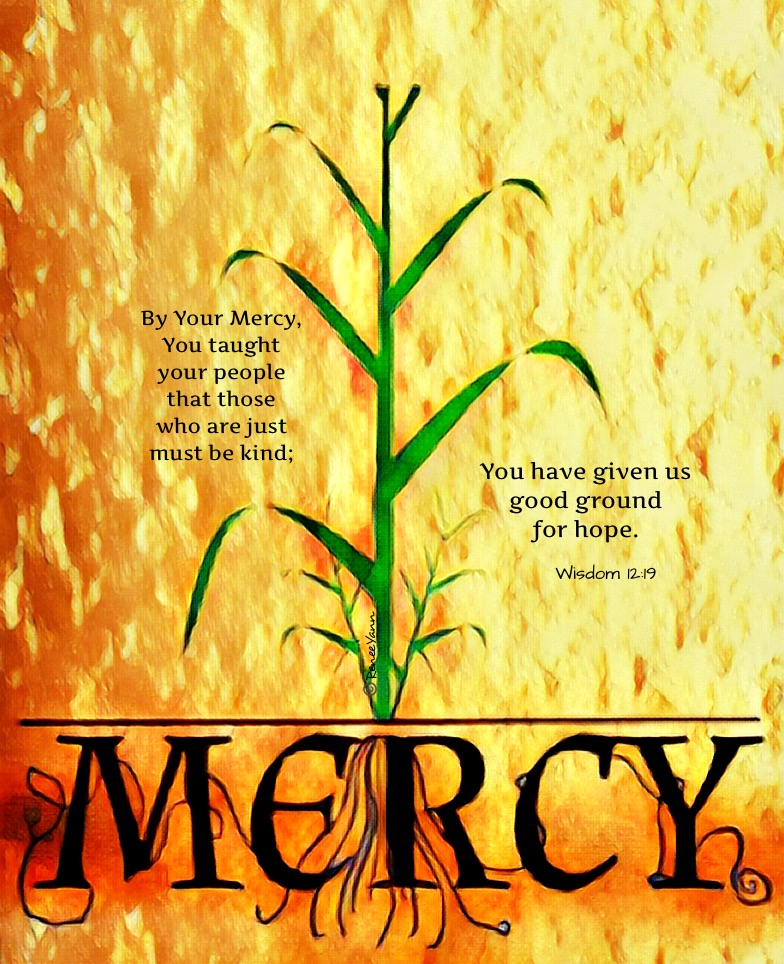
that those who are just must be kind;
and you gave your children good ground for hope
that you would permit repentance for their sins.

Wisdom 12:18-19

Paul, in another passage from magnificent Romans 8, acknowledges that we can sustain hopeful hearts only by the power of the Holy Spirit who lifts us up and prays within us when we are too overwhelmed to do so ourselves.

The Spirit comes to the aid of our weakness;
for we do not know how to pray as we ought,
but the Spirit intercedes with inexpressible groanings. 
And the one who searches hearts
knows what is the intention of the Spirit,
because Spirit intercedes for the holy ones
according to God’s will.

Romans 8:26-27

Jesus gives us a great parable for understanding hope. How discouraged might that farmer have been when the enemy tried to ruin his crop! But instead, the farmer realized that his field, like life, can sustain both the wheat and the weeds. If we live hopefully and faithfully, the wheat can be gathered from the harvest, and the weeds ultimately cast aside.


How many times in our own lives have we nearly been overwhelmed by the weeds! There is no life which passes without its hurts, disappointments, confusions, and dashed wishes! Some experience a sparse scattering of these weeds, and some lives are thick with difficulty. How surprising that it is often in the latter circumstance that hope rises up and sustains hearts.


As our Responsorial Psalm reminds us, those who live simply and sincerely are most able to tap deeply into the mysterious power of hope.

Blessed are you, Father, Lord of heaven and earth;
you have revealed to little ones the mysteries of the kingdom.


Poetry: From “Odes” – George Santayana was a Spanish-American philosopher known more for his aphorisms than his poetry. He came up with lines like, ‘Those who cannot remember the past are doomed to repeat it”, and “Fanaticism consists in redoubling your effort when you have forgotten your aim.”

IV

Slowly the black earth gains upon the yellow,
And the caked hill-side is ribbed soft with furrows.
Turn now again, with voice and staff, my ploughman,
Guiding thy oxen.
Lift the great ploughshare, clear the stones and brambles,
Plant it the deeper, with thy foot upon it,
Uprooting all the flowering weeds that bring not
Food to thy children.
Patience is good for man and beast, and labour
Hardens to sorrow and the frost of winter.
Turn then again, in the brave hope of harvest,
Singing to heaven.

Music: Weed and Wheat – Silayio Kirisua is a Maasi woman who represented Kenya in the Voice of Holland singing competition. After winning the competition, she has become an international sensation.

Magdalene, Disciple of Christ

Feast of Saint Mary Magdalene
July 22, 2023

Today’s Readings:

https://bible.usccb.org/bible/readings/072223.cfm


(This is a “repeat post”, but I think it’s worth the repeat. I hope you agree.)

Today, in God’s Lavish Mercy, we pray with St. Mary Magdalene, disciple of Christ.

Massimo_Stanzione,_Mary-Magdalene_in_meditation
Magdalen in Meditation by Massimo Stanzione

Modern scripture scholarship recognizes Mary Magdalene as a disciple and companion of Jesus.  She is present in stories throughout all four Gospels, and most notably, as one who remained with Jesus at the foot of the Cross. Mary is the first witness to the Resurrection who then announces the Good News to the other disciples.

Over the centuries, Mary Magdalene has been confused with the many other Marys in the Gospel, as well as with the unnamed repentant woman who washes Jesus’ feet with her tears. These confusions have inclined us to think of Mary Magdalene as a reformed prostitute. This erroneous concept has supported a diminished understanding of the role of women in the ministry of Jesus and done a huge disservice to Mary’s vital role as beloved disciple.

The Gospel passage for the feast captures the powerful moment when the Resurrected Jesus is first revealed to the world. The scene also portrays the deep love, trust and friendship between Jesus and Mary Magdalene – a relationship which serves as a model for all of us who want to be Christ’s disciples. I imagined the scene like this in an earlier Easter reflection:

 Rabbouni

 The Upper Room on Holy Saturday evening: a place filled with sadness, silence and seeking. Jesus was dead. Jerusalem, scattered to their various houses to keep Shabbat, murmur their shocked questions under their shaky prayers.

 We have all been in rooms like this. They enclose a special kind of agony – one teetering between hope and doubt, between loss and restoration. It may have been a surgical waiting room or the hallway outside the courtroom. Sometimes, such a space is not bricks and mortar.  It is the space between a sealed envelope and the news inside. It is the hesitant pause between a heartfelt request and the critical response. In each of these places, we exist as if in a held breath, hoping against hope for life, freedom, and wholeness.

 It was from such a room that Mary Magdalene stole away in the wee hours. A woman unafraid of loneliness, she walked in tearful prayer along the path to Jesus’ tomb. Scent of jasmine rose up on the early morning mist. Hope rose with it that his vow to return might be true. Then she saw the gaping tomb, the alarm that thieves had stolen him to sabotage his promise. She ran to the emptiness seeking him. She was met by angels clothed in light and glory, but they were not enough to soothe her.

 Turning from them, she bumped against a gardener whom she begged for word of Jesus, just so she might tend to him again. A single word revealed his glory, “Mary”. He spoke her name in love.

 As we seek the assurance of God’s presence in our lives, we too may be unaware that God is already with us. The deep listening of our spirit, dulled with daily burdens, may not hear our name lovingly spoken in the circumstances of our lives. God is standing behind every moment. All we need do is turn to recognize him.

 Turn anger into understanding. Turn vengeance into forgiveness. Turn entitlement into gratitude. Turn indifference into love. All we need do is turn to recognize him.


For a comprehensive and enlightening lecture on the current theological and scriptural thinking on Mary Magdalen, follow this link to an Elizabeth Johnson, CSJ lecture at Fordham.

Click here for lecture


Music: I Know That My Redeemer Liveth

The Passover of the Lord

Friday of the Fifteenth Week in Ordinary Time
July 21, 2023

Today’s Readings:

https://bible.usccb.org/bible/readings/072123.cfm


Today, in God’s Lavish Mercy, we hear the familiar tones of the central Exodus story.

Waiting for Easter Vigil

As we prayerfully read this passage, we may be carried back to the many Holy Saturday liturgies we have attended in our lives. In our memories, it is early spring, the evenings are still dark, and chapel is barely lit. We know the momentous story we are about to hear and re-enact. We believe it is brought to fruition in the sacramental liturgy we are about to offer. And, within all the memories, all the rituals, and all the words, one phrase stands out:

It is the Passover of the Lord.

“This is how you are to eat the lamb:
with your loins girt, sandals on your feet

and your staff in hand,
you shall eat like those who are in flight.
It is the Passover of the LORD.


Walter Brueggemann says that, in the act of “passover”, the community chooses to move on from its prohibitive existence to a new way of being. It chooses an alternative that requires “departure”:

That alternative is not easy or obvious or automatic. It requires a departure, an intentional departure from that system that the Bible terms “exodus.” In that ancient narrative the Israelites did not want to go, and once they had gone they wished to resubmit to Pharaoh. The departure is a piece of demanding, sustained work. The capacity to think and imagine and act and live beyond that system requires imagination that has dimensions of the psychological, the economic, and the liturgical. Indeed, the core liturgy of Israel (Passover) and the derivative liturgies of the church are practiced departures that now and then take on reality in the world.

Walter Brueggemann: Journey to the Common Good

In our reading from Matthew, and continually throughout the Gospel, Jesus invites his community to a profound “departure” – to a new understanding of the Law as love not requirement.

When the Pharisees criticize the hungry disciples for plucking and eating grain heads on the Sabbath, Jesus confronts them:

I say to you, something greater than the temple is here.
If you knew what this meant, I desire mercy, not sacrifice,
you would not have condemned these innocent men.
For the Son of Man is Lord of the sabbath.”

Matthew 12:7-8

Something greater than the Temple?????? The Pharisees stare at Jesus in stunned amazement! Could such a thing be possible?

Our Gospel tells us that not only is it possible, it is reality. The “Temple” and the old Law had lost their heart to the belief that personal power and affluence trumped human need. Their “systems” for becoming holy had become vacuous.

Jesus teaches that gaining sanctity requires that we live in mercy toward ourselves and others. Rituals, Temples, Churches and codes of conduct are meaningless unless they direct us always to act in mercy. When these same institutions and practices contradict God’s Mercy, we must have the courage for “departure” and “passover”.

“Departure” though does not mean abandonment. It means ceasing the merciless practices condoned by institutionalization, and having the courageous perseverance to build new paths to meaning.


It is clear in the Jewish practice of Passover that the exodus memory became a paradigmatic narrative through which all social reality is described and re-experienced. That is, the narrative pertains to a one-time remembered social upheaval caused by God’s holiness; but the narrative looks beyond that one-time memory to see that the same transactions of oppression and emancipation continue everywhere to evoke holy power.

Walter Brueggemann, Journey to the Common Good

Every day of our lives, we are called to “passover” into greater spiritual awareness, merciful practice, and just living. We may hear the call in small personal interactions, or in the larger context of our fragmented world.

We are faced constantly with alternatives between (just to name a few):

  • selfishness or generosity
  • forgiveness or vengefulness
  • honesty or pretense
  • peacemaking or rabble-rousing
  • addiction or freedom
  • informed decision-making or arrogant ignorance
  • gossip or respect
  • action for the poor or indifferent comfort
  • political and economic elitism or social justice
  • respect fro Creation or utilitarian ignorance

The sacred bridge in each of these passovers is the Gospel of Jesus Christ. Choosing it wholeheartedly, we will arrive on the right side of God.


Poetry: Journey – by Mary Oliver

One day you finally knew
what you had to do, and began,
though the voices around you
kept shouting
their bad advice--
though the whole house
began to tremble
and you felt the old tug
at your ankles.
"Mend my life!"
each voice cried.
But you didn't stop.
You knew what you had to do,
though the wind pried
with its stiff fingers
at the very foundations,
though their melancholy
was terrible.
It was already late
enough, and a wild night,
and the road full of fallen
branches and stones.
But little by little,
as you left their voices behind,
the stars began to burn
through the sheets of clouds,
and there was a new voice
which you slowly
recognized as your own,
that kept you company
as you strode deeper and deeper
into the world,
determined to do
the only thing you could do--
determined to save
the only life you could save.

Music: Took Me Out of Egypt – David Baroni (lyrics below)

Lord I’m feel so empty seems like we’re so far apart
Even tho’ some may applaud me
You alone can see my heart
You don’t look at my achievements or my ability
All You really wants is all of me
And though it frightens me to give my control
There is only room for one King
In the throne room of my soul

Lord You took me out of Egypt
Now take Egypt out of me
You delivered me from Pharaoh
now set me free from me
Let my heart become a promised land
Where the desert used to be
Lord You took me out of Egypt
Now take Egypt out of me

Blessed are the pure in heart
For they shall see the Lord
But eyes that only look to earth
Will lose the rich reward
Of the fellowship eternal the blissful unity
Of the ones who live in Jesus
And no longer serve King Me

Lord You took me out of Egypt…….

Lord I love the gifts You’ve given me
But I love the Giver more
And to worship You more perfectly
That’s what those gifts are for

Lord You took me out of Egypt…….

Angels Hidden in the Bushes

Wednesday of the Fifteenth Week in Ordinary Time
July 19, 2023

Today’s readings:

https://bible.usccb.org/bible/readings/071923.cfm


Today, in God’s Lavish Mercy, our readings lead us to consider how God is present in our lives, calling us to deeper spiritual awareness and vitality.


In Exodus 3, Moses has fled Egypt and taken up a new, uneventful life, working for his father-in-law, napping by the sheepfold in Midian.

Meanwhile, Moses was tending the flock
of his father-in-law Jethro, the priest of Midian.


The text makes no notation that Moses is contemplating the gravity of his past experiences, nor seeking spiritual meaning from them. As a matter of fact, the first three chapters of Exodus make little reference to God, except for God’s faithfulness to the resistant midwives who saved Moses’ life.

Left up to Moses, no great theophanic event would be recorded in Exodus. It would simply be a story about a Midian shepherd too scared to go back to his old hometown. It was God Who made the magic happen in Exodus, and oh, what magic it was!


We first have notice that God is about to act in the final verses of Exodus 2:

A long time passed (after Moses fled), during which the king of Egypt died. The Israelites groaned under their bondage and cried out, and from their bondage their cry for help went up to God.
God heard their moaning and God was mindful of the covenant with Abraham, Isaac and Jacob.
God saw the Israelites, and God knew….

Exodus 2: 23-25

Because God knew – and always knows – our sufferings and joys, God cares and is present to us in our lives. We are not always aware of that Divine Accompaniment, as perhaps Moses was unaware in his Midian field.

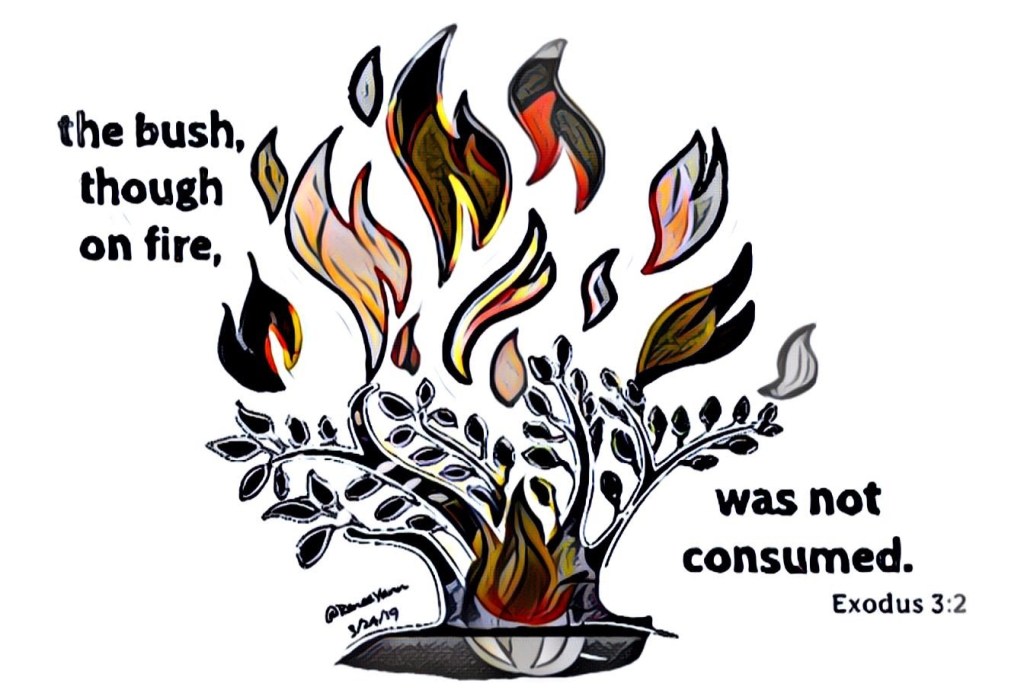
God woke Moses up with a burning bush. Then, by sharing his Name, God invited Moses to the deep spiritual intimacy which empowered him to act for God in the world.

God called out to him from the bush, “Moses! Moses!”
He answered, “Here I am.”
God said, “Come no nearer!
Remove the sandals from your feet,
for the place where you stand is holy ground.
I am the God of your father,” he continued,
“the God of Abraham, the God of Isaac, the God of Jacob.”


I think, for most of us, God is often hidden in our circumstances. I know I haven’t found too many buring bushes along life’s road. So what’s the secret to that deep spiritual awarnessthat allows us to live always in God’s Presence?

Jesus tells us in today’s Gospel that the secret is innocence.

At that time Jesus exclaimed:
“I give praise to you, Father, Lord of heaven and earth,
for although you have hidden these things
from the wise and the learned
you have revealed them to the childlike.


Spiritual innocence is not childish or uniformed. It is not faultless or naïve. The childlike quality Jesus describes is guileless, trusting, open, and wise. It waits in prayer and reflection for God’s time and movement. It believes despite doubt, and hopes despite setback.

Humble Moses – murderer, exile, and loafer on his in-law’s farm – had this kind of innocence. Like a wick awaiting kindling, Moses’s innocent heart caught fire with God. After that there was never an unnoticed “bush” in his life. After all, every one of them might contain angels!


Poetry: excerpt from Aurora Leigh by Elizabeth Barret Browning

But man, the two-fold creature, apprehends
The two-fold manner, in and outwardly,
And nothing in the world comes single to him.
A mere itself,–cup, column, or candlestick,
All patterns of what shall be in the Mount;
The whole temporal show related royally,
And build up to eterne significance
Through the open arms of God. 'There's nothing great
Nor small,' has said a poet of our day,
(Whose voice will ring beyond the curfew of eve
And not be thrown out by the matin's bell)
And truly, I reiterate, . . nothing's small!
No lily-muffled hum of a summer-bee,
But finds some coupling with the spinning stars;
No pebble at your foot, but proves a sphere;
No chaffinch, but implies the cherubim:
And,–glancing on my own thin, veined wrist,–
In such a little tremour of the blood
The whole strong clamour of a vehement soul
Doth utter itself distinct. Earth's crammed with heaven,
And every common bush afire with God:
But only he who sees, takes off his shoes,
The rest sit round it, and pluck blackberries,
And daub their natural faces unaware
More and more, from the first similitude.

Music: Burning Bush – Terrana and Manicardi

Burning bush You are, 
glowing and endless love. 
Living in Your midst, 
to live by You, 
to be alive in You. 

This Fire does not consume 
the essence of every person. 
You show Yourself in creation
in all of the beauty,  
that speaks and cries out Thee.

That You are Love 
in a flower, in the waves of the sea, 
in the dawn, in the song of a swan, 
in a kiss of a child to his mother 
in the farewell of a dying father. 

You are Love 
In a man who climbs the slope, 
In a woman who chooses life, 
In a star bursting with light, 
In the forgiveness that brings pain. 

You are earth, water, air and fire. 
Earth, water, air and fire. 

(Interlude)

Let’s take off our shoes 
in front of so much love. 
We need only to listen to 
the beautiful, the good, the true, 
That lies around us. 

For it’s Love
In a flower, in the waves of the sea,
in the dawn, in the song of a swan, 
in a kiss of a child to his mother
in the farewell of a dying father

It is Love
In a man who climbs the slope, 
In a woman who chooses life, 
In a star bursting with light,
In the forgiveness that costs pain

(Interlude)
repeat above
You are earth, water, air and fire
Earth, water, air and fire

The Promise Survives Deception

Saturday of the Thirteenth Week in Ordinary Time
July 8, 2023

Today’s Readings:

https://bible.usccb.org/bible/readings/070823.cfm

Today, in God’s Lavish Mercy, Genesis presents us with a story that may make us pick sides.

Jacob Deceives Isaac (Rebekah in back). James Jacques Joseph Tissot. c. 1896-1902.

(All I can say is that Esau must have been one hairy dude!)


Old, blind Isaac, sensing death on the horizon, dramatically prepares to hand over the promise to Esau. But his wife Rebekah has other ideas:

Rebekah then took the best clothes of her older son Esau
that she had in the house,
and gave them to her younger son Jacob to wear;
and with the skins of the kids she covered up his hands
and the hairless parts of his neck.
Then she handed her son Jacob the appetizing dish
and the bread she had prepared.

Genesis 27:15-17

It’s a fascinating and powerful narrative. I can see the movie trailer in my mind’s eye:

Watch as “The Promise” is passed to the wrong son
by means of his mother’s deception.


So is that what the story is about? Well, only on the surface.

The real story stars an Actor who is never mentioned in the script:

God, the Promise Keeper

This Bible passage teaches that God does not deviate from the Promise, no matter how the other players manipulate its unfolding. God performs the Promise despite human fiddling.


Friends, aren’t we just a little bit like Rebekah and Jacob? When our life’s dramas swirl around us, don’t we make every effort possible to salvage our own designs? It’s human nature, and it’s all good.

But all the same, God must smile at us and our sometimes frenzied efforts to control our lives. I think God smiled like that at Rebekah, covering her favorite son with smelly sheepskins so as to deceive her hungry husband.

Rebekah thought she had a better plan, but it was God’s plan all the time!

It takes some of us so long to realize that we can’t control much of our life. We can only engage our days, trusting that, as they unfold for us, they carry the promise and will of God for our hallowing.

By grace, we can learn to receive our lives as an infinite river of blessing, with all its natural turns. We can pray to trust that blessing when it is hidden in the curve of life’s shadows.


In our Gospel, the Baptist’s disciples are confused by Jesus’ behavior because it contradicts the old Law which offered them a controllable path to holiness.

Jesus tells them that the Law of Requirements is no longer sufficient. It is an old wineskin.
With the new wine of the Gospel, He is calling them to trust and enfold themselves in the Law of Love.

No one patches an old cloak with a piece of unshrunken cloth,
for its fullness pulls away from the cloak and the tear gets worse.
People do not put new wine into old wineskins.
Otherwise the skins burst, the wine spills out, and the skins are ruined.
Rather, they pour new wine into fresh wineskins, and both are preserved.

Matthew 9:16-17

Poetry: Late Ripeness – Czeslaw Milosz

Not soon, as late as the approach of my ninetieth year,
I felt a door opening in me and I entered
the clarity of early morning.
One after another my former lives were departing,
Like ships, together with their sorrow.
And the countries, cities, gardens, the bays of seas
assigned to my brush came closer,
ready now to be described better than they were before.
I was not separated from people,
grief and pity joined us.
We forget -- I kept saying -- that we are all children of
the King.
For where we come from there is no division
Into Yes and No, into is, was, and it will be.
We were miserable, we used no more than a hundredth part
of the gift we received for our long journey.
Moments from yesterday and from centuries ago --
a sword blow, the painting of eyelashes before a mirror
of polished metal, a lethal musket shot, a caravel
staving its hull against a reef -- they dwell in us,
waiting for a fulfillment.
I knew, always, that I would be a worker in the vineyard,
as are all men and women living at the same time,
whether they are aware of it or not.

Music: Piano and Flute Meditation – by Laura Sullivan


Chaos, Prayer, and Mercy

Tuesday of the Thirteenth Week in Ordinary Time
July 4, 2023

Today’s Readings:

https://bible.usccb.org/bible/readings/070423.cfm


Today, in God’s Lavish Mercy, we resume our readings from Genesis and Matthew – and they’re packed with action and inspiration!

Sodom and Gomorrha by Henry Osawa Tanner

(Note Lot’s wife left behind in white)


If you’re “of an age” like me, you might remember your old Bible History class and first hearing the story of Lot and his “mortonized” wife.

I spent a lot of my 7-year-old energy wondering what she looked like as a salty pillar. I even imagined how she might have melted in the next rain after the meteor set Sodom on fire.

But most of all, I felt bad for her. I mean, really, one glance backward and ZAP! And by correlation, I felt bad for myself because, even at that young age, I realized that I was quite capable of backward glances once God had spoken. And it scared me.

Was God really like that?!


Looking back on those childhood feelings, I consider how my faith and perception of God have evolved over the course of my now long life. The God of my grade school years was not the God of my late teens and twenties. Nor was that God of my young adulthood the God of my 50s and 60s.

Did God grow and change during those years? Of course not. It was I who deepened, widened, and mellowed in experience and grace.


The stories in Genesis, and throughout the Hebrew Scriptures, were told and interpreted over many centuries before they were ever written down. After being written down, they have continued to be studied and parsed even into our own times.

Just as we grow in the spiritual understanding of our own lives, we mature in our ability to look through the surface of scriptures to their deep and sacred meaning.


As Christians, we must read the ancient scriptures in the light of the Gospel. We have the advantage and responsibility to seek the deep spiritual understanding resident within these stories. Buried in a sometimes bizarre passage is the fundamental truth of God’s abiding Presence, no matter our circumstances.

The particular words used to convey these stories were designed for and by people of a very different culture from ours. Some of the concepts are relayed in a primitive manner that may not speak to a modern reader. But we can’t let ourselves get stuck on those cultural differences — the way I did when I was seven years old.


The story of Abraham, Lot and Lot’s wife is not a news report about some family that avoids a natural disaster save for one disobedient member.

It is instead a parable which invites us to consider God’s persistent desire for our wholeness despite our own resistance to that grace. If we continually harden our spirits to God’s invitation to relationship, it is we, not God, who make the choice to distance ourselves in spiritual exile.

Yet, Genesis tells us that, even if we make that distancing choice, all is not lost. We cannot cause God to disassociate from us, no matter how hard we might try. There is always a path back to the heart of God – even if it leads through a storm of brimstone.


As our Gospel assures us, even in the scariest of storms, our God is with us:

They came and woke him, saying,
“Lord, save us! We are perishing!”
He said to them, “Why are you terrified, O you of little faith?”
Then he got up, rebuked the winds and the sea,
and there was great calm.


Poetry: Lot’s Wife – Anna Akhmatova

And the just man trailed God's shining agent,
over a black mountain, in his giant track,
while a restless voice kept harrying his woman:
"It's not too late, you can still look back
at the red towers of your native Sodom,
the square where once you sang, the spinning-shed,
at the empty windows set in the tall house
where sons and daughters blessed your marriage-bed."
A single glance: a sudden dart of pain
stitching her eyes before she made a sound . . .
Her body flaked into transparent salt,
and her swift legs rooted to the ground.
Who will grieve for this woman? Does she not seem
too insignificant for our concern?
Yet in my heart I never will deny her,
who suffered death because she chose to turn.

Music: The Love I Have for You , O Lord – sung by James Kilbane


Me? A Prophet?

Thirteenth Sunday in Ordinary Time
July 2, 2023

Today’s Readings:

https://bible.usccb.org/bible/readings/070223.cfm

Today, in God’s Lavish Mercy, our readings instruct us on the nature of prophecy.


Walter Bruggemann, in his transformational book “The Prophetic Imagination” writes about prophets. He indicates that prophets emerge in the context of “totalism” – those paralyzing systems which attempt to control and dominate all freedom and possibility.

Totalism kills ideas, hope, freedom, choice, self-determination, and creativity for the sake of controlling reality for its own advantage. Totalism is the ultimate “abusive relationship“. Examples in our society include cults, hate groups, mob rule, or any relationship that subjugates another’s free will.

Brueggemann defines the prophet as one engaged in these three tasks to restore hope and freedom:

  • the prophet is clear on the force and illegitimacy of the totalism.
  • the prophet pronounces the truth about the force of the totalism that contradicts the purpose of God.
  • the prophet articulates the alternative world that God has promised, and that God is actually creating within the chaos around us.

Our first reading comes from the Second Book of Kings which was written about 600 years before Christ. The Jewish people experienced the totalism of the Babylonian Captivity.. First and Second Kings was written to help the people understand their situation, to remain faithful to God, and to move toward freedom.


These two books are full of powerful figures pulling the people both toward and away from God – biblical Baddies and Goodies who carried profound messages about faith or its abandonment.


One of the Goodies is Elisha the Prophet whom we meet in today’s verses. Elisha confronts barrenness and death with the transformative power of faith. The Summanite woman is able to benefit from this power because she believes.


In our second reading, Paul doesn’t use the word “prophet” but he talks about the Resurrection Power we receive through our Baptism. This power calls us and confirms us as bearers of God’s transformative Word in a hostile and unfree world.


In our Gospel, Jesus is direct with his disciples about the rewards which fall to those who have prophetic faith:

“Whoever receives you receives me,
and whoever receives me receives the one who sent me.
Whoever receives a prophet because he is a prophet
will receive a prophet’s reward,
and whoever receives a righteous man
because he is a righteous man
will receive a righteous man’s reward.
And whoever gives only a cup of cold water
to one of these little ones to drink
because the little one is a disciple—
amen, I say to you, he will surely not lose his reward.”

Matthew 10:40-42

So, are we actually called to be prophets? The answer is YES. We are called by the Gospel and through our Baptism to do what Walter Brueggemann describes above:

  • to name the structures of unfreedom in our lives and in our world
  • to speak truth and stand against those things which contradict God’s Mercy and Love
  • to witness hope and courage by the joyous, generous service of our lives

Photo by Ashley Batz on Unsplash


Poetry: Onto a Vast Plane – Rainer Maria Rilke

You are not surprised at the force of the storm—
you have seen it growing.
The trees flee. Their flight
sets the boulevards streaming. And you know:
he whom they flee is the one
you move toward. All your senses
sing him, as you stand at the window.

The weeks stood still in summer.
The trees’ blood rose. Now you feel
it wants to sink back
into the source of everything. You thought
you could trust that power
when you plucked the fruit:
now it becomes a riddle again
and you again a stranger.

Summer was like your house: you know
where each thing stood.
Now you must go out into your heart
as onto a vast plain. Now
the immense loneliness begins.

The days go numb, the wind
sucks the world from your senses like withered leaves.

Through the empty branches the sky remains.
It is what you have.
Be earth now, and evensong.
Be the ground lying under that sky.
Be modest now, like a thing
ripened until it is real,
so that he who began it all
can feel you when he reaches for you.


Music: When the Prophet Speaks – Van Morrison (lyrics below)

When the prophet speaks, mostly no one listens
When the prophet speaks and no one hears
Only those who have ears to listen
Only those that are trained to hear

Come closer now, I'll tell you what they whisper
Closer now, we'll whisper it in your ear
What big ears you've got when you get the details
Do you understand, do I make it clear?

When the prophet speaks, yeah, no one listens
When the prophet speaks, mostly no one hears
Only those that are trained to listen
Only those who have ears to hear

When the prophet speaks, yeah, no one listens
Baby, baby, baby, baby, baby
Don't you have no fear
You gotta get the truth on what is happening

When the prophet speaks, have to make it clear
Come closer now and I will whisper
Whisper the secret in your ear
What thick ears you've got when you get all the details

Do you understand, do I make myself clear?
When the prophet speaks, you've got to listen
When the prophet speaks, you've got to get the truth
When the prophet speaks, don't need no explanation

When the prophet speaks, have to make it move
Prophet speaks, no one listens
When the prophet speaks, mainly nobody hears
Only those that are trained to listen

Only those who have ears to hear

Is Anything Impossible for God?

Saturday of the Twelfth Week in Ordinary Time
July 1, 2023

Today’s Readings:

https://bible.usccb.org/bible/readings/070123.cfm


Today, in God’s Lavish Mercy, our readings build on yesterday’s themes of promise and patience, faith and resistance.

The Trinity or The Hospitality of Abraham –
Icon by Sister Petra Clare


Genesis tells the rich and instructive story of the visiting angels who come as spokespeople for God’s Promise. Abraham, in a flurry of Middle Eastern hospitality convinces the three visitors to linger at his home. Exuding a deferential hospitality certain to gain them a blessing, Abraham and Sarah lay out a lovely dinner. The blessing comes in an unexpected reiteration of that nagging, and still unfulfilled, promise:

They asked him, “Where is your wife Sarah?” 
He replied, “There in the tent.” 
One of them said, “I will surely return to you about this time next year,
and Sarah will then have a son.”

Genesis 18:9-10

This time, post-menapausal Sarah has had it with the inconclusive, and seemingly outlandish, promise!

Sarah was listening at the entrance of the tent, just behind him.
Now Abraham and Sarah were old, advanced in years,
and Sarah had stopped having her womanly periods.
So Sarah laughed to herself and said,
“Now that I am so withered and my husband is so old,
am I still to have sexual pleasure?”

Genesis 18:10-12

God doesn’t think it’s funny. To Abraham and Sarah, God poses the elemental faith question that will be posed to every potential believer:

But the LORD said to Abraham: “Why did Sarah laugh and say,
‘Shall I really bear a child, old as I am?’
Is anything too marvelous for the LORD to do?

Genesis 18:13

Our Gospel centurion has already answered that question for himself. When Jesus agrees to come heal the beloved suffering servant, the centurion expresses his humble and unconditional faith in God’s promise:

The centurion said in reply,
“Lord, I am not worthy to have you enter under my roof;
only say the word and my servant will be healed.”

Matthew 8:8

This prayer, repeated at every Eucharistic celebration, allows us to measure our own faith and to ask for our own healing.


Poetry: Thou Art Just Indeed, Lord, If I Contend – Gerard Manley Hopkins

Hopkins questions God about his suffering, stating that he’s a good priest and if God treats him this poorly, how must God treat enemies! Like Abraham, Hopkins needs fruitfulness – “send my roots rain?”


Justus quidem tu es, Domine, si disputem tecum; verumtamen
justa loquar ad te: Quare via impiorum prosperatur? &c.


Thou art indeed just, Lord, if I contend
With thee; but, sir, so what I plead is just.
Why do sinners’ ways prosper? and why must
Disappointment all I endeavour end?
Wert thou my enemy, O thou my friend,
How wouldst thou worse, I wonder, than thou dost
Defeat, thwart me? Oh, the sots and thralls of lust
Do in spare hours more thrive than I that spend,
Sir, life upon thy cause. See, banks and brakes
Now, leavèd how thick! lacèd they are again
With fretty chervil, look, and fresh wind shakes
Them; birds build – but not I build; no, but strain,
Time’s eunuch, and not breed one work that wakes.
Mine, O thou lord of life, send my roots rain.


Music: Abraham and Sarah – Bryan Sirchio

I just love this song. I hope you do too! Lyrics below.


Ha Ha Ha – Ho Ho Ho
I wonder what’s so funny?

Abraham and Sarah were very old and grey.
An angel of Lord showed up and said to them one day,
“I know you’re very old and that you’ve never had a kid,
but God says, “Better find a baby crib!”

And they said:
Ha Ha Ha – Ho Ho Ho
You can’t have a baby when you get this old.
Abraham and Sarah had to laugh.
Oh, bend at the knees

Ha Ha Ha – Ho Ho Ho
So now Abraham and Sarah know
that nothing is too hard for God.

Abraham and Sarah were very old and grey.
An angel of Lord showed up and said to them one day,
“I know you’re very old and that you’ve never had a kid,
but God says, “Better find a baby crib!”

And they said:
Ha Ha Ha – Ho Ho Ho
You can’t have a baby when you get this old.
Abraham and Sarah had to laugh.
Oh, bend at the knees

Ha Ha Ha – Ho Ho Ho
So now Abraham and Sarah know
that nothing is too hard for God.

And sure enough they had a baby
and they named the baby Isaac
which means “Laughter”!

The Root of Your Self

Twelfth Sunday in Ordinary Time
June 25, 2023

Today’s Readings:

https://bible.usccb.org/bible/readings/062523.cfm


Today, in God’s Lavish Mercy, our readings are studies in darkness and light.

Jeremiah – from the Sistine Chapel ceiling painted by Michelangelo c. 1512


Our first reading comes from Jeremiah, sometimes referred to as “the weeping prophet”. Jeremiah was pretty much a sad sack, as today’s selection demonstrates. He wrote for the Jews during the darkness of the Babylonian exile, helping them to mourn their situation which had been brought upon themselves by their unfaithfulness and sin. Jeremiah calls the people to repent and to find a healing grace by trusting God.

Sing to the LORD,
praise the LORD,
who has rescued the life of the poor
from the power of the wicked!

Jeremiah 22:13

Paul, addressing the Romans, uses the same light/dark, sin/redemption theme. He says that all of us display an inclination to darkness by any choice to break relationship with God, neighbor and Creation.


In the Genesis allegory of Adam and Eve, they choose to supersede God’s terms of relationship, eschewing the pure abundance of Creation for the sake of a self-satisfying “apple”.


The magnificent encyclical “Laudato Si” leads us through an enlightened understanding of of this Genesis story:

The creation accounts in the book of Genesis contain, in their own symbolic and narrative language, profound teachings about human existence and its historical reality. They suggest that human life is grounded in three fundamental and closely intertwined relationships: with God, with our neighbor and with the earth itself. According to the Bible, these three vital relationships have been broken, both outwardly and within us. This rupture is sin. The harmony between the Creator, humanity and creation as a whole was disrupted by our presuming to take the place of God and refusing to acknowledge our creaturely limitations. This in turn distorted our mandate to “have dominion” over the earth (cf. Gen 1:28), to “till it and keep it” (Gen 2:15). As a result, the originally harmonious relationship between human beings and nature became conflictual (cf. Gen 3:17-19). It is significant that the harmony which Saint Francis of Assisi experienced with all creatures was seen as a healing of that rupture. Saint Bonaventure held that, through universal reconciliation with every creature, Saint Francis in some way returned to the state of original innocence. This is a far cry from our situation today, where sin is manifest in all its destructive power in wars, the various forms of violence and abuse, the abandonment of the most vulnerable, and attacks on nature.

Laudato Sì, paragraph 66

Our Gospel so beautifully complements this enlightened understanding. Jesus encourages his disciples not to be afraid because the Creator embraces them in love and care. They, as we, need not make parsimonious choices that fracture essential relationships with God, neighbor, self, or Creation. We are already safe and whole in God.

Jesus said to the Twelve:
“Fear no one.
Nothing is concealed that will not be revealed,
nor secret that will not be known.
What I say to you in the darkness, speak in the light;
what you hear whispered, proclaim on the housetops…

… Are not two sparrows sold for a small coin?
Yet not one of them falls to the ground without your Father’s knowledge.
Even all the hairs of your head are counted.
So do not be afraid; you are worth more than many sparrows…

Matthew 10:26-33

Poetry: The Root of the Root of Yourself – Rumi

(Reading this poem, we might imagine that the Trinity is inviting us to recover the pristine goodness of our creation.)

Don’t go away, come near.
Don’t be faithless, be faithful.
Find the antidote in the venom.
Come to the root of the root of yourself.
Molded of clay, yet kneaded
from the substance of certainty,
a guard at the Treasury of Holy Light —
come, return to the root of the root of your Self.
Once you get hold of selflessness,
You’ll be dragged from your ego
and freed from many traps.
Come, return to the root of the root of your Self.
You are born from the children of God’s creation,
but you have fixed your sight too low.
How can you be happy?
Come, return to the root of the root of your Self.
You were born from a ray of God’s majesty
and have the blessings of a good star.
Why suffer at the hands of things that don’t exist?
Come, return to the root of the root of your Self.
You are a ruby embedded in granite.
How long will you pretend it’s not true?
We can see it in your eyes.
Come to the root of the root of your Self.
You came here from the presence of that fine Friend,
a little dazed, but gentle, stealing our hearts
with that look so full of fire; so,
come, return to the root of the root of your Self.

Music: Rainlight – David Lanz

No One Greater

Solemnity of the Nativity of Saint John the Baptist
June 24, 2023

Today’s Readings:

https://bible.usccb.org/bible/readings/062423.cfm


Today, in God’s Lavish Mercy, we celebrate John the Baptist of whom Jesus said, “no man greater has been born of women”.

John the Baptist – Caravaggio

Today’s Gospel talks about the surprise conception of John, and all the drama surrounding his birth. Several other Gospel passages tell us about John’s preaching, his challenges to Herod, and his eventual martyrdom at the request of Salome. These are worth a read today, if you have a little time, just to be reacquainted with this extraordinary man.

http://www.usccb.org/bible/matthew/3

http://www.usccb.org/bible/matthew/11

http://www.usccb.org/bible/matthew/14


John the Baptist was the living bridge between the Old Law and the New. He was the doorway from a religion of requirements to a religion of love. That bridge and doorway were built on a baptism of repentance in order to clear one’s heart to receive the Good News.


The magnificent Greek word for repentance is “metanoia” which indicates a turning of one’s mind and heart after realizing a new truth. Metanoia is to have awareness dawn on us, and to feel sorrow for our former blindness or hardness of heart.

May our prayer today help us to receive the grace of metanoia wherever our spirits are hardened or closed – or just plain deadened by routine. May we hear the Baptist calling to us, “Prepare your hearts – EVERYDAY- for the Lord. There is always room for you to be surprised by God.”


Poetry: Song of Zechariah – Irene Zimmerman, OSF

At the circumcision of his son,
relatives and neighbors came
to speak for Zechariah of the tied
tongue. The child, they concurred,
would bear his worthy father’s name.
But during her husband’s silence,
old Elizabeth had found her voice.
“His name will be John,” she said. 

Why this strange, unprecedented choice,
the relatives and neighbors wondered.
Armed with writing instrument,
back they went to poor, dumb Zechariah.
But during the long confinement,
as young Mary and Elizabeth
spoke about the missions of their sons,
he had listened and grown wise.
Straightaway, he wrote: “His name is John.”
He caught Elizabeth’s smiling eyes,
felt his old tongue loosen, found his voice,
sang of God’s tender mercy,
sang of the breaking dawn,
sang of the prophet, their son,
who would make straight the way
for the long awaited One.

Music: Ut Queant Laxis ( English translation below)

“Utqueant laxis” or “Hymnus in Ioannem” is a Latin hymn in honor of John the Baptist written in Horatian Sapphics and traditionally attributed to Paulus Diaconus, the eighth-century Lombard historian. It is famous for its part in the history of musical notation, in particular solmization (do-re-mi-fa-so-la-ti-do). The hymn is sung to a Gregorian chant, and introduces the original do-re-mi music.

1. O for your spirit, holy John, to chasten
Lips sin-polluted, fettered tongues to loosen;
So by your children might your deeds of wonder
Meetly be chanted.

2. Lo! a swift herald, from the skies descending,
Bears to your father promise of your greatness;
How he shall name you, what your future story,
Duly revealing.

3. Scarcely believing message so transcendent,
Him for a season power of speech forsaketh,
Till, at your wondrous birth, again returneth,
Voice to the voiceless.

4. You, in your mother’s womb all darkly cradled,
Knew your great Monarch, biding in His chamber,
Whence the two parents, through their offspring’s merits,
Mysteries uttered.

5. Praise to the Father, to the Son begotten,
And to the Spirit, equal power possessing,
One God whose glory, through the lapse of ages,
Ever resounding. Amen.