Today, in God’s Mercy, Jesus asks Peter an open-ended question, the kind that leaves both parties very vulnerable to the answer:
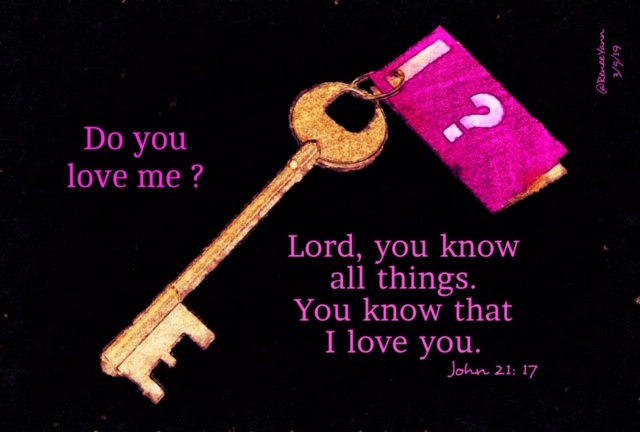
Do you love me?
Wow! What if Peter says “No”, or “Sort of” or worse yet, just stares off into the distance in silence? Would that break Jesus’ heart?!
And the question is kind of scary for Peter too. Maybe he’s thinking, “OK, this is it. Jesus wants me to lay it all on the line. Am I ready?” — because, as Jesus says so clearly, the measure of true love is service and sacrifice:
Jesus said to him the third time, “Simon, son of John, do you love me?” Peter was distressed that Jesus had said to him a third time, “Do you love me?” and he said to him, “Lord, you know everything; you know that I love you.” Jesus said to him, “Feed my sheep. Amen, amen, I say to you, when you were younger, you used to dress yourself and go where you wanted; but when you grow old, you will stretch out your hands, and someone else will dress you and lead you where you do not want to go.”
John 21: 17-19
The Gospel poses questions to each of us today as well:
Who and what do I really love?
How does my primary love drive my life choices?
Are there places in my life that lack love – places where prejudice, blindness, selfishness or hate have filled in the emptiness?
How inclusive is my love? How redemptive? How merciful? How Christlike?
Where is God in my loves?
Prose: St. John of the Cross wrote this:
At the end of our lives we will be judged on love. Learn therefore to love God as God wishes to be loved.
Music: Where Charity and Love Prevail – a lovely English translation of Ubi Caritas, written in Gregorian chant.
Today, in God’s Lavish Mercy, our readings continue to show us the rising power of Christ after the Resurrection.
Acts demonstrates how powerfully Jesus lives in his disciples, and in the faith of the emerging Church.
… the people esteemed them. Yet more than ever, believers in the Lord, great numbers of men and women, were added to them. Thus they even carried the sick out into the streets and laid them on cots and mats so that when Peter came by, at least his shadow might fall on one or another of them.
Acts 5: 13-15
Our Gospel recounts two Post-Resurrection appearances of Jesus where He bolsters that faith for these still fledgling followers. They were gathered in the Upper Room, doors locked and fearful. When Jesus appears, the first thing he says is, “Peace”, because that is what his little flock most needs.
In the course of the reading, we discover Thomas’s adamant doubt unless he can see and touch evidence of the Christ he once knew in the flesh. His doubt is so strong that his faith, when it comes, overwhelms him.
My Lord, and my God!
In these first sainted founders of the faith, we can find a mirror image of our own call to witness Christ. We are delegated to be his presence in the world, to cast a shadow that bears his blessing in the midst of suffering and confusion.
But in the locked room of our hearts, we may still be afraid. We may feel, like Thomas, that we were absent when the affirmation and courage were distributed!
Knowing our own weaknesses – and captured in the maze of their little dramas – we may be skeptical that Christ desires to rise in us, to preach by our lives.
What Jesus said to these very fragile witnesses, he says to us
Peace be with you. As the Father has sent me, so I send you.
Let us look around today in awareness of those who fall in the shadow of our faith: our children and families, our religious communities, our elders, our neighbors, our friends and co-workers. As we pass through life together, does our presence bless them with a trace of God?
As we pray today, let us place our doubts, fears, weaknesses and self-concerns into Christ’s sacred wounds. Let us leave them there in confidence as we humbly choose to be his Presence and Mercy for others by the simple, selfless choices of our lives.
Poetry: In the Upper Room – by Fr. Charles O’Donnell, CSC – 11th President of Notre Dame University (unfortunately not as well known for his beautiful, mystical poetry)
Music: Under the Shadow of Your Wings – Chris Bowater
Today, in God’s Lavish Mercy, the betrayal of Jesus continues, as does his mounting courage to endure its consequences.
In our first reading, the experience of the prophet Isaiah foreshadows that of Jesus. We can hear Jesus praying in Isaiah’s words:
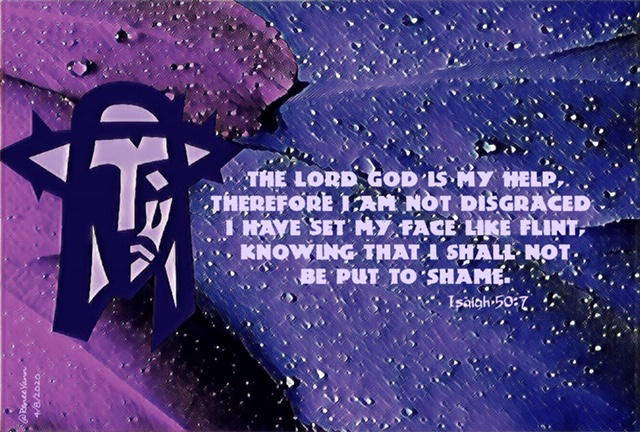
The Lord GOD is my help, therefore I am not disgraced; I have set my face like flint, knowing that I shall not be put to shame. He is near who upholds my right; if anyone wishes to oppose me, let us appear together. Who disputes my right? Let him confront me. See, the Lord GOD is my help; who will prove me wrong?
Isaiah 50:7-8
We hear Christ’s transcendent openness to the Father’s accompaniment:
Morning after morning God opens my ear that I may hear; And I have not rebelled, have not turned back.
We hear Christ’s courage to face what life unfolds before him:
I gave my back to those who beat me, my cheeks to those who plucked my beard; My face I did not shield from buffets and spitting.
We hear Christ’s utter commitment, despite suffering, to the Father’s Presence:
The Lord GOD is my help, therefore I am not disgraced; I have set my face like flint, knowing that I shall not be put to shame.
As we pray with Jesus today, may we:
hear God’s purpose in our lives.
see grace unfold in all our circumstances
set our hearts, like flint, upon faith and trust in God
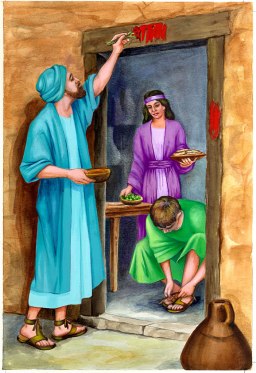
As our Jewish sisters and brothers will begin the Passover celebration this Friday, their rich faith heritage inspires us always to find God in the journey, no matter where it leads us.
In the Gospel’s Passover moment, Jesus walks toward the painful experience of Gethsemane. He invites us to come and receive the reassuring blessing of his Father even as the night shadows fall.
Poetry: The Garden of Gethsemane – by Boris Pasternak who won the Nobel Prize for Literature after writing Dr. Zhivago
Indifferently, the glimmer of stars Lit up the turning in the road. The road went round the Mount of Olives, Below it the Kedron flowed.
The meadow suddenly stopped half-way. The Milky Way went on from there. The grey and silver olive trees Were trying to march into thin air.
There was a garden at the meadow’s end. And leaving the disciples by the wall, He said: ‘My soul is sorrowful unto death, Tarry ye here, and watch with Me awhile.’
Without a struggle He renounced Omnipotence and miracles As if they had been borrowed things, And now He was a mortal among mortals.
The night’s far reaches seemed a region Of nothing and annihilation. All The universe was uninhabited. There was no life outside the garden wall.
And looking at those dark abysses, Empty and endless, bottomless deeps, He prayed the Father, in a bloody sweat, To let this cup pass from His lips.
Assuaging mortal agony with prayer, He left the garden. By the road he found Disciples, overcome by drowsiness, Asleep spreadeagled on the ground.
He wakened them: ‘The Lord has deemed you worthy To live in My time. Is it worthiness To sleep in the hour when the Son of Man Must give Himself into the hands of sinners?’
And hardly had He spoken, when a mob Of slaves, a ragged multitude, appeared With torches, sowards, and Judas at their head Shaping a traitor’s kiss behind his beard.
Peter with his sword resisted them And severed one man’s ear. But then he heard These words: ‘The sword is no solution. Put up your blade, man, in its scabbard.
Could not My Father instantly send down Legions of angels in one thunderous gust? Before a hair of my head was touched, My enemies would scatter like the dust.
But now the book of life has reached a page Most precious and most holy. What the pen Foretold in Scripture here must be fulfilled. Let prophecy come to pass. Amen.
The course of centuries is like a parable And, passing, can catch fire. Now, in the name Of its dread majesty, I am content To suffer and descend into the tomb.
I shall descend and on the third day rise, And as the river rafts float into sight, Towards My Judgement like a string of barges The centuries will float out of the night.’
Music: I Come to the Garden Alone – Sean Clive
I come to the garden alone while the dew is still on the roses, And the voice I hear falling on my ear, The Son of God discloses
And He walks with me and He talks with me, And He tells me I am his own; And the joy we share as we tarry there, None other has ever known
He speaks, and the sound of his voice is so sweet The birds hush their singing, And the melody that He give to me Within my heart is to ringing.
And He walks with me and He talks with me, And He tells me I am his own; And the joy we share as we tarry there, None other has ever known
I stay in the garden with Him, Though the night around me is falling. But He bids me go; through the voice of woe His voice to me is calling.
And He walk with me and He talks with me, And He tells me I am His own; And the joy we share as we tarry there, None other has ever known.
Today, in God’s Lavish Mercy, our Gospel tells the sad story of Jesus’s betrayal by his closest friends.
“Amen, amen, I say to you, one of you will betray me.” The disciples looked at one another, at a loss as to whom he meant. One of his disciples, the one whom Jesus loved, was reclining at Jesus’ side. So Simon Peter nodded to him to find out whom he meant. He leaned back against Jesus’ chest and said to him, “Master, who is it?” Jesus answered, “It is the one to whom I hand the morsel after I have dipped it.” So he dipped the morsel and took it and handed it to Judas, son of Simon the Iscariot. After Judas took the morsel, Satan entered him.
The Last Supper (1630–1631) is an oil painting by Peter Paul Rubens. The painting depicts Jesus and the Apostles during the Last Supper, with Judas dressed in blue turning back towards the viewer and away from the table. Other than Jesus, the most prominent figure is Judas. Judas holds his right hand to his mouth with his eyes avoiding direct contact with the other figures in the painting creating a nervous expression. (Wikipedia)
Pope Francis, in his 2020 Palm Sunday homily, reflected on the depth of these betrayals:
Jesus suffered betrayal by the disciple who sold him and by the disciple who denied him. He was betrayed by the people who sang hosanna to him and then shouted: “Crucify him!” He was betrayed by the religious institution that unjustly condemned him and by the political institution that washed its hands of him.
We can think of all the small or great betrayals that we have suffered in life. It is terrible to discover that a firmly placed trust has been betrayed. From deep within our heart a disappointment surges up that can even make life seem meaningless. This happens because we were born to be loved and to love, and the most painful thing is to be betrayed by someone who promised to be loyal and close to us. We cannot even imagine how painful it was for God who is love.
These first three days of Holy Week are like the days in our lives when we know there is a wave of suffering coming but it hasn’t quite broken over us. Something just isn’t right in our bodies, minds, spirits, or in the world around us. In such times, the actual pain might be muted, but the fear, loneliness, anxiety and dark imaginations can be acute.
It’s hard to be with ourselves or with another in this kind of suffering. We see in our Gospel how hard it was for the disciples.
All one really has in such moments are the faith and trust that God ever abides with us. It is the kind of assurance Jesus had with the Father.
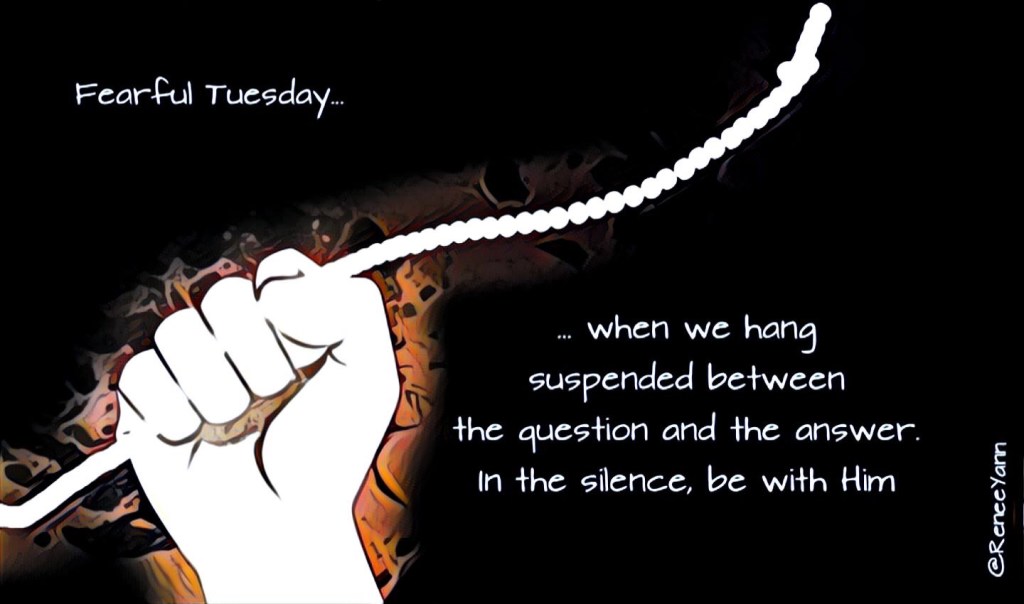
As we walk beside Jesus on this Fearful Tuesday, let us confide our sufferings, current or remembered, asking to be gracefully transformed by them. Let us listen to Jesus’s pain and heart-break, asking to be a source of comfort and love to Him.
With Jesus, may we carry in our prayer all those throughout the world suffering abandonment, fear, loss, or betrayal at this painful time.
Saint Judas – James Wright
When I went out to kill myself, I caught
A pack of hoodlums beating up a man.
Running to spare his suffering, I forgot
My name, my number, how my day began,
How soldiers milled around the garden stone
And sang amusing songs; how all that day
Their javelins measured crowds; how I alone
Bargained the proper coins, and slipped away.
Banished from heaven, I found this victim beaten,
Stripped, kneed, and left to cry. Dropping my rope
Aside, I ran, ignored the uniforms:
Then I remembered bread my flesh had eaten,
The kiss that ate my flesh. Flayed without hope,
I held the man for nothing in my arms.
Music: I Will Carry You – Sean Clive You might hear this song in many ways. Perhaps Jesus comforts you with it. Or you might comfort Jesus in his escalating suffering. Or together, Jesus and you may sing it over a suffering world. (Lyrics below)
I will carry you when you are weak. I will carry you when you can’t speak. I will carry you when you can’t pray. I will carry you each night and day.
I will carry you when times are hard. I will carry you both near & far. I’ll be there with you whenever you fall. I will carry you through it all.
My arms are wider than the sky, softer than a little child, stronger than the raging, calming like a gentle breeze. Trust in me to hold on tight because
I will carry you when you can’t stand. I’ll be there for you to hold your hand. And I will show you that you’re never alone. I will carry you and bring you back home.
Not pain, not fear, not death, no nothing at all can separate you from my love. My arms and hands will hold you close. Just reach out and take them in your own. Trust in me to hold on tight. I will carry you.
Today, in God’s Lavish Mercy, there are some common threads running through our readings.
In the passage from Numbers, we have a restless crowd, confused and hungry, feeling directionless in a vast wilderness. They demand an answer from Moses:
Why have you brought us up from Egypt to die in this desert, where there is no food or water? We are disgusted with this wretched food!”
To make things worse, God, annoyed at their complaints, sends a bunch of snakes to hassle them.
In John’s Gospel, a disgruntled gathering of Pharisees pesters Jesus for a resolution to their questions. Even after all Jesus’ signs and preaching, they ask Him, “Who are you?”
In both instances, it is impossible for the questioners to receive the answer they seek because they lack faith.
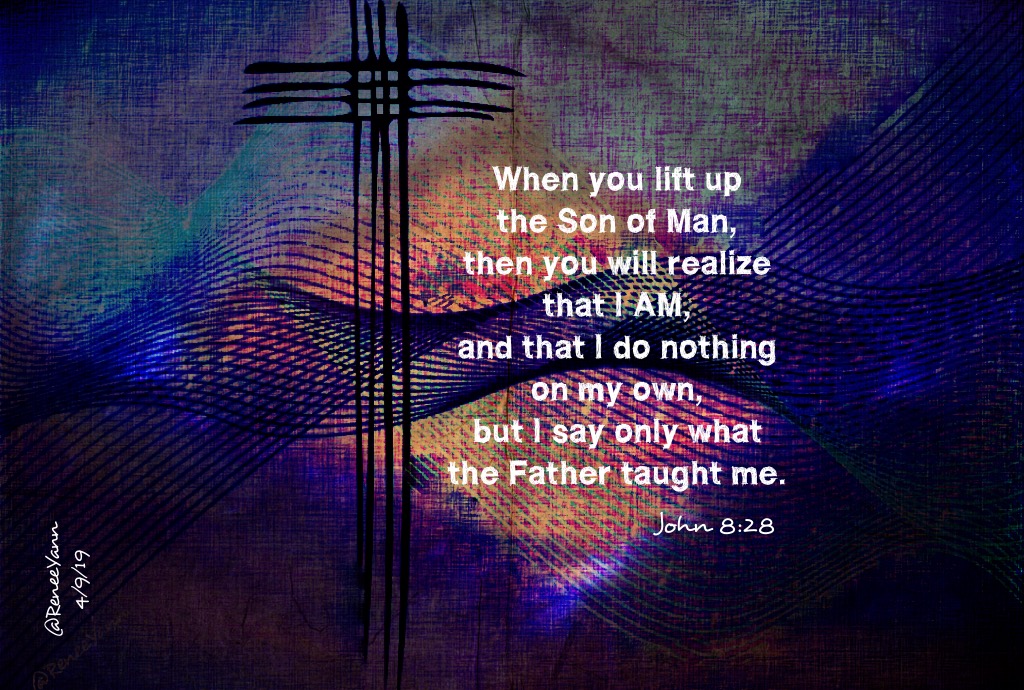
In both instances, they are told that a sign will be lifted up before them and that then they will understand.
We’re on a life’s journey, at times confused and disgruntled, just like those ancient Hebrews.
We may be locked in faithless expectations of God, just like those debating Pharisees.
In our difficulties and challenges, will we be able to see the sign that God offers us? Not the one we design or demand – but the unexpected one rising up out of the depths of our faith?
Poetry: The Crosse – George Herbert
What is this strange and uncouth thing?

To make me sigh, and seek, and faint, and die,

Untill I had some place, where I might sing,

          And serve thee; and not onely I,

But all my wealth and familie might combine

To set thy honour up, as our designe.

          And then when after much delay,

Much wrastling, many a combate, this deare end,

So much desir’d, is giv’n, to take away

          My power to serve thee; to unbend

All my abilities, my designes confound,

And lay my threatnings bleeding on the ground.

          One ague dwelleth in my bones,

Another in my soul (the memorie

What I would do for thee, if once my grones

          Could be allow’d for harmonie):

I am in all a weak disabled thing,

Save in the sight thereof, where strength doth sting.

          Besides, things sort not to my will,

Ev’n when my will doth studie thy renown:

Thou turnest th’ edge of all things on me still,

          Taking me up to throw me down:

So that, ev’n when my hopes seem to be sped,

I am to grief alive, to them as dead.

          To have my aim, and yet to be

Further from it then when I bent my bow;

To make my hopes my torture, and the fee

          Of all my woes another wo,

Is in the midst of delicates to need,

And ev’n in Paradise to be a weed.

          Ah my deare Father, ease my smart!

These contrarieties crush me: these crosse actions

Doe winde a rope about, and cut my heart:

          And yet since these thy contradictions

Are properly a crosse felt by the Sonne,

With but foure words, my words, Thy will be done.
( George Herbert (3 April 1593 – 1 March 1633) was a Welsh poet, orator, and priest of the Church of England. His poetry is associated with the writings of the metaphysical poets, and he is recognized as “one of the foremost British devotional lyricists.” He was born into an artistic and wealthy family and largely raised in England. He received a good education that led to his admission to Trinity College, Cambridge, in 1609. He went there with the intention of becoming a priest, but he became the University’s Public Orator and attracted the attention of King James I. He served in the Parliament of England in 1624 and briefly in 1625.
After the death of King James, Herbert renewed his interest in ordination. He gave up his secular ambitions in his mid-thirties and took holy orders in the Church of England, spending the rest of his life as the rector of the rural parish of Fugglestone St Peter, just outside Salisbury. He was noted for unfailing care for his parishioners, bringing the sacraments to them when they were ill and providing food and clothing for those in need. Henry Vaughan called him “a most glorious saint and seer”.[4] He was never a healthy man and died of consumption at age 39. ~ from Wikipedia)
Today, in God’s Lavish Mercy, our first reading offers us one of the most captivating, and perhaps infuriating, stories of the Bible – the story of Susanna. This is a tale that can offer us many points of reflection. Rather than offer you my own, I would like to refer you to this excellent article by Dr. Malka Zeiger Simkovich is a the Crown-Ryan Chair of Jewish Studies at Catholic Theological Union in Chicago, and the director of their Catholic-Jewish Studies program.
Our Gospel for today picks of the themes of knowledge, truth and judgement we have found in Daniel.
Jesus in facing mounting harassment and criticism from those threatened by his message. In today’s passage, a group of Pharisees engages in a verbal duel with Jesus:
The Pharisees said to him, “You testify on your own behalf, so your testimony cannot be verified.” Jesus answered and said to them, “Even if I do testify on my own behalf, my testimony can be verified, because I know where I came from and where I am going. But you do not know where I come from or where I am going. You judge by appearances, but I do not judge anyone.
Jesus makes it clear that such mental gymnastics, devoid of heart and spirit, are nothing but a journey in darkness:
Jesus spoke to them again, saying, “I am the light of the world. Whoever follows me will not walk in darkness, but will have the light of life.”
We’ve all met people who want to make faith into a mental Rubik’s cube. But deep faith will never fit into blocks and clever twists. Deep faith releases us from the need to have everything fit – from the futile imagination that we are in control of anything but our power to love.
As we pray with the little pieces of Susanna, Pharisees, and wicked elders we might discover in our own lives, let’s ask for the courage and grace to relax into the Light that Jesus offers us today.
Poetry: Peter Quince at the Clavier – Wallace Stevens
I
Just as my fingers on these keys
Make music, so the selfsame sounds
On my spirit make a music, too.
Music is feeling, then, not sound;
And thus it is that what I feel,
Here in this room, desiring you,
Thinking of your blue-shadowed silk,
Is music. It is like the strain
Waked in the elders by Susanna:
Of a green evening, clear and warm,
She bathed in her still garden, while
The red-eyed elders, watching, felt
The basses of their beings throb
In witching chords, and their thin blood
Pulse pizzicati of Hosanna.
II
In the green water, clear and warm,
Susanna lay.
She searched
The touch of springs,
And found
Concealed imaginings.
She sighed,
For so much melody.
Upon the bank, she stood
In the cool
Of spent emotions.
She felt, among the leaves,
The dew
Of old devotions.
She walked upon the grass,
Still quavering.
The winds were like her maids,
On timid feet,
Fetching her woven scarves,
Yet wavering.
A breath upon her hand
Muted the night.
She turned—
A cymbal crashed,
And roaring horns.
III
Soon, with a noise like tambourines,
Came her attendant Byzantines.
They wondered why Susanna cried
Against the elders by her side;
And as they whispered, the refrain
Was like a willow swept by rain.
Anon, their lamps’ uplifted flame
Revealed Susanna and her shame.
And then, the simpering Byzantines
Fled, with a noise like tambourines.
IV
Beauty is momentary in the mind—
The fitful tracing of a portal;
But in the flesh it is immortal.
The body dies; the body’s beauty lives.
So evenings die, in their green going,
A wave, interminably flowing.
So gardens die, their meek breath scenting
The cowl of winter, done repenting.
So maidens die, to the auroral
Celebration of a maiden’s choral.
Susanna’s music touched the bawdy strings
Of those white elders; but, escaping,
Left only Death’s ironic scraping.
Now, in its immortality, it plays
On the clear viol of her memory,
And makes a constant sacrament of praise.
Music: Bach: Prelude in C Major, BWV 846, The Well-Tempered Clavier
March 27, 2022 Fourth Sunday of Lent Laetare Sunday
It’s optional, but I’ve always liked it — when the Church’s sacred ministers wear “pink” on Laetare Sunday — Roman Catholicism’s Fourth Sunday of Lent.
The day’s theme comes from the entrance antiphon reflecting on Isaiah 66:10-11: “Rejoice, Jerusalem, and all who love her. Be joyful, all who were in mourning; exalt and be satisfied at her consoling breast.”
Laetare is the first word — meaning “rejoice” — in the Latin text. On Laetare Sunday (as similarly with the Third Sunday of Advent’s Gaudete Sunday) the Church expresses hope and joy in the midst of our Lenten fasts and penances. Call it pink — or, more fittingly, rose — this change in color indicates a glimpse of the joy that awaits us at Easter, just before we enter into the somber days of Passiontide.
Today, in God’s Lavish Mercy, halfway through Lent, we see in our readings glimpses of new life.
The captivity in Egypt had been TOUGH on Israel. During those many decades, they had appeared to be abandoned and forgotten by God. It was a harsh reckoning for them … hard to be forgotten. Even then, when they thought they had found freedom, they still wandered for forty years in the desert.
But now Israel stands at a new horizon. Moses has died and Joshua has become Israel’s leader. God tells him that it is a new day:
“Today I have removed the reproach of Egypt from you.”
In our second reading, Paul tells us:
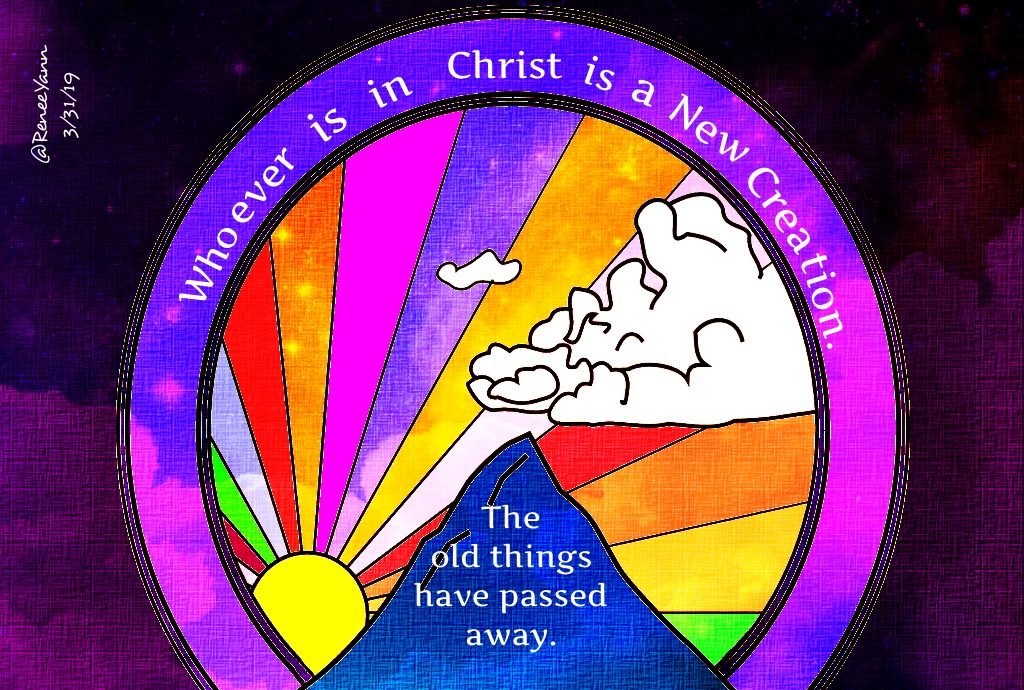
Whoever is in Christ is a new creation: the old things have passed away; behold, new things have come.
And in our revered Gospel story of the Prodigal Son, Jesus tells us:
This beloved child of mine was dead, and has come to life again; was lost, and has been found.
All of these passages speak to us in our Lenten journey, and in our Life journey. We have experienced our own “Egypts”, times when we felt disconnected, even abandoned, by God. We have sometimes felt we were journeying aimlessly toward an unknown goal. We have at times wandered, like the prodigal son, from the path of God’s love. We have darknesses in our memories that still long for Light.
This poem from Mary Oliver might capture the feeling for us:
Someone I loved once gave me a box full of darkness. It took me years to understand that this, too, was a gift. ~ Mary Oliver ~
In today’s readings, God is reminding us that the Light awaits us. Forgiveness, reconciliation, new energy and grace are the gifts of Easter – the gifts where we must keep our eyes focused as we journey.
So let us do as e.e.cummings encourages us in this poem:
Let It Go – e.e. cummings
let it go – the smashed word broken open vow or the oath cracked length wise – let it go it was sworn to go
let them go – the truthful liars and the false fair friends and the boths and neithers – you must let them go they were born to go
let all go – the big small middling tall bigger really the biggest and all things – let all go dear
so comes love
Music: Remember Not the Things of the Past – Bob Hurd (Lyrics below)
Remember not the things of the past; now I do something new, do you not see it? Now I do something new, says the Lord.
In our distress God has grasped us by the hand, opened a path in the sea, and we shall pass over, we shall pass over, free at last.
In our parched land of hypocrisy and hate, God makes a river spring forth, a river of mercy, truth and compassion; come and drink.
And who among us is sinless in God’s sight? Then who will cast the first stone, when he who was sinless carried our failings to the cross?
Pressing ahead, letting go what lies behind, may we be found in the Lord, and sharing his dying, share in his rising from the dead.
Today in God’s Lavish Mercy, Jeremiah begins our readings by describing the evil heart:
… they obeyed not, nor did they pay heed. They walked in the hardness of their evil hearts and turned their backs, not their faces, to Me.
Jeremiah :24
It is a terrible thing to encounter a truly evil-hearted person – someone who exudes a twisted energy which is the polar opposite of God’s Love.
I believe we are seeing such a individual now in the person of Vladimir Putin. His actions leave us astounded at their arrogance and cruelty. How can such a person face himself, and certainly, how can he face God?
But our Psalm and Gospel Verse, lead me to ask myself the question:
What if we prayed FOR Vladimir Putin?
Come, let us bow down in worship; let us kneel before the LORD who made us. For he is our God, and we are the people he shepherds, the flock he guides. R. If today you hear his voice, harden not your hearts.
What if we took pity on the wretched soul he has become and asked God to heal his mind and give him a new heart? He has become sick with evil, and that is a tragic thing to see in a leader responsible for millions of lives!
All of us feel tremendous sorrow and compassion toward the Ukrainian people. But in the end, no matter what, they will triumph through their sincerity, courage and faithfulness.
Putin, on the other hand, is otherwise lost for all eternity.
Will you consider praying today for Putin and those who share his evil culpabilities that they may yet hear the voice of goodness, justice, peace, and reverence for human life?
As we witness the power of God revealed in our Gospel story, let us ask that the evil of war be driven out of the hearts of all those responsible for the outrageous suffering and inhumanity being perpetrated again the people of Ukraine and in all war-infested parts of our world.
Music: Shchedryk by Mykola Leontovich
One of the world’s most famous Christmas songs – The Carol of the Bells – was based on the Ukrainian song Shchedryk, written in 1916 by composer Mykola Leontovich, which was in turn based on the melody and lyrics of a pre-Christian folk song.
This is Gimnazija Kranj Symphony Orchestra and Choir’s dedication to brave Ukrainian people who suffer under the brutal Russian invasion. Our musicians performed this beautiful love song a couple of years ago. Tine Bec did an amazing arrangement. It was composed by Mykola Leontovych: Shchedryk (Carol the Bells) with a splendid arrangement, made by composer Slovenian Tine Bec.
This arrangement is magical. It starts like deep sad mourning and continues to strengthen, unitarian voice, which is stronger than any steel, any armoury and any Russian bullet, rocket or trank grande. Music is a winner. It gives hope, unites us in a way, that no aggression will ever win.
Arrangement: Tine Bec Piano: Monika Podlogar; Cello: Katarina Minatti
Today, in God’s Lavish Mercy, there is a great sadness in our readings.
The poignant opening line from Genesis immediately strikes us:
Israel loved Joseph best of all his sons, for he was the child of his old age. Genesis 37:3
We picture young Joseph in his beautiful rainbow coat and, under an olive tree’s shade, old Jacob(Israel) proudly, tenderly, watching him play.
As the story ensues to reveal the later betrayal of Joseph’s jealous brothers, we are left astounded. Such treachery, especially among brothers, sickens the heart.
Our Gospel picks up the sad theme because Joseph and his brothers are archetypes of Christ’s story with humankind.
The Wicked Husbandman by John Everett Millais shows the owner’s murdered son
Jesus tells a parable in which he is actually the unnamed main character. He is the Son sent by a loving Father. He is the one rejected, beaten and killed by the treacherous tenants of his Father’s garden.
We know from our familiarity with Scripture that both these stories ultimately come to glorious conclusions. But today’s readings do not take us there. They leave us standing, mouths dropped open, at the dense meanness of the human heart, at the soul’s imperviousness to grace, at the profound sadness Jesus felt at this point in his ministry.
In our prayer today, let’s just be with Jesus, sharing his sadness for the meanness still poisoning our world. We might pray today for Jesus suffering in the Ukrainian people and throughout the many war-infested parts of our world.
May our prayers comfort Jesus with our desire to be open to God’s Grace and Mercy. May they lead us to actions of peace and justice on behalf of our suffering sisters and brother.
Poetry: Despised and Rejected – Christina Rossetti
My sun has set, I dwell In darkness as a dead man out of sight; And none remains, not one, that I should tell To him mine evil plight This bitter night. I will make fast my door That hollow friends may trouble me no more.
“Friend, open to Me.”–Who is this that calls? Nay, I am deaf as are my walls: Cease crying, for I will not hear Thy cry of hope or fear. Others were dear, Others forsook me: what art thou indeed That I should heed Thy lamentable need? Hungry should feed, Or stranger lodge thee here?
“Friend, My Feet bleed. Open thy door to Me and comfort Me.” I will not open, trouble me no more. Go on thy way footsore, I will not rise and open unto thee.
“Then is it nothing to thee? Open, see Who stands to plead with thee. Open, lest I should pass thee by, and thou One day entreat My Face And howl for grace, And I be deaf as thou art now. Open to Me.”
Then I cried out upon him: Cease, Leave me in peace: Fear not that I should crave Aught thou mayst have. Leave me in peace, yea trouble me no more, Lest I arise and chase thee from my door. What, shall I not be let Alone, that thou dost vex me yet?
But all night long that voice spake urgently: “Open to Me.” Still harping in mine ears: “Rise, let Me in.” Pleading with tears: “Open to Me that I may come to thee.” While the dew dropped, while the dark hours were cold: “My Feet bleed, see My Face, See My Hands bleed that bring thee grace, My Heart doth bleed for thee, Open to Me.”
So till the break of day: Then died away That voice, in silence as of sorrow; Then footsteps echoing like a sigh Passed me by, Lingering footsteps slow to pass. On the morrow I saw upon the grass Each footprint marked in blood, and on my door The mark of blood forevermore.
Music: Handel: Messiah – He was despised and rejected – sung by Jakub Józef Orliński
“He was despised and rejected of men; a man of sorrows, and acquainted with grief. (Isaiah 53, v.3) “He gave his back to the smiters, and his cheeks to them that plucked off the hair: he hid not his face from shame and spitting.” (Isaiah 50, v.6)
Today, in God’s Lavish Mercy, our readings invite to consider God’s naming us – calling us.
We celebrate wonderful Saint Peter – so fully human, so fully holy, so fully in love with God! As we pray the Gospel of Peter’s naming, may we deepen in understanding our own naming by God.
Once, Jesus asked Peter what he believed. Peter answered, simply and magnificently: “YOU ARE THE CHRIST, THE SON OF THE LIVING GOD.” Peter was an ordinary man who responded to Jesus with a clear and extraordinary faith.
One June morning, nearly fifty years ago, I sat in a sun-drenched field in the Golan Heights of Israel at a spot called Caesarea Philippi. Thirty other pilgrims composed the group as we heard today’s Gospel being read. Listening, I watched the rising sun grow brilliant on the majestic rock face in the near distance.
I thought how Peter might have watched his day’s sun playing against the same powerful cliffs as Jesus spoke his name:
Jesus said to him, You are Peter (which means “Rock”), and upon this Rock I will build my Church.
A few years later, I stood at the center of St. Peter’s Basilica in the Vatican. Looking up, I saw these words emblazoned around the awesome rotunda dome:
Tu es Petrus, et super hanc petram aedificabo ecclesiam.
On that sunlit afternoon two-thousand years ago, Peter could never have imagined what God already saw for him. Yet, Peter responded – with his whole life. This is what makes a Saint.
Jesus calls us to be saints too. He lovingly speaks our name into a sacred future we cannot even imagine. But if, like Peter, we trust and believe, God does the rest.
Poetry: Peter by John Poch. The poem captures the transformation of Peter’s humanness into God’s hope for him – the “changing” of his name.
There are three things which are too wonderful for me, Yes, four which I do not understand. The way of an eagle in the air, The way of a serpent on a rock, The way of a ship in the heart of the sea, And the way of a man with a maid –Prov. 30:18, 19
I Contagious as a yawn, denial poured over me like a soft fall fog, a girl on a carnation strewn parade float, waving at everyone and no one, boring and bored. There actually was a robed commotion parading. I turned and turned away and turned. A swirl of wind pulled back my hood, a fire of coal brightened my face, and those around me whispered: You’re one of them, aren’t you? You smell like fish. And wine, someone else joked. That’s brutal. That’s cold, I said, and then they knew me by my speech. They let me stay and we told jokes like fisher- men and houseboys. We gossiped till the cock crowed, his head a small volcano raised to mock stone.
II Who could believe a woman’s word, perfumed in death? I did. I ran and was outrun before I reached the empty tomb. I stepped inside an empty shining shell of a room, sans pearl. I walked back home alone and wept again. At dinner. His face shone like the sun. I went out into the night. I was a sailor and my father’s nets were calling. It was high tide, I brought the others. Nothing, the emptiness of business, the hypnotic waves of failure. But a voice from shore, a familiar fire, and the nets were full. I wouldn’t be outswum, denied this time. The coal-fire before me, the netted fish behind. I’m carried where I will not wish.
Music: Peter’s Song – Face to Face – Michael O’Brien
I recall something in the way you called my name, an ordinary fisherman you called me friend and took me in. How everything had changed because then I knew I’d never be the same.
Love came and rescued me. I gave up my everything to follow. Now I know. All that I was before won’t matter anymore for I am a new man because I have seen my Savior face-to-face.
I recall standing in the courtyard by the fire, words still ringing in my head, three times before the break of dawn you would be denied. And yet I saw no judgment in your eyes.
Love came and died for me. I gave up my everything, gave up my everything to follow. Now I know all that I was before is dead and it lives no more for I am a new man because I have seen my savior face-to-face.
The dark night, the new day – The stone was rolled away – my Savior, You are the Light You are alive! Ascended to heaven. I know that you will come again.
That moment I will arise to worship before your throne, to bow down for you alone are worthy, so worthy and there with saints of old, I’ll sing a brand new song in heaven forever where I will see my Savior face-to-face.












 Lavish Mercy