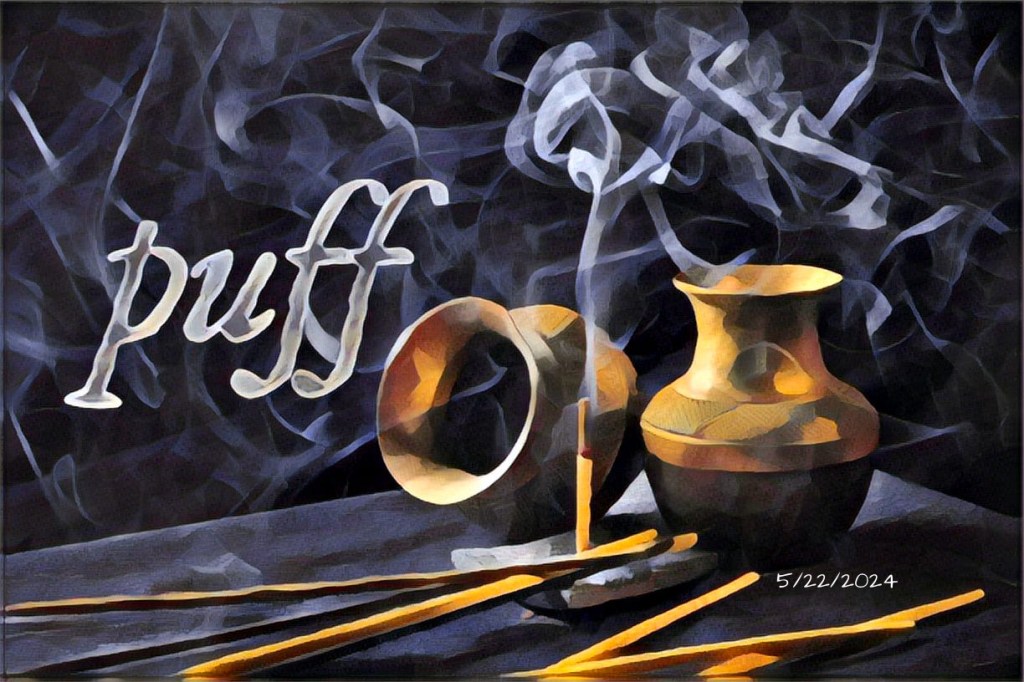
You have no idea what your life will be like tomorrow. You are a puff of smoke that appears briefly and then disappears. Instead you should say, “If the Lord wills it, we shall live to do this or that.” James 4:13-15
From the passages of these few days, it appears that James was a “no-nonsense”, fire and brimstone preacher. Instructing against pride and boastfulness, he forcefully reminds his listeners that they have no control over their lives. The only thing they can control is their commitment to God, and their openness to God’s Will.
Today, in God’s Lavish Mercy: We pray in faith and trust to our God who loves us beyond our comprehension. Indeed, we do not know what tomorrow – or even this afternoon – will bring. But we ask for the strength and joy to receive our lives with hope and fidelity.
Poetry: by Joy Harjo
To pray you open your whole self

To sky, to earth, to sun, to moon

To one whole voice that is you

And know there is more

That you can't see, can't hear

Can't know except in moments

Steadily growing, and in languages

That aren't always sound but other

Circles of motion.
Music: Be Thou My Vision – The text is based on a Middle Irish poem most attributed to Dallán Forgaill, an early Christian Irish poet born in 530 AD. Since the early 20th century, the text has been sung to an Irish folk tune, known in church hymnals as ‘Slane’.
You are my friends if you do what I command you. I no longer call you slaves, because a slave does not know what his master is doing. I have called you friends, because I have told you everything I have heard from my Father. It was not you who chose me, but I who chose you and appointed you to go and bear fruit that will remain, so that whatever you ask the Father in my name he may give you. This I command you: love one another.” John 15: 14-17
What about Matthias and the story of his emerging role in the spread of the Gospel? He must have been holy and good even to be considered for the office of Apostle. Were there just too many holy people initially to fit him into the biblically magic number of 12? And what about Justus who didn’t make the numerical cut? Was his giftedness lost to the early Church because of a short straw or a muffed coin flip?
In our Gospel, Jesus tells us that we are each “appointed” to bear fruit that will remain. No matter our title or function, we are equally “chosen” to nurture and sustain the life of the community.
Today, in God’s Lavish Mercy:
Let’s pray with Matthias that, whether recognized or unrecognized, we will be faithful to the Gospel in word and action.
Poetry: Fear of Being Chosen – Sister Natalia, member of Christ the Bridegroom Byzantine Catholic Monastery
O Matthias, what did you think,
what did you feel,
when you were beckoned forward?
Did your heart race at the idea
of joining ranks with those eleven?
Eleven different types of broken,
all seeking to be whole.

Did you fear the possibility
of secret brokenness revealed?
And did you also feel
the thrill of sure adventure,
after having seen the ups and downs
of the men whose eyes were now on you?

You’d seen their pain, their dying,
and in your heart felt a pull.
One thing you must have known,
known without a doubt
being witness to the resurrection
would mean a life of miracles.

And when you heard your name called out,
and reality sunk in,
did you feel that joyful pain of knowing
that all now know that you are His?

Did your thoughts bounce back and forth
between death and resurrection?
And did you steal one more glance
at Joseph Barsabbas
and wonder, “Why not him?”
Music: Mathias Sanctus – Hildegard von Bingen (chanted by Bella Voce Chicago)
Mathias, sanctus per electionem, vir preliator per victoriam, ante sanguinem Agni electionem non habuit, sed tardus in scientia fuit quasi homo qui perfecte non vigilat.
Donum Dei illum excitavit, unde ipse pre gaudio sicut gygas in viribus suis surrexit, quia Deus illum previdit sicut hominem quem de limo formavit cum primus angelus cecidit, qui Deum negavit.
Homo qui electionem vidit – ve, ve, cecidit!
Boves et arietes habuit, sed faciem suam ab eis retrorsum duxit et illos dimisit.
Unde foveam carbonum invasit, et desideria sua osculatus in studio suo, illa sicut Olimpum erexit.
Tunc Mathias per electionem divinitatis sicut gygas surrexit, quia Deus illum posuit in locum quem perditus homo noluit.
O mirabile miraculum quod sic in illo resplenduit!
Deus enim ipsum previdit in miraculis suis cum nondum haberet meritum operationis, sed misterium Dei in illo gaudium habuit, quod idem per institutionem suam non habebat.
O gaudium gaudiorum quod Deus sic operatur, cum nescienti homini gratiam suam impendit, ita quod parvulus nescit ubi magnus volat, cuius alas Deus parvulo tribuit.
Deus enim gustum in illo habet qui seipsum nescit, quia vox eius ad Deum clamat sicut Mathias fecit, qui dixit: O Deus, Deus meus, qui me creasti, omnia opera mea tua sunt.
Nunc ergo gaudeat omnis ecclesia in Mathia, quem Deus in foramine columbe sic elegit. Amen.
Mathias, a saint through being chosen, a champion in his victory, did not know himself chosen before the Lamb’s blood was shed: he was tardy in knowledge, like a man who is not perfectly awake.
God’s gift aroused him, so that for joy he rose like a giant in his strength: God foresaw him as he had foreseen the man whom he formed of clay when the first angel, who denied God, fell.
The man who saw his choice, alas, alas, he fell!
He had oxen and rams at his bidding, yet he looked away from them, turned his back and abandoned them.
Thus he plunged in the pit of coal and, kissing his own desires, in his ardor he raised them high, like an Olympus.
Then Mathias, divinely chosen, rose like a giant, because God set him in the place that Judas, the lost, rejected:
O wondrous miracle that shone through him thus!
For God foresaw him in his miracles, though he had not yet the merit of accomplishment, but the mystery of God had joy in him, joy that in its original plan it did not have.
Joy of joys that God works in this way, when he lavishes his grace on one who does not know, so that the child does not know where the grown man will fly, whose wings God has given to the child!
For God savors the one who does not know himself, because his voice is crying out to God, as Mathias cried, saying: God, my God, who created me, all my works are yours!
So now let all Ecclesia take joy in Mathias, he whom God thus chose in the cleft where the dove nestles. Amen.
Jesus said to his disciples: “If the world hates you, realize that it hated me first. If you belonged to the world, the world would love its own; but because you do not belong to the world, and I have chosen you out of the world, the world hates you. Remember the word I spoke to you, ‘No slave is greater than his master.’ If they persecuted me, they will also persecute you. If they kept my word, they will also keep yours. And they will do all these things to you on account of my name, because they do not know the one who sent me.” John 15: 18-21
I have written about the word “if” several times in past reflections. There are a lot more “ifs” in today’s Gospel – and each of them has a very important “then”.
Thinking about the “if – then” syllogism, I remember one of my favorite professors. Florence Fay taught us Logic when we were young enough not to have practiced it much. She was a wonderful teacher, and building on this basic conditional argument, she led us through the labyrinths of logic.
Jesus seems to be doing the same thing for his disciples. He invites them to recognize that the “thens” of their lives are directly dependent on the “ifs”. He asks them to receive that interdependence without fear because in doing so, they imitate him.
Today, in God’s Lavish Mercy:
We ask for the courage to live a life balanced on faith so that the “if-then”s of our lives lead us to holiness, not away from it.
Poetry: I See His Blood – Joseph Plunkett
I see his blood upon the rose
And in the stars the glory of his eyes,
His body gleams amid eternal snows,
His tears fall from the skies.
I see his face in every flower;
The thunder and the singing of the birds
Are but his voice—and carven by his power
Rocks are his written words.
All pathways by his feet are worn,
His strong heart stirs the ever-beating sea,
His crown of thorns is twined with every thorn,
His cross is every tree.
I am reminding you, brothers and sisters, of the Gospel I preached to you, which you indeed received and in which you also stand. Through it you are also being saved, if you hold fast to the word I preached to you, unless you believed in vain. 1 Corinthians 15:1-2
In today’s passage, Paul describes the Gospel as a gift, given through his preaching, and received by his listeners.
Today, in God’s Lavish Mercy:
Think of the most precious gift that has ever been placed in your hands – how carefully and tenderly you received it, handled it, cared for it. I think of the times the newborns of our family have been handed to me, and how I cherished them and vigilantly held them.
Paul, and our early leaders such as Philip and James, have handed on to us the precious Gospel as they received from Christ himself. It is the key to our eternal life. How we should treasure it, learn from it, stand in it, and hold fast to it, as Paul encourages us to do!
Prose: from John Calvin, Golden Booklet of the True Christian Life
“The Gospel is not a doctrine of the tongue, but of life.
It cannot be grasped by reason and memory only,
but it is fully understood when it possesses the whole soul
and penetrates to the inner recesses of the heart.”
Music: Verbum Dei (Word of God) – by Voices Thules
Vocal ensemble Voces Thules was founded in 1992 and has established itself as a leading ensemble for performance and research on Icelandic medieval and traditional music in Iceland. Voces Thules perform both sacred and secular music either a-cappella or with Medieval period instruments.
Children, let us love not in word or speech but in deed and truth. Now this is how we shall know that we belong to the truth and reassure our hearts before him in whatever our hearts condemn, for God is greater than our hearts and knows everything. Beloved, if our hearts do not condemn us, we have confidence in God and receive from him whatever we ask, because we keep his commandments and do what pleases him.
1 John 3:18-22
John makes it so clear and simple, doesn’t he? It’s what we do that matters, not what we say. Jesus said the same thing once when he pointed out a tree to his disciples and said, “By their fruits, you will know them..”
Today, in God’s Lavish Mercy:
Let’s take a good look at our lives, and the lives of those we allow to influence us. Are we like trees bearing good fruit – good deeds of charity, peace, forgiveness, mercy, honesty, respect, encouragement, hope, and fidelity?
If our deeds reflect the opposite of these virtues, John says they condemn us. He calls us to Gospel faithfulness in what we do as well as what we say.
Poetry:
How far that little candle throws his beams! So shines a good deed in a weary world.
William Shakespeare
Music: Good Tree – Hillbilly Thomists (I thought these guys were fascinating! See more about them on their website: https://www.hillbillythomists.com/about)
You can’t gather grapes from a bramble bush Or pick a fig from thorns What I’d like to be Oh, to be a good tree
Some fall in the rocks, on the beaten path Some sink into great soil From a tiny seed Oh, to a good tree
Like a cedar high And mustard wide Where all the birds of the air can hide Find rest inside
Oh, a good tree The beetle bites The black rot strikes From the inside Have your enemies
Oh, if you’re a good tree High and dry Some branches die From time to time A prune’s required If you wanna be Oh, a good tree
Even when I’m old I still will be Still full of sap, still green That’s what I want to be Oh, to be a good tree
By Your word The dark is light The tree of death becomes the tree of life So let it be Oh, to be a good tree Oh, to be a good tree Oh, to be a good tree Oh, to be a good tree Oh, to be a good tree
Observing the boldness of Peter and John and perceiving them to be uneducated, ordinary men, the leaders, elders, and scribes were amazed, and they recognized them as the companions of Jesus.
Acts 4:11
When Jesus had risen, early on the first day of the week, he appeared first to Mary Magdalene, out of whom he had driven seven demons. She went and told his companions who were mourning and weeping. When they heard that he was alive and had been seen by her, they did not believe.
Mark 16:9-11
Think of it! Jesus had companions – people he depended on and who depended on him. Like all companions, they had a common bond – their faith and mission.
It was this shared faith and mission that made them recognizable even when they were not standing side by side.
Today, in God’s Lavish Mercy:
How wonderful to be so invested in the faith and mission of the Gospel that we are recognizable as companions of Jesus!
Poetry: The Companion – John N. Morris
I shall begin
To appear too often.
You will not recall
When first you saw me.
I shall arrive
At the light beside you.
Catching a plane
You will observe me.
I will never speak.
I will never ignore you.
I shall open a door.
You will pass before me.
I will stand
In a line behind you. Whatever you do
I will be the same.
Nobody else
Will ever believe you.
Soon you will find
You are looking for me.
The day will come,
It is getting closer,
When I shall stand
At every corner.
Then you will know
That you deserve me
And there will be
No more excuses.
Mary said to the angels, “They have taken my Lord, and I don’t know where they laid him.” When she had said this, she turned around and saw Jesus there, but did not know it was Jesus. Jesus said to her, “Woman, why are you weeping? Whom are you looking for?” She thought it was the gardener and said to him, “Sir, if you carried him away, tell me where you laid him, and I will take him.” Jesus said to her, “Mary!” She turned and said to him in Hebrew, “Rabbouni,”….
John 20:13-16
It is not until He says her name that Mary recognizes Jesus. Earlier, when He simply calls her “Woman”, she is still confused about who He is. But the speaking of her name clears her vision and she names Him, lovingly, in return.
Today, in God’s Lavish Mercy:
Let us listen to God’s names for us. They will be beyond the Baptismal or nicknames by which everyone knows us. God’s names for us are infinite, changing as we grow in knowledge of ourselves. They are wordless invitations to ever-deeper intimacy as we discover ourselves in God’s heart.
And let us pray with our own names for God. These too may be beyond the common catalog of “Lord” and “Father”. Plumb your soul for your own deepest – perhaps even silent – names for God.
Poetry: Thom Satterlee – One Hundred and Eight Names for God (based on Hal M. Helms translation of The Confessions)
Some of them we’ve heard before–
Lord, Almighty, Omnipotent One.
And others turn God into a pedant,
even if that wasn’t always a bad thing to be:
Power That Weds My Mind with My Inmost Thought.
But many, the best, are like a new birdcall:
Beauty of All Things Beautiful,
The One by Whom I Have Been Apprehended.
They remind me of the unsteady joy
in learning a foreign language: God, Light
of My Eyes in Secret, Inmost Physician,
Exaltation of My Humility. What impresses me most is
his trying again and again to name what he loves,
and how the attempt at once shows
and grows his love.

So what shall we call him,
This Most Effusive Saint? He is An Eloquent
Lover of the Divine, One Holy
Word Hoarder, God’s Appellation Artist.
He is One Who Shows Us
What a Name Can Mean, An Alphabet
That Ends with the Letter for God.
When I found Thom Satterlee’s poem on the internet, there was a link to this wonderful article for anyone who loves to write. Some of you may enjoy it. I think it’s really beautiful.
Mary Magdalene and the other Mary went away quickly from the tomb, fearful yet overjoyed, and ran to announce the news to his disciples. And behold, Jesus met them on their way and greeted them. They approached, embraced his feet, and did him homage. Then Jesus said to them, “Do not be afraid. Go tell my brothers to go to Galilee, and there they will see me.”
Matthew 28: 8-10
Oh, the young, heartbroken yet hopeful, fearful yet joyful Marys! Their whole beings leapt at the realization of Easter.
And so they RAN to share the incredible news. They didn’t just walk. They didn’t just return. They didn’t just hurry. They RAN!
Today, in God’s Lavish Mercy: Now it’s been a while since this nearly octogenarian body has run. But I ask myself on this post-Easter morning, can my spirit still run … RUN … with the Resurrection News to every heart that longs to hear it?
Poetry: Messenger – Mary Oliver
My work is loving the world.
Here the sunflowers, there the hummingbird—
equal seekers of sweetness.
Here the quickening yeast; there the blue plums.
Here the clam deep in the speckled sand.
Are my boots old? Is my coat torn?
Am I no longer young, and still half-perfect? Let me
keep my mind on what matters,
which is my work,
which is mostly standing still and learning to be
astonished.
The phoebe, the delphinium.
The sheep in the pasture, and the pasture.
Which is mostly rejoicing, since all the ingredients are here,
which is gratitude, to be given a mind and a heart
and these body-clothes,
a mouth with which to give shouts of joy
to the moth and the wren, to the sleepy dug-up clam,
telling them all, over and over, how it is
that we live forever.
He loved his own in the world and he loved them to the end. The devil had already induced Judas, son of Simon the Iscariot, to hand him over. So, during supper, fully aware that the Father had put everything into his power and that he had come from God and was returning to God, he rose from supper and took off his outer garments. He took a towel and tied it around his waist. Then he poured water into a basin and began to wash the disciples’ feet and dry them with the towel around his waist.
John 13: 1-4
Be there. Feel the astonished silence in the room as Jesus kneels before each of his disciples to wash their feet. Enter their hearts as they begin to realize he is giving them one of the final gifts of his amazing love. Imagine Jesus’ own heart as he washes the feet of each dear friend, knowing the time has come to be parted from them.
Today, in God’s Lavish Mercy:
We let Jesus lean over us and pour the cleansing water of his love over us. We listen to the water, to his hands, to the silence – to hear the call to imitate his humble love in our lives.
Poetry: Morning of Fog – Jessica Powers (Sr. Miriam of the Holy Spirit, OCD)
Between this city of death with its gray face
and the city of life where my thoughts stir wild and free
a day stands. It is a road I trace
too eagerly. For morning can give me nothing but a dull
cold sense of having died. The towers lift
like dreams. Down through the streets the beautiful
gray fogs of sorrow drift. This is a city of phantoms. I am lost
in a place where nothing that beats with life should roam.
Only a spirit chilled into a ghost
could call these streets its home.
I shall go exiled to the fall of night,
until I can return
to the city I love where the streets are washed with light
and the windows burn.
Music: Wash Me, Lord – Harvest
I thought I was so clever Thought I was so wise Surely You could never see Inside this darkness I thought that I had fooled You Now I see I was the fool Thinking that I could hide this darkness In my heart
So wash me, Lord In Your presence Wash me, make me clean There’s a stain in my heart That only You can see Wash me, make me clean
I brought You sacrifices My silver and my gold In my selfishness I tried to buy Your pleasure But Your holiness requires The offering You desire Is that I bring to You A brokеn, humble heart
So break mе, Lord In Your presence Break me, set me free There’s a stain in my heart That only You can see So wash me, Lord In Your presence Wash me, make me clean There’s a stain in my heart That only You can see Wash me, make me clean
Reclining at table with his disciples, Jesus was deeply troubled and testified, “Amen, amen, I say to you, one of you will betray me.” The disciples looked at one another, at a loss as to whom he meant. One of his disciples, the one whom Jesus loved, was reclining at Jesus’ side. So Simon Peter nodded to him to find out whom he meant. He leaned back against Jesus’ chest and said to him, “Master, who is it?” Jesus answered, “It is the one to whom I hand the morsel after I have dipped it.” So he dipped the morsel and took it and handed it to Judas, son of Simon the Iscariot.
John 13: 21-26
To be betrayed is so much worse than to be outright opposed! An opponent is someone who stands against you from the beginning. You know who they are. You know how to protect yourself from them.
But a betrayer is someone who turns on you after you have given your trust. With that trust, you have handed over all your tools for self-protection. You are left vulnerable to their inconstancy.
Today, in God’s Lavish Mercy:
We pray to be a true-hearted person, one who deserves and keeps the confidence of God and of our companions on the journey.
We pray to understand the weaknesses that may have motivated Judas, and to ask God to heal us of any trace of them in our own hearts.
Poetry: Judas Iscariot by Countee Cullen (1925)
This long but simple poem offers an interesting take on Judas. Countee Cullen was a central figure of the Harlem Renaissance, a movement centered in the cosmopolitan community of Harlem, in New York City, which had attracted talented migrants from across the country. During the 1920s, a fresh generation of African-American writers emerged, although a few were Harlem-born. Other leading figures included Alain Locke (The New Negro, 1925), James Weldon Johnson (Black Manhattan, 1930), Claude McKay (Home to Harlem, 1928), Langston Hughes (The Weary Blues, 1926), Zora Neale Hurston (Jonah’s Gourd Vine, 1934), Wallace Thurman (Harlem: A Melodrama of Negro Life, 1929), Jean Toomer (Cane, 1923) and Arna Bontemps (Black Thunder, 1935).(information from Wikipedia)
I think when Judas' mother heard
His first faint cry the night
That he was born, that worship stirred
Her at the sound and sight.

She thought his was as fair a frame
As flesh and blood had worn;
I think she made this lovely name
For him— "Star of my morn."

As any mother's son he grew
From spring to crimson spring;
I think his eyes were black, or blue,
His hair curled like a ring.

His mother's heart-strings were a lute
Whereon he all day played;
She listened rapt, abandoned, mute,
To every note he made.

I think he knew the growing Christ,
And played with Mary's son,
And where mere mortal craft sufficed,
There Judas may have won.

Perhaps he little cared or knew,
So folly-wise is youth,
That He whose hand his hand clung to
Was flesh-embodied Truth;

Until one day he heard young Christ,
With far-off eyes agleam,
Tell of a mystic, solemn tryst
Between Him and a dream.

And Judas listened, wonder-eyed,
Until the Christ was through,
Then said, “And I, though good betide,
Or ill, will go with you."

And so he followed, heard Christ preach,
Saw how by miracle
The blind man saw, the dumb got speech,
The leper found him well.

And Judas in those holy hours,
Loved Christ, and loved Him much,
And in his heart he sensed dead flowers
Bloom at the Master's touch.

And when Christ felt the death hour creep,
With sullen, drunken lurch,
He said to Peter, "Feed my sheep,
And build my holy church.”

He gave to each the special task
That should be his to do,
But reaching one, I hear him ask,
“What shall I give to you?”

Then Judas in his hot desire
Said, "Give me what you will."
Christ spoke to him with words of fire,
“Then, Judas, you must kill,

One whom you love, One who loves you
As only God's son can:
This is the work for you to do
To save the creature man."

"And men to come will curse your name,
And hold you up to scorn;
In all the world will be no shame
Like yours; this is love's thorn.

It takes strong will of heart and soul,
But man is under ban.
Think, Judas, can you play this role
In heaven's mystic plan?"

So Judas took the sorry part,
Went out and spoke the word,
And gave the kiss that broke his heart,
But no one knew or heard.

And no one knew what poison ate
Into his palm that day,
Where, bright and damned, the monstrous weight
Of thirty white coins lay.

It was not death that Judas found
Upon a kindly tree;
The man was dead long ere he bound
His throat as final fee.

And who can say if on that day
When gates of pearl swung wide,
Christ did not go His honored way
With Judas by His side?

I think somewhere a table round
Owns Jesus as its head,
And there the saintly twelve are found
Who followed where He led.

And Judas sits down with the rest,
And none shrinks from His hand,
For there the worst is as the best,
And there they understand.

And you may think of Judas, 'friend,
As one who broke his word,
Whose neck came to a bitter end
For giving up his Lord.

But I would rather think of him
As the little Jewish lad
Who gave young Christ heart, soul, and limb,
And all the love he had.
Music: Heaven On Their Minds – Judas’s song from Jesus Christ Superstar






 Lavish Mercy