With Open Arms

Friday, January 7, 2022
Friday after Epiphany

Today, in God’s Lavish Mercy, John and Jesus continue to teach us.

In our first reading, we hear John preaching to a community that has become confused. Some have begun to doubt and to teach a watered-down version of Christ and the Gospel.

John convinces his community, and us, that we are invited into God’s own life through Baptism, the Paschal-Eucharistic Mystery, and through the Holy Spirit. This is the truth of Jesus Christ which we embrace by a faithful life.

This is the one who came through water and Blood, Jesus Christ,
not by water alone, but by water and Blood. 
The Spirit is the one who testifies,
and the Spirit is truth. 
So there are three who testify,
the Spirit, the water, and the Blood, 
and the three are of one accord. 

1 John 5:6

In our Gospel, Jesus shows us how to live that faithful life – through loving, generous service such as he models.

Jesus cleans the leper, Mosaic detail, 12thC,
Cathedral of the Assumption, Monreale, Sicily

A pitiable leper interrupts Jesus on his journey to ask for help. People like this man were scorned, feared, and isolated. Their leprosy impoverished them, making them annoying beggars. Their cries usually met with indifference at best and banishment at worst.

But when this leper poses his proposal to Jesus – “If you want to, you can heal me.” — Jesus gives the spontaneous answer of a true, merciful heart: “Of course I want to!” He responds with open arms and open heart.

Greek rendering of phrase “Of course I do!”

There is no annoyance, no suggestion that other concerns are more important. There is just the confirmation that – Yes- this is the purpose of my life: to heal, love, show mercy toward whatever suffering is in my power to touch. There is just the clear message that “You, too, poor broken leper, are Beloved of God.”

What an example and call Jesus gives us today! We are commissioned to continue this merciful touch of Christ along the path of our own lives. When circumstances offer us the opportunity to be Mercy for another, may we too respond with enthusiasm, “Of course I want to!” May we have the eyes to see through any “leprosy” to find the Beloved of God.


Prose: Mother Teresa – from In the Heart of the World: Thoughts, Stories and Prayers

Seeking the face of God
in everything, everyone, all the time,
and his hand in every happening;
This is what it means to be contemplative
in the heart of the world.
Seeing and adoring the presence of Jesus,
especially in the lowly appearance of bread,
and in the distressing disguise of the poor.

Music: Compassion Hymn – Kristyn and Keith Getty

Rain Down, Lord!

December 15, 2021
Wednesday of the Third Week in Advent

Today, in God’s Lavish Mercy, we pray with Isaiah and Luke who both offer us passages in which God self-describes in displays of omnipotence and tenderness.

In Isaiah, we meet the powerful Creator Who dispenses both justice and mercy.

In Luke, we meet the merciful Savior Who tenderly uses that power to heal.

With our psalm response from Isaiah, we voice our longing to be healed by God’s infinite power – a power which finds the world’s brokenness, seeps into it like rain, transforms it with love.


Poetry: I Rain by Hafiz

The poem came to mind when I prayed the verse:
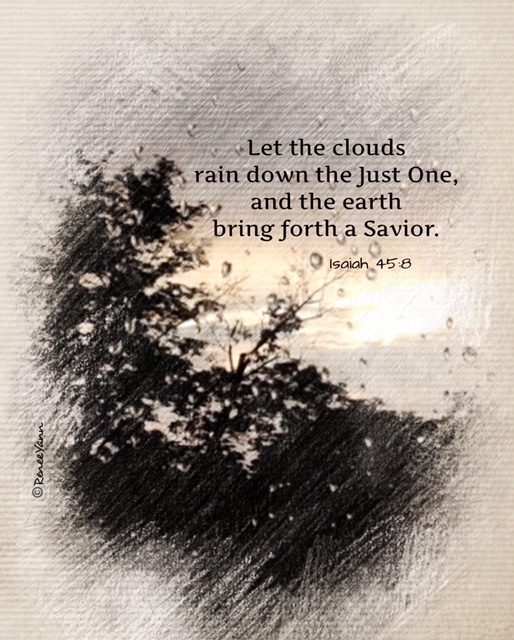
Let the clouds rain down the Just One, and the earth bring forth a Savior.

I rain
Because your meadows call
For God.

I weave light into words so that
When your mind holds them

Your eyes will relinquish their sadness,
Turn bright, a little brighter, giving to us
The way a candle does
To the dark.

I have wrapped my laughter like a gift
And left it beside your bed.

I have planted my heart’s wisdom
Next to every signpost in the sky.

A wealthy one, seeing all this,
May become eccentric,

A divinely wild soul
transformed to infinite generosity

Tying gold sacks of gratuity
To the dangling feet of moons, planets, ecstatic
Midair dances, and singing birds.

I speak
Because every cell in your body
Is thirsty
For God.

Music: Waiting for the Rain – Kathryn Kaye

Sing Mercy in the Sadness

December 7, 2021
Tuesday of the Second Week of Advent
Memorial of St. Ambrose

Today, in God’s Lavish Mercy, we are blessed, once again, with magnificent readings!

Our psalm coaches us to rejoice and sing – a song that will heal the nations.

Sing to the LORD a new song;
    sing to the LORD, all you lands.
Sing to the LORD; bless the LORD’s name;
    announce God’s salvation, day after day.

Psalm 96:1-2

Our first reading is the exquisite “Comfort” passage from Isaiah. And our Gospel gives us Jesus tenderly seeking the single lost lamb.

The first and last words of these two readings – COMFORT, LOST – capture the whole intent of today’s message:


Life is a maze whose walls are heightened
by our incivility to one another.
Isaiah calls us to be a leveler of walls,
a straightener of twists, a bridge over deadly valleys.
Jesus calls us to seek and carry the lost sheep.
We are called to be Mercy in a suffering world.


These beautiful and challenging readings come to us this year at a time when Pope Francis has offered a clear and similar challenge to the world. Last week, during his visit to the refugee encampment on the Greek island of Lesbos, Francis voiced his profound pain at the international immigration tragedy:

“Let us not let our sea (mare nostrum) be transformed into a desolate sea of death (mare mortuum),” the Pope concluded.  “Let us not allow this place of encounter to become a theatre of conflict.  Let us not permit this “sea of memories” to be transformed into a “sea of forgetfulness”.  Please, let us stop this shipwreck of civilization.”

“It is an illusion to think it is enough to keep ourselves safe, to defend ourselves from those in greater need who knock at our door”, Pope Francis said.  “In the future, we will have more and more contact with others.  To turn it to the good, what is needed are not unilateral actions but wide-ranging policies.  History teaches this lesson, yet we have not learned it.” 

Source for quotes: Vatican News – vaticannews.va

During his address, the Pope asked every man and woman, “to overcome the paralysis of fear, the indifference that kills, the cynical disregard that nonchalantly condemns to death those on the fringes.” 


Resource: To learn about and reflect on the issue of immigration, here is a link to NETWORK. Founded by Catholic Sisters in the progressive spirit of Vatican II, NETWORK works to create a society that promotes justice and the dignity of all in the shared abundance of God’s creation.


Music: Comfort Ye from Handel’s Messiah – sung by Jerry Hadley

As we pray this glorious music today, let us ask for the strength and courage to be Mercy for the world, to find the ways to comfort God’s people, close by and at life’s borders.

No More Tears

December 4, 2021
Saturday of the First Week of Advent

Today, in Mercy, Isaiah – in glorious prophecy – promises God’s People better times.

Thus says the Lord GOD,
    the Holy One of Israel:
O people of Zion, who dwell in Jerusalem,
    no more will you weep;
GOD will be gracious to you when you cry out,
    answering as soon as you are heard.
The Lord will give you the bread you need
    and the water for which you thirst.
No longer will your Teacher be hidden,
    but with your own eyes you shall see your Teacher,
While from behind, a voice shall sound in your ears:
    “This is the way; walk in it,”
    when you would turn to the right or to the left.

Isaiah 30: 19-21

Oh my, don’t we all long for the fulfillment of that promise! So much in both our larger and smaller worlds longs for healing!


Perhaps we can use our prayer within these readings today to call on God for the promised healing.

It is a healing that requires our cooperation. Isaiah says that we must name our pain to God – for ourselves and for all who suffer in our world:

The Lord will be gracious to you when you cry out,
answering as soon as you are heard.


The prophet says that this crying out will change us. We will see the Lord with us in our suffering. God will lead us through that suffering by our acts of faith, hope, love, justice and mercy:

No longer will your Teacher be hidden,
but with your own eyes you shall see your Teacher,
While from behind, a voice shall sound in your ears:
“This is the way; walk in it,”
when you would turn to the right or to the left.


Our Gospel tells us that we are called to be Christ’s disciples, and that disciples are healers. By letting our lives become sources of healing in the world, Isaiah’s prophecy is fulfilled for our time.

Jesus sent out these twelve after instructing them thus,
“Go to the lost sheep of the house of Israel.
As you go, make this proclamation: ‘The Kingdom of heaven is at hand.’
Heal the sick, raise the dead, cleanse lepers, drive out demons.

Without cost you have received; without cost you are to give.”

Matthew 10:5-8

How we do these wondrous deeds in the world is an ongoing revelation. When I was very young, I took the proclamation quite literally. But I soon lost the expectation that I would ever help “cure” anyone of anything!

Life has blessed me with the realization that there is a difference between “curing” and “healing” – and that there are many degrees of healing.

  • There are many ways in which living people are caught in deadly lives.
  • There are all kinds of “lepers” in our society, rendered so by the prejudices of others.
  • Certainly, many of us carry all sorts of crippling demons.

All these situations, and others like them, invite us to offer the gift of sacred healing implanted in us at our Baptism.

Acknowledging the pain in ourselves and others,
and trusting that God wants us to be healed and whole,
is the work of true discipleship.

Let’s draw strength from Isaiah’s promise in order to find a generous, merciful courage for our call to be “healed healers”.


Poetry: The Cure of Souls – Denise Levertov

The pastor
of grief and dreams

guides his flock towards
the next field

with all his care.
He has heard

the bell tolling
but the sheep

are hungry and need
the grass, today and

every day. Beautiful
his patience, his long

shadow, the rippling
sound of the flocks moving

along the valley.


Music: Your Healing Touch – Joe Bongiorno

Our Tender God

October 25, 2021
Monday of the Thirtieth Week in Ordinary Time

Today, in God’s Lavish Mercy, we pray with Psalm 68 which pictures a triumphant God, rising like the sun over the darkness of evil.

Arise, O God, and let your enemies be scattered;
let those who hate you flee.
Let them vanish like smoke when the wind drives it away; 
as the wax melts at the fire,
so let the wicked perish at your presence.

Psalm 68: 1-3

This psalm comforts us with a tender picture of God:

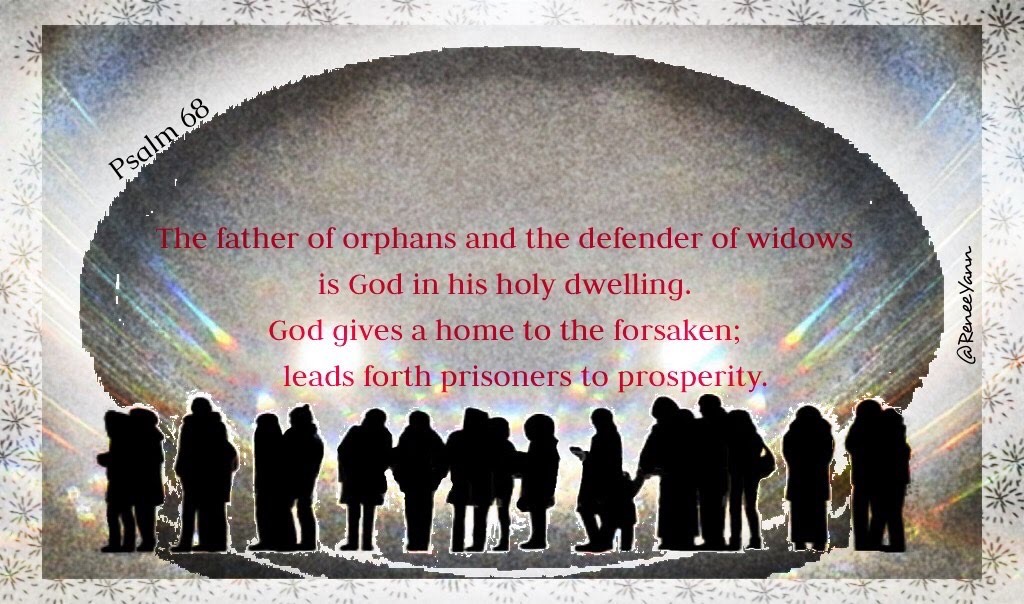
Protector of orphans, defender of widows,
the One who dwells in holiness,
who gives the solitary a home
and brings forth prisoners into freedom;
but the rebels shall live in dry places.

Psalm 68: 5-6

It is the same tenderness Paul presents in our first reading:

For those who are led by the Spirit of God are children of God.
For you did not receive a spirit of slavery to fall back into fear,
but you received a spirit of adoption,
through which we cry, “Abba, Father!”
The Spirit bears witness with our spirit
that we are children of God,
and if children, then heirs,
heirs of God and joint heirs with Christ…

if only we suffer with him
so that we may also be glorified with him.

And there we have the key line:
we are to live a life aligned with
the Passion, Death, and Resurrection of Christ.

And what will that kind of life look like? It will look like our merciful Jesus of today’s Gospel – who stepped out to see, comfort, and heal the suffering around him.

Jesus recognized the crippled woman as “an heir of God, and joint heir with him” to the fullness of life in God. We are called recognize ourselves and all of our sisters and brothers in the same way.


Poetry: WOMAN UN-BENT (LUKE 13:10–17) – by Irene Zimmerman, OSF

That Sabbath day as always
she went to the synagogue
and took the place assigned her
right behind the grill where,
the elders had concurred,
she would block no one’s view,
she could lean her heavy head,
and (though this was not said)
she’d give a good example to
the ones who stood behind her. 

That day, intent as always
on the Word (for eighteen years
she’d listened thus), she heard
Authority when Jesus spoke. 

Though long stripped
of forwardness,
she came forward, nonetheless,
when Jesus summoned her.
“Woman, you are free
of your infirmity,” he said. 

The leader of the synagogue
worked himself into a sweat
as he tried to bend the Sabbath
and the woman back in place. 

But she stood up straight and let
God’s glory touch her face.

Video: Jesus Heals the Bent-over Woman

If you’d still like a little music, this one seems to fit: Spirit Touch by Joseph Akins

Don’t Pass Me By

October 24, 2021
Thirtieth Sunday in Ordinary Time

Today, in God’s Lavish Mercy, we pray with Psalm 126, a song of irrepressible joy at Divine Deliverance:

When the LORD brought back the captives of Zion,
    we were like men dreaming.
Then our mouth was filled with laughter,
    and our tongue with rejoicing.

Then they said among the nations,
    “The LORD has done great things for them.”
The LORD has done great things for us;
    we are glad indeed.

Psalm 126: 1-3

The psalm captures for us
a community which
recognizes, beseeches,
and thanks God for its deliverance.

Our Gospel presents us with a story of someone who is delivered – the blind man, Bartimeus. He is an otherwise unknown character in scripture. Yet this short passage suggests so much about him.

It is stated that he was the son of Timeus, apparently someone of note in the community – otherwise, why mention his name? And yet this notable man’s blind son is left to begging on the side of the road. Had disability driven father and son apart? Was Dad unable to accept a son with a physical challenge?

The passage also reveals that Bartimeus knew about Jesus. Perhaps while begging in the public square, he talked and listened. He daydreamed about what he planned to do if he should ever have a chance to meet Jesus!

His cronies in the marketplace were not very supportive. They told him to shut up, even as he pathetically cried for Jesus’s mercy. Still, Bartimues persisted and Jesus heard him.

When he comes to Jesus, Jesus asks, “What do you want me to do for you?” It has always struck me as a strange question. The man is obviously blind, stumbling through the crowd on some disciple’s arm. Why did Jesus bother to ask what Bartimeus wanted?


This might be the lesson hidden in this Gospel. We need to name and claim our needs before God can reach through and transform them. If we don’t even know we’re “blind”, how can we know we’re cured? If we don’t present our needs to God, how can we believe that it is God Who has healed us?

The freshly cured Bartimeus, eyes wide open in grace, now follows along the path with Jesus. All the “shut-uppers” are silenced. Perhaps, Timeus weeps off in a doorway to see the power of his son’s faith and Jesus’s love.

How might our lives be changed if we had that kind of faith… that kind of love?


Poetry: Blind Bartimeus – Henry Wadsworth Longfellow

Blind Bartimeus at the gates
Of Jericho in darkness waits;
He hears the crowd;--he hears a breath
Say, "It is Christ of Nazareth!"
And calls, in tones of agony,
Ἰησοῦ ἐλέησόν με! (Have mercy on me!)

The thronging multitudes increase;
Blind Bartimeus, hold thy peace!
But still, above the noisy crowd,
The beggar's cry is shrill and loud;
Until they say, "He calleth thee!"
Θάρσει ἔγειρε φωνεῖ σε! (Jesus is calling you)

Then saith the Christ, as silent stands
The crowd, "What wilt thou at my hands?"
And he replies, "Oh, give me light!
Rabbi, restore the blind man's sight."
And Jesus answers, "ὕπαγε
πίστις σου σέσωκέν σε!" (Your faith has saved you)

Ye that have eyes, yet cannot see,
In darkness and in misery,
Recall those mighty Voices Three,
Ἰησοῦ ἐλέησόν με! (Have mercy on me.)
Θάρσει ἔγειρε φωνεῖ σε! (Jesus is calling you.)
ἡ πίστις σου σέσωκέν σε! (Your faith has saved you.)

Music: Don’t Pass Me By – Fred Hammond (lyrics below)

There was a blind man on the road side, and he heard a commotion
It was Jesus passing by with a crowd and it stirred his emotions
He’d been displaced his whole life, should he even try

Don’t bother Jesus (they say you have nothing)
You have nothing to offer (stay in your place)
Right then he knew(he had to choose)
He had nothing to lose

So he cried Jesus (Jesus), I need you,  please don’t pass me by
He cried out Jesus, I’m not ashamed(to tell you) I need you in my life
(I need you in my life)

I’m not much different from that man, and this is the honest truth
Could this sinful one, with this messed up life, could I ever serve you
people and things clutter my mind, should I even try

Don’t bother Jesus (they say you have nothing)
You have nothing to offer (stay in your place)
Right then he knew (he had to choose)
He had nothing to lose

So I cry Jesus(Jesus), I need you
Please don’t pass me by
I’m crying out Jesus, I’m not ashamed to tell you I need you in my life

As the deer (as the deer panted)
Thirsty for the water yeah(thirsty for the water)
My soul desires and longs to be(to be with you)

Jesus, I need you, please don’t pass me by
I don’t mean to waste your time but I can’t listen to the crowd,
Situations in my life telling me to keep it down
But I need you

I know I’m broken, but you can heal me, Jesus, Jesus I’m calling you
(I might not be worth much)might not be worth much, but I’m still willing
Jesus, Jesus, I’m calling you

Tuesday of the Eighteenth Week in Ordinary Time

Tuesday, August 3, 2021

Today, in God’s Lavish Mercy, we pray with Psalm 51 which expresses the ardent desire for forgiveness and reconciliation.

The psalm reflects back to our first reading – an episode of sibling rivalry, jealousy, and hidden motives.

Moses, favored of God and leader of the people, makes a questionable choice. He marries outside the tribe, after telling everyone else not to. Hmmm. His siblings, Aaron and Miriam, don’t like that. So they indignantly complain:

Is it through Moses alone that the LORD speaks?
Does God not speak through us also?

Numbers 12:2

God hears their complaint and sees through it. God sees that they are less concerned about the marriage and more concerned about themselves. They’re tired of Moses telling them what to do. They think God could have picked a better leader — one of them!

God sets them straight about how special Moses is, and their responsibility to support, not undermine, him.

Should there be a prophet among you,
in visions will I reveal myself to him,
in dreams will I speak to him;
not so with my servant Moses!
Throughout my house he bears my trust:
face to face I speak to him;
plainly and not in riddles.
The presence of the LORD he beholds.

Numbers 12:6-7

The whole story is really about motives. Everything we do must be done out of love – out of reverence for God, and out of respect and hope for ourselves and others. This is what it means to have a clean heart. And it is the plea of Psalm 51.

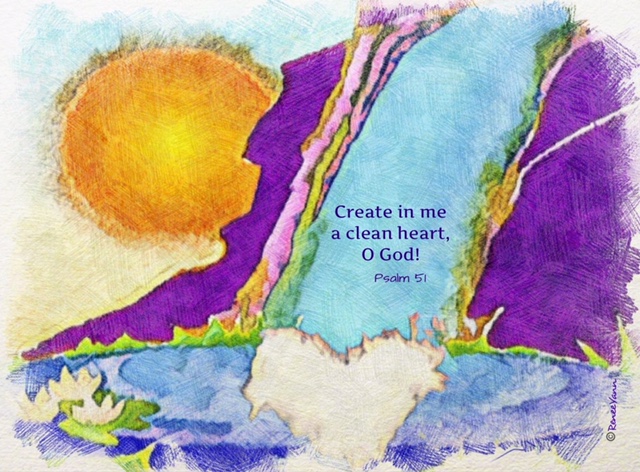
A clean heart create for me, O God,
and a steadfast spirit renew within me.
Cast me not off from your presence,
and your Holy Spirit take not from me.

Psalm 51:12-13

Reflection: This is a great piece by Sister Joyce Rupp on a clean heart (published in America magazine)

Music: some Gospel smooth jazz from Fred Hammond who is one of the most popular figures in contemporary Gospel music

Tuesday of the Fifteenth Week in Ordinary Time

Tuesday, July 13, 2021

Today, in God’s Lavish Mercy, we pray with Psalm 69 whose speaker, not to make a pun, is in bad straits!

I am sunk in the abysmal swamp
    where there is no foothold;
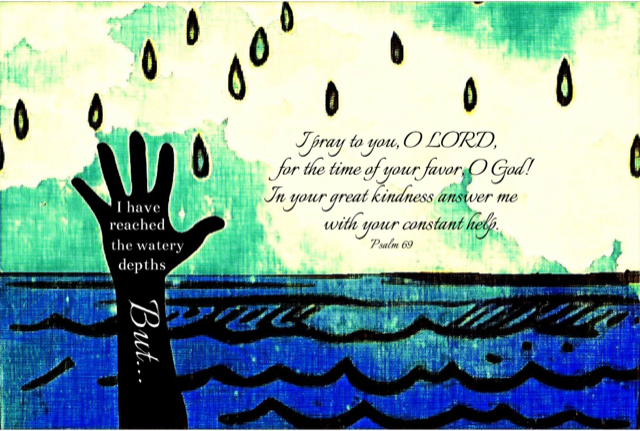
I have reached the watery depths;
    the flood overwhelms me.

Psalm 69:3

This is painful stuff – the kind of desperate pain we find threaded throughout the psalms in the prayers of lament.

These laments follow a pattern:

  • a petition for God’s help
  • multiple repetitions of this plea
  • detailed descriptions of the suffering being endured
  • proclamations of the sufferer’s innocence
  • assurances of the sufferer’s goodness
  • and often, a list of suggestions about how God should solve the problem

So the prayer, at least mine, would go something like this:

  • Dear God, please help me get out of this mess!
  • Do something, please. I know you can do something!
  • I am being harassed and destroyed. Let me tell you all about it.!
  • And it’s not my fault- (well, not completely anyway)
  • I try to be a good person and look what happens anyway!
  • I still believe in you and pray that you take care of my persecutors
  • (By the way, here are some tips on how you might do that, God.)

All in all, such a lament is a really healthy prayer. If we pray it completely, we get to the “BUT” of the pictured verse – that place where we allow God to teach and change us.

When we pray like this, we do these things in God’s Presence:

  • recognize our pain and name it
  • admit that we need help
  • analyze what’s really at the root of our pain
  • acknowledge our part in causing the suffering
  • rehearse our vengeance until we have exhausted it
  • reclaim our faith as a way to healing
  • THEN allow God to convert us to the Love of which we are made

The psalmist has given us a gift by laying out such vulnerability for us. It is healing to humbly and honestly pray this psalm when we are “overwhelmed” by hurt, confusion, anger, fear or any form of desperation.

The psalm is a script for
unburdening negation in God’s presence.
It is a script for rehabilitation to
the community of praise and thanks.

Walter Brueggemann

We may have to pray Psalm 69 many times before we let God through to teach us the real meaning of our suffering. It is only then that we might pray the psalm’s final verses:

See, you humble ones, and be glad;
you who seek God, take heart!
For the LORD hears us,
and does not turn away from our pain.
Let the heaven and the earth praise God,
the seas and whatever moves in them!
For God will rescue usand rebuild us
so that we can be at home with ourselves
as the dwelling place of God.

Psalm 69: 33-36

Poetry: Psalm 69 – Christine Robinson

Save me, O God,
I have gotten myself in deep waters.
and find no firm ground under my feet.

I am tired of crying.
I feel at war with myself and with others;
I’m unable to do what is expected of me.

O God, you know my foolishness and my faults—
Do you love me anyway?
I really am sinking.

These rushing, dark waters are going to swallow me up.
Answer me, God!
Your loving kindness would save me.

If I could see your face, it would be enough
to ease my distress and help me relax in the flood.
I will remember that you are here,
even in the torrent, even in the war.

I will give thanks for the small beauties
and kindnesses of the day.
And for the love that is in my heart.

Music: Deep Water – American Authors 

Monday of the Fourteenth Week in Ordinary Time

July 5, 2021

Today, in God’s Lavish Mercy, we pray with the beautiful Psalm 91, so full of images to help us experience the steadfast tenderness of God.

Our Gospel shows us this tender mercy in the story of Jesus and two complementary healings – the woman who suffered for twelve years, and the young girl who has lived only twelve years.

In both cases Jesus, by a touch received or given, gathers a broken soul under Mercy’s wing. In the mystery of that grace-filled shade, the soul is restored to the fullness of Light.

As we pray Psalm 91 today let us, like the Gospel’s woman and young girl, reach for any healing and wholeness we long for. 

Is there something in us
that has died too soon
and longs to be reborn?

Is there something
crippled in us
that longs to leap once more
and run free?

May we find new life under God’s infinitely caring wing which ever hovers over us in love.


Poetry: A video mix of Rumi and Hafiz, a dynamite combo!


Music: Shadow of Your Wings – Jeff Nelson

Friday of the Ninth Week in Ordinary Time

June 4, 2021

Today, in God’s Lavish Mercy, we pray with Psalm 146, a song of uninhibited delight and thanksgiving to God.

Coming after our reading from Tobit, we see just what such utter delight looks like.

That “angelic fish gall” re-lit the world for Tobit in a way he had never imagined before!


Sometimes we too have to experience a profound blindness before we really begin to see rightly. Let’s be honest: haven’t we all been blind a few times in our lives.

  • Blessings unrecognized
  • Friendships taken for granted
  • Kindnesses overlooked
  • People misjudged 
  • Needs ignored
  • Expectations unsurrendered 
  • Biases unexamined
  • Opportunities bypassed
  • Perhaps even responsibilities shirked

Praying with Psalm 146, we might take note of those whom the Lord favors:

the oppressed, the hungry. captives, those who are bowed down; 
the just, strangers, orphans and widows

These favored of God share a common trait – a vulnerability learned through suffering.


None of us seeks suffering in our lives. But we all will encounter it personally at least to some degree. Further, all in the community of faith are called to share the sufferings of others by our works of mercy.

In both instances, can we allow suffering to let us see the world differently, to lift the scales of any blindness in our hearts? Because here is the beautiful mystery: the God of Mercy is with us in our lights and shadows — and is always Light.

Praise the LORD, O my soul;
    I will praise the LORD all my life;
    I will sing praise to my God while I live. 

Psalm 146:1

Poetry: God Pours Light – Hafiz

God
pours light
into every cup,
quenching darkness.
The proudly pious
stuff their cups with parchment
and critique the taste of ink
while God pours light
and the trees lift their limbs
without worry of redemption,
every blossom a chalice.
May I seduce those withered souls
with words that wet their parched lips
as light
pours like rain
into every empty cup
set adrift on the Infinite Ocean.


Music: Amazing Grace – Leo Rojas