Today , in Mercy, we read in Acts about Baptism in the Spirit and the powers it bestows. When Paul encounters some believers who have received the Baptist’s rite of repentance, he asks if they had received the Holy Spirit.
Their simple answer kind of amuses me:
We’ve never even heard of him!
Paul remedies the situation with a few quick sacramental steps and:
… they were baptized in the name of the Lord Jesus. And when Paul laid his hands on them, the Holy Spirit came upon them, and they spoke in tongues and prophesied.
When I read passages like this, I sometimes wonder what has happened in the millennia since those early Spirit-filled Baptisms… since the days when the Holy Spirits seems to have burst out all over in flames, wonders and eloquence.
Has the Holy Spirit changed? Diminished? Is Her battery running low? Or have we changed … the Church and we members who comprise it?
Well, I guess we all know the answer, given our faith in a changeless God.
So why doesn’t the Holy Spirit blaze for us as She did for those twelve Ephesians in today’s reading?
I think it’s a matter of how we see, and listen.
Sir John Lubbock, a 19th century scientist and polymath wrote this: “What we see depends mainly on what we look for. … In the same field the farmer will notice the crop, the geologists the fossils, botanists the flowers, artists the colouring, sportmen the cover for the game. Though we may all look at the same things, it does not all follow that we should see them.”
― John Lubbock, The Beauties of Nature and the Wonders of the World We Live In
Might not this wisdom apply as well to how we perceive the Spirit in our lives?
If in our daily experiences and interactions, we remain on a superficial, distracted relationship with the Holy then we, like the fellows in our reading, may “never even hear” of the Holy Spirit.
But if, by prayer and contemplation, we open ourselves to the Sacred within all Creation, what we see and hear, what we feel and respond to begins to change — to catch fire.
During this week leading up to Pentecost, we might try this practice: let’s look more intensely for the Spirit in our daily lives by noticing the presence (or absence) of the Spirit’s gifts.
How are our choices, conversations, judgements, reactions reflective of these gifts?
In my experiences each day, what persons or circumstances have mirrored these gifts? What has overshadowed or eradicated them?
The Holy Spirit’s heart beats alive and well within all Creation. I might just need to dust off my stethoscope a bit!🤗 Maybe this beautiful poem will help.
God’s Grandeur- Gerard Manley Hopkins, SJ
The world is charged with the grandeur of God.
It will flame out, like shining from shook foil;
It gathers to a greatness, like the ooze of oil
Crushed. Why do men then now not reck his rod?
Generations have trod, have trod, have trod;
And all is seared with trade; bleared, smeared with toil;
And wears man’s smudge and shares man’s smell: the soil
Is bare now, nor can foot feel, being shod.
And for all this, nature is never spent;
There lives the dearest freshness deep down things;
And though the last lights off the black West went
Oh, morning, at the brown brink eastward, springs —
Because the Holy Ghost over the bent
World broods with warm breast and with ah! bright wings.
Meditation: God’s Grandeur- read so beautifully by Samuel West
Today, in Mercy, Paul gives a magnificent oration at the Areopagus in Athens. It was a big deal billing!
St. Paul at the Areopagus by Raphael (c.1515)
Areopagus, earliest aristocratic council of ancient Athens. The name was taken from the Areopagus (“Ares’ Hill”), a low hill northwest of the Acropolis, which was its meeting place.
In pre-classical times (before the 5th century BC), the Areopagus was the council of elders of the city, similar to the Roman Senate. Like the Senate, its membership was restricted to those who had held high public office.
The Areopagus, like most city-state institutions, continued to function in Roman times, and it was from this location, drawing from the potential significance of the Athenian altar to the Unknown God that Paul is said to have delivered the famous speech, “Now what you worship as something unknown I am going to proclaim to you. The God who made the world and everything in it is the Lord of heaven and earth and does not live in temples built by hands.” (Wikipedia)
The sermon has so many beautiful lines, like glorious diamonds that can be turned over and over in prayer. Here are a few that glistened for me:
God … does not dwell in sanctuaries made by human hands (Instead, God dwells within us)
God is not served by human hands because God needs nothing. (Instead, our everything comes from God)
God made from one the whole human race to dwell on the entire surface of the earth. (We are all connected in the One Creation)
God fixed the ordered seasons and the boundaries of their regions, so that people might seek God, even perhaps grope for him and find him, though indeed he is not far from any one of us. (We do grope, sometimes in darkness.)
God has overlooked the times of ignorance, but now he demands that all people everywhere repent… (Without Christ, we were in shadows of unknowing. With Christ, we are in Light.)
And my favorite:
What is the “everything” that God is giving you today? What is the abundance of grace, or hope, or longing in your heart as you pray today? Let God’s fullness embrace any emptiness as you offer God your silence and waiting.
Today, in Mercy, Jesus counsels the disciples as they grieve his impending departure. He assures them that they will be consoled and animated by the Holy Spirit whom he will send to them.
We all understand how the disciples feel. They love Jesus. They have been through hell and high water with him. They are comfortable with him. They have learned to be brave with him beside them.
All in all, they can’t imagine going on without him by their side.
Jesus, as he has so often had to tell them, says “You don’t quite get it!”. He explains that there will be no vacuum – that the Divine Presence will forever be with them in the form of the Holy Spirit. They are about to catch fire with the Love between Jesus and the Father! They should rejoice!
But, you know, it took these disciples three years of see-saw living with Jesus to fully embrace his Presence. It’s going to take more than a speech to kindle in them the full wonder of the Holy Spirit. It’s going to take a lifetime. It’s going to take thousands of little matches striking again and again in their hearts.
Decision by decision, action by action, they must now allow the Spirit to bring God’s Presence to life within them.
When Catherine McAuley, the first Sister of Mercy, died, her beloved sisters kneeling at her bedside felt a lot like the disciples in today’s Gospel. How would they carry on the works of mercy without Catherine beside them? But as those of us who never knew Catherine realize, she left a living Spirit burning within those sisters which has descended to all her followers for nearly 200 years.
Within Catherine, as within all faithful disciples of Jesus, the Holy Spirit inspires, generates, and sustains the Presence of God for the sanctification of all Creation. The Spirit pours out over the world in our works of mercy toward all who hunger for Life.
Like the early disciples, we may wish Jesus would come along and cook us a beach breakfast so we could just sit down and talk to him in the flesh. But Jesus tells us today, as he told his disciples:
But I tell you the truth, it is better for you that I go. For if I do not go, the Advocate will not come to you. But if I go, I will send the Spirit to you.
Let us ask for the kind of faith that can believe, see, and sit down with that Holy Spirit in our hearts, catching Her fire, lighting the world with Mercy.
Music: Holy Spirit, Living Breath of God – The Gettys
(with Gabriel’s Oboe from the movie “The Mission”)
(Sorry for the late post. I had a brief episode of social life this afternoon. 🙂 )
Today, in Mercy, our readings talk about the polar opposites of unity and division.
Our first reading gives us David, embraced by his kinsmen, and anointed King. Strong in his unified reign, David leads his people to victory over all their enemies. His is the idyllic kingdom – the “Camelot” of the Old Testament.
Then Mark gives us Jesus, of whom David was but a pale foreshadowing. Today’s passage follows the incident in which Jesus’s kinsmen, rather than embrace him, try to “seize”him because they think he’s “out of his mind”.
Clearly, the Kingdom of Mercy for sinners and outcasts is not as acceptable as David’s kingdom of prosperity and military might. Jesus had a hard sell on his hands as his listeners have their old definitions and expectations shattered. His family can’t accept his challenge – they think he’s crazy. And now his neighbors say he is possessed by the devil!
Pretty dispiriting for Jesus, right?
No way! Here, very early in Mark, Jesus – despite challenge – emerges as “the stronger one”:
But no one can enter a strong man’s house to plunder his property unless he first ties up the strong man.
Jesus’s strength lies in his Oneness with the Father and the Holy Spirit, the Divine Community that embraces and inspires his mission. Human rejection, even in the ultimate form of Calvary, will not change or diminish his Truth.
When Jesus talks about blaspheming against the Holy Spirit, it is that kind of rejection he is describing – that place where a human heart is hardened against an abandonment to grace.
Here the sin is unforgivable because those who charge Jesus
with demonic possession see goodness as evil, and therefore
are closed to the action of God’s Spirit. This makes sense for
Mark’s readers only in terms of the preceding narrative
where Jesus, endowed with the Spirit, preaches the good news of God. The unforgivable sin in biblical thought is similar to “hardness of heart”.
The Gospel of Mark ~ John R. Donahue, SJ, Daniel J. Harrington, SJ
Today’s Gospel reminds us to continually purify that inner heart where God wants to dwell in us. The demons that would petrify us are often more subtle than the ones in our Gospel story. They masquerade under the guise of a false “gospel” that fails to require our inner conversion to mercy, justice and love.
May we pray with today’s Responsorial Psalm that God’s faithfulness and mercy guide us as we seek to deepen in the Mystery of Christ.
Today, in Mercy, Samuel anoints Saul King of Israel.
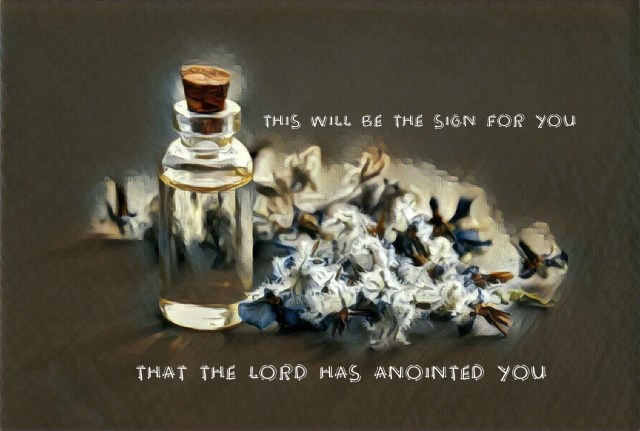
Then, from a flask he had with him, Samuel poured oil on Saul’s head; he also kissed him, saying: “The LORD anoints you commander over his heritage. You are to govern the LORD’s people Israel, and to save them from the grasp of their enemies.
Throughout Scripture, the act of anointing signifies being blessed, commissioned by grace. The sacred oil heals and strengthens the anointed to do the work of God.
We share in the grace of anointing through the sacraments – Baptism, Confirmation and Anointing of the Sick. We may not think about the power these rituals give us to live our lives in the pattern of Christ. But it is an amazing power which creates saints out of ordinary human beings like you and me!
Caritas, The Seven Acts of Mercy, pen and ink drawing by Pieter Bruegel the Elder, 1559. Counter-clockwise from lower right: feed the hungry, give drink to the thirsty, ransom the captive, bury the dead, shelter the stranger, comfort the sick, and clothe the naked
In a less formal way, we can anoint one another by our acts of generosity, honesty, justice and love. Think of the woman who anointed Jesus with nard from her alabaster jar. How that act strengthened him for the suffering he had to face!
There are so many chaffed and sore places in our world awaiting the oil of mercy!
We can also “anoint” our own life by gratefully remembering God’s presence in our lives: the blessings we have received, the challenges we have gracefully met, the love we have both given and received – all that strengthened us to do the work of God over our lifetime.
Picture the scene. It is a beautiful morning in the Judean Valley where the Jordan Riven runs fresh and sparkling. Most scholars place the Baptism of Jesus sometime in January, which means the weather would have been relatively cool. But perhaps, like our own weather, an unusually warm day may have snuck in.
Rustic, fiery preacher John is baptizing in the Jordan River. Crowds have come to hear what he has to say. Some are convinced and dive into the cool water under his hand.
Others rim the hillside, not so sure John isn’t one of the many who have glorious visions but few facts.
Then, out from the pines on the far side of the river, comes Jesus, flanked by some of the Twelve. While his companions chat away to Jesus, his eyes are focused on John. In an instant, Jesus realizes that this is the moment for his revelation. In that same instant, all Creation realizes the same thing.
As Jesus walks slowly toward John, the birds and little animals speak to him, “My Lord and my God…”.Wind whistling through the trees becomes an Oratorio praising him. All the surrounding colors deepen, breaking forth in unimaginable light.
John is stunned by the cosmic change he senses but cannot describe. Heart trembling, he looks into Jesus’s eyes and catches a glimpse of heaven. “I need to be baptized by you”, John says,”and yet you are coming to me?”
Jesus smiles at his cousin, replying,
“Let it be so now; it is proper for us to do this to fulfill all righteousness.”
Then John consented.
Perhaps those in the crowd, schooled in the ancient scriptures, heard Isaiah’s voice in the charged atmosphere:
Here is my servant whom I uphold, my chosen one with whom I am pleased, upon whom I have put my spirit; he shall bring forth justice to the nations, not crying out, not shouting, not making his voice heard in the street. a bruised reed he shall not break, and a smoldering wick he shall not quench, until he establishes justice on the earth; the coastlands will wait for his teaching.
Matthew tells us:
As soon as Jesus was baptized, he went up out of the water.
Can you see him light-heartedly splashing John as he shakes his dark curls free of the chilly water? Can you see his transfigured face as he hears his Father speak Love over him?
At that moment heaven was opened, and he saw the Spirit of God descending like a dove and alighting on him.
And a voice from heaven said, “This is my Son, whom I love; with him I am well pleased.”
What a beautiful moment in time! Don’t we wish we might have been there in the blessed and awe-struck crowd? We can. Let your prayer of imagination take you there.
Today, in Mercy, we celebrate Mary, Mother of Jesus.
I begin my prayer today by asking a question posed by distinguished theologian, Elizabeth Johnson, CSJ:
What would be a theologically sound, spiritually empowering and ethically challenging theology of Mary, mother of Jesus the Christ, for the 21st century? This question has no simple answer, for the first-century Jewish woman Miriam of Nazareth, also held in faith to be Theotokos, the God-bearer, is arguably the most celebrated woman in the Christian tradition. One could almost drown surveying the ways different eras have honored her in painting, sculpture, icons, architecture, music and poetry; venerated her with titles, liturgies, prayers and feasts; and taught about her in spiritual writings, theology and official doctrine.
In my own prayer today, though, I am not reaching for a deeper theological understanding of Mary. I simply want to talk with her as my Mother, my older Sister, my Friend. I want to seek her guidance and her inspiration. I want to thank her for her continual willingness to bear Christ into the world, and into my life.
How significant it is that the Church begins the year inviting us all to Mary’s Light! Our first reading blesses us in a way that Mary might bless us:
The LORD bless you and keep you! The LORD let his face shine upon you, and be gracious to you! The LORD look upon you kindly and give you peace!
Mary was all about giving us the LORD, not giving us herself. We see Mary best when we see her holding Christ toward us – the “God-bearer” or “Theotokos”.
Theotokos Vladimirskaya icon, Vologda, Vladimirskaya Church, mid-end 16 century
This title, used especially in Eastern Christianity, originated in the 3rd century Syriac tradition. It affirms Mary as the Mother of Jesus, Who was both human and divine in nature.
Our reading from Galatians assures us that we too, by our Baptism, are the daughters and sons of God – thus becoming Mary’s own. She is our Mother too by the power of this sacrament.
Our Gospel reveals the spirituality of Mary who “pondered” all the mysterious workings of God deep in her heart. This Mary is my revered sister, guiding me as I meet the unfolding of God in my own life.
Today, let us pray with Mary, our Mother, our Sister, Bearer of God. Let us pray for the whole Church, the whole world – all of whom she tenderly loves.
Music: Two selections today.
A Peaceful Hymn to the Theotokos – Nuns of the Carmazani Monastery in Romania
Today, in. Mercy, we celebrate one of the many feasts honoring Mary, Mother of Jesus.
Today’s feast can be confusing to people. It is sometimes mixed up with the Virgin Birth – the moment when Jesus was born. What we celebrate today, however, is the moment Mary was conceived by her parents, Anna and Joachim.
From a young age, I have had a tender devotion to Mary under the title of the Immaculate Conception. Some of my local readers will be familiar with the Shrine of the Immaculate Conception in the Germantown section of Philadelphia. Established in 1915, the Shrine promotes this devotion through its well-known novena and other means.
My Mom and Dad said that novena every day. Most Monday evenings, Mom and I would walk to our parish church where the community gathered to pray the novena together, celebrate Benediction, and sing the rousing hymn to Mary entitled, “O Mary, Conceived Without Sin”. ( I know some of my old friends are humming the tune right now🤗) When I received my First Communion, I was given my first Miraculous Medal which I treasured.
( A little reminiscence about that coming later today. Hope you enjoy it.)
These remembered devotions were the foundation on which the legacy of faith was planted in our young hearts. But as with any good foundation, a rich garden of understanding has grown from that early soil. Over the intervening years, many graced theologians have helped me grow in understanding of, and relationship with Mary.
One powerful impetus for this growth has come from Elizabeth Johnson, CSJ, a Sister of St. Joseph and Professor Emerita at Fordham University. Her magnificent work Truly Our Sister opens with this sentence:
“ This book proposes that one fruitful approach to the theology of Mary, historically the mother of Jesus, called in faith the Theotokos or God-bearer, is to envision her as a concrete woman of our history who walked with the Spirit.”
Annunciation – Henry Ossawa Tanner
Reading Johnson and others has let me see Mary more fully, allowing Mary to move from an isolated perfectionism to a womanly humanity transformed by the Holy Spirit. Johnson says:
“ I am proposing that one fruitful way to work out a liberating feminist theology of Mary is to locate her in the communion of saints and there to remember her, dangerously and consolingly, as a woman with her own particular history among her contemporaries and before God. At first glance placing Mary in the company of the saints may seem strange to those accustomed to more traditional Catholic practice, even though the title ‘Saint Mary’ adorns many churches, schools, and other institutions. It may even seem a diminishment of the honor that is her due as the Theotokos, or bearer of God. But at root it grants her the greatest honor the Christian tradition acknowledges for a human being, namely, the core dignity of being created in the divine image and likeness and gifted, in community with others, with a graced relationship to the living God.”
Today, as we pray with our many images, devotions and understandings of Mary, may we open our hearts to be inspired by her singular witness to God’s desire to be among us.
Music: The Magnificat – Mary’s radical prayer for justice and mercy, sung here in Latin by the Daughters of Mary (English below)
My soul magnifies the Lord, and my spirit rejoices in God my Savior.
For he has regarded the lowliness of his handmaiden. For behold, from henceforth all generations shall call me blessed. And his mercy is on them that fear him throughout all generations.
He has shown strength with his arm. He has scattered the proud in the imagination of their hearts. He has put down the mighty from their seat s and has exalted the humble and meek.
He has filled the hungry with good things. And the rich he has sent empty away. Remembering his mercy, he has helped his servant Israel as he promised to our forefathers Abraham, and his posterity forever.
Poster of fresco after John Dryden’s poem “A Song for Saint Cecilia’s Day
(Following in a second post will be John Dryden’s A Song for St. Cecilia’s Day, 1687)
Today, in Mercy, we celebrate the feast of St. Cecilia who is the patron of musicians. A Christian martyr of the 2nd century, she is one of seven women in addition to the Blessed Virgin mentioned by name in the Canon of the Mass. Her deep spirituality led to a sacred intimacy with God which gave her the faith and courage to endure martyrdom.
Both readings today speak about the Temple. After the victory of Judas Maccabeus, the Jewish people restore their Temple with exuberant celebration, recognizing it as a symbol of God’s Presence with them.
In today’s Gospel. Jesus also “restores” the Temple by driving out the merchants who have diverted the Temple’s purpose as representative of God’s Presence.
Our bodies too are temples of the Holy Spirit.
Paul, in his letter to the Corinthians tells us:
Do you not know that your bodies are temples of the Holy Spirit, who is in you, whom you have received from God? You are not your own; you were bought at a price.
Through our Baptism into the Passion, Death and Resurrection of Christ, the Holy Spirit dwells in us. We are called to be transformed by this Indwelling. As in any relationship, this transformation is accomplished through transparency, communication, listening and acting on behalf of the Beloved.
Geoffrey Brown, a deeply spiritual poet, offers us this imaginative image of waiting for and welcoming, as Cecilia did, the transformative Presence of God in our lives:
I must remember to go down to the heart cave
And sweep it clean, make it warm, with fire on the hearth
And candles in their niches
The pictures on the walls glowing with quiet lights
I must remember to go down to the heart cave
And make the bed with the quilt from home
Strew rushes on the floor
And hang lavender and sage from the corners
I must remember to go down to the heart cave
And be there when you come.
Music:Marc-Antoine Charpentier – Caecilia Virgo et Martyr
Charpentier’s Histoires Sacrées, or sacred histories, are in reality, dramatic religious scenes taken from the bible or the lives of the saints and set to music.
Cæcilia, virgo et martyr octo vocibus dates from around 1677. This tells the story of St Cecilia, the patron saint of music and musicians, and an early Christian martyr. Cecilia’s husband and brother are executed for converting to Christianity, with Cecilia following shortly afterwards. Perhaps the highpoint of this piece is the final Guay – Nolite flere fideles where firstly the angels claim that Cecilia has been ‘crowned by them’, before the rest of the chorus sing ‘Come, then, let us sing and exult in Cecilia’s victory.’ Quite wonderful in the way it incorporates Cecilia’s position among musicians. (Stuart Sillitoe)