Today, in God’s Lavish Mercy, we finally stand at the edge of the diving board before our plunge into the sublime days of Advent!
Daniel, at the end of a daunting passage, closes with this conviction that foreshadows the Messiah’s reign:
Then the kingship and dominion and majesty of all the kingdoms under the heavens shall be given to the holy people of the Most High, Whose Kingdom shall be everlasting: all dominions shall serve and obey him.
Daniel 7:27
In our Gospel, Jesus uses a tone similar to Daniel to encourage our vigilance:
Jesus said to his disciples: “Beware that your hearts do not become drowsy from carousing and drunkenness and the anxieties of daily life, and that day catch you by surprise like a trap. For that day will assault everyone who lives on the face of the earth. Be vigilant at all times and pray that you have the strength to escape the tribulations that are imminent and to stand before the Son of Man.”
Luke 21:34-36
I take these words as an imperative to engage the days of Advent for what they are supposed to be – a time of thoughtful, prayerful preparation to receive the gift and mystery of Christ in all its splendor.
The Gospel seems to suggest that we might become too tired for such prayer during all our frenetic Christmas preparations, or that we might break out the spiked egg nog a little too early. We are admonished to be alert, sober, and unanxious. We are advised to “Be vigilant” – that is, to light the heart’s candle and to wait patiently for God.
Poetry: Tug and Sigh – May Sarton, from “The Silence Now”
Like the datura’s yellow trumpets
I am waiting for the breath of angels
to perfume the twilight
of this ordinary day
and play the vigil hymn
reminding me
that heaven and earth
wed long ago.

I too am married
to the unseen
sigh and scent,
filling and returning,
thus never full –
always longing,
often failing,
yet ever blessed
with heaven’s pull.
Today, in God’s Lavish Mercy, our Responsorial Psalm from Daniel gives us a beautiful prayer. But, in the first reading, we pray with some pretty dramatic passages from the Book of Daniel. I mean, it’s the stuff of a rather scary special effects movie!
Even Daniel indicates how disturbing his visions are:
Because of this, my spirit was anguished and I, Daniel, was terrified by my visions.
Daniel 7:15
So does the Church, or maybe even God, want us to be disturbed in our prayer today and tomorrow with our last two readings before Advent?
Listen! If you’re not disturbed already by the strain of unholiness in the world, then Daniel isn’t going to rock your boat! But if you, like most good people, have trouble even watching the evening news without anguish, then Daniel is speaking to you.
The writer of Daniel was delivering a message to the people of their time. The visions of chapters 7–12 reflect the crisis which took place in Judea in 167–164 BCE when Antiochus IV Epiphanes, the Greek king of the Seleucid Empire, threatened to destroy traditional Jewish worship in Jerusalem.
The message was:
pay attention to the changing world
focus on God in the disturbing change
choose to be faithful, hopeful, and brave
God will always remain faithful to us and most important of all:
God is coming to deliver us!
As with all Scripture, texts that spoke to an ancient people continue to speak to us. Our world suffers and hopes in the same way Daniel’s did. For us, the elements of today’s passage can serve as pre-Advent encouragements. Trusting them, we are moved to pray with all Creation which is ever steadfast in praising God:
Give glory and eternal praise to him!
“Mountains and hills, bless the Lord;
    praise and exalt him above all forever.”
“Everything growing from the earth
“You springs, bless the Lord;
“Seas and rivers, bless the Lord;
“You dolphins and all water creatures, bless the Lord;
“All you birds of the air, bless the Lord;
“All you beasts, wild and tame, bless the Lord;
    praise and exalt him above all forever.”
R.    Give glory and eternal praise to him!
Poetry: The Second Coming – William Butler Yeats
Turning and turning in the widening gyre The falcon cannot hear the falconer; Things fall apart; the centre cannot hold; Mere anarchy is loosed upon the world, The blood-dimmed tide is loosed, and everywhere The ceremony of innocence is drowned; The best lack all conviction, while the worst Are full of passionate intensity. Surely some revelation is at hand; Surely the Second Coming is at hand. The Second Coming! Hardly are those words out When a vast image out of Spritus Mundi Troubles my sight: somewhere in the sands of the desert.
A shape with lion body and the head of a man, A gaze blank and pitiless as the sun, Is moving its slow thighs, while all about it Reel shadows of the indignant desert birds. The darkness drops again; but now I know That twenty centuries of stony sleep were vexed to nightmare by a rocking cradle, And what rough beast, its hour come round at last, Slouches towards Bethlehem to be born?
Today, in God’s Lavish Mercy, our readings share a common theme of “worthiness“.
In a passage familiar to us from the many funeral Masses we have attended in our lives, the Wisdom writer assures us that God will find us worthy if we are just:
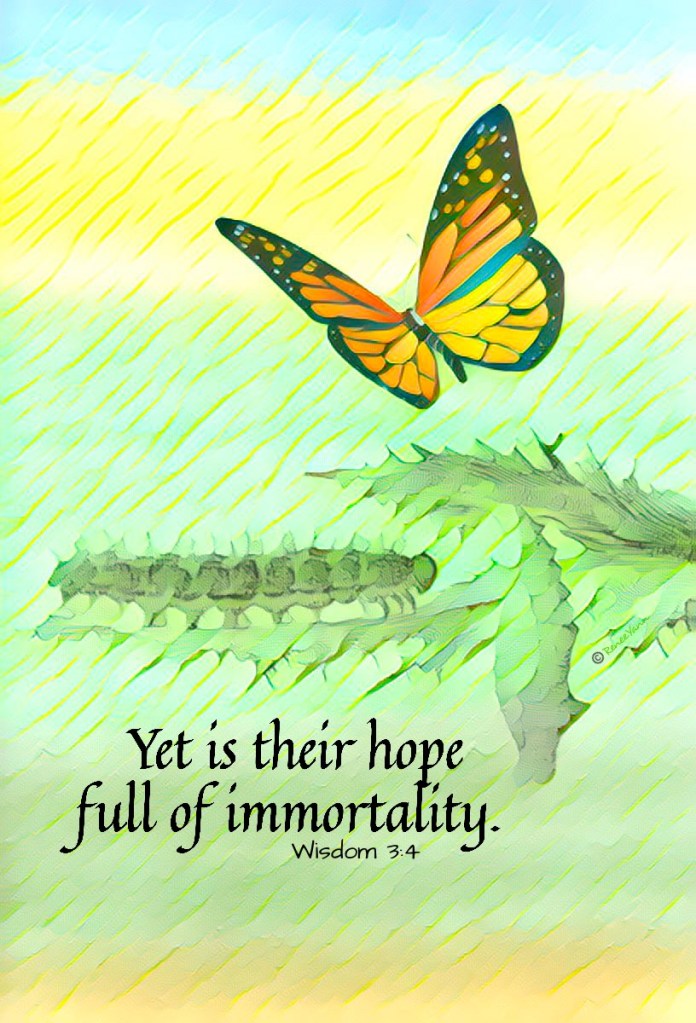
But the souls of the just are in the hand of God, and no torment shall touch them. They seemed, in the view of the foolish, to be dead; and their passing away was thought an affliction and their going forth from us, utter destruction. But they are in peace. For if before observers, indeed, they be punished, yet is their hope full of immortality; Chastised a little, they shall be greatly blessed, because they have been tested and found worthy by God.
Wisdom 3: 1-5
The Wisdom writer seems to be so practical! He imagines life as a test, but one that God assures us we will pass if we live justly.
The word “just” comes from the Latin word meaning law, or right. To be just, in the sense of our first reading, is to be in alignment with the Divine Balance Who created us … to be “in the hand of God”.
But life does test our balance, doesn’t it! And if, by the poor use of our free will, we have climbed or tumbled out of God’s hand, the test can upend us.
Still, Wisdom instructs us that all is never lost. God loves us too much not to pick us up again into the palm of grace and mercy:
Those who trust in God shall understand truth, and the faithful shall abide with God in love: Because grace and mercy are with God’s holy ones, God cares tenderly for us beloved.
Wisdom 3:9
In our Gospel reading from Luke, Jesus gives us some advice about how to keep that graceful balance which aligns us with God. He compares us to devoted servants who, so deep is their gratitude, cannot do enough for the master who loves them:
When you have done all you have been commanded, say, ‘We are unprofitable servants; we have done what we were obliged to do.”
Luke 17:10
Indeed, as grateful creatures, we are obliged to love the God who deigned to create us. But the more we deepen in that love, the less it is an obligation. It becomes a delight, a reciprocal exchange, a sustaining source of the grace and mercy that justifies us.
Poetry: from Ode: Intimations of Immortality from Recollections of Early Childhood – William Wordsworth.
I cite only a section here. If you would like to read it in its beautiful context, click here. This poem is so worth your time!:
                      O joy! that in our embers
                     Is something that doth live,
                      That Nature yet remembers
What was so fugitive!
The thought of our past years in me doth breed
Perpetual benediction: not indeed
For that which is most worthy to be blest;
Delight and liberty, the simple creed
Of Childhood, whether busy or at rest,
With new-fledged hope still fluttering in his breast:—
                      Not for these I raise
                      The song of thanks and praise
                But for those obstinate questionings
                Of sense and outward things,
                Fallings from us, vanishings;
                Blank misgivings of a Creature
Moving about in worlds not realised,
High instincts before which our mortal Nature
Did tremble like a guilty thing surprised:
                      But for those first affections,
                      Those shadowy recollections,
                Which, be they what they may
Are yet the fountain-light of all our day,
Are yet a master-light of all our seeing;
                Uphold us, cherish, and have power to make
Our noisy years seem moments in the being
Of the eternal Silence: truths that wake,
                To perish never;
Which neither listlessness, nor mad endeavour,
                      Nor Man nor Boy,
Nor all that is at enmity with joy,
Can utterly abolish or destroy!
                Hence in a season of calm weather
                      Though inland far we be,
Our Souls have sight of that immortal sea
                      Which brought us hither,
                Can in a moment travel thither,
And see the Children sport upon the shore,
And hear the mighty waters rolling evermore
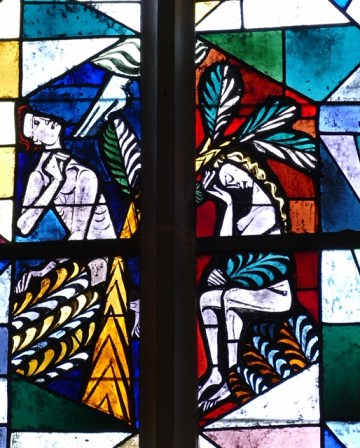
Today, in God’s Lavish Mercy, Paul contrasts the sin of “Adam” with the gift of Jesus, demonstrating the specifics of Christ’s redemptive act.
A key phrase for our prayer might be the following. The concupiscence of human nature will always make the sinful choice a possibility. But we can gain courage and strength from this powerful line from Paul:
Where sin increased, grace overflowed all the more….
Romans 5:15
In our Gospel, Jesus teaches a lesson about perseverance in the spiritual life. He says if we stick with it, God will welcome us the way a generous master thanks and embraces a loyal servant. He adds a comforting thought for those of us of “a certain age”.
And should he come in the second or third watch and find them prepared in this way, blessed are those servants.
Luke 12:38
Speaking personally now, I find that moving into “the second or third watch” can be a little scary. As various physical functions occasionally fail me, and some of my joints are replaced with earth minerals, a line from Yeats’s poem comes to mind – “things fall apart“:
Turning and turning in the widening gyre
The falcon cannot hear the falconer;
Things fall apart; the centre cannot hold;
Mere anarchy is loosed upon the world...
As I look through my reading glasses at the information for my new titanium knee, I remember the young athlete who could drive a basketball down the lane for an explosive layup, often being knocked on her nethers by a powerful opponent. Nevertheless, she would jump up for the next rebound. What happened to that girl?
This Gospel reminds me that she is still inside me, but she is golden now — lifting her spirit, by God’s grace, to deeper challenge.
I am beginning to understand that aging is its own life phase, not just a final comfortable fixity in one’s maturing. Just as every other life phase requires a gradual mastery of its challenges, so does aging. Toddlers must conquer balance and language skills. Teens must gain confidence and self-direction. Young adults work for greater wisdom and meaningful life relationships. Those “post-50” evaluate and may be challenged by the “successes” of their past years. And those in the sometimes not-so-really golden years are still doing all these earlier tasks while meeting the unique challenges of aging. One must be brave!
I hope some of you are Harry Potter fans. The books have powerful little encouragements tucked in their magical dialogue. One of my favorites is this. Harry, encouraging his elderly and fearful teacher to make a courageous choice, says, “Be brave, Professor… Otherwise, the bowl will remain empty… forever.”
The bowl of our life is never filled until it’s filled. Jesus reminds us that none of us knows when that day of fulfillment will come and we must be vigilant for it until it does.
Blessed are those servants whom the master finds vigilant on his arrival. Amen, I say to you, he will gird himself, have them recline at table, and proceed to wait on them.
Luke 12:37
We draw courage for that vigilance not from Harry Potter of course, but from Christ’s own promise to us that there is a special blessing especially for us 2nd or 3rd watchers:
And should he come in the second or third watch and find them prepared in this way, blessed are those servants.
Luke 12:38
I believe that if we prayerfully listen, we will find that this blessing already suggests itself this side of Christ’s final arrival. As Paul indicates in our first reading, when we remain open to graceful relationship with God, we already live in the peaceable kingdom.
… how much more will those who receive the abundance of grace and the gift of justification come to reign in life through the one Jesus Christ…
Romans 5:17
Poetry: Sailing to Byzantium – William Butler Yeats
I
That is no country for old men. The young In one another’s arms, birds in the trees, —Those dying generations—at their song, The salmon-falls, the mackerel-crowded seas, Fish, flesh, or fowl, commend all summer long Whatever is begotten, born, and dies. Caught in that sensual music all neglect Monuments of unageing intellect.
II
An aged man is but a paltry thing, A tattered coat upon a stick, unless Soul clap its hands and sing, and louder sing For every tatter in its mortal dress, Nor is there singing school but studying Monuments of its own magnificence; And therefore I have sailed the seas and come To the holy city of Byzantium.
III
O sages standing in God’s holy fire As in the gold mosaic of a wall, Come from the holy fire, perne in a gyre, And be the singing-masters of my soul. Consume my heart away; sick with desire And fastened to a dying animal It knows not what it is; and gather me Into the artifice of eternity.
IV
Once out of nature I shall never take My bodily form from any natural thing, But such a form as Grecian goldsmiths make Of hammered gold and gold enamelling To keep a drowsy Emperor awake; Or set upon a golden bough to sing To lords and ladies of Byzantium Of what is past, or passing, or to come.
Music: Candlelight – Ottmar Liebert
Liebert is a German classical guitarist, songwriter and producer best known for his Spanish-influenced music. A five-time Grammy Award nominee, he is also an ordained Zen monk.
Today, in God’s Lavish Mercy, we pray with Psalm 25, set perfectly in the midst of a few readings that speak to us about, among other things , “the Father’s Will”.
I think there is no greater spiritual mystery than the meaning of “God’s Will”, (and not wanting to show up Thomas Aquinas, I’ll resist explaining it here. 😂🧐)
But we’ve all heard attempts at explaining it, haven’t we, especially as it relates to suffering— as in:
everything that happens is God’s Will, so we must accept it
God wills our suffering to test us
if God wills that we suffer, He will give us the strength to endure it
I just don’t think so … not the God I love and Who loves me.
But these attempts to explain suffering are understandable because we want to rationalize the things we fear. Most of us, I think, struggle with the problem of evil and suffering in the world. We want to know what to do when, as Rabbi Kushner wrote, “… Bad Things Happen to Good People”.
Our first reading from Ezekiel shows us that even the ancient peoples met this struggle. The prophet seems to suggest that if you’re bad, you’ll suffer. If you repent, you won’t. Well, we all know that’s not quite the reality! But nice try, Ezekiel.
Our psalm gently leads to another way of facing suffering as the psalmist prays for wisdom, compassion and divine guidance. In the Garden of Gethsemane, Jesus himself prayed like this as he confronted his impending suffering.
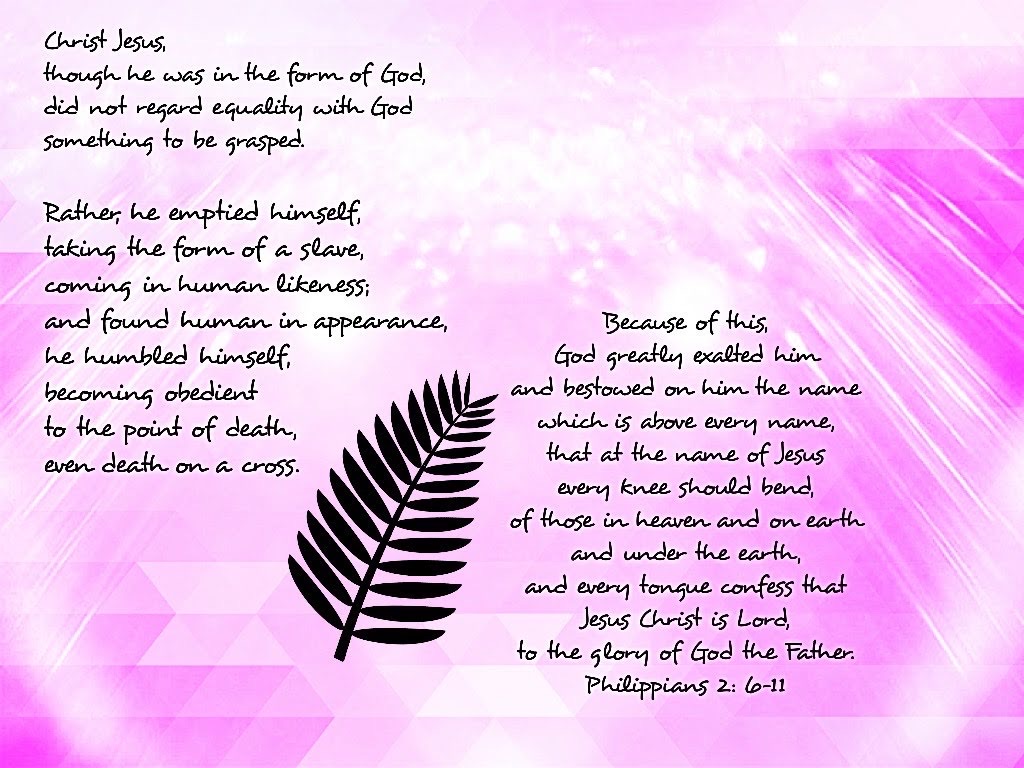
In our second reading, Paul places before us the example of Jesus who, in the face of suffering, was transformed by love:
Praying with these readings, each one of us must come to our own peace with the mystery of suffering. What we can be sure of is this: God’s Will is always for our wholeness and joy as so simply taught to us when we were little children:
God made me to know, love, and serve God, and to be happy with God in this world and forever.
Our Gospel tells us that such happiness comes through faith and loving service, through responding to “the Father’s Will”. May we have the insight, the love, and the courage!
Poetry: Of Being by Denise Levertov
I know this happiness is provisional: the looming presences — great suffering, great fear— withdraw only into peripheral vision: but ineluctable this shimmering of wind in the blue leaves: this flood of stillness widening the lake of sky: this need to dance, this need to kneel: this mystery:
Today, in God’s Lavish Mercy, we have our final reading from 1 Timothy. In the closing words of this letter, Paul pleads with Timothy, and with the community Timothy shepherds, to stay faithful. Paul encourages them to do this even though the Power they believe in is invisible.
… keep the commandment without stain or reproach until the appearance of our Lord Jesus Christ that the blessed and only ruler will make manifest at the proper time, the King of kings and Lord of lords, who alone has immortality, who dwells in unapproachable light, and whom no human being has seen or can see. To him be honor and eternal power. Amen.
1 Timothy 6:14-16
In our Gospel today, Jesus describes the Word of God aa a seed that falls upon the human heart with varying results. It is a parable we are familiar with and we get it. If we don’t have a ready heart, plowed and furrowed with faith and charity, that lonely seed is going to die.
The problem is that even when that seed falls into our very faithful hearts, we don’t always SEE the results. The work of faith is a work with invisible powers. It is a work with hope, with trust, with perseverance, with courage – much like the work in any garden.
I hear really good people, whose lives are beautiful witnesses to faith, still question themselves and their goodness. Because their lives are threaded with challenges and disappointments, they think their lack of faith might be the cause. Because the world at large may appear to be a mess, they wonder if the God they believe in is really there!
Indeed, even though the seed of God’s Word is alive, still it is buried in the realities of our lives. And we wait in sometimes doubtful anticipation for its flowering.
Paul knew that Timothy would encounter these roadblocks just as we all do. That is why his letters to Timothy are a powerful source of encouragement to us all as we strive to live a holy life. As we close these letters today, don’t put them on a shelf forever. I go back to Timothy often just to grab a few verses for light in a shadowy time. I encourage you to do the same.
The final verses of 1 Timothy struck me with a smile as I read them today. They follow just after today’s reading:
O Timothy, guard what has been entrusted to you. Avoid profane babbling and the absurdities of so-called knowledge. By professing it, some people have deviated from the faith.
Poetic Prose: Rainer Maria Rilke
When I think of the Paul’s letters to young Timothy, I am reminded of Rilke’s Letters to a Young Poet. Here is a favorite passage:
You are so young; you stand before beginnings…
have patience with everything that
remains unsolved in your heart.
Try to love the questions themselves,
like locked rooms and like
books written in a foreign language.
Do not now look for the answers.
They cannot now be given to you
because you could not live them.
It is a question of experiencing everything.
At present you need to live the question.
Perhaps you will gradually,
without even noticing it,
find yourself experiencing the answer,
 some distant day.
Today, in God’s Lavish Mercy, Moses recounts for the people God’s immense generosity toward them.
Have you ever heard yourself, or someone dear to you, saying, “God has been so good to me!” Such a statement rises out of our awe at God’s love and mercy to us.
The deeper our faith, the clearer our insight into these gifts. I have heard people in the sparest of circumstances utter such a prayer. How can they do that, we might ask?
In all cases, there is a beautiful humility, trust, and generosity emanating from their spirits. Gratitude has transformed them. Hope, not wishing, has freed them.
Moses wants his People to be like that. He says:
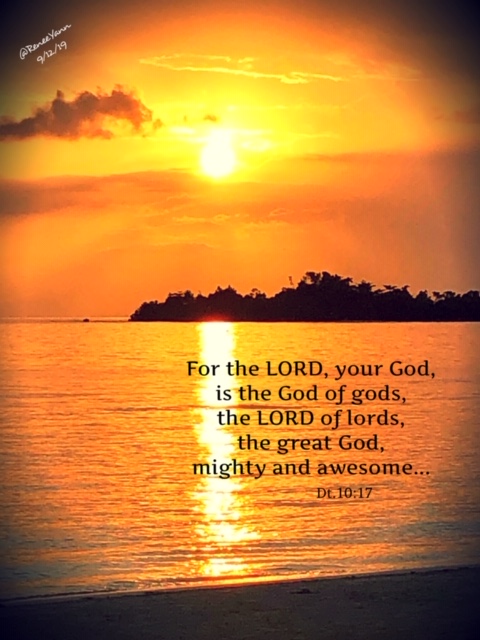
Think! The heavens, even the highest heavens, belong to the LORD, your God, as well as the earth and everything on it. Yet in his love for your fathers the LORD was so attached to them as to choose you, their descendants …
This is your glory, he, your God, who has done for you those great and awesome things which your own eyes have seen.
I want to be that kind of grateful, faith-filled person too. Don’t you?
Today’s profound advice from Moses can help us as we pray its words into our own lives.
Poetry: Praying the whole of today’s Responsorial Psalm 147 can also help us recognize our blessings. I love this transliteration by Christine Robinson.
Psalm 147 - Mother of All Creation
It is good to sing praises to you,
Mother of all creation.
And to recognize the touch of your love.
You bring us home, help us heal,
You love your creation
You call every one of your stars by name.
You bless the young, the poor, the ill
You wait forever for the lost to turn to you.
Your love is music to our hearts, and we sing.
You are in the clouds that darken the sky
You send the rain which gives us life.
The cycles of the seasons and the growth of the plants
are your delight.
You provide food for the wild animals
even the young ravens when they cry.
You love the horse’s proud strength
and the athlete’s prowess.
You crave our love and attention.
And so we pray.
We give thanks for life, for children, for the beauty of the snow
that lies soft in the morning.
We give thanks for the storm,
the hail, scattered like popcorn on the grass.
We are in awe of your power.
When the seasons turn, the growing warmth
reminds us of your warmth
The flowing waters remind us
of the life which comes from you.
Thank you, Mother of us all, help us
to keep your love in our hearts and to love your creation.
Music: Your Grace Still Amazes Me – Philips, Craig and Dean
Today, in God’s Lavish Mercy, both our readings express the character of farewells or life testaments.
In our first reading, we close out our few weeks’ journey through Genesis with Jacob’s instructions to his posterity. These directives attach his passing and their future to Israel’s ancestral roots:
Jacob gave his sons this charge: “Since I am about to be taken to my people, bury me with my fathers in the cave that lies in the field of Ephron the Hittite, the cave in the field of Machpelah, facing on Mamre, in the land of Canaan, the field that Abraham bought from Ephron the Hittite for a burial ground.
Genesis 49:29-30
Reading these verses, I remembered two sets of similar instructions that I had once received.
The first set was given to me and my brother.
Our beloved mother had just died after a few months’ illness. We were about the business of preparing for her burial. Our family storage systems were very simple but definite. Confident that no thief would want to do any tailoring while burglarizing the house, we kept important documents in an old tin sewing box. Jim and I knew the cemetery deed would be there, top shelf of the living room closet, under a couple of afghans.
What we didn’t know was that Mom, never much for sad or purple prose, had left us a letter in that box. The letter, penned in a strong hand, anticipated her death and counseled us for a future without her. Surprisingly, her letter had been written long before her terminal diagnosis, prompted no doubt by my Dad’s sudden death about a decade before.
Mom was brief but direct in her hopes and instructions, the core of which was this:
Know that I loved the two of you more than anything in the world. Love and care for each other when I am gone.
The second set of instructions was not the fruit of a bloodline inheritance, but of a spiritual one: my call to Mercy. My dear sponsor, realizing at my Silver Jubilee that the years were passing for us both, offered this wisdom so typical of her direct and good-natured style:
In our Gospel, Jesus anticipates a time when his disciples will be without his guiding presence. Like Jacob, and like my Mom and my sponsor, Jesus wants his beloved descendants to recognize, and find courage in, the amazing love which is their inheritance.
Are not two sparrows sold for a small coin? Yet not one of them falls to the ground without your Father’s knowledge. Even all the hairs of your head are counted. So do not be afraid; you are worth more than many sparrows. Everyone who acknowledges me before others I will acknowledge before my heavenly Father.
Matthew 10:29-32
As we pray with today’s scriptures, we might give thanks for the blessings we have received from our ancestors, be they of blood or spirit.
Further, we might prayerfully consider those who need and deserve our blessing as they assume the future we will not see — our children, nieces, nephews, sisters and brothers in religious formation — any number of disciples and pupils who look to us for hopeful and grateful witness.
Poetry: My Legacy – Lucy Maude Montgomery Lucy Maud Montgomery OBE (1874 – 1942), was a Canadian author best known for a collection of novels, essays, short stories, and poetry beginning in 1908 with Anne of Green Gables.
My friend has gone away from me
From shadow into perfect light,
But leaving a sweet legacy.
My heart shall hold it long in fee A grand ideal, calm and bright, A song of hope for ministry,
A faith of unstained purity, A thought of beauty for delight These did my friend bequeath to me;
And, more than even these can be,
The worthy pattern of a white,
Unmarred life lived most graciously.
Dear comrade, loyal thanks to thee
Who now hath fared beyond my sight,
My friend has gone away from me,
But leaving a sweet legacy.
Memorial of Saint Irenaeus, Bishop and Martyr Wednesday of the Twelfth Week in Ordinary Time June 28, 2023
Today, in God’s Lavish Mercy, both our readings speak to the call to bear holy fruit for God.
In the passage from Genesis, we are witnesses to a delightful conversation between Abraham and the Lord. The homey tone and mutuality of their exchange reveals Abraham’s great comfort in God’s Presence – to the point of his feeling free to give God some advice:
The Lord said, “Fear not, Abram! I am your shield; I will make your reward very great.”
But Abram said, “O Lord GOD, what good will your gifts be, if I keep on being childless and have as my heir the steward of my house, Eliezer?” Abram continued, “See, you have given me no offspring, and so one of my servants will be my heir.”
Genesis 15:1-3
Like many of us, what Abraham doesn’t realize is that God already has him covered. God has a desire and plan for Abraham’s fruitfulness – a dream far beyond any that Abraham can himself conceive.
God took him outside and said: “Look up at the sky and count the stars, if you can. Just so,” he added, “shall your descendants be.” Abram put his faith in the LORD, who credited it to him as an act of righteousness.
Genesis 15:5-6
The “act of righteousness” described here in Genesis is an offering God asks of each of us in our lives: confident faith expressed in loving action.
Think about it. Abraham and Sarah have waited and waited (for five chapters now) for God’s promise of fruitfulness to transform their barren lives. It hasn’t happened yet! Abraham asks God, “What’s going on????”
Brueggemann says:
The large question (posed in this chapter) is that the promise does delay, even to the point of doubt. It is part of the destiny of our common faith that those who believe the promise and hope against barrenness nevertheless must live with the barrenness.
… the promise does delay, even to the point of doubt
Oh, my dears, have we not all been there? Have we not all, at some time or another, anguished over the questions of our own fruitfulness, destiny, meaning, survival, relevance in this life? Have we not sometimes wondered if God is even there?
But God is, and will arise out of any barreness or darkness if we can be faithful. God says to us, as to Abraham, “Take it easy, Abe. I gotcha’. Trust me and believe. The “fire pot” and the “flaming torch” are coming. Keep your heart ready!”
When the sun had set and it was dark, there appeared a smoking fire pot and a flaming torch, which passed between those pieces. It was on that occasion that the LORD made a covenant with Abram, saying: “To your descendants I give this land, from the Wadi of Egypt to the Great River the Euphrates.”
Genesis 15:17-18
Poetry: The Night Abraham Called to the Stars – Robert Bly
Do you remember the night Abraham first saw
The stars? He cried to Saturn: "You are my Lord!"
How happy he was! When he saw the Dawn Star,

He cried, "You are my Lord!'
How destroyed he was
When he watched them set.

Friends, he is like us:
We take as our Lord the stars that go down.
We are faithful companions to the unfaithful stars.

We are diggers, like badgers; we love to feel
The dirt flying out from behind our back claws.
And no one can convince us that mud is not

Beautiful. It is our badger soul that thinks so.
We are ready to spend the rest of our life
Walking with muddy shoes in the wet fields.

We resemble exiles in the kingdom of the serpent.
We stand in the onion fields looking up at the night.
My heart is a calm potato by day, and a weeping

Abandoned woman by night.
Friend, tell me what to do,
Since I am a man in love with the setting stars.
Today, in God’s Lavish Mercy, you might be reminded of your younger days when you read our passage from Tobit.
Tobiah’s mom is worried about his long absence. He was sent off on an errand to retrieve his Dad’s money, but he’s been busy getting married and catching magic fish. So he probably hasn’t taken the time to “call home”.
Meanwhile, Anna has sat watching the road by which her son was to return. When she saw him coming, she called to his father, “Look, your son is coming, and the man who traveled with him!”
Tobit 11:5-6
Dante Gabriel Rossetti Tobias in the House of His Father and Mother
Did your parents ever keep a vigil like this for you? Maybe after a date that went too long? Or an assigned journey to which you added a few stops of your own? Wouldn’t Mom and Dad have been glad to see you coming home, like Tobiah, with a guardian angel by your side – instead of, maybe, the school principal or a police officer! 😉
We keep vigil in the restless expectation of good things. Even though vigils occur in the darkness before the dawn, they are fired by hope and trust in God.
Many years ago, my then young brother spent several months in Thailand for his job. My mother and I missed him so much! When we received word that he was coming home for Christmas, the long vigil for his arrival began. It included cleaning, cooking, and planning the holiday calendar that would celebrate his return. (You would have thought Julius Caesar was returning from the conquest of Gaul!)
Waiting…
But Jimmy didn’t arrive on the day he was expected. What did arrive was a big nor’easter snow storm that clogged the roads he would be traveling!
Mom and I took turns peeking out the front window at ten minute intervals, but no matter how often we peeked, Jim still didn’t appear. Finally, bleary-eyed past midnight, we both surrendered to a strained sleep.
Awakening before dawn the next morning, I prayed to see my brother sleeping on the couch. But my hope was not met. Nervous now, I opened the front door to retrieve the nearly frozen milk containers resting in the snow outside.
And there he was – asleep behind the wheel of a rental car parked under the amber street light. He hadn’t wanted to wake us since the snow had delayed his arrival until long after midnight.
Our entire life is a vigil for the expected coming of God Who arrives in every moment. Imagine God, like my kind and freezing brother, wanting us to wake up gently on our own to the Divine Presence right outside the door of our consciousness. Imagine ourselves opening that door in surprised delight and welcoming God into our warm relief.
Poetry: The Heart Cave – Geoffrey Brown (My long time readers will recognize this beautiful poem as one of my often repeated favorites.)
I must remember to go down to the heart cave And sweep it clean, make it warm, with fire on the hearth And candles in their niches The pictures on the walls glowing with quiet lights.
I must remember to go down to the heart cave And make the bed with the quilt from home Strew rushes on the floor And hang lavender and sage from the corners.
I must remember to go down to the heart cave And be there when you come.












 Lavish Mercy