The Last Day of April

April 30, 2023

On this last day of the month, let me start with a caveat:  I love April.  It is the month of my birth and the birth of several people I love.  April often gives us our first glimpse of spring and our first sounds of Alleluia. 

But April is also full of contradictions: teasing sun and drenching rain; “shorts” weather one day, mufflers the next; a large measure of Easters, but a heavy dose of Good Fridays.

In other words, April – like its cousin October – is most perfectly reflective of our rollercoaster lives. And that reflection mirrors, not exactly a sadness, but a certain purple wistfulness inherent in all of life. Catherine McAuley described it this way: 

This mingling is something we balance within ourselves every day of our lives, but maybe especially in April, as the great poet T.S. Eliot notes:

April is the cruellest month, breeding
Lilacs out of the dead land, mixing
Memory and desire, stirring
Dull roots with spring rain.
Winter kept us warm, covering
Earth in forgetful snow, feeding
A little life with dried tubers.

So what do we do with April’s “cruelty” which might be defined as that tinge of melancholy lurking even in the greatest joy? 

Rather than push it down or turn away from it (which I think most of us try to), there is a gift in prayerfully breaking open that languor, like an egg shell holding life’s fragile and surprising transformation. 

For example, we might place before God in prayer these “cruelties” which carry both joys and sorrows:

  • Change which, in any form, requires a shifting from the comforts that have secured us
  • Loss that comes in the shape of missed opportunities, lapsed friendships, harbored unforgiveness, wrong choices and a hundred other “wish I could do over”s
  • Aging which, though a blessing when considering the alternative, brings a slow reckoning with our vulnerabilities
  • Bereavement, that terrible forest of loving memories and winding sadness where we feel lost as we long for healing

The poet Phillis Levin captures the power of such reflection in her beautiful poem. It’s a sad poem, but articulating it gave the poet an emotional release that carried healing :

Under a cherry tree
I found a robin’s egg,
broken, but not shattered.
I had been thinking of you,
and was kneeling in the grass
among fallen blossoms
when I saw it: a blue scrap,
a delicate toy, as light
as confetti
It didn’t seem real,
but nature will do such things
from time to time.
I looked inside:
it was glistening, hollow,
a perfect shell
except for the missing crown,
which made it possible
to look inside.
What had been there
is gone now
and lives in my heart
where, periodically,
it opens up its wings,
tearing me apart.

As we move into the bright light of May then summer, it’s important not to neglect that shadowed strain running through and binding all human experience. When we, like Catherine McAuley, find it rising to the surface of our lives, we too must reflectively pray it into God’s heart so that we can find its healing power and peace.


Music: The Last Day of April – Ann Sweeten

The Other Side of Light

April 1, 2023

Dear Friends,

It feels appropriate that, before we resume gathering together in Lavish Mercy tomorrow, I comment a bit on my time away from the blog.

First, I sincerely thank you all for your prayers and encouragement. In a shadowy time, you gave me the generous lights of comfort and joy. I am deeply grateful.

Now, as I continue to heal from a time of unexpected vulnerability, I have the advantage of being able to reflect in peace on what has happened to me. 

Part of that peace and healing has been a move to our Motherhouse, a loving community where I have the support and care I need right now. I am blessed beyond words by this gift.


This photo was taken in the early 1900s for the Merion Historical Society


My new room is on the very western end of the building (See blue arrow above.) However, I look out my ample windows not to a sunset horizon – but instead to the imposing wall of our magnificent chapel. Some were concerned that the “wall view” might not be optimal. They didn’t realize that the wall housed an unexpected gift – a bird’s eye view of the glorious rose window that, for over a century, has blessed our chapel with dawn Light.

And I am now on the other side of that Light as it flows over my beloved community – a place that feels ever closer to God with each sunrise.


Sometimes, especially in the evening, I will catch a lovely glow within chapel on one of the several stained glass windows. I consider these my own special sunsets given only to me for my unique reflection. These windows are icons for me as I pray and learn from my own little “passover experience” this winter. 

Evening Window from the Outside!

During times of suffering, loss, or unchosen change in our lives, it is hard to turn to the Light. As we begin our Holy Week walk, consider that Jesus faced this struggle in the shadows of Gethsemane. There, he taught us what it takes not only to turn toward Light, but to become It.

Then going out he went, as was his custom, to the Mount of Olives, and the disciples followed him. 

When he arrived at the place he said to them, “Pray that you may not undergo the test.”

After withdrawing about a stone’s throw from them and kneeling, he prayed, saying, “Father, if you are willing, take this cup away from me; still, not my will but yours be done.”

And to strengthen him an angel from heaven appeared to him.

Matthew 22: 40-43

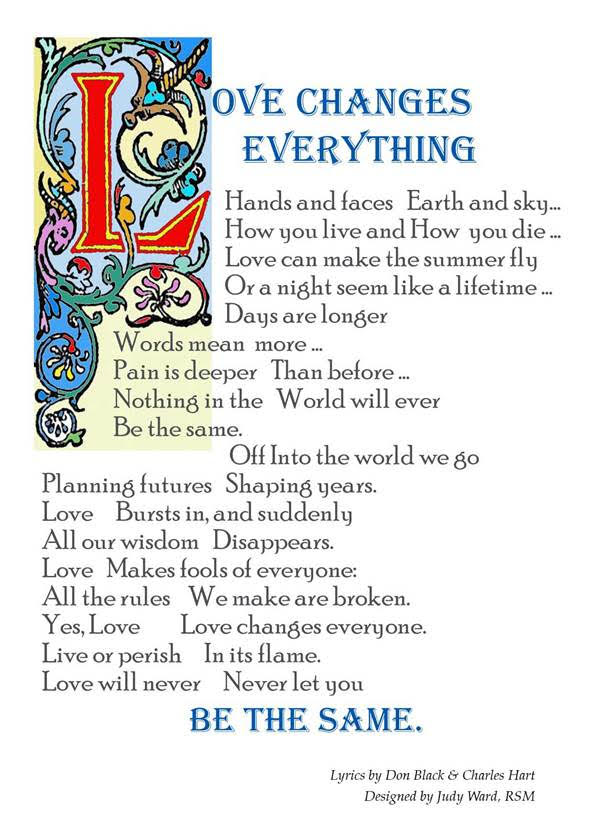
As it was with Jesus, a “Gethsemane moment” in any of our lives is an invitation to abandon ourselves in trust to God’s inscrutable Love — a falling helplessly, but hopefully, into a Love that changes everything.

For Jesus, his embrace of God’s Will in that tenebrous garden opened his heart to the glory of the Resurrection and led him to the other side of Light. How might such self-giving open and lead us?


Love Changes Everything – Andrew Lloyd Webber, Don Black, and Charles Hart

Springing Across the Mountains

Wednesday of the Fourth Week of Advent
December 21, 2022

Today’s Readings:

https://wordpress.com/post/lavishmercy.com/21853

Today, in God’s Lavish Mercy, as the anticipation of Christmas builds to a crescendo, we have the tender and sublime images of the Song of Songs.

Hark! my lover–here he comes
springing across the mountains,
leaping across the hills.
My lover is like a gazelle
or a young stag.
Here he stands behind our wall,
gazing through the windows,
peering through the lattices.

Song of Songs 2:8-9

This book of the Bible is unique in that “it shows no interest in Law or Covenant or the God of Israel, nor does it teach or explore wisdom like Proverbs or Ecclesiastes. Jewish tradition reads it as an allegory of the relationship between God and Israel; Christianity, as an allegory of Christ and his bride, the Church.” (Wikipedia)

Like all enduring poetry, the Song of Songs invites us to match its images with our own understanding of God. Of course, God is more than any image we can humanly create, but our relationship with God has the characteristics of a human relationship because WE are human.

As we read this passage, we might pray with thoughts like these:

  • God loves me – and all Creation – passionately.
  • God wants and waits for me to notice the loving Divine Presence in my life
  • God’s love is energetic and attentive. God is at the center and edge of all my existence.

Added to all that, God wants us to live in the world as people who already see the Spring of Eternal Life. Living with that kind of faith and hope allows us not only to find God, but to reflect God’s Presence to all around us.

For see, the winter is past,
the rains are over and gone.
The flowers appear on the earth,
the time of pruning the vines has come,
and the song of the dove is heard in our land.
The fig tree puts forth its figs,
and the vines, in bloom, give forth fragrance.
Arise, my beloved, my beautiful one,
and come!

Songs of Songs 8: 11-13

On this day of Winter Solstice, when – depending on our hemisphere – we are ultimately close or far from our Sunstar, this particular passage is so comforting. In our everyday life we will still experience a rollercoaster of seasons – sadness and joy and everything in between. But beyond all the seasons, the Verdant Eastertide has already redeemed our lives. With deep faith and hope, we can always live with the Spring’s abundance.


The Visitation by Raphael

In our Gospel, we are given a beautiful picture of Mary and Elizabeth, with in-vitro Jesus and John – dancing in the graces of this holy Springtime. Join them as we sing of O Antiphon for today:

R. Alleluia, alleluia.
O Emmanuel, our King and Giver of Law:
come to save us, Lord our God!
R. Alleluia, alleluia.


Poetry: May is Mary’s Month – Gerard Manley Hopkins

May is Mary’s month, and I
Muse at that and wonder why:
    Her feasts follow reason,
    Dated due to season—
 
Candlemas, Lady Day;
But the Lady Month, May,
    Why fasten that upon her,
    With a feasting in her honour?
 
Is it only its being brighter	
Than the most are must delight her?
    Is it opportunest
    And flowers finds soonest?	

Ask of her, the mighty mother:
Her reply puts this other
    Question: What is Spring?—
    Growth in every thing—
 
Flesh and fleece, fur and feather,
Grass and greenworld all together;
    Star-eyed strawberry-breasted
    Throstle above her nested
 
Cluster of bugle* blue eggs thin
Forms and warms the life within;
    And bird and blossom swell
    In sod or sheath or shell.
 
All things rising, all things sizing
Mary sees, sympathising
    With that world of good,
    Nature’s motherhood.
 
Their magnifying of each its kind
With delight calls to mind
    How she did in her stored
    Magnify the Lord.

Well but there was more than this:
Spring’s universal bliss
    Much, had much to say
    To offering Mary May.
 
When drop-of-blood-and-foam-dapple
Bloom lights the orchard-apple
    And thicket and thorp† are merry
    With silver-surfèd cherry
 
And azuring-over greybell makes
Wood banks and brakes‡ wash wet like lakes
    And magic cuckoocall
    Caps, clears, and clinches all—
 
This ecstasy all through mothering earth
Tells Mary her mirth till Christ’s birth
    To remember and exultation
    In God who was her salvation.

Music: Spring – Antonio Vivaldi

Journey into Wisdom

Saturday of the Third Week of Advent
December 17, 2022

Today’s Readings:

https://bible.usccb.org/bible/readings/121722.cfm

Today, in God’s Lavish Mercy, we begin the recitation of the O Antiphons.

No doubt many of you, like me, love these beautiful verses for any number of reasons:

  • First off, they alert us that we are very close to the astounding miracle of Christmas!
  • They capture, in a very simple way, the riches of the Hebrew Scriptures which foretold and longed for the Messiah.
  • The dramatic “O” introducing each one conveys the depth of our own longing and “O”penness to God’s grace.

The O Antiphons are Magnificat antiphonies used at Vespers of the last seven days of Advent. They are also used as the Alleluia Verse during the daily Mass.

Each antiphon is a name of Christ, one of his attributes mentioned in Scripture. They are:

  • 17 December: O Sapientia (Wisdom)
  • 18 December: O Adonai (Lord)
  • 19 December: O Radix Jesse (Root of Jesse)
  • 20 December: O Clavis David (O Key of David)
  • 21 December: O Oriens (O Dayspring)
  • 22 December: O Rex Gentium (O King of the Nations)
  • 23 December: O Emmanuel (With Us is God)

(information above from Wikipedia)


We begin today with a heartfelt plea to God to fill our world with a Wisdom that orders all things and teaches us prudence.

O, how our world needs this prayer to be answered.  How we need to return to a Wisdom rooted in truth, justice and mutual love!

Let us pray this prayer together today, dear friends, by opening our hearts like the wide space of an “O”. Let our hearts be ready to receive, on behalf of the world, the transforming gift of Jesus – given on Christmas, and on every day of our lives.

O Wisdom of our God Most High,
guiding creation with power and love:
come to teach us the path of knowledge!
R. Alleluia, alleluia.


Poetry: Journey into Wisdom – Renee Yann, RSM


Music: Michael G. Hegeman, 1997 Performed by: The Lauda! Chamber Singers

A Perfect Heart

Friday of the Third Week in Advent
December 16, 2022

Today’s Readings:

https://bible.usccb.org/bible/readings/121622.cfm

Today, in God’s Lavish Mercy, we stand at the edge of the final deep dive into Christmas.

Tomorrow, we will begin the magnificent O Antiphons with their rich and repeated invitation for God, not only to enter, but to take up residence our lives. We hear the hint of those invitations in today’s Responsorial Psalm:

Alleluia, alleluia.
Come, Lord, bring us your peace
that we may rejoice before you
with a perfect heart.


It’s a perfect prayer for these last few days before Christmas, because so many of us get caught up in a contradictory kind of frenzy of shopping, gifts, parties, decorating, cooking, wrapping, buying…. and on, and on, and on.

The hyperactivity doesn’t leave a lot of space for peace and the perfection of our hearts to welcome the Savior.


This lovely poem by Geoffrey Brown has always helped focus me on the peace-making of my heart so that I could welcome Grace as it comes to me.


The Heart Cave

I must remember
To go down to the heart cave
& sweep it clean; make it warm
with a fire on the hearth,
& candles in their niches,
the pictures on the walls
       glowing with a quiet light.
       I must remember
To go down to the heart cave
       & make the bed
with the quilt from home,
strew
the rushes on the floor
hang
lavender and sage
         from the corners.
         I must go down
        To the heart cave & be there
         when You come.

Isaiah, with a powerful “how-to”, reminds us that we are all called to this spiritual readying:

Thus says the LORD:
Observe what is right, do what is just,
for my salvation is about to come,
my justice, about to be revealed.
Happy is the one who does this,
whoever holds fast to it:
Keeping the sabbath without profaning it,
keeping one’s hand from doing any evil


As a last reminder before our journey through the O Antiphons, Isaiah coaches us in inclusivity – assuring us that all people are welcome in the arms of the One Who is to come:

Let not the foreigners say,
when they would join themselves to the LORD,
“The LORD will surely exclude me from the people.”
The foreigners who join themselves to the LORD,
ministering to and
Loving the name of the LORD,
and becoming God’s servants–
All who keep the sabbath free from profanation
and hold to my covenant,
Them I will bring to my holy mountain
and make joyful in my house of prayer …


Music: Rorate Caeli – sung by Harpa Dei

“Rorate caeli” (Drop down, ye heavens) are the opening words of Isaiah 45:8. The text is frequently sung to plainsong at Mass and in the Divine Office during Advent where it gives expression to the longings of Patriarchs and Prophets, and symbolically of the Church, for the coming of the Messiah.

Gaudete, Rejoice!

Third Sunday of Advent
December 11, 2022

Today’s Readings:

https://bible.usccb.org/bible/readings/121122.cfm

Today, in God’s Lavish Mercy, Isaiah gives us the best news anyone could ever want to hear:

Here is your God…
Who comes to save you!

The news inspires great joy in the waiting heart. Our first reading is full of exultant words pulling us from the shadows of waiting into the hope-filled Light.

What Isaiah proclaims for all generations is that we never need remain in darkness and confusion; that the Lord of Light wills a sunrise for us; that something wondrous and holy is not only possible but inevitable if we but have faith.

This is a powerful revelation and call. If we receive and accept it with open hearts, we are bound to live in joy.


In our second reading, James tells us the secret to living with this kind of joy – PATIENCE.

Be patient, brothers and sisters,
until the coming of the Lord.
See how the farmer waits for the precious fruit of the earth, 
being patient with it
until it receives the early and the late rains.
You too must be patient.
Make your hearts firm,
because the coming of the Lord is at hand.

James 5: 7-8

We too must welcome into our lives both “the early and the late rain”. We must not only believe; we must ponder our faith within the circumstances of our life and the world around us. This pondering deepens us and allows the power of God to visit the world through our lives.


In our Gospel, Jesus explains what the world looks like when we let the Mercy of God shine through us:

“Go and tell John what you hear and see: 
the blind regain their sight, 
the lame walk,
lepers are cleansed, 
the deaf hear,
the dead are raised,
and the poor have the good news proclaimed to them.
And blessed is the one who takes no offense at me.”

Matthew 11: 4-6

On this beautiful Gaudete Sunday,
as we come closer to the Gift of Christmas,
let us choose to be agents of God’s joy,
love and mercy in our world.

Poetry: Gaudete – Brad Reynolds, SJ

Because Christmas is almost here
Because dancing fits so well with music
Because inside baby clothes are miracles.
Gaudete
Because some people love you
Because of chocolate
Because pain does not last forever
Because Santa Claus is coming.
Gaudete
Because of laughter
Because there really are angels
Because your fingers fit your hands
Because forgiveness is yours for the asking
Because of children
Because of parents.
Gaudete
Because the blind see.
And the lame walk.
Gaudete
Because lepers are clean
And the deaf hear.
Gaudete
Because the dead will live again
And there is good news for the poor.
Gaudete
Because of Christmas
Because of Jesus
You rejoice.

Music: The Medieval Carol “Gaudete” sung by the Choir of Clare College with the London Cello Orchestra (lyrics and translation below)

Rejoice, rejoice Christ is born 
Gaudete, gaudete Christos est natus 

From the virgin Mary, rejoice. 
Ex Maria virginae, gaudete. 

Rejoice, rejoice Christ is born 
Gaudete, gaudete Christos est natus 

From the virgin Mary, rejoice. 
Ex Maria virginae, gaudete. 

It is time to thank you for what we have hoped for. 
Tempus ad est gratiae hoc quod optabamus, 

We devoutly sing songs of joy. 
Carmina laetitiae devote redamus. 

Rejoice, rejoice Christ is born 
Gaudete, gaudete Christos est natus 

From the virgin Mary, rejoice. 
Ex Maria virginae, gaudete. 

Rejoice, rejoice Christ is born 
Gaudete, gaudete Christos est natus 

From the virgin Mary, rejoice.
Ex Maria virginae, gaudete.

God became man, being nature, 
Deus homo factus est naturam erante, 

The world has been renewed by the reigning Christ. 
Mundus renovatus est a Christo regnante. 

Rejoice, rejoice Christ is born 
Gaudete, gaudete Christos est natus 

From the virgin Mary, rejoice. 
Ex Maria virginae, gaudete. 

Rejoice, rejoice Christ is born 
Gaudete, gaudete Christos est natus 

From the virgin Mary, rejoice. 
Ex Maria virginae, gaudete. 

Ezekiel’s gate was closed by the passerby 
Ezecheelis porta clausa per transitor 

Whence the light arose, the finder of pebbles. 
Unde lux est orta sallus invenitor. 

Rejoice, rejoice Christ is born 
Gaudete, gaudete Christos est natus 

From the virgin Mary, rejoice.
Ex Maria virginae, gaudete.

Rejoice, rejoice Christ is born 
Gaudete, gaudete Christos est natus 

From the virgin Mary, rejoice. 
Ex Maria virginae, gaudete. 

Therefore, our congregation sings already in the twilight, 
Ergo nostra contio psallat jam in lustro, 

Bless the lord of the saddles for our king. 
Benedicat domino sallas regi nostro. 

Rejoice, rejoice Christ is born 
Gaudete, gaudete Christos est natus 

From the virgin Mary, rejoice. 
Ex Maria virginae, gaudete. 

Rejoice, rejoice Christ is born 
Gaudete, gaudete Christos est natus 

From the virgin Mary, rejoice.
Ex Maria virginae, gaudete.

Undimmable Light

Friday of the Second Week of Advent
December 9, 2022

Today’s Readings:

https://bible.usccb.org/bible/readings/120922.cfm

(Today, I am re-publishing an earlier blog. I used it for my own prayer this morning and I thought it really deserved another read. I hope you agree.)

Today, in God’s Lavish Mercy, we pray with Psalm 1 and its confident responsorial verse.

Last night we watched a public television Christmas special, “Rick Steves’s European Christmas“. From its many beautiful scenes, one in particular remained with me: a little group of friends tobogganing down a snow covered hill at night. Their only lights came from the small lanterns they held and the full moon’s generous luster against the white snow.

My first reaction to the scene was to wonder, “What if their light goes out?”. Then I realized that there was a light beyond them which would guide their way.


There are times in our lives when the light, if it doesn’t go out, at least flickers. I wrote about that awareness in this story a few years ago: 

She had arranged to visit with an old college friend. They had been separated too long by the distancing choices that life often demands. She wanted to reconnect to that rare experience of shared transparency found just once or twice in a lifetime – the gift of a real friend.

They sat on a porch overlooking a gentle pond. The day was bright, the coffee hot, the chairs comfortable. But the magic was gone.  Only half her friend had arrived for the cherished conversation. The other half – joy, adventure and the excess of youthful hope – had been lost. Somewhere in the intervening years, the light had gone out. Her friend had suffered a wound she did not share. This one afternoon would be too short a time to give that wound a name.

During our Advent journey, God is waiting in the seeming darkness to guide us. God already knows the wounds we carry. God sees where our heart’s light has dimmed. Holding our half-heartedness next to the Divine Heart, God yearns to rekindle us.


Today’s psalm reminds us that there is a always Light waiting beyond us to guide our way.

Blessed the one follows not
the counsel of darkness
nor walks in it ways,
nor remains in the company of the insolent,
But delights in the law of the LORD
and meditates on its Light day and night.

Psalm 1:1-2

Poetry: from Mary Oliver

When I am among the trees,
especially the willows and the honey locust,
equally the beech, the oaks and the pines,
they give off such hints of gladness.

I would almost say that they save me, and daily.
I am so distant from the hope of myself,
in which I have goodness, and discernment,
and never hurry through the world
but walk slowly, and bow often.

Around me the trees stir in their leaves
and call out, “Stay awhile.”
The light flows from their branches.
And they call again, “It’s simple,” they say,
“and you too have come
into the world to do this, to go easy, to be filled
with light, and to shine.”

Music: Christ, Be Our Light – Bernadette Farrell

O Constant Creator!

Memorial of Saint Ambrose, Bishop and Doctor of the Church
December 7, 2022

Today’s Readings

https://bible.usccb.org/bible/readings/120722.cfm

Today, in God’s Lavish Mercy, we pray with Psalm 103 which bursts with music even as we silently read it!

Bless the LORD, O my soul;
and all my being, bless God’s holy name.
Bless the LORD, O my soul,
and forget not all God’s benefits.

Psalm 103:1–2

Our psalm rests today between two Advent readings that pick up its melody of grace and mercy.

In our first reading, Isaiah has just finished praising the Creator in the magnificence of nature. Today’s verses continue that praise and awed wonderment. As we read, we can picture God, robed in glory, marching out the sun, moon, stars …

Lift up your eyes on high
and see who has created these things:
He leads out their army and numbers them,
calling them all by name.
By his great might and the strength of his power
not one of them is missing!

Isaiah 40:26

When we take the time to appreciate a sunrise or sunset, or to trace the constellations across the dark December sky, we are doing what Isaiah encourages his listeners to do – trusting our all-powerful God. If our Creator can hold the heaven’s together in eternal beauty, we can expect the same to be done for us who are the most cherished of God’s creatures.

Do you not know
or have you not heard?
The LORD is the eternal God,
creator of the ends of the earth.
He does not faint nor grow weary,
and his knowledge is beyond scrutiny.
He gives strength to the fainting;
for the weak he makes vigor abound.

Isaiah 40:28-29

In our Gospel, Jesus puts God’s abiding promise into a comforting invitation:

Jesus said to the crowds:
“Come to me, all you who labor and are burdened,
and I will give you rest.
Take my yoke upon you and learn from me,
for I am meek and humble of heart;
and you will find rest for yourselves.
For my yoke is easy, and my burden light.

Matthew 11:28-30

As we continue our Advent journey with Isaiah and Jesus, maybe we might like to catch a sunset or sunrise … or go out and look up at the winter stars. Doing so, let’s give ourselves fully in faith to our Creator’s promise to be with us in every rising and setting of our lives. Let us act as people who fully hope and believe:

They that hope in the LORD will renew their strength,
they will soar as with eagles’ wings;
They will run and not grow weary,
walk and not grow faint.

Isaiah 40:31

Poetry: Come – Christina Rossetti 

‘Come,’ Thou dost say to Angels,
To blessed Spirits, ‘Come’:
‘Come,’ to the lambs of Thine own flock,
Thy little ones, ‘Come home.’

‘Come,’ from the many-mansioned house
The gracious word is sent;
‘Come,’ from the ivory palaces
Unto the Penitent.

O Lord, restore us deaf and blind,
Unclose our lips though dumb:
Then say to us, ‘I will come with speed,’
And we will answer, ‘Come.’


Music: On Eagle’s Wings – Michael Joncas

That Comforting Voice …

Tuesday of the Second Week of Advent
December 6, 2022

Today’s Readings:

https://bible.usccb.org/bible/readings/120622.cfm

Today, in God’s Lavish Mercy, we once again hear that powerful passage from Isaiah, “Comfort Ye, My People”.

In these words from ancient Isaiah, also suggest echos of the Baptist’s voice, yet to be born, but fashioned from the same hope:

A voice cries out:
In the desert prepare the way of the LORD!
Make straight in the wasteland a highway for our God!
Every valley shall be filled in,
every mountain and hill shall be made low;
The rugged land shall be made a plain,
the rough country, a broad valley.
Then the glory of the LORD shall be revealed,
and all people shall see it together;
for the mouth of the LORD has spoken.

Isaiah 40:1-2

Our Gospel gives us the gentle parable of the Good Shepherd who finds and comforts the lost sheep. This Divine Shepherd rejoices in the chance to seek out the hurt sheep and to comfort them, just as God rejoices in comforting and healing us.

And finding the sheep, amen, I say to you, the shepherd rejoices more over it
than over the ninety-nine that did not stray.
In just the same way, it is not the will of your heavenly Father
that one of these little ones be lost.”


As we listen to today’s magnificent music, let us slowly name in our prayer those who most need God’s comfort – the “little ones” – not so much in stature – but in hope, freedom, justice, and the blessings of this world. 

We may pray for ourselves, for someone we love, for those we know by name, or for those dear to God though nameless to us – all who suffer throughout the world.


Poetry: Shepherd – William Blake

How sweet is the Shepherd's sweet lot,
From the morn to the evening he strays:
He shall follow his sheep all the day
And his tongue shall be filled with praise.

For he hears the lambs innocent call,
And he hears the ewes tender reply,
He is watchful while they are in peace,
For they know when their Shepherd is nigh

Music: Comfort Ye from Handel’s Messiah, sung by Jerry Hadley

The Holy Way

Monday of the Second Week of Advent
December 5, 2022

Today’s Readings:

https://bible.usccb.org/bible/readings/120522.cfm

Today, in God’s Lavish Mercy, Isaiah describes a beautiful hike through a desert turned verdant and lush. Usually that’s not the way we picture a desert, but the phenomenon is real.


A desert bloom is a climatic phenomenon that occurs in various deserts around the world. The phenomenon consists of the blossoming of a wide variety of flowers during early-mid spring in years when rainfall is unusually high. The blossoming occurs when the unusual level of rainfall reaches seeds and bulbs that have been in a latent or dormant state, and causes them to germinate and flower in early spring. It is accompanied by the proliferation of insects, birds and small species of lizards. (Wikipedia)

Bloom in Chilean Desert – photo by Javier Rubilar

Isaiah preached during tough times — real “desert” times for Israel. He uses the image of the luxuriant desert bloom to encourage his listeners that, despite their dire circumstances (the Assyrian occupation followed by the Babylonian captivity), there is hope.

But it is hard to hope and believe when you haven’t yet seen the flowers, right? Some of Isaiah’s audience may have seemed a little “weak kneed” about launching out on the journey when the horizon still looked pretty dry and lifeless.


    Strengthen the hands that are feeble,
        make firm the knees that are weak,
    Say to those whose hearts are frightened:
        Be strong, fear not!
    Here is your God,
        Who comes with vindication;
    With divine recompense
        God comes to save you.

Isaiah 35:3-4

I know I’ve felt weak-kneed at times, both literally and figuratively — those times when we are afraid to walk, to step forward or back, to move around or toward what we should. I’ll bet some of you have felt that way too.

At those times, we’re a little bit like the paralyzed man in today’s Gospel. We need courage, the help of good friends, and faith in God in order to stand up and walk on our own. Jesus wants to help us just like he helped this young man.

That you may know
that the Son of Man has authority on earth to forgive sins”–
Jesus said to the one who was paralyzed,
“I say to you, rise, pick up your stretcher, and go home.” 

He stood up immediately before them,
picked up what he had been lying on,
and went home, glorifying God. 

Luke 5:24-25

Advent invites us to journey
into deep faith and spiritual freedom,
to trust the desert for its flowers,
to believe that God lovingly wills
our vigor and wholeness.
 

The LORD himself will give his benefits;
    our land shall yield its increase.
Justice shall walk before him,
    and salvation, along the way of his steps.

Today’s Psalm 85: 13-14

Poetry: I Walked in a Desert – Stephen Crane

I walked in a desert.
And I cried,
“Ah, God, take me from this place!”
A voice said, “It is no desert.”
I cried, “Well, But —
The sand, the heat, the vacant horizon.”
A voice said, “It is no desert.”

Music: Desert Flower – Biljana Obradovic Bixy