Praise be to the God and Father of our Lord Jesus Christ! In God’s great mercy, we have been given new birth into a living hope through the Resurrection of Jesus Christ from the dead, and into an inheritance that can never perish, spoil, or fade.
1 Peter 1:3-4
They woke up one morning beside each other as they had for fifteen years. The scent of last night’s acrid argument lingered in the corners of the room. After a few moments, he turned to her and said, “We need to learn how to love each other again. Can we try?”
Over the course of long-term relationships, the parties change. Phil and Judy wanted to remain committed to their marriage, but they found themselves strangled by years of unpruned misunderstandings. All heart commitments meet similar challenges. All dreams fray a little on their way to fulfillment.
We have followed Jesus through Holy Week on such a road. Passover Sunday filled his spirit with the fresh scent of palms and possibilities. But as the week waned, the Father led Jesus in a daunting direction. He asked his Son to give the ultimate price for love.
Our lives too will teach us this: every ride on a palm-strewn road meets a fork toward Gethsemane. There is no true love without sacrifice. But the road does not end at the foot of the cross. Loving sacrifice lifts us to see this morning’s Easter sunrise. The life that had lain hidden in darkness now rises triumphant in our hearts. Today, we are offered the grace to live this mystery on our own journeys. Amazingly, Easter invites us to fall in love again with God and to begin our lives anew
Music: Love Is Come Again (Now the Green Blade Riseth)
We expect things, don’t we? Things as simple as rain. Things as complex as babies. We expect to wake up tomorrow, to have a safe drive home from work, to complete the to-do lists stuffed in our pockets. We expect life. We even expect death. We expect much of the in-between.
But it is the things we don’t expect that profoundly change our lives. These things shatter our routine and make a passageway for extraordinary grace. You have had such moments. During them, you were like the ancient Jews standing at the fracture of the Red Sea. Your soul was in a battle between fear and awe.
These moments came to you in various disguises: tragedy, surprise, celebration, disappointment, betrayal, or forgiveness. From the vantage point of time, you may be able to see how these moments freed you, redeemed you. Or, now within such a moment, you may still be struggling to discover its Divine Potential.
The Body of the Dead Christ in the Tomb by Hans Holbein (c. 1522)
We are not unlike the disciples experiencing the Passover of Jesus’s life. They, even He, may not have expected the Thursday of Transubstantiation – the giving of his body into the eternal bread and wine. They did not expect the cleavage of their sacred world by an unholy crucifixion. They did not expect a dislodged stone to yield a golden resurrection.
All that they did not expect we now call “Easter” – a rebirth in the steadfast assurance that God’s life ever triumphs. May we all be broken and blessed by this astounding and unexpected grace!
Spend some time today considering your hopes. Look for the things yet hidden behind the stone of expectation. Are they worthy of the awesome soul God gave you, and the immense invitation within the Paschal Mystery? Are we looking into an empty tomb, expecting new life? Or, on this hollow and hallow Saturday, are we quietly listening for whatever unexpected grace Easter will offer us?
Music: Exsultet – setting by Ryan Clouse
(And yes, I was annoyed by what I thought was a misspelling of “Exultet”. However, I did some research and this is an acceptable, though archaic, version of the word. There is an unfortunate ad near rhe end. Hit “skip” in lower right to view end of video. It’s worth it.
At some time in each of our lives, we yearn to pass:
from emptiness to abundance
from loneliness to love
from exhaustion to renewal
from anxiety to peace
from burden to freedom
from confusion to understanding
from bitterness to forgiveness
from pain to healing
from mourning to remembrance
The sacred mystery of Good Friday assures us that God accompanies us in our torturous journeys. But we must name whatever darkness surrounds us, and reach through it to the hand of God outstretched from the Cross. Like a parent leading a child in from the storm, the God of Resurrection longs to bring our hearts home with Him to Easter joy.
Purity of heart is to be without guile, hidden agendas. It is to be honestly intentioned in our actions and words.
During Holy Week, a fundamental question comes before us. How should the precious oil be used – tenderly poured out or reasonably saved? It is a question that challenges us to balance justice with mercy, reality with hope, law with passion, to be pure of heart. How are we being asked to open our alabaster jar?
After Peg’s father died, she rummaged through parts of his house preparing it for sale. When Peg was a child, the bottom drawer of the china closet was always her dad’s exclusive domain. She prepared to open it now like a priest approaching the sacred altar. Inside, Peg found the normal treasures stored against a rainy day: rubber bands, expired coupons, Band-aids, and a Swiss Army knife.
In an old wallet, she discovered a forgotten twenty-dollar bill and a creased, browning paper. Unfolded, the note revealed a 1960’s Christmas shopping list. Beside Peg’s name was scribbled “skates, pajamas and Slinky.” Beside her mother’s name, there was a single phrase: “Chanel N°5.”
Peg’s middle class family avoided extravagance. With four children, they could not afford it. Her father’s one excursion into luxury was to anoint her mother with this prized perfume. The annual act released a balm of silent devotion between them redeeming any of the year’s frayed misunderstandings.
During Holy Week, we see Mary anoint Jesus’s feet with costly aromatic nard. We watch Jesus kneel to pour a sacred blessing over his disciples’ feet. We experience God’s lavish mercy wash over us in blood and water, in sacrament and sacrifice. These acts draw us into God’s infinite, unquenchable love.
Our names have been folded eternally into God’s heart. An extravagant mercy has been given for us. This week, walking with Jesus from the supper table, through the garden and on to Calvary, may we embrace the deep anointing of God’s Passion for us. May it redeem us and open us to full Easter joy!
Music: Agnus Dei – Monks of the Abbey of Notre Dame
Candlemas, also known as the Feast of the Presentation of Jesus Christ, the Feast of the Purification of the Blessed Virgin Mary, or the Feast of the Holy Encounter, is a Christian feast day commemorating the presentation of Jesus at the Temple by Joseph and Mary. It is based upon the account in Luke 2:22–40.
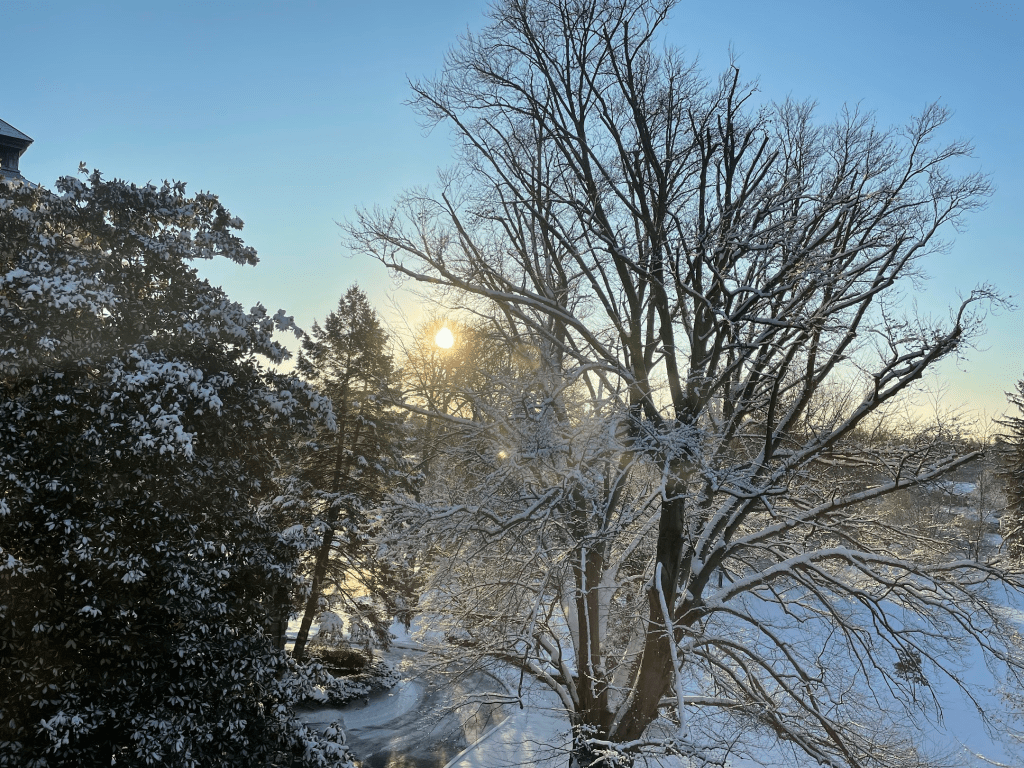
How do the great trees die and come to life again? It’s a question we might ponder every winter as the bare, black branches fill with ice. Their stark emptiness seems a place from which there is no return. But we know otherwise. In the relentless cold of every February, our experience whispers the hope for April. Our liturgical year is filled with lynchpins to stabilize and orient us in this hope.
The Feast of Candlemas (February 2), an ancient celebration of hope, is one of the seasonal anchors Medieval people used to ground their faith through its various seasons. The Feast commemorates Mary’s Purification and the Presentation of Christ to the world – thus the candles!
Other ancient and seasonal feasts were:
May 3: Roodmas – celebrating the discovery and veneration of the True Cross (called “Rood” in Middle English) Aug 1: Lammas – Originating from the Old English hlafmaesse (“loaf-mass”), it involved blessing loaves made from the new crop, signifying gratitude for the summer’s bounty and preparation for the coming winter. Sept 29 Michealmas – Festival of St. Michael the Archangel, known as the protector against evil and leader of heaven’s armies Nov 11 Martinmas – a festival celebrated on November 11th, marking the end of the harvest and the start of winter, honoring St. Martin of Tours, a soldier famous for sharing his cloak with a beggar, symbolizing light and charity as days grow shorter Dec 25 Christmas – the ultimate celebration of hope in the Light of Jesus Christ
Like nature, each one of us has our seasons. Our lives contain the cycles of our youth and aging, birth and death. Our daily experiences turn in both the warm and the chilly intervals of our lives.
We have blossomed with the expectant life of spring: a new job, relationship, adventure.
We have cultivated love over warm summers of dedication and growth – our faith, families, friends, and ministries.
We have reaped the autumnal returns of our efforts, walking away from a red and golden field carrying a well-earned harvest – graduations, anniversaries, promotions, retirements.
Certainly, each of us has known our own winters, when cold has threatened and dark has isolated – and yet, like the trees – we have survived.
As we experience the depths of “Winter 2026”, Candlemas seems an opportune time to review the lessons of the season – especially the chapters on deep roots, inner quiet, and a hidden spiritual warmth that defies freezing.
In the winters of our lives, we learn what truly sustains us. We are called to delve into the power of endurance, resilience, forgiveness, honesty, loyalty, and faithfulness. These are the winter virtues that preserve life deep under the surface of any paralyzing storm. These are the salts that keep life’s highways passable, allowing us to stay connected to all that keeps us vibrant.
On any given day of the year, we can experience “winter”. Think of the times you have received (or given) the “cold shoulder”. Remember when your explanations have been given an icy reception? Haven’t there been conversations where you were frozen out? Can’t you still see the frosty stare you got from someone who thought you were beneath them? We have all known some sub-zero responses when we were really looking for a warm word. We have all received some chilly greetings when we needed not to feel like an isolated stranger.
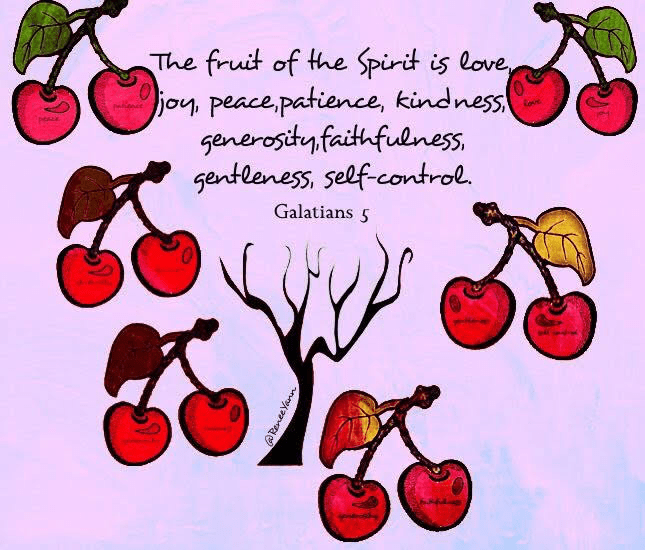
Hospitality is not listed as a Fruit of the Holy Spirit. Nevertheless, it is the melding of many of them. Hospitality is a radical welcome rooted in God’s love. It is the perfect antidote to all our methods of freezing one another out. It is the human anti-freeze that reminds us that we need one another’s warmth to survive the treacheries of life. It is a virtue to be deeply pondered in this societal age of frigid inhumanity to those we judge to be “alien”.
If there is someone in your life that you have exiled to the Arctic, consider reaching out in hospitality, care, forgiveness, or honesty. This winter, let go of the glacial grudges, silences, and harbored hurts that sometimes freeze our souls and kill our hope of returning life. Listen to the voice of the dark February nights. It is telling us how to move toward spring.
Music: We Are Called to Welcome Strangers – Jubilate
Christmas, 2025 Today is born our Savior, Christ the Lord. – Luke 2: 11
It was Christmas Eve, 1985 and we knew only his name, not his story.
Leon, just thirty-seven years old, was one of those rootless souls who, by life’s violent incisions, become severed from their history and their future. He had come to us from a local boarding home, comatose and dying. He came with no friend or family to attend his imminent passage. So, through the night of Christmas Eve, I sat silently with Leon, adamant that he should not die alone.
Leon had a quiet death. Very little changed in him except for stilled breathing and the relaxed mask that follows expiration. It was I who changed.
In that sterile hospital room, grey-lit with early morning, the palpable breath of God embraced me. I knew, and from that Christmas moment will always know, that all life beats within the Divine Heart; that every one of us is sacred and immortal within its mysterious rhythm.
Over these celebratory days, we will orchestrate a series of Christmas moments in our decorations, carols, gifts, and feasts. We will visit our treasured memories and revered mangers. We will be blessed by the love of family and friends who are the face of Christ to us.
May we also receive this singular grace: to know that any true Christmas moment comes only when the Spirit of Christ passes through us into the heart of another person.
To receive this grace, we may need to sit in a silent room with a dying stranger. We may need to welcome that ostracized family member who has carelessly injured us. We may need to rediscover, in our own quiet contrition, the radiant Gospel commitment that has paled in us.
Meister Eckhart, seven centuries ago, sought such a Christmas moment:
Today we celebrate the Eternal Birth
which God the Father has borne
and never ceases to bear in all eternity.
But if it takes not place in me, what avails it?
Everything lies in this,
that it should take place in me.
A Blessed Christmas to you all, dear friends.
Music: Christmas Concerto – Corelli
For Your Reflection
What feelings or reactions do I have after reading this reflection?
Do my feelings or reactions remind me of any passage or event in scripture, especially in the life of Christ?
What actions might I take today because of my response to these readings?
It may be a bit early, but as we draw closer to the season of Thanksgiving, it is time to make preparations for our “family eucharist”.
Families pass batons much like relay teams do. One generation hands its gifts and stories on to the next. Eventually, the cycle of love and tradition wears a deep path in history that becomes known by your family name.
How often do we see a newborn child and comment that she has her grandmother’s eyes? How many times have we said to someone, “You remind me so much of your father.”? Whenever we see the pattern of strength and generosity repeated through the generations, we are given reason to hope and to be grateful.
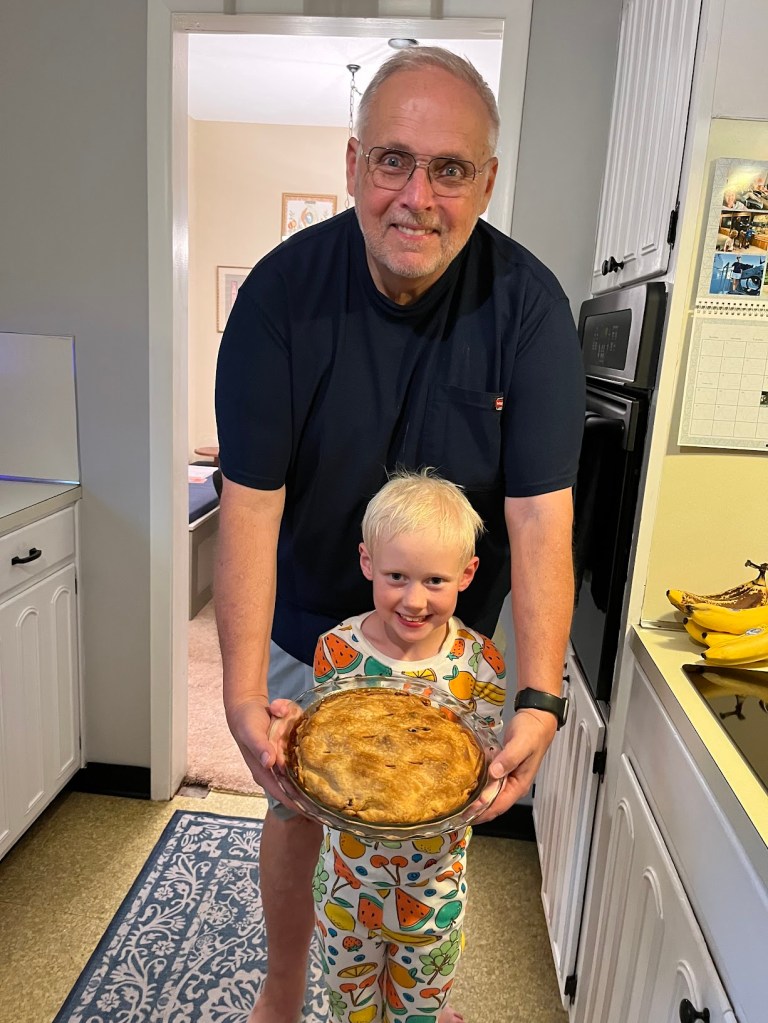
In our family, the making of the Thanksgiving pies is a beloved tradition. Over the years, it has passed from my grandmother to my mother, my father, my brother, and me. Like many family traditions, pie-making has become a mark of our family – a “charism”, if you will – symbolizing our desire to feed, support, and love one another. It is also a way of remembering those who have taught us its intricacies.
30 years ago....
Over thirty years ago, I went into the kitchen and found my oldest niece, then about nine years old, preparing the pie crust and stirring the filling. Looking at her, I realized that she and her brother and sisters are the beloved hope of our family’s future and the blessed confirmation of its past. Now, I have the joy of seeing their children making the Thanksgiving pies – so symbolic of that renewed hope and blessing – and such a source of joy.
Cookies Count TooPie with GrandpaSome prefer to eat pieTraining without product!Where’s the meat …?
The Newest Generation
Be especially mindful of your children this Thanksgiving. Confirm in them the traditions they continue and the newness they contribute to your family. Whether they sit over at the kids’ table or have joined you at the “big table”, make Thanksgiving Day a special time to love them. Share the stories that connect them to their heritage. Offer them that irreplaceable stability as they create their unique chapter of your family’s story.
Such simple moments can offer us a eucharistic grace –
the welcoming of all at a shared table,
the telling of stories that define our values,
the exchange of joyful hope, and the security of forgiveness with our familial community
the challenge and encouragement to model such hope in the world
Surely at such times, Jesus is with us, reminding us to “Do this in memory of Me.” As we pass the bread – or the pie – to one another, let’s remember the power of such Love.
My Mom’s Family-Famous Chocolate Pie
Music: “Family is Family” from the movie “Family Camp”
For Your Reflection
What feelings or reactions do I have after reading this reflection?
Do my feelings or reactions remind me of any passage or event in scripture, especially in the life of Christ?
What actions might I take today because of my response to these readings?
Isaiah Zagar is a noted mosaic artist whose artistic materials are primarily broken and discarded scraps. His unique genius lies in his ability to reshape unwanted fragments into inspiring art. Viewing one of his pieces, one considers the past existence of each remodeled element. What had that delft tile once adorned? Whose uniform had been secured by that battered brass button? That rose-colored glass, whom had is shaded?
We imagine each piece in its wholeness and wonder what fractured that former existence. We imagine the journeys carrying each particle to this new expression, locked now in harmony with every element surrounding it. We begin to discern what our own story might look like fragmented into so many parts. The effect is profound amazement that a wall plastered with debris can evoke such deep reflection.
Like these mosaic pieces, our Lenten journey has brought each of us to a new place. In the company of Christ, we have been broken, healed and lifted into new life. We share the astonishment of Christ’s disciples. Like so many of us, fragmented by our hectic lives, they had forgotten his promise. “I shall rise again,” he told them. Yet they go seeking him in an empty tomb.
Today, remade by Easter grace, we leave the vacant graves where our broken hearts may have lingered. We are new beings in the Resurrected Christ. The world’s disguise has been rolled away, like the boulder at the tomb. We see all creation anew as the expression of the Holy Spirit. With those first disciples, let us run rejoicing to our sisters and brothers. Let us assure them by our actions that Christ is indeed alive!
Music: Se impassibile, immortale – from La resurrezione by George by Frideric Handel
An Aria of Mary Magdalen at the tomb:
Se impassibile, immortale sei risorto o Sole amato, deh fa ancor ch’ogni mortale teco sorga dal peccato.
If immovable and immortal You are risen, oh beloved Sun, ah, let all mortals rise with you out of their sinful state.
For Your Reflection
What feelings or reactions do I have after reading this reflection?
Do my feelings or reactions remind me of any passage or event in scripture, especially in the life of Christ?
What actions might I take today because of my response to these readings?
Tears of the Earth- Michael Hoppè and Tim Whheater
The Buriers of Jesus
In this world, we know much of dying. It is the inverse of our living. It is what we do here, alone, and with each other.
What we do not know is death itself. We think we know, but these are death’s imposters: isolation, self-absorption, dark despair.
The only persons who, living, may have fathomed death were the buriers of Jesus who carried him through space immediately bereft of God. All creation was a tomb, and they within it, tombed.
Those buriers of Christ watched God’s own Body blanch to white, to blue, distancing Itself to pallor on the far horizon that is all lost possibility.
They listened, paralyzed, as Life sucked Breath from the miracle of Christ, in horror at the blasphemy Rejected Gift had turned to.
Left with just the ivory casing of a once warm God, the buriers of Jesus tendered it in perfumed cloths.
The rest of earth was dry, unscented. Herbs and flowers closed against the giving of themselves to air that held the final breath of Christ. They dared not fracture the least of his remains.
Even earth, unbreathing, accepted Christ into her womb, a mother turned within to mourn her own Stillborn Redemption.
No other moment anywhere in time has known a death like that. It was so infinite, so huge it ripples now to every life, a nameless anguish, distancing itself to pallor in the pining soul.
Music: In Paradisum – Michael Hoppé
In paradisum deducant te angeli; in tuo adventu suscipiant te martyres, et perducant te in civitatem sanctam Jerusalem. Chorus angelorum te suscipiat, et cum Lazaro quondam paupere æternam habeas requiem.
May the angels lead you into paradise; may the martyrs receive you at your arrival and lead you to the holy city Jerusalem. May choirs of angels receive you and with Lazarus who once was poor, may you have eternal rest.
For Your Reflection
What feelings or reactions do I have after reading this reflection?
Do my feelings or reactions remind me of any passage or event in scripture, especially in the life of Christ?
What actions might I take today because of my response to these readings?
Chopin: Nocturn in C Sharp Minor, played by Hauser. (Listen to it all – lovely.)
Calvary was a glass box where God, confined, no longer touched the world. It was a white plain, without sound, not the groaning, blood-soaked hill the scriptures leave us.
I know. Calvary hewed itself inside me once with the chisel of a long sorrow that fell, persistent, merciless like cold, steel rain.
It was a place bereft of feeling. Only the anticipation and the memory of pain are feelings. Pain itself is a huge abyss, bled by a silence that mimics death, but is not as absolutely kind.
Calvary is the place where all strength is given to the drawing of a breath to linger in it unfulfilled.
God, now I go quietly inside where you are dying in a glass box, still. I release all definitions to pass through and companion you. I watch the rain, itself like glass, crashing to an unknown life beneath the earth. Where love roots absolute, unbreakable, I cling to you in a transparent act of will.
Agios O Theos Agios Ischyros Agios Athanatos Eleison Imas
Holy God Holy Strong One Holy Deathless One Have Mercy On Us
For Your Reflection
What feelings or reactions do I have after reading this reflection?
Do my feelings or reactions remind me of any passage or event in scripture, especially in the life of Christ?
What actions might I take today because of my response to these readings?














 Lavish Mercy