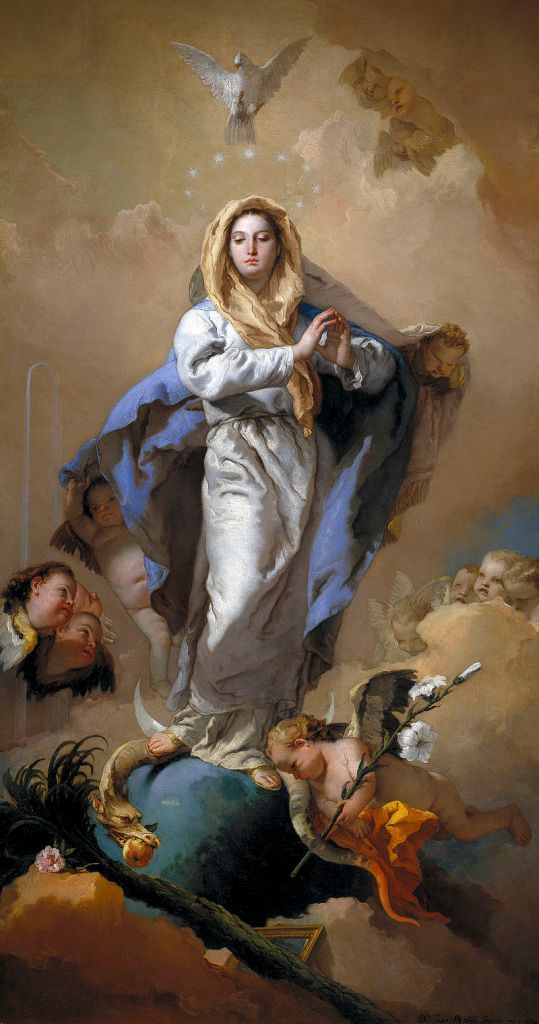
Today, in God’s Lavish Mercy, we celebrate the feast of the Immaculate Conception, the belief that Mary was conceived without the mark of Original Sin.
Beyond the intricate theology underlying the feast, what we treasure is that Mary made a holy place for Christ to dwell as he became incarnate, grew, lived and redeemed the world in loving mercy.
Mary chose to be God’s partner in our salvation!
Our Gospel story today invites us to pray with the most important word Mary ever said, “Yes. Fiat.” Think about it. Mary was not TOLD to become the mother of Jesus. She was asked. She could have said, “No” … for any number of logical reasons.
I’m too young.
I’ve got other plans.
Joseph won’t like this!
I don’t trust angels.
I’m afraid.
I’m sure all of us can think of a few more very rational excuses to tell our “angels” that we’re not ready for transforming grace. I know I have quite a few of them tucked away from over the years. But Mary calls us to something more – she calls us to an “irrational season” of love which responds to the irrational love God has for us!
Mary chose to say “Yes.” She may not have had to work too hard to find the courage for it within her heart. She was already “full of grace”, having lived her short young life with a faithfulness that made her ready to bear Christ to the world.
We pray that, with Mary’s love and guidance, we too may find the courage to make choices that sanctify our hearts, readying them to receive God.
God will come to us today – not on angel’s word – but in the human form of someone poor, sick, desperate, heart-broken, lonely, or just plain tired. May our faith allow us to respond as Mary did, with a grace-fullness that invites God into the situation.
Today, in God’s Lavish Mercy, we pray with Psalm 103 which bursts with music even as we silently read it!
Bless the LORD, O my soul; and all my being, bless God’s holy name. Bless the LORD, O my soul, and forget not all God’s benefits.
Psalm 103:1–2
Our psalm rests today between two Advent readings that pick up its melody of grace and mercy.
In our first reading, Isaiah has just finished praising the Creator in the magnificence of nature. Today’s verses continue that praise and awed wonderment. As we read, we can picture God, robed in glory, marching out the sun, moon, stars …
Lift up your eyes on high and see who has created these things: He leads out their army and numbers them, calling them all by name. By his great might and the strength of his power not one of them is missing!
Isaiah 40:26
When we take the time to appreciate a sunrise or sunset, or to trace the constellations across the dark December sky, we are doing what Isaiah encourages his listeners to do – trusting our all-powerful God. If our Creator can hold the heaven’s together in eternal beauty, we can expect the same to be done for us who are the most cherished of God’s creatures.
Do you not know or have you not heard? The LORD is the eternal God, creator of the ends of the earth. He does not faint nor grow weary, and his knowledge is beyond scrutiny. He gives strength to the fainting; for the weak he makes vigor abound.
Isaiah 40:28-29
In our Gospel, Jesus puts God’s abiding promise into a comforting invitation:
Jesus said to the crowds: “Come to me, all you who labor and are burdened, and I will give you rest. Take my yoke upon you and learn from me, for I am meek and humble of heart; and you will find rest for yourselves. For my yoke is easy, and my burden light.
Matthew 11:28-30
As we continue our Advent journey with Isaiah and Jesus, maybe we might like to catch a sunset or sunrise … or go out and look up at the winter stars. Doing so, let’s give ourselves fully in faith to our Creator’s promise to be with us in every rising and setting of our lives. Let us act as people who fully hope and believe:
They that hope in the LORD will renew their strength, they will soar as with eagles’ wings; They will run and not grow weary, walk and not grow faint.
Isaiah 40:31
Poetry: Come – Christina Rossetti
‘Come,’ Thou dost say to Angels, To blessed Spirits, ‘Come’: ‘Come,’ to the lambs of Thine own flock, Thy little ones, ‘Come home.’
‘Come,’ from the many-mansioned house The gracious word is sent; ‘Come,’ from the ivory palaces Unto the Penitent.
O Lord, restore us deaf and blind, Unclose our lips though dumb: Then say to us, ‘I will come with speed,’ And we will answer, ‘Come.’
Today, in God’s Lavish Mercy, Isaiah describes a beautiful hike through a desert turned verdant and lush. Usually that’s not the way we picture a desert, but the phenomenon is real.
A desert bloom is a climatic phenomenon that occurs in various deserts around the world. The phenomenon consists of the blossoming of a wide variety of flowers during early-mid spring in years when rainfall is unusually high. The blossoming occurs when the unusual level of rainfall reaches seeds and bulbs that have been in a latent or dormant state, and causes them to germinate and flower in early spring. It is accompanied by the proliferation of insects, birds and small species of lizards. (Wikipedia)
Bloom in Chilean Desert – photo by Javier Rubilar
Isaiah preached during tough times — real “desert” times for Israel. He uses the image of the luxuriant desert bloom to encourage his listeners that, despite their dire circumstances (the Assyrian occupation followed by the Babylonian captivity), there is hope.
But it is hard to hope and believe when you haven’t yet seen the flowers, right? Some of Isaiah’s audience may have seemed a little “weak kneed” about launching out on the journey when the horizon still looked pretty dry and lifeless.
Strengthen the hands that are feeble, make firm the knees that are weak, Say to those whose hearts are frightened: Be strong, fear not! Here is your God, Who comes with vindication; With divine recompense God comes to save you.
Isaiah 35:3-4
I know I’ve felt weak-kneed at times, both literally and figuratively — those times when we are afraid to walk, to step forward or back, to move around or toward what we should. I’ll bet some of you have felt that way too.
At those times, we’re a little bit like the paralyzed man in today’s Gospel. We need courage, the help of good friends, and faith in God in order to stand up and walk on our own. Jesus wants to help us just like he helped this young man.
That you may know that the Son of Man has authority on earth to forgive sins”– Jesus said to the one who was paralyzed, “I say to you, rise, pick up your stretcher, and go home.”
He stood up immediately before them, picked up what he had been lying on, and went home, glorifying God.
Luke 5:24-25
Advent invites us to journey into deep faith and spiritual freedom, to trust the desert for its flowers, to believe that God lovingly wills our vigor and wholeness.
The LORD himself will give his benefits; our land shall yield its increase. Justice shall walk before him, and salvation, along the way of his steps.
Today’s Psalm 85: 13-14
Poetry: I Walked in a Desert – Stephen Crane
I walked in a desert. And I cried, “Ah, God, take me from this place!” A voice said, “It is no desert.” I cried, “Well, But — The sand, the heat, the vacant horizon.” A voice said, “It is no desert.”
Today, in God’s Lavish Mercy, we pray with Psalm 147 coming after the consoling passage from Isaiah:
O my people, no more will you weep; I will be gracious to you when you cry out, as soon as I hear you, I will answer.
Isaiah 30:19
Our readings today assure us that God sees and cares about our suffering. Like a mother who sings to a crying child, God wants to comfort us.
God heals the brokenhearted and binds up their wounds. God tells the number of the stars; calling each by name.
Psalm 147:3-4
God’s lullaby is Jesus Christ. In Jesus, our Creator sings over us the melody of Infinite Love and Mercy. All we need do is calm ourselves and listen.
Jesus is the Divine Song. He sings God’s Mercy over all who suffer.
At the sight of the crowds, Jesus’s heart was moved with pity for them because they were troubled and abandoned.
Matthew 9:36
All of us, at some time in our lives, stand amidst the troubled crowd. Our friends and family members too stand there at times.
Today, as we pray Psalm 147, let us place all our troubles, and theirs, — all of the world’s troubles — into the loving embrace of God who sings the lullaby of Jesus over us. Let us beg for all who are hurting to be cradled in infinite grace, resilient hope, holy courage and lavish mercy.
Poetry: from Rumi
Every midwife knows
that not until a mother's womb
softens from the pain of labour
will a way unfold
and the infant find that opening to be born.
Oh friend!
There is treasure in your heart,
it is heavy with child.
Listen.
All the awakened ones,
like trusted midwives are saying,
'welcome this pain.'
It opens the dark passage of Grace.
Today, in God’s Lavish Mercy, Isaiah tells us that – “on that Day“, God’s People will sing a new song:
On that day they will sing this song in the land of Judah: “A strong city have we; God sets up walls and ramparts to protect us. Open up the gates to let in a nation that is just, one that keeps faith.
Isaiah 26:1-2
It is the song of a People who have recognized God’s abiding, protective Presence in their lives. That realization impels them to respond in faith and to open their lives ever more radically to God’s constant graces.
And so it is with us. As we deepen in our trust that God is with us in every circumstance, and as we choose to live out of that trust, our hearts too open to ever deeper relationship with the Holy.
In our Gospel, Jesus says that this kind of faith is more than words. It is action, choice, presence, witness — all of which declare, “I choose to anchor my life in God and to invite God’s Mercy to live through me.”
Jesus said to his disciples: “Not everyone who says to me, ‘Lord, Lord,’ will enter the Kingdom of heaven, but only the one who does the will of my Father in heaven.
“Everyone who listens to these words of mine and acts on them will be like a wise person who built their house on rock. The rain fell, the floods came, and the winds blew and buffeted the house.”
Matthew 7: 21;24-25
Just what are “these words” of Jesus to which we must listen and respond?
Today’s Gospel passage comes from the first of the Five Discourses in Matthew’s Gospel by which Jesus teaches the New Law of Love. This first discourse holds treasures like the Sermon on the Mount and the Golden Rule.
These are the “words” Jesus is talking about in today’s Gospel passage — words we must hear and act on in order that God will recognize us “on that Day“. Maybe, if you have a little time, you might like to read through Matthew, chapters 5-7, to savor this First Discourse.
Poetry: Let’s use today’s Responsorial Psalm as our poem-prayer. In it, God’s People celebrate God’s Mercy which has brought them to the “gate” of a new relationship of gratitude and trust with the Holy One.
Give thanks to the LORD, Who is good, Whose mercy endures forever. It is better to take refuge in the LORD than to trust in human appearances. It is better to take refuge in the LORD than to trust in human power.
Open to me the gates of justice and mercy; I will enter them and give thanks to the LORD. This gate is the LORD’s; the just shall enter it. I will give thanks to you, for you have answered me and have been my savior.
O LORD, grant salvation! O LORD, grant prosperity! Blessed is the one who comes in the name of the LORD; we bless you from the house of the LORD. The LORD is God, and has given us Light.
Psalm 118:1 and 8-9, 19-21, 25-27a
Music: The Breath at Dawn – Gary Schmidt – some lovely music to start your “new day”.
Today, in God’s Lavish Mercy, we celebrate the Feast of St. Andrew, the brother of Peter, also a fisherman, a beloved Apostle and friend of Jesus.
Our Gospel tells the story of Andrew’s call. The spontaneity of Andrew and Peter’s response to Jesus is stunning and deeply inspiring!
As Jesus was walking by the Sea of Galilee, he saw two brothers, Simon who is called Peter, and his brother Andrew, casting a net into the sea; they were fishermen. He said to them, “Come after me, and I will make you fishers of men.” At once they left their nets and followed him.
Matthew 4:18-20
Another favorite passage about Andrew is when he points out to Jesus that, in the famished crowd, there is a young boy with five loaves and two fish.
When Jesus looked up and saw a great crowd coming toward him, he said to Philip, “Where shall we buy bread for these people to eat?” He asked this only to test him, for he already had in mind what he was going to do.
Philip answered him, “It would take more than half a year’s wages to buy enough bread for each one to have a bite!” Another of his disciples, Andrew, Simon Peter’s brother, spoke up, “Here is a boy with five small barley loaves and two small fish, but how far will they go among so many?”
Jesus said, “Have the people sit down.”
John 6: 5-10
How simple and complete was Andrew’s faith! Those seven little items must have seemed so minute among 5000. Can you picture Andrew looking into Jesus’s eyes as if to say, “I know it’s not much but you can do anything!” Maybe it was that one devoted look which prompted Jesus to perform this amazing miracle!
We trust that our deep devotion and faith can move God’s heart too. On this feast of St. Andrew, many people begin a prayer which carries them through to Christmas. Praying it, we ask for particular favors from God.
I love this prayer because it was taught to me by my mother, a woman blessed with simple faith like Andrew’s. As I recite it, I ask to be gifted with the same kind of faith.
( Another reason I love it is this: how often in life do you get a chance to say a word like “vouchsafe“! )
St. Andrew Christmas Novena Hail and blessed be the hour and moment in which the Son of God was born of the most pure Virgin Mary, at midnight, in Bethlehem, in the piercing cold. In that hour vouchsafe, I beseech Thee, O my God, to hear my prayer and grant my desires through the merits of Our Savior Jesus Christ, and of His blessed Mother. Amen.
Like the hungry five thousand. our hurting world needs sustenance and healing. Let’s fold our Advent prayers around its many wounds, asking God for miracles with a simple faith like Andrew’s.
Poetry: St. Andrew’s Day – John Keble
In this thought-provoking poem, the poet uses Andrew’s and Peter’s relationship to reflect on the meaning of being true brothers (and of course SISTERS).
When brothers part for manhood's race, What gift may most endearing prove To keep fond memory its her place, And certify a brother's love?
'Tis true, bright hours together told, And blissful dreams in secret shared, Serene or solemn, gay or bold, Shall last in fancy unimpaired.
E'en round the death-bed of the good
Such dear remembrances will hover,
And haunt us with no vexing mood
When all the cares of earth are over.
But yet our craving spirits feel,
We shall live on, though Fancy die,
And seek a surer pledge-a seal
Of love to last eternally.
Who art thou, that wouldst grave thy name Thus deeply in a brother's heart? Look on this saint, and learn to frame Thy love-charm with true Christian art.
First seek thy Saviour out, and dwell Beneath this shadow of His roof, Till thou have scanned His features well, And known Him for the Christ by proof;
Such proof as they are sure to find
Who spend with Him their happy days,
Clean hands, and a self-ruling mind
Ever in tune for love and praise.
Then, potent with the spell of Heaven, Go, and thine erring brother gain, Entice him home to be forgiven, Till he, too, see his Savior plain..
Or, if before thee in the race, Urge him with thine advancing tread, Till, like twin stars, with even pace, Each lucid course be duly aped.
No fading frail memorial give To soothe his soul when thou art gone, But wreaths of hope for aye to live, And thoughts of good together done.
That so, before the judgment-seat, Though changed and glorified each face, Not unremembered ye may meet For endless ages to embrace.
Music: Hear my prayer, O Lord is an eight-part choral anthem by the English composer Henry Purcell (1659–1695). The anthem is a setting of the first verse of Psalm 102 in the version of the Book of Common Prayer. Purcell composed it c. 1682 at the beginning of his tenure as Organist and Master of the Choristers for Westminster Abbey.
Today, in God’s Lavish Mercy, Isaiah teaches us how to imagine with the power of faith.
We’ve probably all done this, at least in small ways. It’s a mechanism for getting through some of the tougher spots in our lives. For example, when I have an unpleasant dental procedure, I calm myself by imagining the pizza I will pick up on the way home. I even envision a specific time when the procedure will be over and I’ll be in line at the pizzeria.
Isaiah is coaching us in the same coping mechanisms, but on a much grander scale.
On that day, The branch of the LORD will be luster and glory, and the fruit of the earth will be honor and splendor for the survivors of Israel. He who remains in Zion and he who is left in Jerusalem Will be called holy: every one marked down for life in Jerusalem.
During his lifetime, Isaiah lived in a war torn land where the poor and the vulnerable were particularly threatened. These daily anxieties challenged their faith and eroded their confidence in God. Their intent to build and participate in a faithful community suffered because they could not see beyond their pain.
Isaiah tells them that a better day is coming. He invites Israel to stretch their faith, to trust in God’s promise, and to believe that God abides with them and will deliver them to glory.
Then will the LORD create, over the whole site of Mount Zion and over her place of assembly, A smoking cloud by day and a light of flaming fire by night. For over all, the LORD’s glory will be shelter and protection: shade from the parching heat of day, refuge and cover from storm and rain.
Isaiah is asking a lot of these bereft people. It is really hard to live in the Light when there is nothing around you but darkness. But it is possible to do so by the power of faith.
In our Gospel, Jesus meets a man who has that kind of powerful faith. When Jesus offers to come cure the man’s paralyzed servant, the man says there is no need to come. He already trusts that God is with that servant and will bring him to wholeness.
Hearing the man, Jesus was amazed and said to those following him, “Amen, I say to you, in no one in Israel have I found such faith. I say to you, many will come from the east and the west, and will recline with Abraham, Isaac, and Jacob at the banquet in the Kingdom of heaven.”
Wow! Wouldn’t it be great to amaze Jesus with our faith!
Indeed, as we pray today, Isaiah and Jesus may be asking us for the same kind of faith. There is a lot of pain and darkness in the larger world we share, and in many of our individual worlds. As we make our Advent journey, God asks us to live in a way that does not ignore the gloom, but still sees through it to trust the Light – a faith that proclaims God is already with us, bringing us to wholeness.
Come and save us, LORD our God; let your face shine upon us, that we may be saved. R. Alleluia, alleluia.
Poetry: To Imagination – Emily Brontë
When weary with the long day's care,
And earthly change from pain to pain,
And lost and ready to despair,
Thy kind voice calls me back again:
Oh, my true friend! I am not lone,
While thou canst speak with such a tone!
So hopeless is the world without;
The world within I doubly prize;
Thy world, where guile, and hate, and doubt,
And cold suspicion never rise;
Where thou, and I, and Liberty,
Have undisputed sovereignty.
What matters it, that, all around,
Danger, and guilt, and darkness lie,
If but within our bosom's bound
We hold a bright, untroubled sky,
Warm with ten thousand mingled rays
Of suns that know no winter days?
Reason, indeed, may oft complain
For Nature's sad reality,
And tell the suffering heart, how vain
Its cherished dreams must always be;
And Truth may rudely trample down
The flowers of Fancy, newly-blown:
But, thou art ever there, to bring
The hovering vision back, and breathe
New glories o'er the blighted spring,
And call a lovelier Life from Death,
And whisper, with a voice divine,
Of real worlds, as bright as thine.
I trust not to thy phantom bliss,
Yet, still, in evening's quiet hour,
With never-failing thankfulness,
I welcome thee, Benignant Power;
Sure solacer of human cares,
And sweeter hope, when hope despairs!
Today, in God’s Lavish Mercy,we embark once again on an age-old journey — the path through Advent to Christmas. It is a spiritual journey about which we must be intentional because there are so many cultural distractions to waylay us from the path.
Beloved Isaiah, beautiful poet and prophet, stands along the sideline rallying us:
In days to come, the mountain of the LORD’s house shall be established as the highest mountain and raised above the hills. All nations shall stream toward it; many peoples shall come and say: “Come, let us climb the LORD’s mountain, to the house of the God of Jacob, that he may instruct us in his ways, and we may walk in his paths.” O house of Jacob, come, let us walk in the light of the Lord!
Isaiah is telling us that it is time to get moving – moving deeper into our relationship with God.
Like the “House of Jacob”, winding through a long journey, we may forget where we are really going in our lives. We are not going to material, social, or political success. We are not traveling life’s roads in order to end up at a cushy retirement.
Our lives are about moving deeper and deeper into the heart of God — that’s all. If we are not doing that by engaging the grace of our everyday lives, then we are missing the whole point!
Paul trusts that we understand this. He says, “You know the time … wake up!”
You know the time; it is the hour now for you to awake from sleep. For our salvation is nearer now than when we first believed; the night is advanced, the day is at hand. Let us then throw off the works of darkness and put on the armor of light…
I have a sleepy friend who loves to linger in her blankets in the morning. When we need to be up and “at ‘em”, I can sound a lot like Paul. “Look at the time!”, “We don’t want to be late!”, “Throw off those blankets of night!”
Friends, the Church gives us the gift of Advent so that we will not be late for the ultimate “God-Party” which is our life’s glorious destination. The potential to reach this “destination” is offered us, not only in some future parousia, but in each moment of our existence by our choice for grace.
In our Gospel, Jesus reiterates the profound importance of our wakeful awareness of God’s Presence in our lives.
For you do not know on which day your Lord will come. Be sure of this: if the master of the house had known the hour of night when the thief was coming, he would have stayed awake and not let his house be broken into. So too, you also must be prepared, for at an hour you do not expect, the Son of Man will come.
So, let the journey begin! Begin today to receive every moment as an invitation to God’s house — God’s heart. Whether the moment comes in darkness or light, joy or sorrow, God is in it – calling.
May this Advent bless each of us with deeper understanding of God’s Love incarnate in our lives.
Poetry: Advent Calendar – Rowan Williams
He will come like last leaf’s fall.
One night when the November wind has flayed the trees to bone, and earth wakes choking on the mould, the soft shroud’s folding.
He will come like frost. One morning when the shrinking earth opens on mist, to find itself arrested in the net of alien, sword-set beauty.
He will come like dark. One evening when the bursting red December sun draws up the sheet and penny-masks its eye to yield the star-snowed fields of sky.
He will come, will come, will come like crying in the night, like blood, like breaking, as the earth writhes to toss him free. He will come like child.
Today, in God’s Lavish Mercy, we celebrate the Solemnity of Christ the King. This feast was established in 1925 by Pope Pius XI by his encyclical Quas Primas. The Pope was acutely aware of the secularization of society and culture. He wanted this feast and devotion to bring people a deep awareness that Christ is the center of all Creation.
The images, language and metaphors surrounding the feast are ones that spoke to the people in the early 20th century. They may ring differently to us. Concepts of “king”, “empire”, “dominion”, “subjection” tend to engender negative connotations for many of us. But our readings today can direct us to a deeper understanding of the characteristics Pius sought to highlight, ones that may speak more clearly to us in our time.
Our first reading from Samuel presents the anointing of David as King of Israel. Anointed by those who were “his own bone and flesh”, David prefigured the Incarnate Christ who, by the power of the Holy Spirit, took our flesh to redeem us.
The magnificent passage from Colossians offers exultant praise to the Creator for
…delivering us from the power of darkness and transferring us to the kingdom of the beloved Son, in whom we have redemption …
And our Gospel gives us our precious Jesus on the Cross, teaching us the paradoxical truth of what his “Kingdom” really means – not oppressive dominion, but rather a sacrificial love that gives everything for the life of the beloved.
Van Eyck’s painting of Christ King and his follower Petrus Christus’s Christ Suffering (15th C.)
Many cannot recognize such “kingship”. They cannot see the holy power within Christ’s sacrifice. They are, as Pius XI recognized for his time, blinded by a secularized culture and a dispirited life.
Let us pray today with the “justly condemned”, but spiritually enlightened, man in our Gospel who asked his Crucified King,
“Lord Jesus, remember me when you come into Kingdom!”
Poetry: As Kingfishers Catch Fire – Gerard Manley Hopkins
As kingfishers catch fire, dragonflies draw flame;
As tumbled over rim in roundy wells
Stones ring; like each tucked string tells, each hung bell's
Bow swung finds tongue to fling out broad its name;
Each mortal thing does one thing and the same:
Deals out that being indoors each one dwells;
Selves — goes itself; myself it speaks and spells,
Crying Whát I dó is me: for that I came.
I say móre: the just man justices;
Keeps grace: thát keeps all his goings graces;
Acts in God's eye what in God's eye he is —
Chríst — for Christ plays in ten thousand places,
Lovely in limbs, and lovely in eyes not his
To the Father through the features of men's faces.
Today, in God’s Lavish Mercy, we pray with Psalm 149 which calls the community to sing and dance because God has delivered them.
This happy, celebratory summons is set, contrastingly, between two readings that mention weeping.
Then I saw a mighty angel who proclaimed in a loud voice, “Who is worthy to open the scroll and break its seals?” But no one in heaven or on earth or under the earth was able to open the scroll or to examine it. I shed many tears because no one was found worthy to open the scroll or to examine it.
Revelation 5: 2-4
As Jesus drew near Jerusalem, he saw the city and wept over it, saying, “If this day you only knew what makes for peace– but now it is hidden from your eyes.
Luke 19: 41-42
The readings leave us with a sense that there is a secret to eternal life – a secret to which only grace can open our eyes and hearts.
John writes that “the Lion of Judah” has the key:
One of the elders said to me, “Do not weep. The lion of the tribe of Judah, the root of David, has triumphed, enabling him to open the scroll with its seven seals.”
Revelation 5: 5-6
Jesus, Uncreated Grace, is the Lion of Judah. He has incarnated the sacred key in his Life, Death, and Resurrection. For those who receive him and share his life, the door is opened, the scroll unrolled.
So what is the path to such union with Jesus?
Our psalm contains a brief line tucked at its center which foreshadows the entire message of the Gospel.
Let them praise God’s name in the festive dance, let them sing praise with timbrel and harp. For the LORD loves us, and adorns the lowly with victory.
We will find a dancing, singing joy when we give ourselves to these truths:
God loves us irrevocably
We can fully receive this great love to the degree that we become like Christ whose image we find among the poor, lowly, and suffering.
Poetry: Dance from Rumi
Come to me, and I shall dance with you In the temples, on the beaches, through the crowded streets Be you man or woman, plant or animal, slave or free I shall show you the brilliant crystal fires, shining within I shall show you the beauty deep within your soul I shall show the path beyond Heaven. Only dance, and your illusions will blow in the wind Dance, and make joyous the love around you Dance, and your veils which hide the Light Shall swirl in a heap at your feet.