Today, in Mercy, our readings are all about “law”.
Deuteronomy talks about the Law of Moses as he received it from God.
Psalm 147 talks about God’s law as it is expressed in nature and human understanding.
In Matthew, Jesus talks about his New Law as a development, not a contradiction, of the Old Law.
All this talk of “law” seems coincidental, doesn’t it, in these days after the Mueller report and what is within, above and beyond “the law”. So many definitions and concepts of “law”!
So, as we pray these scriptures, we might ask ourselves, “What exactly is “law”, especially in terms of my spiritual life and development?”
St. Thomas Aquinas may be a good place to start. Here are his definitions, simplified:
Eternal Law = God’s will and guidance which orders all creatures toward the good of the universe.
Natural Law = our self-ordering, by reason, toward this universal good.
Human Law = particular statutes instituted in accord with human reason for the good of civil society.
Divine Law= the revealed law of God as found in Scripture
Praying with these concepts is different from studying them.
If we pray with the concept of eternal law, we might offer praise for God’s unchanging Presence in our lives, assuring us that we are eternally loved.
If we pray with the concept of natural law, we might say of a prayer of supplication for the grace to be attuned to God in all our natural thoughts, words and actions.
If we pray with the concept of human law, we might pray in contrition for all the ways we humans mistake law for justice.
If we pray with the concept of divine law, we might offer thanks for God’s generous revelation which allows us to contemplate and grow in relationship with God.
We want our understanding and living of law to be rooted in the heart of God, according to these verse from John 6:
Your words, Lord, are Spirit and life; you have the words of everlasting life.
Let’s pray for that rootedness today.
Music: I Will Delight in the Law of the Lord – Maranatha
Today, in Mercy, our readings describe God’s lavish mercy and the expectation for our reciprocity.
The passage from the Book of Daniel, written in lilting prose, quotes the prayer of Azariah. It gives us several phrases to savor in our own prayer, depending on the particular disposition of our heart on any given day:
To whom you promised …. like the stars of heaven, or the sand on the shore of the sea. What has God promised you to give you hope in your life? Can you call on those promises today in your prayer?
For we are reduced, O Lord, beyond any other nation… Are you feeling sad, disconnected, humiliated or depressed? Can you give these feelings to God and open your heart to healing?
We have in our day no prince, prophet, or leader, no burnt offering, sacrifice, oblation, or incense, no place to offer first fruits, to find favor with you. Do you ever feel abandoned by the institutions we all once depended on, whether Church, government, law etc.? Can we pray for the courage to depend only on God in all things?
Now we follow you with our whole heart… Have our life circumstances brought us to the point of placing ourselves totally in God’s care? Can we pray with that peaceful and holy abandonment?
Deliver us by your wonders, and bring glory to your name, O Lord.Can our prayer be one of giving glory to God for all the blessings in our lives?
God has been so good to us! Our Gospel enjoins us to be reciprocally good to others.
Music: Give Me Your Eyes – An interesting song by rock singer Brian Heath. As his plane is landing one night, he receives a grace to pray for new eyes — eyes that see and love all humanity as God does.
Today, in Mercy, we have powerful readings – they get really serious about repentance!
In our first reading, Moses has been on a kind of decades-long sabbatical on his father-in-law’s homestead. After the young glory days of Egypt, and the ensuing drama that exiled him, Moses had settled into being a humble shepherd in Midian. He probably wasn’t expecting a fiery, direct telegram from God.
But God never gives up on his plan for us. So God, divinely expert at getting our attention, conflagrates a bush right in front of Moses.Supposedly, it was not that unusual for this type of bush to spontaneously combust in the desert heat. What was unusual was for it not to be consumed by the fire.
God then delivers a message of overwhelming fidelity to Moses:
Thus shall you say to the Israelites: The LORD, the God of your fathers, the God of Abraham, the God of Isaac, the God of Jacob, has sent me to you. This is my name forever; thus am I to be remembered through all generations.
Because of God’s mercy and fidelity, the Israelites – and Moses – are getting another chance to live in covenant with God.
In our Gospel, Jesus tells his followers not to ignore such chances. He reminds his listeners that life is fragile and transitory. If we haven’t acted on God’s invitation to grace, we might lose the opportunity.
If we look back over our lives, we might realize that there have been burning bushes all over the place – times and events where life offered us a choice between grace and sin, smallness of heart, selfishness. When we chose grace, the bush kept burning and was not consumed. It lit our way to deeper covenant with God.
These final weeks of Lent offer us countless encouragements to look for God’s Fire in our hearts and to go deeper toward the Light. Let’s not ignore them.
Today, in Mercy, our readings pour out the lavish mercy of God. Our prayer invites us bask in that warmth and understanding.
The prophet Micah asks,
“Who is there like You … the God who delights in clemency?”
Our Psalm reminds us that “the Lord is kind and merciful”:
For as the heavens are high above the earth, so surpassing is his kindness toward those who fear him. As far as the east is from the west, so far has he put our transgressions from us.
(Two musical selections today.)
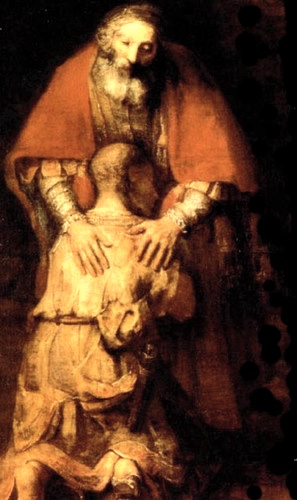
Then Jesus tells us the tender parable of the Prodigal Son, which is really more about the Merciful Father. He receives his contrite child in the same way that God receives us in our repentance.
Sometimes we become so content with ourselves that we fail to realize our need for contrition. Sometimes our failures are buried so deep and so long in us that we become blind to them. Repentance is the grace to break through that blindness.
We were created to be an image of the merciful God we meet in today’s scripture. Where we are short of that in our actions, words, choices and attitudes – that’s where we have need of repentance.
Rembrandt’s magnificent painting captures a sacred feeling that might help our prayer. Sometimes we are the gracious Father – loving, forgiving, hoping and working for life in others. Sometimes we are the son, returning from our own destructive selfishness to seek a new beginning. Sometimes we are a little bit of each.
Today, in Mercy, we begin with the powerful and moving story of Joseph – sweet, innocent son of of Jacob who was betrayed by his brothers. Jacob sends Joseph to work with his brothers, believing they love him. He was wrong.
Our Gospel then tells the story of the frustrated landowner who sent his son on mission to settle his accounts. though the landowner’s servants had been abused by the tenants, he believed his son would be respected. He was wrong.
Both these stories are prototypes of the Father sending Jesus to redeem us. The intention is the same. The hope is the same. Unfortunately, the result is the same.
In our Gospel, Jesus realizes that the Father’s hope for him will not be met with openness and acceptance. He sees the Pharisees milling around in hateful conversation.Referencing the parable, Jesus says:
“The Kingdom of God will be taken away from you
and given to a people that will produce its fruit.”
When the chief priests and the Pharisees heard his parables,
they knew that he was speaking about them.
And although they were attempting to arrest him,
they feared the crowds, for the crowds regarded him as a prophet.
This morning, let’s pray for all those who send their beloveds out in hope to do good in the world:
for police officers, firefighters, first responders whose families send them out each day always fearing for their safety
for medical personnel who risk sickness in their care for others
for missionaries and justice workers who encounter threat and danger in helping others
for peacekeepers and military who work to end war and tyranny
for all of us when we reach out in justice and courage, hoping to be received with respect and mutuality
May the example of Christ inspire and sustain us to do our part for God’s continuing redemption of the world.
Today, in Mercy, our Gospel gives us the disturbing parable of the rich man, sometimes called Dives, and Lazarus, a very poor man.
The story is disturbing because
Lazarus suffers so desperately
Dives is impervious to that suffering
God won’t give Dives a break after his death
We fear being in either of these guys’ situations
Probably, like most people, we’d rather be rich than poor. But would we rather be generous with that wealth or selfish? Do we ever find ourselves thinking thoughts like this, deciding we’re not responsible for the gap between rich and poor:
“I worked hard for what I have. Let everybody else do the same!”
That wealth gap cannot be mended simply by giving a dollar to a corner beggar nor by donating our wornout clothes to Goodwill. This kind of re-balancing requires a conversion of heart which touches our economic, political and moral understanding.
I was struck this morning by this headline from The Economist, a British weekly magazine.
How can today’s Gospel inspire and encourage us in a global culture that infcreasingly marginalizes persons who are poor, resourceless, and politically oppressed?
May the story of Lazarus and Dives influence us to use the powers we have to make just and generous decisions.
We can vote for just, generous and moral leaders.
We can advocate for universally just policies.
We can donate to compassionate causes.
We can confront hateful speech and stereotyping.
We can speak and act for justice, peace, inclusivity and mercy.
We just have to be courageous before, like Dives, it is too late for us.
Today, in Mercy, our Gospel tells the story of Mrs. Zebedee, who sought a prejudiced advantage for her two disciple sons.
Jesus said to her, “What do you wish?” She answered him, “Command that these two sons of mine sit, one at your right and the other at your left, in your kingdom.”
Sounds a little like something ripped from today’s headlines, doesn’t it.
There is a natural inclination to advantage those we love. But when we do so to the unjust disadvantage of others, that’s a problem.
We know from experience that people use various points of leverage to gain advantage in life. We see people use money, power, political connections, and other influences to get a job, choose a school, land an important invitation, get a traffic ticket written off, etc., etc. Maybe, on occasion, we are one of those people.
Today’s Gospel teaches us a lesson. In gaining such advantage, we may, as Jesus says, “not know what we are asking for”. Can we actually DO the job, succeed in the school, … become a better person by what we have maniputively gained?
The Gospel also brings before us the “other people” who lost the right to what we unjustly claimed. How do they begin to see us? What do we lose in respect and mutuality within our community? How do we begin to see ourselves in relationship to justice, honesty, sincerity and truth?
Jesus hopes that we will love every person to the extent that we want her/his just advantage as much as we want our own? That is the “cup” He drinks through his Passion and Death.
Let us ponder Jesus’s question to us: Can you drink the cup that I will drink?
Today, in Mercy, we celebrate the Solemnity of St. Joseph, husband of the Blessed Virgin Mary.
St. Theresa of Avila wrote, “I took for my patron the glorious St. Joseph and recommended myself earnestly to him. It is now very many years since I began asking St. Joseph for something on his feast, and I always received it. If the petition was in any way amiss, he rectified it for my greater good.”
The very way the Church defines the Feast tells us a great deal about Joseph. Men are seldom described by their relationship to a woman.It is more often the other way around. Consider our lingering custom of wives assuming their husband’s surnames, for example.
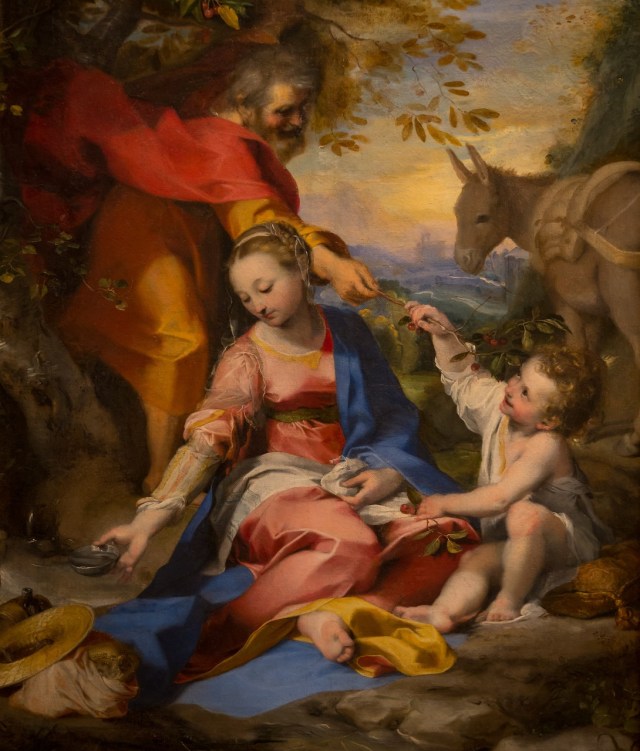
But Joseph is known because of his connection to Mary. He is a steady force in the background of her life and the life of Jesus. Joseph is the kind, generous and faithful one who nurtures and protects them.
And he is the silent one. Not a single word was ever recorded from him. What we know of Joseph issues from his actions. For example, before he knew that Mary had conceived through the Holy Spirit:
Joseph her husband, since he was a righteous man, yet unwilling to expose her to shame, decided to divorce her quietly.
This virtue of righteousness sums up the character of Joseph as we find him in scripture. Righteousness is complementary to justice.
Walter Brueggemann in his book, Journey to the Common Good, says this about the relationship between justice and righteousness:
“Justice in the Old Testament concerns distribution in order to make sure that all members of the community have access to resources and goods for the sake of a viable life of dignity…. Righteousness concerns active intervention in social affairs, taking an initiative to intervene effectively in order to rehabilitate society, to respond to social grievance, and to correct every humanity-diminishing activity.”
Joseph exercised such righteousness not only in responding to Mary’s unexpected pregnancy. He took the risk of becoming a refugee family in order to save Jesus’s infant life. After the finding in the Temple, he stepped into the background in order to allow young Jesus to assume his teaching vocation. No doubt, during the silent years which then surround Joseph, he continued to live an active life doing good for his family and community, and quietly fostering the ministry of Jesus.
Despite the scarcity of recorded knowledge about Joseph, there is an ample devotional treasury describing him. It is captured in outline form in the Litany to St. Joseph, a prayer I learned to love because it was one of my father’s favorites. I sometimes say just a few lines, slowly, to let the holiness of Joseph call me deeper into my own spiritual life.
(Music is below the Litany.)
Lord, have mercy. Christ, have mercy.
Lord, have mercy.
Christ, hear us. Christ, graciously hear us.
God, the Father of Heaven, have mercy on us.
God the Son, Redeemer of the world, have mercy on us.
God the Holy Spirit, have mercy on us.
Holy Trinity, One God, have mercy on us.
Holy Mary, pray for us (after each line)
Saint Joseph,
Renowned offspring of David,
Light of Patriarchs,
Spouse of the Mother of God,
Chaste guardian of the Virgin,
Foster-father of the Son of God,
Diligent protector of Christ,
Head of the Holy Family,
Joseph most just,
Joseph most chaste,
Joseph most prudent,
Joseph most strong,
Joseph most obedient,
Joseph most faithful,
Mirror of patience,
Lover of poverty,
Model of artisans,
Glory of home life,
Guardian of virgins,
Pillar of families,
Solace of the wretched, Hope of the sick,
Patron of the dying,
Protector of Holy Church,
Lamb of God, who take away the sins of the world, Spare us, O Lord.
Lamb of God, who take away the sins of the world, Graciously hear us, O Lord.
Lamb of God, who take away the sins of the world, Have mercy on us.
V. He made him the lord of His house:
R. And ruler of all His substance.
Let us pray.
O God, who in Your unspeakable providence chose blessed Joseph to be the spouse of Your own most holy Mother: grant, we ask, that we may deserve to have him for our intercessor in heaven, whom we reverence as our defender on earth. Amen.
Today, in Mercy, in our reading from Deuteronomy, God tells the People that they are loved in a unique way. So are you!
God says: And today the LORD is making this agreement with you:
You are to be a people peculiarly his own
The word “peculiarly” may strike us exactly as it says. It is a word whose usage has changed over the centuries. We think of it today as “odd” or “unusual”, a meaning given it only since the 18th century.
The word’s actual derivation is this:
Mid-15th century: “belonging exclusively to one person,” from Latin peculiaris “of one’s own (property),” from peculium “private property,” literally “property in cattle” (in ancient times the most important form of property).
So Deuteronomy is telling us that we are to God as the herdsman’s possessions are to herdsman. We belong to God Who has invested everything in us. God will protect, nurture and strengthen us in a relationship of mutual investment and harmony — IF we do our part which is:
… provided you keep all his commandments, he will then raise you high in praise and renown and glory above all other nations he has made, and you will be a people sacred to the LORD, your God, as he promised.
In our Gospel, Jesus outlines exactly how to do this.
Love your enemies, and pray for those who persecute you, that you may be children of your heavenly Father, for he makes his sun rise on the bad and the good, and causes rain to fall on the just and the unjust.
In today’s world, so full of hate, greed and retribution, I suppose we are “peculiar”, in both senses of the word, when we live as Jesus asks.
Music: How He Loves Is ~David Crowder Band ( The Song may not resonate with at first, but stick with it. There is something deep in this melody..)







 Lavish Mercy