When the Hour Comes…

Friday, April 5, 2019

Click here for readings

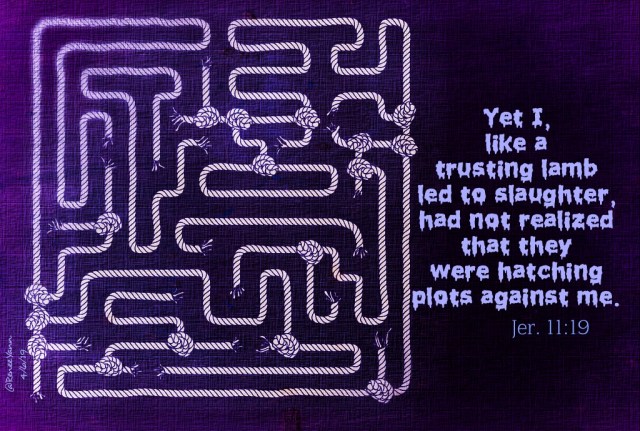
Today, in Mercy, John let’s us know how difficult things were for Jesus. Even very early in John’s Gospel, doubt, criticism, jealousy, and hatred swirl around Jesus. He realizes that people are trying to kill Him. All this because he does good and preaches love! How can that be?

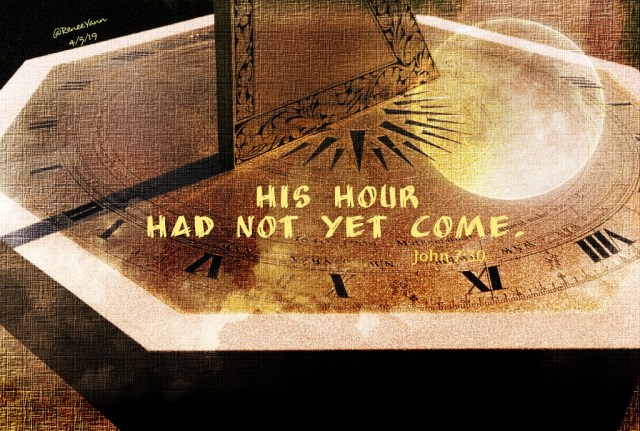
Jn7_30 hourJPG

Jesus upset the apple cart, and many people didn’t like that. They preferred control over love, familiarity over faith. There were others who wanted a more violent shake-up, a political overthrow rather than a spiritual transformation. Basically, people wanted to remake Jesus’s message in their own design. And we’ve been doing the same thing ever since.

Eventually these opposing forces meet in the contradiction of the Cross – that place where Love seems to lose, and Life seems to die. But when Jesus’s hour comes – that timeless moment when Eternal Love and Life break open in the Resurrection – our faith in Christ will be confirmed.

We pray today for all those experiencing great trauma or testing in their lives. May their faith sustain, restore and surprise them.

We pray for ourselves that, like Jesus, when our “hour comes” we are ready because we have already deepened and steadied our hearts in prayer and fidelity.

Music: I Need Thee Every Hour – Annie Hawks (May 28, 1836 – January 3, 1918), an American poet and Gospel hymnist who wrote a number of hymns with her pastor, Robert Lowry.

In 1872, the hymn by which Hawks is most widely known, “I Need Thee Every Hour”, was written. It is said to have been translated into more foreign languages than any other modern hymn at the time of her death. Hawks stated:— “For myself, the hymn was prophetic rather than expressive of my own experiences, for it was wafted out to the world on the wings of love and joy, instead of under the stress of personal sorrow.”

Be Light!

Thursday, April 4, 2019

Click here for readings

Jn5_35 light

Today, in Mercy, the Gospel gives us Jesus claiming his throne. He is setting his disciples straight before he is no longer with them. He drives home each of the pillars of his Messiahship, like so many stakes in the ground:

  • I have testimony greater than John’s.
  • The works that the Father gave me to accomplish,these works that I perform testify on my behalf that the Father has sent me.
  • The Father has testified on my behalf.
  • I came in the name of my Father.

Jesus is saying these things to his persecutors, but he says them for the benefit of his surrounding disciples. He wants them to remember these things to sustain them in the dark times to come.

In this passage, Jesus also pays a glorious compliment to John the Baptist:

He was a burning and shining lamp.

Now Jesus wants his followers, fired by their faith, to burn with an even greater light. He wants us to do the same, to burn with a flame steadied by Christ’s assurances, by the stunning testimony of his Passion, Death and Resurrection.

Music:  But Who May Abide the Day of His Coming – Handel

But who may abide the day of His coming, and who shall stand when He appeareth? For He is like a refiner’s fire.

Law or Love?

Tuesday, April 2, 2019

Click here for readings

Today, in Mercy, our readings bring to mind the role of religion in our spiritual life.

take up mat 2

The dictionary defines religion as a particular system of faith and worship. The origin of the word “religion” is from the Latin “religare”: to bind.

In the magnificent passage from Ezekiel, we are given a metaphorical description of grace flowing from the Temple, the locus of faith for Israel. Ezekiel is led by a radiant vision to this source of abundant life symbolized by water. Slowly and incrementally, this abundance deepens for Ezekiel, until he is swimming in its grace. 

Ezekiel’s vision demonstrates what happens in us when religion, ritual and law enhance grace. The beauty, power and architectural symmetry of the Temple symbolize the great benefits of religious practice.

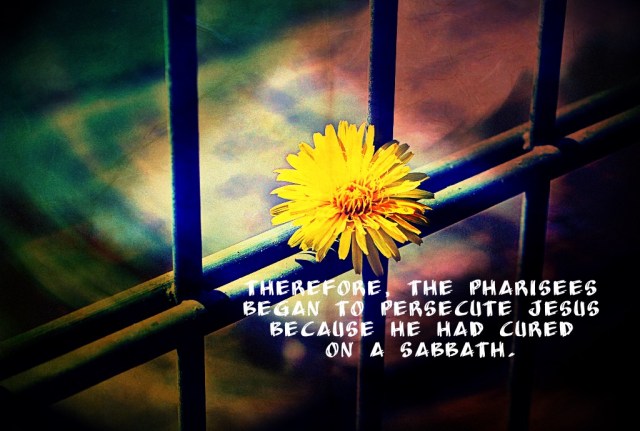
Our Gospel, on the other hand, shows us a Pharisaical religion built on empty practice and bereft of heart. When Jesus cures on the Sabbath, he moves beyond these skeletal boundaries to mercy, which is the reason for all religious practices.

take up mat
Jesus Cures on the Sabbath

Jesus shows us that when religion – and its ensuing ritual and law – bind grace, it needs to be set aside. His whole life was predicated on a faith which generated mercy, not sacrifice. The alleviation of suffering and need always supersede observance – even on the Sabbath.

When we see any so-called faith or religion which places law over mercy, we see an empty temple where the river of grace has run dry. Our culture is filled with fake holiness that measures, condemns and ostracizes others. We see religion distorted into political bullying. We see it redefined as an excuse for excessive wealth. We even see it used as legitimization for nationalism, violence, racism, and war.

Today’s readings tell us to be on guard. The forces which twist religion are very subtle and pervasive in our culture. They dress themselves in impressive words and practices, just like the Pharisees did, but their costumes hide an ugly hate and fear.

To the fearful and weak, these forces preach power – but it is a power over not for others.

Jesus has shown us what faithful practice looks like: mercy and love. It is vulnerable, courageous, inclusive, and humble. It sees the suffering of others and responds. It waters the Temple of our hearts to make them verdant with hope, joy and generosity.

Music: Come to the Water – John Foley, SJ and Matt Maher

God’s Loving Promises

Friday, March 29, 2019

Click here for readings.

Hosea14

Today, in Mercy, Hosea, the composer of passionate love songs, tells us this:

I will heal your weaknesses, says the LORD,
I will love you freely;
for my wrath is turned away.
I will be like the dew for you:
you shall blossom like the lily;
You shall strike root like the Lebanon cedar,
and put forth your shoots.
Your splendor shall be like the olive tree
and your fragrance like the Lebanon cedar.
Again you shall dwell in the shade
and raise grain;
You shall blossom like the vine,
and your fame shall be like the wine of Lebanon.

The passage sings of new life, strength, vigor – the hope of Easter! Today as we pray, what withering branches in our lives do we wish to place in the warmth of this promise?

Mc 12,28-34 e
You are not far from the kingdom of God

In our Gospel, the good scribe asks for Jesus’s confirmation that he is on the right track to holiness. Jesus blesses him by saying:

You are not far from the kingdom of God

God is so good to us. Let us ask God’s generous help as we seek to grow in holiness, goodness and peace this Lent, so that we may be blessed by the same promises.

Music: Good to Me – Audrey Assad 

It’s the Law … hmmm!

Wednesday, March 27, 2019

Click here for readings

Today, in Mercy, our readings are all about “law”.

law,JPG

  • Deuteronomy talks about the Law of Moses as he received it from God.
  • Psalm 147 talks about God’s law as it is expressed in nature and human understanding.
  • In Matthew, Jesus talks about his New Law as a development, not a contradiction, of the Old Law.

All this talk of “law” seems coincidental, doesn’t it, in these days after the Mueller report and what is within, above and beyond “the law”. So many definitions and concepts of “law”!

So, as we pray these scriptures, we might ask ourselves, “What exactly is “law”, especially in terms of my spiritual life and development?”

St. Thomas Aquinas may be a good place to start. Here are his definitions, simplified:

oh boy

  • Eternal Law = God’s will and guidance which orders all creatures toward the good of the universe.
  • Natural Law = our self-ordering, by reason, toward this universal good.
  • Human Law = particular statutes instituted in accord with human reason for the good of civil society.
  • Divine Law = the revealed law of God as found in Scripture

Praying with these concepts is different from studying them.

If we pray with the concept of eternal law, we might offer praise for God’s unchanging Presence in our lives, assuring us that we are eternally loved.

If we pray with the concept of natural law, we might say of a prayer of supplication for the grace to be attuned to God in all our natural thoughts, words and actions.

If we pray with the concept of human law, we might pray in contrition for all the ways we humans mistake law for justice.

If we pray with the concept of divine law, we might offer thanks for God’s generous revelation which allows us to contemplate and grow in relationship with God.

We want our understanding and living of law to be rooted in the heart of God, according to these verse from John 6:

Your words, Lord, are Spirit and life;
you have the words of everlasting life.

Let’s pray for that rootedness today.

Music: I Will Delight in the Law of the Lord – Maranatha

To See As God Sees

Tuesday, March 26, 2019

Click here for readings

Today, in Mercy, our readings describe God’s lavish mercy and the expectation for our reciprocity.

love one another

The passage from the Book of Daniel, written in lilting prose, quotes the prayer of Azariah. It gives us several phrases to savor in our own prayer, depending on the particular disposition of our heart on any given day:

To whom you promised …. like the stars of heaven, or the sand on the shore of the sea.
What has God promised you to give you hope in your life? Can you call on those promises today in your prayer?

For we are reduced, O Lord, beyond any other nation…
Are you feeling sad, disconnected, humiliated or depressed? Can you give these feelings to God and open your heart to healing?

We have in our day no prince, prophet, or leader,
no burnt offering, sacrifice, oblation, or incense,
no place to offer first fruits, to find favor with you.
Do you ever feel abandoned by the institutions we all once depended on, whether Church, government, law etc.? Can we pray for the courage to depend only on God in all things?

Now we follow you with our whole heart…
Have our life circumstances brought us to the point of placing ourselves totally in God’s care? Can we pray with that peaceful and holy abandonment?

Deliver us by your wonders, and bring glory to your name, O Lord.Can our prayer be one of giving glory to God for all the blessings in our lives?

God has been so good to us! Our Gospel enjoins us to be reciprocally good to others.

Music: Give Me Your Eyes – An interesting song by rock singer Brian Heath. As his plane is landing one night, he receives a grace to pray for new eyes — eyes that see and love  all humanity as God does.

Heart-Burn?

Sunday, March 24, 2019

Click here for readings

Today, in Mercy, we have powerful readings – they get really serious about repentance!

Ex3_2 bush

In our first reading, Moses has been on a kind of decades-long sabbatical on his father-in-law’s homestead. After the young glory days of Egypt, and the ensuing drama that exiled him, Moses had settled into being a humble shepherd in Midian. He probably wasn’t expecting a fiery, direct telegram from God.

But God never gives up on his plan for us. So God, divinely expert at getting our attention, conflagrates a bush right in front of Moses.  Supposedly, it was not that unusual for this type of bush to spontaneously combust in the desert heat. What was unusual was for it not to be consumed by the fire.

God then delivers a message of overwhelming fidelity to Moses:

Thus shall you say to the Israelites:
The LORD, the God of your fathers,
the God of Abraham, the God of Isaac, the God of Jacob,
has sent me to you.
This is my name forever;
thus am I to be remembered through all generations.

Because of God’s mercy and fidelity, the Israelites – and Moses – are getting another chance to live in covenant with God.

In our Gospel, Jesus tells his followers not to ignore such chances. He reminds his listeners that life is fragile and transitory. If we haven’t acted on God’s invitation to grace, we might lose the opportunity.

If we look back over our lives, we might realize that there have been burning bushes all over the place – times and events where life offered us a choice between grace and sin, smallness of heart, selfishness. When we chose grace, the bush kept burning and was not consumed. It lit our way to deeper covenant with God.

These final weeks of Lent offer us countless encouragements to look for God’s Fire in our hearts and to go deeper toward the Light. Let’s not ignore them.

Music: Fire of God – Craig Musseau

None like You, Merciful God

Saturday, March 23, 2019

Click here for readings

Today, in Mercy, our readings pour out the lavish mercy of God. Our prayer invites us bask in that warmth and understanding.

Prodigal son

The prophet Micah asks,

“Who is there like You … the God who delights in clemency?”

Our Psalm reminds us that “the Lord is kind and merciful”:

For as the heavens are high above the earth,
so surpassing is his kindness toward those who fear him.
As far as the east is from the west,
so far has he put our transgressions from us.

(Two musical selections today.)

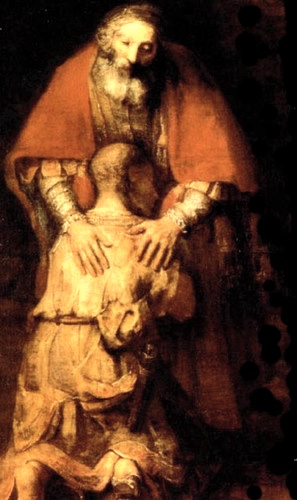
Then Jesus tells us the tender parable of the Prodigal Son, which is really more about the Merciful Father. He receives his contrite child in the same way that God receives us in our repentance.

Sometimes we become so content with ourselves that we fail to realize our need for contrition. Sometimes our failures are buried so deep and so long in us that we become blind to them. Repentance is the grace to break through that blindness.

We were created to be an image of the merciful God we meet in today’s scripture. Where we are short of that in our actions, words, choices and attitudes – that’s where we have need of repentance.

Rembrandt’s magnificent painting captures a sacred feeling that might help our prayer. Sometimes we are the gracious Father – loving, forgiving, hoping and working for life in others. Sometimes we are the son, returning from our own destructive selfishness to seek a new beginning. Sometimes we are a little bit of each.

Music: Father, I Have Sinned – Eugene O’Reilly

Skies Darken for Jesus

Friday, March 22, 2019

Click here for readings

Agnus Dei

Today, in Mercy, we begin with the powerful and moving story of Joseph – sweet, innocent son of of Jacob who was betrayed by his brothers. Jacob sends Joseph to work with his brothers, believing they love him. He was wrong.

Our Gospel then tells the story of the frustrated landowner who sent his son on mission to settle his accounts. though the landowner’s servants had been abused by the tenants, he believed his son would be respected. He was wrong.

Both these stories are prototypes of the Father sending Jesus to redeem us. The intention is the same. The hope is the same. Unfortunately, the result is the same.

In our Gospel, Jesus realizes that the Father’s hope for him will not be met with openness and acceptance. He sees the Pharisees milling around in hateful conversation.  Referencing the parable, Jesus says:

“The Kingdom of God will be taken away from you
and given to a people that will produce its fruit.”
When the chief priests and the Pharisees heard his parables,
they knew that he was speaking about them.
And although they were attempting to arrest him,
they feared the crowds, for the crowds regarded him as a prophet.

This morning, let’s pray for all those who send their beloveds out in hope to do good in the world:

  • for police officers, firefighters, first responders whose families send them out each day always fearing for their safety
  • for medical personnel who risk sickness in their care for others
  • for missionaries and justice workers who encounter threat and danger in helping others
  • for peacekeepers and military who work to end war and tyranny
  • for all of us when we reach out in justice and courage, hoping to be received with respect and mutuality

May the example of Christ inspire and sustain us to do our part for God’s continuing redemption of the world.

Music: Agnis Dei – Michael Hoppè

A Warning Sign

Thursday, March 21, 2019

Click here for readings

generous impulse

Today, in Mercy, our Gospel gives us the disturbing parable of the rich man, sometimes called Dives, and Lazarus, a very poor man.

The story is disturbing because 

  • Lazarus suffers so desperately 
  • Dives is impervious to that suffering 
  • God won’t give Dives a break after his death
  • We fear being in either of these guys’ situations 

Probably, like most people, we’d rather be rich than poor. But would we rather be generous with that wealth or selfish? Do we ever find ourselves thinking thoughts like this, deciding we’re not responsible for the gap between rich and poor:

“I worked hard for what I have. Let everybody else do the same!”

That wealth gap cannot be mended simply by giving a dollar to a corner beggar nor by donating our wornout clothes to Goodwill. This kind of re-balancing requires a conversion of heart which touches our economic, political and moral understanding.

I was struck this morning by this headline from The Economist, a British weekly magazine.

economist

How can today’s Gospel inspire and encourage us in a global culture that infcreasingly marginalizes persons who are poor, resourceless, and politically oppressed?

May the story of Lazarus and Dives influence us to use the powers we have to make just and generous decisions.

  • We can vote for just, generous and moral leaders. 
  • We can advocate for universally just policies. 
  • We can donate to compassionate causes. 
  • We can confront hateful speech and stereotyping. 
  • We can speak and act for justice, peace, inclusivity and mercy.

We just have to be courageous before, like Dives, it is too late for us.

Music:  Act Justly