You have been present to me, God
like light to flame,
like heat to flame
like fluid movement
and energy of shape to flame.
The wax of my life
is consumed in such Presence.
Shall I simply be content
that it burn,
or shall I seek the Transparency
to which it disappears?
Kairos
All the ages that have loved You
sometimes rush into me
like the white falls of a river,
and Your engagement of the earth
from all antiquity
is caught in a great gasp
by the walls of my soul.
In every creature that has ever been
or ever will be, You and I
have been loving each other.
All that treasure swells
in me for a moment
before it thins again into the Chronos
where I seek You in its shadows.
For a second, split in light
I may have held your still
eternal soul within my own.
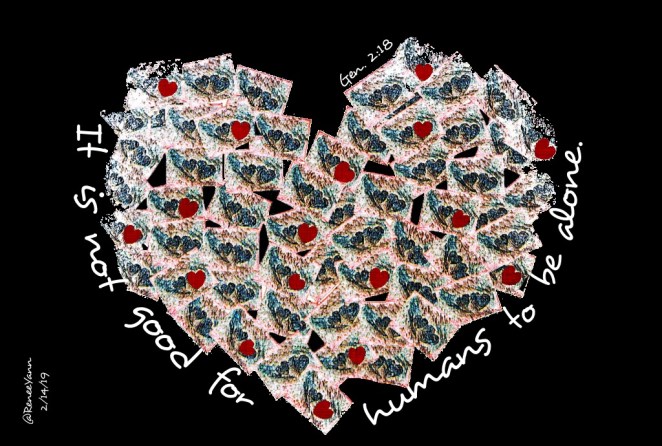
Today, in Mercy, our reading from Genesis tells of the creation of Eve to be Adam’s companion.Theological volumes are written to interpret this passage. But for today’s prayer, let’s draw out one small phrase:
The LORD God said:
“It is not good for this human being to be alone.
God, Who lives in the community of the Trinity, exists within relationship. God knows that is the only way that any life can exist. This leads us to realize that:
We were created from Love for Love
We were meant to learn love in one another’s company.
Our learning with one another is modeled on the perfect triune love of God.
On Valentine’s Day, our culture romanticizes the notion of love (and makes a lot of money doing so!) But it might also be a good day for us to consider what and whom we have fallen in love with all throughout our lives.
The late Father Pedro Arrupé, now being considered for sainthood, was once the superior general of the Jesuit community. Understanding what it meant to be in love with God and God’s Creation, Arrupé wrote this:
Nothing is more practical than finding God, that is, than falling in love in a quite absolute, final way. What you are in love with, what seizes your imagination, will affect everything. It will decide what will get you out of bed in the morning, what you will do with your evenings, how you will spend your weekends, what you read, who you know, what breaks your heart, and what amazes you with joy and gratitude. Fall in love, stay in love and it will decide everything.
(I’ll be sending two of my love poems to God in a later email.I hope you find them helpful to your prayer.)
Music: Love Changes Everything ~ Andrew Lloyd Webber, Charles Hart, Don Black
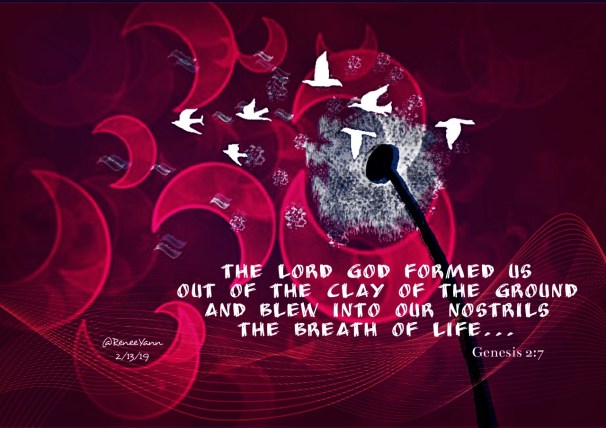
Today, in Mercy, Genesis gives us a picture of our “Original Innocence“. It is a beautiful story, the earth freshly sprung from nothingness, our Ancient Ancestor cradled to life in the palm of God’s hand.
See God gazing at this work of his fingers, bending over it in love. See God draw up his own eternal breath and gently whisper it into this yet lifeless image of God’s own Divinity.
Adam bursts forth, the dazzling image of God Who, liking what He has made, draws a second, even more lovely creature from its side.
All was given to these two glorious creatures – all but the right to consume the knowledge of good and evil. It almost seems that God feared their innocence could not sustain such knowledge. And it ensues that God is right (of course!)
The elegantly profound poet Ranier Maria Rilke captures the drama with this poem:
I read it here in your very Word…
I read it here in your very Word,
From the story of the gestures
With which your hands cupped themselves
Around our becoming, warm and wise.
You said, live loudly and die softly,
And over and over again you said: be.
But before the first death came Murder.
At this, a rift tore
through your ripened spheres,
And a crying-out,
And tore away the voices
That had just begun to gather
To speak you
To carry you,
Over the chasm of everything–
And what they’ve since then stammered
Are fragments
Of your ancient name.
I’ll leave you with this poem, and with your own prayerful thoughts on the divine image of your soul, its original innocence, and the reclamation of that innocence in the gift of Jesus Christ.
Music: For the Music of Creation ~ Shirley Elena Murray & Daniel Nelson
(Lyrics below)
For the music of creation,
for the song your Spirit sings,
for your sound’s divine expression,
burst of joy in living things:
God, our God, the world’s composer,
hear us, echoes of your voice —
music is your art, your glory,
let the human heart rejoice!
Psalms and symphonies exalt you,
drum and trumpet, string and reed,
simple melodies acclaim you,
tunes that rise from deepest need,
hymns of longing and belonging,
carols from a cheerful throat,
lilt of lullaby and lovesong
catching heaven in a note.
All the voices of the ages
in transcendent chorus meet,
worship lifting up the senses,
hands that praise, and dancing feet;
over discord and division
music speaks your joy and peace,
harmony of earth and heaven,
song of God that cannot cease.
I bet I know the first word that popped into your mind when you read today’s headline:PROSECUTION!
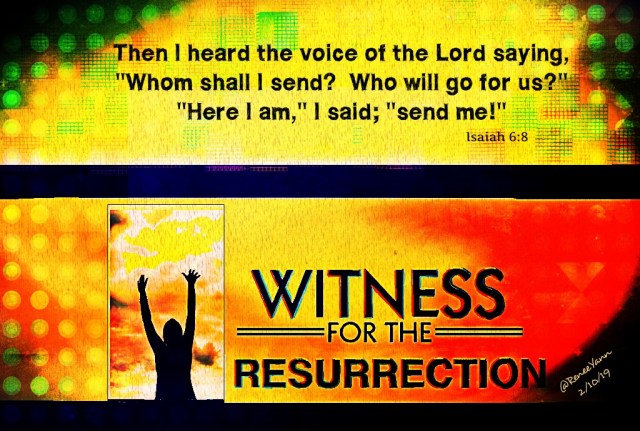
Today, in Mercy, our readings invite us to consider WITNESS — not for the prosecution, but for the RESURRECTION!
In our first reading, we see Isaiah dramatically commissioned to WITNESS to the vision of faith in his heart. He responds wholeheartedly:
Then I heard the voice of the Lord saying, “Whom shall I send? Who will go for us?” “Here I am,” I said; “send me!”
Our second reading, Paul describes how Christ appeared to him and commissioned him, “the least of the Apostles” to be his WITNESS. Paul, too, responds wholeheartedly:
He appeared to me. Therefore, … so we preach and so you believed.
In our Gospel, Simon Peter, James and John are awed by the miraculous power of Jesus as their nets pull hundreds of fish from the otherwise unproductive sea. Jesus tells them that, by their WITNESS, they will attract hundreds of souls to his message. They also respond wholeheartedly:
When they brought their boats to the shore, they left everything and followed him.
For the Word of God to live,
WITNESS is everything.
Macrina Wiederkehr, OSB, in her beautiful book, “Seven Sacred Pauses”, describes the level of WITNESS in the first disciples:
They were impelled to continue proclaiming the Gospel in the face of opposition. They were zealous in preaching because they felt passionate about being entrusted with the sacred message.
Think of this often-heard philosophical conundrum:
If a tree falls in the forest, and no one is there to hear it, does it make a sound?
Logic tells us that it does. But what does it matter if no one hears it?
If the Resurrection happened, and no one bears witness to it, what does it matter? That is the importance of our call to WITNESS – just like Isaiah, Paul, Peter, James, John, and two millennia of believers who carry on the sound of that tomb bursting open to eternal life.
How will we witness to our faith today – not by preachy words or empty opinions, but by our active passion for justice and mercy in the world, and in our own choices?
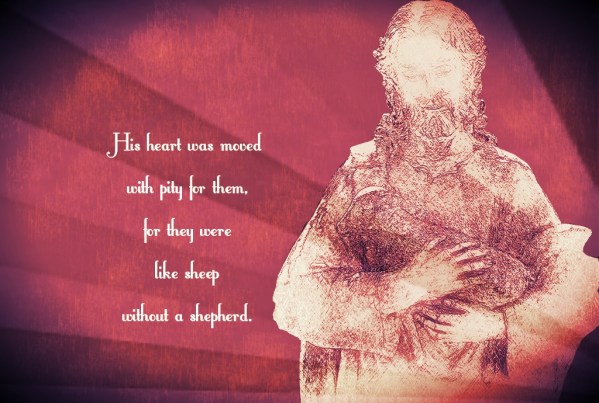
Today, in Mercy,our readings refer to Christ’s infinite compassion by using the image of a shepherd.
It is an image that, while not completely lost on us, is removed from our daily experience. Within the image, though, are elements which transcend time and culture. These elements become clear as we pray with our Responsorial Psalm 23:
Just as Jesus looked at the crowd with pity – (pietàs – a devoted, compassionate love), so he looks on us. It is love like that conveyed in Michaelangelo’s Pietà, where Mary looks on Jesus with a love we cannot imagine.
Psalm 23
(Jesus sees that we need rest from the things that harass our spirits.)
The LORD is my shepherd; I shall not want.
In verdant pastures he gives me repose.
Beside restful waters he leads me;
he refreshes my soul.
R. The Lord is my shepherd; there is nothing I shall want.
(Jesus sees that we need guidance in our complex and morally bereft world.)
He guides me in right paths
for his name’s sake.
Even though I walk in the dark valley
I fear no evil; for you are at my side
With your rod and your staff
that give me courage.
R. The Lord is my shepherd; there is nothing I shall want.
(Jesus sees that we are hungry for deeply spiritual nourishment.)
You spread the table before me
in the sight of my foes;
You anoint my head with oil;
my cup overflows.
R. The Lord is my shepherd; there is nothing I shall want.
(Jesus sees that we need to be assured that we are deeply loved and protected.)
Only goodness and kindness follow me
all wthe days of my life;
And I shall dwell in the house of the LORD
for years to come.
R. The Lord is my shepherd; there is nothing I shall want
What assurance, what pietàs, do we most need from God today?
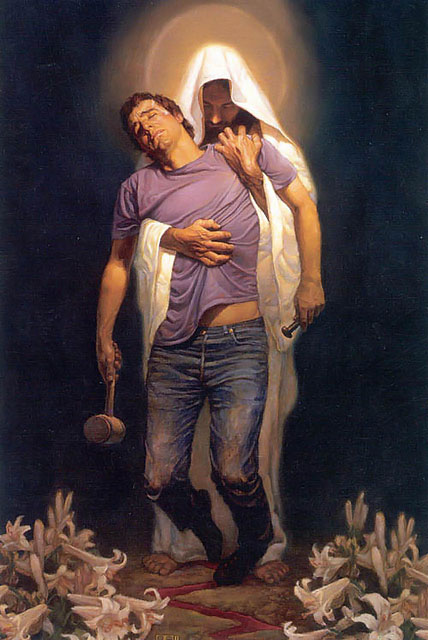
Perhaps these modern images of Pietà will help us with our prayer.
Modern Pietà – Michael BelkChrist Holds the Beloved – Thomas Blackshear
Music: Piè Jesu – Andrew Lloyd Webber
sung here by Lea Salonga & Daniel Rodriguez (note English translation in lower right)
Today, in Mercy, Jesus’s disciples set out on their first solo mission. Most of us can relate to their feelings that morning.
Remember your first real job? You had studied, trained, prepared. You had aced the interview. You bought a new blouse, shirt or pair of shoes. You were IN!
And you were scared. You might have done a dry run to make sure you wouldn’t be late your first day. You checked that your gas tank was topped off. You packed a lunch (or someone who loved you did), and wondered who would eat with you.
The disciples were probably scared too. Look at whose shoes they were following in! And Jesus sets out some tough dress code for their work life:
take nothing but a walking stick
no food, no sack, no money in their belts
wear sandals but not a second tunic.
The behavior code was just as lean:
take a buddy for support
when you enter a house, stay there the whole time
if they don’t welcome you or listen to you, don’t argue
leave there and shake the dust off your feet
As we set out to work each day, do we think of our labor as “ministry”? Do we see that our work in some way benefits the life of the community? Do our interactions with our peers encourage their contributions to the common good?
We all need jobs to earn the means to live. But if that’s all our job is, we will never find happiness in it. Meaningful work must benefit more than ourselves and, in that, it can become a ministry.
If Jesus were sending us out to our workday this morning, he might give instructions like these:
work responsibly, mutually and unselfishly
earn all that you need to be happy, but avoid greed
make sure your labors enhance life for others as well as yourself
if your job chokes your soul, move on
What we do does not determine our worth. How we do it does. We may be sewing buttons on shirts. If we do that with attention and pride, our work will have meaning for us and for others.
Every meaningful job gives us the chance to make the world better for those we serve, and for those with whom we work – to add to the beauty of the world already begun in the blessing of God. Does our work offer us that life-giving opportunity? Do we respond to it wholeheartedly?
Today, in Mercy, I would like to share a homily about today’s Gospel that I prepared for the Catholic Health Association in 2015. Even though it is a little long, I hope you find it fruitful for your prayer.
It is a soft, summer morning in Capernaum and Jesus is in the height of his ministry. Large crowds follow him wherever he goes, crowds hungry with hope; crowds fired by his counter-cultural words and miraculous deeds. This morning, Jesus prepares to speak to them, to translate into language they can comprehend the Eternal Life that lives in his heart. His back is to the gentle, sunlit sea. The hubbub softens to a murmur, finally stilled by the lapping waves.
But before Jesus can begin, a distressed man bursts through the gathered crowd. His robes fly about him as he runs to Jesus and falls at his feet. This man is important, so important that we all have known his name for two thousand years. This is Jairus who lives nearby and organizes the worship in the synagogue. Now breathless and swallowing sobs, Jairus pleads with Jesus: Please! My daughter! You can give her life!
Every loving father has been Jairus at least once in his life. We know these fathers. We are these fathers. They are the ones who burst into emergency rooms with a seizing infant in their arms. They are the ones who stare blankly at the pronouncement of a stillborn child. They are the old men in war-ravaged countries who kneel at the sides of their fallen sons and desecrated daughters. They are all the men throughout history rendered helpless by the forces of unbridled power, greed and death.
The merciful heart of Jesus understands this man and his desperate urgency. Without even a word, Jesus gets up and accompanies Jairus to the place of his pleading.
But there is another urgency pushing forward from the crowds: a woman, apparently of low importance for we have never known her name. She is a woman whom the ages have defined by her affliction. She is “The Woman with the Hemorrhage”. Without the status of Jairus, she approaches Jesus as such a woman must. She crawls behind him at his heels, reaching through the milling masses to even scrape the hem of his garment.
This is a troubled woman, a stigmatized woman. Her life has been spent, literally, in embarrassment, isolation, fatigue and, no doubt, abuse. For twelve years – coincidentally the life span of Jairus’ s daughter – her vitality has bled out of her. Her face is gaunt; her eyes sunken. Her soul’s light is all but extinguished. She is a woman who knows a particular kind of scorn.
We know these women. We are these women. They are the ones filled with remorse for an aborted baby. They are the ones who miscarry their longed-for child. They are the women whose beautiful young sons are profiled, stereotyped and hunted on the violent streets. They are the mothers of “The Disappeared”. They are the women who suffer disproportionately from war, poverty, hunger and violence. They are trafficked women, prostituted women, women victimized by the long saga of domination and dehumanization.
It is just such a broken woman who stretches her fingers through the Galilean dust in a last reckless reach for healing. She finds only the hem of his robe. Touching it, she is transformed, like a parched meadow in the spring rain. Her whole being reaches up to receive the holy restoration. She knows herself to be healed. And it is enough; it is everything. She retreats into the resignation of her otherwise lonely life.
But Jesus wants more for us than just the practical miracles we beg for. We ask for one healing; Jesus wants our eternal salvation. We ask for one blessing; Jesus wants our entire lives to be filled with grace. We ask for one prayer to be answered; Jesus wants our life to become a prayer.
Jesus feels the electrical touch of her hope. He feels the secret healing she has extracted from him. He turns to seek her. Can you see their eyes meet? Yes, the bleeding has been stemmed, but he sees the deeper wounds that scar her soul. His look of immense mercy invites her to tell him “the whole truth”. By her touch, she has commandeered a physical healing. But by his gracious turning toward her, her entire being is renewed. In this sacred glance, her history has been healed. Her future has been pulled from darkness into light. Her capacity to love has been rekindled. She now and forever will remember herself as a child of God.
Jairus waits, no doubt impatiently, at the edge of this miracle, anxious for such power to touch his daughter’s life. He fears they have lingered too long with the woman. His servants arrive, confirming his fears. He receives the dreaded report, “Your daughter has died.”
Jesus now pushes Jairus to the gauntlet of pure faith. In the face of this devastating news, Jesus tells him, “Do not be afraid; just have faith.” Is this not an almost impossible command? Like Jairus, we all know what it is to worry for our children:
Fathers of color teach their sons behaviors to protect them from profiling.
Immigrant parents fear their children will be ripped from them in a pre-dawn raid.
Famine-ravaged mothers watch their children disappear into hunger.
In hospitals and doctor’s offices, devastated parents summon the courage to accompany their critically ill child.
And Jesus says, “ Don’t be afraid. Have faith.”! What can he possibly mean?
Perhaps it is this simple. In Jairus’s home, Jesus takes the dead girl’s hand. He says, “Talitha, koumi – Little girl, arise.” His call to her heart tells her there is no darkness, devastation or death from which God cannot draw us into life. This is the truth Jesus brings to the little girl and to us. But it is a truth that, in our fear and need, we cannot always see.
For the moment, this girl lives. But at some time in history she, like all of us, will die. So the miracle is not the restoration of her life. The miracle is that her eyes, and her parents’ eyes, are opened to the power of God over death. Despite all appearances, God’s life endures eternally.
This is the revelation of this Gospel passage. If we live by faith, we live beyond cure into healing. If we live by faith, even death can bring life. If we live by faith, we are free to release all worry into the abundant mercy of God who grants us healing even beyond our asking or desire.
Man or woman, old or young, at some time in our lives each one of us has been Jairus. Each one of us has been one or the other of these two women. Within their stories of woundedness and deep faith, our stories shelter. Jairus and the afflicted women – unnamed like so many women throughout time – believed there was a way to new life. They reached for it. They begged for it. What is it in us that cries out for such healing? What is it in us that, without the touch of Jesus, teeters on the verge of death?
Simply by believing, these three Gospel figures became new beings. Simply by believing, their orientation changed from darkness to light. By their example, let us lift up those wounded and deadened places in our hearts and world before the loving gaze of Jesus.
To what suffering in our souls is God whispering the encouragement, “Talitha, koum”? What is the “whole truth” Jesus is inviting us to confide? Let us arise and respond to him in the full energy of our faith. Let us gaze with boundless confidence into the eyes of God’s mercy.
Today, in Mercy, our readings are all about God’s transforming power and our human ability to tap into that power by our faith.
Hebrews 11 references several heroes, named and unnamed, whose faith and perseverance were so great that, “The world was not worthy of them.”
Mark’s Gospel tells the story of the Gerasene demoniac, a story with many layers of meaning and challenge. In it, Jesus demonstrates an astounding power that both amazes and frightens his audience.
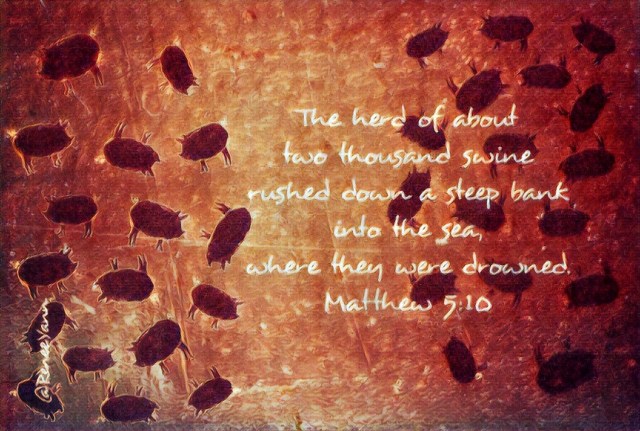
We have the very detailed description of the demoniac, a wild, unnaturally strong and violent man. We have the Gerasene community which doesn’t know what else to do to control the disruptive forces of this wretched man. And we have an innocent, unsuspecting herd of pigs.
Jesus is unafraid of the forces erupting from this troubled man. He approaches the man’s suffering on a whole different level from the unsuccessful tactics of the community.Jesus speaks to the man’s soul which has been shattered into many howling fragments by the evil dwelling inside him. Jesus then casts out that evil in a demonstration that both awes and angers his observers.
Imagine how the pig farmers felt. Their livelihood lay drowning at the bottom of a precipice! The food supply, water integrity, employment opportunities all took a steep drop in that one moment of Christ’s command. In healing this broken man, who is representative of all suffering humanity, Jesus disrupted the comfortable systems which had allowed him to be isolated and chained at the edge of this society.
Jesus challenged this whole community to see the world from a different perspective – a spiritual one in which human life and wholeness is at the heart of all our societal systems. This man was more important than a herd of 2000 pigs!
These readings challenge us who live in a surface world “not worthy” of our faith.
There is incredible suffering throughout this world. It is not enough to simply pray that it is alleviated. It is surely not enough to “chain” it by our indifference and acceptance.
Global suffering will be addressed only by confronting our comfortable systems (our herd of pigs). Our legal, political, economic and social systems must cherish the integrity of the human person. Otherwise, they should be challenged, changed, and maybe even cast away.
Our small part is to learn, understand, choose, vote and speak out for this kind of wholeness – both in our immediate, personal experiences as well as through the social justice structures available to us. For example:
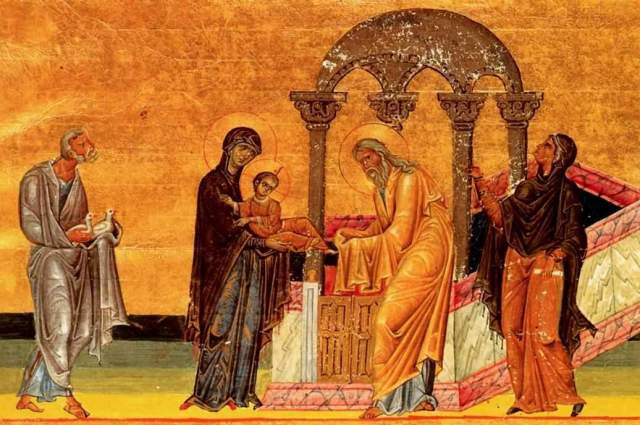
Today, in Mercy, we celebrate the feast of the Presentation of Jesus in the Temple.
Icon from The Menologion of Basil II, an illuminated manuscript designed as a church calendar or Eastern Orthodox Church service book (menologion) that was compiled c. 1000 AD, for the Byzantine Emperor Basil II
This event is layered with human and Divine dimensions. It is filled with memorable characters and key moments in their lives. One or more of their stories may touch your own experience as you pray today.
The infant Jesus, just forty days old, is presented and dedicated in the Temple, setting in motion his whole life as the fulfillment of Jewish expectation. We may reflect on the power of our own Baptisms. If we were infants when baptized, we may recall who carried us to the font and who stood for our dedication to Christ.
Mary and Joseph came to the Temple that day for the ritual of Purification. They place their young marriage, and their beginning parenthood, into the circle of their Jewish faith. We may reflect on those points of religious dedication in our own lives – marriage, religious profession, ordination, Confirmation, and just how much the sacred nature of these events impacts our daily living.
Anna and Simeon, long-faithful servants of God, rejoice in the fulfillment of their hopes for the Messiah. Those of us richer in years might gratefully reflect on God’s fidelity to us over the course of our lifetime, and what sacred hopes we still might long to have fulfilled.
Simeon, so completed by seeing his Savior, intones the moving prayer Nunc Dimittis – “Now You may dismiss your servant in peace.” We might pray for those who are nearing their life’s close that they may be blessed with peace. We might also pray for ourselves that we will experience peace and joy at the end of our lives.
And finally venerable Anna who, woman to woman, stood beside young Mary as Mary faced Simeon’s painful words:
Behold, this child is destined
for the fall and rise of many in Israel,
and to be a sign that will be contradicted
and you yourself a sword will pierce
so that the thoughts of many hearts may be revealed.
Music: Bach – Cantate BWV 125 – Mit Fried und Freud ich fahr dahin
Johann Sebastian Bach composed the cantata Mit Fried und Freud ich fahr dahin– With peace and joy I depart), BWV 125, for use in a Lutheran service. He composed this in 1725 for the feast for the Purification of Mary which is celebrated on 2 February and is also known as Candlemas. The cantata is based on Martin Luther’s 1524 Hymn.
Mit Fried und Freud ich fahr dahin
In Gottes Willen,
Getrost ist mir mein Herz und Sinn,
Sanft und stille.
Wie Gott mir verheißen hat:
Der Tod ist mein Schlaf worden.
With peace and joy I go on my way
in God’s will.
My heart and mind are comforted,
peaceful and calm.
As God promised me
death has become my sleep.
You choose to own me
despite and within everything,
in a place
at the core of my life,
both removed and essential.
At that wordless
unwordable pool,
I bless You, singular
and whole,
and bow before Love as
it laps at the edges of my soul,
as it breaks
in pure revelation
that holiness
exceeds any act of will;
that grace is a desirous God
who possesses me there.
Union
Still ourselves, we are more one
than separate now,
Heart over heart, heart within Heart,
like a word’s meaning
caressed within its sound.
I drink from that union
like the verdant earth drinks
from its deep reserve of water.
It is Your color that flushes the shape
of every blossom sprung from me.
But that water, once tasted
precludes satiety by any other water.
There is no return for me now
to a season not fed by you.
What I have given you, then
is the whole seed of my life.








 Lavish Mercy