Power of the Keys

Friday, February 22, 2019

Click here for readings

Peter_keys

Today, in Mercy, we celebrate  the Feast of the Chair of Saint Peter, Apostle. It seems both fitting and painfully ironic that this feast should coincide with the Pope’s Summit on Protection of Minors in the Church. When He handed the “keys” to Peter, could Christ ever have foreseen that his beloved church would descend to this shame?

Factions in the Catholic Church argue over where to place the blame for this horror. Some point to the entitlements of clericalism. Some point to more liberal stances on sexuality. The most vocal factions use their voices to blame others rather than look to their own faults. 

But today’s Gospel suggests that none of these explanations goes to the root of the crisis.

What Christ handed Peter was POWER. Our Gospel says that this power was to be used to map the journey to heaven for the rest of us – appropriately “binding” and “loosening” the guidelines of that journey.

That’s a lot of power!

Unfortunately, the famous quote of John Dalberg-Acton, a 19th century Catholic writer, too often proves true. He said:

Power tends to corrupt.
And absolute power corrupts absolutely.

What was it that Jesus saw in Peter to give him hope for Peter’s incorruptibility?

  • Peter, who abandoned his livelihood in full devotion to the call. 
  • Peter, who tried to protect his beloved Lord from the wrath of the Pharisees
  • Peter who, defending Jesus in the Garden, cut off the ear of Malchus
  • Peter, who recognized and begged forgiveness for his weakness
  • Peter, who chose an inverted crucifixion because he deemed himself unworthy to die as his master did.

Power fueled by this kind of single-hearted devotion and humility is the true “Power of the Keys”. It suffers no shadow of greed, self-importance, domination, or lust. It is always “power for” not “power over” others.

Until our church structures foster this kind of mutual, non-exclusionary power in our leaders AND members, we have little hope of transformation.

Let us pray for true insight and courage for those gathered in Rome.

Music: (Maybe the Cardinals could sing this song in their hearts on the way to their meetings? Maybe we could sing it too sometimes?)

Lay It Down – Moxie Gibson

Open to Hope

Wednesday, February 20, 2019

Click here for readings

Today, in Mercy, each of our readings talks, in some way, about hope and second efforts.

Gen8_6 hatch

Dear old Noah, getting cabin fever after nearly forty days with hundreds of animals, opens the hatch he has built into his ark. His action is a sign of hope. He sends a raven out to test if his hope is justified.

Alas, the raven finds no place to land.  So Noah tries a few more times by launching a dove through the hopeful hatch, until finally the dove returns with an olive leaf – the first sign of renewed Creation.

In our Gospel, even Jesus has to give his miracle a second try! The first time around, the blind man sees “walking trees”. So Jesus gives it a second shot, this time without spittle. The story is so human and so hopeful in God’s power!

These stories encourage us to pray with immovable hope for the things we need; to open the hatch of our heart and wait for the olive leaf; to trust that God will give us, in God’s own beautiful form, the perfect answer to our prayer.

Music: Beautiful Things ~ Gungor

Genesis – Get Out of My Garden!

Saturday, February 16, 2019

Click here for readings

in every age

Today, in Mercy, Adam and Eve get to “pay the piper”. Now, they have to answer to God for the delicious, forbidden bite!

And God is tough on them! No hint of that “lavish mercy”! Of course, the writer(s) of Genesis had to fold a lot of explanations into this story such as:

  • why we feel body shame
  • why we are estranged from nature
  • why women suffer labor
  • why men work hard to no avail
  • why we die

We know that these explanations were written originally to meet the questions of an ancient culture. They were told and retold in the form of a story with all that structure’s inherent possibilities and handicaps.

Some of us are inclined to accept “story” only as history, demanding that the events recount specific concrete people and interactions. In other words, we demand that Adam and Eve were real people with a historical identity.

Some of us accept the “story” only as myth, not necessarily integral to the foundation of our modern faith.

The great biblical scholar Walter Bruggemann says neither stance is accurate. He says that these sacred stories are “mystery” which continue to unfold through the ages in the faith-life and sharing of the living community.

As we pray with these passages, we may deepen our faith by looking for the revelations within them:

  • God created us in God’s own image
  • God formed a covenant of love with us
  • We are called to be responsive to that loving covenant 
  • We sometimes fail and reap the fruits of that failure
  • But God did not dissolve Creation nor the Covenant
  • And so, in every age, we place our hope in Jesus Christ, the New Creation and New Covenant

Music: In Every Age ~ Janet Sullivan Whitaker

Be Opened!

Friday, February 15, 2019

Click here for readings.

Today, in Mercy, our readings are about being opened by the grace and power of God.

ephphatha

In the Genesis passage, Eve and Adam eat fruit from the tree of knowledge. Their eyes are opened to good and evil.

In our reading from Mark, Jesus opens the ears of a deaf man, allowing him both to hear and to speak clearly.

In the first passage, Adam and Eve’s new “openness” brings a burden. Their innocence now fractured, they must forever exercise their free will to choose good over evil.

In the second passage, the deaf man’s burdens are lifted. He now has no obstacle to hearing and proclaiming God’s mercy.

Like Adam and Eve, we bear the burden of knowledge in a disturbing and sinful world. Every choice challenges us to be and do good in a culture of human degradation.

But like the man who was cured, we have been transformed by Christ’s touch. We see, not just with the discernment of good and evil, but with God’s eyes – with the power to see past death to life.

This power is expressed in our lives by:

  • our faith in a world filled with uncertainty
  • our hope in a world trapped in despair
  • our love in a world blinded by selfishness and greed

Every morning, God wakes us and says, “Ephphatha – be a sign of my gracious openness in your world because I am that Openness for you.”

Today, in our prayer, let us find what is closed in us. We may have judged and shut out someone. We may have given up on a good and necessary practice. We may have withdrawn from a generous responsibility. We may have capitulated to a life-sapping addiction. Inside us somewhere, we may have curled up into  “No”!

God calls us to be a “Yes” to the abundance of life and grace God offers us. We are called to open, to be “uncurled”. This poem by e.e.cummings has helped me on occasion with such uncurling.

love is a place
& through this place of
love move
(with brightness of peace)
all places

yes is a world
& in this world of
yes live
(skillfully curled)
all worlds

Music: Open My Eyes, Lord

Valentine’s Poems

pexels-photo-220483

Consummation

You have been present to me, God
like light to flame,
like heat to flame
like fluid movement
and energy of shape to flame.

The wax of my life
is consumed in such Presence.
Shall I simply be content
that it burn,
or shall I seek the Transparency
to which it disappears?


ocean

Kairos

All the ages that have loved You
sometimes rush into me
like the white falls of a river,
and Your engagement of the earth
from all antiquity
is caught in a great gasp
by the walls of my soul.

In every creature that has ever been
or ever will be, You and I
have been loving each other.
All that treasure swells
in me for a moment
before it thins again into the Chronos
where I seek You in its shadows.

For a second, split in light
I may have held your still
eternal soul within my own.

Music: Bach: Jesu, Joy of Man’s Desiring

Love Really Is Everything!

Thursday, February 14, 2019

Readings:  http://www.usccb.org/bible/readings/021419.cfm

Today, in Mercy, our reading from Genesis tells of the creation of Eve to be Adam’s companion.Theological volumes are written to interpret this passage. But for today’s prayer, let’s draw out one small phrase:

The LORD God said:
“It is not good for this human being to be alone.

Gen2_18 Eve

God, Who lives in the community of the Trinity, exists within relationship. God knows that is the only way that any life can exist. This leads us to realize that:

  • We were created from Love for Love
  • We were meant to learn love in one another’s company.
  • Our learning with one another is modeled on the perfect triune love of God.

On Valentine’s Day, our culture romanticizes the notion of love (and makes a lot of money doing so!) But it might also be a good day for us to consider what and whom we have fallen in love with all throughout our lives.

The late Father Pedro Arrupé, now being considered for sainthood, was once the superior general of the Jesuit community. Understanding what it meant to be in love with God and God’s Creation, Arrupé wrote this:

Nothing is more practical than finding God, that is, than falling in love in a quite absolute, final way. What you are in love with, what seizes your imagination, will affect everything. It will decide what will get you out of bed in the morning, what you will do with your evenings, how you will spend your weekends, what you read, who you know, what breaks your heart, and what amazes you with joy and gratitude. Fall in love, stay in love and it will decide everything.

(I’ll be sending two of my love poems to God in a later email.  I hope you find them helpful to your prayer.)

Music: Love Changes Everything ~ Andrew Lloyd Webber, Charles Hart, Don Black

Original Innocence

Wednesday, February 13, 2019

Click here for Readings

Today, in Mercy, Genesis gives us a picture of our “Original Innocence“. It is a beautiful story, the earth freshly sprung from nothingness, our Ancient Ancestor cradled to life in the palm of God’s hand.

Gen2_7 breath

See God gazing at this work of his fingers, bending over it in love. See God draw up his own eternal breath and gently whisper it into this yet lifeless image of God’s own Divinity.

Adam bursts forth, the dazzling image of God Who, liking what He has made, draws a second, even more lovely creature from its side.

All was given to these two glorious creatures – all but the right to consume the knowledge of good and evil. It almost seems that God feared their innocence could not sustain such knowledge. And it ensues that God is right (of course!)

The elegantly profound poet Ranier Maria Rilke captures the drama with this poem:

I read it here in your very Word

I read it here in your very Word,
From the story of the gestures
With which your hands cupped themselves
Around our becoming, warm and wise.

 You said, live loudly and die softly,
And over and over again you said: be.

But before the first death came Murder.

At this, a rift tore
through your ripened spheres,
And a crying-out,
And tore away the voices
That had just begun to gather
To speak you
To carry you,
Over the chasm of everything–

 And what they’ve since then stammered
Are fragments
Of your ancient name.

I’ll leave you with this poem, and with your own prayerful thoughts on the divine image of your soul, its original innocence, and the reclamation of that innocence in the gift of Jesus Christ.

Music: For the Music of Creation ~ Shirley Elena Murray & Daniel Nelson
(Lyrics below)

For the music of creation,
for the song your Spirit sings,
for your sound’s divine expression,
burst of joy in living things:

       God, our God, the world’s composer,
hear us, echoes of your voice —
music is your art, your glory,
let the human heart rejoice!

Psalms and symphonies exalt you,
drum and trumpet, string and reed,
simple melodies acclaim you,
tunes that rise from deepest need,

       hymns of longing and belonging,
carols from a cheerful throat,
lilt of lullaby and lovesong
catching heaven in a note.

All the voices of the ages
in transcendent chorus meet,
worship lifting up the senses,
hands that praise, and dancing feet;

       over discord and division
music speaks your joy and peace,
harmony of earth and heaven,
song of God that cannot cease.

Witness for the …

Sunday, February 10, 2019

Click here for readings

I bet I know the first word that popped into your mind when you read today’s headline:  PROSECUTION!

Agatha-Christies-Witness-for-the-Prosecution-set-for-BBC-One-remake-767x421

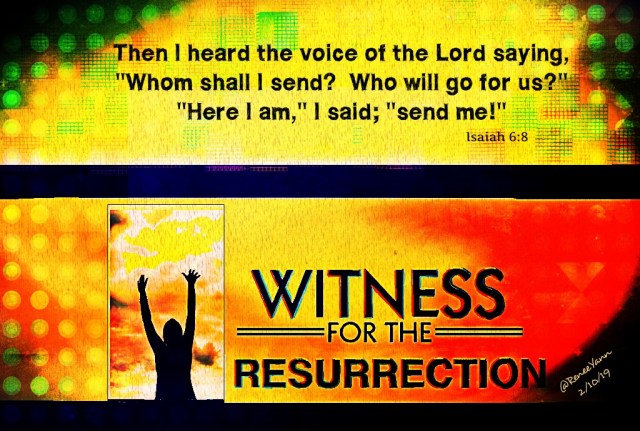
Today, in Mercy, our readings invite us to consider WITNESS — not for the prosecution, but for the RESURRECTION!

Is6_8 witness

In our first reading, we see Isaiah dramatically commissioned to WITNESS to the vision of faith in his heart. He responds wholeheartedly:

Then I heard the voice of the Lord saying,
“Whom shall I send?  Who will go for us?”
“Here I am,” I said; “send me!”

Our second reading, Paul describes how Christ appeared to him and commissioned him, “the least of the Apostles” to be his WITNESS. Paul, too, responds wholeheartedly:

He appeared to me.
Therefore, … so we preach and so you believed.

In our Gospel, Simon Peter, James and John are awed by the miraculous power of Jesus as their nets pull hundreds of fish from the otherwise unproductive sea. Jesus tells them that, by their WITNESS, they will attract hundreds of souls to his message. They also respond wholeheartedly:

When they brought their boats to the shore,
they left everything and followed him.


For the Word of God to live,
WITNESS is everything.


Macrina Wiederkehr, OSB, in her beautiful book, “Seven Sacred Pauses”, describes the level of WITNESS in the first disciples:

They were impelled to continue proclaiming the Gospel in the face of opposition. They were zealous in preaching because they felt passionate about being entrusted with the sacred message.

Think of this often-heard philosophical conundrum:

If a tree falls in the forest,
and no one is there to hear it,
does it make a sound?

Logic tells us that it does. But what does it matter if no one hears it?

If the Resurrection happened, and no one bears witness to it, what does it matter? That is the importance of our call to WITNESS –   just like Isaiah, Paul, Peter, James, John, and two millennia of believers who carry on the sound of that tomb bursting open to eternal life.

How will we witness to our faith today – not by preachy words or empty opinions, but by our active passion for justice and mercy in the world, and in our own choices?

Music: I Will Stand as a Witness for Christ

Merciful Jesus – Piè Jesu

Saturday, February 9, 2019

Click here for readings

rgular shepherd

Today, in Mercy,  our readings refer to Christ’s infinite compassion by using the image of a shepherd.

It is an image that, while not completely lost on us, is removed from our daily experience. Within the image, though, are elements which transcend time and culture. These elements become clear as we pray with our Responsorial Psalm 23:

Just as Jesus looked at the crowd with pity – (pietàs – a devoted, compassionate love), so he looks on us. It is love like that conveyed in Michaelangelo’s Pietà, where Mary looks on Jesus with a love we cannot imagine.

rome pieta

Psalm 23
(Jesus sees that we need rest from the things that harass our spirits.)

The LORD is my shepherd; I shall not want.
In verdant pastures he gives me repose.
Beside restful waters he leads me;
he refreshes my soul.
R. The Lord is my shepherd; there is nothing I shall want.

(Jesus sees that we need guidance in our complex and morally bereft world.)
He guides me in right paths
for his name’s sake.
Even though I walk in the dark valley
I fear no evil; for you are at my side
With your rod and your staff
that give me courage.
R. The Lord is my shepherd; there is nothing I shall want.

(Jesus sees that we are hungry for deeply spiritual nourishment.)
You spread the table before me
in the sight of my foes;
You anoint my head with oil;
my cup overflows.
R. The Lord is my shepherd; there is nothing I shall want.

(Jesus sees that we need to be assured that we are deeply loved and protected.)
Only goodness and kindness follow me
all wthe days of my life;
And I shall dwell in the house of the LORD
for years to come.
R. The Lord is my shepherd; there is nothing I shall want

What assurance, what pietàs, do we most need from God today?
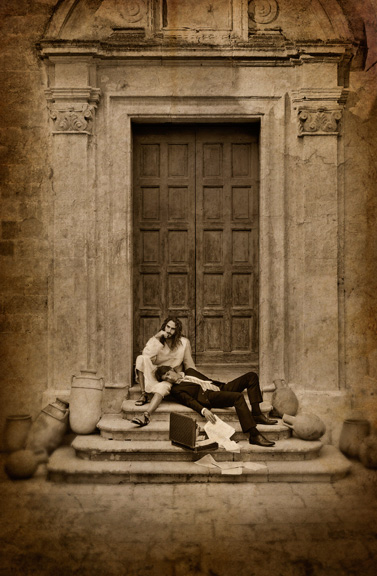
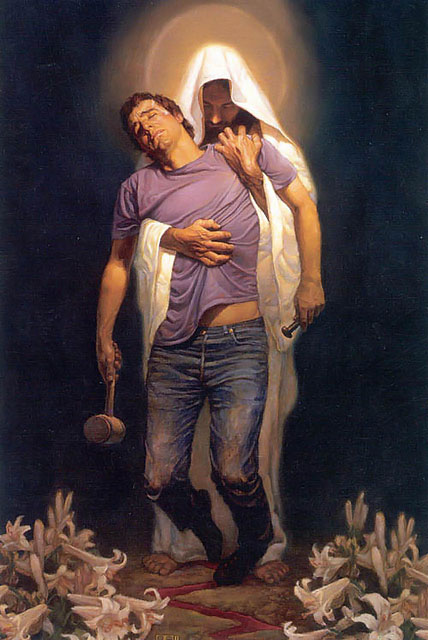
Perhaps these modern images of Pietà will help us with our prayer.

pieta modern
Modern Pietà – Michael Belk
standing piets
Christ Holds the Beloved – Thomas Blackshear

Music: Piè Jesu – Andrew Lloyd Webber
sung here by Lea Salonga & Daniel Rodriguez
(note English translation in lower right)

Add to the Beauty

Thursday, February 7, 2019

Click here for readings

Mk16_15 add to beauty

Today, in Mercy, Jesus’s disciples set out on their first solo mission. Most of us can relate to their feelings that morning.

Remember your first real job? You had studied, trained, prepared. You had aced the interview. You bought a new blouse, shirt or pair of shoes. You were IN!

And you were scared. You might have done a dry run to make sure you wouldn’t be late your first day. You checked that your gas tank was topped off. You packed a lunch (or someone who loved you did), and wondered who would eat with you.

The disciples were probably scared too. Look at whose shoes they were following in! And Jesus sets out some tough dress code for their work life:

  • take nothing but a walking stick
  • no food, no sack, no money in their belts
  • wear sandals but not a second tunic.

The behavior code was just as lean:

  • take a buddy for support
  • when you enter a house, stay there the whole time
  • if they don’t welcome you or listen to you, don’t argue
  • leave there and shake the dust off your feet

As we set out to work each day, do we think of our labor as “ministry”? Do we see that our work in some way benefits the life of the community? Do our interactions with our peers encourage their contributions to the common good?

We all need jobs to earn the means to live. But if that’s all our job is, we will never find happiness in it. Meaningful work must benefit more than ourselves and, in that, it can become a ministry.

If Jesus were sending us out to our workday this morning, he might give instructions like these:

  • work responsibly, mutually and unselfishly 
  • earn all that you need to be happy, but avoid greed
  • make sure your labors enhance life for others as well as yourself
  • if your job chokes your soul, move on

What we do does not determine our worth. How we do it does. We may be sewing buttons on shirts. If we do that with attention and pride, our work will have meaning for us and for others.

Every meaningful job gives us the chance to make the world better for those we serve, and for those with whom we work – to add to the beauty of the world already begun in the blessing of God. Does our work offer us that life-giving opportunity? Do we respond to it wholeheartedly?

Song: Add to the Beauty ~ Sara Groves