“The coming of the Kingdom of God cannot be observed,
and no one will announce, ‘Look, here it is,’ or, ‘There it is.’
For behold, the Kingdom of God is among you.”
And it remains a bit of a secret, even after He tells it, because it is often very hard to discern the “Kingdom among us”. There is nothing more invisible than something hiding in plain sight.
Through prayer, we discover that it is about our eyes – not visibility. It is about the power of grace within us to see beyond appearances. We need a soul that can “peel the onion” of experience to find the face of God resident within all things.
With that kind of eyes, you don’t just have a business meeting today. You have an opportunity to build God’s Kingdom through respect, encouragement and mutuality.
You don’t just pass a person begging on the corner. You walk near Christ himself accompanying a broken spirit.
You don’t just encounter the hurts and challenges of your life. You are invited by God into a living faith that finds his will in all things.
You don’t live in the world with just other creatures. You meet and honor the Divine Presence in every living thing.
Indeed, the Kingdom of God is right here among us.
May we see it!
May we treasure it!
May we reveal it!
Today, in Mercy, we learn lessons from widows – those whose place in biblical times was uncertain and frightening. Without a husband, a woman experienced diminished standing in the legal, financial and political life of the community.
She was often dependent on charity, and was deemed fortunate to capture a bit of good will from those in better circumstances.
There are several examples of widows being blessed by miracles, because they were among those most in need of them.
In today’s first reading and in the Gospel, we meet two widows displaying amazing charity and character strength.The widow of Zarephath steadfastly prepares for death because she has nothing left to live on. When Elijah asks to share in her last few cornmeal cakes, she does not hesitate to feed him.
In our Gospel, it is significant that, just across the road from the well-stocked treasury, a nearly penniless widow gives her last coins to the poor.
In Elijah’s account, we learn the outcome of the widow’s generosity.She reaps an abundant reward in perpetual flour and oil to sustain her.
We never learn what happens to Jesus’s widow. We are left to imagine that, in some way, her selflessness is rewarded.
It is so hard to give it all to God, especially if we feel we have little left for ourselves.It is hard to give our love when we feel empty-hearted.It is hard to give care when we feel unappreciated.It is hard to assist others when we ourselves are exhausted. It is hard to do good if no one, not even God, seems to notice.
But God does notice.Like Jesus on that long-ago afternoon, God is watching as we empty our coffers in service and care for the poor, sick, troubled and lost.
What we have to give may be small — a single corn cake or two little coins. It is the act of givingit that is large — and will make our hearts large by the choice.
One this date in 1841, Catherine McAuley, the first Sister of Mercy, died. She had given everything she had — a fortune actually.. and a life — for God’s poor and needy.Let’s call on her to inspire us to greater charity and mercy. God knows we need to do something for this aching world!
Today, in Mercy, we meet the Shepherd bringing the lost lamb home.Haven’t we all, at sometime in our lives, been carried on those sacred shoulders?
Whether by our own prayers, or the prayers of those who love us, have we not been rescued from sorrow, foolishness, isolation or fear?
This beautiful Gospel assures us of the one thing we most deeply need – we are cherished, irrevocably, by God.
This morning, if we need to ride those shoulders, let us trust ourselves to them in prayer.
If, by grace, we are already home, let us pray for those feeling most lost or abandoned – those most beset by a hostile world. May our merciful action help lift them to peace and the sweet scent of God so close beside them.
Music: I Will Carry You – Sean Clive
I will carry you when you are weak.
I will carry you when you can’t speak.
I will carry you when you can’t pray.
I will carry you each night and day.
I will carry you when times are hard.
I will carry you both near & far.
I’ll be there with you whenever you fall.
I will carry you through it all.
My arms are wider than the sky,
softer than a little child,
stronger than the raging,
calming like a gentle breeze.
Trust in me to hold on tight because
I will carry you when you can’t stand.
I’ll be there for you to hold your hand.
And I will show you that you’re never alone.
I will carry you and bring you back home.
Not pain, not fear, not death, no nothing at all
can separate you from my love.
My arms and hands will hold you close.
Just reach out and take them in your own.
Trust in me to hold on tight.
I will carry you.
Today, in Mercy,we continue our readings from Paul’s inspiring letter to the Philippians. Paul sincerely loves this community and wants them to be perfected in Christ.
This is what Jesus wants for us too.Today’s Gospel is just one example of Jesus showing his followers the way to holiness. He uses the opportunity of a dinner to remind those gathered that they are very fortunate. Their lives are like a banquet compared with the lives of those who are poor and burdened.
He suggests that his followers do what God would do:
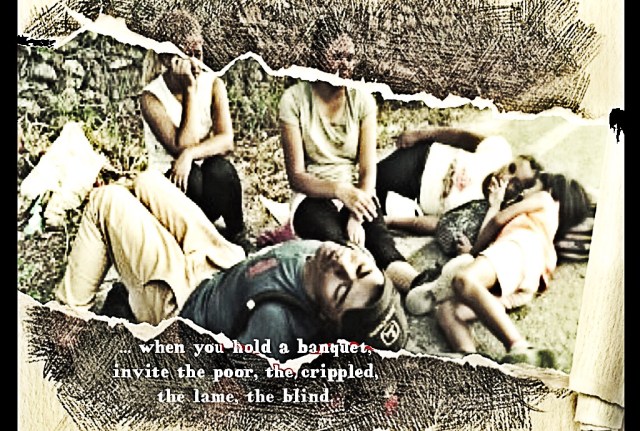
When you hold a banquet,
invite the poor, the crippled, the lame, the blind; blessed indeed will you be because of their inability to repay you….
Just such an opportunity to be blessed awaits us, in the USA, at our southern border. A wave of God’s beloved poor and besieged washes toward us. Will we meet them with true mercy and justice born out of Christian charity? Or will we confront them with a brutal show of power born of fear and alienation?
Of course, there are legitimate concerns with such a large migration. But these concerns must be met with wisdom and prudence, not prejudice and vilification. This is not a horde of animals attacking us. These are human beings desperately seeking a better life.
Jesus thought that his table companions, gifted as they were by God, had the moral capacity to respond to his challenge. Can he expect the same of us?
Let’s hope so, because our Gospel closes with a very compelling reason:
“For you will be repaid
(one way or the other, I might add)
at the resurrection of the righteous.”
Today, in Mercy, our Gospel presents the blind man, Bartimeus. He is an otherwise unknown character in scripture. Yet this short passage suggests so much about him.
It is stated that he was the son of Timeus, apparently someone of note in the community – otherwise, why mention his name? And yet this notable man’s blind son is left to begging on the side of the road. Had disability driven father and son apart? Was Dad unable to accept a son with a physical challenge?
The passage also reveals that Bartimeus knew about Jesus. Perhaps while begging in the public square, he talked and listened. He daydreamed about what he planned to do if he should ever have a chance to meet Jesus!
His cronies in the marketplace were not very supportive. They told him to shut up, even as he pathetically cried for Jesus’s mercy. Still, Bartimues persisted and Jesus heard him.
When he comes to Jesus, Jesus asks, “What do you want me to do for you?” It has always struck me as a strange question. The man is obviously blind, stumbling through the crowd on some disciple’s arm. Why did Jesus bother to ask what Bartimeus wanted?
This might be the lesson hidden in this Gospel. We need to name and claim our needs before God can reach through and transform them. If we don’t even know we’re “blind”, how can we know we’re cured? If we don’t present our needs to God, how can we believe that it is God Who has healed us?
The freshly cured Bartimeus, eyes wide open in grace, now follows along the path with Jesus. All the “shut-uppers” are silenced. Perhaps, Timeus weeps off in a doorway to see the power of his son’s faith and Jesus’s love.
How might our lives be changed if we had that kind of faith… that kind of love?
Music: Don’t Pass Me By – Fred Hammond (lyrics below)
There was a blind man on the road side, and he heard a commotion
It was Jesus passing by with a crowd and it stirred his emotions
He’d been displaced his whole life, should he even try
Don’t bother Jesus (they say you have nothing)
You have nothing to offer (stay in your place)
Right then he knew(he had to choose)
He had nothing to lose
So he cried Jesus (Jesus), I need you, please don’t pass me by
He cried out Jesus, I’m not ashamed(to tell you) I need you in my life
(I need you in my life)
I’m not much different from that man, and this is the honest truth
Could this sinful one, with this messed up life, could I ever serve you
people and things clutter my mind, should I even try
Don’t bother Jesus (they say you have nothing)
You have nothing to offer (stay in your place)
Right then he knew (he had to choose)
He had nothing to lose
So I cry Jesus(Jesus), I need you
Please don’t pass me by
I’m crying out Jesus, I’m not ashamed to tell you I need you in my life
As the deer (as the deer panted)
Thirsty for the water yeah(thirsty for the water)
My soul desires and longs to be(to be with you)
Jesus, I need you, please don’t pass me by
I don’t mean to waste your time but I can’t listen to the crowd, Situations in my life telling me to keep it down
But I need you
I know I’m broken, but you can heal me, Jesus, Jesus I’m calling you
(I might not be worth much)might not be worth much, but I’m still willing Jesus, Jesus, I’m calling you
Songwriters: Fred Hammond / Kim Rutherford / Tommie Walker
Today, in Mercy, on this memorial of Saints John de Brébeuf, Isaac Jogues, and Companions, Paul tells us that we were created “for the praise of His glory”. Paul emphasizes the phrase by using it twice in the first reading.
Thinking about the prayer of praise may remind us of the four types of prayer we learned by nemonic as a child: ACTS.
Adoration
Contrition
Thanksgiving
Supplication
The last three types are prayers centered in the self. They express my regrets, my gratitude, and my needs.But the first type, Adoration, is centered on God – a prayer of awe and absorption into God’s Presence.
That kind of prayer is so important to deepening our relationship with God. We can understand why just by considering our human relationships.
In order to love someone deeply and intimately, we have to forget ourselves and allow ourselves to embrace their reality. It’s very hard to do this. We are naturally self-centered and self-concerned. But through generosity, intentionality and self-sacrifice, we can learn to love unselfishly.
We can learn to love God like this too. Our prayer of adoration may be a shared silence with God. It may be simple phrases we offer in the awareness of God’s Being, as we breathe the breath of God’s life:
You are Beauty….
You are Life….
You are Mercy….
You are Love…
You are…
We let go of time and purpose. We give ourselves to the One who sustains us.
We don’t ask for anything, say thanks or sorry for anything. We simply absorb God’s Presence and return it in praise.
If we feel the need for words to begin this prayer, we might use the first phrases of an old, beloved mantra – the Divine Praises:
Blessed be God. Blessed be God’s Holy Name. Blessed be Jesus Christ, truly God, truly human. Blessed be the Name of Jesus. Blessed be His Most Sacred Heart. Blessed be His Most Precious Blood.
Today in Mercy, our readings are both beautiful and poignant.
In our first passage, we drink from Wisdom’s sweet nectar. This book, written about fifty years before Christ’s birth, is the work of an unnamed Jewish poet and scholar. At points, as in today’s segment, the writer assumes the persona of Solomon, speaking in his name.
We know from the Book of Kings, chapter 3, that Solomon, as a young king, led a faithful and righteous life. Because of this, God offered Solomon “whatever you want me to give you.”
Think of the possibilities for this young man, just on the cusp of kingship! Power, wealth, longevity, peace, prosperity, political dominance – all the things we are inclined to covet in this world.
But Solomon prays instead for wisdom, as described in today’s reading:
Beyond health and comeliness I loved her, and I chose to have her rather than the light, because the splendor of her never yields to sleep.
Our Gospel tells of a young man offered an opportunity similar to Solomon’s. Already living a faithful life, he wants to go deeper into God’s heart.
Jesus, looking at him, loved him and said to him,
“You are lacking in one thing. Go, sell what you have, and give to the poor and you will have treasure in heaven;
then come, follow me.”
But this young man, unlike Solomon, cannot accept the invitation to this deep place of love and devotion. Instead, he goes away sad. It makes me sad, too, whenever I read these verses. I always hope that, after a few steps, he turned around and shouted, “Yes! I will do what you ask. I love God that much. Help me!”
Like these young men,we have a deep desire to live within God’s love. But are we walking toward that love or away from it? Most of us don’t say an outright “No” to God’s invitation. Instead, we are distracted, lazy, or just not paying attention to the the whispers of grace.
Let’s pray today’s powerful Psalm 90 to open our minds and hearts to God’s hope for us.
Today, in Mercy, we meet Martha and Mary. These sisters are the personification of the Benedictine motto: Ora et labora: Pray and work – the two essentials that we all struggle to balance in our lives.
They, with their brother Lazarus, are dear friends of Jesus. The scriptures show us that Jesus felt comfortable at their home, and that they loved to have him stay with them.
As all of us do with our closest friends, Jesus understood the lights and shadows of their personalities – and they of his. He knew that Martha was the organizer, the one who planned and worried about the incidentals. Mary was deeply spiritual, but maybe had her head in the clouds a bit when it came to getting things done.
Perhaps these personality differences caused some tensions between the sisters, as they might between us and our family members or close friends. Sometimes these little, unnoticed frictions can suddenly become chasms between us and those we love.
How and why does it happen?
Jesus gives us the answer in this Gospel passage. He hears Martha’s simmering frustration. He calms her, as one might a child – “Martha, Martha…”. We can hear his gentle tone. Jesus tells her that worry and anxiety are signs that we are not spiritually free. He tells her that Mary has focused on the important thing.
This may sound repetitious, but just think about it a while:
It is so important to know what is important.
It is so freeing to agree on what matters with those closest to us. Talking with each other in openness, respect, and unconditional love is the only path to that freedom.
Martha and Mary slipped off that path a bit in this situation. But with Jesus’ help, they righted their relationship.
That’s the best way for us to do it too. Let Jesus show us what is most important through sharing our faith, and even our prayer, with those closest to us. Let him show us where our self-interests, need for control, fears and anxieties are blocking us from love and freedom.
It is the same way that we, like Mary, can strengthen our relationship with God. It is not sufficient for our prayer to consist of incidentals — pretty words and empty practices.
We must sit open-hearted at the feet of Jesus and let him love us, let him change us. Even in the midst of our responsibilities and duties, we must balance “the better part”.
Music: a charming little song by Peg Angell which leaves me with same practical question I always have when reading this passage: who actually did get the dinner ready?😂
Today, in Mercy,Jesus castigatesthe people of Chorazin, Bethsaida, and even his beloved Capernaum for their lack of faith.
In these Galilean villages, nearby to his own hometown, Jesus has performed many of his miracles and cures. These people have been the audience for his most memorable sermons. But now, Jesus begins to meet resistance and doubt as his disciples assume greater participation in his ministry.
Jesus is preparing for the time when he will no longer be here. He wants to see strong faith in his followers, but he is disappointed. He tells the crowds that they will regret their hard-heartedness, their slowness of conversion. They will be more harshly judged because they failed to respond to more abundant graces.
This passage is filled with spiritual lessons. We, too, have received so many blessings from God. How have we responded?
It is a sad thing to look back on any part of our lives with regret – to say, “I wish I had…” or “I wish I hadn’t”. The only benefit of such sadness is to learn a lesson for our future.
Let’s pray today to live ever more intentional lives – giving ourselves time to recognize and respond to our blessings, to the needs of others, and to the deepening call of faith within our spirits.
May this prayer help us turn our spirits from any crippling self-interest and lukewarm faith to a dynamic, life-giving spirituality. As our responsorial psalm today encourages us: “If today you hear his voice, harden not your hearts.”
Today, in Mercy, on this feast of St. Matthew, Apostle and Evangelist, we are blessed with an inspiring reading from Ephesians. We are reminded that each of us is called in God according to our particular gifts. Paul encourages us to live “in a manner worthy of the call we have received” in our Baptism.
For most of us, it has been quite a while since we were washed in the waters of our Baptism. A lot of other waters have passed under the bridge since then. We may, or may not, have recognized and responded to our call, continually carried to us on those life waters.
Each moment, each choice, each act and decision asks us once again to choose Christ – over sin, over self, over meaninglessness. Each life opportunity calls us closer to Jesus, to the pattern of his Cross, to the witness of his Resurrection.
Matthew heard such a call as he sat, perhaps dulled by the unconscious disengagement of his life, by the failure to live with intention and openness to grace. As He passed by Matthew, Jesus reached into that ennui, calling Matthew to evangelize all the future generations by his Gospel.
Jesus calls us to be evangelists too – every moment, every day. Our “Yes” to our particular call writes its own Gospel, telling the Good News through our faith, hope and love.
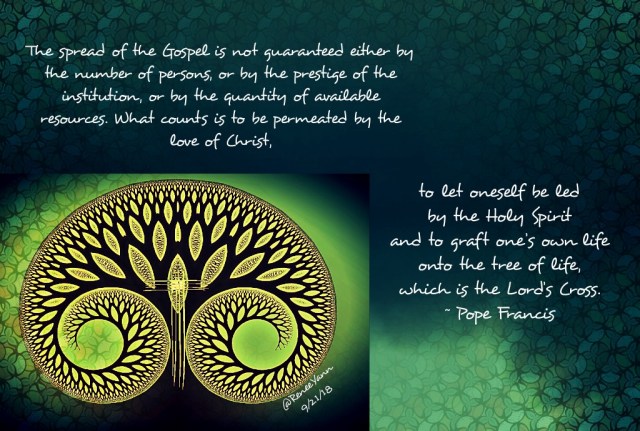
Pope Francis says this:
The spread of the Gospel is not guaranteed either by the number of persons, or by the prestige of the institution, or by the quantity of available resources. What counts is to be permeated by the love of Christ, to let oneself be led by the Holy Spirit and to graft one’s own life onto the tree of life, which is the Lord’s Cross.
Music: When You Call My Name ~ Brian Doerksen & Steve Mitchinson






 Lavish Mercy