Love your enemies and pray for those who persecute you, that you may be children of our Creator God, Who makes the sun rise on the bad and the good, and causes rain to fall on the just and the unjust. Matthew 5:44-45
It must have been so hard to hear and accept Jesus’s words in his Sermon on the Mount. These listening disciples had been raised on the Deuteronomic principle “An eye for an eye and a tooth for a tooth”. What could ever make them turn that principle inside out to do just the opposite of what they had always thought? What would make us turn from this kind of “justice”? After all, it’s even-steven, isn’t it?
In Jesus Christ, there is no even-steven. The Mercy of God is given to all of us without limits. It rains from the heart of God over all Creation. Jesus showed us that there is no place in Mercy for quid pro quo justice. If a disciple wants to love like Jesus, this precept is foundational.
Today, in God’s Lavish Mercy: Perhaps we are someplace where we can watch the rain today. If not we can remember how rain falls without distinction over everything within its embrace. So too does God’s Mercy fall on us moving us to be its agents in our world.
Enjoy the Peaceful Rain
Poetry: from The Merchant of Venice – William Shakespeare
The quality of mercy is not strained;
It droppeth as the gentle rain from heaven
Upon the place beneath. It is twice blest;
It blesseth him that gives and him that takes:
'T is mightiest in the mightiest; it becomes
The throned monarch better than his crown:
His sceptre shows the force of temporal power,
The attribute to awe and majesty,
Wherein doth sit the dread and fear of kings;
But mercy is above this sceptred sway;
It is enthronèd in the hearts of kings,
It is an attribute to God himself;
And earthly power doth then show likest God's
When mercy seasons justice.
Therefore, if you bring your gift to the altar, and there recall that your brother has anything against you, leave your gift there at the altar, go first and be reconciled with your brother, and then come and offer your gift. Matthew 5: 23-24
Jesus teaches a profound lesson in today’s Gospel. We cannot be in balance with God if we are out of balance with our neighbor.
In the “court” of God’s justice, that balance resides not in judgment or vengeance. It resides in a love beyond “liking” — in reconciliation, forgiveness, mercy, patience, hospitality, reverence, and service toward one another.
Today, in God’s Lavish Mercy:
We realize that we can’t like everybody. We can’t feel good toward everybody. We can’t approve of everybody. But we can choose to be Christlike to everybody.
May we grow in that grace, inspired by the awareness that we are One in God with all Creation.
Poetry: One Hundred Love Sonnets: XVII – Pablo Neruda
I don’t love you as if you were a rose of salt, topaz,
or arrow of carnations that propagate fire:
I love you as one loves certain obscure things,
secretly, between the shadow and the soul.
I love you as the plant that doesn’t bloom but carries
the light of those flowers, hidden, within itself,
and thanks to your love the tight aroma that arose
from the earth lives dimly in my body.
I love you without knowing how, or when, or from where,
I love you directly without problems or pride:
I love you like this because I don’t know any other way to love,
except in this form in which I am not nor are you,
so close that your hand upon my chest is mine,
so close that your eyes close with my dreams.
So the chief priests and the Pharisees convened the Sanhedrin and said, “What are we going to do? This man is performing many signs. If we leave him alone, all will believe in him, and the Romans will come and take away both our land and our nation.” But one of them, Caiaphas, who was high priest that year, said to them, “You know nothing, nor do you consider that it is better for you that one man should die instead of the people, so that the whole nation may not perish.”
John 11: 47-50
From the moment described in this Gospel, down through the ages, the name “Caiaphas” shouts infamy. At a moment when he could have made all the difference in history, Caiaphas folded to political expediency, planting the seed for Jesus’s crucifixion.
Moral courage is a gift of the Holy Spirit. It strengthens us to tell the truth when doing so may cost us life, limb, or desired status in the world.
Today, in God’s Lavish Mercy:
With the gift of free will, God has given us tremendous power, just as God gave Caiaphas. Our words, or our silences, can make or break the flow of grace in the world. By the practice of prayerfully considering our allegiances and testimonies, we can fortify our spirits with a sacred honesty – the kind which Caiaphas lacked on that momentous day.
Why am I making this choice?
Why am I voicing this opinion?
Why am I standing on this side of justice or mercy?
Who benefits, or who suffers, because of my stance?
And, ultimately, will my testimony make the way for God’s grace?
Poetry: All Is Truth – Walt Whitman
O me, man of slack faith so long!
Standing aloof—denying portions so long;
Only aware to-day of compact, all-diffused truth;
Discovering to-day there is no lie, or form of lie, and can be none,
but grows as inevitably upon itself as the truth does upon
itself,
Or as any law of the earth, or any natural production of the earth
does.

(This is curious, and may not be realized immediately—But it must be
realized;
I feel in myself that I represent falsehoods equally with the rest,
And that the universe does.)

Where has fail'd a perfect return, indifferent of lies or the truth?
Is it upon the ground, or in water or fire? or in the spirit of man?
or in the meat and blood?

Meditating among liars, and retreating sternly into myself, I see
 that there are really no liars or lies after all,
And that nothing fails its perfect return—And that what are called
lies are perfect returns,
And that each thing exactly represents itself,
and what has preceded it,
And that the truth includes all, and is compact, just as much as
space is compact,
And that there is no flaw or vacuum in the amount of the truth—but
 that all is truth without exception;
And henceforth I will go celebrate anything I see or am,
And sing and laugh, and deny nothing.
Today, in God’s Lavish Mercy, John is gentle but scathingly direct in his teaching:
Children, let no one deceive you. The person who acts in righteousness is righteous, just as God is righteous. Whoever sins belongs to the Devil, because the Devil has sinned from the beginning.
1 John 3: 7-8
John tells us that good is good, and bad is bad. Don’t let anyone fool you. And don’t make excuses when you fool yourself!
John gives us a clear measuring stick to test alignment with his teaching:
In this way, the children of God and the children of the Devil are made plain; no one who fails to act in righteousness belongs to God, nor anyone who fails to love their sisters and brothers.
1 John 3:10
It’s so simple but so hard to be the kind of person John calls us to be!
In our deep hearts, we know what righteousness looks like. It looks like peace, forgiveness, reverence, truth-telling, kindness, service, faithfulness, hope.
And we know what unrighteousness looks like. It looks like war, vengeance, brutality, bigotry, manipulation, indifference, greed, selfishness, megalomania, dishonesty, fear-mongering.
How has our society gotten so mixed up that we allow unrighteousness to parade in the costume of justice! How have we gotten so lazy, greedy, or indifferent that we refuse to look for and remedy the root causes of our societal grievances? For example, when I dig deeper in my prayerful thinking, I might realize that:
Thousands of immigrants are not crossing their borders just to bother me or take my job! They are in fear for their lives and well-being because of a lopsided global economy and a classist devaluation of life.
The armament and weapons industries are not founded on a mission to protect me and my loved ones. Like all businesses, they operate to make money. The more guns they sell, and the more expensive and destructive they are, all the better. We are their marketplace not their protectorate.
The Scriptures are God’s living Word. They are not to be read and set aside as a completed devotional practice meaningless for today’s world.
They teach us about the past but they speak to us of the present. As we pray with them, we are called to be changed by them into persons who more clearly reflect Jesus and the Gospel. That is the hard work of righteousness – work that is the everyday stuff of our lives.
Deeply internalizing John’s teaching today is a good place to start our transforming prayer.
Poetry:And 2morrow – Tupac Shakur, (1971 – 1996), was an American rapper. He is widely considered one of the most influential and successful rappers of all time. Shakur is among the best-selling music artists, having sold more than 75 million records worldwide. Much of Shakur’s music has been noted for addressing contemporary social issues that plagued inner cities. His life was filled with violence and eventually, he was murdered, but his creative work revealed a deep though conflicted longing for justice and peace.
Today is filled with anger
fueled with hidden hate
scared of being outcast
afraid of common fate
Today is built on tragedies
which no one wants 2 face
nightmares 2 humanities
and morally disgraced
Tonight is filled with rage
violence in the air
children bred with ruthlessness
because no one at home cares
Tonight I lay my head down
but the pressure never stops
knawing at my sanity
content when I am dropped
But 2morrow I c change
a chance 2 build a new
Built on spirit intent of Heart
and ideals
based on truth
and tomorrow I wake with second wind
and strong because of pride
2 know I fought with all my heart 2 keep my
dream alive
Music: Beauty for Brokenness (God of the Poor) – Graham Kendrick
Today, in God’s Lavish Mercy, Paul and Jesus seem to give us contradictory messages. Paul talks about love, and Jesus tells us what we must “hate” – a bit of a challenge to untangle the core message.
Here’s one way.
We don’t like Jesus telling us to “hate” anything, as in:
If anyone comes to me without hating his father and mother, wife and children, brothers and sisters, and even his own life, he cannot be my disciple.
Luke 14:26
Come on, Jesus! You don’t mean that do you – my sweet mom, my precious kids???
No, the scholars say, Jesus doesn’t mean “hate” the way we interpret it in modern English. He is using the common, hyperbolic language of the ancient East which, in this circumstance, would mean “love less or without bias”.
So what is Jesus really saying?
This.
We love many people and things in our lives. But we must love God, and God’s dream for all people, above and within all things.
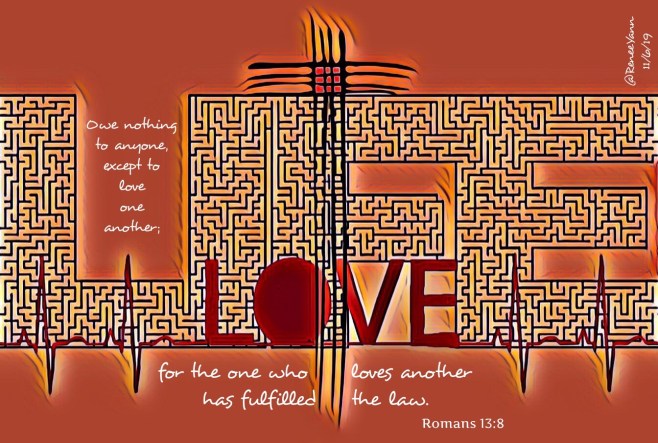
And that’s not easy! Life is a maze of relationships and situations that can get us very confused about what is most important. That’s why Jesus uses such strong language to remind us that there is only one way through the maze: to love as God loves. This is the heartbeat of our life in God!
Paul says this too, indicating as well how to negotiate the maze by keeping Love’s commandments.
We have such a critical example of this love-hate dynamic in our world just now. The terrible situation in the Holy Land has brought out radical feelings in people all over the world. People who love Israel and abhor violence are disgusted and furious over the attack against the Israeli people. People who love and pity the Palestinians, who have been suppressed into human desperation for decades, are equally disgusted and furious over the mass revenge being wrought upon innocents in Gaza and the West Bank.
I think Jesus would say this to us: You must “hate” those human relationships enough to make you not take sides in this horror. You must look past blood ties and religious ties. You must look to the human person, God’s creature like you who is the innocent victim of political forces. You must add to the voice for justice, mercy, and humane solutions.
No matter how far we may feel from the wars in Ukraine and the Middle East, each one of us is at a point of moral discernment regarding them. As massive funding is poured into weapons of war, how do we respond to the ongoing massacre of innocent people? I ask myself what is required of me as a citizen of the world to make my voice heard in this unspeakable tragedy.
If we love with God’s love, of course we will love those we cherish. But we will love them selflessly, with an infinite generosity that always chooses their eternal good. And we will try always to love all Creatures in the same way, seeking to the degree that is possible their well-being and peace. This is the kind of love Jesus taught us on the Cross. May God give us the courage to learn.
Prose: Remarks of Pope Francis at the Angelus on October 15, 2023
Dear brothers and sisters, I continue to follow with great sorrow what is happening in Israel and Palestine. I think again of the many people … in particular of the children and the elderly. I renew my appeal for the release of the hostages, and I strongly ask that children, the sick, the elderly, women, and all civilians not be made victims of the conflict. May Humanitarian Law be respected, especially in Gaza, where it is urgent and necessary to ensure humanitarian corridors and to come to the aid of the entire population. Brothers and sisters, many have already died. Please, let no more innocent blood be shed, neither in the Holy Land nor in Ukraine, nor in any other place! Enough! Wars are always a defeat, always!
Prayer is the meek and holy force to oppose the diabolical force of hatred, terrorism and war.
Music: Ubi Caritas performed by Stockholm University Choir (texts below)
Latin Text
Ubi caritas et amor, Deus ibi est. Congregavit nos in unum Christi amor. Exsultemus, et in ipso jucundemur. Timeamus, et amemus Deum vivum. Et ex corde diligamus nos sincero. Ubi caritas et amor, Deus ibi est. Simul ergo cum in unum congregamur: Ne nos mente dividamur, caveamus. Cessent iurgia maligna, cessent lites. Et in medio nostri sit Christus Deus. Ubi caritas et amor, Deus ibi est. Simul quoque cum beatis videamus, Glorianter vultum tuum, Christe Deus: Gaudium quod est immensum, atque probum, Saecula per infinita saeculorum. Amen.
English Translation Where charity and love are, God is there. Love of Christ has gathered us into one. Let us rejoice in Him and be glad. Let us fear, and let us love the living God. And from a sincere heart let us love one. Where charity and love are, God is there. At the same time, therefore, are gathered into one: Lest we be divided in mind, let us beware. Let evil impulses stop, let controversy cease. And in the midst of us be Christ our God. Where charity and love are, God is there. At the same time we see that with the saints also, Thy face in glory, O Christ our God: The joy that is immense and good, Unto the World without end. Amen.
Today, in God’s Mercy, Paul sounds a lot like someone approaching the microphone at “Sinners Anonymous“:
I know that good does not dwell in me, that is, in my flesh. The willing is ready at hand, but doing the good is not. For I do not do the good I want, but I do the evil I do not want.
Romans 7:18-19
Paul basically attests to the fact that for human beings, even him, will and actions often don’t synch up. Sure, we want to be good people, but as Nike says, do we:
Paul says no, we don’t. The only way we do the good we will to do is by the grace of Jesus Christ.
In our Gospel, Jesus affirms the slowness of the human spirit to act on the realities around us. In some translations, Jesus uses a phrase which caught on with the architects of Vatican II: the signs of the times.
You hypocrites! You know how to interpret the appearance of the earth and the sky; why do you not know how to interpret the present time? “Why do you not judge for yourselves what is right?
Luke 12:56-57
Jesus is telling his listeners and us that we need to be alert to the circumstances of our world. It both weeps and rejoices. Where it weeps, we must be a source of mercy and healing. Where it rejoices, we must foster and celebrate the Presence of the Spirit.
In the Vatican II document Gaudium et Spes (The Church in the Modern World), we read:
In every age, the church carries the responsibility of reading the signs of the times and of interpreting them in the light of the Gospel, if it is to carry out its task. In language intelligible to every generation, it should be able to answer the ever recurring questions which people ask about the meaning of this present life and of the life to come, and how one is related to the other. We must be aware of and understand the aspirations, the yearnings, and the often dramatic features of the world in which we live.
While we look forward hopefully to the communications that will come from the current Synod on Synodality, the Documents of Vatican II have everlasting meaning for the Church. Although written in the 1960s, these powerful words hold true today. We are the Church of which the document speaks. We are the ones whom Jesus calls to respond with authentic justice and mercy to the signs of the times. Read the newspaper in that light today. Watch the news in that light. Meet your brothers and sisters in that light today.
Poetry: The Right Thing – Theodore Roethke
Let others probe the mystery if they can. Time-harried prisoners of Shall and Will — The right thing happens to the happy man.
The bird flies out, the bird flies back again; The hill becomes the valley, and is still; Let others delve that mystery if they can.
God bless the roots! Body and soul are one! The small become the great, the great the small; The right thing happens to the happy man.
Child of the dark, he can outleap the sun, His being single, and that being all: The right thing happens to the happy man.
Or he sits still, a solid figure when The self-destructive shake the common wall; Takes to himself what mystery he can,
And, praising change as the slow night comes on, Wills what he would surrendering his will Till mystery is no more: No more he can. The right thing happens to the happy man.
Music: The Times They Are A’changin’ – Bob Dylan whose songs in the 50s and 60sbecame anthems for the Civil Rights and anti-war movements. His lyrics during this period incorporated a wide range of political, social, philosophical, and literary influences, defied popular music conventions and appealed to the burgeoning counterculture. (Wikipedia) (Ah, it was a good time to be young!)
The Swedish Academy awarded Dylan the 2016 Nobel Prize inLiterature “for having created new poetic expressions within the great American song tradition.
Today, in God’s Lavish Mercy, we pray with Psalm 96, one of the “royal psalms” praising God as King.
Bow down to the LORD, splendid in holiness. Tremble before God, all the earth; declare among the nations: The LORD is King. The world will surely stand fast, never to be shaken. The Lord rules the peoples with fairness. The Lord rules the peoples with fairness.
Psalm 96: 9-10
Our psalm today forms a link between two readings about two different kinds of human leaders.
In our first reading, we hear about King Cyrus, an “anointed” one:
Thus says the LORD to his anointed, Cyrus, whose right hand I grasp, subduing nations before him …
Isaiah 45:1
In fact, Cyrus the Great respected the customs and religions of the lands he conquered. This became a very successful model for centralized administration and establishing a government working to the advantage and profit of its subjects. Israel thrived under Cyrus and found no barriers to their own religious practices
In our Gospel, however, the Pharisees try to trap Jesus by testing him about their current political leadership, which is not so kindly inclined to the people:
Tell us, then, what is your opinion: Is it lawful to pay the census tax to Caesar or not?
Matthew 22:17
Jesus’s answer simply tells the Pharisees to obey the legitimate law. But that answer is secondary to his real challenge to them:
Why are you testing me, you hypocrites?
Our psalm is the praise song of a people who do not “test” God; who receive both the blessings and trials of life with faith and hope, and seek the path to God within those circumstances.
A “Cyrus-type” leader builds up that holy courage in the people. A “Caesar-type” type leader only builds up only himself.
In his letter to the Thessalonians, Paul shows himself to be such an anointed leader, praying for and encouraging the Church in the journey of faith:
We give thanks to God always for all of you, remembering you in our prayers, unceasingly calling to mind your work of faith and labor of love and endurance in hope of our Lord Jesus Christ, before our God and Father …
1 Thessalonians 1;2-4
Today, there’s a lot of political dust swirling in the wind – a lot of discerning about leadership and our own modern brand of “kings”. The current sufferings of our time cause our hearts to long for “a new song”.
The readings today remind us that the only way our spirits can …
Sing to the LORD a new song; sing to the LORD, all you lands. Tell God’s glory among the nations; among all peoples, God’s wondrous deeds
… is by living Paul’s formula – “to live our lives as a work of faith and labor of love and endurance in hope of our Lord Jesus Christ.”
Poetry: New Day’s Lyric – Amanda Gorman
May this be the day
We come together.
Mourning, we come to mend,
Withered, we come to weather,
Torn, we come to tend,
Battered, we come to better.
Tethered by this year of yearning,
We are learning
That though we weren't ready for this,
We have been readied by it.
We steadily vow that no matter
How we are weighed down,
We must always pave a way forward.
*
This hope is our door, our portal.
Even if we never get back to normal,
Someday we can venture beyond it,
To leave the known and take the first steps.
So let us not return to what was normal,
But reach toward what is next.
*
What was cursed, we will cure.
What was plagued, we will prove pure.
Where we tend to argue, we will try to agree,
Those fortunes we forswore, now the future we foresee,
Where we weren't aware, we're now awake;
Those moments we missed
Are now these moments we make,
The moments we meet,
And our hearts, once altogether beaten,
Now all together beat.
*
Come, look up with kindness yet,
For even solace can be sourced from sorrow.
We remember, not just for the sake of yesterday,
But to take on tomorrow.
*
We heed this old spirit,
In a new day's lyric,
In our hearts, we hear it:
For auld lang syne, my dear,
For auld lang syne.
Be bold, sang Time this year,
Be bold, sang Time,
For when you honor yesterday,
Tomorrow ye will find.
Know what we've fought
Need not be forgot nor for none.
It defines us, binds us as one,
Come over, join this day just begun.
For wherever we come together,
We will forever overcome.
Today, in God’s Lavish Mercy, we begin the first of three passages from the prophet Zechariah to be read over the next few days. These are the only times we meet Zechariah in our cycle of readings, other than December 12th, the Feast of Our Lady of Guadalupe.
For that reason, we could easily overlook Zechariah, a minor prophet whose visions, so specifically directed to the post-exilic Israelite community, may seem alien and extraneous to our own spirituality.
But we should not overlook Zechariah. Here’s why.
These two prophets (Zechariah and Haggai) seek to rally the identity and vocation of Jews in a time when faith is hard and prospects are lean. Such a time, they assert, is a time for vigorous action. The rebuilding of the temple is thus an act of faith, confident in the reality of God, and an act of defiance against the established imperial order of the world, even the imperial order that funded the project. We might well read these prophets in our own time of “small things” when the church seems to lack energy, courage, and imagination. In just such a time it is urgent to enact visible faithful gestures (like the temple building) that defy business as usual. Thus the prophetic imagination given here outruns historical possibility. That is the quality and depth of faith held here to which we are invited.
Walter Brueggeman: From Judgement to Hope
Zechariah invites the people to imagine a world vastly beyond their present perceptions. It is a world where the Temple is rebuilt as a symbol of God’s Presence, central to their identity. That Divine Presence provides any protection needed, thus removing the need for “walls” of isolation, fear, oppression, defensiveness, and exclusion.
People will live in Jerusalem as though in open country, because of the multitude of men and beasts in her midst. But I will be for her an encircling wall of fire, says the LORD, and I will be the glory in her midst.
Zechariah 2:8-9
Surely we could use such holy imagination in our times! And surely this is the sacred energy Pope Francis seeks as he leads the Church in synodality.
As our shared geopolitical world seems daily to become more fragmented and hostile, the power of our communal, Resurrection faith is crucial to its graceful restoration.
Zechariah calls the people to sing, even in the midst of their disheartening exile, and to dream of a world without vicious walls. We are called to the same hope even in a world that conspires to feed cynicism and indifference rather than justice and mercy.
Sing and rejoice, O daughter Zion! See, I am coming to dwell among you, says the LORD. Many nations shall join themselves to the LORD on that day, and they shall be his people and he will dwell among you.
Zechariah 2:14
Prose: The Monk Manifesto – Christine Valtners Paintner
Monk Manifesto is a public expression of one’s commitment to live a compassionate, contemplative, and creative life. When I read it, I find encouragement to act for a more integrated world, one without dissociative walls.
I commit to finding moments each day for silence and solitude, to make space for another voice to be heard, and to resist a culture of noise and constant stimulation.
I commit to radical acts of hospitality by welcoming the stranger both without and within. I recognize that when I make space inside my heart for the unclaimed parts of myself, I cultivate compassion and the ability to accept those places in others.
I commit to cultivating community by finding kindred spirits along the path, soul friends with whom I can share my deepest longings, and mentors who can offer guidance and wisdom for the journey.
I commit to cultivating awareness of my kinship with creation and a healthy asceticism by discerning my use of energy and things, letting go of what does not help nature to flourish.
I commit to bringing myself fully present to the work I do, whether paid or unpaid, holding a heart of gratitude for the ability to express my gifts in the world in meaningful ways.
I commit to rhythms of rest and renewal through the regular practice of Sabbath and resist a culture of busyness that measures my worth by what I do.
I commit to a lifetime of ongoing conversion and transformation, recognizing that I am always on a journey with both gifts and limitations.
Music: One World – Toby Mac
I’m not a big fan of rap, but I think this song is pretty good for today’s reflection.
Today, in God’s Lavish Mercy – and tomorrow – we will hear from Haggai, one of the twelve minor prophets of the Hebrew Scriptures. These dozen writers are referred to as “minor” because of the length of their writings, not their value.
So Haggai, even though many of us have never heard of him, has something important to say for Judeo-Christian tradition and for each of us who read him. Let’s see what that might be.
Haggai is prophesying during the Persian period of Jewish history, around the middle of the 6th century, BC. The Jewish people had been back home from the Babylonian captivity for almost 20 years. When they first returned they were passionate about rebuilding the Temple. But as the decades passed, and opposition from their non-Jewish neighbors increased, their commitment waned.
The building of worship places has always been an activity with fans on both sides of the aisle. Some argue that God needs a spot where the Divine Presence can be recognized and revered. Others believe that the effort and resources expended in such building could better be used in human services for God’s poor and needy people. Haggai’s community had people in both camps. (Sound familiar?)
Haggai offers a turning point for their arguments. He tells the people they are a mess. The absence of a central symbol for their faith has weakened and scattered them to their own selfish pursuits. He tells them to look at themselves:
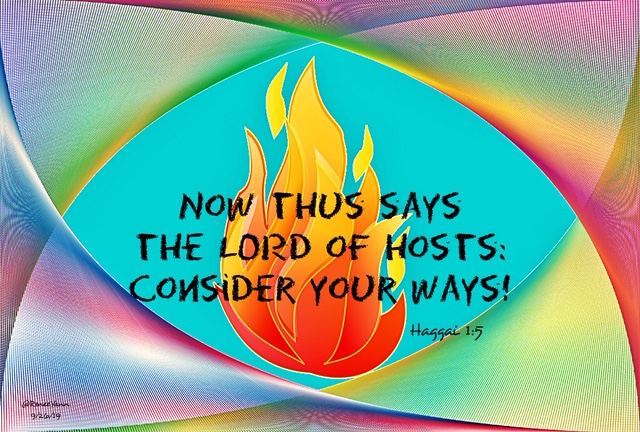
Consider your ways! You have sown much, but have brought in little; you have eaten, but have not been satisfied; You have drunk, but have not been exhilarated; have clothed yourselves, but not been warmed; And whoever earned wages earned them for a bag with holes in it.
The Temple, while it is important, isn’t the most important part of Haggai’s prophecy. He tells the people they have lost their souls. The lack of a central, shared faith has caused them to forget who they are. They will remember only when they remember God’s centrality in their lives.
Haggai appeals to the people to restore a public life which gives honor to God. For their time and circumstance, such a return is symbolized by the rebuilding of the Temple which had been destroyed at the time of their enslavement by Babylon.
We humans often forget what’s important. We chip away at, and ultimately destroy, what makes us who we are by little acts of faithlessness, deceit, covetousness, and envy. These small treacheries grow into big ones redeemable only by an impeachment of the soul and the renewal of a common moral purpose. Haggai offered that conversion to Israel. Pope Francis is offering it to us today.
Video: TED Talk by Pope Francis given at the Annual TED Conference in 2017 and pleading for a “Revolution of Tenderness”. (Yes, it’s long, but it is profound. When he delivered this talk, the Pope was given a standing ovation by some of the most prestigious business people of our time.)
Today, in God’s Lavish Mercy, our readings lead us in prayer to the concept of responsible membership in community, specifically the Church.
Paul counsels Timothy in this regard, reminding the Ephesian community, whom Timothy shepherded, how profoundly graced they are in their Church membership :
… you should know how to behave in the household of God, which is the Church of the living God, the pillar and foundation of truth. Undeniably great is the mystery of devotion, Who was manifested in the flesh, vindicated in the spirit, seen by angels, proclaimed to the Gentiles, believed in throughout the world, taken up in glory.
In today’s Gospel, Jesus assesses the “membership potential” of the surrounding crowd and finds it wanting. He compares them to a gaggle of immature children taunting and gossiping in the streets:
Jesus said to the crowds: “To what shall I compare the people of this generation? What are they like? They are like children who sit in the marketplace and call to one another,
‘We played the flute for you, but you did not dance. We sang a dirge, but you did not weep.’
Membership in any community is a serious commitment. It requires our sincere and charitable investment in the daily give-and-take of life.
As a creature of God, Who exists in the Trinitarian Community, every human being – even a hermit in the desert – subsists in some dimension of sustaining community. We live, and exchange life, in our families, neighborhoods, countries, world, and universe. We choose communities of faith, ministry, political belief, philosophical understanding, and social interaction. We have a bearing on the lives of those with whom we share the gifts of time and space.
These commitments, to be life-giving, demand our sincere, honest, and reverent participation. Community is never a perfect circle, but more like an interlaced wreath requiring courage to navigate, as David Whyte describes here:
Courage is the measure of our heartfelt participation with life, with another, with a community, a work; a future. To be courageous is not necessarily to go anywhere or do anything except to make conscious those things we already feel deeply and then to live through the unending vulnerabilities of those consequences.
Pope Francis has called all of us to a “culture of encounter”, a way of living together in compassionate community:
An invitation to work for “the culture of encounter”, in a simple way, “as Jesus did”: not just seeing, but looking; not just hearing, but listening; not just passing people by, but stopping with them; not just saying “what a shame, poor people!”, but allowing yourself to be moved with compassion; “and then to draw near, to touch and to say: ‘Do not weep’ and to give at least a drop of life”.
Pope Francis, in a 2016 homily on the Gospel of the Widow of Nain
Pope Francis has also said that the most common and insidious way to kill this culture of encounter is the evil of gossip:
Gossip is a weapon and it threatens the human community every day; it sows envy, jealousy and power struggles. It has even caused murder. Therefore, discussing peace must take into account the evil that can be done with one’s tongue.
Sometimes we become so used to gossip that we don’t even recognize it in ourselves and others. Sometimes our motivations, unexamined, seem innocent enough. However, consider this:
Some bad motivations are more wicked than others. Backstabbing gossip bent on revenge is birthed in malice and threatens to sink whole fellowships (2 Corinthians 12:19–13:2; 3 John 9–10). That kind of gossip is worse than being a busybody who is too interested in other peoples’ business (2 Thessalonians 3:11; 1 Peter 4:15). Yet Jesus said that we will give an account for every careless word we have spoken (Matthew 12:36), not just for the malicious ones.
Matt Mitchell, author – Resisting Gossip: Winning the War on the Wagging Tongue
We don’t want to be like the thoughtless children mocking and teasing in the streets. I know that, for me, it warrants taking a good look at myself, my investment in my many communities, and the reverence of my conversations about them.
Poetry: A Word by Emily Dickinson
A word is dead
When it is said,
     Some say.
I say it just
Begins to live
     That day.
Music: Neighbor, Neighbor – Jimmy Hughes
While this song presents a rather isolationist interpretation of relationships, it still has its valid points — and definitely a great beat to wake up your morning. 😉
Neighbor, neighbor, don’t wonder what goes on in my home You’re always lookin’ for somethin’ to gossip about You’re goin’ around from door to door Runnin’ your mouth about things you don’t know Neighbor, neighbor, don’t wonder what goes on in my home
[Verse 2] Neighbor, neighbor, don’t worry how I make my bread ‘Cause my success is drivin’ you out of your head You got in those troubles, my trouble, too Something bad’s gonna happen to you Neighbor, neighbor, don’t worry what goes on in my home
[Guitar Solo]
[Verse 3] Neighbor, neighbor, don’t worry how I treat my wife Quit tellin’ ev’rybody we fuss and fight ev’ry night You’re sweepin’, peepin’ through the hall Keepin’ your big ears glued to my wall Neighbor, neighbor, don’t worry what goes on in my home
[Verse 4] Neighbor, neighbor, don’t worry who knocks on my front door You’re walkin’, a-talkin’, a-pacin’ all over the floor You’re sweepin’, peepin’ through the hall Keepin’ your big ears glued to my wall Neighbor, neighbor, don’t worry who goes in and out of my door








 Lavish Mercy