God’s Firewall

Memorial of Saint Jerome, Priest and Doctor of the Church
September 30, 2023

Today’s Readings:

https://bible.usccb.org/bible/readings/093023.cfm


Today, in God’s Lavish Mercy, we begin the first of three passages from the prophet Zechariah to be read over the next few days. These are the only times we meet Zechariah in our cycle of readings, other than December 12th, the Feast of Our Lady of Guadalupe.

For that reason, we could easily overlook Zechariah, a minor prophet whose visions, so specifically directed to the post-exilic Israelite community, may seem alien and extraneous to our own spirituality.


But we should not overlook Zechariah. Here’s why.

These two prophets (Zechariah and Haggai) seek to rally the identity and vocation of Jews in a time when faith is hard and prospects are lean. Such a time, they assert, is a time for vigorous action. The rebuilding of the temple is thus an act of faith, confident in the reality of God, and an act of defiance against the established imperial order of the world, even the imperial order that funded the project. We might well read these prophets in our own time of “small things” when the church seems to lack energy, courage, and imagination. In just such a time it is urgent to enact visible faithful gestures (like the temple building) that defy business as usual. Thus the prophetic imagination given here outruns historical possibility. That is the quality and depth of faith held here to which we are invited.

Walter Brueggeman: From Judgement to Hope

Zechariah invites the people to imagine a world vastly beyond their present perceptions. It is a world where the Temple is rebuilt as a symbol of God’s Presence, central to their identity. That Divine Presence provides any protection needed, thus removing the need for “walls” of isolation, fear, oppression, defensiveness, and exclusion.

People will live in Jerusalem as though in open country,
because of the multitude of men and beasts in her midst.
But I will be for her an encircling wall of fire, says the LORD,
and I will be the glory in her midst.

Zechariah 2:8-9

Surely we could use such holy imagination in our times! And surely this is the sacred energy Pope Francis seeks as he leads the Church in synodality.

As our shared geopolitical world seems daily to become more fragmented and hostile, the power of our communal, Resurrection faith is crucial to its graceful restoration.


Zechariah calls the people to sing, even in the midst of their disheartening exile, and to dream of a world without vicious walls. We are called to the same hope even in a world that conspires to feed cynicism and indifference rather than justice and mercy.

Sing and rejoice, O daughter Zion!
See, I am coming to dwell among you, says the LORD.
Many nations shall join themselves to the LORD on that day,
and they shall be his people and he will dwell among you.

Zechariah 2:14

Prose: The Monk Manifesto – Christine Valtners Paintner

Monk Manifesto is a public expression of one’s commitment to live a compassionate, contemplative, and creative life. When I read it, I find encouragement to act for a more integrated world, one without dissociative walls.

  • I commit to finding moments each day for silence and solitude, to make space for another voice to be heard, and to resist a culture of noise and constant stimulation.
  • I commit to radical acts of hospitality by welcoming the stranger both without and within. I recognize that when I make space inside my heart for the unclaimed parts of myself, I cultivate compassion and the ability to accept those places in others.
  • I commit to cultivating community by finding kindred spirits along the path, soul friends with whom I can share my deepest longings, and mentors who can offer guidance and wisdom for the journey.
  • I commit to cultivating awareness of my kinship with creation and a healthy asceticism by discerning my use of energy and things, letting go of what does not help nature to flourish.
  • I commit to bringing myself fully present to the work I do, whether paid or unpaid, holding a heart of gratitude for the ability to express my gifts in the world in meaningful ways.
  • I commit to rhythms of rest and renewal through the regular practice of Sabbath and resist a culture of busyness that measures my worth by what I do.
  • I commit to a lifetime of ongoing conversion and transformation, recognizing that I am always on a journey with both gifts and limitations.

Music: One World – Toby Mac

I’m not a big fan of rap, but I think this song is pretty good for today’s reflection.

Turn to Tenderness, Turn to God

Thursday of the Twenty-fifth Week in Ordinary Time
September 28, 2023

Today’s Readings:

https://bible.usccb.org/bible/readings/092823.cfm


Today, in God’s Lavish Mercy – and tomorrow – we will hear from Haggai, one of the twelve minor prophets of the Hebrew Scriptures. These dozen writers are referred to as “minor” because of the length of their writings, not their value.

So Haggai, even though many of us have never heard of him, has something important to say for Judeo-Christian tradition and for each of us who read him. Let’s see what that might be.

Hag1_9JPG

Haggai is prophesying during the Persian period of Jewish history, around the middle of the 6th century, BC. The Jewish people had been back home from the Babylonian captivity for almost 20 years. When they first returned they were passionate about rebuilding the Temple. But as the decades passed, and opposition from their non-Jewish neighbors increased, their commitment waned.


The building of worship places has always been an activity with fans on both sides of the aisle. Some argue that God needs a spot where the Divine Presence can be recognized and revered. Others believe that the effort and resources expended in such building could better be used in human services for God’s poor and needy people. Haggai’s community had people in both camps. (Sound familiar?)

Haggai offers a turning point for their arguments. He tells the people they are a mess. The absence of a central symbol for their faith has weakened and scattered them to their own selfish pursuits. He tells them to look at themselves:

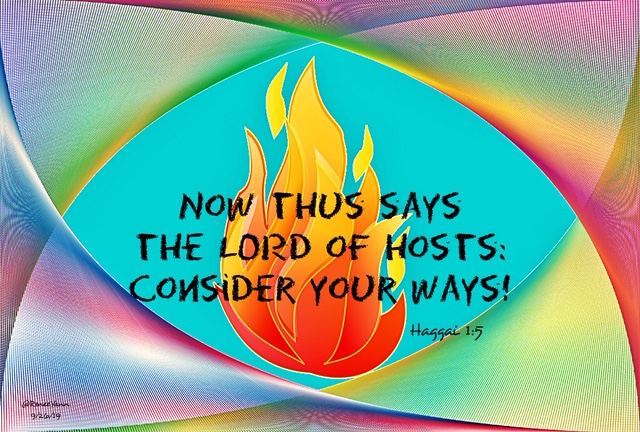
Consider your ways!
You have sown much, but have brought in little;
you have eaten, but have not been satisfied;
You have drunk, but have not been exhilarated;
have clothed yourselves, but not been warmed;
And whoever earned wages
earned them for a bag with holes in it.


The Temple, while it is important, isn’t the most important part of Haggai’s prophecy. He tells the people they have lost their souls. The lack of a central, shared faith has caused them to forget who they are. They will remember only when they remember God’s centrality in their lives.

Haggai appeals to the people to restore a public life which gives honor to God. For their time and circumstance, such a return is symbolized by the rebuilding of the Temple which had been destroyed at the time of their enslavement by Babylon.


We humans often forget what’s important. We chip away at, and ultimately destroy, what makes us who we are by little acts of faithlessness, deceit, covetousness, and envy. These small treacheries grow into big ones redeemable only by an impeachment of the soul and the renewal of a common moral purpose. Haggai offered that conversion to Israel. Pope Francis is offering it to us today.


Video: TED Talk by Pope Francis given at the Annual TED Conference in 2017 and pleading for a “Revolution of Tenderness”. (Yes, it’s long, but it is profound. When he delivered this talk, the Pope was given a standing ovation by some of the most prestigious business people of our time.)

https://www.npr.org/sections/thetwo-way/2017/04/26/525699847/in-surprise-ted-talk-pope-francis-asks-the-powerful-for-revolution-of-tenderness


Music: Come Back to Me – by Gregory Norbet, sung by John Michael Talbot

Responsible Membership

Memorial of Saints Andrew Kim Tae-gŏn, Priest,
and Paul Chŏng Ha-sang, and Companions, Martyrs
September 20, 2023

Today’s Readings:

https://bible.usccb.org/bible/readings/092023.cfm


Today, in God’s Lavish Mercy, our readings lead us in prayer to the concept of responsible membership in community, specifically the Church.

Paul counsels Timothy in this regard, reminding the Ephesian community, whom Timothy shepherded, how profoundly graced they are in their Church membership :

… you should know how to behave in the household of God,
which is the Church of the living God,
the pillar and foundation of truth.
Undeniably great is the mystery of devotion,
Who was manifested in the flesh,
vindicated in the spirit,
seen by angels,
proclaimed to the Gentiles,
believed in throughout the world,
taken up in glory.


In today’s Gospel, Jesus assesses the “membership potential” of the surrounding crowd and finds it wanting. He compares them to a gaggle of immature children taunting and gossiping in the streets:

Jesus said to the crowds:
“To what shall I compare the people of this generation?
What are they like?
They are like children who sit in the marketplace and call to one another,

‘We played the flute for you, but you did not dance.
We sang a dirge, but you did not weep.’


Membership in any community is a serious commitment. It requires our sincere and charitable investment in the daily give-and-take of life.

As a creature of God, Who exists in the Trinitarian Community, every human being – even a hermit in the desert – subsists in some dimension of sustaining community. We live, and exchange life, in our families, neighborhoods, countries, world, and universe. We choose communities of faith, ministry, political belief, philosophical understanding, and social interaction. We have a bearing on the lives of those with whom we share the gifts of time and space.


These commitments, to be life-giving, demand our sincere, honest, and reverent participation. Community is never a perfect circle, but more like an interlaced wreath requiring courage to navigate, as David Whyte describes here:

Courage is the measure of our heartfelt participation with life, with another, with a community, a work; a future. To be courageous is not necessarily to go anywhere or do anything except to make conscious those things we already feel deeply and then to live through the unending vulnerabilities of those consequences.


Pope Francis has called all of us to a “culture of encounter”, a way of living together in compassionate community:

An invitation to work for “the culture of encounter”, in a simple way, “as Jesus did”: not just seeing, but looking; not just hearing, but listening; not just passing people by, but stopping with them; not just saying “what a shame, poor people!”, but allowing yourself to be moved with compassion; “and then to draw near, to touch and to say: ‘Do not weep’ and to give at least a drop of life”.

Pope Francis, in a 2016 homily on the Gospel of the Widow of Nain

Pope Francis has also said that the most common and insidious way to kill this culture of encounter is the evil of gossip:

Gossip is a weapon and it threatens the human community every day; it sows envy, jealousy and power struggles. It has even caused murder. Therefore, discussing peace must take into account the evil that can be done with one’s tongue.

Sometimes we become so used to gossip that we don’t even recognize it in ourselves and others. Sometimes our motivations, unexamined, seem innocent enough. However, consider this:

Some bad motivations are more wicked than others. Backstabbing gossip bent on revenge is birthed in malice and threatens to sink whole fellowships (2 Corinthians 12:19–13:2; 3 John 9–10). That kind of gossip is worse than being a busybody who is too interested in other peoples’ business (2 Thessalonians 3:11; 1 Peter 4:15). Yet Jesus said that we will give an account for every careless word we have spoken (Matthew 12:36), not just for the malicious ones.

Matt Mitchell, author – Resisting Gossip: Winning the War on the Wagging Tongue

We don’t want to be like the thoughtless children mocking and teasing in the streets. I know that, for me, it warrants taking a good look at myself, my investment in my many communities, and the reverence of my conversations about them.


Poetry: A Word by Emily Dickinson

A word is dead
When it is said,
Some say.
I say it just
Begins to live
That day.

Music: Neighbor, Neighbor – Jimmy Hughes

While this song presents a rather isolationist interpretation of relationships, it still has its valid points — and definitely a great beat to wake up your morning. 😉

Neighbor, neighbor, don’t wonder what goes on in my home
You’re always lookin’ for somethin’ to gossip about
You’re goin’ around from door to door
Runnin’ your mouth about things you don’t know
Neighbor, neighbor, don’t wonder what goes on in my home

[Verse 2]
Neighbor, neighbor, don’t worry how I make my bread
‘Cause my success is drivin’ you out of your head
You got in those troubles, my trouble, too
Something bad’s gonna happen to you
Neighbor, neighbor, don’t worry what goes on in my home

[Guitar Solo]

[Verse 3]
Neighbor, neighbor, don’t worry how I treat my wife
Quit tellin’ ev’rybody we fuss and fight ev’ry night
You’re sweepin’, peepin’ through the hall
Keepin’ your big ears glued to my wall
Neighbor, neighbor, don’t worry what goes on in my home

[Verse 4]
Neighbor, neighbor, don’t worry who knocks on my front door
You’re walkin’, a-talkin’, a-pacin’ all over the floor
You’re sweepin’, peepin’ through the hall
Keepin’ your big ears glued to my wall
Neighbor, neighbor, don’t worry who goes in and out of my door

Jubilee!

Saturday of the Seventeenth Week in Ordinary Time
Saturday, August 5, 2023

Today’s Readings:

https://bible.usccb.org/bible/readings/080523.cfm


One in a series of 60 paintings by Jacob Lawrence which captures
the journeys of millions of African-Americans
who left the Jim Crow South
in search of better lives elsewhere.


Today, in God’s Lavish Mercy, Leviticus offers us a reading critical to our moral clarity.

This fiftieth year you shall make sacred
by proclaiming liberty in the land for all its inhabitants.
It shall be a jubilee for you,
when every one of you shall return to his own property,
every one to his own family estate.

Leviticus 25:10

Leviticus 25 is the account of Jubilee which, for the Mosaic community, was the quintessential practice of justice.

When the Israelites came to the Promised Land, they came as an emancipated people to share in the abundance to which God had delivered them. There was initial equity in the sharing. But over time, power, influence and wealth were hoarded – endangerments that threaten all communities.

In the proclamation of Jubilee, God directs the people to return to an original justice in which all persons are freed from indebtedness of any kind in order to live in communal harmony.


Consider the hypothetical example of an Israelite family that lost their land twelve years before the Jubilee Year. On the tenth day of the seventh month, the entire community participates in the Day of Atonement and its ritual purging of sin. On this very same day, the trumpet is blown and the Jubilee year is announced; in this year, both sins and debts are forgiven, and the family that had been forced to live and work in another’s household for more than a decade regain possession of their land.

Imagine the joy of this moment! Imagine the dreams and desires! After having served as hired hands for a generation, now to be restored to a position of social and economic strength!

Michael J. Rhodes – Jubilee Formation: Cultivating Desire and Dependence in Leviticus 25

The concept of this type of justice is alien to our capitalist and consumerist orientations. We may have heard the attitude expressed, or we may hold it ourselves, that some people have and some people don’t. And the ones who “have” earned it and deserve it.

“Jubilee” instructs us that this is a false context for fulfilling God’s Will for the wholeness of Creation. In such a false context, reward ensues from avarice, dominance, possessiveness, and aggression, yielding a continually deeper gap between those who have and those who do not, between those who influence and those who cannot, between those who thrive and those who do not.


“Jubilee” resets the game board and in so doing resets attitudes about who owns what and how they must use it to enact the Reign of God.

I recently heard a story which speaks of forgetting to whom things belong. A very proper lady went to a tea shop. She sat at a table for two, ordered a pot of tea, and prepared to eat some cookies which she had in her purse. Because the tea shop was crowded, a man took the other chair and also ordered tea. As it happened, he was a Jamaican black, though that is not essential to the story. The woman was prepared for a leisurely time, so she began to read her paper. As she did so, she took a cookie from the package. As she read, she noticed that the man across also took a cookie from the package. This upset her greatly, but she ignored it and kept reading. After a while she took another cookie. And so did he. This unnerved her and she glared at the man. While she glared, he reached for the fifth and last cookie, smiled and offered her half of it. She was indignant. She paid her money and left in a great hurry, enraged at such a presumptuous man. She hurried to her bus stop just ouside. She opened her purse to get a coin for her bus ticket. And then she saw, much to her distress, that in her purse was her package of cookies unopened. The lady is not different from all of us. Sometimes we possess things so long that do not really belong to us that we come to think they are ours. Sometimes, by the mercy of God, we have occasion to see to whom these things in fact belong.

Walter Brueggemann, “Voices of the Night—Against Justice,” in To Act Justly, Love Tenderly, Walk Humbly: An Agenda for Ministers

The applications are abundant, obvious, and profound for our own lives in the various communites in which we live. But they are not easy applications to confront or practice. They pose the ultimate question to us: where do we place our security? The answer determines how fully we understand “Jubilee”.


You have two meaningful prose passages to consider today so let’s just add a little music for your prayer time.

Gabriel’s Oboe – Ennio Morricone played by Henrik Chaim Goldschmidt

Two Kinds of Silence

Tuesday of the Fifteenth Week in Ordinary Time
July 18, 2023

Today’s Readings:

https://bible.usccb.org/bible/readings/071823.cfm

Today, in God’s Lavish Mercy, silence plays a role in both our readings, but they are silences that differ profoundly from each other.

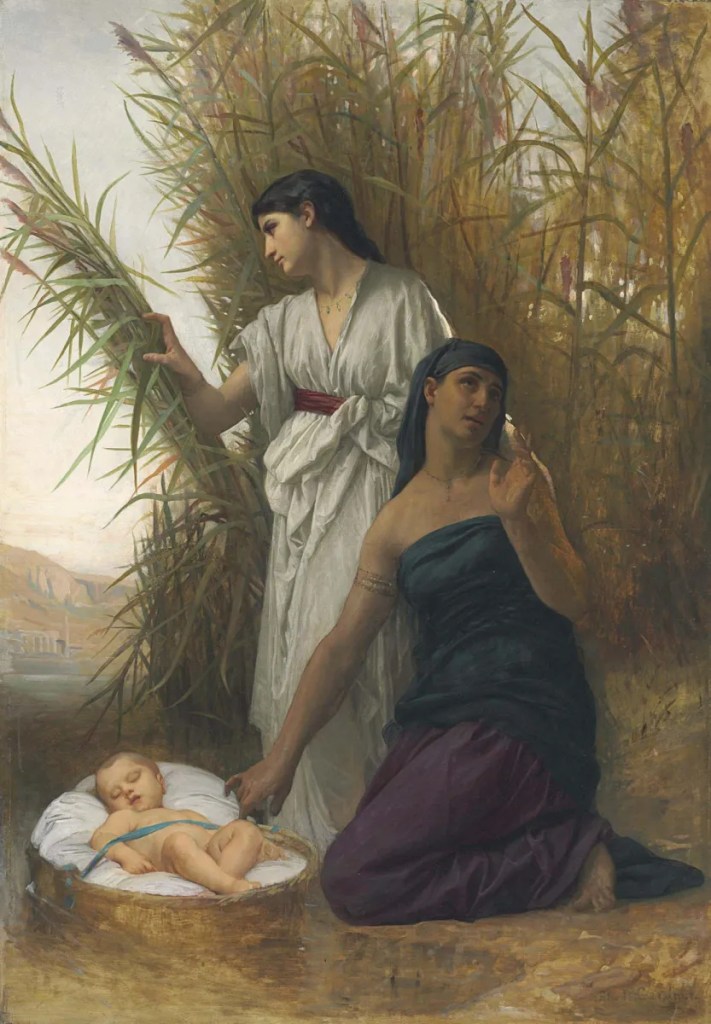
Moses in the Bulrushes – by Elizabeth Jane Gardner


In Exodus, we see the power of silent resistance to turn the tide of history. It is the resistance of righteousness.

Pharaoh, out of fear, has ordered all Hebrew boy babies drowned at birth. But Moses’s mother (Jochebed), aided by his sister (Miriam), silently resists.

A certain man of the house of Levi married a Levite woman,
who conceived and bore a son.
Seeing that he was a goodly child, she hid him for three months.
When she could hide him no longer, she took a papyrus basket,
daubed it with bitumen and pitch,
and putting the child in it,
placed it among the reeds on the river bank.
His sister stationed herself at a distance
to find out what would happen to him.

Her resistance, though silent, was nonetheless active. Look at all the intricate steps she took to assure the success of her plot.


The resistance cited in Matthew is of a different nature entirely. It reflects a hard heart not a determined heart. It is the resistance of indifference.

Christ Preaching at Capernaum – by Maurycy Gottlieb


Capernaum had become Jesus’s own home town. He had moved there as a young adult in order to begin his ministry after his own neighborhood had rejected him. But despite Jesus’s miracles and witness, Capernaum resisted the call of the Gospel:

Jesus began to reproach the towns
where most of his mighty deeds had been done,
since they had not repented.

And as for you, Capernaum:

Will you be exalted to heaven?
You will go down to the netherworld.

For if the mighty deeds done in your midst had been done in Sodom,
it would have remained until this day.
But I tell you, it will be more tolerable
for the land of Sodom on the day of judgment than for you.


We might find ourselves anywhere in these stories. We all experience resistances within, around, and toward us – sometimes for good reasons, sometimes not. We just have to fill in the blank to imagine all the resistances we are capable of:

I tend to resist ______________________________.

What did you come up with? Maybe some of these?

  • change
  • work
  • quiet
  • commitment
  • injustice
  • direction
  • strangers
  • programming
  • affection
  • cronyism, and on and on and on……

Jesus wanted to break through the negative resistance of his dearest communities.

Jocebed and her courageous women companions used positive resistance to break through abusive domination.

In our spiritual lives, we must, by prayer and informed reflection, lower our resistance to God’s transforming Word.

We must, at the same time, assume our role in resisting the injustice and violence of our times. Like Jocebed, we might consider our precious world and its peoples as if they were our own children, threatened by fear-blinded tyranny. In that case, what determined steps would we be willing to take to preserve its sacred life?


Poetry: Rosa Parks by Nikki Giovanni

This is for the Pullman Porters who organized when people said
they couldn’t. And carried the Pittsburgh Courier and the Chicago
Defender to the Black Americans in the South so they would
know they were not alone. This is for the Pullman Porters who
helped Thurgood Marshall go south and come back north to fight
the fight that resulted in Brown v. Board of Education because
even though Kansas is west and even though Topeka is the birth-
place of Gwendolyn Brooks, who wrote the powerful “The
Chicago Defender Sends a Man to Little Rock,” it was the
Pullman Porters who whispered to the traveling men both
the Blues Men and the “Race” Men so that they both would
know what was going on. This is for the Pullman Porters who
smiled as if they were happy and laughed like they were tickled
when some folks were around and who silently rejoiced in 1954
when the Supreme Court announced its 9—0 decision that “sepa-
rate is inherently unequal.” This is for the Pullman Porters who
smiled and welcomed a fourteen-year-old boy onto their train in
1955. They noticed his slight limp that he tried to disguise with a
doo-wop walk; they noticed his stutter and probably understood
why his mother wanted him out of Chicago during the summer
when school was out. Fourteen-year-old Black boys with limps
and stutters are apt to try to prove themselves in dangerous ways
when mothers aren’t around to look after them. So this is for the
Pullman Porters who looked over that fourteen-year-old while
the train rolled the reverse of the Blues Highway from Chicago to
St. Louis to Memphis to Mississippi. This is for the men who kept
him safe; and if Emmett Till had been able to stay on a train all
summer he would have maybe grown a bit of a paunch, certainly
lost his hair, probably have worn bifocals and bounced his grand-
children on his knee telling them about his summer riding the
rails. But he had to get off the train. And ended up in Money,
Mississippi. And was horribly, brutally, inexcusably, and unac-
ceptably murdered. This is for the Pullman Porters who, when the
sheriff was trying to get the body secretly buried, got Emmett’s
body on the northbound train, got his body home to Chicago,
where his mother said: I want the world to see what they did
to my boy. And this is for all the mothers who cried. And this is
for all the people who said Never Again. And this is about Rosa
Parks whose feet were not so tired, it had been, after all, an ordi-
nary day, until the bus driver gave her the opportunity to make
history. This is about Mrs. Rosa Parks from Tuskegee, Alabama,
who was also the field secretary of the NAACP. This is about the
moment Rosa Parks shouldered her cross, put her worldly goods
aside, was willing to sacrifice her life, so that that young man in
Money, Mississippi, who had been so well protected by the
Pullman Porters, would not have died in vain. When Mrs. Parks
said “NO” a passionate movement was begun. No longer would
there be a reliance on the law; there was a higher law. When Mrs.
Parks brought that light of hers to expose the evil of the system,
the sun came and rested on her shoulders bringing the heat and
the light of truth. Others would follow Mrs. Parks. Four young
men in Greensboro, North Carolina, would also say No. Great
voices would be raised singing the praises of God and exhorting
us “to forgive those who trespass against us.” But it was the
Pullman Porters who safely got Emmett to his granduncle and it
was Mrs. Rosa Parks who could not stand that death. And in not
being able to stand it. She sat back down.


Music: Soften My Heart, Lord – Maranatha Singers

Don’t Be Afraid

Wednesday of the Thirteenth Week in Ordinary Time
July 5, 2023

Today’s Readings:

https://bible.usccb.org/bible/readings/070523.cfm

Today, in God’s Lavish Mercy, our readings encourage us not to be afraid.

“Do not be afraid”, or one of its many forms (e.g. “take courage”, “be at peace”), is a phrase that appears frequently in scripture. It is often uttered by God. And it usually occurs at a point of human desperation but spiritual opportunity for the one who actually is afraid.


Today, Genesis offers us the story of Hagar, the enslaved concubine of Abraham and mother of his eldest son Ishmael. Hagar draws the fearful scorn of Sarah after Sarah bears Isaac. Sarah is afraid that the older boy, Ismael, will inherit what she wants only for her own son. Sarah forces Abraham to send Hagar away as our passage today describes:

Sarah noticed the son whom Hagar the Egyptian
had borne to Abraham
playing with her son Isaac;
so she demanded of Abraham:
“Drive out that slave and her son!
No son of that slave is going to share the inheritance
with my son Isaac!”

Genesis 21:9-10

Sarah is worried about Abraham’s material legacy, but God knows there is an infinitely greater endowment to be left to the children of Abraham. God does not limit that promise to Isaac alone:

God said to Abraham: “Do not be distressed about the boy
or about your slave woman.
Heed the demands of Sarah, no matter what she is asking of you;
for it is through Isaac that descendants shall bear your name.
As for the son of the slave woman,
I will make a great nation of him also,
since he too is your offspring.”

Gemesis 21:12-13

Poor Hagar trods off into the desert with baby Ismael where, finally bereft of water, food, and energy she sits down near some bushes to die.

As she sat opposite Ishmael, he began to cry.
God heard the boy’s cry,
and God’s messenger called to Hagar from heaven:
“What is the matter, Hagar?
Don’t be afraid; God has heard the boy’s cry in this plight of his.
Arise, lift up the boy and hold him by the hand;
for I will make of him a great nation.”
Then God opened her eyes, and she saw a well of water.
She went and filled the skin with water, and then let the boy drink.

Genesis 21:14-19

God opened Hagar’s eyes and she could see the means of her survival – a fresh well in the desert.

“Seeing” is a key reflection point of this passage. When no one else cared to see Hagar as a person, God saw her. When Hagar was at the very edge of existence, her spiritual eyes were cleared and she saw God.

This passage from Genesis invites us to reflect on:

  • times we have felt “invisible” or afraid in our lives, and how that circumstance may have offered us a new understanding of God
  • times when we have been blind to the fear or desperation of others who needed us to notice their marginalization

Hagar, (like Adam, Abraham, Jonah, David, Ruth), is an archetype of the Hebrew Scriptures. Yet her powerful story often takes second place to those of the great ancestors, just as she herself took second place to Sarah in the Abrahamic canon. I found an excellent article about Hagar as I prepared this reflection. If you would like to read it, the link is below.


Poetry: I Return to the Church – Carolyn Marie Rogers

I like this poem because it speaks to me of the appreciation which grows in us as we mature in faith and experience. The poet seems to have passed through a “desert”, from youth to a later age. It is only then that she recognizes all the grace she did not “see” in her earlier life.


Spoons of love and
grace, mushy with mercy,
like oatmeal in a bowl
hushes my mouth into
sugary sweet solemnity.
A neophyte’s reverence.
Holiness. Me. God’s witness
recipient.
A finger to make a cross
across my lips.
And is this love?
Oh yes, this is love
when I come, returned from
the world from walking through
hells, my hungry years.
Hunger that is called youth
looking for rainbows, promised
lands, edens, and paradises.
Only to find it all
that I left behind, that
I could not see like Hagar.
And I did not
even know the word,
desert.

Music: Hagar’s Song – Sue Hahn, writer; Amanda Hopper, vocalist (lyrics below)


A life of injustice is all I have known.
Shamed and mistreated I’ve never been loved.
My dignity’s taken. I finally fled
alone and forsaken in this wilderness

You speak my name like you really know me.
You ask where I’ve come from 
and where I am going
You tell me return, there is no need to run.
You give me your blessing, a name for my son.

You are the God who sees me.
You are the God who hears me.
You keep all your promises.
You know all my fears.
You met me in my wilderness
wandering in despair.
I will choose to trust and obey.
You are the God who cares.

Now we are abandoned, 
a wasteland to roam.
My son won’t survive here,
nowhere to call home.
Life seems so hopeless.
We’ve cried all we can.
I thought you’d protect us .
Did I misunderstand?

You speak my name,
“Hagar, Don’t Be Afraid”.
You’ve seen all our tears 
and your plan hasn’t changed.
They’ve reawakened, 
you open my eyes.
A well in the desert proves
You will provide.

You are the God who sees me.
You are the God who hears me
You keep promises.
You know all my fears.
You met me in my wilderness
wandering in despair.
I will choose to trust and obey.
You are the God who cares
This is not the path I would have chosen
but it’s the one that led me straight to You.
Just when I was sure my life was over
You retold my story with your truth.
You see me; You know me.
Hallelujah, Hallelujah
you see me and you know me
Hallelujah, Hallelujah

Living the Gospel

Feast of Saint Mark, evangelist
April 25, 2023

Today’s Readings:

https://bible.usccb.org/bible/readings/042523.cfm

Today, in God’s Lavish Mercy, on the feast of St. Mark, our readings instruct and nourish us on how to live the Gospel.

As devout lovers of the Gospel, we have heard this phrase a thousand times: “the Gospel according to Mark…”.

But who was this “Mark”, and how was he motivated to become one of the four Evangelists who have given the Gospel to the ages?

According to Eusebius of Caesarea (260-339 A.D.), Herod Agrippa I, in his first year of reign over the whole of Judea (AD 41), killed James, son of Zebedee and arrested Peter, planning to kill him after the Passover. Peter was saved miraculously by angels, and escaped out of the realm of Herod (Acts 12:1–19). Peter went to Antioch, then through Asia Minor (visiting the churches in Pontus, Galatia, Cappadocia, Asia, and Bithynia, as mentioned in 1 Peter 1:1), and arrived in Rome in the second year of Emperor Claudius (AD 42). Somewhere on the way, Peter encountered Mark and took him as travel companion and interpreter. Mark the Evangelist wrote down the sermons of Peter, thus composing the Gospel according to Mark, before he left for Alexandria in the third year of Claudius (AD 43).

Wikipedia on the Historia Ecclesiastica of Eusebius

Peter dictating the Gospel to Mark
This finely-carved ivory from the 7th century
is in the Victoria and Albert Museum in London.

Our first reading from Peter’s letters gives us an intimate insight into the conversations between Peter and Mark as they traveled those roads in Asia Minor. These were real people reflecting on their call to preach the Gospel to all the world:

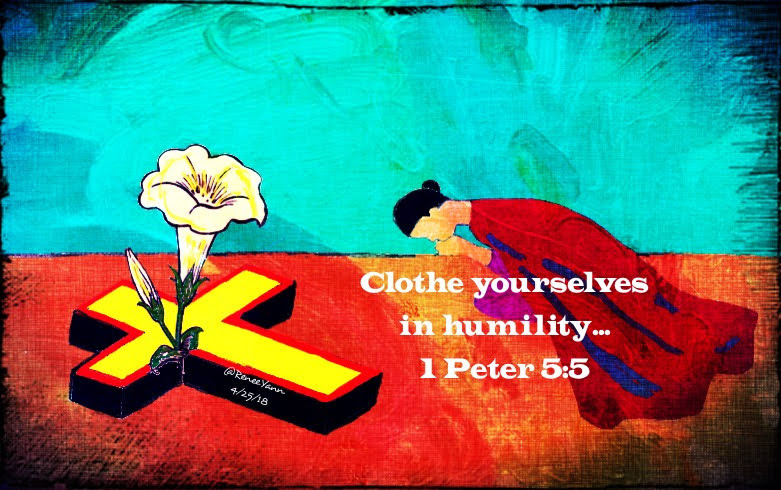
Clothe yourselves with humility
in your dealings with one another, for:

God opposes the proud
but bestows favor on the humble.


So humble yourselves under the mighty hand of God,
that he may exalt you in due time.
Cast all your worries upon him because he cares for you.

1 Peter :5-7

While Peter offers these words for the sake of the churches in Asia Minor, picture him sitting only with Mark as Mark diligently scribes Peter’s words. Mark is a young man, maybe still a teenager. His heart is fired with the story of Jesus to the point that he has left his home to travel and learn from this one man who was closest to Jesus himself.

Peter’s stories burn into Mark’s soul and inspire him. Eventually, his own preaching and discipleship will carry the Gospel to the church of Alexandria years after Peter has died, and to us through the written word he inspired.

Our devout and consistent prayer and study of the scriptures allows us to be transformed by that same Sacred Fire – the power of the Holy Spirit given at Pentecost. We, too, can sit beside Peter and Mark and learn from their ardent spirituality.


Dr. Mary Healy is professor of Scripture at Sacred Heart Major Seminary in Detroit. She is a general editor of the Catholic Commentary on Sacred Scripture and author of two of its volumes, The Gospel of Mark and Hebrews. She says this:

What we have not fully taken into account is the first evangelisation – the explosive growth of Christianity in the ancient world, when a handful of fishermen, tax collectors, and ordinary people turned the world upside down for Christ, even while undergoing waves of state-sanctioned persecution.

The beginnings of that story are told in the New Testament, and it’s there that we find the secret to becoming the missionary disciples we are called to be.


Jesus appeared to the Eleven and said to them:
“Go into the whole world
and proclaim the Gospel to every creature.
Whoever believes and is baptized will be saved;
whoever does not believe will be condemned.
These signs will accompany those who believe:
in my name they will drive out demons,
they will speak new languages.
They will pick up serpents with their hands,
and if they drink any deadly thing, it will not harm them.
They will lay hands on the sick, and they will recover.”

Mark 16:15-18

I think that most of us, when we read today’s Gospel, do not see ourselves standing with the Eleven, receiving the ability to “cast out demons, …speak new languages,… handle serpents, … and drink poison…”.

But think about it:

  • How are we called to respond with Gospel grace when we encounter the demon of injustice in our world?
  • How are we called to speak new languages of peace, kindness, and respect for human life in a culture that has normalized violence and deception?
  • How are we called to handle and confront meanness, prejudice, gossip, and hatred when these slither like snakes into our conversations and opinions?
  • How do we help ourselves and others recognize and avoid the poisons of a dishonest and manipulative culture when they threaten our familial, economic, political, educational, religious, and medicinal constructs?

Indeed, we are called to love, learn and live the Gospel in our own particular time and circumstances — just like Mark and Peter were. Let’s pray with them today and ask them to strengthen us in a courageous response to that glorious call.


Poetry: Mark – a sonnet by Malcolm Guite

A wingèd lion, swift, immediate
Mark is the gospel of the sudden shift
From first to last, from grand to intimate,
From strength  to weakness, and from debt to gift,
From a wide deserts haunted emptiness
To a close city’s fervid atmosphere,
From a voice crying in the wilderness
To angels in an empty sepulcher.
And Christ makes the most sudden shift of all;
From swift action as a strong Messiah
Casting the very demons back to hell
To slow pain, and death as a pariah.
We see our Saviour’s life and death unmade
And flee his tomb dumbfounded and afraid.

Music: My God, I Love Thee from St. Mark Passion by Charles Wood (lyrics below)

My God, I love Thee: not because
I hope for heaven thereby,
Nor yet because who love Thee not
Are lost eternally.
Thou, O my Jesus, Thou didst me
Upon the Cross embrace;
For me didst bear the nails, and spear,
And manifold disgrace,

And griefs and torments numberless,
And sweat of agony;
Yea, death itself; and all for me
Who wast Thine enemy.
Then why, most loving Jesus Christ,
Should I not love Thee well?
Not for the sake of winning heaven,
Or of escaping hell;
Not from the hope of gaining aught, 
Not seeking a reward;
But as Thyself has lovèd me,
O ever­loving Lord?
So do I love Thee, and will love,
Who such a love hast showed Only because
Thou art my King,
Because Thou art my God

So Loved …

Wednesday of the Second Week of Easter
April 19, 2023

Today’s Readings:

https://bible.usccb.org/bible/readings/041923.cfm

Today, in God’s Lavish Mercy, we continue what we began on Monday, a long immersion in John’s Gospel which will not conclude until Pentecost.

As a guide in praying with the glorious Gospel, I am using a book from the series “A Catholic Commentary on Sacred Scripture”. This particular volume is “The Gospel of John” by Francis Martin and William M. Wright. These authors open their work with this beautiful introduction:

Pope St. Gregory the Great compared Scripture to
a “smooth, deep river
in which a lamb may walk
and an elephant may swim.


These words certainly apply to the Gospel of John.
Within its pages are found divine teachings
articulated with simple images such as water and light,
memorable stories composed with literary and dramatic skill,
and glimpses into the very mystery of God,
proceeding from the most profound mystical illumination.
Like the loaves and fishes multiplied by Jesus,
the Gospel of John provides a superabundance
of spiritual teaching, edification, and challenges to all its readers,
whether beginners or experienced.


Our Gospel today gives us the central point inspiring John’s entire Gospel:

God so loved the world that he gave his only-begotten Son,
so that everyone who believes in him might not perish
but might have eternal life.

John 3:16

As we go deeper into our post-Easter journey, on the way to the confirmation of Pentecost, we need to keep repeating this amazing truth to ourselves …

And it helps to remind ourselves as well that “God so loved ME … that God gave God’s ALL for me.”


As we pray with John’s Gospel over the next several weeks, we will be doing the same work that the Apostles are doing in our first reading from Acts.  We will be telling the story of Love – the story of Jesus who lived, died and rose from the dead to save us.

Each little part of that story can teach us and change us.  By our choice to believe, and to act on that faith, we are transformed from darkness to Light in the power of the Resurrection.

And this is the verdict,
that the light came into the world,
but people preferred darkness to light,
because their works were evil.
For everyone who does wicked things hates the light
and does not come toward the light,
so that his works might not be exposed.
But whoever lives the truth comes to the light,
so that his works may be clearly seen as done in God.

John 3:19-21

For today, we may want to consider any darkness in our world or in ourselves that we wish to carry into God’s amazing Light and Love. There, let us lay the darkness down and pray to live the truth which John encourages us to live.


Poetry: “Truth”, said a traveller by Stephen Crane

“Truth," said a traveller,
“Is a rock, a mighty fortress;
“Often have I been to it,
“Even to its highest tower,
“From whence the world looks black.”

“Truth," said a traveller,
“Is a breath, a wind,
“A shadow, a phantom;
“Long have I pursued it,
“But never have I touched
“The hem of its garment.”

And I believed the second traveller;
For truth was to me
A breath, a wind,
A shadow, a phantom,
And never had I touched
The hem of its garment.

Music: God So Loved the World – Sir John Stainer

God so loved the world,
that He gave His only-begotten Son,
that whoso believeth in Him should not perish,
but have everlasting life.
For God sent not His Son into the world
to condemn the world;
but that the world through Him
might be saved. Amen.

A Perfect Heart

Friday of the Third Week in Advent
December 16, 2022

Today’s Readings:

https://bible.usccb.org/bible/readings/121622.cfm

Today, in God’s Lavish Mercy, we stand at the edge of the final deep dive into Christmas.

Tomorrow, we will begin the magnificent O Antiphons with their rich and repeated invitation for God, not only to enter, but to take up residence our lives. We hear the hint of those invitations in today’s Responsorial Psalm:

Alleluia, alleluia.
Come, Lord, bring us your peace
that we may rejoice before you
with a perfect heart.


It’s a perfect prayer for these last few days before Christmas, because so many of us get caught up in a contradictory kind of frenzy of shopping, gifts, parties, decorating, cooking, wrapping, buying…. and on, and on, and on.

The hyperactivity doesn’t leave a lot of space for peace and the perfection of our hearts to welcome the Savior.


This lovely poem by Geoffrey Brown has always helped focus me on the peace-making of my heart so that I could welcome Grace as it comes to me.


The Heart Cave

I must remember
To go down to the heart cave
& sweep it clean; make it warm
with a fire on the hearth,
& candles in their niches,
the pictures on the walls
       glowing with a quiet light.
       I must remember
To go down to the heart cave
       & make the bed
with the quilt from home,
strew
the rushes on the floor
hang
lavender and sage
         from the corners.
         I must go down
        To the heart cave & be there
         when You come.

Isaiah, with a powerful “how-to”, reminds us that we are all called to this spiritual readying:

Thus says the LORD:
Observe what is right, do what is just,
for my salvation is about to come,
my justice, about to be revealed.
Happy is the one who does this,
whoever holds fast to it:
Keeping the sabbath without profaning it,
keeping one’s hand from doing any evil


As a last reminder before our journey through the O Antiphons, Isaiah coaches us in inclusivity – assuring us that all people are welcome in the arms of the One Who is to come:

Let not the foreigners say,
when they would join themselves to the LORD,
“The LORD will surely exclude me from the people.”
The foreigners who join themselves to the LORD,
ministering to and
Loving the name of the LORD,
and becoming God’s servants–
All who keep the sabbath free from profanation
and hold to my covenant,
Them I will bring to my holy mountain
and make joyful in my house of prayer …


Music: Rorate Caeli – sung by Harpa Dei

“Rorate caeli” (Drop down, ye heavens) are the opening words of Isaiah 45:8. The text is frequently sung to plainsong at Mass and in the Divine Office during Advent where it gives expression to the longings of Patriarchs and Prophets, and symbolically of the Church, for the coming of the Messiah.

Turn to Me

Memorial of Saint John of the Cross, Priest and Doctor of the Church
Wednesday of the Third Week of Advent
December 14, 2022

Today’s Readings:

https://bible.usccb.org/bible/readings/121422.cfm

Today, in God’s Lavish Mercy, through the lyricism of Isaiah, God proclaims his majesty and omnipotence. But as awesome as that Power is, it descends over us in the gentlest form – justice and salvation like morning dew and springtime blossoms:

Let justice descend, O heavens, like dew from above,
like gentle rain let the skies drop it down.
Let the earth open and salvation bud forth;
let justice also spring up!
I, the LORD, have created this.

Isaiah 45:8

Our God invites us all into that gentle embrace, asking us to deepen our hearts in faith and worship:

Turn to me and be safe,
all you ends of the earth,
for I am God; there is no other!
By myself I swear,
uttering my just decree
and my unalterable word:
To me every knee shall bend;
by me every tongue shall swear,
Saying, “Only in the LORD
are just deeds and power.

Isaiah 45:22-24

Our Gospel is a repeat of this past Sunday’s, only this time told by Luke instead of Matthew. It again reminds us of what this just and gentle reign of God will look like:

“Go and tell John what you have seen and heard:
the blind regain their sight,
the lame walk,
lepers are cleansed,
the deaf hear, the dead are raised,
the poor have the good news proclaimed to them. 
And blessed is the one who takes no offense at me.”

Luke 7:22-23

Praying in these twilight days of Advent,
let’s ask to be drenched in gentle Justice
and life-giving Mercy
so that we may be living signs
of the One Who is to come on Christmas.

Poetry: Annunciation – Scott Cairns – a wonderful poet. Read about him here:

https://www.poetryfoundation.org/poets/scott-cairns

Deep within the clay, and O my people
very deep within the wholly earthen
compound of our kind arrives of one clear,
star-illumined evening a spark igniting
once again the tinder of our lately
banked noetic fire. She burns but she
is not consumed. The dew lights gently,
suffusing the pure fleece. The wall comes down.
And—do you feel the pulse?—we all become
the kindled kindred of a King whose birth
thereafter bears to all a bright nativity.


Music: Turn to Me – John Foley, SJ