Lent: Healing the Wounds

March 4, 2022
Friday after Ash Wednesday

Today, in God’s Lavish Mercy, Isaiah cuts his listeners no slack — and, remember, we too are his listeners.
In this powerful passage, the prophet shatters the pretenses of those who make a show of religion. Speaking with God’s voice, Isaiah lambastes those who fast and pray but practice no works of justice and mercy.

Lo, on your fast day you carry out your own pursuits,
and drive all your laborers.
Yes, your fast ends in quarreling and fighting,
striking with wicked claw.

These “fake fasters” are left wondering why God doesn’t answer their prayers. The prophet tells them that God isn’t fooled by their pretenses:

Is this the manner of fasting I wish,
of keeping a day of penance:
That a man bow his head like a reed
and lie in sackcloth and ashes?


Isaiah says that God’s not into sackcloth and ashes. God’s into good works of mercy and justice. These are the actions that change our hearts, opening us to deeper relationship with God.

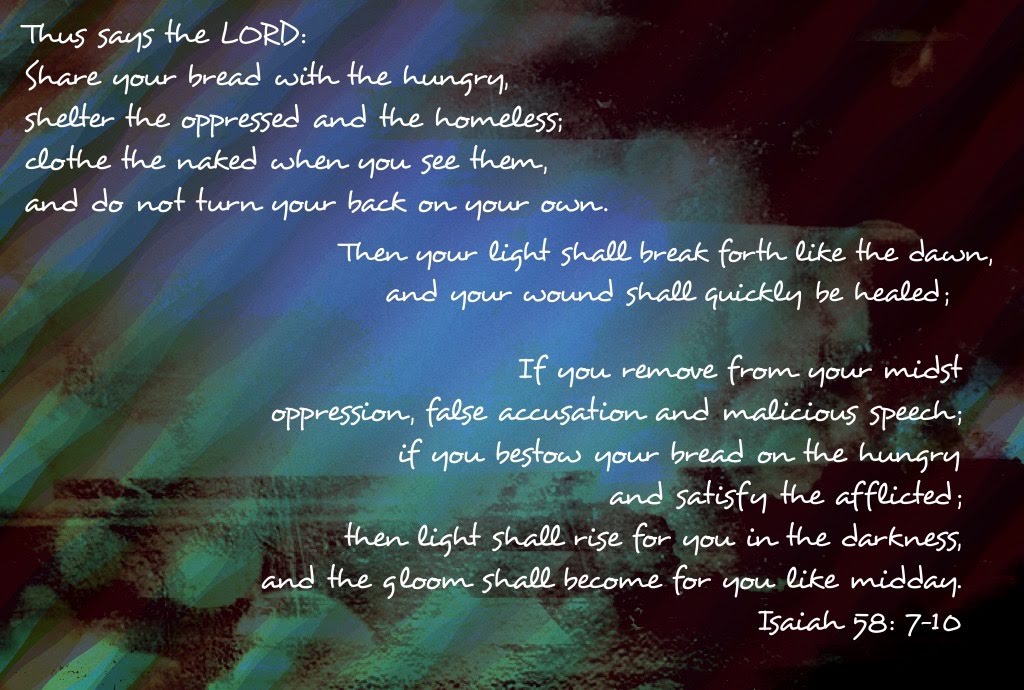
This, rather, is the fasting that I wish:
releasing those bound unjustly,
untying the thongs of the yoke;
Setting free the oppressed,
breaking every yoke;
Sharing your bread with the hungry,
sheltering the oppressed and the homeless;
Clothing the naked when you see them,
and not turning your back on your own.


Listen, dear friends. It can’t be clearer than that.

In a world full of “prosperity gospels”, false piety and pretend religion – used to justify all kinds of injustice – we may get mixed up sometimes about what pleases God.

Let’s really open our hearts to Isaiah’s message and try to rid our own lives of any pretense about these things.

Let’s confront such hypocrisy when we see it used to subtly oppress rather than to lift up others.

Then your light shall break forth like the dawn,
and your wound shall quickly be healed.


Perhaps we might spend sometime today thinking about that “wound” we need healed. Might there be some harbored prejudice, indifference, fear, or ignorance that distances us from others who are different, vulnerable, or in need?

Isaiah cautions that until that wound is healed,
we will never hear God’s true answer to our prayers.


Poetry: from Gitanjali by Rabindranath Tagore

Then said a rich man, “Speak to us of Giving”.

And he answered:
“You give but little when you give of your possessions.
It is when you give of yourself that you truly give.
For what are your possessions but things you keep and guard
for fear you may need them tomorrow?
And tomorrow, what shall tomorrow bring
to the overprudent dog burying bones in the trackless sand
as he follows the pilgrims to the holy city?

And what is fear of need but need itself?
Is not dread of thirst when your well is full, thirst that is unquenchable?

There are those who give little of the much which they have

and they give it for recognition and their hidden desire
makes their gifts unwholesome.
And there are those who have little and give it all.
These are the believers in life and the bounty of life,
and their coffer is never empty.

There are those who give with joy, and that joy is their reward.
And there are those who give with pain, and that pain is their baptism.
And there are those who give and know not pain in giving,
nor do they seek joy, nor give with mindfulness of virtue;
They give as in yonder valley the myrtle breathes its fragrance into space.
Through the hands of such as these God speaks,
and from behind their eyes He smiles upon the earth.

It is well to give when asked,
but it is better to give unasked, through understanding;
And to the open-handed
the search for one who shall receive is joy greater than giving.

And is there aught you would withhold?
All you have shall some day be given;
Therefore give now, that the season of giving
may be yours and not your inheritors’.

You often say, “I would give, but only to the deserving.”
The trees in your orchard say not so, nor the flocks in your pasture.
They give that they may live, for to withhold is to perish.

Surely he who is worthy to receive his days and his nights
is worthy of all else from you.
And he who has deserved to drink from the ocean of life
deserves to fill his cup from your little stream.
And what desert greater shall there be than that which lies
in the courage and the confidence, nay the charity, of receiving?

And who are you that men should rend their bosom and unveil their pride,
that you may see their worth naked and their pride unabashed?
See first that you yourself deserve to be a giver,
and an instrument of giving.
For in truth it is life that gives unto life –
while you, who deem yourself a giver, are but a witness.

And you receivers – and you are all receivers –
assume no weight of gratitude,
lest you lay a yoke upon yourself and upon him who gives.
Rather rise together with the giver on his gifts as on wings;
For to be overmindful of your debt, is to doubt his generosity
who has the free-hearted earth for mother, and God for father.

Music: Respond – Collin Campbell (Lyrics below)

Oh how long will you cry out
And never truly seek my face
You come to me with heavy hearts
But you ignore what makes mine break

I see your thoughts, I hear your words
And I have watched you as you’ve prayed
I’ve told you my desires
But you don’t follow all the way

Children, I’m crying out
Break the chains
Let the oppressed go free
Empty yourselves to those in need
Be my hands Be my feet
What you do unto them You do unto Me

Every day you lift your voice
And await my swift response
But I see only what’s inside
And it’s (what i see on the inside) an offering I don’t want

Children, I’m crying out
Break the chains
Let the oppressed go free
Empty yourselves to those in need
Be my hands Be my feet
What you do unto them You do unto Me

Then your Salvation will come like the dawn
And my glory will be your shield
When you call on My name I will not turn away
I am Your God And I am here
And your light it will shine from the dark
You will be like a free flowing stream
And when you call on My name I will not turn away
I am your God And I am here

Lent: The Choice

March 3, 2022
Thursday after Ash Wednesday

Today, in God’s Lavish Mercy, our readings confirm that a life patterned on Christ contradicts worldly definitions.

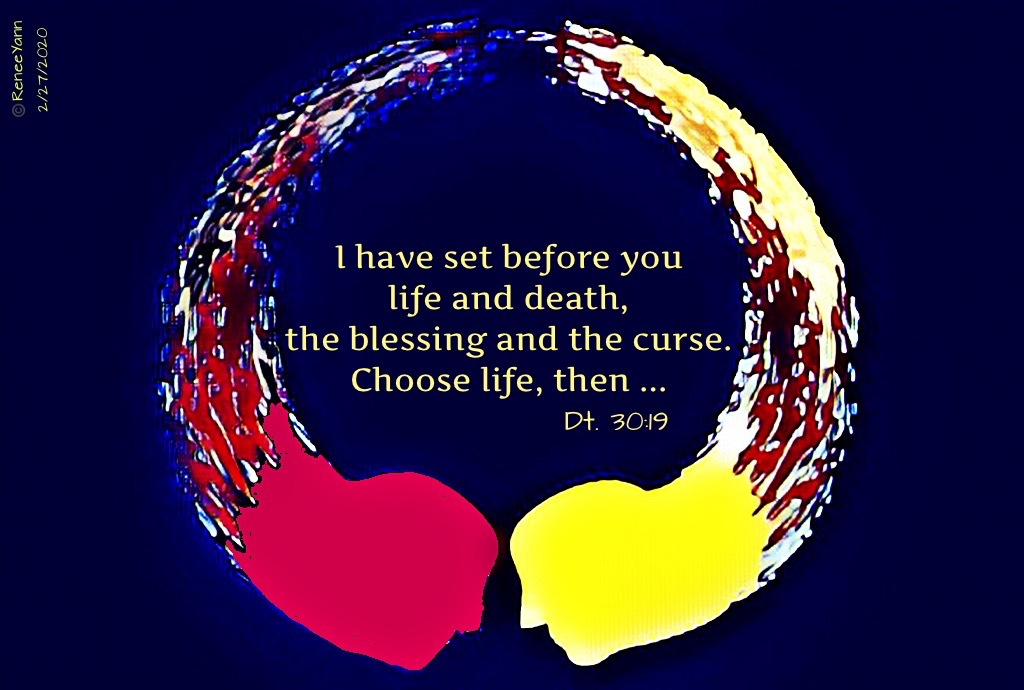
Deuteronomy gives us stark, either-or, advice:

I have set before you life and death,
the blessing and the curse.
Choose life, then,
that you and your descendants may live,
by loving the LORD, your God,
heeding his voice,
and holding fast to him.

Deuteronomy 30: 15-16

It’s definitive advice, but we could probably do these things, right?

  • Choose life
  • Love God
  • Heed God’s voice
  • Hold fast to God

Sounds OK, doesn’t it?


It’s when Jesus comes along that it begins to sound difficult.
Jesus tells us, “Here’s how you choose life:

“Whoever wishes to save his life will lose it,
but whoever loses his life for my sake will save it.”


Jesus tells us, “Here’s the God you must love, one who:

“suffers greatly, is rejected, and is killed.”


Jesus tells us, “Here’s what my voice says to you :

“What profit is there for you to gain the whole world
yet lose or forfeit yourself?”


Jesus tells us, “Here’s how you hold fast to me:

‘Take up your cross daily and follow me.”

The deep love of the Holy Cross was the sacred gift of Catherine McAuley to her Mercy Family.
Let us listen to her counsel.

Some have huge crosses to carry in their lives – war, famine, enslavement, untended illness, homelessness, persecution, poverty. Those who carry such crosses are singularly loved by God who dwells with them.

But if we don’t have big, obvious crosses in our lives – if we are among those the world deems fortunate – how do we follow the crucified Jesus to find our way to eternal life?

How do we really CHOOSE LIFE?

We need to get close to the ones God singularly loves. We need to walk beside them and lift some of their heavy crosses. We need to help their voices be heard, their needs be met, their rights be honored.

Not all of us can do this by direct service. But we can do it by our advocacy, our material contributions, and our articulated support for justice.

We need to make these choices for LIFE all the time. But Lent is a great time to examine the vigor and commitment of our choices, a time to take a closer walk with our suffering Christ and ask him to inspire our courage.


Poetry: Simon the Cyrenian Speaks – Countée Cullen, an American poet, novelist, children’s writer, and playwright, particularly well known during the Harlem Renaissance. I picked his poem today because Simon of Cyrene is someone who chose to carry the cross just as we are asked to do.

He never spoke a word to me,
And yet He called my name;
He never gave a sign to me,
And yet I knew and came.

At first I said, “I will not bear
His cross upon my back;
He only seeks to place it there
Because my skin is black.”

But He was dying for a dream,
And He was very meek,
And in His eyes there shone a gleam
Men journey far to seek.

It was Himself my pity bought;
I did for Christ alone
What all of Rome could not have wrought
With bruise of lash or stone.


Music: Just a Closer Walk with Thee – Patsy Cline and Willie Nelson

Lent: Time of Holy Listening

March 2, 2022
Ash Wednesday

Today, in God’s Lavish Mercy, we resolve to turn our hearts more fully to God. The sacred journey of Lent, one we have traveled so often over the years, invites us each time to go deeper into the Well of Mercy.

Joel’s pregnant phrase summons us:

Think of the “even now” moments of your life, those times when, despite darkness and cold, you turned toward light and warmth. Think of a time when, in contradiction to all negativity, your soul proclaimed:

  • Even now I hope
  • Even now I believe
  • Even now I love
  • Even now I care
  • Even now I repent
  • Even now I forgive
  • Even now I begin again

The rise of an “Even Now” moment in our souls is like the hint of spring pushing its head through the winter snow.

It is the reddish-green thread suggesting life at the tip of the brown, cold-cracked branch.

It is the moment we believe that what we desire and love will turn toward us and embrace us.

Can you imagine God having such moments, longing for our attention, love, presence, catching a glimpse of our turning?

Our reading from Joel describes such a God.

Even now, says the LORD,
return to me with your whole heart…
These words suggest God’s longing for us, for our devotion and love.

But our holy intentions weaken and we often drift away from our “first fervors”. Our hearts attach to distractions from God. So God says:

Rend your hearts …
and return to the LORD, your God.
For I am gracious and merciful,
slow to anger, rich in kindness …
Come back to Me, with all your heart.

Joel 2: 13-14

This is what Lent is all about. Each of us knows where our hearts have wandered. Each of knows what we must turn from — even now — to return to God’s embrace.

If we can hear God’s longing in this haunting reading from Joel perhaps the true turning will begin. A blessed Lent, a holy listening, my friends.


Poetry: God’s Longing – from Rumi

All night, a man called out “God! God!”
Until his lips were bleeding.
Then the Adversary of mankind said, “Hey! Mr Gullible!
… How come you’ve been calling all night
And never once heard God say, “Here, I AM”?
You call out so earnestly and, in reply, what?
I’ll tell you what. Nothing!”

The man suddenly felt empty and abandoned.
Depressed, he threw himself on the ground
And fell into a deep sleep.
In a dream, he met an angel, who asked,
“Why are you regretting calling out to God?”

The man said, “ I called and called
But God never replied, “Here I AM.”

The Angel explained, “God has said,
“Your calling my name is My reply.
Your longing for Me is My message to you.
All your attempts to reach Me
Are in reality My attempts to reach you.
Your fear and love are a noose to catch Me.
In the silence surrounding every call of “God”
Waits a thousand replies of “Here I AM.”


Music: Come Back to Me – Gregory Norbet, sung by John Michael Talbot

Primed for Transformation

February 27, 2022
Eighth Sunday in Ordinary Time

Today, in God’s Lavish Mercy, our readings prime us for the coming of Lent. Lent is all about the transformation of our hearts within of the Passion, Death, and Resurrection of Jesus.

But before we are ready for such transformation, we must be totally aware of ourselves and open to God’s Presence in our lives.


Our readings call us to a deep look at our spiritual integrity as it is revealed in our words and actions. The image of a good tree, bearing fruit, suffuses all our scriptures today.

What about the integrity of our words:

The fruit of a tree shows the care it has had;
so too does one’s speech disclose the bent of one’s mind.
Praise no one before he speaks,
for it is then that people are tested.

Sirach 27:6-7

What about the integrity of our faith:

The just one shall flourish like the palm tree,
like a cedar of Lebanon shall he grow.
They that are planted in the house of the LORD
shall flourish in the courts of our God.

Psalm 92: 13-14

What about the perseverance of our faithful labor:

Be firm, steadfast, always fully devoted to the work of the Lord,
knowing that in the Lord your labor is not in vain.

1 Corinthians 92:15-16

What about our actions – the fruit we bear to the world:

A good tree does not bear rotten fruit,
nor does a rotten tree bear good fruit.
For every tree is known by its own fruit.
For people do not pick figs from thornbushes,
nor do they gather grapes from brambles.
A good person out of the store of goodness in his heart produces good,
but an evil person out of a store of evil produces evil;
for from the fullness of the heart the mouth speaks.

Luke 6:43-54

Let’s set our sights on the beginning of Lent which is now on the near horizon. How do we want to begin the transformative journey offered us once again in this magnificent liturgical cycle? Now is the time to prepare.


Poetry: Birches BY ROBERT FROST

When I see birches bend to left and right
Across the lines of straighter darker trees,
I like to think some boy’s been swinging them.
But swinging doesn’t bend them down to stay
As ice-storms do. Often you must have seen them
Loaded with ice a sunny winter morning
After a rain. They click upon themselves
As the breeze rises, and turn many-colored
As the stir cracks and crazes their enamel.
Soon the sun’s warmth makes them shed crystal shells
Shattering and avalanching on the snow-crust—
Such heaps of broken glass to sweep away
You'd think the inner dome of heaven had fallen.
They are dragged to the withered bracken by the load,
And they seem not to break; though once they are bowed
So low for long, they never right themselves:
You may see their trunks arching in the woods
Years afterwards, trailing their leaves on the ground
Like girls on hands and knees that throw their hair
Before them over their heads to dry in the sun.
But I was going to say when Truth broke in
With all her matter-of-fact about the ice-storm
I should prefer to have some boy bend them
As he went out and in to fetch the cows—
Some boy too far from town to learn baseball,
Whose only play was what he found himself,
Summer or winter, and could play alone.
One by one he subdued his father's trees
By riding them down over and over again
Until he took the stiffness out of them,
And not one but hung limp, not one was left
For him to conquer. He learned all there was
To learn about not launching out too soon
And so not carrying the tree away
Clear to the ground. He always kept his poise
To the top branches, climbing carefully
With the same pains you use to fill a cup
Up to the brim, and even above the brim.
Then he flung outward, feet first, with a swish,
Kicking his way down through the air to the ground.
So was I once myself a swinger of birches.
And so I dream of going back to be.
It’s when I’m weary of considerations,
And life is too much like a pathless wood
Where your face burns and tickles with the cobwebs
Broken across it, and one eye is weeping
From a twig’s having lashed across it open.
I'd like to get away from earth awhile
And then come back to it and begin over.
May no fate willfully misunderstand me
And half grant what I wish and snatch me away
Not to return. Earth’s the right place for love:
I don’t know where it's likely to go better.
I'd like to go by climbing a birch tree,
And climb black branches up a snow-white trunk
Toward heaven, till the tree could bear no more,
But dipped its top and set me down again.
That would be good both going and coming back.
One could do worse than be a swinger of birches.

Music: Tree Song – sung by Evie Karlsson

Good Friday of the Lord’s Passion

April 2, 2021

Today, in God’s Lavish Mercy, we pray with Psalm 31, the prayer of one who will not be shaken from faith in God.

For all my foes I am an object of reproach,
    a laughingstock to my neighbors, and a dread to my friends;
    they who see me abroad flee from me.
I am forgotten like the unremembered dead;
    I am like a dish that is broken.
But my trust is in you, O LORD;
    I say, “You are my God.
In your hands is my destiny; rescue me
    from the clutches of my enemies and my persecutors.”

Psalm 31: 12-13

What is there to say about the Good Friday journey of Jesus? It may be that we can only walk beside him in loving, heart-broken silence.

There are times in our lives when we will be called to walk like this beside others in loving and merciful ministry.

There may be times when others are called to walk with us in such a way.

Let these times inform our prayer today.

Good Friday is the time we gather strength and compassionate understanding from Jesus to help us, in his Name, be Mercy in the world.


Poetry: From “The Dream of the Rood”, one of the Christian poems in the corpus of Old English literature and an example of the genre of dream poetry. Like most Old English poetry, it is written in alliterative verse. Rood is from the Old English word rōd ‘pole’, or more specifically ‘crucifix’. Preserved in the 10th-century Vercelli Book, the poem may be as old as the 8th-century Ruthwell Cross, and is considered as one of the oldest works of Old English literature.

The Rood (cross of Christ) speaks:

“It was long past – I still remember it – 
That I was cut down at the copse’s end,
Moved from my root. Strong enemies there took me,
Told me to hold aloft their criminals,
Made me a spectacle. Men carried me
Upon their shoulders, set me on a hill,
A host of enemies there fastened me.

“And then I saw the Lord of all mankind
Hasten with eager zeal that He might mount
Upon me. I durst not against God’s word
Bend down or break, when I saw tremble all
The surface of the earth. Although I might
Have struck down all the foes, yet stood I fast.

“Then the young hero (who was God almighty)
Got ready, resolute and strong in heart.
He climbed onto the lofty gallows-tree,
Bold in the sight of many watching men,
When He intended to redeem mankind.

I trembled as the warrior embraced me.
But still I dared not bend down to the earth,
Fall to the ground. Upright I had to stand.

“A rood I was raised up; and I held high 
The noble King, the Lord of heaven above.
I dared not stoop. They pierced me with dark nails;
The scars can still be clearly seen on me,
The open wounds of malice. Yet might I
Not harm them. They reviled us both together.
I was made wet all over with the blood
Which poured out from his side, after He had 
Sent forth His spirit. And I underwent
Full many a dire experience on that hill.

I saw the God of hosts stretched grimly out.
Darkness covered the Ruler’s corpse with clouds
His shining beauty; shadows passed across,
Black in the darkness. All creation wept,
Bewailed the King’s death; Christ was on the cross….

“Now you may understand, dear warrior,
That I have suffered deeds of wicked men
And grievous sorrows. Now the time has come
That far and wide on earth men honor me,
And all this great and glorious creation,
And to this beacon offers prayers. On me
The Son of God once suffered; therefore now
I tower mighty underneath the heavens,
And I may heal all those in awe of me.
Once I became the cruelest of tortures,
Most hateful to all nations, till the time
I opened the right way of life for men.”

Music: Pie Jesu – Michael Hoppé

Holy Thursday

Evening Mass of the Lord’s Supper

April 1, 2021

Today, in God’s Lavish Mercy, we pray with Psalm 116 which Walter Bruggemann calls an example of “the performance of thanks”. 

How shall I make a return to the LORD
    for all the good he has done for me?
The cup of salvation I will take up,
    and I will call upon the name of the LORD.

Psalm 116: 12-13

There is a tone of solemn ritual woven through the psalm, just as there is throughout the Holy Thursday liturgies.

The time of waiting and wondering is over. Jesus chooses the Passover meal to formalize his understanding that the time has come to offer his life in an ultimate sacrifice of praise.

Before the feast of Passover, Jesus knew that his hour had come
to pass from this world to the Father.
He loved his own in the world and he loved them to the end.

John 13:1

The Last Supper by the nun Plautilla Nelli (1524–1588) of Florence
Inscribed: Suor Plautilla · Orate Pro Pictora (Pray for the Paintress)

It is likely that, during his Last Supper, Jesus would have prayed, and possibly sung, Psalm 116 as part of the ancient Hallel,  six thanksgiving prayers included in the Passover rites. 

On our behalf, Jesus is about to enflesh in his own life the redemptive promise awaited through the ages. He is about to enact the Great Deliverance — far greater than that achieved in the Passover. By the power of his Paschal sacrifice, we are redeemed from death itself:

Return, my soul, to your rest;
the LORD has been very good to you.
For my soul has been freed from death,
my eyes from tears, my feet from stumbling.
I shall walk before the LORD
in the land of the living

Psalm 116: 7-9

For me, Holy Thursday is the most solemnly beautiful and meaningful day of the Liturgical Year. There is so much to be found in the readings, especially as we peel back single phrases to hear their living power and love. There is so much to be learned at the side of Jesus as we pray with Him.

May we place ourselves beside Jesus at the holy table of his life. Feel him lay the gathering tensions down as he gathers his beloveds in the truth of this moment. It is time for him to give everything over in love. This is the moment of Holy Acquiescence, this is the moment of Eucharist.

With Jesus, let us pray for the loosening of any bonds which prevent us from giving our lives lovingly into God’s Will for us, from allowing Eucharist to be offered through our lives.

Dear to the eyes of the LORD
    is the death of his faithful ones.
I am your servant, the child of your handmaid;
    you have loosed my bonds.
To you will I offer sacrifice of thanksgiving,
    and I will call upon the name of the LORD.
My vows to the LORD I will pay
    in the presence of all his people.

Psalm 116: 15-18

Prose: from Mass on the World, by Pierre Teilhard de Chardin

Since once again Lord 
I have neither bread nor wine nor altar,
I will raise myself beyond these symbols 
up to the pure majesty of the real itself.
 
I, your priest, will make the whole earth my altar, 
and on it I will offer you 
all the labors and the sufferings of the world.
 
I will place on my paten Lord God 
all the harvest to be won from your renewal. 

Into my chalice, I shall pour all the sap 
which is to be pressed out this day 
from the earth’s fruits and from its sufferings.
 
All the things in the world 
to which this day will bring increase; 
all those that will diminish; 
all those, too, that will die: 
all of them, Lord, I try to gather into my arms 
so as to hold them out to you in offering.
 
This is the material of my sacrifice, 
the only material you desire.
The restless multitude, confused or orderly, 
the immensity of which terrifies us, 
this ocean of humanity, 
the slow, monotonous wave-flows which trouble the hearts 
of even those whose faith is most firm.
 
My paten and my chalice are 
the depths of a soul laid widely open 
to all the forces which in a moment will rise up 
from every corner of the earth 
and converge upon the Spirit. 

Grant me the remembrance and the mystic presence 
of all those whom the light is now awakening to the new day.
Receive, O Lord, this all-embracing Host
which your whole creation, moved by your magnetism, 
offers you at this dawn of a new day.
 
Sanctus, Sanctus, Sanctus
Dominus Deus Sabaoth.
Pleni sunt cæli et terra gloria tua.
Hosanna in excelsis.

Music: Sanctus – Jessie Norman

(Get someplace where you can turn the sound up for this and let it blow you away. There are some exquisite soft notes, beginning and end, that you don’t want to miss. Wait for them.)

Psalm 69: The Plea

Wednesday of Holy Week

Wednesday, March 31, 2021

Today, in God’s Lavish Mercy, we pray with Psalm 69. The verses offered for today’s liturgy describe someone who is abused and abandoned by the community he depended on:

Insult has broken my heart, and I am weak,
    I looked for sympathy, but there was none;
    for consolers, not one could I find.
Rather they put gall in my food,
    and in my thirst they gave me vinegar to drink.

Psalm 69: 21-22

The psalmist goes on, into today’s passage and throughout the whole psalm, to proclaim his innocence and call on God for justice – one might say even vengeance.

Heap punishment upon their punishment;
let them gain from you no vindication.
May they be blotted from the book of life;
not registered among the just!

Psalm 69: 28-29

Several Gospel writers include parts of Psalm 69 to describe Jesus’s situation throughout his Passion and Death. However, we find Jesus not invoking divine vengeance but forgiving those who persecute him.

Does Christ’s forgiveness mean that he didn’t feel heart-broken, angry, perhaps even wishing, as the psalmist does, that the tables would be turned onto his harassers? 

We don’t really know what he felt. We can only imagine. What we do know is what Jesus chose. Jesus chose forgiveness.

As we pray with Psalm 69 today, let us remember that we cannot help our feelings. They come unbidden. What we can control are our choices. In the sufferings of our lives, may we have the strength to choose as Jesus did.


Poetry: John Greenleaf Whittier, ‘Forgiveness’

My heart was heavy, for its trust had been
Abused, its kindness answered with foul wrong;
So, turning gloomily from my fellow-men,
One summer Sabbath day I strolled among
The green mounds of the village burial-place;
Where, pondering how all human love and hate
Find one sad level; and how, soon or late,
Wronged and wrongdoer, each with meekened face,
And cold hands folded over a still heart,
Pass the green threshold of our common grave,
Whither all footsteps tend, whence none depart,
Awed for myself, and pitying my race,
Our common sorrow, like a mighty wave,
Swept all my pride away, and trembling I forgave!


Music: Antonio Vivaldi – Domine ad adjuvandum me festina (Psalm 69)

Deus, in adjutorium meum intende.
Domine, ad adjuvandum me festina.
Gloria Patri et Filio et Spiritui Sancto,
sicut erat in principio et nunc et semper
et in saecula saeculorum. Amen. Alleluia

O Lord, make speed to save me:
O Lord, make haste to help me.
Glory be to the Father, and to the Son, and to the Holy Spirit:
As it was in the beginning, is now and ever shall be,
World without end, Amen. Alleluia.

Psalm 71: A Long Trust

Tuesday of Holy Week

March 30, 2021

Today, in God’s Lavish Mercy, we pray with Psalm 71, a prayer of yielding and confident faith.

Often thought to be the prayer of an aging David, Psalm 71 recalls a long and steady relationship with God. Even as his youthful vigor wanes, the psalmist declares that his true strength rests in God’s faithfulness.

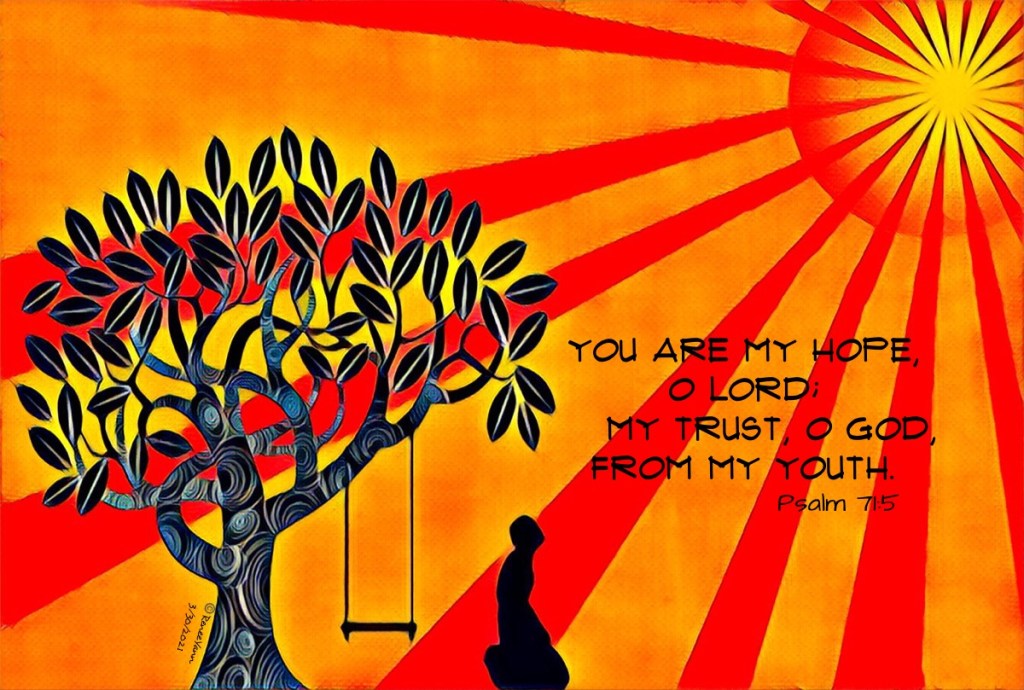
For you are my hope, O LORD;
    my trust, O God, from my youth.
On you I depend from birth;
    from my mother’s womb you are my strength.
My mouth shall declare your justice,
    day by day your salvation.
O God, you have taught me from my youth,
    and till the present I proclaim your wondrous deeds.

Psalm 71: 15-17
King David as an Old Man – Rembrandt

David witnesses to a powerful faith, one that we all might cherish in our human diminishments. It is hard to lose things in our life – youth, health, relationships, reputation, enthusiasm, hope, direction, security. But all of us face at least some of these challenges at some time in our lives.


Judas Iscariot (right), retiring from the Last Supper,
painting by Carl Bloch, late 19th century

In our Gospel today, Jesus acknowledges the loss of trust in a close disciple:

“Amen, amen, I say to you, one of you will betray me.”
The disciples looked at one another, at a loss as to whom he meant.

John 13:21-22

That betrayal is a sign to Jesus that the great dream of his earthly ministry is coming to an ignominious close when even those dearest to him slip into betrayal and denial.


What is it that holds Jesus together, heart and soul riveted on the Father’s Will, as he moves through these heart-wrenching days.

Jesus is the living sacrament of complete obedience and union with God. Every choice of his life has brought him to a readiness for this final and supreme act of trusting love. Like the psalmist today, Jesus’s whole life proclaims:

I will always hope in you
and add to all your praise.
My mouth shall proclaim your just deeds,
day after day your acts of deliverance,
though I cannot number them all.i
I will speak of the mighty works of the Lord;
O GOD, I will tell of your singular justice.
God, you have taught me from my youth;
to this day I proclaim your wondrous deeds.

Psalm 71: 14-17

As we accompany Jesus today, let us pray this psalm with him, asking for an ever-deepening faith, hope, and love.


Poetry: Jesus Weeps – Malcolm Guite

Jesus comes near and he beholds the city
And looks on us with tears in his eyes,
And wells of mercy, streams of love and pity
Flow from the fountain whence all things arise.
He loved us into life and longs to gather
And meet with his beloved face to face
How often has he called, a careful mother,
And wept for our refusals of his grace,
Wept for a world that, weary with its weeping,
Benumbed and stumbling, turns the other way,
Fatigued compassion is already sleeping
Whilst her worst nightmares stalk the light of day.
But we might waken yet, and face those fears,
If we could see ourselves through Jesus’ tears.

Music: Long Ago – Michael Hoppé, Tom Wheater, Michael Tillman

A Psalm from Jeremiah

Saturday of the Fifth Week of Lent

March 27, 2021


Today, in God’s Lavish Mercy, we pray a responsorial from the Book of Jeremiah:

The Lord will guard us, as a shepherd guards the flock.

The psalm today, with the first reading, brings assurance that God remains with us through suffering and will heal and make us whole again.

That reassurance is needed as we hear the Gospel’s tone darken. After the raising of Lazarus, the whole nation waits to see what will happen to Jesus as Passover nears.


I think, in some ways, impending doom is almost worse than doom itself. Picture the part in a movie where the attacker waits in the dark while the victim tiptoes into lurking danger.

That frightening music they always play! Sometimes the tension heightens to the point that I have to hit the mute or close my eyes!


Entry of Christ into Jerusalem, a 1617 oil painting by Flemish Baroque painter Anthony van Dyck

This is what all surrounding Jerusalem felt like in today’s Gospel. The dark edge of evil hangs in inevitable threat.

But for Jesus, who walked in the hidden light of the Father, the moment brought more than threatening shadows. It was time to fulfill an ancient promise. It was time to offer the greatest act of Love.

Hear the word of the LORD, O nations,
    proclaim it on distant isles, and say:
He who scattered Israel, now gathers them together,
    he guards them as a shepherd his flock.
The LORD shall ransom Jacob,
    he shall redeem him from the hand of his conqueror.

Jeremiah 31: 10-12

As Jesus went off alone to Ephraim to prepare his heart and soul for this ultimate fulfillment, perhaps a prayer from Jeremiah strengthened him, a remembered promise from Ezekiel focused him.

Let us pray with Jesus today as he asks the Father to “shepherd” him. With Jesus, may we find our own strengths and understandings in these ancient prophets.


Poetry: Redemption by George Herbert (1593-1633)who was a Welsh-born poet, orator, and priest of the Church of England. His poetry is associated with the writings of the metaphysical poets, and he is recognised as “one of the foremost British devotional lyricists.”

Having been tenant long to a rich lord, 
    Not thriving, I resolvèd to be bold, 
    And make a suit unto him, to afford 
A new small-rented lease, and cancel th’ old. 

In heaven at his manor I him sought; 
    They told me there that he was lately gone 
    About some land, which he had dearly bought 
Long since on earth, to take possessiòn. 

I straight returned, and knowing his great birth, 
    Sought him accordingly in great resorts; 
    In cities, theaters, gardens, parks, and courts; 

At length I heard a ragged noise and mirth 
    Of thieves and murderers; there I him espied, 
    Who straight, Your suit is granted, said, and died.

Music: Like a Shepherd – St. Louis Jesuits

Psalm 18: God’s Right Here

Friday of the Fifth Week of Lent

March 26, 2021


Today, in God’s Lavish Mercy, we pray with Psalm 18. It is a royal psalm, full of triumph, praise and rejoicing. But the psalmist, presumably David, never forgets the depths from which he has been delivered. He remembers the “storm” from which he called out to God.


The psalmist imagines God, in the distant temple, hearing his cry and responding. The image brought to my mind the memory of an early morning prayer time when I was a very young nun. 

An hour or so before dawn, I looked out my window to the morning star, imagining God out there in the heavens. Like David, I presumed God was distant and needed to be called into my experience. But, on that morning, I realized that God was not distant – that God was within me, my life, and the very storm I was praying about.

I still love to look out to the stars while I pray. But since that morning, I imagine God sitting beside me, enjoying the same beauty – sorting through my life with me from within my own heart. Verse 29 makes me think that David came to a similar realization:


Poetry: Go Not to the Temple – Ravindranath Tagore

Go not to the temple to put flowers upon the feet of God,
First fill your ownhouse with the Fragrance of love and kindness. 

Go not to the temple to light candles before the altar of God,
First remove the darkness of sin , pride and ego, 
from your heart…

Go not to the temple to bow down your head in prayer,
First learn to bow in humility before your fellowmen.
And apologize to those you have wronged. 

Go not to the temple to pray on bended knees,
First bend down to lift someone who is down-trodden.
And strengthen the young ones. 
Not crush them.

Go not to the temple to ask for forgiveness for your sins,
First forgive from your heart those who have hurt you!


Music: Christ Be Beside Me – St. Patrick’s Breastplate adapted by Michael Foscher