Today, in God’s Lavish Mercy, we pray with Psalm 51 which, together with our other readings, tests the depths and sincerity of our prayer.
A clean heart create for me, God; renew within me a steadfast spirit.
Psalm 51:12
Our readings today put this consideration before us:
What is prayer really, and what is the quality of my prayer?
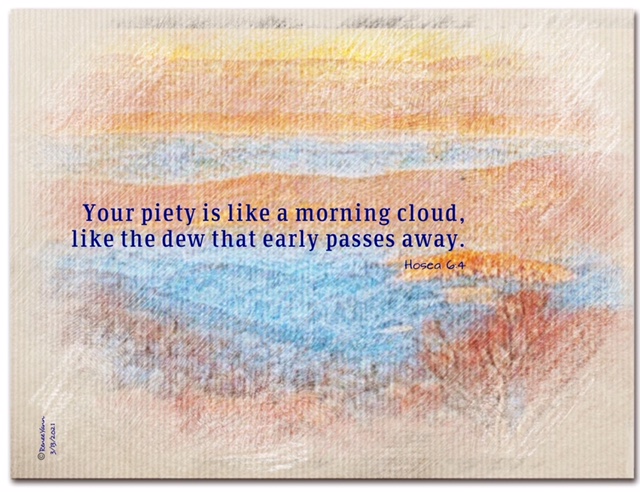
Hosea tells us
For it is love that I desire, not sacrifice, and knowledge of God rather than burnt offerings.
Luke tells us
For everyone who exalts himself will be humbled, and the one who humbles himself will be exalted.
And our psalm tells us
For you are not pleased with sacrifices; should I offer a burnt offering, you would not accept it. My sacrifice, O God, is a contrite spirit; a heart contrite and humbled, O God, you will not spurn.
To sum up our readings, here’s what prayer is NOT:
It is not a roll call of our sacrifices and righteousness.
It is not fasting, or paying tithes, or even keeping the commandments.
Then what is it?
Prayer is an intimate exchange with God with whom we are humble, honest, open, generous and grateful – with Whom we are safe, confident and in love.
Prayer is our response to God who desires our merciful hearts. … so Let us Pray.
Poetry: A Prayer from Teresa of Avila
May today there be peace within.
May you trust God that you are exactly where you are meant to be.
May you not forget the infinite possibilities that are born of faith.
May you use those gifts that you have received,
and pass on the love that has been given to you.
May you be content knowing you are a child of God.
Let this presence settle into your bones,
and allow your soul the freedom to sing, dance, praise and love.
It is there for each and every one of us.
Today, in God’s Lavish Mercy, we pray with Psalm 105. Together with our other readings, the psalm allows us to participate in Israel’s great family storytelling.
Give thanks to the LORD, invoke God’s name; make known among the peoples God’s deeds! Sing praise to the Lord, play music; proclaim all the Lord’s wondrous deeds!
Psalm 105: 1-2
Psalm 105 is one of two historical psalms. (The other is Psalm 78.) Its verses summarize an amazing catalogue of God’s faithfulness to Israel and invites the listeners to grateful praise and unfettered hope.
Today’s particular passage is chosen because it recounts the same incidents as our first reading – the story of Joseph. And Joseph’s story prefigures Jesus’s own story which he offers in parable form in today’s Gospel.
When the LORD called down a famine on the land and ruined the crop that sustained them, He sent a man before them, Joseph, sold as a slave.
Psalm 105: 16-17
For us, the telling and re-telling of relationship stories is an important human rubric, practiced at crowded Thanksgiving tables, at relaxed summer reunions, and at our inevitable bereavements.
Eventually, with enough retellings, a story becomes part of our family or friendship canon. Thence forward, it gains new dimension. Just like the canon of the Mass, whose formula becomes beautifully rote to us, the story now may be endlessly repeated without being exhausted. In its retelling, it always reveals something new and confirms something old.
Seek out the LORD and the Lord’s might; constantly seek God’s face. Recall the wondrous deeds God has done for you and your beloved ones
Psalm 105: 4-5
In fact, such a story becomes a kind of sacrament, carrying within it the mysterious and unwordable blessings of what it means to live, love, die, and believe.
Each human story is, in some form, a re-enactment of Christ’s life, death, and Resurrection. The faith, courage, humor, pathos, genius and serendipity of our lives carry the graces to make us holy, to make us Love as Jesus was Love.
When we gratefully retell the history of those graces – as Psalm 105 does today – we practice a powerful ritual of faith. By such liturgy, we are invited to the same grateful praise and unfettered hope as we meet in Psalm 105.
The LORD, is our God whose judgments reach through all the earth. Who remembers forever the covenant, the word commanded for a thousand generations.
Psalm 105: 8-9
Poetry: The Storyteller – Mike Jones
I’m a teller of tales, a spinner of yarns,
A weaver of dreams and a liar.
I’ll teach you some stories to tell to your friends,
While sitting at home by the fire.
You may not believe everything that I say
But there’s one thing I’ll tell you that’s true
For my stories were given as presents to me
And now they are my gifts to you.

My stories are as old as the mountains and rivers
That flow through the land they were born in
They were told in the homes of peasants in rags
And kings with fine clothes adorning.
There’s no need for silver or gold in great store
For a tale becomes richer with telling
And as long as each listener has a pair of good ears
It matters not where they are dwelling.

A story well told can lift up your hearts
And help you forget all your sorrows
It can give you the strength and the courage to stand
And face all your troubles tomorrow.
For there’s wisdom and wit, beauty and charm
There’s laughter and sometimes there’s tears
But when the story is over and the spell it is broken
You’ll find that there’s nothing to fear

My stories were learned in my grandparent’s home
Where their grandparents also had heard them
They were given as payment by travelling folk
For a warm place to lay down their burdens
My stories are ageless, they never grow old
With each telling they are born anew
And when my story is ended, I’ll still be alive
In the tales that I’ve given to you.
Music: The Story I’ll Tell – Morgan Harper Nichols
Today, in God’s Lavish Mercy, we pray with Psalm 1. We’ve prayed with it several times, but today a particular word and verse struck me.
“Insolent” — I’ll bet it’s a word you seldom, if ever, said out loud. The last time I think I heard it was when my sixth grade teacher caught me smoking in the girls’ lav. I didn’t know what the word meant, but I knew it wasn’t good.
Even etymologists are uncertain of the origin of the word, but it has come to define one who is contemptuous of rightful authority.
Despite its current infrequent use, the Bible likes the word and uses it at least 23 times to instruct our spiritual life.
Psalm 1 declares that even hobnobbing with the insolent is a bad idea. Insolence rubs off on us if we’re not careful. You know, “birds of a feather” and all that.
And isn’t it true? Haven’t you run into one or two cliques of contemptuous, snidely belligerent people in your lifetime who feed on one another’s insolence?
Those are the kind of folks Psalm 1 is talking about. We meet them everywhere – school, church, work, socially. They are the ones gossiping, passing judgment, stereotyping, slandering … Perhaps we’ve even joined them at times 🥲
In their worst form, they are the ones in the white hoods, carrying the burning torches, pushing kids into cages. We should pray for them because, as our psalmist suggests, they have been emptied of their souls:
… they are like chaff which the wind drives away.
Psalm 1:4
It’s been a long time since sixth grade and, even if I still don’t know the etymology of the word, I’ve come to understand what severe insolence does to a soul.
I don’t want to harbor even an ounce of it. Reflecting on Psalm 1 today, that is my heartfelt prayer.
Poetry: Know Yourself – Meister Eckert
A human being has so many skins inside, covering the depths of the heart. We know so many things, but we don’t know ourselves! Why, thirty or forty skins or hides, as thick and hard as an ox’s or bear’s, cover the soul. Go into your own ground and learn to know yourself there.
Today, in God’s Lavish Mercy, we pray with Psalm 32 in which the psalmist expresses joy at being delivered from great suffering.
On this Valentines Day, our culture incentivizes us to think about “love”.
But our psalm might ask us to ponder that the greatest suffering is to believe, quite falsely, that we are unloved – or worse, unloveable. Still, Psalm 32 assures us that we are never unloveable to our God:
Then I acknowledged my sin to you my guilt I covered not. I said, “I confess my faults to the LORD,” and you took away the guilt of my sin.
Psalm 32
One of the reasons we are drawn to love is that the Beloved delivers us from “trouble”, brings us light, peace, comfort, hope, courage. The true Beloved allows us to see ourselves as beloved too. And we respond in love!
On this Valentines Day, you may have many dear human hearts to whom you wish to tell your love. But most important, in your prayer, tell the One Who is Love within you. And listen to Love telling you the same.
Poem: Bridges – Marion Strober
Music: Bridge Over Troubled Water – Simon and Garfunkel
Today, in God’s Lavish Mercy, we pray with Psalm 32, a classic penitential psalm.
It is an uncomplicated description of repentance and forgiveness which, nevertheless, discloses profound insights into the human spirit.
Blessed is the one whose fault is taken away, whose sin is covered. Blessed the one to whom the LORD imputes not guilt, in whose spirit there is no guile.
Psalm 32:1-2
This relational sequence of confession and forgiveness is probed in depth in Psalm 32 (where) the speaker describes his silence and his consequent bodily disability (vv. 3–4). One can observe in the psalm an inchoate theory of repression that became definitive for Sigmund Freud. Repression immobilizes, says the psalmist! The abrupt move in verse 5 concerns the process of making his sin known, saying it aloud, confessing it.
It is confession that makes forgiveness possible. It is denial that precludes assurance and that immobilizes the perpetrator.
Walter Brueggemann, From Whom No Secrets Are Hid
Praying with Psalm 32 this morning reminded me of a story I wrote a few years ago.
The Earring
Young Emma, skewered by indecision, had stared into her mother’s jewelry box. She had always loved those silver earrings, a gift to her mother from her grandmother—an heirloom now, a treasure beyond price. She wanted so to wear them on this special date, but they were “hands off” and she knew it. Still, her mother at work and unaware of her desire, Emma had succumbed to temptation.
The dance had been wonderful, a whirlwind of such delight that Emma had not noticed when her left earring had brushed against her partner’s shoulder, tumbling hopelessly under the dancers’ trampling feet. Only at evening’s end, approaching her front door exhausted and dreamy, had she reached up to unclip the precious gems.
Her mother sat waiting for her in the soft lamplight, having already noticed the earrings missing from her dresser. Awaiting retribution, Emma knelt beside her mother and confessed the further sacrilege of loss. But her mother simply cupped Emma’s tearful face in her hands, whispering, “You are my jewel. Of course I forgive you.” Though accustomed to her mother’s kindness, this act of compassion astonished Emma, filling her with an indescribable, transformative gratitude.
As we pray Psalm 32, there may be a great forgiveness we are thankful for, or just the small kindnesses that allow us to rise each morning with joy and hope. Perhaps there is a memory of compassion, like Emma’s, that we treasure—one that in turn has made us kinder and more honest.
But maybe, on the other hand, there is a “lost earring”, never acknowledged. With time, that unacknowledgement burrows deeper into the spirit restricting our capacity to love.
Psalm 32 reminds us that God is our Mother waiting in the lamplight to cup our face with love, to receive our joyful thanks for divine mercies.
For this shall every faithful soul pray to you in time of stress. Though deep waters overflow, they shall not reach us.
Psalm 32:6
Like Emma, we may be astonished at the graciousness that has been given to us. We may respond by pouring out our thanks to God in a silent act of prayer.
May we also have the courage to become like our merciful God, anticipating the other’s need for our forgiveness. May we seek the strength not to harbor injury, but too release it to make room for further grace in our hearts.
Poetry: FIRST FORGIVENESS - Irene Zimmerman
The usually mild evening breeze
became a wailing wind
when the gates clanged shut behind them.
They shivered despite their leathery clothes
as they searched for the fragrant blossoms
they’d grown accustomed to sleep on,
but found only serpentine coils
that bit and drew blood from their hands. It was Eve who discovered the cave.
When she emerged, she saw Adam
standing uncertainly at the entrance. A river of fire flooded her face
as she remembered his blaming words—
“The woman you gave me,
she gave me fruit from the tree,
and I ate.”

“Spend the night wherever you choose,”
she told him bitterly.
“You needn’t stay with me.” Long afterwards, when even the moon’s
cold light had left the entrance
and she’d made up a word
for the hot rain running from her eyes,
she sensed Adam near her in the dark. His breath shivered on her face.
“Eve,” he moaned,
“I’m sorry. Forgive me.” In the darkness between them
the unfamiliar words
waited, quivering.
She understood their meaning
when she touched his tears.
Music: Father, I Have Sinned – Eugene O’Reilly
Our story above was about a “prodigal daughter”. Our music is about a “prodigal son”.
Today, in God’s Lavish Mercy, we pray with Psalm 27, a song of intimate relationship with God. The psalmist is suffused with God’s Presence in the way morning light permeates the shadows.
The LORD is my light and my salvation; whom should I fear? The LORD is my life’s refuge; of whom should I be afraid?
Psalm 27:1
Because of this deeply abiding Love, the psalmist fears nothing – not armies, nor any other threat to peace and grace-filled confidence.
Though an army encamp against me, my heart will not fear; Though war be waged upon me, even then will I trust.
Psalm 27:3
We have little, or maybe big, wars at times, don’t we? Armies of pain, or sadness, struggle or confusion standing at the border of our hearts? In such times, Psalm 27 invites to remember and trust:
For God will hide me in the holy abode in the day of trouble; will conceal me in the shelter of God’s tent, will set me high upon a rock.
With the psalmist, we pray with longing – we implore God to show us this comforting, protective love.
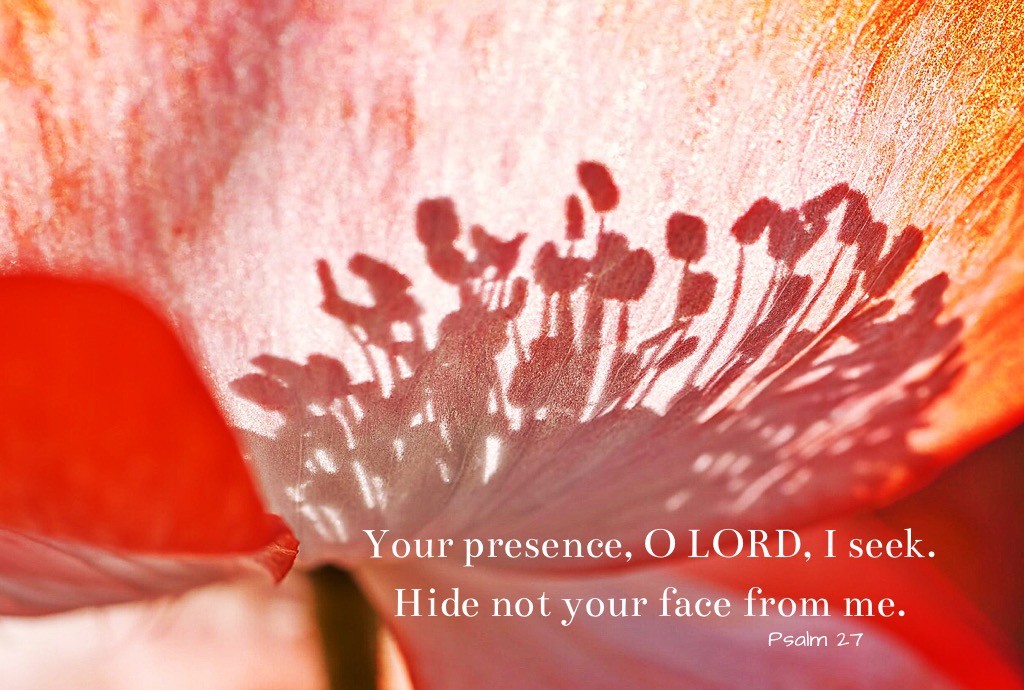
Your presence, O LORD, I seek. Hide not your face from me; do not in anger repel your servant. You are my helper: cast me not off.
Poetry: from The Spiritual Canticle – John of the Cross
Oh, then, soul,
most beautiful among all creatures,
so anxious to know
the dwelling place of your Beloved
so you may go in search of him
and be united with him,
now we are telling you that
you yourself are his dwelling
and his secret inner room and hiding place.
There is reason for you to be elated
and joyful in seeing that all your good and hope
is so close as to be within you,
or better, that you cannot be without him.
Behold, exclaims the Bridegroom,
the kingdom of God is within you.
Music: Unchained Melody – sung by Susan Boyle
Psalm 27 reminds me of this modern classic which, no doubt, was written about a different kind of love. But listening to the song as a prayer, a holy longing can be unchained in our spirits.
Today, in God’s Lavish Mercy, we pray with Psalm 95, once again a call to a holy tenderheartedness – that mix of love, discernment, and generosity that magnetizes us into dynamic relationship with God.
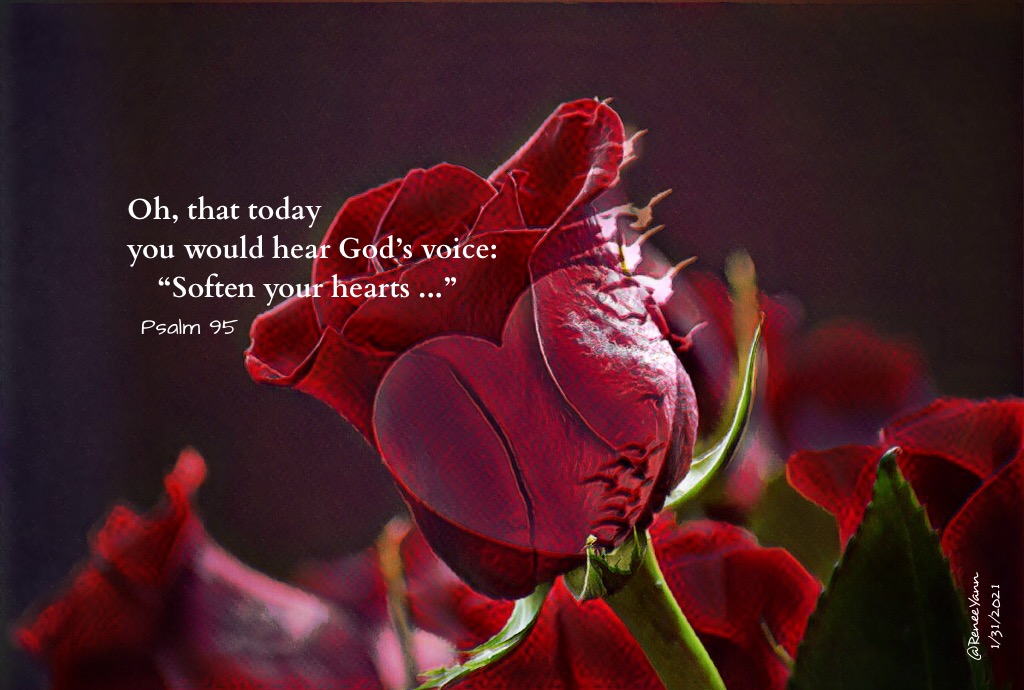
Oh, that today you would hear his voice: “Harden not your hearts as at Meribah, as in the day of Massah in the desert, Where your fathers tempted me; they tested me though they had seen my works.”
Psalm 95: 7-9
Our other Sunday readings, which Psalm 95 anchors, clarify the reason we seek this tenderheartedness. It is so that we might not only hear, but really listen and respond to the Truth of God in our lives.
Those who will not listen to my words which a prophet speaks in my name, I myself will make them answer for it.
Deuteronomy 18:18
In our first reading from Deuteronomy, the people were confused. They were passing into a new land with lots of rivaling religions and spiritualities. Moses was nearing the end of his life and leadership over them. They wanted to know who to listen to and how to behave in order to stay in God’s favor.
God promises that God’s voice will come through a prophet like Moses:
I will raise up for them a prophet like you from among their kin, and will put my words into his mouth; he shall tell them all that I command him.
Deuteronomy 18: 19
In our Gospel, we see Jesus – the fulfillment of the Deuteronomic Promise. The people witnessing his power are amazed. They struggle with whether they can believe in him when he seems just one of them, a Nazarene, Joseph’s son.
But some could believe – readily. Some, like the disciples, discerned quickly the Truth Jesus was. They heard, listened, believed and obeyed the Word.
Our psalm suggests that such readiness, such tenderheartedness comes from the consistent practice of relationship with God through praise, witness, thanksgiving, prayer, worship, humility, and obedience.
To me, it boils down to this:
let your life unfold in God’s Presence
be silent under God’s loving gaze
thank God for all you have been given
realize you are nothing without God
listen to your life as God speaks it to you
act on what you hear
Come, let us sing joyfully to the LORD;
    let us acclaim the rock of our salvation.
Let us come into God’s presence with thanksgiving;
    let us joyfully sing psalms to the Lord.
R. If today you hear God’s voice, harden not your hearts.
Come, let us bow down in worship;
    let us kneel before the LORD who made us.
For the Lord is our God,
    and we are the people God shepherds, the flock God guides.
Poetry: Rumi
I keep telling my heart,
“Go easy now.
I am submerged in golden treasure.”
It replies,
“Why should I be afraid of love?”
Today, in God’s Lavish Mercy, we pray with Psalm 111, a song of reassurance and hope.
God, renowned for grace and mercy, Who gives to those living in awe, will forever be mindful of the covenant once promised.
Psalm 111: 4-5
It is a wonderful thing when we can trust someone to remember a promise made to us. Psalm 111 tells us we can trust God like that.
Maybe some of you share this experience. When I was a little girl, my Dad often did the food shopping. Sometimes, he went to the new “big store” (supermarkets were the new thing in the early ‘50s). When he did, I always asked him to remember to bring me a surprise, and he never forgot.
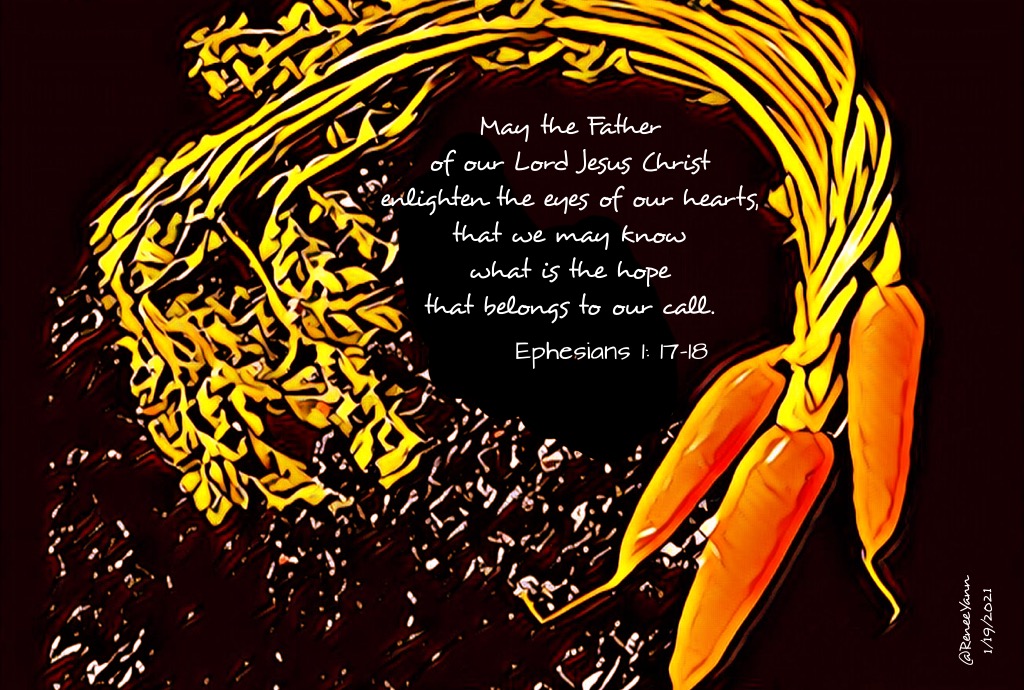
Usually the surprise would be a little bag of M&Ms or Hershey kisses. But once it was a carrot- remarkably like the carrots he bought for the week’s cooking!
Had Dad forgotten his promise, or was he just in to a healthier form of surprise?😂😉
Sometimes it feels like that with God’s Promise. Its fulfillment doesn’t always come to us in the ways we expect or pray for. Instead of special, surprising sweetness, God’s signs feel like carrots … ordinary carrots that we see every day, that we mix into the soup of our daily unsurprising lives.
Our Alleluia Verse today is a good prayer when our life seems full of “carrots”:
May the Father of our Lord Jesus Christ enlighten the eyes of our hearts, that we may know what is the hope that belongs to our call.
Ephesians 1: 17-18
May our eyes be enlightened to see God’s Promise fulfilled in the amazing blessings of our lives:
I will give thanks to the LORD with all my heart in the company and assembly of the just. Great are the works of the LORD, exquisite in all their delights.
Psalm 111: 1-2
My Dad loved me with all his heart and would have given me anything good that was in his power to give.
We can be assured, as in Psalm 111, that all- powerful God is like that too. It’s just that sometimes those good things look like ordinary carrots and we need enlightened eyes to recognize their exquisiteness.
Poetry: Mindful – Mary Oliver
Everyday
I see or hear
something
that more or less

kills me
with delight,
that leaves me
like a needle

in the haystack
of light.
It was what I was born for —
to look, to listen,

to lose myself
inside this soft world —
to instruct myself
over and over

in joy,
and acclamation.
Nor am I talking
about the exceptional,

the fearful, the dreadful,
the very extravagant —
but of the ordinary,
the common, the very drab,

the daily presentations.
Oh, good scholar,
I say to myself,
how can you help

but grow wise
with such teachings
as these —
the untrimmable light

of the world,
the ocean’s shine,
the prayers that are made
out of grass?
Music: Blessed Assurance
Blessed assurance, Jesus is mine!
Oh, what a foretaste of glory divine!
Heir of salvation, purchase of God,
Born of His Spirit, washed in His blood
Chorus:
This is my story, this is my song,
Praising my Savior all the day long;
This is my story, this is my song,
Praising my Savior all the day long.
Perfect submission, perfect delight,
Visions of rapture now burst on my sight;
Angels, descending, bring from above
Echoes of mercy, whispers of love.
Perfect submission, all is at rest,
I in my Savior am happy and blest,
Watching and waiting, looking above,
Filled with His goodness, lost in His love.
Today, in God’s Lavish Mercy, we pray with Psalm 97 which reminds us that, as Jesus begins his earthly ministry, he is accompanied by the unseen powers of heaven.
The heavens proclaim his justice, and all peoples see his glory. Let all his angels worship him.
Psalm 97: 6-7
The psalm is reflective of the glorious passage from our first reading describing the Divinity of Jesus:
The Son of God is… the refulgence of God’s glory, the very imprint of God’s being, who sustains all things by his mighty word. When he had accomplished purification from sins, he took his seat at the right hand of the Majesty on high, as far superior to the angels as the name he has inherited is more excellent than theirs.
Hebrews 1: 3-4
These seem perfect readings to begin a season described as “Ordinary Time” because they remind us that the power of Jesus Christ is far from ordinary.
And our days do not feel like ordinary times, do they? They are both fraught with threat and charged with hope.
They are times belabored by pandemic struggle, political vitriol, climate dissolution, global strife and systemic oppression.
But they are also times bristling with breakthrough discovery, civic renewal, social consciousness, communal courage and spiritual awakening.
Just as in our Gospel on this first day of “Ordinary Time”, Jesus asks his disciples to “Come”, dream extraordinary dreams with him, so he asks us.
– He asks us to believe that there are unseen angels attending us. – He asks us to remember that we, like him, are made in the refulgent image of God.
– He calls us, like Simon and Andrew, to believe that our “ordinary time” is actually the “time of fulfillment”:
This is the time of fulfillment. The Kingdom of God is at hand. Repent, and believe in the Gospel.
Mark 1:15
Poetry: Maya Angelou – Touched by an Angel
We, unaccustomed to courage,
exiles from delight,
live coiled in shells of loneliness
until love leaves its high holy temple
and comes into our sight
to liberate us into life.

Love arrives
and in its train come ecstasies
old memories of pleasure
ancient histories of pain.
Yet if we are bold,
love strikes away the chains of fear
from our souls.

We are weaned from our timidity
In the flush of love's light
we dare be brave
And suddenly we see
that love costs all we are
and will ever be.
Yet it is only love
which sets us free.
Music: Ordinary Time – Marie Bellet
There will come a day for quiet kitchen mornings
Lunches with the girls, book clubs in the afternoon
There will come a day for chintz flowers on my sofa
Just the perfect lipstick, matching purse and shoes.

There will come a day without constant interruption
Confusing all my senses, my reason and my rhyme
But for now I trip on the backpacks in the hallway
Scrub the crayon from the walls that mark this ordinary time.

There will come a day for uneventful dinners
When no one drops their fork or spills their milk upon the floor
There will come a day, I’ll be wiser, I’ll be thinner
I will finish conversations before running out the door.

Well, isn’t that the way it is for all those happy women
Who smile at me from magazines there in the checkout line?
What about the tired, the simple and forgotten?
Blessed be the ordinary here in ordinary time.

He said “Who will feed my sheep?
Who will heed their cry?”
I said “I am vain and weak
But surely I will try.

You know everything
And You know that I’m
Just an ordinary woman
here in ordinary time”.

There will come a day when everything is order
And I will be the queen of everything I see
But how my heart will leap to find one backpack in the hallway
With the promise of a face, and a story just for me.

So may I never yearn for those cocktail conversations
Clever observations made for fashionable minds
May I finally learn to be happy and have patience
With the constant changing rhythm of this ordinary time,
The constant changing rhythm of this ordinary time.
Today, in God’s Lavish Mercy, as we once again pray with Psalm 27, we do so in the light of our seminal first reading from John:
God is love, and when we remain in love we remain in God and God in us.
1 John 4:16
How can we love like that?
Psalm 27 tells us how God does it:
For the Lord rescues the poor who cry out, and the afflicted who have no other help. The Lord has pity for the lowly and the poor; and saves the lives of the poor.
Psalm 27: 12-13
Our psalm gives us the measure for love in our lives. Who are the suffering ones in the circle of our experience? How are we widening that circle to offer loving mercy with greater energy and fidelity?
The Spiritual and Corporal Works of Mercy can be our guide as we seek to stretch our love in ever-widening circles.
The Corporal Works of Mercy
To feed the hungry To give water to the thirsty To clothe the naked To shelter the homeless To visit the sick To visit the imprisoned, and ransom the captive To bury the dead
The Spiritual Works of Mercy
To instruct the ignorant. To counsel the doubtful. To admonish sinners. To bear patiently those who wrong us. To forgive offenses. To comfort the afflicted. To pray for the living and the dead.
Poetry: Widening Circles – Rainer Maria Rilke
I live my life in widening circles
that reach out across the world.
I may not complete this last one
but I give myself to it.
I circle around God, around the primordial tower.
I’ve been circling for thousands of years
and I still don’t know: am I a falcon,
a storm, or a great song?























 Lavish Mercy