Around us,
and at times within us,
there is a foolishness
that has forgotten You.
There is a shallowness
that skims this
sacred well of life
on the thinest surface of
our pretenses,
our distractions,
our frightened preoccupations.
Take us to the depth
where Your Wisdom
dwells within us.
There let us find
peace
undisturbed by circumstance;
justice
fed by lavish mercy;
Love
beyond boundaries,
beyond definition,
beyond imagination,
beyond time.
Maranatha! Come, Lord Jesus!
Music: Who Has Known – John Foley, SJ
O the depth of the riches of God;
and the breadth of the wisdom and knowledge of God!
For who has known the mind of God?
To Him be glory forever.
A virgin will carry a child and give birth,
and His name shall be called Emanuel.
For who has known the mind of God?
To Him be glory forever.
The people in darkness have seen a great light;
for a child has been born, His dominion is wide.
For who has known the mind of God?
To Him be glory forever.
I so loved my great-aunt Peg. She was that perfect mix of elegance and earthiness that made one both comfortable and inspired.
Aunt Peg on Her Wedding Day to Uncle Frank – 1929
Her husband, Uncle Frank, loved her totally. And to boot, he was a romantic which led him to proclaim that love often. One summer, in the 1950s, he surprised her with a second honeymoon trip to Niagara Falls.
Upon return, they visited us and Uncle Frank brought a movie of their trip.
Now, taking a movie and eventually showing it was quite an accomplishment in the ‘50s. Not only were the camera and lights cumbersome, so was the screening equipment.
But that effort on my Uncle Frank’s part yielded a long-lasting blessing for me. It came in a brief scene still indelibly etched on my mind.
Aunt Peg, dressed in her Sunday best, stood looking over the rail at the majestic falls, her back to the camera. There was no sound on the film, but you could tell Uncle Frank had called to her to turn around. Knowing him, my guess was that he said something like, “Peg, you are as beautiful as the falls!”.
Aunt Peg turns and clearly, despite the silent film, mouths a bashful response,
“O, Frank!”.
Those two words, given with a slight blush and demure smile, carried the whole story of their very special love. And they left me, even at a young age, with such a profound message.
Every time I have thought of that short phrase over these sixty years, this is what I hear:
O, Frank!
how blessed am I to be so loved
how good you are to show that love so clearly
how grateful I am that you share your life with me
please know how much I love you in return
Tomorrow, we will enter one of the loveliest times of the Liturgical Year – the proclamation of the O Antiphons.
The great O Antiphons are Magnificat antiphons used at Vespers on the last seven days of Advent. They are also used as the Alleluia verse on same days. The importance of the O Antiphons is twofold. First, each one is a title for the Messiah. Second, each one refers to Isaiah’s prophecy of the coming of the Messiah.
As we prepare for this beautiful and sacred time, I am reminded of my dear Aunt Peg standing before both the magnificent Niagara Falls and my Uncle Frank’s tremendous love.
We, dear friends, are standing in awe at the passage of time into eternity. Our God calls to us to turn around and look into God’s loving face. As we pause in silent, grateful adoration, the great thunder of life silenced behind us, we respond with awe:
17 December: O Sapientia (O Wisdom)
18 December: O Adonai (O Lord)
19 December: O Radix Jesse (O Root of Jesse)
20 December: O Clavis David (O Key of David)
21 December: O Oriens (O Dayspring)
22 December: O Rex Gentium (O King of the Nations)
23 December: O Emmanuel (O God With Us)
As we stand in the shadowed eve of these profound prayers, let’s prepare our hearts to gratefully experience God’s tremendous love.
O Beloved God
how blessed am I to be so loved
how good you are to show that love so clearly
how grateful I am that you share your life with me
please know how much I love you in return
Music: Peg of My Heart – sung in full here by Charles Harrison
I hope you might enjoy this tribute to Uncle Frank. This is a very early version of the song he always sang to Aunt Peg. We did a lot a singing when the family gathered back then– an activity sadly lost today. There are more mellow, later versions, but this is the way Uncle Frank sang it, straight from the Ziegfeld Follies Of 1913.
Oh, my heart’s in a whirl over one little girl
I love her, I love her, yes, I do
Although her heart is far away
I hope to make her mine some day
Ev’ry beautiful rose, ev’ry violet knows
I love her, I love her fond and true
And her heart fondly sighs, as I sing to her eyes
Her eyes of blue, sweet eyes of blue, my darling
Peg o’ my Heart, I love you
We’ll never part, I love you
Dear little girl, sweet little girl
Sweeter than the Rose of Erin
Are your winning smiles endearin’
Peg o’ my Heart, your glances
With Irish art entrance us
Come, be my own, come, make your home in my heart
When your heart’s full of fears
And your eyes full of tears
I’ll kiss them, I’ll kiss them all away
For, like the gold that’s in your hair
Is all the love for you I bear
Oh, believe in me, do
I’m as lonesome as you
I miss you, I miss you all the day
Let the light of live shine from your eyes into mine
And shine for aye, sweetheart for aye, my darling
Peg o’ my Heart, I love you
We’ll never part, I love you
Dear little girl, sweet little girl
Sweeter than the Rose of Erin
Are your winning smiles endearin’
Peg o’ my Heart, your glances
With Irish art entrance us
Come, be my own, come, make your home in my heart
Today, in Mercy, our readings are about spiritual wealth, stewardship and Godly generosity.
Paul starts us off by proclaiming that the wealth/riches of salvation belong to ALL humanity. He presents himself as a unique “steward “ of those riches to the Gentiles.
Our Gospel gives us a second interpretation of “stewardship” in the parable the wily steward. This fella’ gets called on the carpet for squandering his employer’s resources. Pink slip time!
So the steward calls in some of the debtors and reduces their debt by the amount of his own commission. By doing this, he hopes to make some friends to support him in his impending unemployment.
Many years ago, there was a Talbot’s outlet in the Franklin Mills Mall in Northeast Philly (I know. Heaven, right?) You could get an amazing deal on the clearance items. But you got an even better deal if you went to a certain cashier for your checkout.
He was a tall, flamboyant and loudly funny guy. If a price tag was missing on an item, you got it virtually for free. He would make outlandish comments like, “Oh, honey, this isn’t your color so let’s discount it 50%.” If you bought two of the same item, he might announce,”Two for one today”, charging for only one. He was a living example of the Biblical steward! Over time, he developed a devoted buying community – those who had learned the secret of why people waited in his long line!
In today’s parable, Jesus isn’t advocating that we cheat our employers. The parable isn’t really about that at all. It is about the way he wants his disciples to be profligate in preaching the mercy of God.
Remember that this parable comes in between two blockbusters about Mercy- the Prodigal Son and Lazarus and the Rich Man. In a way, you might say Jesus is on a tear about the unbounded generosity of God in forgiveness and hope for us. He makes clear that the wealth of Divine Love is delivered to us by our unbounded Christian love for one another.
So today, maybe we can think about the Talbot’s guy. We have been abundantly blessed by God’s love for us. Let’s pay it forward over and over today… and every day. Let’s generously share the infinite discount of Mercy.
Music: Jesus Paid It All – Elvira M. Hall (1865) This rendition of the hymn by Kristian Stanfill (born 1983) is so interesting. Offered here with modern instrumentation, the words date back to the era of the US Civil War. Past and present meld in the ever eternal love God has for us.
Today, in Mercy, Paul exults in God’s love and Jesus suffers the full burden of his impending passion. And the two are tied tightly together.
Let me tell you a story that symbolizes that tight knot.
It was in the late 1960s. A group of us had traveled to Atlantic City for the National Catholic Education Convention. Weather forecasting was not so advanced in those days, or at least, we were not so attuned to it. We went to our various sessions early one morning, only to come out of them a few hours later into a hurricane!
I remember walking, obliviously, up to the boardwalk, on my way to the next session in another hotel. The wind became so heavy that I was blown, motionless, against the boardwalk railing. A plexiglass window pane blew by me, cutting me just below the eye. For a short while, that seemed very long, I feared for my life. A strong, young man actually pulled me into a nearby lobby where I tried to calm my fears.
But the next morning, there was a beautiful rainbow and a brilliant, calm sky. I walked back to the bay to survey the previous day’s damage. It was significant. But one image remains in my mind these fifty years later: the front quarter of a battered boat still attached to a half-sunken dock by a thick, sodden rope that wouldn’t let go in the storm.
I think that, in today’s Gospel, Jesus might have felt a little bit like that boat. He has been battered by the resistance of his enemies. He knows it is an ill wind for his message.
Jerusalem, Jerusalem, you who kill the prophets and stone those sent to you, how many times I yearned to gather your children together as a hen gathers her brood under her wings, but you were unwilling!
Still, like that strong, unrelenting rope, he is held sure by the love of God:
But I tell you, you will not see me until the time comes when you say, “Blessed is he who comes in the name of the Lord.”
Paul, through his baptism, inherited that faith, hope and love purchased for us all by the Passion, Death and Resurrection of Christ.
Whenever a storm rises up around your soul, whether expected or not, remember that knot which ties you to the steady and enduring love of God:
No, in all these things we conquer overwhelmingly through him who loved us. For I am convinced that neither death, nor life, nor angels, nor principalities, nor present things, nor future things, nor any other creature will be able to separate us from the love of God in Christ Jesus our Lord.
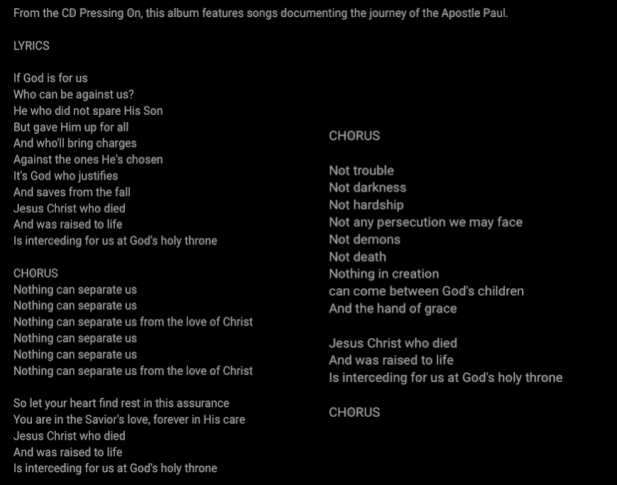
Music: Nothing Can Separate Us – First Call (Lyrics below)
Today, in Mercy, we celebrate St. Thérèse, popularly venerated as The Little Flower. She propagated a spirituality that has become known as “The Little Way”.
Rev. John F. Russell, O.Carm. describes the Little Way like this: The Little Way is an image that tries to capture St. Thérèse’s understanding of being a disciple of Jesus Christ, of seeking holiness of life in the ordinary and the everyday.
Saint Therese based her “little way” on two fundamental convictions:
God shows love by mercy and forgiveness
She could not be perfect in following the Lord.
Both our readings today also talk about a “way”.
Zechariah has a vision of all nations following the way to a New Jerusalem.
Thus says the LORD of hosts: In those days ten men of every nationality, speaking different tongues, shall take hold, yes, take hold of every Jew by the edge of his garment and say, “Let us go with you, for we have heard that God is with you.”
In our Gospel, Jesus begins his way on his final journey. He knows now that the way will be through suffering and death yet, He dared…
When the days for Jesus to be taken up were fulfilled, he resolutely set his face toward Jerusalem…
Grace makes a way in our lives too. As with Thérèse, the ancient Jews, and Jesus, our particular way will unfold before us through prayer and a listening heart. It is the way of love that leads away from selfishness to God and God-in-Others.
Rumi’s poem captures it:
The way of love is not a subtle argument.
The door there is devastation.
Birds make great sky-circles of their freedom. How do they learn it?
They fall, and falling, they’re given wings.
(In a later post today, I will share a poem by Amy Lowell which I feel could describe “the journey “ — Christ’s, mine, yours… and perhaps offer further food for prayer.)
Today, we pray for the courage and freedom to follow the Way, the Truth, and the Life.
Music: from the musical Godspell – By My Side
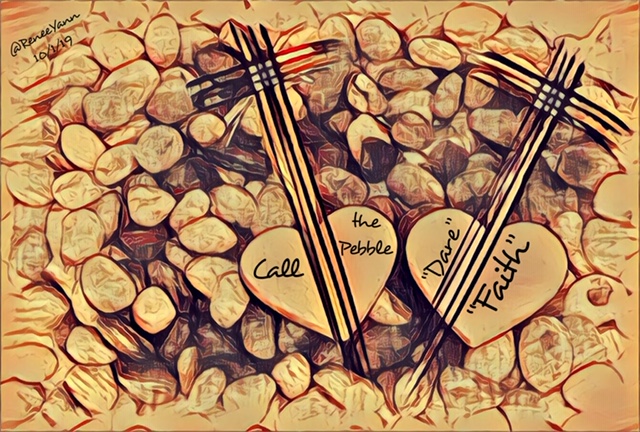
The song conveys the desire of Jesus’s disciples, all but Judas, to accompany him on his Way. They were not perfect – but they dared. As we consider our lives, have we dared? What “pebbles” have we willingly “put in our shoes” to follow Jesus?
Today, in Mercy,Zechariah channels God, with the most intense of human emotion.
The prophet wants Israel to have some understanding of God’s infinite love and hope for them, so he puts these words in God’s mouth:
I am intensely jealous for Zion, stirred to jealous wrath for her.
Like a spouse longing for a lost beloved, God longs for the restoration of Israel to the Divine embrace.
Wherever our relationship with God is frayed or broken, God is jealous for us too. If we can turn our hearts in repentance, prayer, and hope, we too will hear God’s longing for us.
In our Gospel, Jesus tries to refocus his disciples on that loving call. In a classic example of missing the obvious, they are distracted over who is the most important. Here is the Lord of all sitting beside them, and they are arguing about their personal status!
By pointing to a child in their midst, Jesus reminds his followers of the innocence and transparency we need in order to open ourselves to God.
Let’s pray for that openness today so that we can hear and rejoice in a promise such as Israel heard through Zechariah:
You shall be my people, and I will be your God, with faithfulness and justice.
Today, in Mercy, Numbers tells a story of Moses’ intervention to save the people from God’s wrath. It is a story of God’s relenting … a theme which repeats itself endlessly in the Hebrew Scriptures.
This is the way we sometimes characterize the astonishment of Grace – God’s overwhelming passion to love and forgive us over and over. We just can’t imaginesuch mercy, such infinite generative love!
And so we imagine instead that Moses made God do it!😉 Yeah, I don’t think so.
We imagine that God cannot tolerate our sinful pursuits because we cannot tolerate them in ourselves or in others. But God is mercy, forgiveness, reconciliation, wholeness, love. God can’t help loving us!
Of course, we shouldn’t be stupid and take advantage of the divine largesse… not because it would hurt God, but because it so damages us and limits our capacity for wholeness. But nevertheless, whether we’re stupid or not, God will always welcome us home.
A few days ago, we prayed with the word splancha – that “gut love” that so describes God’s passion for us. We find the word again today in the heart-wrenching parable of the Prodigal Son.
You know the story. Near the end, as the devastated son returns seeking mercy…
While he was still a long way off, his father caught sight of him, and was filled with compassion — withsplancha – esplanchnisthē Luke 15:20
Our God is a Love that is filled, overflowing – with no room for retribution or condemnation.
Indeed, our God, like the Prodigal Father, is soft-hearted, an easy mark, a pushover for our sincere repentance, trust, and hope. Our God would bleed for us!
This short but powerful scene from George Balanchine’s ballet, Prodigal Son, may inspire our prayer today. The father is steadfast, a monolith of strength and love. The son is broken, naked in his desperation. Let their magnetic reunion take you to God’s heart. Let God wrap you too in the mantle of Love for any hurt or emptiness that is within you.
George Balanchine “Prodigal Son” – Final Scene (Son- Barishnikov)
Claude Debussy also wrote a beautiful piece on this parable. If you have a contemplative space sometime this week, you may want to listen to Debussy’s moving opera (with my all-time fav Ms. Jessye Norman.)
Today, in Mercy, we turn our hearts to the mystery of the Holy Cross.
Let’s face it. Most of us would prefer a life without ANY suffering. So how does the Cross help us understand that we will never have that kind of life?
The mystery of suffering is integral to all life and transformation. The ability to live and deepen with that mystery doesn’t happen in the mind. It happens in the soul.
The desert Israelites in our first reading don’t get it. They think an angry God is fed up with their complaining and so sends snakes to bite them and cause them suffering.
Not really.
Indeed, snakes have bitten them. But a loving God tells them: Hold up a symbol of my love. It will strengthen you to pass through your suffering because I am always in relationship with you.
The deep love of the Holy Cross was the sacred gift of Catherine McAuley to her Mercy Family. Let us listen to her counsel.
Paul, in the powerful passage from Philippians, takes us much deeper into the heart of this mystery. He tells us how Jesus put on human suffering to show us how suffering is transformed by the love it attempts to overcome.
Paul says that by becoming obedient – by listening – to the deep mystery of suffering and death in his life, Jesus shows us how to hear the whisper within it … the whisper of eternal life that can only be found when we pass through that awesome mystery in transcendent and enduring faith.
John suggests to us that, in some way that we cannot here understand, the mystery of suffering reveals something of the nature of God. It is an overwhelming, incomprehensible revelation that the Father could convey to us only in the visible gift of Jesus Christ.
For God so loved the world that he gave his only Son, so that everyone who believes in him might not perish but might have eternal life. For God did not send his Son into the world to condemn the world, but that the world might be saved through him.
Praying with these deep considerations, we are invited to enter “the mind of Jesus”. May we wholeheartedly respond with today’s Alleluia verse:
We adore you, O Christ, and we bless you, because by your Cross you have redeemed the world.
Music: Philippians Canticle- John Michael Talbot (Lyrics below)
And if there be therefore any consolation
And if there be therefore any comfort in his love
And if there be therefore any fellowship in spirit
If any tender mercies and compassion
We will fulfill His joy
And we will be like-minded
We will fulfill His joy
We can dwell in one accord
And nothing will be done
Through striving or vainglory
We will esteem all others better than ourselves
This is the mind of Jesus
This is the mind of Our Lord
And if we follow Him
Then we must be like-minded
In all humility
We will offer up our love
Though in the form of God
He required no reputation
Though in the form of God
He required nothing but to serve
And in the form of God
He required only to be human
And worthy to receive
Required only to give
This is the mind of Jesus
This is the mind of Our Lord
And if we follow Him
Then we must be like-minded
In all humility
We will offer up our love
In all humility
We will offer up our love
Today, in Mercy, we have one of the most beautiful yet demanding readings in the Bible – Colossians 3:12-17.
Therefore, as God’s chosen people, holy and dearly loved,
clothe yourselves with compassion, kindness,
humility, gentleness and patience. Bear with each other and forgive one another
if any of you has a grievance against someone.
Forgive as the Lord forgave you. And over all these virtues put on love,
which binds them all together in perfect unity.
I remember our beloved Mother Mary Bernard recommending this passage to us when we were only novices – so unripe in our pursuit of spirituality. Since that treasured recommendation, I have prayed with this passage thousands of times. It never fails to reveal something new, deeper, and challenging.
A particularly pregnant verse is this:
Put on, as God’s chosen ones, holy and beloved, heartfelt compassion…
Gosh, the way it’s translated there makes it sound like a Valentine, doesn’t it?
But take a look at the Douay-Rheims Version, the translation popular before the Jerusalem Bible of the 1960s:
Put ye on therefore, as the elect of God, holy, and beloved, the bowels of mercy…
The Greek word for “mercy” here is σπλάγχνα – splagchnon or splancha. And it means “guts” – bowels. So there goes our Valentine! You wouldn’t want to get that picture on a greeting card!
What Paul is preaching is not a lovey-dovey sweet religiosity. He wants mercy, and all the accompanying virtues, to grab our guts and never let go until we love as radically as Jesus loves.
We all know what “splancha” feels like:
It’s the way your heart twists with adrenaline when a truck runs the red light just hair in front of you.
It’s the way your stomach tosses when it’s your turn for your first public speaking foray.
It’s the way your throat catches when you have to speak the words of a beloved’s death.
It’s the tears that well up unbidden when you kiss your sleeping child.
Splancha is the place where we are tied to other human beings so deeply that it is visible only to God.
It is the place where our soul’s umbilical cord is knit with God’s womb, that sacred place where we are recreated again and again in the Holy Spirit by our acts of mercy and love for one another.
God wants us to have “splancha love” for every one of God’s Creatures. God wants us to make that love real in our acts of mercy and justice. Paul is telling us how to do it today.
Music: How He Loves Us – sung by Kim Walker Smith with Jesus Culture
This song was composed by John Mark McMillan. This beautiful video about his composition is a real witness story. I encourage you to take the time to watch it.
Today, in Mercy, our readings challenge us to see things differently- to see with God’s eyes.
Paul invites us first with the glorious Colossians Hymn. No words can enhance it. Let us savor it in itself:
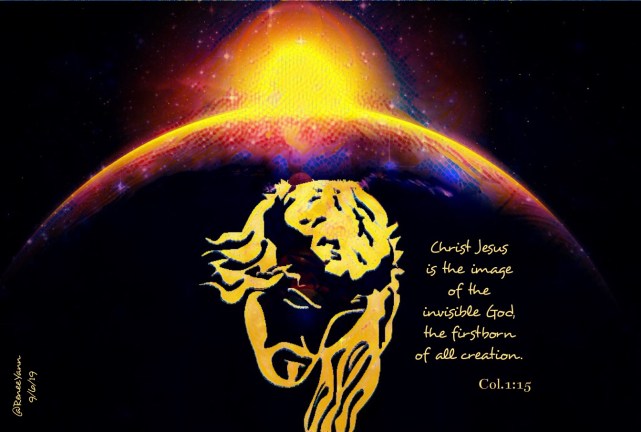
Christ Jesus is the image of the invisible God, the firstborn of all creation. For in him were created all things in heaven and on earth, the visible and the invisible, whether thrones or dominions or principalities or powers; all things were created through him and for him. He is before all things, and in him all things hold together. He is the head of the Body, the Church. He is the beginning, the firstborn from the dead, that in all things he himself might be preeminent. For in him all the fullness was pleased to dwell, and through him to reconcile all things for him, making peace by the Blood of his cross through him, whether those on earth or those in heaven.
Ancient wineskins were not like the fancy botas we see today. They were formed from the entire skin of the animal. As the new wine fermented inside, the skin expanded with the fermentation. It ultimately stretched beyond further use. – thus the necessity for new skins for new wine.
Jesus, in our Gospel, tells us we must become new wineskins in order to hold the vibrant gift of new life in Christ. He says the old ways, stiffened by pharisaical pretensions, have lost the elasticity of grace. He warns us to avoid the accretions of showy religious practice which may bury and inhibit sincere faith.
Jesus is the new wine of love and mercy, and our hearts must become his new wineskins.
As we pray, this poetic musical piece may inspire us. … in Him, all things hold together …










 Lavish Mercy