Today, in God’s Lavish Mercy, we pray with Psalm 147 coming after the consoling passage from Isaiah:
O my people, no more will you weep; I will be gracious to you when you cry out, as soon as I hear you, I will answer.
Isaiah 30:19
Our readings today assure us that God sees and cares about our suffering. Like a mother who sings to a crying child, God wants to comfort us.
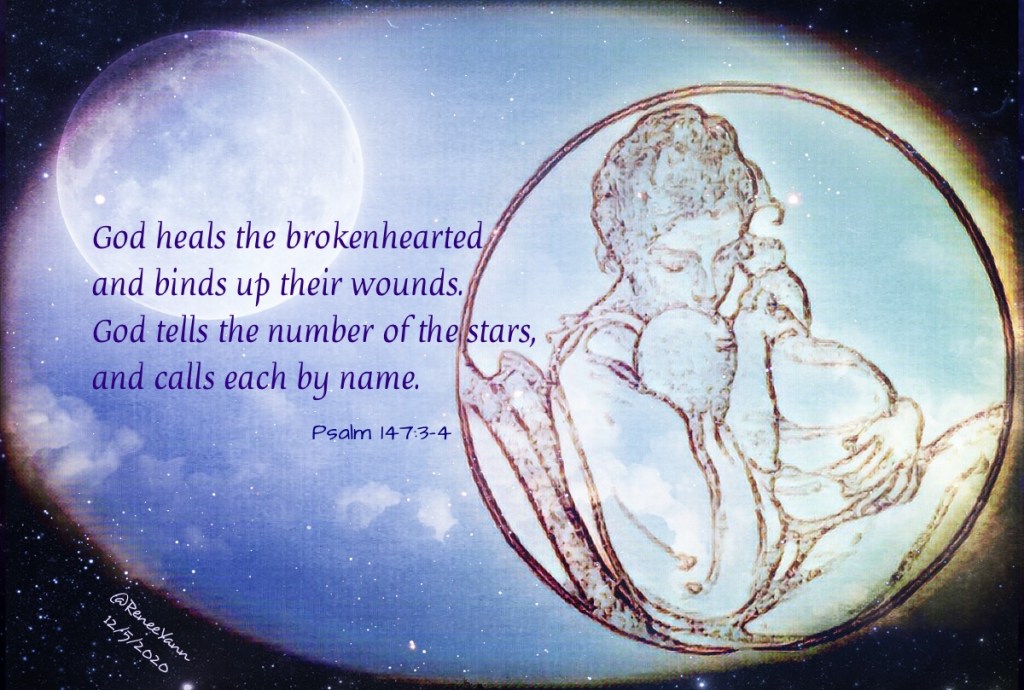
God heals the brokenhearted and binds up their wounds. God tells the number of the stars; calling each by name.
Psalm 147: 3-4
God’s lullaby is Jesus Christ. In Jesus, our Creator sings over us the melody of Infinite Love and Mercy. All we need do is calm ourselves and listen.
Jesus is the Divine Song. He sings God’s Mercy over all who suffer.
At the sight of the crowds, Jesus’s heart was moved with pity for them because they were troubled and abandoned.
Matthew 9:36
All of us, at some time in our lives, stand amidst the troubled crowd. Our friends and family members too stand there at times.
Today, as we pray Psalm 147, let us place all our troubles, and theirs, in the loving embrace of God who sings the lullaby of Jesus over us.
Poetry: from Rumi
Every midwife knows
that not until a mother's womb
softens from the pain of labour
will a way unfold
and the infant find that opening to be born.
Oh friend!
There is treasure in your heart,
it is heavy with child.
Listen.
All the awakened ones,
like trusted midwives are saying,
'welcome this pain.'
It opens the dark passage of Grace.
A blessed and heartfelt Happy Thanksgiving to all!
Today’s special readings for the feast are so rich and beautiful. They evoke and confirm in us a deep sense of thanksgiving as we read and pray with them today.
Let their beauty and instruction enrich your prayer as you slowly read these scriptures. You may want to speak the phrases aloud slowly, letting their wisdom flow gently over your spirit.
May you, your families, your communities and all our precious world be blessed in any way our spirits deeply need. Let us give thanks for the Lavish Mercy of God!
Memorial of the Presentation of the Blessed Virgin Mary
Saturday, November 21, 2020
From 2018 Post: We celebrate the Memorial of the Presentation of the Blessed Virgin Mary. This feast memorializes a story not present in Scripture. We know of it only from apocryphal writings, those considered of unsubstantiated origin. It tells of Mary’s dedication in the Temple at the age of three. Some versions say she remained there until the age of twelve, thus giving her life fully to God even from youth.
On the day of the Presentation of the Blessed Virgin Mary, “we celebrate that dedication of herself which Mary made to God from her very childhood under the inspiration of the Holy Spirit who filled her with grace … .” (Liturgy of the Hours)
Today, in God’s Lavish Mercy, on Mary’s holy feast, we pray with Psalm 144, a song attributed to David as he thanks God for his war victories.
Blessed be the LORD, my rock, who trains my hands for battle, my fingers for war.
How strange that the Church would use this psalm to celebrate gentle Mary as we commemorate her Presentation in the Temple. The traditional story, not included in scripture, is that Mary’s grateful parents brought her, at age three, to be dedicated to God.
The Presentation of Mary by Titian
Psalm 144 reminds us, as we pray with Mary today, that life can be filled with daunting challenges. It can even, at times, seem like a war. Pope Francis has described our times as beset by a “culture of death’:
It is difficult both to recognize and to contradict the overwhelming barrage of selfish, materialistic messaging our culture throws at us. It really is an ongoing battle.
But it is a battle we face not with weapons of violence. We stand up, like Mary, by the power of the God in whom we trust.
My mercy and my fortress, my stronghold, my deliverer, My shield, in whom I trust, who rallies strength around me.
We pray with Mary:
to discern the path of grace for our lives
to turn our whole lives over to God,
to become a portal for God to enter our world
We pray for the courage to be God’s new song of hope for our times.
O God, I will sing a new song to you; with a ten stringed lyre I will chant your praise, You who give victory to your beloved, and deliver us from the grasp of evil.
Poem: To the Immaculate Virgin, On a Winter Night – Thomas Merton
Lady, the night is falling and the dark
Steals all the blood from the scarred west.
The stars come out and freeze my heart
With drops of untouchable music, frail as ice
And bitter as the new year's cross.
Where in the world has any voice
Prayed to you, Lady, for the peace that's in your power?
In a day of blood and many beatings
I see the governments rise up, behind the steel horizon,
And take their weapons and begin to kill.
Where in the world has any city trusted you?
Out where the soldiers camp the guns begin to thump
And another winter time comes down
To seal our years in ice.
The last train cries out
And runs in terror from this farmer's valley
Where all the little birds are dead.
The roads are white, the fields are mute
There are no voices in the wood
And trees make gallows up against the sharp-eyed stars.
Oh where will Christ be killed again
In the land of these dead men?
Lady, the night has got us by the heart
And the whole world is tumbling down.
Words turn to ice in my dry throat
Praying for a land without prayer,
Walking to you on water all winter
In a year that wants more war.
Music: Blessed Be the Lord, My Rock – by Abbie Betinis sung by St. Pius X Choir, Atlanta, Georgia
Today however, with the usual elasticity of scriptural prayer, a new theme suggests itself, thanks to the two readings in which our psalm is couched.
That theme is justice, and what it really means for us in our daily lives.
Wealth and riches shall be in the blessed one’s house; where generosity shall endure forever. Light shines through the darkness for the upright; who is gracious and merciful and just.
In secular culture, the words “justice” and “law” carry very different interpretations from biblical meanings. In the Bible, justice is that right-balance of Creation in which all beings support one another in the fullness of God’s love.
It is a balance which we all must help achieve, as we see in our first reading from John. In this unique letter, addressed to only one person – a Christian named Gaius, John requests material help for his early missionaries.
Beloved, you are faithful in all you do for the brothers and sisters, especially for strangers; they have testified to your love before the Church. Please help them in a way worthy of God to continue their journey.
Such requests mark the life of the Church throughout the ages, because our call in Christian community is about helping one another to live a full life in Christ. We could easily read John’s plea as a plea to us, especially in these times of seeking just global immigration policies.
In our Gospel, Jesus tells a parable which is overtly about prayer. But it carries deep themes of the justice God desires for all people, especially the vulnerable:
Will not God then secure the rights of God’s chosen ones who call out day and night? Will God be slow to answer them? I tell you, God will see to it that justice is done for them speedily. But when the Son of Man comes, will he find justice on the earth?
Practicing justice and righteousness means active advocacy for the vulnerable. It means to do the works of mercy as a way to love God.
Light shines through the darkness for the upright; that person is gracious and merciful and just. It is well for the one who is gracious and lends, who lives a graceful justice justice; they shall never be moved; the just ones shall be in everlasting remembrance.
Still lots to pray with in Psalm 112, even after a third round! 🙂
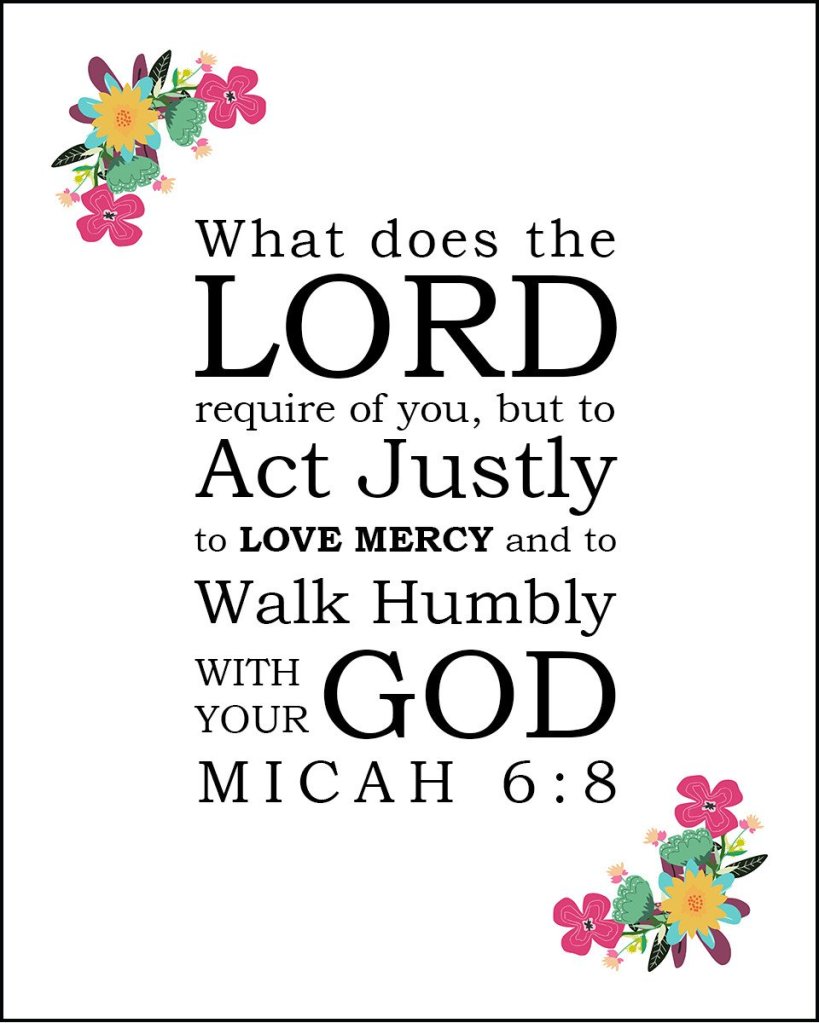
Poetry from Micah 6:8
You have been shown,,
O human heart,
what is good.
Then what does the Lord
require of you?
Just this:
to act justly,
to love mercy,
to walk humbly
with your God.
Today, in God’s Lavish Mercy, we pray with Psalm 146, a call to praise God. The call is supported by the particular verses of today’s reading. We should praise God, the psalmist says, because God:
secures justice for the oppressed
gives food to the hungry
sets captives free
gives sight to the blind
raises up the humble
loves the just
protects strangers
sustains fatherless and the widow
thwarts the way of the wicked
Reading this elaborate hymn of praise makes one think the Lord was pretty busy in ancient Israel. Were all these good things happening for otherwise unfortunate people?
For me, this psalm, rather than being a retrospective list of God’s generous accomplishments, is a call to realize the way God wants things to be. Within that call is another deeper call – to become an agent for God’s Will for good. In other words, God acts through us to make God’s mercy real in the world through the ways the psalm describes.
The loving will of God is always turning the world toward good. But sometimes our lack of faith inhibits our insight into that holy turning. Sometimes we see only the surface of life and get caught in its tangles.
Prayer is the ointment that releases our inner vision to find God in all things, either calling us to foster good or to thwart evil, as our psalm describes. As we cooperate with this call, God’s everlasting creative action opens before us and we see the world, and our role in it, with new eyes.
( Good morning, friends, as the world awaits the final result of the U.S. Presidential election. It is an unsettling morning for many of us, and a difficult one for me to create new inspiration! Maybe that’s because I slept so little! Today, I find myself relying on some of my older reflections to bring myself a measure of equanimity. I was glad to see this one from two years ago. It comforted me as I hope it does you.)
Today, in Mercy, we meet the Shepherd bringing the lost lamb home. Haven’t we all, at some time in our lives, been carried on those sacred shoulders?
Whether by our own prayers, or the prayers of those who love us, have we not been rescued from sorrow, foolishness, isolation or fear?
This beautiful Gospel assures us of the one thing we most deeply need – we are cherished, irrevocably, by God.
This morning, if we need to ride those shoulders, let us trust ourselves to them in prayer.
If, by grace, we are already home, let us pray for those feeling most lost or abandoned – those most beset by a hostile world. May our merciful action help lift them to peace and the sweet scent of God so close beside them.
Poetry: from Kahlil Gibran
We live only to discover beauty. All else is a form of waiting.
Music: I Will Carry You – Sean Clive
I will carry you when you are weak. I will carry you when you can’t speak. I will carry you when you can’t pray. I will carry you each night and day.
I will carry you when times are hard. I will carry you both near & far. I’ll be there with you whenever you fall. I will carry you through it all.
My arms are wider than the sky, softer than a little child, stronger than the raging, calming like a gentle breeze. Trust in me to hold on tight because
I will carry you when you can’t stand. I’ll be there for you to hold your hand. And I will show you that you’re never alone. I will carry you and bring you back home.
Not pain, not fear, not death, no nothing at all can separate you from my love. My arms and hands will hold you close. Just reach out and take them in your own. Trust in me to hold on tight. I will carry you.
Today, in God’s Lavish Mercy, on this feast of the great St. Teresa of Avila, we pray with Psalm 98.
Our psalm is the exultant song of a joyful and triumphant people – a people grateful and blessed by the Lord’s Presence among them.
Sing to the LORD a new song, Who has done wondrous deeds; Whose right hand has won for us the victory of peace.
Psalm 98:1-2
We have all experienced these types of moments when we feel “delivered”.
We might have been praying for someone’s health, or our own.
We might have been caught in a difficult decision.
We might have been waiting for an acceptance letter or call.
We might have been hoping our apology would be accepted, or that one would be given.
We might have been aching for an inspiration, a thread of hope, or a new understanding.
And then —- Light!
We know what it feels like when the Light comes. But often, it is not the light we had expected. True “deliverance” comes not from shedding a worrisome circumstance. Instead, it comes from being incorporated into an unshakable faith and trust, as St. Teresa of Ávila describes it:
May today there be peace within. May you trust God that you are exactly where you are meant to be. May you not forget the infinite possibilities that are born of faith. May you use those gifts that you have received, and pass on the love that has been given to you. May you be content knowing you are a child of God. Let this presence settle into your bones, and allow your soul the freedom to sing, dance, praise and love. It is there for each and every one of us.
Poem: Nada Te Turbe – Teresa of Ávila
Let nothing disturb you, Let nothing frighten you, All things are passing: God alone is changeless. Patience obtains all things. Whoever has God lacks nothing; God alone suffices.
Nada te turbe, Nada te espante. Todo se pasa. Dios no se muda. La paciencia Todo lo alcanza. Quien a Dios tiene, Nada le falta. Solo Dios basta.
Music: Voice in My Heart – Iris Koh
A beautiful reflection in Spanish from the Discalced Carmelite Sisters
Today, in God’s Lavish Mercy, we pray with Psalm 119 whose refrain is beautiful to the ears of those who love Mercy.
We can invite Mercy in many ways.
One way is to ask Mercy to heal the fractured circumstances of our lives – the outside of the cup, if we would borrow an image from today’s Gospel:
to strengthen us against any pain or fear in our own lives
to deliver us and those we love from all that overwhelms
to forgive our inexcusable retreats into selfishness
to repair that which seems irrevocably broken
But another, deeper way is to invite Mercy to the inside of our “cup”:
to indwell our hearts
to transform, within us, the place where we encounter life
to inspire us to respond always with the heart of Jesus
to flow from us in continual witness to God’s Mercy
Today, in our prayer, let’s spend some time with Mercy, the most beautiful Face of God.
Poem:Blest are the undefiled in heart (Psalm 119) by Isaac Watts – (1674 – 1748) was an English Christian minister (Congregational), hymn writer, theologian, and logician. He was a prolific and popular hymn writer and is credited with some 750 hymns. He is recognized as the “Godfather of English Hymnody”; many of his hymns remain in use today and have been translated into numerous languages.
Blest are the undefiled in heart,
whose ways are right and clean;
who never from your law depart,
but flee from every sin.
Blest are the ones that keep your word,
and serve you with their hands;
with their whole heart they seek you, Lord,
obeying your commands.
Great is their peace who love your law;
how firm their souls abide!
Nor can a bold temptation draw
their steady feet aside.
Then shall my heart have inward joy!
I’ll keep my steps from shame;
your statutes help me to obey,
and glorify your name.
Today, in God’s Lavish Mercy, for our Responsorial, we pray with a passage from Luke’s Gospel. This passage is known as the Benedictus or Canticle of Zechariah. It is one of three canticles in the first two chapters of Luke, the others being the Magnificat and the Nunc Dimittis. The Angelic Hymn is often considered a fourth.
At the Wednesday General Audiences given by the Pope, a theme is chosen for “catechesis” or teaching. From October 2001 until February 2006, Popes John Paul II and Benedict XVI gave their teachings based on the Psalms. JPII closed the first section of these audiences with these words:
“Our commentary on the Psalms and canticles from Morning Prayer concludes today with the Canticle of Zechariah, commonly known as the Benedictus. It is a prophetic canticle, in which the father of John the Baptist, indicates three events in God’s liberation of Israel: the covenant with Abraham, the covenant with David, and the new covenant with Christ. Like the “dawn from on high,” Christ gives light and guides us into the way of peace.”
Wednesday General Audience, October 1, 2003
As we pray with the hope-filled verses of the Benedictus, we pray in a world still seeking the fullness of that Dawn of Tender Mercy …
… the tender mercy of our God by which the daybreak from on high will visit us to shine on those who sit in darkness and death’s shadow, to guide our feet into the path of peace.
Pope Francis’s closing prayer in Fratelli Tutti reflects the same hope as his predecessors for that universal Dawn, that rising of Love in our hearts.
O God, Trinity of love,
from the profound communion
of your divine life,
pour out upon us a torrent
of fraternal love.
Grant us the love reflected
in the actions of Jesus,
in his family of Nazareth,
and in the early Christian community.
Grant that we Christians
may live the Gospel,
discovering Christ in each human being,
recognizing him crucified
in the sufferings of the abandoned
and forgotten of our world,
and risen in each brother or sister
who makes a new start.
Come, Holy Spirit,
show us your beauty,
reflected in all the peoples of the earth,
so that we may discover anew
that all are important
and all are necessary,
different faces of the one humanity
that God so loves. Amen.