Come Back!

Saturday of the Second Week of Lent

March 14, 2020

Click here for readings

Today, in Mercy, our readings are soaked in Mercy itself … seasoned by repentance, forgiveness, hope, and trust.

Both in Micah’s lilting, poetic words and in Jesus’s  parable, we are embraced by the infinite tenderness of God.

You may find the following comparison odd at first, but stay with me a minute. Reading this morning’s scriptures, I thought of Lidia Bastianich, the famous chef. To me, her show is the perfect combination of instruction, humor, and familial camaraderie. Still, even though Lydia offers tons of invaluable culinary tips, it is her repeated farewell phrase that I most treasure: “Tutti a tavola a mangiare!”. “Let everyone come to the table and eat!”

Lydia


Micah, who prophesied just prior to the Siege of Jerusalem in 587 BC, condemned the sinfulness rampant in Israel and Judah. At the same time, he consoled the “remnant” people and, àla Lydia, invited them to the table of forgiveness and reconciliation. Here’s the way Micah asks God to “set the table” for God’s repentant People:

Shepherd your people with your staff,
the flock of your inheritance,
That dwells apart in a woodland,
in the midst of Carmel.
Let them feed in Bashan and Gilead,
as in the days of old …


prodigal dinner
The Parable of the Prodigal Son by Frans II Francken

Jesus describes a similar banquet offered to the repentant son:

The father ran to his son, embraced him and kissed him.
His son said to him,
‘Father, I have sinned against heaven and against you;
I no longer deserve to be called your son.’
But his father ordered his servants,
‘Quickly, bring the finest robe and put it on him;
put a ring on his finger and sandals on his feet.
Take the fattened calf and slaughter it.
Then let us celebrate with a feast
because this son of mine was dead, and has come to life again;
he was lost, and has been found.’

As I pray today, I ask if there is any lost or hungry part of my spirit that longs to return to the table of Peace and Mercy. I pray also for those places and souls throughout our world who hunger to hear:

Tutti a tavola a mangiare!”

Music: Father, I Have Sinned -written by Fr. Eugene O’Reilly

Rejected

Friday of the Second Week of Lent

March 13, 2020

Click here for readings

Mt21_42rejected

Today, in Mercy, there is a great sadness in our readings.

The poignant opening line from Genesis immediately strikes us:

Israel loved Joseph best of all his sons,
for he was the child of his old age

Joseph

We picture young Joseph in his beautiful rainbow coat and, under an olive tree’s shade, old Jacob(Israel) proudly, tenderly, watching him play.

As the story ensues to reveal the later betrayal of Joseph’s jealous brothers, we are left astounded. Such treachery, especially among brothers, sickens the heart.


Our Gospel picks up the sad theme because Joseph and his brothers are archetypes of Christ’s story with humankind.

800px-The_Wicked_Husbandman_(The_Parables_of_Our_Lord_and_Saviour_Jesus_Christ)_MET_DP835802
The Wicked Husbandman by John Everett Millais shows the owner’s murdered son

Jesus tells a parable in which he is actually the unnamed main character. He is the Son sent by a loving Father. He is the one rejected, beaten and killed by the treacherous tenants of his Father’s garden.

We know from our familiarity with Scripture that both these stories ultimately come to glorious conclusions. But today’s readings do not take us there. They leave us standing, mouths dropped open, at the dense meanness of the human heart, at the soul’s imperviousness to grace, at the profound sadness Jesus felt at this point in his ministry.

In our prayer today, let’s just be with Jesus, sharing his sadness for the meanness still hardening our world. Let us comfort him with our desire to be open to God’s Grace and Mercy.

Music:  Handel:Messiah – He was despised and rejected – Alfred Deller

Turn and See

Thursday of the Second Week of Lent

March 12, 2020

Click here for readings

Today, in Mercy, our readings offer us studies in dramatic contrasts.

the barren bush in a lava waste
vs.
the tree planted beside the waters

that turns its roots to the stream

Jere17_7barrentree


a rich man who dressed in purple garments and fine linen

vs.
a poor man named Lazarus, covered with sores

Gustave_Dore_Lazarus_and_the_Rich_Man
Lazarus and the Rich Man by Gustave Dore (1891)


What are Jeremiah and Jesus teaching us with these unforgettable images?

Jeremiah summarizes his point in the very first verse:

Cursed is the one who trusts in human beings,
who seeks strength in flesh,
whose heart turns away from the LORD.

In his parable, Jesus has Abraham deliver the point:

You received what was good during your lifetime
while Lazarus likewise received what was bad;
but now he is comforted here, whereas you are tormented.


Praying with these passages, we might determine to make sure we don’t end up like the barren bush or the ultimately tormented rich person. 

But how can we do that?

I think the key lies in Jeremiah’s phrase, “one whose heart turns away from the LORD.” 

In his parable, Jesus shows us what that “turning” looks like. It is any blind indifference in us that allows us to ignore another’s suffering. 

Most of us don’t consciously choose that indifference. We simply fail to turn from our own comfort … plans, needs, agenda … to observe the pain or need around us.

So as we leave our prayer today, perhaps we can do so determined to turn from our self-interests … to see if there is a “Lazarus” right beside us whom we had failed to notice.

Music: Turn My Heart – Lynn DeShazo (Lyrics below)

Turn my heart O Lord
Like rivers of water
Turn my heart O Lord
By Your hand
‘Til my whole life flows
In the river of Your Spirit
And my name
Bring honor to the Lamb

Lord I surrender to
Your work in me
I rest my life within
Your loving hands

(Repeat chorus 3 times)

‘Til my name brings honor
To the Lamb

A Plea for Mercy

Monday of the Second Week in Lent

March 9, 2020

Click here for readings

bruggemann

Today, in Mercy, our reading from Daniel gives us one of the Great Prayers of the Old Testament (according to Walter Brueggemann’s like-named book.)

The Book of Daniel and chapter nine in particular, have been the subjects of extensive biblical exegesis. Chapter nine in considered one of the Messianic Prophecies, Old Testament markers pointing to Christ. So there is much we could study about today’s first reading.


But how might we pray with it?

Naming the sins of all the People, Daniel’s great prayer is a plea for mercy:

Lord, great and awesome God,
you who keep your merciful covenant
toward those who love you
and observe your commandments! …
… yours, O Lord, our God,
are compassion and forgiveness!

Three themes, so strikingly germane to Lent, arise from Daniel’s prayer:

Repentance
Forgiveness
Transformation


Our Responsorial Psalm picks up this plea to Mercy for Mercy:

Remember not against us the iniquities of the past;
may your compassion quickly come to us,
for we are brought very low.
R.    Lord, do not deal with us according to our sins.
Help us, O God our savior,

because of the glory of your name;
Deliver us and pardon our sins
for your name’s sake.


The questions for each of us as we pray today —

Is there someplace in my life
longing for such mercy and healing?

Where can my spirit grow
from repentance, forgiveness, and transformation?

be Mercy

In our Gospel Jesus tells us how to open our hearts to this merciful healing.

Be merciful, just as your Father is merciful.
Stop judging and you will not be judged.
Stop condemning and you will not be condemned.
Forgive and you will be forgiven.
Give and gifts will be given to you;
a good measure, packed together, shaken down, and overflowing,
will be poured into your lap.
For the measure with which you measure
will in return be measured out to you.”

There it is in black and white. Whether or not the advice changes my heart is up to me!

Music: Kyrie Eleison (Lord, have mercy) Beethoven- Missa Solemnis

Be Careful of Love

Saturday of the First Week of Lent

March 7, 2020

Click here for readings

Moses spoke to the people, saying:
“This day the LORD, your God,
commands you to observe these statutes and decrees.
Be careful, then,
to observe them with all your heart and with all your soul.


Today, in Mercy, Moses tells us this:

Be careful, then …

Be careful of what? Does he mean be careful like,”Don’t fall down the steps!”. Or does he mean be careful like, “Hold tenderly to love in your life.”?

In this passage from Deuteronomy, Moses goes on to say one of my favorite biblical phrases:

… today the LORD is making this agreement with you:
you are to be a people peculiarly his own, as he promised you…

Since the 17th century, the word “peculiar” has taken on the meaning of “odd” or “unusual”.  But the original sense comes from the Latin peculiaris meaning “of private property”

Moses is reminding us that we belong to God and God to us in a covenant similar to, but far exceeding, the mutuality of a marriage.

So we should “be careful”, full of care, in appreciation for this infinite love.


chick

In our Gospel, Jesus tells us how to take this exquisite care of our precious relationship with God:

But I say to you, love your enemies,
and pray for those who persecute you,
that you may be children of your heavenly Father,
for God makes the sun rise on the bad and the good,
and causes rain to fall on the just and the unjust.
… Be compassionate as your Heavenly Father is compassionate.

So, let’s be careful of love today when we find this precious God in our sisters and brothers and in all God’s Creation. Let us be compassionate.

Music:  Compassion Hymn – The Gettys 

Even Now…

Ash Wednesday

February 26, 2020

Click here for readings

Today, in Mercy, we resolve to turn our hearts more fully to God. The sacred journey of Lent, one we have traveled so often over the years, invites us each time to go deeper into the Well of Mercy.

Joel’s pregnant phrase summons us:

Joel2_12 even now

Think of the “even now” moments of your life, those times when, despite darkness and cold, you turned toward light and warmth. Think of a time when, in contradiction to all negativity, your soul proclaimed

  • Even now I hope
  • Even now I believe
  • Even now I love
  • Even now I care
  • Even now I repent
  • Even now I forgive
  • Even now I begin again

buddingThe rise of an “Even Now” moment in our souls is like the hint of spring pushing its head through the winter snow.

It is the reddish-green thread suggesting life at the tip of the brown, cold-cracked branch.

It is the moment we believe that what we desire and love will turn toward us and embrace us.


Can you imagine God having such moments, longing for our attention, love, presence, catching a glimpse of our turning?

Our reading from Joel describes such a God.

Even now, says the LORD,
return to me with your whole heart…

These words suggest God’s longing for us, for our devotion and love.

But our holy intentions weaken and we often drift away from our “first fervors”. Our hearts attach to distractions from God. So God says:

Rend your hearts …
and return to the LORD, your God.
For I am gracious and merciful,
slow to anger, rich in kindness …
Come back to Me, with all your heart.

This is what Lent is all about. Each of us knows where our hearts have wandered. Each of knows what we must turn from — even now — to return to God’s embrace.

If we can hear God’s longing in this haunting reading from Joel perhaps the true turning will begin. A blessed Lent, my friends.


I found this modern song helpful to my prayer. I imagine God singing it to me, to the world, as we begin our Lenten journey. Perhaps it may touch your prayer too. God loves us so much, infinitely more than we can comprehend. But imagining God’s love in human terms, as John of the Cross did, can sometimes deepen our understanding and response to God.

Music: Even Now – Nana Mouskouri

What Profit?

Friday of the Sixth Week in Ordinary Time

February 21, 2020

Click here for readings

Today, in Mercy, James actually made me chuckle out loud! In today’s celebrated passage about faith and works, James – ever direct and uncompromising – really takes it home. Get this verse:

Do you want proof, you ignoramus,
that faith without works is useless?

OK, James! Tell us what you really think!😂

Well, here’s what he really thinks:

For just as a body without a spirit is dead,
so also faith without works is dead.


whole world

In our Gospel, Jesus says that living a life of good works is hard. He did it through the Cross and says we must follow his example:

Whoever wishes to come after me must deny himself,
take up his cross, and follow me.
For whoever wishes to save his life will lose it,
but whoever loses his life for my sake
and that of the Gospel will save it.

The Gospel Jesus is talking about, and the “works” James refers to,  are summarized like this:


Corporal Works of Mercy

feed the hungry.
give water to the thirsty.
clothe the naked.
shelter the homeless.
visit the sick.
visit the imprisoned, ransom the captive.
bury the dead.

Spiritual Works of Mercy

instruct the ignorant.
counsel the doubtful.
admonish the sinners.
bear patiently those who wrong us.
forgive offenses.
comfort the afflicted.
pray for the living and the dead.


If we live by these, we will find the Cross – but we will also find the Crown.

Music: Lose My Soul – TobyMac, a multi-award winning Christian hip-hop singer. The music is a departure for me, but I thought the song was really good (maybe of use to some of my readers who are teachers.) I hope you agree.

Be Impartial, or Not?

Thursday of the Sixth Week in Ordinary Time

February 20, 2020

Click here for readings

Today, in Mercy, two Apostles of Jesus are our teachers. James advises us on what to do. Beloved Peter, as so often is the case, shows us what not to do.

James tells us to show no partiality. He makes clear that he is talking about impartiality toward those who are materially poor. It’s a maxim that Jesus gave us time and again in the Gospel.

James2_1 partiality

James reminds us that Jesus is not just impartial toward the poor, he actually has a preferential love for them. So Jesus was partial to the poor, right? Hmm!

Yes, I think that’s right. In order to balance our human inclination to the richest, best, strongest, etc., Jesus teaches us to go all out in the other direction.

It’s like this great cartoon that’s popped up on Facebook recently:

equity


Our Gospel picks up the theme.

Because of his great love for the poor and his passion for mercy, Jesus tells his followers that suffering is coming. Peter doesn’t like hearing that. Can you see Peter take Jesus aside and say, “Listen, Jesus, negative talk is going to hurt you campaign. You’re God! You can just zap suffering out of your life!


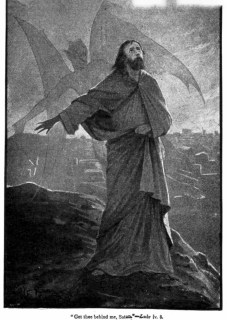
behind me satan

Jesus responds to Peter definitively: “Get thee behind me, Satan!

Wow! That must have stung! But that’s how important it was to Jesus that his followers understood his mission: to preach Mercy to the poor, sick, and broken by sharing and transforming their experience.

Jesus wants us to understand that too.


Music: Beauty for Brokenness – Graham Kendrick

Like Trees Walking

Wednesday of the Sixth Week in Ordinary Time

February 19, 2020

Click here for readings

Today, in Mercy, our readings are around the theme of our spiritual senses.

James1_22 doers

James tells us to listen, look, see, and act on the Word planted within our hearts. Once again, he gives us great images to help our understanding.

mirror

For if anyone is a hearer of the word and not a doer,
he is like a man who looks at his own face in a mirror.
He sees himself, then goes off and promptly forgets
what he looked like.


horse


If anyone thinks he is religious
and does not bridle his tongue

but deceives his heart, his religion is vain.


In our Gospel, once again our dear, earthy Jesus heals someone in a deeply human way. Jesus takes the blind man aside, holding his hand to lead him. As he did in a passage recently, Jesus spits on his fingers and massages the blind man’s eyes.

blind man

The man tries to work with Jesus, exclaiming that he sees “people like trees walking”. 

I’ve always loved that line because it makes me feel like I’m right there, listening to the man’s amazement!

As we pray this morning, we might wonder what Jesus said back to that overwhelmed man as they sat together. What might he say to us as he lifts one of our many blindnesses from our hearts?

Music:  I See Men As Trees Walking – Johnny Cash (lyrics below)

No Shadow of Turning

Tuesday of the Sixth Week in Ordinary Time

February 18, 2020

Click here for readings

Today, in Mercy, James continues with his spiritual encouragements. 

For one thing, he makes it clear that God doesn’t tempt us. Some of us make the mistake of thinking that, saying things like, “God is testing me.”

James, outlining a perfect way to examine one’s conscience, says this:

No one experiencing temptation should say,
“I am being tempted by God”;
for God is not subject to temptation to evil,
and God himself tempts no one.
Rather, each person is tempted when lured and enticed by his own desire.
Then desire conceives and brings forth sin,
and when sin reaches maturity it gives birth to death.


I don’t really like to talk about sins; I’d probably much rather commit them!!!! So if we have some little labyrinths of temptation and sinful habits ensnaring us, we should listen to James. He encourages us to examine and check our own concupiscent  desires as they are the seeds of our spiritual undoing. 

In my experience, these desires are usually disguised, pretending to be beneficial for us at first sight. But underneath, they are rooted in selfishness and excess, deviating us from our center in God. Just think how some of the famous ones have masqueraded into our lives: Pride, Envy, Gluttony, Sloth, Lust, Greed, Wrath (Vengeful Anger).


In the second part of this passage, James takes the tone up a notch. He reminds us that, once centered on God, we realize that only good things come from God.

All good giving and every perfect gift is from above,
coming down from the Father of lights,
with whom there is no alteration or shadow caused by change.

I particularly love that last phrase, rendered in our hymn today like this:
James1_17 no shadow

It’s beautiful to see how James, as a real spiritual leader, is so aware of his flock’s human struggles. No doubt, he shares them. What a blessing that his wise and loving guidance has come down through the ages to us!

Music: Great Is Thy Faithfulness- Chris Rice