Merry Christmas, dear readers! May our sweet Jesus abundantly bless you and those you love.
Below is a video beautifully edited by our Sister Mary Kay Eichman. We both thought you might like to enjoy it, whole or in parts, over this Christmastide.
Today, in God’s Lavish Mercy, let us pray within the amazing Presence of God in our life renewed in us this Christmas.
Mary is wrapped in the cold darkness of this winter night. She is vulnerable as she waits to bring forth her child. Yet she feels wrapped in tenderness by God and supported by God’s love. She longs to welcome this Holy Child in warmth And to wrap him in the same love and tenderness.
We too want to welcome Jesus with warm tenderness. In Mercy, we have tried to bring Christ into world and to warm and comfort people with God’s presence.
Is there a person in your life, Or a place in your heart today that needs warmth, comfort and love?
Be in quiet prayer for that person or place for a while as we absorb the amazing graces offered us in the Christmas miracle.
Prayer
Today the Christ Child is born We welcome Him into our hearts We wrap Him in our adoration.
Today the Christ Child is born In the refugee who longs for home In the sick who long care In the poor who long for sustenance In the uneducated who long for hope In these, we welcome Him. We wrap them in our prayer.
Today the Christ Child in born In children who long for a future In families who long for unity In elders who long for peace In all people who long for dignity and love In these, we welcome Him. We wrap them in our prayer.
Today the Christ Child is born In our Church that longs for holiness In our community that longs for grace In our world that longs for peace In our hearts that long for God In these we welcome Him. We wrap them in our prayer.
Today, in God’s Lavish Mercy, our readings are about spiritual wealth, stewardship, and Godly generosity.
Paul starts us off by proclaiming that the wealth/riches of salvation belong to ALL humanity. He presents himself as a unique “steward “ of those riches to the Gentiles.
But I have written to you rather boldly in some respects to remind you, because of the grace given me by God to be a minister of Christ Jesus to the Gentiles in performing the priestly service of the Gospel of God, so that the offering up of the Gentiles may be acceptable, sanctified by the Holy Spirit.
Romans 15:15-16
Our Gospel gives us a second interpretation of “stewardship” in the parable the wily steward. This fella’ gets called on the carpet for squandering his employer’s resources. Pink slip time!
So the steward calls in some of the debtors and reduces their debt by the amount of his own commission. By doing this, he hopes to make some friends to support him in his impending unemployment.
Many years ago, there was a Talbot’s outlet in the Franklin Mills Mall in Northeast Philly. You could get an amazing deal on the clearance items. But you got an even better deal if you went to a certain cashier for your checkout.
He was a tall, flamboyant and loudly funny guy. If a price tag was missing on an item, you got it virtually for free. He would make outlandish comments like, “Oh, honey, this isn’t your color so let’s discount it 50%.” If you bought two of the same item, he might announce,”Two for one today”, charging for only one. He was a living example of the Biblical steward! Over time, he developed a devoted buying community – those who had learned the secret of why people waited in his long line!
In today’s parable, Jesus isn’t advocating that we cheat our employers. The parable isn’t really about that at all. It is about the way Jesus wants his disciples to be profligate in preaching the mercy of God.
Remember that this parable comes in between two blockbusters about Mercy- the Prodigal Son and Lazarus and the Rich Man. In a way, you might say Jesus is on a tear about the unbounded generosity of God in forgiveness and hope for us. He makes clear that the wealth of Divine Love is delivered to us by our unbounded Christian love for one another.
So today, maybe we can think about the Talbot’s guy. We have been abundantly blessed by God’s love for us. Let’s pay it forward over and over today… and every day. Let’s generously share the infinite discount of Mercy.
Poetry: from Day of a Stranger by Thomas Merton
I am out of bed at two-fifteen in the morning, when the night is darkest and most silent. . .. I find myself in the primordial lostness of night, solitude, forest, peace, a mind awake in the dark, looking for a light, not totally reconciled to being out of bed. A light appears, and in the light an ikon. There is now in the large darkness a small room of radiance with psalms in it. The psalms grow up silently by themselves without effort like plants in this light which is favorable to them. The plants hold themselves up on stems that have a single consistency, that of mercy, or rather great mercy. Magna misericordia. In the formlessness of night and silence a word then pronounces itself: Mercy.
Music: Jesus Paid It All – Elvira M. Hall (1865) This rendition of the hymn by Kristian Stanfill (born 1983) is so interesting. Offered here with modern instrumentation, the words date back to the era of the US Civil War. Past and present meld in the ever eternal love God has for us.
Today, in God’s Lavish Mercy, Paul and Jesus seem to give us contradictory messages. Paul talks about love, and Jesus tells us what we must “hate” – a bit of a challenge to untangle the core message.
Here’s one way.
We don’t like Jesus telling us to “hate” anything, as in:
If anyone comes to me without hating his father and mother, wife and children, brothers and sisters, and even his own life, he cannot be my disciple.
Luke 14:26
Come on, Jesus! You don’t mean that do you – my sweet mom, my precious kids???
No, the scholars say, Jesus doesn’t mean “hate” the way we interpret it in modern English. He is using the common, hyperbolic language of the ancient East which, in this circumstance, would mean “love less or without bias”.
So what is Jesus really saying?
This.
We love many people and things in our lives. But we must love God, and God’s dream for all people, above and within all things.
And that’s not easy! Life is a maze of relationships and situations that can get us very confused about what is most important. That’s why Jesus uses such strong language to remind us that there is only one way through the maze: to love as God loves. This is the heartbeat of our life in God!
Paul says this too, indicating as well how to negotiate the maze by keeping Love’s commandments.
We have such a critical example of this love-hate dynamic in our world just now. The terrible situation in the Holy Land has brought out radical feelings in people all over the world. People who love Israel and abhor violence are disgusted and furious over the attack against the Israeli people. People who love and pity the Palestinians, who have been suppressed into human desperation for decades, are equally disgusted and furious over the mass revenge being wrought upon innocents in Gaza and the West Bank.
I think Jesus would say this to us: You must “hate” those human relationships enough to make you not take sides in this horror. You must look past blood ties and religious ties. You must look to the human person, God’s creature like you who is the innocent victim of political forces. You must add to the voice for justice, mercy, and humane solutions.
No matter how far we may feel from the wars in Ukraine and the Middle East, each one of us is at a point of moral discernment regarding them. As massive funding is poured into weapons of war, how do we respond to the ongoing massacre of innocent people? I ask myself what is required of me as a citizen of the world to make my voice heard in this unspeakable tragedy.
If we love with God’s love, of course we will love those we cherish. But we will love them selflessly, with an infinite generosity that always chooses their eternal good. And we will try always to love all Creatures in the same way, seeking to the degree that is possible their well-being and peace. This is the kind of love Jesus taught us on the Cross. May God give us the courage to learn.
Prose: Remarks of Pope Francis at the Angelus on October 15, 2023
Dear brothers and sisters, I continue to follow with great sorrow what is happening in Israel and Palestine. I think again of the many people … in particular of the children and the elderly. I renew my appeal for the release of the hostages, and I strongly ask that children, the sick, the elderly, women, and all civilians not be made victims of the conflict. May Humanitarian Law be respected, especially in Gaza, where it is urgent and necessary to ensure humanitarian corridors and to come to the aid of the entire population. Brothers and sisters, many have already died. Please, let no more innocent blood be shed, neither in the Holy Land nor in Ukraine, nor in any other place! Enough! Wars are always a defeat, always!
Prayer is the meek and holy force to oppose the diabolical force of hatred, terrorism and war.
Music: Ubi Caritas performed by Stockholm University Choir (texts below)
Ubi caritas et amor, Deus ibi est. Congregavit nos in unum Christi amor. Exsultemus, et in ipso jucundemur. Timeamus, et amemus Deum vivum. Et ex corde diligamus nos sincero. Ubi caritas et amor, Deus ibi est. Simul ergo cum in unum congregamur: Ne nos mente dividamur, caveamus. Cessent iurgia maligna, cessent lites. Et in medio nostri sit Christus Deus. Ubi caritas et amor, Deus ibi est. Simul quoque cum beatis videamus, Glorianter vultum tuum, Christe Deus: Gaudium quod est immensum, atque probum, Saecula per infinita saeculorum. Amen.
English Translation Where charity and love are, God is there. Love of Christ has gathered us into one. Let us rejoice in Him and be glad. Let us fear, and let us love the living God. And from a sincere heart let us love one. Where charity and love are, God is there. At the same time, therefore, are gathered into one: Lest we be divided in mind, let us beware. Let evil impulses stop, let controversy cease. And in the midst of us be Christ our God. Where charity and love are, God is there. At the same time we see that with the saints also, Thy face in glory, O Christ our God: The joy that is immense and good, Unto the World without end. Amen.
Today, in God’s Lavish Mercy, as we read our scriptures for the day, we sense that both Jesus and Paul suffer heartbreak for those who resist the Gospel.
Brothers and sisters: I speak the truth in Christ, I do not lie; my conscience joins with the Holy Spirit in bearing me witness that I have great sorrow and constant anguish in my heart. For I could wish that I myself were accursed and cut off from Christ for the sake of my own people, my kindred according to the flesh.
Romans 9:1-3
Paul expresses his deep regret that his own people, the Israelites, resist the Messiah who is God’s final gift to them in a long line of unique blessings:
They are children of Israel; theirs the adoption, the glory, the covenants, the giving of the law, the worship, and the promises; theirs the patriarchs, and from them, according to the flesh, is the Christ, who is over all, God blessed forever. Amen.
Romans 9:4-5
In our Gospel, Jesus encounters a man with a withered hand. From the get-go, Jesus plans to heal the suffering man, but he decides to use the occasion to teach the Pharisees a lesson.
Jesus invites the scholars and Pharisees to move beyond the written Law and into the true practice of its spirit:
Jesus spoke to the scholars of the law and Pharisees in reply, asking, “Is it lawful to cure on the sabbath or not?” But they kept silent; so he took the man and, after he had healed him, dismissed him. Then he said to them “Who among you, if your son or ox falls into a cistern, would not immediately pull him out on the sabbath day?” But they were unable to answer his question.
Luke 14: 5-6
What Jesus asked was apparently too much for them. They were so encrusted in the worldly benefits the Law had brought them that they couldn’t challenge themselves to hear Jesus’s message. So they were silent – they gave no response to the divine invitation to life-giving change.
And to be fair to the Pharisees, Jesus’s invitation was a huge challenge. Their lives had become entirely dependent on a system that had lost its true meaning. The Law no longer led them to God but to themselves. They had lost the way through the woods, as you will see in Kipling’s poem below.
There are many levels on which we can pray with this passage. We are surely aware of the same kind of resistant silences in ourselves and in our world.
We may be caught in a sort of personal woods where we can’t make our way through to a life-giving choice or, like the Pharisees, to an inclusive, merciful understanding.
Or we may see this kind of entrapment happening in a beloved’s life.
Or we may see the atrophic effects of dead, unreviewed laws in our country, world, and Church. Failing to adapt laws that have lost their true spirit allows us to normalize outrageous behaviors based on manufactured”legality”. The image of a 16-year-old carrying an AK-47 down a neighborhood street, “legally” shooting unarmed protesters, comes to my mind!
All of these situations arise when we are entwined in a system that no longer gives life. The spirit and energy of the Gospel is the key to our un-entwining. Let’s pray for it in ourselves and in our very knotted world.
Poetry: The Way Through the Woods – Rudyard Kipling
They shut the road through the woods Seventy years ago. Weather and rain have undone it again, And now you would never know There was once a road through the woods Before they planted the trees. It is underneath the coppice and heath, And the thin anemones. Only the keeper sees That, where the ring-dove broods, And the badgers roll at ease, There was once a road through the woods.
Yet, if you enter the woods Of a summer evening late, When the night-air cools on the trout-ringed pools Where the otter whistles his mate, (They fear not men in the woods, Because they see so few.) You will hear the beat of a horse’s feet, And the swish of a skirt in the dew, Steadily cantering through The misty solitudes, As though they perfectly knew The old lost road through the woods. But there is no road through the woods.
Today, in God’s Lavish Mercy, we pray with Psalm 68 which pictures a triumphant God, rising like the sun over the darkness of evil.
Arise, O God, and let your enemies be scattered; let those who hate you flee. Let them vanish like smoke when the wind drives it away; as the wax melts at the fire, so let the wicked perish at your presence.
Psalm 68:1-3
This psalm comforts us with a tender picture of God:
Protector of orphans, defender of widows, the One who dwells in holiness, who gives the solitary a home and brings forth prisoners into freedom; but the rebels shall live in dry places.
Psalm 68: 5-6
It is the same tenderness Paul presents in our first reading:
For those who are led by the Spirit of God are children of God. For you did not receive a spirit of slavery to fall back into fear, but you received a spirit of adoption, through which we cry, “Abba, Father!” The Spirit bears witness with our spirit that we are children of God, and if children, then heirs, heirs of God and joint heirs with Christ… if only we suffer with him so that we may also be glorified with him.
Romans 8:8-9
And there we have the key line: we are to live a life aligned with the Passion, Death, and Resurrection of Christ.
And what will that kind of life look like? It will look like our merciful Jesus of today’s Gospel – who stepped out to see, comfort, and heal the suffering around him.
Jesus recognized the crippled woman as “an heir of God, and joint heir with him” to the fullness of life in God. We are called to recognize ourselves and all of our sisters and brothers in the same way.
Poetry: WOMAN UN-BENT (LUKE 13:10–17) – by Irene Zimmerman, OSF
That Sabbath day as always
she went to the synagogue
and took the place assigned her
right behind the grill where,
the elders had concurred,
she would block no one’s view,
she could lean her heavy head,
and (though this was not said)
she’d give a good example to
the ones who stood behind her.
That day, intent as always
on the Word (for eighteen years
she’d listened thus), she heard
Authority when Jesus spoke.
Though long stripped
of forwardness, she came forward, nonetheless,
when Jesus summoned her.
“Woman, you are free of your infirmity,” he said.
The leader of the synagogue
worked himself into a sweat
as he tried to bend the Sabbath
and the woman back in place.
But she stood up straight and let
God’s glory touch her face.
Today, in God’s Mercy, Paul sounds a lot like someone approaching the microphone at “Sinners Anonymous“:
I know that good does not dwell in me, that is, in my flesh. The willing is ready at hand, but doing the good is not. For I do not do the good I want, but I do the evil I do not want.
Romans 7:18-19
Paul basically attests to the fact that for human beings, even him, will and actions often don’t synch up. Sure, we want to be good people, but as Nike says, do we:
Paul says no, we don’t. The only way we do the good we will to do is by the grace of Jesus Christ.
In our Gospel, Jesus affirms the slowness of the human spirit to act on the realities around us. In some translations, Jesus uses a phrase which caught on with the architects of Vatican II: the signs of the times.
You hypocrites! You know how to interpret the appearance of the earth and the sky; why do you not know how to interpret the present time? “Why do you not judge for yourselves what is right?
Luke 12:56-57
Jesus is telling his listeners and us that we need to be alert to the circumstances of our world. It both weeps and rejoices. Where it weeps, we must be a source of mercy and healing. Where it rejoices, we must foster and celebrate the Presence of the Spirit.
In the Vatican II document Gaudium et Spes (The Church in the Modern World), we read:
In every age, the church carries the responsibility of reading the signs of the times and of interpreting them in the light of the Gospel, if it is to carry out its task. In language intelligible to every generation, it should be able to answer the ever recurring questions which people ask about the meaning of this present life and of the life to come, and how one is related to the other. We must be aware of and understand the aspirations, the yearnings, and the often dramatic features of the world in which we live.
While we look forward hopefully to the communications that will come from the current Synod on Synodality, the Documents of Vatican II have everlasting meaning for the Church. Although written in the 1960s, these powerful words hold true today. We are the Church of which the document speaks. We are the ones whom Jesus calls to respond with authentic justice and mercy to the signs of the times. Read the newspaper in that light today. Watch the news in that light. Meet your brothers and sisters in that light today.
Poetry: The Right Thing – Theodore Roethke
Let others probe the mystery if they can. Time-harried prisoners of Shall and Will — The right thing happens to the happy man.
The bird flies out, the bird flies back again; The hill becomes the valley, and is still; Let others delve that mystery if they can.
God bless the roots! Body and soul are one! The small become the great, the great the small; The right thing happens to the happy man.
Child of the dark, he can outleap the sun, His being single, and that being all: The right thing happens to the happy man.
Or he sits still, a solid figure when The self-destructive shake the common wall; Takes to himself what mystery he can,
And, praising change as the slow night comes on, Wills what he would surrendering his will Till mystery is no more: No more he can. The right thing happens to the happy man.
Music: The Times They Are A’changin’ – Bob Dylan whose songs in the 50s and 60sbecame anthems for the Civil Rights and anti-war movements. His lyrics during this period incorporated a wide range of political, social, philosophical, and literary influences, defied popular music conventions and appealed to the burgeoning counterculture. (Wikipedia) (Ah, it was a good time to be young!)
The Swedish Academy awarded Dylan the 2016 Nobel Prize inLiterature “for having created new poetic expressions within the great American song tradition.
Today, in God’s Lavish Mercy, we pray with radically liberating readings including Psalm 23, a familiar, comforting and beloved prayer.
The LORD is my shepherd; I shall not want. In verdant pastures he gives me repose; beside restful waters he leads me; he refreshes my soul.
Psalm 23: 1-3
The psalm comes between readings that assure us of a waiting and sumptuous banquet to which we gain entrance by both mercy and grace.
Isaiah describes the feast in the future tense:
On that day it will be said: “Behold our God, to whom we looked to save us! This is the LORD for whom we looked; let us rejoice and be glad that he has saved us!”
Isaiah 25:9
But Paul reminds us of the truth we often forget. The banquet is NOW!
My God will fully supply whatever you need, in accord with his glorious riches in Christ Jesus.
Philippians 4:20
In our Gospel, Jesus invites his guests to that feast with both an immediacy and a demand. The celebration of abundance is open to all. But we must at least make the effort to don a wedding garment – that reverent, grateful attitude which gives glory to the Source of our abundance.
The edge of the white choir mantle is visible below the veils.
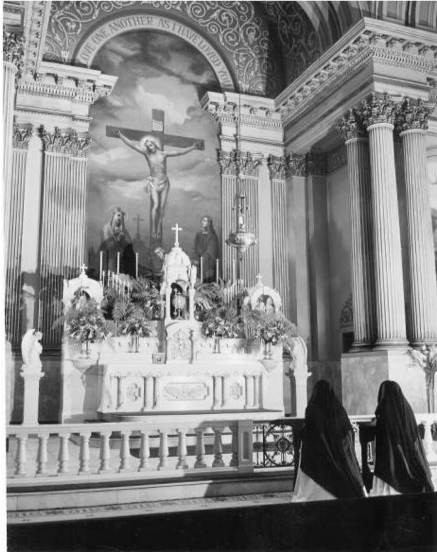
In ancient times – when I first came to religious life 🙂 – we would add a special garment to our habit to celebrate a great feast. The white choir mantle was a symbol of our awareness of a particularly sacred moment.
Miraculously, it is that reverent awareness that opens our eyes to the plentitude in our midst. It releases us to the freedom of a hope already realized, but hidden from those whose hearts refuse to be dressed in grace.
You spread the table before me in the sight of my foes; you anoint my head with oil; my cup overflows.
Psalm 23:5
Our readings invite us to live as not only invited but saved people, completely convinced of God’s eternal welcome and protection.
Only goodness and kindness follow me all the days of my life; and I shall dwell in the house of the LORD forever.
Psalm 23:6
What would the world be like if we lived out this conviction – that we already possess God’s gracious abundance?
How might the reproaches of fear, competition, domination, selfishness, and hoarding be removed from our midst?
How might the rush of generosity, forgiveness, and mercy flow out of our confident hearts to wash the earth in God’s restful waters?
Poem: Manifesto: The Mad Farmer Liberation Front by Wendell Berry
Love the quick profit, the annual raise, vacation with pay. Want more of everything ready-made. Be afraid to know your neighbors and to die. And you will have a window in your head. Not even your future will be a mystery any more. Your mind will be punched in a card and shut away in a little drawer. When they want you to buy something they will call you. When they want you to die for profit they will let you know. So, friends, every day do something that won’t compute. Love the Lord. Love the world. Work for nothing. Take all that you have and be poor. Love someone who does not deserve it. Denounce the government and embrace the flag. Hope to live in that free republic for which it stands. Give your approval to all you cannot understand. Praise ignorance, for what man has not encountered he has not destroyed. Ask the questions that have no answers. Invest in the millennium. Plant sequoias. Say that your main crop is the forest that you did not plant, that you will not live to harvest. Say that the leaves are harvested when they have rotted into the mold. Call that profit. Prophesy such returns. Put your faith in the two inches of humus that will build under the trees every thousand years. Listen to carrion – put your ear close, and hear the faint chattering of the songs that are to come. Expect the end of the world. Laugh. Laughter is immeasurable. Be joyful though you have considered all the facts. So long as women do not go cheap for power, please women more than men. Ask yourself: Will this satisfy a woman satisfied to bear a child? Will this disturb the sleep of a woman near to giving birth? Go with your love to the fields. Lie down in the shade. Rest your head in her lap. Swear allegiance to what is nighest your thoughts. As soon as the generals and the politicos can predict the motions of your mind, lose it. Leave it as a sign to mark the false trail, the way you didn’t go. Be like the fox who makes more tracks than necessary, some in the wrong direction. Practice resurrection.
Music: Abundant Life – written by Ruth Duck, sung by Marty Haugen
Today, in God’s Lavish Mercy, we begin the first of three passages from the prophet Zechariah to be read over the next few days. These are the only times we meet Zechariah in our cycle of readings, other than December 12th, the Feast of Our Lady of Guadalupe.
For that reason, we could easily overlook Zechariah, a minor prophet whose visions, so specifically directed to the post-exilic Israelite community, may seem alien and extraneous to our own spirituality.
But we should not overlook Zechariah. Here’s why.
These two prophets (Zechariah and Haggai) seek to rally the identity and vocation of Jews in a time when faith is hard and prospects are lean. Such a time, they assert, is a time for vigorous action. The rebuilding of the temple is thus an act of faith, confident in the reality of God, and an act of defiance against the established imperial order of the world, even the imperial order that funded the project. We might well read these prophets in our own time of “small things” when the church seems to lack energy, courage, and imagination. In just such a time it is urgent to enact visible faithful gestures (like the temple building) that defy business as usual. Thus the prophetic imagination given here outruns historical possibility. That is the quality and depth of faith held here to which we are invited.
Walter Brueggeman: From Judgement to Hope
Zechariah invites the people to imagine a world vastly beyond their present perceptions. It is a world where the Temple is rebuilt as a symbol of God’s Presence, central to their identity. That Divine Presence provides any protection needed, thus removing the need for “walls” of isolation, fear, oppression, defensiveness, and exclusion.
People will live in Jerusalem as though in open country, because of the multitude of men and beasts in her midst. But I will be for her an encircling wall of fire, says the LORD, and I will be the glory in her midst.
Zechariah 2:8-9
Surely we could use such holy imagination in our times! And surely this is the sacred energy Pope Francis seeks as he leads the Church in synodality.
As our shared geopolitical world seems daily to become more fragmented and hostile, the power of our communal, Resurrection faith is crucial to its graceful restoration.
Zechariah calls the people to sing, even in the midst of their disheartening exile, and to dream of a world without vicious walls. We are called to the same hope even in a world that conspires to feed cynicism and indifference rather than justice and mercy.
Sing and rejoice, O daughter Zion! See, I am coming to dwell among you, says the LORD. Many nations shall join themselves to the LORD on that day, and they shall be his people and he will dwell among you.
Zechariah 2:14
Prose: The Monk Manifesto – Christine Valtners Paintner
Monk Manifesto is a public expression of one’s commitment to live a compassionate, contemplative, and creative life. When I read it, I find encouragement to act for a more integrated world, one without dissociative walls.
I commit to finding moments each day for silence and solitude, to make space for another voice to be heard, and to resist a culture of noise and constant stimulation.
I commit to radical acts of hospitality by welcoming the stranger both without and within. I recognize that when I make space inside my heart for the unclaimed parts of myself, I cultivate compassion and the ability to accept those places in others.
I commit to cultivating community by finding kindred spirits along the path, soul friends with whom I can share my deepest longings, and mentors who can offer guidance and wisdom for the journey.
I commit to cultivating awareness of my kinship with creation and a healthy asceticism by discerning my use of energy and things, letting go of what does not help nature to flourish.
I commit to bringing myself fully present to the work I do, whether paid or unpaid, holding a heart of gratitude for the ability to express my gifts in the world in meaningful ways.
I commit to rhythms of rest and renewal through the regular practice of Sabbath and resist a culture of busyness that measures my worth by what I do.
I commit to a lifetime of ongoing conversion and transformation, recognizing that I am always on a journey with both gifts and limitations.
Music: One World – Toby Mac
I’m not a big fan of rap, but I think this song is pretty good for today’s reflection.
Today, in God’s Lavish Mercy, we pray with Psalm 145 which, with our Sunday readings, ties together the themes of call and commitment.
In our first reading, Isaiah proclaims a repentant urgency to that call:
Seek the LORD while he may be found, call him while he is still near.
Isaiah 55:6
In our second reading, Paul confirms his own ultimate commitment to that call and urges his followers to imitate him:
Christ will be magnified in my body, whether by life or by death….
Only, conduct yourselves in a way worthy of the gospel of Christ, so that, whether I come and see you or am absent, I may hear news of you, that you are standing firm in one spirit, with one mind struggling together for the faith of the gospel.
Philippians 1:20;27
But our Gospel reveals that not everyone responds immediately to God’s voice in their lives. Some of us come late to the call of grace. Nevertheless, our generous God seeks us, time and again, and embraces us fully no matter how close to the evening.
The early hires chafe against this system, imagining themselves somehow deprived by the Master’s abundance. Perhaps we heard attitudes like theirs expressed in self-sufficient phrases like:
but I’ve worked hard for everything I have
you need to earn your way in life
it’s not a free ride
if you can’t stand the heat, get out of the kitchen
Walter Brueggemann writes that the Psalms refute such an attitude:
The counter-world of the Psalms contradicts our closely held world of self-sufficiency by mediating to us a world confident in God’s preferential option for those who call on him in their ultimate dependence.
Psalm 145 lifts us beyond our selfish imaginations. It expresses the grateful praise of one who, swaddled in God’s lavish blessing, recognizes that Divine Justice looks like Mercy not calculation.
The LORD is gracious and merciful, slow to anger and of great kindness. The LORD is good to all and compassionate toward all his works.
Psalm 145: 8-9
Poem: by Rumi
By the mercy of God, Paradise has eight doors. One of those is the door of repentance, child. All the others are sometimes open, sometimes shut, but the door of repentance is never closed. Come seize the opportunity: the door is open; carry your baggage there at once.
Today, in God’s Lavish Mercy, in his letter to Timothy, we see that Paul thought he had been the foremost of bad dudes.
This saying is trustworthy and deserves full acceptance: Christ Jesus came into the world to save sinners. Of these I am the foremost.
1 Timothy 1:15
Well, maybe – maybe not! It’s hard to imagine that a really bad guy could end up with the sacred portfolio Paul compiled before he met his maker. Jesus says as much in today’s Gospel:
A good tree does not bear rotten fruit, nor does a rotten tree bear good fruit. For every tree is known by its own fruit.
Luke 6:43-44
So let’s say Paul wasn’t really a “bad guy” before he got knocked off his Damascus-bound horse. Then what was he? The key word in Paul’s self-description is this: SINNER. Paul was a sinner.
Sinners are otherwise “good guys” who make bad choices for their spiritual lives. When those bad choices multiply and begin to feed on one another, the soul deteriorates like the rotten tree in Jesus’s image.
Jesus uses an additional metaphor to describe the process of continual spiritual conversion:
“Why do you call me, ‘Lord, Lord,’ but not do what I command? I will show you what someone is like who comes to me, listens to my words, and acts on them. That one is like a man building a house, who dug deeply and laid the foundation on rock; when the flood came, the river burst against that house but could not shake it because it had been well built.
Luke 6:46-48
We open our hearts to Mercy by these commitments to God’s Word in our daily spiritual life:
listening
acting
deepening
Integrity in these three spiritual practices requires dedicated prayer and reflection, a faithful “keeping” with the Word of God. As our Alleluia Verse assures us:
Alleluia, alleluia. Whoever loves me will keep my Word, and my Father will love them, and we will come to them.
John 14:23
Poetry: [i carry your heart with me(i carry it in] – e.e.cummings
i carry your heart with me(i carry it in my heart)i am never without it(anywhere i go you go,my dear;and whatever is done by only me is your doing,my darling) i fear no fate(for you are my fate,my sweet)i want no world(for beautiful you are my world,my true) and it’s you are whatever a moon has always meant and whatever a sun will always sing is you
here is the deepest secret nobody knows (here is the root of the root and the bud of the bud and the sky of the sky of a tree called life;which grows higher than soul can hope or mind can hide) and this is the wonder that's keeping the stars apart