Wednesday of the Tenth Week in Ordinary Time

June 9, 2021

Today, in God’s Lavish Mercy, we pray with Psalm 25 which is our Alleluia Verse.

Psalm 25, in total, is a psalm of lament. But today’s single phrase is a golden thread in an otherwise somber weave. It is a simple act of faith and dependence on God. It is the yielding of one’s life into God’s unfolding promise.


Praying with this psalm today, I am nostalgic. On June 9th, 58 years ago, I graduated from high school.

I guess for some, high school graduation isn’t a remarkable or memorable event. But for me, and the two other young women in this photo, it was a time of earth-shaking choices and profound commitments. It was a moment in our personal stories that would shape our lives forever – we had decided to become Sisters of Mercy.


Every life has one – or likely a few – such moments. They are the hinges on which our life story revolves. Praying gratefully with them helps us to recognize God’s enduring Presence in our lives and to rejuvenate our faith. 

When you get as old as I am, the accumulation of gratitude is overwhelming and the trust in God’s continued abiding is assuring.
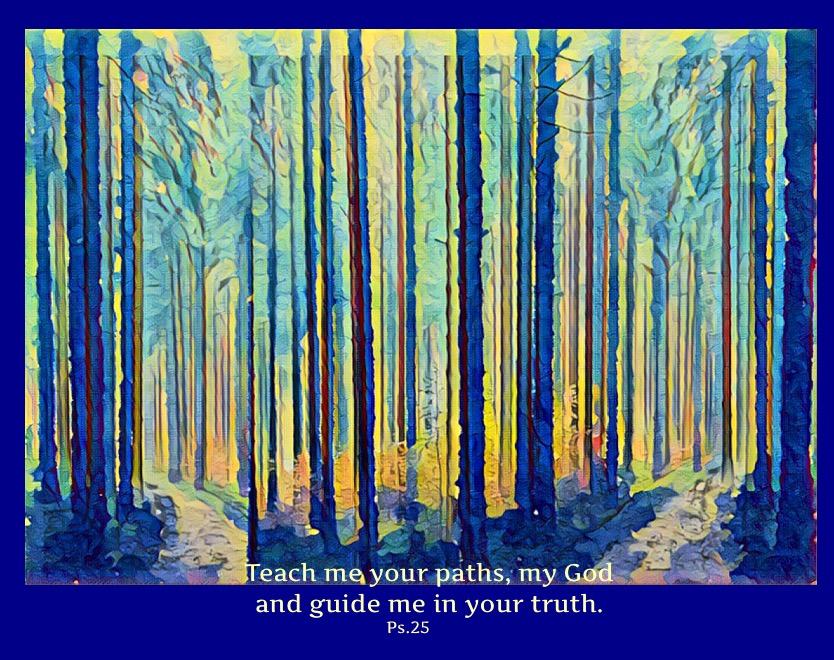
Robert Frost seems to have been having such a prayer when he wrote his beloved poem. Maybe it will help your prayer today or at some other date of holy reminiscence in your life.


Poetry: The Road Not Taken – Robert Frost

Two roads diverged in a yellow wood,
And sorry I could not travel both
And be one traveler, long I stood
And looked down one as far as I could
To where it bent in the undergrowth;

Then took the other, as just as fair,
And having perhaps the better claim,
Because it was grassy and wanted wear;
Though as for that the passing there
Had worn them really about the same,

And both that morning equally lay
In leaves no step had trodden black.
Oh, I kept the first for another day!
Yet knowing how way leads on to way,
I doubted if I should ever come back.

I shall be telling this with a sigh
Somewhere ages and ages hence:
Two roads diverged in a wood, and I—
I took the one less traveled by,
And that has made all the difference.

Music: The Magnificat Medley – John Michael Talbot

I chose this song today for two reasons.

  1. It is the verse in our Responsorial Psalm:

Holy is the Lord our God.

Psalm 99:7

2. The Magnificat was such a moment in Mary’s life.
Tuesday of the Tenth Week in Ordinary Time

June 8, 2021

Today, in God’s Lavish Mercy, we pray with Psalm 119, a repeated favorite on the blog – you might like to re-visit any of the 13 entries:


Today, let’s pray with 119 in the light of Paul’s words to the Corinthians:

For the Son of God, Jesus Christ, … 
was not “yes” and “no,” but always “YES”.
God’s promises … find their “Yes” in him.

2 Corinthians 1:19-20

Here’s what those slightly cryptic but profoundly meaningful phrases mean to me.

No doubt, sometime in your life you have heard someone powerful say “No” to you. Or perhaps life itself has said it with some insurmountable limitations.

It is in those moments that we truly understand what “Yes” means because it has eluded us!

That meaning takes various forms depending on our circumstances. “Yes” can mean freedom, love, mercy, forgiveness, renewal, possibility, hope, fulfillment.

And “Yes” is always a beginning … a mystery that longs to be unfurled, unpeeled – like this beautiful red onion ( that I bought yesterday for a salad that turned into a reflection!)


Psalm 119 “unpeels” the layers of our relationship with God. Here’s how I hear it in my prayer:

O Lovely God,
You are wonderful.
You are my Light.
You amaze me
by the “Yes” of your Love.
You fire my spirit
to love You in return.

Lavish Mercy, turn to me
because I love You.
Steady me in my shadows.
Draw my “yes” 
into the Light 
of your beautiful Face.

based on Psalm 119:129-135

Poem: love is a place – e.e.cummings 

love is a place
& through this place of
love move
(with brightness of peace)
all places

yes is a world
& in this world of
yes live
(skillfully curled)
all worlds

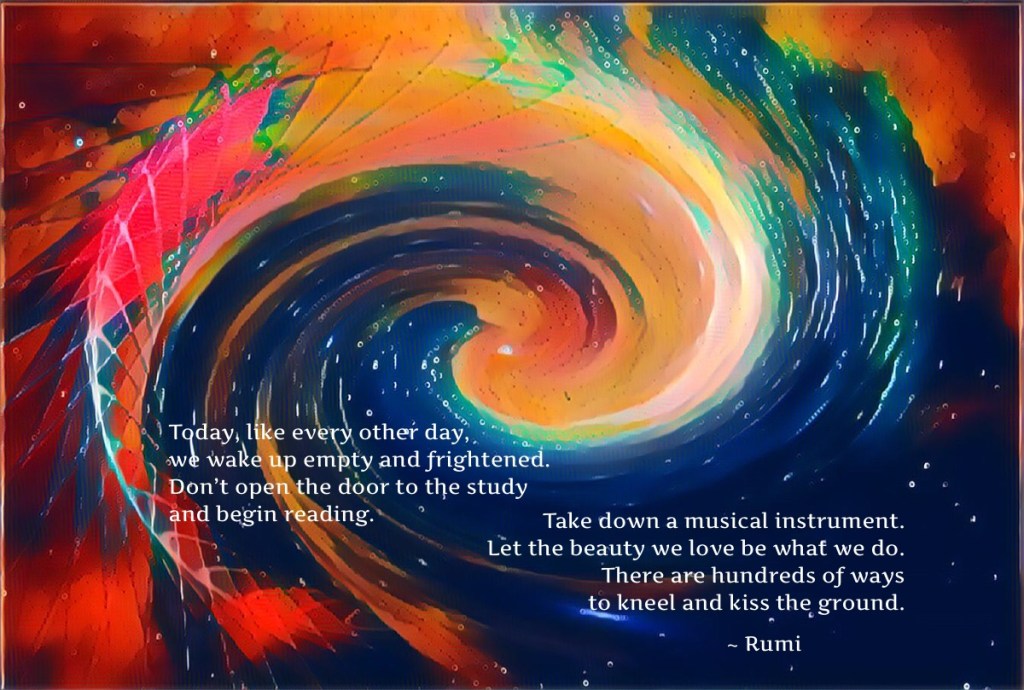
Music: The Beauty We Love

Monday of the Tenth Week in Ordinary Time

Monday, June 7, 2021

Today, in God’s Lavish Mercy, we pray with Psalm 34, filled with lovely images assuring us of God’s abiding mercy. This mercy moves the psalmist to promise perpetual praise – that means “no matter what”!

I will bless the LORD at all times;
    praise shall be ever in my mouth.
Let my soul glory in the LORD;
    the lowly will hear me and be glad.

Psalm 34:2-3

By telling about God’s loving intervention in our lives, the psalmist invites everyone to join in praise:

Glorify the LORD with me,
    let us together extol God’s name.
I sought the LORD who answered me
    and delivered me from all my fears.

Psalm 34:4-5

I’m not so sure it’s an easy thing to rejoice in another’s blessing when we ourselves are feeling overlooked by God. But that’s the whole point of the psalm. It is WE who feel overlooked, not God who is overlooking. 

It is as if we have turned our back to a brilliant sun and complained how cloudy it is. The psalmist says, “Stop that … turn your self around.

Look to God that you may be radiant with joy,
    and your faces may not blush with shame.
When the suffering one called out, the LORD heard,
    and from all distress was saved. 

Psalm 34:6-7

Notice that they were not saved from suffering but from distress. Such salvation rests in the confidence that, even in suffering, we are never alone; that when we take refuge in God, palpable blessing ensues.

The angel of the LORD encamps
    around those who reverence God, and delivers them.
Taste and see how good the LORD is;
    blessed the one who takes refuge in God’s embrace.

Psalm 34:8-9

Surely Psalm 34 calls us
to live in the spirit of the Beatitudes
which we can savor in today’s Gospel.

Poetry: Safe Harbor by Robert B. Shaw


Music: Two songs suggested themselves today. Here are both🤗 Enjoy!

Multiplied by needtobreathe
(notice the radiant diamonds)

Psalm 34 – Brooklyn Tabernacle Choir

I sought the Lord
And He answered me
And delivered me
From every fear
Those who look on Him
Are radiant
They'll never be ashamed

This poor man cried
And the Lord heard me
And saved me from
My enemies
The Son of God
Surrounds His saints
He will deliver them

Magnify the Lord with me
Come exalt His name together
Glorify the Lord with me
Come exalt His name forever
Oh taste and see
That the Lord is good
Oh blessed is he
Who hides in Him
Oh fear the Lord
Oh all you saints
He'll give you everything

Magnify the Lord with me
Come exalt His name together
Glorify the Lord with me
Come exalt His name forever
Magnify the Lord with me
Come exalt His name together
Glorify the Lord with me
Come exalt His name forever

Let us bless the Lord
Every day and night
Never ending praise
May our incense rise

Let us bless the Lord
Every day and night
Never ending praise
May our incense rise

Let us bless the Lord
Every day and night
Never ending praise
May our incense rise
Every day and night
Never ending praise
May our incense rise

Magnify the Lord with me
Come exalt His name together
Glorify the Lord with me
Come exalt His name forever
Magnify the Lord with me
Come exalt His name together
Glorify the Lord with me
Come exalt His name forever
Oh taste and see
That the Lord is good
He'll give you everything

Memorial of Saint Boniface, Bishop and Martyr

Saturday, June 5, 2021

Today, in God’s Lavish Mercy, we pray with the final prayer of Tobit for our Responsorial Psalm.

The Church has  followed Tobit’s story for a little over a week. We have seen a man who, even through his dramatic ups and downs, remains a steadfast believer. 

For Tobit, the exigencies of his life do not dictate the intensity of his faith. Rather, that intense faith fuels his response to life.

The Lord scourges and then has mercy;
    casts down to the depths of the nether world,
    and brings up from the great abyss.
No one can escape the Lord’s hand.
So now consider what the Lord has done for you,
    and give praise with full voice.
Bless the Lord of righteousness,
    and exalt the King of ages.

Tobit 13: 2,6

Tobit realized that his faith stood as a sign to others. He preached by his attitude in life, not so much by his words:

In the land of my exile I praise him
    and show his power and majesty to a sinful nation.

Tobit 13:7

Written from a place of exile, the Book of Tobit gives us good advice to sustain faith in our own small “exiles”. Always bless and praise God. Find the points of light and joy. Cling to and celebrate them.

Bless the Lord, all you his chosen ones,
    and may all of you praise his majesty.
Celebrate days of gladness, and give the Lord praise.

Tobit 13:8

Tobit is a make-believe person. But our Gospel shows us a real woman who embodies the simple, steadfast faith which the Book of Tobit preaches. She also preached with her actions rather than her words.

Although she had little, she lived out of her abundance not her scarcity. That abundance was fired by the God she believed in and trusted, as was the faith of apocryphal Tobit.

As we pray with Tobit and the widow, we might share with them our own faith, both its strengths and it weaknesses, asking to draw inspiration and courage from their stories.


Poetry: This Place of Abundance – Catherine of Siena
~ from Love Poems from God – Twelve Sacred Voices from the East and West
by Daniel Ladinsky

We know nothing until we know everything.
    I have no object to defend
    for all is of equal value
    to me.

I cannot lose anything in this
place of abundance
I found.

    If something my heart cherishes
    is taken away,
    I just say, “Lord, what
    happened?”

And a hundred more
appear.

Music: Live Like You’re Loved – Hawk Nelson

Friday of the Ninth Week in Ordinary Time

June 4, 2021

Today, in God’s Lavish Mercy, we pray with Psalm 146, a song of uninhibited delight and thanksgiving to God.

Coming after our reading from Tobit, we see just what such utter delight looks like.

That “angelic fish gall” re-lit the world for Tobit in a way he had never imagined before!


Sometimes we too have to experience a profound blindness before we really begin to see rightly. Let’s be honest: haven’t we all been blind a few times in our lives.

  • Blessings unrecognized
  • Friendships taken for granted
  • Kindnesses overlooked
  • People misjudged 
  • Needs ignored
  • Expectations unsurrendered 
  • Biases unexamined
  • Opportunities bypassed
  • Perhaps even responsibilities shirked

Praying with Psalm 146, we might take note of those whom the Lord favors:

the oppressed, the hungry. captives, those who are bowed down; 
the just, strangers, orphans and widows

These favored of God share a common trait – a vulnerability learned through suffering.


None of us seeks suffering in our lives. But we all will encounter it personally at least to some degree. Further, all in the community of faith are called to share the sufferings of others by our works of mercy.

In both instances, can we allow suffering to let us see the world differently, to lift the scales of any blindness in our hearts? Because here is the beautiful mystery: the God of Mercy is with us in our lights and shadows — and is always Light.

Praise the LORD, O my soul;
    I will praise the LORD all my life;
    I will sing praise to my God while I live. 

Psalm 146:1

Poetry: God Pours Light – Hafiz

God
pours light
into every cup,
quenching darkness.
The proudly pious
stuff their cups with parchment
and critique the taste of ink
while God pours light
and the trees lift their limbs
without worry of redemption,
every blossom a chalice.
May I seduce those withered souls
with words that wet their parched lips
as light
pours like rain
into every empty cup
set adrift on the Infinite Ocean.


Music: Amazing Grace – Leo Rojas

Wednesday of the Ninth Week in Ordinary Time

June 2, 2021

Today, in God’s Lavish Mercy, we pray with Psalm 25, a heartfelt expression of how to traverse life’s challenges with persevering faith.

Set between our two anguished readings today, Psalm 25 is a solace. Could poor Tobit run into more trouble! His allegorical life, which mirrors Israel’s historic troubles, is a real melodrama.

Then our Gospel recounts the Sadducees’ approach to troubles similar to Tobit’s. They get all up in their heads rather than open their minds to faith.


But Psalm 25 gives us the formula for the practice of such faith:

TRUST IN GOD

In you I trust; let me not be put to shame,
    let not my enemies exult over me.
No one who waits for you shall be put to shame;
    those shall be put to shame who heedlessly break faith.


LEARN GOD’S WAYS

Your ways, O LORD, make known to me;
    teach me your paths,
Guide me in your truth and teach me,
    for you are God my savior.


REFLECT ON GOD’S FAITHFULNESS 

Remember that your compassion, O LORD,
    and your kindness are from of old.
In your kindness remember me,
    because of your goodness, O LORD.


BE HUMBLE AND JUST

Good and upright is the LORD;
    thus showing sinners the way.
God guides the humble to justice,
    and teaches the humble the way.


Today, as we pray Psalm 25, we might reflect on our experience and practice of these attitudes in our own lives.


Poetry: Let Your God Love You – Edwina Gately

Be silent.
Be still.
Alone.
Empty
Before your God.

Say nothing.
Ask nothing.
Be silent.
Be still.
Let your God look upon you.

That is all.
God knows.
God understands.
God loves you
With an enormous love,
And only wants
To look upon you
With that love.

Quiet.
Still.
Be.

Let your God—
Love you.

Music: To You, O Lord – Scott Soper

Saturday of the Eighth Week in Ordinary Time

Saturday May 29, 2021

Today, in God’s Lavish Mercy, we pray with Psalm 19, full of beautiful words for us to pluck and relish. 

The sublime British writer and theologian C.S. Lewis says this about Psalm 19 and how the ancient Israelite may have appreciated it:

“Law” … must have shone with an extraordinary radiance. Sweeter than honey; or if that metaphor does not suit us who have not such a sweet tooth as all ancient peoples (partly because we have plenty of sugar), let us say like mountain water, like fresh air after a dungeon, like sanity after a nightmare. But, once again, the best image is in a Psalm, the 19th. I take this to be the greatest poem in the Psalter and one of the greatest lyrics in the world. Most readers will remember its structure; six verses about Nature, five about the Law, and four of personal prayer.

C.S. Lewis, Reflection on the Psalms

As we pray today with the verses about God’s Law, we may consider each word as a facet of the Holy Spirit’s gifts given at Pentecost and at our Confirmation:

The precepts of the Lord are:

perfect
refreshing
trustworthy
wise
right
joy giving
clear
enlightening
pure
enduring 
true
just
precious
sweet


Meditating on the virtues, wouldn’t we like to fill our days with their peace, beauty, and wisdom?

The writer of Sirach surely wanted to, whose simple and profound prayer is the perfect complement to our psalm.

I thank the LORD and I praise him;
    I bless the name of the LORD.
When I was young and innocent,
    I sought wisdom openly in my prayer
I prayed for her before the temple,
    and I will seek her until the end,
    and she flourished as a grape soon ripe.
My heart delighted in her,
My feet kept to the level path
    because from earliest youth I was familiar with her.

Sirach 51: 12-15

Praying with these readings
may lead us to be awed
by the Spirit’s power in our lives
and open us to
its transformative presence.

Poetry: Psalm 19: XXIX Caeli enarrant – Malcolm Guite

In that still place where earth and heaven meet
Under mysterious starlight, raise your head
and gaze up at their glory: ‘the complete

Consort dancing’ as one poet said
Of his own words. But these are all God’s words

A shining poem, waiting to be read

Afresh in every heart. Now look towards
The bright’ning east, and see the splendid sun
Rise and rejoice, the icon of his Lord’s

True Light. Be joyful with him, watch him run
His course, receive the treasure of his light
Pouring like honeyed gold till day is done.

As sweet and strong as all God’s laws, as right
As all his judgements and as clean and pure,
All given for your growth, and your delight!


Music: Psalm 19 – The Law is Perfect

Friday of the Eighth Week in Ordinary Time

May 28, 2021


Today, in God’s Lavish Mercy, we pray with Psalm 149 exhorting us to praise God out loud. And we can do that. We’ve all been part of that kind of glorious praise with the help of our wonderful choirs, musicians, and praise dancers.


However, the psalm today is set between two intriguing readings that may cause us to think more deeply about our “praise”.

Sirach offers a cryptic description of who might be remembered as a godly person, ultimately saying it is the one whose virtues are unforgettable.

So the practice of virtue is presented as the most important act of praise.

Yet these also were godly persons
    whose virtues have not been forgotten;
Their wealth remains in their families,
    their heritage with their descendants;

Sirach 14: 10-11

In our Gospel, we meet what at first might appear as a moody, frustrated Jesus. Hungry one morning, he curses a figless fig tree. We might be inclined to focus on the poor zapped tree, but that would be to miss the point. 

The leafy yet fruitless tree is a symbol of a wordy “faith” without accompanying works. It describes people who, like the Pharisees in the Temple, shout praise without practicing charity and mercy.


Together, the readings help us see true praise in a clear light – as beautiful waving leaves on a tree full of sweet, loving fruitful actions.


Poetry: Judgement Day – R.S. Thomas

Yes, that’s how I was,
I know that face,
That bony figure
Without grace
Of flesh or limb;
In health happy,
Careless of the claim
Of the world’s sick
Or the world’s poor;
In pain craven –
Lord, breathe once more
On that sad mirror,
Let me be lost
In mist for ever
Rather than own
Such bleak reflections,
Let me go back
On my two knees
Slowly to undo
The knot of life
That was tied there.

Music: Good Fruit – Katy Bowser 

Have fun with this, my friends! 🤗

Thursday of the Eighth Week in Ordinary Time

May 27, 2021

Today, in God’s Lavish Mercy, we pray with Psalm 33. It is a song of extravagant praise to the Creator of a universe which extends infinitely both within and without us.


Our readings call us to be aware – to see – this infinite power and generosity of God, and to order our life upon the abundance of that vision.

Our lyrical passage from Sirach includes this:

How beautiful are all God’s works!
    even to the spark and fleeting vision!
The universe lives and abides forever;
    to meet each need, each creature is preserved.
All of them differ, one from another,
    yet none of them has God made in vain,
For each in turn, as it comes, is good;
    can one ever see enough of their splendor?

Sirach 15:22-25

In Mark’s Gospel, a blind man – one who longs to see – cries out for Jesus:

Jesus stopped and said, “Call him.”
So they called the blind man, saying to him,
“Take courage; get up, Jesus is calling you.”
He threw aside his cloak, sprang up, and came to Jesus.
Jesus said to him in reply, “What do you want me to do for you?”
The blind man replied to him, “Master, I want to see.
Jesus told him, ‘Go your way; your faith has saved you.”
Immediately he received his sight and followed him on the way.

Mark 10:49-52

God is calling us too, as we pray Psalm 33, to be grateful, to trust, to SEE the wonders around and within us:

Give thanks to the LORD on the harp;
on the ten-stringed lyre offer praise.
Sing to God a new song;
skillfully play with joyful chant.
For the LORD’s word is upright,
and works are trustworthy.
God loves justice and right.
The earth is full of the mercy of the LORD.

Psalm 33:2-5

This kind of seeing is more than just looking.
It is letting go of prefabricated expectation.
It is waiting in trust for the Invisible
to capture our hearts.

Prose: from de Chardin

Seeing. One could say that the whole of life lies in seeing — if not ultimately, at least essentially. To be more is to be more united — and this sums up and is the very conclusion of the work to follow. But unity grows, and we will affirm this again, only if it is supported by an increase of consciousness, of vision. That is probably why the history of the living world can be reduced to the elaboration of ever more perfect eyes at the heart of a cosmos where it is always possible to discern more. Are not the perfection of an animal and the supremacy of the thinking being measured by the penetration and power of synthesis of their glance? To try to see more and to see better is not, therefore, just a fantasy, curiosity, or a luxury. See or perish. This is the situation imposed on every element of the universe by the mysterious gift of existence. And thus, to a higher degree, this is the human condition.”
(Pierre Teilhard de Chardin: The Human Phenomenon, trans. Sarah Appleton-Weber, p. 3)

Music: Vision of Change by Back to Earth

Memorial of Saint Philip Neri, Priest

May 26, 2021

Today, in God’s Lavish Mercy, we pray with Psalm 79, one of the “Sad Songs of Zion”. While many of the Psalms are celebratory in nature, offering praise and thanksgiving, about a third of the Psalter is lament.

These mournful songs remind us that life is indeed full of both joys and sorrows. Faith calls us to live through these modulations within the presence of God.

The psalmist of 79 cries out from imprisonment and deathly fear, but is not without hope for a better future:

Let the prisoners’ sighing come before you;
    with your great power free those doomed to death.
Then we, your people and the sheep of your pasture,
    will give thanks to you forever;
    through all generations we will declare your praise.

Psalm 79: 11-13

This is the kind of resilient prayer we can learn from the Psalms. At times, we find ourselves “imprisoned” – locked away from what we most want in our lives – love, peace, security, health, freedom. To deny such suffering only buries us deeper in it. 


As we see in our Gospel today, Jesus calls us to face our truth and to seek God’s Presence within it. Doing so will allow us, as it did the disciples, to move beyond self-centered expectation to God-centered courageous hope.

Then James and John, the sons of Zebedee,
came to Jesus and said to him,
‘Teacher, we want you to do for us whatever we ask of you.”
He replied, ‘What do you wish me to do for you?”
They answered him,
“Grant that in your glory
we may sit one at your right and the other at your left.”
Jesus said to them, “You do not know what you are asking.
Can you drink the chalice that I drink
or be baptized with the baptism with which I am baptized?”
They said to him, ‘We can.”
Jesus said to them, “The chalice that I drink, you will drink,
and with the baptism with which I am baptized, you will be baptized;
but to sit at my right or at my left is not mine to give
but is for those for whom it has been prepared.”


As we look at our world, and perhaps our own lives, we see much suffering. How can God come to us from the midst of such pain? Psalm 79 tells us to keep inviting God and to be vigilant and attentive for God’s appearance. Just as in our Gospel, it will not look as we had expected it to look.

Remember us
Show us
Help us
Deliver us
Free us
Then we will give thanks and praise your Name

The Basic Prayer of Psalm 79

Poetry: A Blessing by Elizabeth Eiland Figueroa 

May the God of Surprises delight you, 
inviting you to accept gifts not yet imagined.
May the God of Transformation call you, 
opening you to continual renewal.
May the God of Justice confront you, 
daring you to see the world through God’s eyes.
May the God of Abundance affirm you, 
nudging you towards deeper trust.
May the God of Embrace hold you, 
encircling you in the hearth of God’s home.
May the God of Hopefulness bless you, 
encouraging you with the fruits of faith.
May the God of Welcoming invite you, 
drawing you nearer to the fullness of God’s expression in you.
May God Who is Present be with you, 
awakening you to God in all things, all people, and all moments.
May God be with you.
Amen.

Music: The Joys and Sorrows of Life – Johannes Bornlöff