Isaiah’s Psalm

Friday of the Fifteenth Week in Ordinary Time

July 17, 2020

Today, in God’s Lavish Mercy, we pray with Isaiah 38 as our Responsorial Psalm.

Although the verses are under Isaiah, they are actually the words of Hezekiah, a king of Israel during Isaiah’s time. Our first reading relates the story of Hezekiah’s mortal illness and the prophetic role Isaiah plays in his recovery.

Our psalm reemphasizes the power and mercy of God who delivers Hezekiah from death. Hezekiah’s vibrant images reveal the depth of his desperation:

Once I said,
“In the noontime of life I must depart!
To the gates of the nether world I shall be consigned
for the rest of my years.”

We all know what the prayer for deliverance feels like. It rises from the depths of our souls and repeats itself in a constant, “Please…”. We can think of nothing else but the favor we are praying for. We linger in our begging, sometimes for years.

Hezekiah stretches into the full extent of his pain with these striking metaphors:

My dwelling, like a shepherd’s tent,
is struck down and borne away from me;
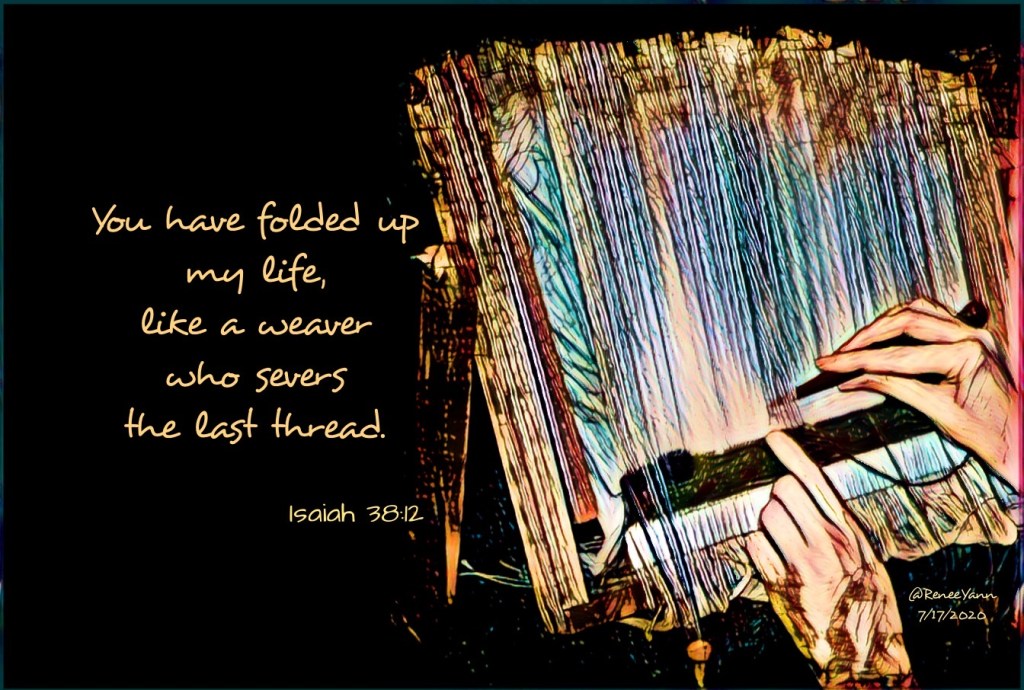
You have folded up my life, like a weaver
who severs the last thread.


Deliverance is that condition in which we, having lost all personal power to effect change, must be carried by another hand to life and well-being. If we can do that in faith, our prayer will be answered.

When it is, by either a merciful “Yes” or “No”, we will understand. It will be as if we have fallen from hanging by our fingernails into the enveloping caress of a feathered bed.

Those live whom the LORD protects;
yours is the life of my spirit.
You have given me healing and life.


Poetry: For Deliverance from a Fever by Anne Bradstreet (1612 – 1672),  the most prominent of early English poets of North America and first writer in England’s North American colonies to be published. She is the first Puritan figure in American Literature.

When sorrows had begirt me round, 
And pains within and out, 
When in my flesh no part was found, 
Then didst Thou rid me out.

My burning flesh in sweat did boil, 
My aching head did break, 
From side to side for ease I toil, 
So faint I could not speak.

Beclouded was my soul with fear 
Of Thy displeasure sore, 
Nor could I read my evidence 
Which oft I read before.

“Hide not Thy face from me!" I cried, 
"From burnings keep my soul. 
Thou know'st my heart, and hast me tried; 
I on Thy mercies roll." 

“O heal my soul," Thou know'st I said, 
"Though flesh consume to nought, 
What though in dust it shall be laid, 
To glory t' shall be brought." 

Thou heard'st, Thy rod Thou didst remove 
And spared my body frail 
Thou show'st to me Thy tender love, 
My heart no more might quail.

O, praises to my mighty God, 
Praise to my Lord, I say, 
Who hath redeemed my soul from pit, 
Praises to Him for aye. 

Music: You Will Redeem It All – Travis Cottrell

You were there at the 
loss of all the innocence
You were there at the 
dawn of all the shame 
You were there, felt the
weight of all the helplessness 
put Yourself into the agony and pain


Nothing is hidden from Your eyes 
You flood the darkness with Your light 
I have this hope
as an anchor for my soul
You will redeem it all, redeem it all
Out of the dust into something glorious
You will redeem it all, redeem it all


You are here in the middle of my circumstance
You are here bringing purpose out of pain 
You are here restoring every broken path
Speaking life, You raise me once again
Nothing is hidden from Your eyes 
Out of the ashes I will rise  
 
Hallelujah in the waiting
Hallelujah even then  
Hallelujah for the healing
You will make a way again 


Hallelujah in the waiting
Hallelujah even then  
Hallelujah for the healing
You will make a way again 


Hallelujah my Redeemer
You redeem me by Your blood
Hallelujah! What a Savior
You turn evil back for good 
 Hallelujah! What a Savior!
Hallelujah! My Redeemer!
My Redeemer!     

Psalm 102: God’s Time

Thursday of the Fifteenth Week in Ordinary Time

July 16, 2020

From 2018: Feast of Our Lady of Mount Carmel

Today, in God’s Lavish Mercy, we pray with Psalm 102, one of the seven penitential psalms. It is introduced as “the prayer of the afflicted”.

Yet, I find our verses today full of hope. They look with confidence to a better future.

You, O LORD, abide forever,
and your name through all generations.
You will arise and have mercy on Zion,
for it is time to pity her.

That last line, “for it is time to pity her”, is particularly touching as the psalmist nudges God to move forward with healing. Don’t we  pray like that sometimes?

  • Dear God, I’ve had all I can take! Please fix this — now!
  • Lord, I’ve learned my lesson. Please relent and rescue me.
  • Jesus, please let this trial be over and let us survive.
  • Lord, it is time for this to be over!

The bedrock of this prayer is the psalmist’s deep trust that God will act as God has promised:

The nations shall revere your name, O LORD,
and all the kings of the earth your glory,
When the LORD has rebuilt Zion
and appeared in his glory;
When he has regarded the prayer of the destitute,
and not despised their prayer.


You may find your heart filled with a prayer like this today. Surely, our whole human community voices a longing for the pandemic sufferings to be over. Or there may be other afflictions you carry that are testing the limits of your endurance.

Psalm 94 holds out encouragement and hope. Reach for it and let it strengthen you.

But you are forever the same, Lord, 
without beginning or end, 
infinite in your compassion, 
fathomless in your love. 
You rebuild the desolate city; 
you bring the exiles back home. 
You grant the poor your abundance; 
you guide the nations toward peace.
You hear the cry of the destitute 
and the sobbing of the oppressed. 
You soothe the pain of the captive; 
you set the prisoner free. 
Come to me too in your mercy 
and set my soul at peace.
from A Book of Psalms by Stephen Mitchell

Poetry: from Burnt Norton – T.S. Eliot

Time present and time past
Are both perhaps present in time future, 
And time future contained in time past.
If all time is eternally present
All time is unredeemable.
What might have been is an abstraction 
Remaining a perpetual possibility
Only in a world of speculation.
What might have been and what has been 
Point to one end, which is always present. 
Footfalls echo in the memory
Down the passage which we did not take 
Towards the door we never opened
Into the rose-garden. 
My words echo 
Thus, in your mind.

Music: On Time God – Deborah Kline Iantorno

Psalm 94: Tough Talk

Memorial of Saint Bonaventure, Bishop and Doctor of the Church

July 15, 2020

From 2016:

Today, in Mercy, on this feast of St. Bonaventure, we pray for God to be revealed across our battered globe. God does not hide from us. We hide God in our sinful choices. May we, no matter our religion or politics, find the means to confront terrorism, war and domination by uniting in the God who made and loves us all.


Today, in God’s Lavish Mercy, we pray with Psalm 94, a ruthless, stinging condemnation of greed, sinful arrogance, and hypocrisy. This morning’s prayer is not a comfortable one.

If you don’t think twice, you might feel like you’re reading today’s newspaper.

Set between Isaiah’s blistering condemnation of an “impious nation”, and Jesus’s expressed preference for the humble and innocent, this psalm scalds those who “trample” the widows, the stranger, the fatherless …


As I pray with the psalm’s uncompromising judgements, flashing before me are:

  • the faces of refugee families.
  • children in cages.
  • desperate parents pushed into buses to return to the terror they fled.
  • the Black and Brown faces of people consigned to our social and economic margins
  • the helpless eyes of those unfavored by a skewed justice system

Your people, O LORD, they trample down,
your inheritance they afflict.
Widow and stranger they slay,
the fatherless they murder.


My prayer is soaked with angry frustration at the unabated moral torpitude and social injustice of many with political power. When will they answer for their soulless actions and inactions!

And they say, “The LORD sees not;
the God of Jacob perceives not.”
Understand, you senseless ones among the people;
and, you fools, when will you be wise?


I take some solace in the promise of these final lines, stilling longing for a glimmer of the justice it describes:

For the LORD will not cast off his people,
nor abandon his inheritance;
But judgment shall again be with justice,
and all the upright of heart shall follow it.

May that day come soon, dear God, for all Creation and for all your beloveds suffering under the willful injustice, selfishness, indifference, or complicity of others.


Poetry: Let America Be America Again – Langston Hughes

Let America be America again.
Let it be the dream it used to be.
Let it be the pioneer on the plain
Seeking a home where he himself is free.
(America never was America to me.)
Let America be the dream the dreamers dreamed—
Let it be that great strong land of love
Where never kings connive nor tyrants scheme
That any man be crushed by one above.
(It never was America to me.)
O, let my land be a land where Liberty
Is crowned with no false patriotic wreath,
But opportunity is real, and life is free,
Equality is in the air we breathe.
(There's never been equality for me,
Nor freedom in this "homeland of the free.")
Say, who are you that mumbles in the dark?
And who are you that draws your veil across the stars?
I am the poor white, fooled and pushed apart,
I am the Negro bearing slavery's scars.
I am the red man driven from the land,
I am the immigrant clutching the hope I seek—
And finding only the same old stupid plan
Of dog eat dog, of mighty crush the weak.
I am the young man, full of strength and hope,
Tangled in that ancient endless chain
Of profit, power, gain, of grab the land!
Of grab the gold! Of grab the ways of satisfying need!
Of work the men! Of take the pay!
Of owning everything for one's own greed!
I am the farmer, bondsman to the soil.
I am the worker sold to the machine.
I am the Negro, servant to you all.
I am the people, humble, hungry, mean—
Hungry yet today despite the dream.
Beaten yet today—O, Pioneers!
I am the man who never got ahead,
The poorest worker bartered through the years.
Yet I'm the one who dreamt our basic dream
In the Old World while still a serf of kings,
Who dreamt a dream so strong, so brave, so true,
That even yet its mighty daring sings
In every brick and stone, in every furrow turned
That's made America the land it has become.
O, I'm the man who sailed those early seas
In search of what I meant to be my home—
For I'm the one who left dark Ireland's shore,
And Poland's plain, and England's grassy lea,
And torn from Black Africa's strand I came
To build a "homeland of the free."
The free?
Who said the free? Not me?
Surely not me? The millions on relief today?
The millions shot down when we strike?
The millions who have nothing for our pay?
For all the dreams we've dreamed
And all the songs we've sung
And all the hopes we've held
And all the flags we've hung,
The millions who have nothing for our pay—
Except the dream that's almost dead today.
O, let America be America again—
The land that never has been yet—
And yet must be—the land where every man is free.
The land that's mine—the poor man's, Indian's, Negro's, ME—
Who made America,
Whose sweat and blood, whose faith and pain,
Whose hand at the foundry, whose plow in the rain,
Must bring back our mighty dream again.
Sure, call me any ugly name you choose—
The steel of freedom does not stain.
From those who live like leeches on the people's lives,
We must take back our land again,
America!
O, yes,
I say it plain,
America never was America to me,
And yet I swear this oath—
America will be!
Out of the rack and ruin of our gangster death,
The rape and rot of graft, and stealth, and lies,
We, the people, must redeem
The land, the mines, the plants, the rivers.
The mountains and the endless plain—
All, all the stretch of these great green states—
And make America again

Music: All Who Love and Serve Your City – Eric Routley

All who love and serve your city,
all who bear its daily stress,
all who cry for peace and justice,
all who curse and all who bless,
In your day of loss and sorrow,
in your day of helpless strife,
honor, peace, and love retreating,
seek the Lord, who is your life.

In your day of wrath and plenty,
wasted work and wasted play,
call to mind the word of Jesus,
“I must work while it is day.”
For all days are days of judgment,
and the Lord is waiting still,
drawing near a world that spurns him,
offering peace from Calvary’s hill.
Risen Lord! shall yet the city 
be the city of despair?
Come today, our Judge, our Glory;
be its name, “The Lord is there!”

Psalm 48: You’re Upheld

Memorial of Saint Kateri Tekakwitha, Virgin

July 14, 2020


From 2016 

Today in Mercy, on this feast of St. Kateri, we pray for the grace to love others while still wisely discerning their words. May we listen, and allow our spirits to be formed, only by those words that reflect the love of God, respect for all God’s creation, and compassion toward all people. May we consistently eliminate from our life all words of hate, prejudice, indifference, and disrespect for ourselves and others.


Today, in God’s Lavish Mercy, we pray with Psalm 48 which describes God’s greatness, especially as enshrined in the magnificent Holy City. Even enemy kings were so stunned by the city’s splendor that they fled before attacking, trembling in their stirrups.

I like to think about that trembling. When we were the youngest of nuns, about three months out of high school, we learned to say the Little Office of the Virgin Mary. This psalm was part of the Office and contained my favorite line:

Quaking seizes them there;
anguish, like a woman’s in labor,
As though a wind from the east
were shattering ships of Tarshish.

Go ahead. You try saying it! It struck a few of us funny and gave us “church giggles”. Ever had them?

We were young. Everything was so new, and a little funny to us. It would take years of praying before God’s awesome magnificence – revealed in the long unfolding of life – to understand that “Tarshish” kind of soul-shaking.


But those years also have proven true the exultant refrain of today’s Responsorial:

God upholds his city for ever.

My dears, we are God’s beloved City. Let’s look back today at God’s merciful upholding of our lives through our many “Tarshishes” (dare you to say that one 😂)

We praise and thank you, Awesome Mercy!


Poem: Tyre – by Bayard Taylor who was an American poet, literary critic, translator, travel author, and diplomat. Taylor was born on January 11, 1825, in Kenneth Square in Chester County, PA. For my readers from other parts of the world, that’s about 30 minutes from where I live.❤️

A wonderful poem, not necessarily religious. But it is so beautifully crafted and will certainly help you imagine those “ships of Tarshish”.

THE wild and windy morning is lit with lurid fire;
The thundering surf of ocean beats on the rocks of Tyre, -- 
Beats on the fallen columns and round the headland roars, 
And hurls its foamy volume along the hollow shores,
And calls with hungry clamor, that speaks its long desire: 
‘Where are the ships of Tarshish, the mighty ships of Tyre?'


Within her cunning harbor, choked with invading sand,
No galleys bring their freightage, the spoils of every land, 
And like a prostrate forest, when autumn gales have blown, 
Her colonnades of granite lie shattered and o'erthrown; 
And from the reef the pharos no longer flings its fire,
To beacon home from Tarshish the lordly ships of Tyre.


Where is thy rod of empire, once mighty on the waves, --
Thou that thyself exalted, till Kings became thy slaves?
Thou that didst speak to nations, and saw thy will obeyed, --
Whose favor made them joyful, whose anger sore afraid, --
Who laid'st thy deep foundations, and thought them strong and sure, 
And boasted midst the waters, Shall I not aye endure?


Where is the wealth of ages that heaped thy princely mart? 
The pomp of purple trappings; the gems of Syrian art;
The silken goats of Kedar; Sabæa's spicy store;
The tributes of the islands thy squadrons homeward bore, 
When in thy gates triumphant they entered from the sea 
With sound of horn and sackbut, of harp and psaltery?


Howl, howl, ye ships of Tarshish! the glory is laid waste: 
There is no habitation; the mansions are defaced.
No mariners of Sidon unfurl your mighty sails;
No workmen fell the fir-trees that grow in Shenir's vales 
And Bashan's oaks that boasted a thousand years of sun, 
Or hew the masts of cedar on frosty Lebanon.


Rise, thou forgotten harlot! take up thy harp and sing: 
Call the rebellious islands to own their ancient king:
Bare to the spray thy bosom, and with thy hair unbound, 
Sit on the piles of ruins, thou throneless and discrowned!


There mix thy voice of wailing with the thunders of the sea, 
And sing thy songs of sorrow, that thou remembered be!
Though silent and forgotten, yet Nature still laments
The pomp and power departed, the lost magnificence:
The hills were proud to see thee, and they are sadder now; 
The sea was proud to bear thee, and wears a troubled brow, 
And evermore the surges chant forth their vain desire: 
‘Where are the ships of Tarshish, the mighty ships of Tyre?'

Music: I Will Carry You – Sean Clive

Psalm 50 Redux: Sacrifice of Praise

Monday of the Fifteenth Week in Ordinary Time

July 13, 2020

I have no past reflection on today’s readings since in 2016 they came on the Feast of Our Lady of Mt. Carmel, and in 2018 on the Feast of St. Benedict – both of whom I chose to highlight on those days. So here is a reflection from the Creighton University archives:


Today, in God’s Lavish Mercy, we pray again with Psalm 50. Today’s passage is what I call the “empty words” section where God leaves no doubt about what does and does not please him.

Why do you recite my statutes,
and profess my covenant with your mouth,
Though you hate discipline
and cast my words behind you?


We all know people who talk a good game about religion but they’re mean, selfish, and miserable to be around (present company excluded of course 🙄) And we all know people who actually distort religion to promote themselves while debasing and marginalizing others.

In Psalm 50, God says, “Cut it out!”. God doesn’t want burnt offerings or empty words. God wants “a sacrifice of praise”. So what exactly might that mean?


Walter Brueggemann, in talking about the similar Psalm 51, describes a sacrifice of praise like this:

It must be an intimate, yielding act of trustful submission of “spirit and heart,” not “sacrifice and burnt offerings”. The speaker (psalmist), now situated in glad praise, can imagine an intimacy and communion in which contact between God and self is available and in which the distinction between the two parties is clear and acknowledged—God in splendor, the self in “brokenness”.


When we pray from a humble understanding such as Bruggemann describes, our souls open to God’s love for us and for all Creation. We move from being the center of an insecure, self-absorbed universe to seeing ourselves in inextricable communion with all Life whose Center and Source is Love itself.

The one that offers praise as a sacrifice glorifies me;
and to the one who goes the right way I will show the salvation of God.


Poetry: one of mine today.

Praise
is the place
where I am lost
in You,
the exchange 
that
has only 
You speaking
without sound, with nothing
but my awed
silence.

Music: Alvin Slaughter – Sacrifice of Praise

Lord I lift a song of worship
For Your glory and Your grace
Let my heart reveal all my words fail to say
Lord receive this sacrifice of praise
(Repeat)
On the mountains, in the valley
As I wait in my secret place
I will trust,trust in the name of the Lord
Now receive this sacrifice of praise
You're my shield You're my shelter
From the storm and from the rain
Cover me beneath the shadow of Your wings
Lord receive this sacrifice of praise
Hallelujah hallelujah
Hallelujah to Your name
For all You've done
You are and evermore will be
Lord receive this sacrifice of praise
Of praise
Of praise----

Psalm 65: Word-Seed

Fifteenth Sunday in Ordinary Time
July 12, 2020

From 2017:

Today, in Mercy, we pray with the powerful and mysterious readings of today’s liturgy. They tell us that God breathes eternal inspiration into us and all Creation. The gift, like seed, is intended to bear fruit that is returned to God in love and praise. By participating in that return, we become children of God. May the seed of God’s Word fall on good ground in our spirits.

Today, in God’s Lavish Mercy, we pray with Psalm 65, a song poem probably written to celebrate the harvest season. The psalm describes an abundantly fruitful earth, filled with life and produce.

Though humans labor for these blessings, God is the bounty’s true agent. The power of that agency is found in the array of words used to describe God’s actions.

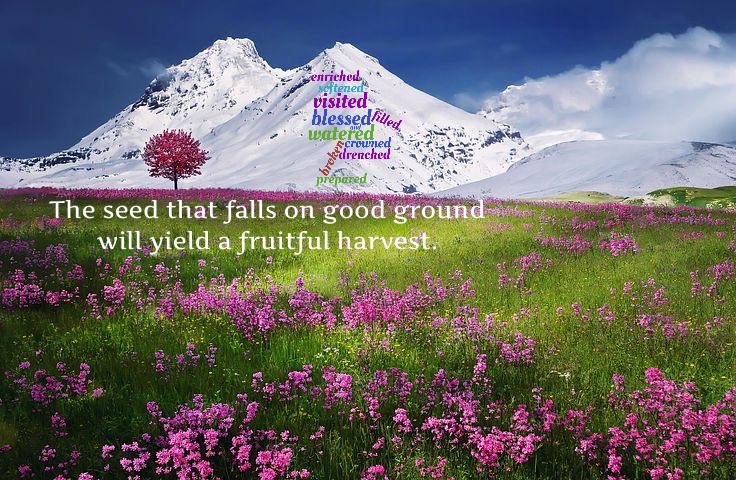
God has: 

  • visited 
    • watered
      • enriched
        • filled
          • prepared
  • drenched
    • broken up
      • softened
        • blessed and
          • crowned

What is it that has drawn all this intervention from God? Our readings tell us. It is the Word-Seed which is God’s own life.

Just as from the heavens
the rain and snow come down….
so shall my Word be. (Isaiah 55)
For creation awaits with eager expectation
the revealing Word of the children of God… (Romans 8)
The seed sown on rich soil
is the one who hears the Word and understands it,
who indeed bears fruit and 
yields a hundred or sixty or thirtyfold. (Matthew 13)

By our dedicated prayer with scripture and trusted spiritual reading, the Word works on our spirits just as the psalm describes.  Our understanding, too, is visited, watered, enriched, filled, prepared, drenched, broken up, softened and ultimately blessed and crowned.

As we pray with Psalm 65 today, we can picture David looking out from hilltop over the abundance of his fields. His heart is filled with awe and praise for God’s generosity.

We all want to live in a spiritual landscape akin to the psalm’s bountiful picture. Inviting God’s Word, in humility, gratitude, and awe is a true path to such blessing.


Poetry: A Word Is Dead – Emily Dickinson


Music: Aria by Secret Garden

Psalm 93: Nestle in God’s Robe

Memorial of Saint Benedict, Abbot

July 11, 2020

Today, in God’s Lavish Mercy, we pray with Psalm 93, the first of the royal psalms (93-99) which praise God as King.

As we pray with today’s verses, we can easily feel the psalmist stretching for a description of God Who is, of course, indescribable. Never having seen God, we can only imagine the Divine Being in human terms. This writer imagines God as a King beyond even the greatness of human kings, and it is a beautiful image:

The LORD is king, in splendor robed;
robed is the LORD and girt about with strength.


Like the psalmist, we may tend to paint God in the colors of those who have had greatest influence in our lives

  • those with power over us, like parents and teachers
  • those who have loved us, or failed to
  • those in positions of success, and strength

Because all human models are flawed in some way, this tendency can give us a blurry, if not distorted picture of God.


Jesus came to correct our perspective.


A beautiful extra hymn for today. Just love this one.

Jesus showed us that, while we live on this earth, the glory of God is a hidden glory. It is robed in the suffering of the poor and abandoned. Its splendor is in the innocence of children. Its strength is in the hope of the sick and weak. Its beauty shines out to us in the vulnerability of our sisters and brothers.


In today’s Gospel, Jesus gives us the tender image of God as One who cherishes every hair on our heads. As we pray today, we might let that gentle God reach down and caress any pain, exhaustion or fear, like a Mother brushing her child’s hair. Just be with God Who knows our needs. Be cradled in the splendrous robe.


Poetry:  God’s True Cloak – Rainer Maria Rilke

We must not portray you in king’s robes,
you drifting mist that brought forth the morning.
Once again from the old paintboxes
we take the same gold for scepter and crown
that has disguised you through the ages.
Piously we produce our images of you
till they stand around you like a thousand walls.
And when our hearts would simply open,
our fervent hands hide you.

Music: George Frideric Handel – Chandos Anthem, #4/ Psalm 93 – O Sing Unto the Lord

Psalm 51: Secret Heart

Friday of the Fourteenth Week in Ordinary Time

July 10, 2020

Today, in God’s Lavish Mercy, we pray with Psalm 51, a deeply moving plea for a pure heart and a right spirit. Psalm 51 is a penitential psalm known by its Latin name, Miserere (Have Mercy). You, dear readers, may remember a reflection on this beautiful psalm from just about a month ago.


As I prayed with Psalm 51 today, I asked myself how my spirit has been doing in the intervening month. May I challenge you all with the same question?

Corona time is not easy on the Spirit. Confinement, uncertainty, suffering and loss have impacted all of us in some way. Restrictions away from friends, family, and community deplete us. Social unrest and political lunacy unsettle us.

On the other hand, some of us have been able to embrace this time as a long retreat from “the way things were”. It has been a time of washing our hearts down to their bare muscle. We have sat in the quiet with questions like “What is it that I most love,  most trust, most need, most believe in, most hope for?”.


It is such an appropriate time to pray Psalm 51, to be with God in our “secret heart” – that place where no one else ever hears our rawest thoughts and purest prayers:

  • to acknowledge any sin or guilt we carry
  • to name our desire for healing and clarity
  • to listen to the whispering of Wisdom within us
  • to find our strength by finding our rootedness in God
  • to reclaim joy even in the midst of difficulty
  • to make our heart at home in praise
  • to be righted by Mercy

Let’s pray with and for one another as we cherish this Psalm.


Poetry: The Place Where We Are Right – Yehuda Amichai

From the place where we are right
Flowers will never grow
In the spring.
The place where we are right
Is hard and trampled
Like a yard.
But doubts and loves
Dig up the world
Like a mole, a plow.
And a whisper will be heard in the place
Where the ruined
House once stood.

Music: Wisdom in the Secret Heart – Shane and Shane

Psalm 80: Restore Us!

Thursday of the Fourteenth Week in Ordinary Time

July 9, 2020

Today, in God’s Lavish Mercy, we pray with Psalm 80, a powerful song poem written by a desperate and suffering poet.

Psalm 80 seems to have been written as a plea for deliverance of the northern kingdom of Israel just before the Assyrian armies conquered it. The psalmist pleads with God to remember God’s earlier kindness and to restore Israel’s wholeness.

Once again, O LORD of hosts,
look down from heaven, and see:
Take care of this vine,
and protect what your right hand has planted,
the son of man whom you yourself made strong.


When I read this psalm, I hear something like the plea of a confused child, asking a parent: 

  • What happened to upset things? 
  • I thought you loved me? 
  • Why am I so afraid now? 
  • Why are you so unconcerned about my fear?
  • Please remember and give me back your love and blessings.
  • Please make things all right again.

It is a prayer not unlike my own in this time of pandemic, profound loss, and moral confusion. There is so much to be mourned in these painful times, and yet so much to be learned. This video, shared with me by a dear Franciscan friend, captures both the mourning and the hope within these past months:


As we experience the continued spread of COVID 19, coupled with confused leadership and astounding popular ignorance, a plea like the psalmist’s might arise in our own hearts.

Much about our lives on and with the Earth has been broken. Let us pray from our brokenness today. May Creation be restored to its sacred vitality. May our human family be renewed with transformed integrity and reverence for Creation and for one another.


Poetry: I Am the Vine – Malcolm Guite

How might it feel to be part of the vine?
Not just to see the vineyard from afar
Or even pluck the clusters, press the wine,
But to be grafted in, to feel the stir
Of inward sap that rises from our root,
Himself deep planted in the ground of Love,
To feel a leaf unfold a tender shoot,
As tendrils curled unfurl, as branches give
A little to the swelling of the grape,
In gradual perfection, round and full,
To bear within oneself the joy and hope
Of God’s good vintage, till it’s ripe and whole.
What might it mean to bide and to abide
In such rich love as makes the poor heart glad?


Music: You Are the Vine- Divine Hymns

Psalm 105: Seek God’s Face

Wednesday of the Fourteenth Week in Ordinary Time

July 8, 2020

Today, in God’s Lavish Mercy, we pray with Psalm 105:2-7, a hymn to God’s omnipotent fidelity. The same hymn, with minor variations, appears in the First Book of Chronicles where it is attributed to David after the Ark of the Covenant, which had been lost during battle, was brought home to the tabernacle.


Psalm 105 is also a companion piece to Psalm 106, the first recounting God’s wondrous mercies; the second lamenting Israel’s ungrateful response.

Our passage today is really a call to remember God’s goodness to us and to our communities.

Look to the LORD who is Strength;
seek to serve God constantly.
Remember the wondrous deeds God has wrought,
the signs, and the judgments God has spoken.

The second line here is very important. If we do remember, we will “seek to serve”, to respond by being at one (obedient) to God’s hope for us.


As we pray today, we might want to take a walk down memory lane with God, noticing all the blessings of our lives.  We might pay particular attention to the things we once resisted which eventually proved to be disguised benedictions.

Our psalm response today reminds us that God is in everything, even those dark places where God waits to lead us through. We pray for the spiritual insight to look for God in all things.


Poetry: The light shouts in your tree-top, and the face – Rainer Maria Rilke

The light shouts in your tree-top, and the face
of all things becomes radiant and vain;
only at dusk do they find you again.
The twilight hour, the tenderness of space,
lays on a thousand heads a thousand hands,
and strangeness grows devout where they have lain.
With this gentlest of gestures you would hold
the world, thus only and not otherwise.
You lean from out its skies to capture earth,
and feel it underneath your mantle’s folds.
You have so mild a way of being.
They
who name you loudly when they come to pray
forget your nearness. From your hands that tower
above us, mountainously, lo, there soars,
to give the law whereby our senses live,
dark-browed, your wordless power.

Music: Remember Mercy – The Many