Be Generous Stewards

November 6, 2021
Saturday of the Thirty-first Week in Ordinary Time 

Today, in God’s Lavish Mercy, we pray with Psalm 145, the only psalm to be designated as “praise” in its superscription: A psalm of praise. Of David.

This is an intriguing psalm to be chosen for today’s readings which, at first glance, have little to do with “praise”.


Our reading from Romans is the closing chapter of Paul’s letter in which is listed a catalogue of early Christians movers and shakers. The names are of influential and generous people who joined Paul and used their resources to foster the Gospel. They were the stewards of our nascent faith and are accorded a timeless memorial in the epistle’s final chapter.(Notably, many of them are women who obviously played significant roles in the blossoming of the early Church.)

In our Gospel, Jesus explains the parable about the dishonest steward. The steward has been accused of squandering his master’s goods and is about to be fired. In order to rectify accounts, the steward rewrites customer receipts, balancing with his own commissions. That way, his master doesn’t prosecute him and his customers like him enough to consider him for the job he now needs.

The parable is about how to use our wealth of blessings in order to respond to God’s goodness to us. By our generosity for others, we also serve God.


So how does Psalm 145 fit in? When the core attitude of our life is one of thanksgiving and praise:

  1. we have the insight to recognize our true wealth, the blessings God has given us

Every day will I bless you,
and I will praise your name forever and ever.
Great is the LORD and highly to be praised;
Whose greatness is unsearchable.

2. we look to our ancestors in faith as inspiration for generosity (people like those of 

Romans 16)

Generation after generation praises your works
and proclaims your might.
They speak of the splendor of your glorious majesty
and tell of your wondrous works.

3. we draw grace from their example and from the eternal beauty of Creation

Let all your works give you thanks, O LORD,
and let your faithful ones bless you.
Let them discourse of the glory of your Reign
and speak of your power.


Poetry: Hymns for the Amusement of Children – Hymn 21. Generosity by Christopher Smart, 1722 – 1771) a talented and controversial English religious poet. 

Christopher Smart’s poetry is notable for its visionary power, Christian ardor, and lyrical virtuosity from The Poetry Foundation: https://www.poetryfoundation.org/poets/christopher-smart

That vast communicative Mind, 
That form'd the world and human kind, 
And saw that all was right; 
Or was Thyself, or came from Thee, 
Stupendous Generosity, 
Above all lustre bright.
 
" Not for themselves the bees prepare 
" Their honey, and the fleecy care, 
" Not for themselves are shorn: 
" Not for themselves the warblers build, 
" Not for themselves the lands are till'd, 
" By them that tread the corn." 

The Lord shed on the Holy Rood 
His infinitely gen'rous blood, 
Not for himself, but all; 
Yea e'en for them that pierc'd his side, 
In patient agony he died, 
To remedy the Fall. 

O highly rais'd above the ranks 
Of Angels — he cou'd e'en give thanks 
Self-rais'd, and self-renew'd — 
Then who can praise, and love, and fear 
Enough? — since he himself, 'tis clear, 
Is also Gratitude.

Music: Generous Giver – Vintage Worship
Paid in Full

November 5, 2021
Friday of the Thirty-first Week in Ordinary Time

Today, in God’s Lavish Mercy, we pray with Psalm 98, a beautiful hymn celebrating God’s munificence.

Our readings are about spiritual wealth, stewardship and Godly generosity.

Paul starts us off by proclaiming that the wealth/riches of salvation belong to ALL humanity. He presents himself as a unique “steward “ of those riches to the Gentiles.

Thus I aspire to proclaim the Gospel
not where Christ has already been named,
so that I do not build on another’s foundation,
but as it is written:

    Those who have never been told of him shall see,
    and those who have never heard of him shall understand.

Romans 15:21

Our Gospel gives us a second interpretation of “stewardship” in the parable the wily steward. This fella’ gets called on the carpet for squandering his employer’s resources. Pink slip time! 

So the steward calls in some of the debtors and reduces their debt by the amount of his own commission. By doing this, he hopes to make some friends to support him in his impending unemployment.


Talbots

Many years ago, there was a Talbot’s outlet in the Franklin Mills Mall in Northeast Philly (I know. Heaven, right?) You could get an amazing deal on the clearance items. But you got an even better deal if you went to a certain cashier for your checkout.

He was a tall, flamboyant and loudly funny guy. If a price tag was missing on an item, you got it virtually for free. He would make outlandish comments like, “Oh, honey, this isn’t your color so let’s discount it 50%.” If you bought two of the same item, he might announce,”Two for one today”, charging for only one. He was a living example of the Biblical steward! Over time, he developed a devoted buying community – those who had learned the secret of why people waited in his long line!


In today’s parable, Jesus isn’t advocating that we cheat our employers. The parable isn’t really about that at all. It is about the way he wants his disciples to be profligate in preaching the mercy of God.

Remember that this parable comes in between two blockbusters about Mercy – the Prodigal Son and Lazarus and the Rich Man. In a way, you might say Jesus is on a tear about the unbounded generosity of God in forgiveness and hope for us. Jesus makes clear that the wealth of Divine Love is delivered to us by our unbounded Christian love for one another.


So today, maybe we can think about the Talbot’s guy. We have been abundantly blessed by God’s love for us. Let’s pay it forward over and over today… and every day. Let’s generously share the infinite discount of Mercy.


Poetry: Mercy – by Charles Mackay, (1814 – 1889), a Scottish poet, journalist, author, anthologist, novelist, and songwriter.

A little stream had lost its way
Amid the grass and fern;
A passing stranger scooped a well,
Where weary men might turn;
He walled it in and hung with care
A ladle at the brink;
He thought not of the deed he did,
But judged that all might drink.
He passed again, and lo! the well,
By summer never dried,
Had cooled ten thousand parching tongues,
And saved a life beside.

A nameless man, amid a crowd
That thronged the daily mart,
Let fall a word of hope and love,
Unstudied, from the heart;
A whisper on the tumult thrown,
A transitory breath–
It raised a brother from the dust,
It saved a soul from death.
O germ! O fount! O word of love!
O thought at random cast!
Ye were but little at the first, But mighty at the last.


Music: Jesus Paid It All – Elvira M. Hall (1865) This rendition of the hymn by Kristian Stanfill (born 1983) is so interesting. Offered here with modern instrumentation, the words date back to the era of the US Civil War. Past and present meld in the ever eternal love God has for us. An original version is below in case you’d like to compare the music. i think both are beautiful.

Love or Hate, hmm?

November 3, 2021
Wednesday of the Thirty-first Week in Ordinary Time

Today, in God’s Lavish Mercy, we pray with Psalm 112, a hymn to the human generosity which mirrors God’s own:

Happy are they who fear the Lord
and have great delight in the divine commandments! 

Light shines in the darkness for the upright;
the righteous are merciful and full of compassion. 

For they will never be shaken;
their righteousness will be kept in everlasting remembrance.

Psalm 112: 1-6

Paul and Jesus seem to give us contradictory messages about how to achieve this “righteousness”. Paul talks about love, and Jesus tells us what we must “hate” – a bit of a challenge to untangle the core message.

Here’s one way.

We probably don’t like Jesus telling us to hate anything, as in:

If anyone comes to me without hating his father and mother,
wife and children, brothers and sisters,

and even his own life,
he cannot be my disciple.

Come on, Jesus! You don’t mean that do you – my sweet mom, my precious kids???


No, the scholars say, Jesus doesn’t mean “hate” the way we interpret it in modern English. He is using the common, hyperbolic language of the ancient East which, in this circumstance, would mean “love less”.

So what is Jesus really saying? 

This, I think.

We love many people and things in our lives. But we must love God, and God’s dream for all people, above and within all things. 


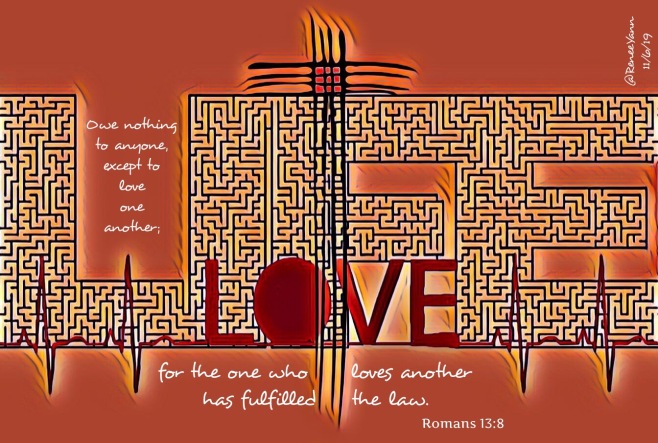
And that’s not easy! Life is a maze of relationships and situations that can get us very confused about what is most important. That’s why Jesus uses such strong language to remind us that there is only one way through the maze: to love as God loves. This is the heartbeat of our life in God!


Paul says this too, indicating how to negotiate the maze by keeping Love’s commandments.

Brothers and sisters:
Owe nothing to anyone, except to love one another;
for the one who loves another has fulfilled the law.

Romans 13:8

If we love with God’s love, of course we will love those we cherish. But we will love them selflessly, with an infinite generosity that always chooses their eternal good. And we will try always to love all Creatures in the same way. This is the kind of love Jesus taught us on the Cross. May God give us the courage to learn.


Poetry: Prayer of Mother Teresa and Brother Roger of Taize 

Oh God, the Creator of all,
you ask every one of us to spread
Love where the poor are humiliated,
Joy where the Church is brought low,
And reconciliation where people are divided. . . 
Father against son, mother against daughter,
Husband against wife,
Believers against those who cannot believe,
Christians against their unloved fellow Christians.

Music: Ubi Caritas performed by Stockholm University Choir (texts below)

Latin Text

Ubi caritas et amor, Deus ibi est.
Congregavit nos in unum Christi amor.
Exsultemus, et in ipso jucundemur.
Timeamus, et amemus Deum vivum.
Et ex corde diligamus nos sincero.
Ubi caritas et amor, Deus ibi est.
Simul ergo cum in unum congregamur:
Ne nos mente dividamur, caveamus.
Cessent iurgia maligna, cessent lites.
Et in medio nostri sit Christus Deus.
Ubi caritas et amor, Deus ibi est.
Simul quoque cum beatis videamus,
Glorianter vultum tuum, Christe Deus:
Gaudium quod est immensum, atque probum,
Saecula per infinita saeculorum. Amen.

English Translation
Where charity and love are, God is there.
Love of Christ has gathered us into one.
Let us rejoice in Him and be glad.
Let us fear, and let us love the living God.
And from a sincere heart let us love one.
Where charity and love are, God is there.
At the same time, therefore, are gathered into one:
Lest we be divided in mind, let us beware.
Let evil impulses stop, let controversy cease.
And in the midst of us be Christ our God.
Where charity and love are, God is there.
At the same time we see that with the saints also,
Thy face in glory, O Christ our God:
The joy that is immense and good,
Unto the World without end. Amen.

Catch the Word!

October 29, 2021
Friday of the Thirtieth Week in Ordinary Time

Today, in God’s Lavish Mercy, we pray with Psalm 147 which calls upon Israel to praise God for gifts received.

God has not done for others what has been done for you;
the Divine Way God has not made known to them. Alleluia.

Psalm 147: 20

The psalm gives us deeper insight into our reading from Romans. In Romans, chapters 9-11, Paul focuses on Israel’s quintessential place in the unfolding of salvation history.

In today’s passage, Paul laments the recalcitrance of some of his kin to open their hearts to the Gospel:

I have great sorrow and constant anguish in my heart. 
For I could wish that I myself were accursed and cut off from Christ
for the sake of my own people,
my kindred according to the flesh. 
They are children of Israel…

Romans 9: 2-3

Paul’s lament is not a condemnation. Rather he mourns the fact that his fellow Israelites, who are uniquely blessed by God, choose not to accept the new and transformative Gift offered them in the person of Jesus Christ.


The lesson for us when praying with this psalm and reading? Perhaps this:

God is always doing something new and wonderful in us and in Creation. God is always inviting us deeper into the relationship of love and mercy.

The path to that sacred depth is laid out for us in the Gospel where we learn to imitate Christ.


Sometimes we too are recalcitrant. We like things to be ordered and controlled, just like today’s Gospel Pharisees liked to control the Sabbath.

But the God of the Sabbath is not to be controlled by our fears, demands, or securities. That God will continue to challenge, invite, surprise, and love us into deeper relationship.

Our work is to stay open and responsive to this dynamic God Whose graces are “new every morning” – in fact, every moment…

Who sends forth the command to the earth;
Whose Word runs swiftly!

Psalm 147: 15

Poetry: He Comes Ever Again – Rowan Williams

He will come like last leaf’s fall.
One night when the November wind
has flayed the trees to bone, and earth
wakes choking on the mould,
the soft shroud’s folding.

He will come like frost.
One morning when the shrinking earth
opens on mist, to find itself
arrested in the net
of alien, sword-set beauty.

He will come like dark.
One evening when the bursting red
December sun draws up the sheet
and penny-masks its eye to yield
the star-snowed fields of sky.

He will come, will come,
will come like crying in the night,
like blood, like breaking,
as the earth writhes to toss him free.
He will come like child.

Music: Blue Dream – Fiona Jay Hawkins

Declare God’s Glory

October 28, 2021
Feast of Saints Simon and Jude, Apostles

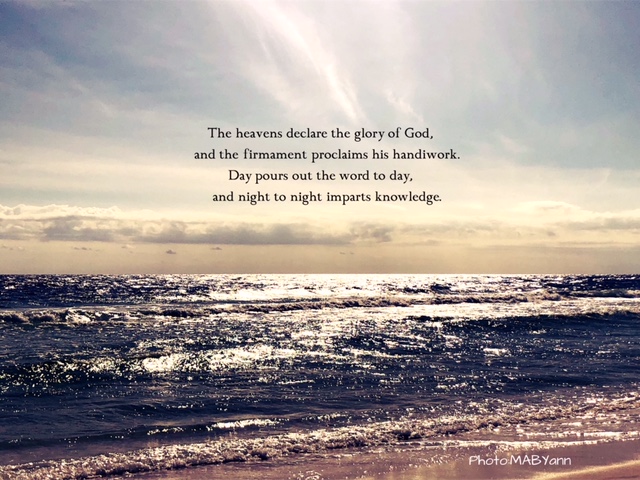
Photo by my talented Sister-in-Law

Today, in God’s Lavish Mercy, we pray with Psalm 19. Today’s beautiful verses alert us to the magnificence of the Heavens as a testament to God’s Glory:

The heavens declare the glory of God,
    and the firmament proclaims God’s handiwork.
Day pours out the word to day,
    and night to night imparts knowledge.

Psalm 19: 2-3

We might picture the psalmist, perhaps burdened, confused, or exhausted by the exigencies of daily life, walking outside under an October sky such as the ones we are given this time of year. The walk may have happened in a crystal blue Noon, or late under a black canopy sprayed with October’s meteor showers.

Photo by my talented Niece

Whatever the hour, that ancient psalmist’s heart is stilled in nature’s constant, silent yet resounding adoration of our Creator:

Not a word nor a discourse
    whose voice is not heard;
Through all the earth their voice resounds,
    and to the ends of the world, their message.

Psalm 19: 4-5

Psalm 19, after today’s introductory stanzas, compares nature’s elegant and eternal balance to the perfection of God’s Law…

The law of the LORD is perfect,
refreshing the soul.

Psalm 19:8

… Psalm 19
where the searching and cleansing sun
becomes an image of
the searching and cleansing Law.

C. S. Lewis: Reflections on the Psalms

On this Feast of Saints Simon and Jude, the Church uses Psalm 19 to describe the work of an Apostle. Like the heavens whose beauty and constancy declare God’s glory, the Apostle lives and preaches that Divine Elegance – that Law of Love perfected in Jesus Christ.

Paul, in our first reading from Ephesians, says that these Apostles lay the foundation for all of us to become – like Sacred Creation – “a dwelling place of God in the Spirit.”

Our Gospel recounts the calling of the first twelve of these “foundation builders”. But the call continues eternally. It comes to each of us.


Under the constant sun and other stars, that call to witness and declare God’s glory summons us to live a life that sings:

We praise you, O God,
we acclaim you as Lord;
with the glorious company of Apostles,
we praise you.

Today’s Alleluia Verse taken from the Te Deum

Poetry: Pied Beauty- Gerard Manley Hopkins

Glory be to God for dappled things – 
   For skies of couple-colour as a brinded cow; 
      For rose-moles all in stipple upon trout that swim; 
Fresh-firecoal chestnut-falls; finches’ wings;
 
   Landscape plotted and pieced – fold, fallow, and plough; 
      And áll trádes, their gear and tackle and trim. 
All things counter, original, spare, strange; 
   Whatever is fickle, freckled (who knows how?) 

      With swift, slow; sweet, sour; adazzle, dim; 
He fathers-forth whose beauty is past change: 
                                Praise him.

Music: Benedictus – Karl Jenkins

How Long, O Lord?!

October 27, 2021
Wednesday of the Thirtieth Week in Ordinary Time

Today, in God’s Lavish Mercy, we pray with Psalm 13, a powerful lesson in prayer.

The psalm is one of my favorites because it feels so “real”. The one who prays, presumably David, needs an answer to his prayer- and is not perceiving one. (emphasis on “perceiving”)

So the psalmist sounds a bit like someone desperately calling customer service to see why a life-saving order has not arrived😉:

How long, LORD? Will you utterly forget me?
How long will you hide your face from me?
..
Look, answer me, O LORD, my God!
Give light to my eyes that I may not sleep in death

Psalm 13: 2, 4

But as the psalmist continues to pray, an evolution of grace and understanding occurs. There is a realization that the kind of answer expected is one according to human measurement … one that will make the pray-er look triumphant in the eyes of his enemies:

Answer me, Lord my God …
Lest my enemy say, “I have prevailed,”
lest my foes rejoice at my downfall.

Psalm 13: 4-5

But the depth of our relationship with God is not determined by what our enemies think … or even our friends. That sacred relationship is rooted in our grateful recognition and trusting immersion in God’s ever-present mercy and love for us:

But I trust in your mercy.
Grant my heart joy in your salvation,
I will sing to the LORD,
Who has dealt bountifully with me!

Psalm 13: 6-7

God always answers us. We may not have the capacity to perceive the answer because it is not the one we expected or wished for. But the truth is that through whatever “answer” unfolds to our prayer, God is leading us deeper into God’s heart.

Can we trust that? Can we yield to it? That is the “salvation” the psalmist ultimately prays for:


Sometimes we might hear a person say that they don’t know how to get started talking with God in prayer. They seem to feel it’s kind of like a blind date where you end up realizing you have nothing in common with each other.

Paul – in our reading from Romans says – no, wait a minute. God is already within you simply by the nature of your creaturehood. You are made of the very stuff of God. In fact, the Spirit of God deep within our souls is like the fiery magma from a volcano. It erupts from our love and prays for us to the Creator – if we will only let it.


Poetry: Praying by Mary Oliver

It doesn’t have to be
the blue iris, it could be
weeds in a vacant lot, or a few
small stones; just
pay attention, then patch
a few words together and don’t try
to make them elaborate, this isn’t
a contest but the doorway
into thanks, and a silence in which
another voice may speak.

Music: Spirit Seeking Light and Beauty – by Janet Erskine Stuart, interpreted here by the Daughters of St. Paul (Lyrics below)

Spirit seeking light and beauty,
Heart still longing for your rest
In your search for understanding,
Only thus can you be blest,

Through the vastness of creation,
Though your restless thought may roam,
God is all that you can long for,
God is all creation’s home.

Taste and see God, feel and hear God,
Hope and grasp the unseen hand;
Though the darkness seem to hide you,
Faith and love can understand.

Loving Wisdom, guiding Spirit,
All our hearts are made anew.
Lead us through the land of shadows
‘Til we come to rest in you.

Our Tender God

October 25, 2021
Monday of the Thirtieth Week in Ordinary Time

Today, in God’s Lavish Mercy, we pray with Psalm 68 which pictures a triumphant God, rising like the sun over the darkness of evil.

Arise, O God, and let your enemies be scattered;
let those who hate you flee.
Let them vanish like smoke when the wind drives it away; 
as the wax melts at the fire,
so let the wicked perish at your presence.

Psalm 68: 1-3

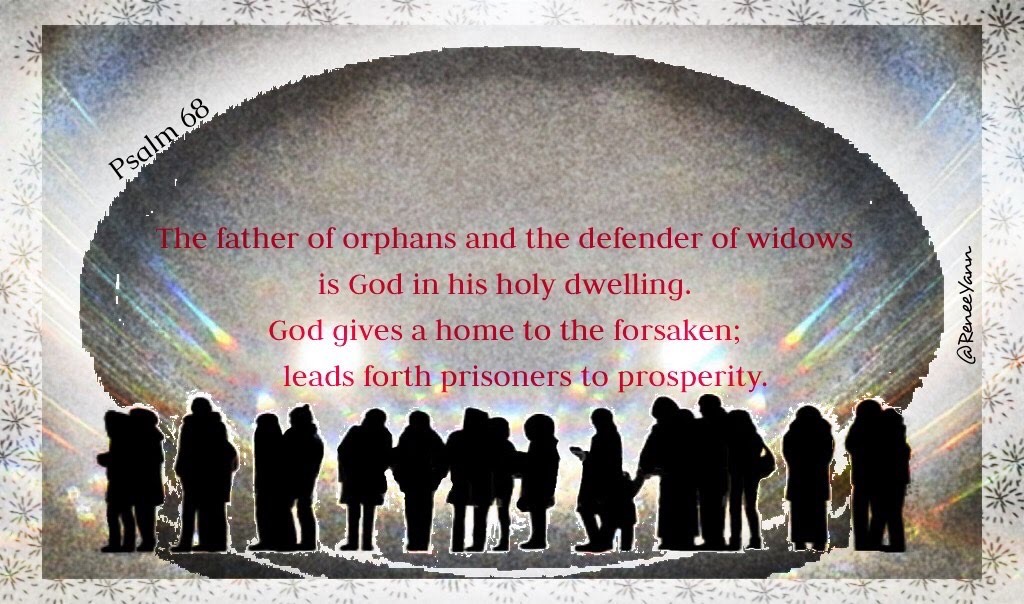
This psalm comforts us with a tender picture of God:

Protector of orphans, defender of widows,
the One who dwells in holiness,
who gives the solitary a home
and brings forth prisoners into freedom;
but the rebels shall live in dry places.

Psalm 68: 5-6

It is the same tenderness Paul presents in our first reading:

For those who are led by the Spirit of God are children of God.
For you did not receive a spirit of slavery to fall back into fear,
but you received a spirit of adoption,
through which we cry, “Abba, Father!”
The Spirit bears witness with our spirit
that we are children of God,
and if children, then heirs,
heirs of God and joint heirs with Christ…

if only we suffer with him
so that we may also be glorified with him.

And there we have the key line:
we are to live a life aligned with
the Passion, Death, and Resurrection of Christ.

And what will that kind of life look like? It will look like our merciful Jesus of today’s Gospel – who stepped out to see, comfort, and heal the suffering around him.

Jesus recognized the crippled woman as “an heir of God, and joint heir with him” to the fullness of life in God. We are called recognize ourselves and all of our sisters and brothers in the same way.


Poetry: WOMAN UN-BENT (LUKE 13:10–17) – by Irene Zimmerman, OSF

That Sabbath day as always
she went to the synagogue
and took the place assigned her
right behind the grill where,
the elders had concurred,
she would block no one’s view,
she could lean her heavy head,
and (though this was not said)
she’d give a good example to
the ones who stood behind her. 

That day, intent as always
on the Word (for eighteen years
she’d listened thus), she heard
Authority when Jesus spoke. 

Though long stripped
of forwardness,
she came forward, nonetheless,
when Jesus summoned her.
“Woman, you are free
of your infirmity,” he said. 

The leader of the synagogue
worked himself into a sweat
as he tried to bend the Sabbath
and the woman back in place. 

But she stood up straight and let
God’s glory touch her face.

Video: Jesus Heals the Bent-over Woman

If you’d still like a little music, this one seems to fit: Spirit Touch by Joseph Akins

Don’t Pass Me By

October 24, 2021
Thirtieth Sunday in Ordinary Time

Today, in God’s Lavish Mercy, we pray with Psalm 126, a song of irrepressible joy at Divine Deliverance:

When the LORD brought back the captives of Zion,
    we were like men dreaming.
Then our mouth was filled with laughter,
    and our tongue with rejoicing.

Then they said among the nations,
    “The LORD has done great things for them.”
The LORD has done great things for us;
    we are glad indeed.

Psalm 126: 1-3

The psalm captures for us
a community which
recognizes, beseeches,
and thanks God for its deliverance.

Our Gospel presents us with a story of someone who is delivered – the blind man, Bartimeus. He is an otherwise unknown character in scripture. Yet this short passage suggests so much about him.

It is stated that he was the son of Timeus, apparently someone of note in the community – otherwise, why mention his name? And yet this notable man’s blind son is left to begging on the side of the road. Had disability driven father and son apart? Was Dad unable to accept a son with a physical challenge?

The passage also reveals that Bartimeus knew about Jesus. Perhaps while begging in the public square, he talked and listened. He daydreamed about what he planned to do if he should ever have a chance to meet Jesus!

His cronies in the marketplace were not very supportive. They told him to shut up, even as he pathetically cried for Jesus’s mercy. Still, Bartimues persisted and Jesus heard him.

When he comes to Jesus, Jesus asks, “What do you want me to do for you?” It has always struck me as a strange question. The man is obviously blind, stumbling through the crowd on some disciple’s arm. Why did Jesus bother to ask what Bartimeus wanted?


This might be the lesson hidden in this Gospel. We need to name and claim our needs before God can reach through and transform them. If we don’t even know we’re “blind”, how can we know we’re cured? If we don’t present our needs to God, how can we believe that it is God Who has healed us?

The freshly cured Bartimeus, eyes wide open in grace, now follows along the path with Jesus. All the “shut-uppers” are silenced. Perhaps, Timeus weeps off in a doorway to see the power of his son’s faith and Jesus’s love.

How might our lives be changed if we had that kind of faith… that kind of love?


Poetry: Blind Bartimeus – Henry Wadsworth Longfellow

Blind Bartimeus at the gates
Of Jericho in darkness waits;
He hears the crowd;--he hears a breath
Say, "It is Christ of Nazareth!"
And calls, in tones of agony,
Ἰησοῦ ἐλέησόν με! (Have mercy on me!)

The thronging multitudes increase;
Blind Bartimeus, hold thy peace!
But still, above the noisy crowd,
The beggar's cry is shrill and loud;
Until they say, "He calleth thee!"
Θάρσει ἔγειρε φωνεῖ σε! (Jesus is calling you)

Then saith the Christ, as silent stands
The crowd, "What wilt thou at my hands?"
And he replies, "Oh, give me light!
Rabbi, restore the blind man's sight."
And Jesus answers, "ὕπαγε
πίστις σου σέσωκέν σε!" (Your faith has saved you)

Ye that have eyes, yet cannot see,
In darkness and in misery,
Recall those mighty Voices Three,
Ἰησοῦ ἐλέησόν με! (Have mercy on me.)
Θάρσει ἔγειρε φωνεῖ σε! (Jesus is calling you.)
ἡ πίστις σου σέσωκέν σε! (Your faith has saved you.)

Music: Don’t Pass Me By – Fred Hammond (lyrics below)

There was a blind man on the road side, and he heard a commotion
It was Jesus passing by with a crowd and it stirred his emotions
He’d been displaced his whole life, should he even try

Don’t bother Jesus (they say you have nothing)
You have nothing to offer (stay in your place)
Right then he knew(he had to choose)
He had nothing to lose

So he cried Jesus (Jesus), I need you,  please don’t pass me by
He cried out Jesus, I’m not ashamed(to tell you) I need you in my life
(I need you in my life)

I’m not much different from that man, and this is the honest truth
Could this sinful one, with this messed up life, could I ever serve you
people and things clutter my mind, should I even try

Don’t bother Jesus (they say you have nothing)
You have nothing to offer (stay in your place)
Right then he knew (he had to choose)
He had nothing to lose

So I cry Jesus(Jesus), I need you
Please don’t pass me by
I’m crying out Jesus, I’m not ashamed to tell you I need you in my life

As the deer (as the deer panted)
Thirsty for the water yeah(thirsty for the water)
My soul desires and longs to be(to be with you)

Jesus, I need you, please don’t pass me by
I don’t mean to waste your time but I can’t listen to the crowd,
Situations in my life telling me to keep it down
But I need you

I know I’m broken, but you can heal me, Jesus, Jesus I’m calling you
(I might not be worth much)might not be worth much, but I’m still willing
Jesus, Jesus, I’m calling you

Zap?

October 23, 2021
Saturday of the Twenty-ninth Week in Ordinary Time

Today, in God’s Lavish Mercy, we pray with Psalm 24 in which the psalmist expresses the heart’s deep longing for God:

Who can ascend the mountain of the LORD?
    or who may stand in that holy place?
The one whose hands are sinless, whose heart is clean,
    who desires not what is vain.
Who shall receive a blessing from the LORD,
    a reward from God the savior.
Such is the race that seeks for God,
    that seeks the face of the God of Jacob.

Psalm 24: 5-6

But achieving those sinless hands and clean heart is not always an easy task. It takes a life focused on faith and rooted in love.

Jesus talks about that focus in today’s Gospel.

Jesus gives us a parable which, at first, appears to say, “Get your act together fast, or God might zap you.” From Jesus’s words, we can assume that some public disasters have recently occurred. Those in the gathered crowd are unnerved by these events.

Jesus uses that nervousness to talk about repentance. He tells the people that tragedy can make us wake up to the fact that life is fragile and fleeting. That awareness should make us want to use our time on earth well, to give glory to God.

The repentance Jesus encourages is not just a contrition, or turning from sin. It is an opening of the soul’s eyes to see our lives and circumstances as God sees them.

Is God going to zap us if we don’t have that kind of repentance? No, I think not.

God is always Mercy …
always, always Mercy.

With the parable of the fruitless fig tree, Jesus assures us that God is with us, giving us every grace and opportunity to bear spiritual fruit. God is patient and nurturing. But, in every human life, there is a limit to the time we have to respond.


Poetry: The Facts of Life – Pádraig Ó Tuama

That you were born
and you will die.

That you will sometimes love enough
and sometimes not.

That you will lie
if only to yourself.

That you will get tired.

That you will learn most from the situations
you did not choose.

That there will be some things that move you
more than you can say.

That you will live
that you must be loved.

That you will avoid questions most urgently in need of
your attention.

That you began as the fusion of a sperm and an egg
of two people who once were strangers
and may well still be.

That life isn’t fair.
That life is sometimes good
and sometimes better than good.

That life is often not so good.

That life is real
and if you can survive it, well,
survive it well
with love
and art
and meaning given
where meaning’s scarce.

That you will learn to live with regret.
That you will learn to live with respect.

That the structures that constrict you
may not be permanently constricting.

That you will probably be okay.

That you must accept change
before you die
but you will die anyway.

So you might as well live
and you might as well love.
You might as well love.


Music: Calm the Soul – Poor Clares Galway

Winds of Change

Friday of the Twenty-ninth Week in Ordinary Time

October 22, 2021

Today, in God’s Lavish Mercy, we pray with Psalm 119, the longest and very familiar psalm which pleads for God to mercifully teach us:

  • Wisdom
  • Knowledge
  • Goodness 
  • Generosity
  • Kindness
  • Compassion

In our readings, Paul asserts that without God’s Grace we can never attain these gifts. Jesus calls us to use these gifts and to practice a holy life by recognizing and responding justly to the challenges of our times.


Paul sounds a lot like someone approaching the microphone at “Sinners Anonymous”:

I know that good does not dwell in me, that is, in my flesh.
The willing is ready at hand, but doing the good is not.
For I do not do the good I want,
but I do the evil I do not want.

Romans 7:18-20

Paul basically attests to the fact that for human beings, even him, will and actions often don’t synch up. Sure, we want to be good people, but as Nike says, do we …

Paul’s says no. The only way we do the good we will to do is by the grace of Jesus Christ.


In our Gospel, Jesus affirms the slowness of the human spirit to act on the realities around us. In some translations, Jesus uses a phrase which caught on with the architects of Vatican II: the signs of the times.

Jesus tells his listeners and us that we need to be alert to the circumstances of our world. It both weeps and rejoices. Where it weeps, we must be a source of mercy and healing. Where it rejoices, we must foster and celebrate the Presence of the Spirit.


In the Vatican II document Gaudium et Spes (The Church in the Modern World), we read:

In every age, the church carries the responsibility
of reading the signs of the times
and of interpreting them in the light of the Gospel, if it is to carry out its task.
In language intelligible to every generation, it should be able to answer
the ever recurring questions which people ask
about the meaning of this present life and of the life to come,
and how one is related to the other.
We must be aware of and understand the aspirations, the yearnings,
and the often dramatic features of the world in which we live.

Although written in the 1960s, these powerful words hold true today. We are the Church of which the document speaks. We are the ones whom Jesus calls to respond with authentic justice and mercy to the signs of the times. 

Read the newspaper in that light today. Watch the news in that light. Meet your brothers and sisters in that light today.


Poetry: Ode to the West Wind by Percy Bysshe Shelley

Perhaps more than anything else, Shelley wanted his message of reform and revolution spread, and the wind becomes the symbol for spreading the word of change through the poet-prophet figure. Some also believe that the poem was written in response to the loss of his son William in 1819 (born to Mary Shelley – author of “Frankenstein”). The ensuing pain influenced Shelley. The poem allegorizes the role of the poet as the voice of change and revolution. (Wikipedia)

O wild West Wind, thou breath of Autumn’s being, 
Thou, from whose unseen presence the leaves dead 
Are driven, like ghosts from an enchanter fleeing, 
Yellow, and black, and pale, and hectic red, 
Pestilence-stricken multitudes: O thou, 
Who chariotest to their dark wintry bed 
The winged seeds, where they lie cold and low, 
Each like a corpse within its grave, until 
Thine azure sister of the Spring shall blow 
Her clarion o’er the dreaming earth, and fill 
(Driving sweet buds like flocks to feed in air) 
With living hues and odours plain and hill: 
Wild Spirit, which art moving everywhere; 
Destroyer and preserver; hear, oh hear! 

II 

Thou on whose stream, mid the steep sky’s commotion, 
Loose clouds like earth’s decaying leaves are shed, 
Shook from the tangled boughs of Heaven and Ocean, 
Angels of rain and lightning: there are spread 
On the blue surface of thine aëry surge, 
Like the bright hair uplifted from the head 
Of some fierce Maenad, even from the dim verge 
Of the horizon to the zenith’s height, 
The locks of the approaching storm. Thou dirge 
Of the dying year, to which this closing night 
Will be the dome of a vast sepulchre, 
Vaulted with all thy congregated might 
Of vapours, from whose solid atmosphere 
Black rain, and fire, and hail will burst: oh hear! 

III 

Thou who didst waken from his summer dreams 
The blue Mediterranean, where he lay, 
Lull’d by the coil of his crystalline streams, 
Beside a pumice isle in Baiae’s bay, 
And saw in sleep old palaces and towers 
Quivering within the wave’s intenser day, 
All overgrown with azure moss and flowers 
So sweet, the sense faints picturing them! Thou 
For whose path the Atlantic’s level powers 
Cleave themselves into chasms, while far below 
The sea-blooms and the oozy woods which wear 
The sapless foliage of the ocean, know 
Thy voice, and suddenly grow gray with fear, 
And tremble and despoil themselves: oh hear! 

IV 

If I were a dead leaf thou mightest bear; 
If I were a swift cloud to fly with thee; 
A wave to pant beneath thy power, and share 
The impulse of thy strength, only less free 
Than thou, O uncontrollable! If even 
I were as in my boyhood, and could be 
The comrade of thy wanderings over Heaven, 
As then, when to outstrip thy skiey speed 
Scarce seem’d a vision; I would ne’er have striven 
As thus with thee in prayer in my sore need. 
Oh, lift me as a wave, a leaf, a cloud! 
I fall upon the thorns of life! I bleed! 
A heavy weight of hours has chain’d and bow’d 
One too like thee: tameless, and swift, and proud. 

Make me thy lyre, even as the forest is: 
What if my leaves are falling like its own! 
The tumult of thy mighty harmonies 
Will take from both a deep, autumnal tone, 
Sweet though in sadness. Be thou, Spirit fierce, 
My spirit! Be thou me, impetuous one! 
Drive my dead thoughts over the universe 
Like wither’d leaves to quicken a new birth! 
And, by the incantation of this verse, 
Scatter, as from an unextinguish’d hearth 
Ashes and sparks, my words among mankind! 
Be through my lips to unawaken’d earth 
The trumpet of a prophecy! O Wind, 
If Winter comes, can Spring be far behind?


Music: The Times They Are A’changin’ – Bob Dylan 

Dylan’s songs in the 50s and 60s became anthems for the Civil Rights and anti-war movements. His lyrics during this period incorporated a wide range of political, social, philosophical, and literary influences, defied popular music conventions and appealed to the burgeoning counterculture. (Wikipedia) 
Ah, it was a good time to be young! (me)

The Swedish Academy awarded Dylan the 2016 Nobel Prize in Literature “for having created new poetic expressions within the great American song tradition.”