Today, in God’s Lavish Mercy, our readings are filled with God’s glory and blessings.
The magnificent passage from Ephesians is considered an example of the great Pauline Hymns. These are places in Paul’s writing where he breaks into lyrical songs of praise and thanksgiving, so overwhelmed is he by the goodness of God.
Have you ever felt like that – just so grateful to God for the blessings of your life? So blessed to wake up in the morning, with the capacity to believe, to hope, and to love!
A practice I learned many years ago has helped me focus on this kind of prayerful gratitude. As soon as I realize I am awake in the morning (and sometimes that takes a while) I say this simple prayer:
Thank you, God, for my life.
On a special morning, I might pause and expand that prayer quite a bit. (And, come on now, isn’t every morning special just for the fact that you woke up!)
But every day, even dull and rainy ones, I start with at least that brief phrase.
Poetry: Savor Paul’s eloquence in his hymn of praise today. Let your heart recognize God’s goodness and sing even a silent, personal Thank You.
Blessed be the God and Father of our Lord Jesus Christ, who has blessed us in Christ with every spiritual blessing in the heavens.
Ephesians 1:3
Music: Ephesians Hymn ~ Suzanne Toolan, RSM, who is Sister of Mercy at Mercy Center in Burlingame, CA. She has mentored many people in centering prayer in retreats and in prisons. She is prolific composer of liturgical music, including the iconic hymn, “I Am the Bread of Life”.
Today, in God’s Lavish Mercy, we pray with Psalm 37 which is widely interpreted as:
“a response to the problem of evil, which the Old Testament often expresses as a question: why do the wicked prosper and the good suffer?”
Wikipedia
It’s a question all of us struggle with, isn’t it? And wouldn’t we manage things a lot differently if we were in charge of the world?
Psalm 37 opens with this advice to help us deal with our consternation:
Do not be provoked by evildoers; do not envy those who do wrong.
Like grass they wither quickly; like green plants they wilt away.
Psalm 37: 1-2
The psalmist continues to demonstrate that even though evil doers seem to prosper, their prosperity is short-lived. Only goodness endures and ultimately thrives.
Psalm 37 sounds very much like a parent teaching a child not to be distressed by the apparent success of the selfish and scheming. God is not fooled by evildoers so neither should we be.
The wicked plot against the righteous and gnash their teeth at them;
But my Lord laughs at them, seeing that their day is coming.
Psalm 37: 12-13
The advice is easily spoken but perhaps not so easily practiced. So the psalmist offers some tips on how to live a spiritually fruitful life:
Trust in the LORD and do good.
Find your delight in the LORD.
Commit your way to the Lord.
Be still before the LORD.
Refrain from anger; abandon wrath;
Do not be provoked; it brings only harm.
Wait a little, and the wicked will be no more.
Turn from evil and do good, that you may be settled forever.
Wait eagerly for the LORD, and keep the Lord’s way;
The psalm indicates the result of such goodness, conditions that sound very much like the Beatitudes:
You will be raised up to inherit the earth.
Yes, the poor will inherit the earth, will delight in great prosperity.
Better the meagerness of the righteous one than the plenty of the wicked.
The LORD will sustain the righteous.
The LORD knows the days of the blameless; their heritage lasts forever.
They will not be ashamed when times are bad; in days of famine they will be satisfied.
For those blessed by the Lord will inherit the earth, but those accursed will be cut off.
It’s hard to live a life like the one this psalm invites us to. (At least, I think it is!) It’s hard to have that much faith, especially when evil is smacking us right in the face. The psalmist acknowledges this difficulty but does so with a beautiful assurance:
The valiant one whose steps are guided by the LORD, who will delight in God’s way, may stumble, but will never fall, for the Lord holds their hand.
Poetry: Give Me Your Hand – Rainer Maria Rilke
God speaks to each of us as we are made,
then walks with us silently out of the night.
These are the words we dimly hear:
You, sent out beyond your recall,
go to the limits of your longing.
Embody me.
Flare up like a flame
and make big shadows I can move in.
Let everything happen to you:
beauty and horror.
Just keep going.
No feeling is final.
Don't let yourself lose me.
Nearby is the country they call life.
You will know it by its seriousness.
Give me your hand.
Music: Hold to God’s Unchanging Hand – Alfred Street Baptist Church
Today, in God’s Lavish Mercy, we pray with Psalm 33 in which the psalmist is clearly awestruck by both the power and the mercy of God. It is a prayer of radical awareness that God is Creator and we are creature.
According to Walter Brueggemann, Psalm 33 describes Yahweh as the settled sovereign, securely in control, who need only speak to have the command fulfilled.
The psalm has two divisions. In part one, the community is called to praise God because God deserves it.
Rejoice, you righteous, in the LORD; praise from the upright is fitting.
Give thanks to the LORD on the harp; on the ten-stringed lyre offer praise.
Sing to God a new song; skillfully play with joyful chant.
For the LORD’s word is upright; and works are trustworthy.
Psalm 33: 1-4
In part two, that praise is articulated by recounting God’s caring intervention in the community’s experience.
From heaven the LORD looks down and observes the children of Adam,
From that dwelling place surveying all who dwell on earth.
The One who fashioned together their hearts and who knows all their works.
Psalm 33: 13-15
Psalm 33 can be summarized in this way:
Because Yahweh rules with righteousness, justice, and unfailing love, we must worship Yahweh with songs and praise and by rejecting all false sources of salvation.
Lynn Jost, Professor of Biblical and Religious Studies – Tabor College, Kansas
Praying Psalm 33 reminds me that one can never demand mercy. We cannot require the other to hold us in continual compassion. We can only hope and be grateful.
Mercy is the gift of a heart moved beyond itself by love and tenderness. Such outpouring is the very nature of God in whose image we are created.
Thus for God, and for us, to be unmerciful is to be unnatural. In Psalm 33, we pray not only to receive mercy, but to become mercy.
Psalm 33 closes with a plea for our hearts to be deepened in their affinity to God, to mirror God by our patience, joy, hope, and mercy.
Our soul waits for the LORD, Who is our help and shield.
For in God our hearts rejoice; in God’s holy name we trust.
May your mercy, LORD, be upon us; as we put our hope in you.
Psalm 33: 20-22
Poetry: To Live in the Mercy of God BY DENISE LEVERTOV
To lie back under the tallest
oldest trees. How far the stems
rise, rise
               before ribs of shelter
                                           open!
To live in the mercy of God. The complete
sentence too adequate, has no give.
Awe, not comfort. Stone, elbows of
stony wood beneath lenient
moss bed.
And awe suddenly
passing beyond itself. Becomes
a form of comfort.
                      Becomes the steady
air you glide on, arms
stretched like the wings of flying foxes.
To hear the multiple silence
of trees, the rainy
forest depths of their listening.
To float, upheld,
                as salt water
                would hold you,
                                        once you dared.
                  .
To live in the mercy of God.
To feel vibrate the enraptured
waterfall flinging itself
unabating down and down
                              to clenched fists of rock.
Swiftness of plunge,
hour after year after century,
                                                   O or Ah
uninterrupted, voice
many-stranded.
                              To breathe
spray. The smoke of it.
                              Arcs
of steelwhite foam, glissades
of fugitive jade barely perceptible. Such passion—
rage or joy?
                              Thus, not mild, not temperate,
God’s love for the world. Vast
flood of mercy
                      flung on resistance.
Music: As you listen to David Arkenstone’s instrumental, you may want to remember Shakespeare’s famous description of mercy. See below the music.
Today, in God’s Lavish Mercy, we pray with Psalm 123.
… eyes fixed on the Lord, pleading for mercy.
Psalm 123:2
This starkly passionate response, repeated throughout the psalm, struck an image in my imagination – an ardent tango with the Beloved, eyes fixed in hope.
Often in my prayer I just dance or sing with God – sometimes with sound and movement, sometimes in still silence. The dances are varied depending on the prayer and the day’s circumstances.
Today’s readings, filled with Israel’s resistance, Paul’s thorn, and Nazarene recalcitrance drew an energetic tango in my mind.
It is a dance between Mercy and Resistance. In my prayer, I searched for where that dance resides in me.
Today, in God’s Lavish Mercy, we pray with Psalm 106 which is a prayerful inventory of Israel’s long story with God. In today’s liturgy, the psalm follows a similar Genesis recounting of the story of the Abraham-Sarah family.
These two readings remind me of my own family as we have gathered, in our many configurations, over the seven decades of my life. For many early years, I was the listener to the old tales and legends. Gradually, as new generations were born, I became a guardian and teller of our history.
Psalmist 106 is a teller of Israel’s many ups and downs to the place where they now find themselves. By remembering both the darkness and light, the calms and the storms, our psalm testifies to God’s faithful and enduring mercy.
Blessed are they who observe what is right, who do always what is just. Remember us, O LORD, as you favor your people.
That testimony encourages the listeners that this faithful God can be trusted now and in the future – to abide, forgive, renew, and call believers.
It holds out for us a heritage of fidelity promising to bless the generations with whom we share it.
If you sat down with your life at the table of holy memory, what would your stories be? What storms and rainbows mark your journey? How would your psalm of memory and gratitude read? How is your faith life transmitting this heritage to the next generations?
Visit me with your saving help, That I may see the prosperity of your chosen ones, rejoice in the joy of your people, and glory with your inheritance.
Poetry: Naked Truth – A Jewish tale retold as a poem by Heather Forest
Naked Truth walked down the street one day.
People turned their eyes away.
Parable arrived, draped in decoration.
People greeted Parable with celebration.

Naked Truth sat alone, sad and unattired,
“Why are you so miserable?” Parable inquired.
Naked Truth replied, “I’m not welcome anymore.
No one wants to see me. They chase me from the door.”

“It is hard to look at Naked Truth,”Parable explained.
“Let me dress you up a bit. Your welcome will be gained.”
Parable dressed Naked Truth in story’s fine attire,
with metaphor, poignant prose, and plots to inspire.

With laughter and tears and adventure to unveil,
Together they went forth to spin a tale.
People opened their doors and served them their best.
Naked Truth dressed in story was a welcome guest.
Music: Heritage of Faith – Babbie Mason (lyrics below)
The patriarchs of old
The saints that now are gone
To their great reward
Held fast to the struggle
Persistent through the years
Forging through their fears
They fought to change their world
For the sake of the gospel

May their love for Jesus
Never go unnoticed
May they spur us on to all
That lies before us
This heritage of faith
This legacy of love
We must pass to our daughters
Hand down to our sons
We must raise the standard high
And proclaim the name of Christ
That others may know the way
And this heritage of faith

In my heart I hear the call
That echoes from the cross
Where the sacrifice for man
Was freely rendered
It's the call to stand for right
Keep the faith and fight the fight
Today, in God’s Lavish Mercy, we pray with Psalm 115, bringing a welcome comfort after the always disturbing story of Isaac’s aborted sacrifice.
This story fascinated Rembrandt. Notice the differences between the 1635 and 1655 interpretations. The old man in the 1655 image has darkened eyes, covers his son’s eyes – not his mouth, and embraces the boy in his lap not laid out on an altar. Old age has gentled what Rembrandt found in the story.
On the left, 1635. On the right, 1655
But here’s what I think. It was never about a human sacrifice. God was never going to let that happen.
It was about whether Abraham’s trust would allow him to really see God – God who is never a God of death, but always of life.
As Abraham looked about, he spied a ram caught by its horns in the thicket. So he went and took the ram and offered it up as a burnt offering in place of his son. Abraham named the site Yahweh-yireh; hence people now say, “On the mountain the LORD will see.”
We live in a world full of choices that run the gamut from death-dealing to life-giving. They may be small, personal choices like what we eat, or how we drive. Or they may be more consequential choices such as the political views we foster or the global ideologies we embrace.
Psalm 115 helps us to solve any confusion we might have about our choices. Always make the choices that lead ourselves and others to the land of the living.
Abraham must have been thrown into the dark by what he believed was God’s expectation of him. But it was really Abraham’s own expectation that had to be broken through. He did this by staying with his pain while trusting that God was bigger than it.
Christine Robinson’s interpretation of Psalm 115 fits well here:
O Great Mystery
   We must love and praise you without understanding.
You are not a little tin god
   with eyes that do not see and ears that do not hear
   and a mouth that does not speak.
You can not be described or boxed up or tamed
   You are beyond our understanding.
Still, we yearn to hear you, know you,
   feel your love, and in mystery, we do.
We know awe at the intricate majesty of the heavens,
We cherish the work of caring for each other
and the Earth.
We praise you, Great Mystery
   all the days of our lives.
Poetry: Silence – Rabbi Rachel Barenblat
Abraham failed the test.
For Sodom and Gomorrah he argued
but when it came to his son
no protest crossed his lips.
God was mute with horror.
Abraham, smasher of idols
and digger of wells
was meant to talk back.
Sarah would have been wiser
but Abraham avoided her tent,
didn’t lay his head in her lap
to unburden his secret heart.
In stricken silence God watched
as Abraham saddled his ass
and took Isaac on their final hike
to the place God would show him.
The angel had to call him twice.
Abraham’s eyes were red, his voice hoarse
he wept like a man pardoned
but God never spoke to him again.
(It is true that, in Genesis, this is the last recorded exchange between God and Abraham!)
Music: Story of Isaac – Leonard Cohen
(If there’s no picture below, just click on the underlined phrase “Watch on Youtube“
The door, it opened slowly
My father, he came in
I was nine years old
And he stood so tall above me
Blue eyes, they were shining
And his voice was very cold
Said, "I've had a vision
And you know I'm strong and holy
I must do what I've been told"
So we started up the mountain
I was running, he was walking
And his axe was made of gold

Well, the trees, they got much smaller
The lake, a lady's mirror
When we stopped to drink some wine
Then he threw the bottle over
Broke a minute later
And he put his hand on mine
Thought I saw an eagle
But it might have been a vulture
I never could decide
Then my father built an altar
He looked once behind his shoulder
He knew I would not hide

You who build these altars now
To sacrifice these children
You must not do it anymore
A scheme is not a vision
And you never have been tempted
By a demon or a god
You, who stand above them now
Your hatchets blunt and bloody
You were not there before
When I lay upon a mountain
And my father's hand was trembling
With the beauty of the word

And if you call me brother now
Forgive me if I inquire
Just according to whose plan?
When it all comes down to dust
I will kill you if I must
I will help you if I can
When it all comes down to dust
I will help you if I must
I will kill you if I can
And mercy on our uniform
Man of peace or man of war
The peacock spreads his fan
Today, in God’s Lavish Mercy, we pray with Psalm 34. We do so in the light of our first reading which tells us the heart-wrenching story of Hagar.
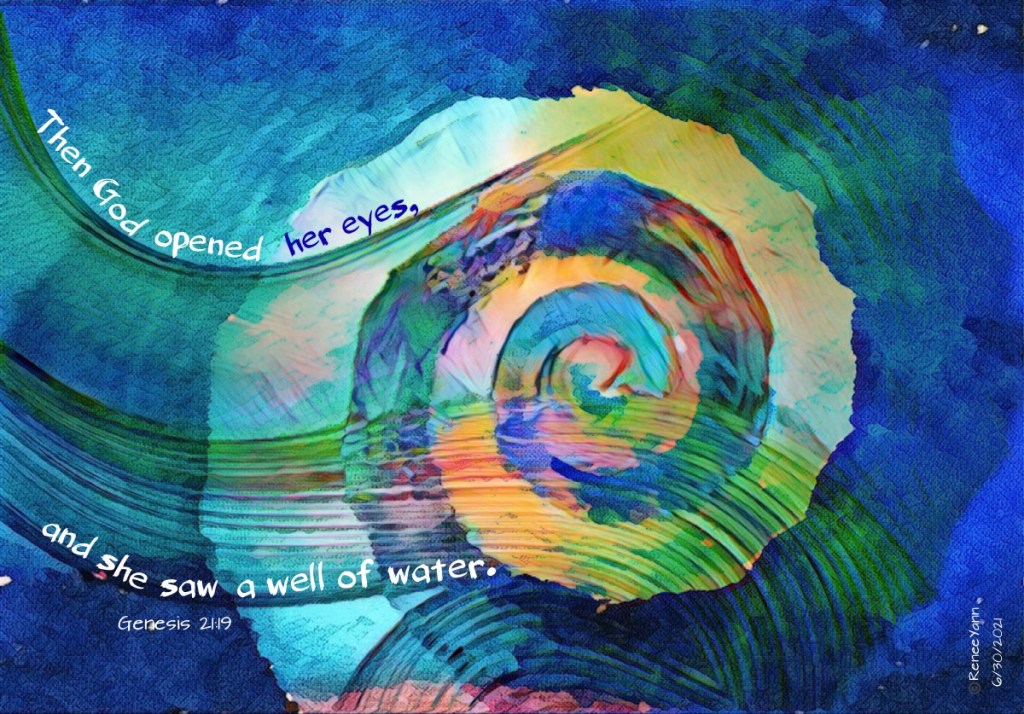
As Hagar sat opposite Ishmael, he began to cry. God heard the boy’s cry, and God’s messenger called to Hagar from heaven: “What is the matter, Hagar? Don’t be afraid; God has heard the boy’s cry in this plight of his. Arise, lift up the boy and hold him by the hand; for I will make of him a great nation.” Then God opened her eyes, and she saw a well of water. She went and filled the skin with water, and then let the boy drink.
Genesis 21: 15-19
Surely Hagar, and her baby Ishmael, are “poor ones” whose cries the Lord hears.
When the poor ones called out, the LORD heard, and from all distress saved them. The angel of the LORD encamps around those who fear God, and delivers them.
Psalm 34: 7-8
Hagar is the embodiment of a faith that has surrendered everything to God. She is pressed to it by the circumstances of her life. But even in that press, she has a choice: God or godlessness.
God sees her heart choice and opens her eyes to its power:
Then God opened her eyes, and she saw a well of water. She went and filled the skin with water, and then let the boy drink.
The revelation I take from today’s readings?
Even in our deepest thirsts, there is a “well of water” awaiting us when we live in faith and reverence for God:
Fear the LORD, you holy ones, for nought is lacking to those who fear God. The great grow poor and hungry; but those who seek God want for no good thing.
Psalm 34: 10-11
Poetry: Hagar in the Wilderness by Tyehimba Jess
My God is the living God,
God of the impertinent exile.
An outcast who carved me
into an outcast carved
by sheer and stony will
to wander the desert
in search of deliverance
the way a mother hunts
for her wayward child.
God of each eye fixed to heaven,
God of the fallen water jug,
of all the hope a vessel holds
before spilling to barren sand.
God of flesh hewn from earth
and hammered beneath a will
immaculate with the power
to bear life from the lifeless
like a well in a wasteland.
I'm made in the image of a God
that knows flight but stays me
rock still to tell a story ancient as
slavery, old as the first time
hands clasped together for mercy
and parted to find only their own
salty blessing of sweat.
I have been touched by my God
in my creation, I've known her caress
of anointing callus across my face.
I know the lyric of her pulse
across these lips...  and yes,
I've kissed the fingertips
of my dark and mortal God.
She has shown me the truth
behind each chiseled blow
that's carved me into this life,
the weight any woman might bear
to stretch her mouth toward her
one true God, her own
beaten, marble song.
sculptor: Edmonia Lewis (1845-1907), an African/Native American expatriate who was phenomenally successful in Rome.
Today, in God’s Lavish Mercy, we pray once again with Mary’s exquisite prayer, the Magnificat. This prayer is so rich that we can pray it in many ways. Today’s other readings suggest to me to pray it as a prayer of spirited possibility.
For you, my God, have done great things for me, and Holy is your Name. Your Mercy is from age to age for those wrapped in awe of you.
In our first reading, Abraham and Sarah are the prototypes of such holy awe. Recognizing something godly in his visitors, Abraham welcomes them extravagantly.
Sarah is so struck by their predictions that she turns giddy.
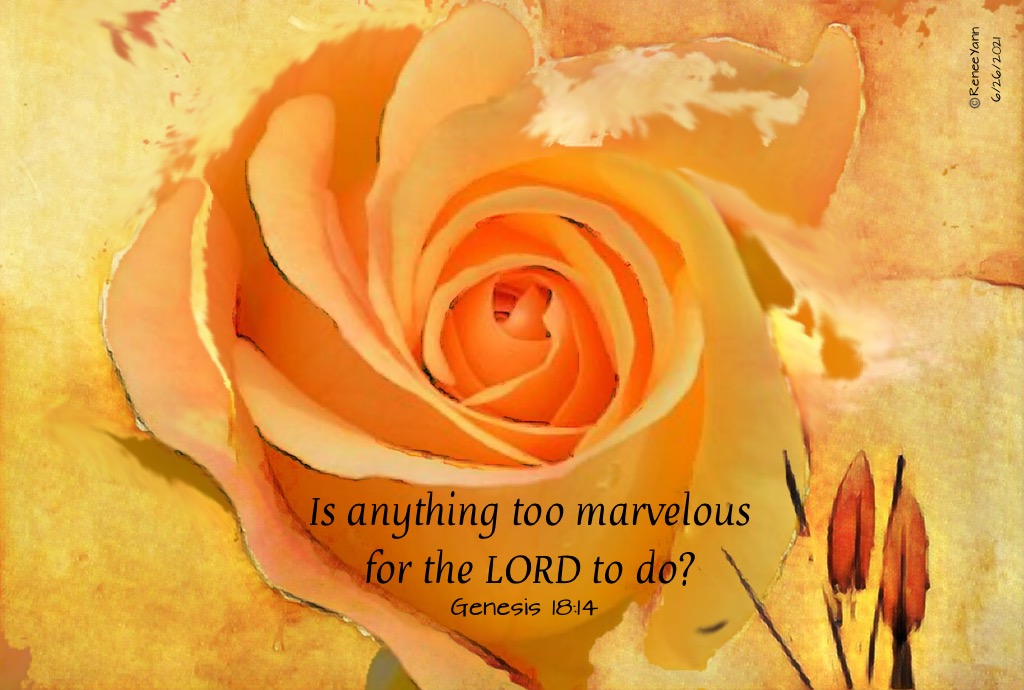
Sometimes when we are overawed by our circumstances, we dissemble rather than quiet ourselves in reverence. God calls Abraham and Sarah to be still within the holy moment by asking the divine rhetorical question:
In our Gospel, the centurion has his own holy moment. Already committed in faith, he hopes for more from Jesus because of his need. With profound trust and humility, the centurion invites God’s Word to act completely and spontaneously in his life.
We may not have visible angels visiting our homes today, like Abraham and Sarah did.
We may not find Jesus walking into our local town like the centurion did.
Still, by faith, we trust that the Holy is present in every moment of our lives.
With Abraham and Sarah, may we open the tent of our lives to heavenly intervention.
With Mary, let us ask God to release the miracle of sacred possibility over our lives and over our world.
Your mercy reaches from age to age for those in awe of you. You have shown strength with your arm; you have scattered the proud in their conceit; you have deposed the mighty from their thrones and raised the lowly to high places. You have filled the hungry with good things, while you have sent the rich away empty. You have come to the aid of Israel your servant, mindful of your mercy― the promise you made to our ancestors― to Sarah and Abraham and their decendants forever.
Poem: SARAH’S LAUGHTER (GENESIS 18:1–15) by Irene Zimmerman, OSF
When Abraham had hurried back
to the three Strangers with bread
and meat, milk and curds,
Sarah, obediently hiding her faded
beauty behind the tent flaps,
watched them feasting beneath the oak.

From there the Strangers’ words
came winging to where she stood—
in shocked disbelief at first,
having grown old and used to
the sterile disfavor of Abraham’s God,
then exploding in peals of laughter
that ricocheted off the oaks of Mamre
and the stony hills of promise.

“How many can you count, Sarah?”
Abraham asked as they held each other
beneath a blanket of stars.
“How many children will there be?”

The words set her off again,
and Abraham too,
with irrepressible mirth
till the hills whooped and hollered
and the stars blazed their Aha
in the pregnant desert night.
Music: Two songs today. One just to laugh! Enjoy the possibilities!🤗
Sarah Laughed – Joe Buchanan
Miracles abound, In front of you and all around
You and I, she and him, It’s a miracle that life begins
Every time we think we’re lost for good
The world keeps turning, just like it should

And out of the darkness came let there be light
And it’s a miracle we’re sharing space, here in this life
The universe is a concert, everything moves in time
Anything can happen when the moment is right
And Sarah laughed…

The day begins the same way each time
The sun and moon and stars, they all know their lines
Life has a heartbeat of its own, you know
The only thing unpredictable… the human soul

And out of the darkness came let there be light
And it’s a miracle we’re sharing space, here in this life
The universe is a concert, everything moves in time
Anything can happen when the moment is right
And Sarah laughed…

And we’re the change in things
The dreamers and the shapers, we’re the crafters and makers
All building our lives
And I try so hard to find G-d’s plan in mine
But I’m a rocky start… maybe that’s by design
And then I laugh, And Sarah laughed

And out of the darkness came let there be light
And it’s a miracle we’re sharing space, here in this life
The universe is a concert, everything moves in time
Everything can happen when the moment is right
And Sarah laughed…
2. Abraham and Sarah Had to Laugh – Bryan Sirchio
Abraham and Sarah were very old and gray
And angel of the LORD showed up and said to them one day
We know you’re very old and that you’ve never had a kid
But God says, “better find a baby crib!”
And they said…

(Chorus)
Ha, ha, ha! Ho, ho, ho!
You can’t have a baby when you get this old
Abraham and Sarah had to laugh
O boy that’s a knee slapper!
Ha, ha, ha! Ho, ho, ho!
But now Abraham and Sarah know
That nothing is too hard for God
This reflection on Psalm 128 was published earlier this year, but I thought it deserved another day. I hope you do too. 🙂
Today, in God’s Lavish Mercy, we pray with Psalm 128 which some describe as a blueprint for a happy home.
Happy are they all who fear the Lord, and who follow in the ways of God! You shall eat the fruit of your labor; happiness and prosperity shall be yours. Your wife shall be like a fruitful vine within your house, your children like olive shoots round about your table.
Psalm 128, Canadian Inclusive Psalter
As lovely as it is, this interpretation may be overly simple.
Psalm 128, written in the post-exilic period, is the people’s song of gratitude for the chance to return to their homeland after the Babylonian captivity.
For Israel, the captivity was the result of their faithlessness to their covenant with God. The core sentiment of the psalm is awareness, repentance, and conviction to live life more intentionally – to live in fear of the Lord and thus preserve oneself from future calamity:
Blessed are you who fear the LORD, who walk in the Lord’s ways!
I think that word “fear” is a tough one. It seems to contradict our desired relationship with the God who is Love, the God we have met in the person of Jesus Christ. How do we reconcile the contradiction?
But Proverbs tells us this:
The fear of the LORD is the beginning of wisdom, and knowledge of the Holy One is understanding.
Proverbs 9:10
So this “fear” is significantly different from the emotion we might feel when, for example, we hear an unfamiliar noise in our darkened house.
Thus the ‘fear of the Lord’ is a relational term signifying the Israelites’ response to God’s grace displayed in salvation (especially the Exodus). As Walter Brueggemann has aptly written, it means: to take God with utmost seriousness as the premise and perspective from which life is to be discerned and lived. That ‘utmost seriousness’ requires attentiveness to some things rather than others, to spend one’s energies in response to this God who has initiated our life.
Mark J. Boda, Professor of Old Testament, McMaster Divinity College
This, in fact, is the rich sentiment underlying Psalm 128, and that will yield the security of an intimate relationship with God
May the LORD bless you from Zion; may you see Jerusalem’s prosperity all the days of your life, and live to see your children’s children. Peace upon Israel!
Psalm 128:4-5
May we live to see our lives unfold in grace.
The psalmist’s “fear” might be more akin to awe, reverence, glad obedience to our God who loves us and wills our good. It is a virtue rooted in our search for a holy awe and wisdom as our life unfolds in God’s Grace:
Old Testament scholar, Walter Brueggemann, says we live in a technological society that has grossly confused knowledge and wisdom. He says wisdom is the mystery, held by God, about how and why life works…how creation holds together…and how human reason has its limits. Wisdom is God’s secret and even our bold Enlightenment expectations barely lay a finger on that secret. Wisdom involves recognizing limits before the mystery of God. Knowledge has to do with control, says Brueggemann. Wisdom has to do with awe.
Walter M. Klein, Pastor, Lexington Presbyterian Church
Poem: I Am Bending My Knee
Originally from the Carmina Gadelica I, 3. Taken from Esther de Waal, editor, The Celtic Vision (Liguori, MO: Liguori/Triumph, 1988, 2001), p. 7.
I am bending my kneeIn the eye of the Father who created me,In the eye of the Son who purchased me,In the eye of the Spirit who cleansed me,In friendship and affection.Through Thine own Anointed One, O God,Bestow upon us fullness in our need,Love towards God,The affection of God,The smile of God,The wisdom of God,The grace of God,The fear of God,And the will of GodTo do on the world of the Three,As angels and saintsDo in heaven;Each shade and light,Each day and night,Each time in kindness,Give Thou us Thy Spirit.
Music: The Fear of the Lord – First Baptist Dallas (Wow! How about this music ministry!)
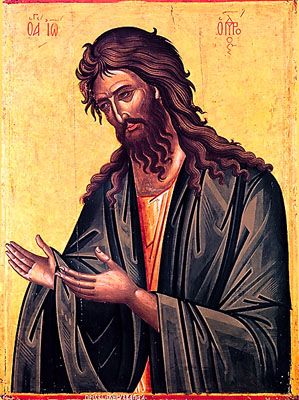
Icon of St. John the Baptist (16th c.) Dionysiou Monastery
Today, in Mercy, we celebrate one of the greatest figures of the Bible, John the Baptist. He prepared the way for the Lord.
Thinking of John’s role in Salvation History, I am reminded of a captivating poem by Geoffrey Brown, author of Road of the Heart Cave:
The Heart Cave
I must remember
To go down to the heart cave & sweep it clean; make it warm with a fire on the hearth, & candles in their niches, the pictures on the walls glowing with a quiet light. I must remember
To go down to the heart cave & make the bed with the quilt from home, strew the rushes on the floor hang lavender and sage from the corners. I must go down To the heart cave & be there when You come.
John the Baptist went down to the heart cave of our human perception of God. He understood, in an inexpressible way, that God was about to do something astounding in human history. God was about to become part of it!
John understood this with unquestioning faith, the way we understand heaven but cannot rationalize it. Understanding it, he knew that the world needed to turn itself toward God – to repent – in radical and ardent expectation.
This was his call and his message – this extraordinary man, dressed in his camel hair vestments, preaching at the desert’s edge.
We might pray with John today to be turned from anything that distracts us from God, to long for God’s presence in our hearts and in our world, to love deeply and make a welcome home for Christ within us.
( On this Feast, 55 years ago, my entrance companions and I professed our vows. I think of all of them with love today. May I humbly ask you, dear readers, to join me in prayer for us as we thank God for the gift of our lives in Mercy.)
Music: “Utqueant laxis” or “Hymnus in Ioannem” is a Latin hymn in honor of John the Baptist written in Horatian Sapphics and traditionally attributed to Paulus Diaconus, the eighth-century Lombard historian. It is famous for its part in the history of musical notation, in particular solmization (do-re-mi-fa-so-la-ti-do). The hymn is sung to a Gregorian chant, and introduces the original do-re-mi music
1. O for your spirit, holy John, to chasten Lips sin-polluted, fettered tongues to loosen; So by your children might your deeds of wonder Meetly be chanted.
2. Lo! a swift herald, from the skies descending, Bears to your father promise of your greatness; How he shall name you, what your future story, Duly revealing.
3. Scarcely believing message so transcendent, Him for a season power of speech forsaketh, Till, at your wondrous birth, again returneth, Voice to the voiceless.
4. You, in your mother’s womb all darkly cradled, Knew your great Monarch, biding in His chamber, Whence the two parents, through their offspring’s merits, Mysteries uttered.
5. Praise to the Father, to the Son begotten, And to the Spirit, equal power possessing, One God whose glory, through the lapse of ages, Ever resounding. Amen.










 Lavish Mercy