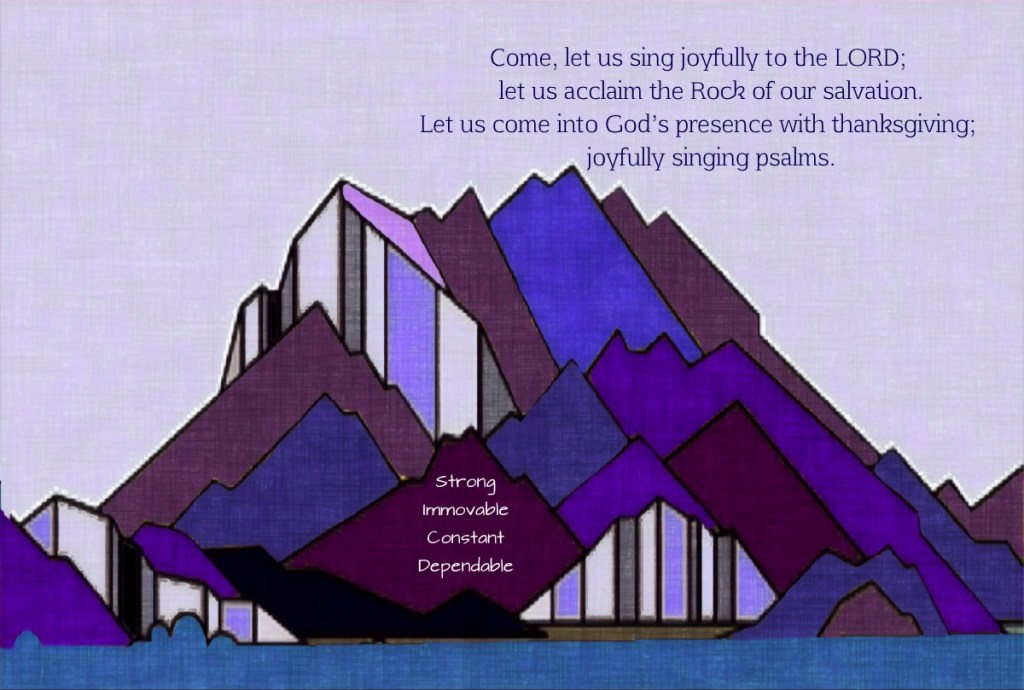
Psalm 46: Secret Stream

Tuesday of the Fourth Week of Lent

March 16, 2021

Today, in God’s Lavish Mercy, we pray with Psalm 46 which celebrates the felt assurance of God’s presence no matter surrounding circumstances.

God is our refuge and our strength,
    an ever-present help in distress.
Therefore we fear not, though the earth be shaken
    and mountains plunge into the depths of the sea.

Psalm 46: 2-3

That kind of faith is pretty amazing! It’s easy to celebrate God when things are going well – but earth shaking and mountains plunging? That’s something else. What’s the secret to that kind of faith?


Such believers seem to have found the “stream”:

There is a stream whose runlets gladden the city of God,
    the holy dwelling of the Most High.
God is in its midst; it shall not be disturbed;
    God will help it at the break of dawn.

Psalm 46: 4-5

In her “Four Waters of Prayer”, St. Teresa of Ávila describes how we find this stream. Imagine your soul as a garden that needs to be nourished by prayer.

  • The first way to nourish it is like drawing water from a well. It is a very active kind of prayer in which we use our faculties to come closer to God.
  • The second way is like a water-wheel. As we accustom ourselves to prayer, it becomes easier to enter a sacred space.
  • The third way is a stream. It is the point in our spiritual lives where prayer, awareness of God, flows throughout our day.
  • The Fourth Water is the prayer of ecstasy when we are filled with and by God as by a luxuriant rain.

You can read St. Teresa’s descriptions here. The language is that of the 16th century but the wisdom is eternal. 


Poetry: Poem for St. John of the Cross by Lisa Zimmerman

 In the dark night of the soul,
bright flows the river of God

John of the Cross
Saint John of the Cross,
Your father married for love
an orphan below his noble station.
Discarded by his wealthy kindred
they say your parents nurtured you in poverty—
and the bread was as sweet as any bread

and the days offered their shiny hands
and their little streams of water
singing in the glades.

I see you wandering happily as a boy,
the sun a crown on your small head,
your bare feet scuffing the dust.
God chirped like a wood lark
in the throat of afternoon
and the lonely months in prison
were far ahead beneath the great shadow
of the future.

I try to follow you there, O mystic,
to watch you defy your greedy brethren
monks who will reject your reforms, your love
of less, of days returned to prayer and fasting.

Fat and threatened, they silenced you
in a narrow stone cell, one tiny window
like the one in the soul where day after day
the voice of God pierced your suffering.

Out of emptiness, a full heart—
out of abandonment, a poem of seeking—
out of utter darkness, a gleam of pure light—
love’s last trembling boat waiting for you
to get in, and row.

Music: Streams in the Desert – Abigail Miller

Psalm 81: Through the Storm

Friday of the Third Week of Lent

March 12, 2021


Today, in God’s Lavish Mercy, we pray with Psalm 81, another call to listen to God’s Word in order to find the fullness of life:

If only my people would hear me,
    and Israel walk in my ways,
I would feed them with the best of wheat,
    and with honey from the rock I would fill them.


But honestly, isn’t it hard to listen sometimes. Even the psalm suggests that there are such loud, distracting events in our lives that we sometimes can’t hear that Word:

In distress you called, and I rescued you.
 Unseen, I answered you in thunder;
    I tested you at the waters of Meribah.
Hear, my people, and I will admonish you;
    O Israel, will you not hear me?


The psalm shows us that God’s deepest Word
comes to us in thunder, in storm.
It is a truth Jesus embraced on Calvary.
It is a truth our lives will sometimes require of us.


This morning my prayer is filled with thoughts of my friend whose young daughter died last week. When even I, who never met Emily, can feel the overwhelming sadness of her untimely death, what unbearable storm must surround her parents! How can they hear the word of faith in the tumult?


Many years ago, I attended an evening event on the other side of my state. During the ceremony, a tornado touched down very nearby. After several frightening hours, I was able to travel back to my hotel, about five miles away.

But the roads were blocked with debris. The streets lights and signs had been blown down. And I was completely unfamiliar with the vicinity. I did eventually make it “home” to the hotel, but it wasn’t the same as I had left it. Part of the roof lay across the street. The window in my room had been fractured and boarded up.

For me, the memory is a parable about suffering. When the storm comes, we may pass through it, but we are not unchanged. Our world is not unchanged.

Jesus was not unchanged by Good Friday and Easter Sunday. By hearing God’s Word in the storm, Jesus was transformed. This is the legacy of faith Christ has given us in the Paschal Mystery. May it strengthen, heal, and transform us this Lent. May it comfort all those who so dearly love Emily.


Poetry: The Man Watching  by Rainer Maria Rilke, Translated by Robert Bly

I can tell by the way the trees beat, after
so many dull days, on my worried windowpanes
that a storm is coming,
and I hear the far-off fields say things
I can’t bear without a friend,
I can’t love without a sister.

The storm, the shifter of shapes, drives on 
across the woods and across time,
and the world looks as if it had no age:
the landscape, like a line in the psalm book, 
is seriousness and weight and eternity.

What we choose to fight is so tiny! 
What fights with us is so great. 
If only we would let ourselves be dominated
as things do by some immense storm, 
we would become strong too, and not need names.

When we win it’s with small things, 
and the triumph itself makes us small. 
What is extraordinary and eternal
does not want to be bent by us. 
I mean the Angel who appeared
to the wrestlers of the Old Testament:
when the wrestlers’ sinews 
grew long like metal strings, 
he felt them under his fingers 
like chords of deep music.

Whoever was beaten by this Angel 
(who often simply declined the fight) 
went away proud and strengthened
and great from that harsh hand, 
that kneaded him as if to change his shape. 
Winning does not tempt that man. 
This is how he grows: by being defeated, decisively, 
by constantly greater beings.


Music: Moonlight Sonata in a Thunderstorm 

Psalm 95: Image of God

Thursday of the Third Week of Lent

March 11, 2021


Today, in God’s Lavish Mercy, we pray with Psalm 95, another frequent friend of our prayer.

Psalm 95 is an “enthronement psalm” which calls us to worship God as Ruler. Our verses today also use the images of Rock and Shepherd as images to help us understand the nature of God’s presence in our lives.

We can know God only through images. Most of us don’t have direct revelations. 😉 The images we choose and cultivate have a profound impact on our relationship with God and on how we live our lives in God’s image.

Psalm 95 offers us two pictures of God today. These two metaphors evoke some similar sentiments. They also contrast in other ways. Praying with ikons like these can be a beneficial way to come deeply into God’s Presence by touching into our deepest spiritual needs.


Poetry: Rainer Maria Rilke, Poems from the Book of Hours

You are the future, the great sunrise red
above the broad plains of eternity.
You are the cock-crow when time’s night has fled,
You are the dew, the matins, and the maid,
the stranger and the mother, you are death.
You are the changeful shape that out of Fate
rears up in everlasting solitude,
the unlamented and the unacclaimed,
beyond describing as some savage wood.
You are the deep epitome of things
that keeps its being’s secret with locked lip,
and shows itself to others otherwise:
to the ship, a haven — to the land, a ship.


Music: Made in the Image of God – We Are Messengers

Psalm 147: Count Your Blessings

Wednesday of the Third Week of Lent

March 10, 2021

Today, in God’s Lavish Mercy, we pray with Psalm 147, a poem filled with reasons to love and praise God. Today’s selected verses mention just a few of those reasons.

The blessings of security and family:

Worship the Lord, O Jerusalem; praise your God, O Zion,
who has strengthened the bars of your gates, 
who has blessed your children within you.

Psalm 147: 12-13

The blessings of diverse Creation:

The Lord sends out a command to the earth, 
and this word runs very swiftly.
The Lord gives snow like wool 
and scatters hoarfrost like ashes

Psalm 147: 15-16

The blessings of faith and religious heritage:

The Lord declares the word to Jacob, 
statutes and judgements to Israel.
The Lord has not done so to any other nation; 
to them these judgements have not been revealed.

Psalm 147: 19-20

Sometimes we spend a lot of energy praying over the things we think we need rather than recognizing all that we have.

This morning as I prayed, a personal thanksgiving psalm unfolded in my heart:

  • Hundreds of snow geese followed their yearly flight path right over my home, honking a symphony of hope.
  • The sun rose warm, tugging a clear promise of spring up over the horizon.
  • The Psalms lay open in my lap, a rich gift of the ages to my sometimes thin prayer.
  • My beloved communities slowly awakened and blossomed around me – my Mercy sisters, the toddlers in the daycare below me, the daily hum of the Motherhouse across the path outside my window, the buses carrying children to our Mercy schools
  • My family texting from their faraway homes.
  • I imagined myself as a small part of the magnificent communities described by beloved Pope Francis in Laudato Sí and Fratelli Tutti.
  • I felt those communities slowly beginning to recover from this past year’s devastation.
  • I prayed my sense of blessing into those still so deeply broken by global suffering, begging for their healing.

Gratitude for my blessings overwhelmed me, as it did our psalmist in #147:

Hallelujah!
How good to sing praise to our God;
how pleasant to give fitting praise.

Psalm 147:1

Poem: God Moves in a Mysterious Way – William Cowper

God moves in a mysterious way,
    His wonders to perform;
He plants his footsteps in the sea,
    And rides upon the storm.

Deep in unfathomable mines
    Of never failing skill;
He treasures up his bright designs,
    And works His sovereign will.

Ye fearful saints fresh courage take,
    The clouds ye so much dread
Are big with mercy, and shall break
    In blessings on your head.

Judge not the Lord by feeble sense,
    But trust him for his grace;
Behind a frowning providence,
    He hides a smiling face.

His purposes will ripen fast,
    Unfolding ev'ry hour;
The bud may have a bitter taste,
    But sweet will be the flow'r.

Blind unbelief is sure to err,
    And scan his work in vain;
God is his own interpreter,
    And he will make it plain.

Music: The Snow Goose – John Ritchie

Speaking of geese this morning, one of my all time favorite stories is “The Snow Goose” by Paul Gallico. I hope many of you have read it. It’s beautiful. I found a website that talks all about it, even with a Richard Harris movie included! For those who might be interested in a literary excursion 😀:

Psalm 25: Remember me?

Tuesday of the Third Week of Lent

March 9, 2021


Today, in God’s Lavish Mercy, we pray with Psalm 25, a gentle call for God’s attention:

The tone of this very human prayer is this: “Pay attention to me, God!”
Think of a toddler peppering her parent – “Mommy, look! Daddy, watch!

That’s what Psalm 25 is – a peppering of God.🤗


It’s not exactly that we feel forgotten by God. We know that can never happen, right? But we want God to put aside everything that might be occupying the Divine Attention, turn around and focus on us, listen intently to our prayer.


Remember that your compassion, O LORD,
    and your kindness are from of old.
In your kindness remember me,
    because of your goodness, O LORD.


Praying with Psalm 25 might lead us to realize that it is not God who must remember, or pay attention. It is us! In our need, we must recall God’s long faithfulness to us and therefore TRUST that God is with us – always – in any current circumstance. We must pray to discover God present there.

Your ways, O LORD, make known to me;
    teach me your paths,
Guide me in your truth and teach me,
    for you are God my savior.


Poetry: Psalm 25 – Trust by Christine Robinson

I put my trust in you, O God, as best as I am able. 
   May I be strong. May I not be afraid
May all who open their hearts
  hear your voice and know your love.

Lead me, teach me, help me to trust.
You are gracious to us, O God
You guide us, you forgive our clumsy ways
You help us prosper.

When I am sad and anxious
  I school my heart to trust
I act with integrity and uprightness
  And hope to feel your touch in my heart.
May it be so for all the peoples of the earth
  Who call you by many names.

Music: Two selections today

  1. To You O Lord – Marty Haugen

2. For lovers of Bach, like me, you might enjoy this:

Psalm 25 – Nach dir, Herr, verlanget mich, BWV 150 (For Thee, O Lord, I Long. Thought to be the earliest extant Cantata by Johann Sebastian Bach)

Here is a link to a great Bach website where I found some of my material for today.

Psalm 103: #BeLike

Saturday of the Second Week of Lent

March 6, 2021


Today, in God’s Lavish Mercy, we pray with Psalm 103, an effusive canticle on God’s unbounded Mercy.

Bless the LORD, O my soul;
    and all my being, bless his holy name.
Bless the LORD, O my soul,
    and forget not all his benefits.
He pardons all your iniquities,
    he heals all your ills.
He redeems your life from destruction,
    he crowns you with kindness and compassion.

Psalm 103:1-4

A sufficient prayer today would be to thank God for our experiences of this overflowing mercy. But our Gospel tells us there is more to it. There is a response required of us.


If you’re into social media like Facebook or Twitter, you may have noticed the popular meme “BeLike”.  (A meme is an idea, behavior, or style that becomes a fad and spreads by means of imitation from person to person within a culture, often carrying a symbolic meaning.) Here is an example of the  #BeLike meme posted by the NJ State Police.


If our psalmist and evangelist were writing a meme for today’s readings, it might look like this:


That’s the message.
I’m spending my prayer time with just that today.


Poetry: The Prodigal’s Mother Speaks to God by Allison Frank

When he returned a second time,
the straps of his sandals broken,
his robe stained with wine,

it was not as easy to forgive.

By then his father
was long gone himself,
leaving me with my other son, the sullen one
whose anger is the instrument he tunes
from good morning on.

I know.

There’s no room for a man
in the womb.

But when I saw my youngest coming from far off,
so small he seemed, a kid
unsteady on its legs.

She-goat
what will you do? I thought,
remembering when he learned to walk.

Shape shifter! It’s like looking through water—
the heat bends, it blurs everything: brush, precipice.

A shambles between us.

Music: Father, I Have Sinned – Eugene O’Reilly

Psalm 105: Tell the Story

Friday of the Second Week of Lent

March 5, 2021


Today, in God’s Lavish Mercy, we pray with Psalm 105. Together with our other readings, the psalm allows us to participate in Israel’s great family storytelling.

Give thanks to the LORD, invoke God’s name;
make known among the peoples God’s deeds!
Sing praise to the Lord, play music;
proclaim all the Lord’s wondrous deeds!

Psalm 105: 1-2

Psalm 105 is one of two historical psalms. (The other is Psalm 78.) Its verses summarize an amazing catalogue of God’s faithfulness to Israel and invites the listeners to grateful praise and unfettered hope.


Today’s particular passage is chosen because it recounts the same incidents as our first reading – the story of Joseph. And Joseph’s story prefigures Jesus’s own story which he offers in parable form in today’s Gospel.

When the LORD called down a famine on the land
    and ruined the crop that sustained them,
He sent a man before them,
    Joseph, sold as a slave.

Psalm 105: 16-17

For us, the telling and re-telling
of relationship stories
is an important human rubric,
practiced at
crowded Thanksgiving tables,
at relaxed summer reunions,
and at our inevitable bereavements.


Eventually, with enough retellings, a story becomes part of our family or friendship canon. Thence forward, it gains new dimension. Just like the canon of the Mass, whose formula becomes beautifully rote to us, the story now may be endlessly repeated without being exhausted. In its retelling, it always reveals something new and confirms something old.

Seek out the LORD and the Lord’s might;
constantly seek God’s face.
Recall the wondrous deeds God has done
for you and your beloved ones

Psalm 105: 4-5

In fact, such a story becomes a kind of sacrament, carrying within it the mysterious and unwordable blessings of what it means to live, love, die, and believe. 

Each human story is, in some form, a re-enactment of Christ’s life, death, and Resurrection. The faith, courage, humor, pathos, genius and serendipity of our lives carry the graces to make us holy, to make us Love as Jesus was Love.

When we gratefully retell the history of those graces – as Psalm 105 does today – we practice a powerful ritual of faith. By such liturgy, we are invited to the same grateful praise and unfettered hope as we meet in Psalm 105.

The LORD, is our God
whose judgments reach through all the earth.
Who remembers forever the covenant,
the word commanded for a thousand generations.

Psalm 105: 8-9

Poetry: The Storyteller – Mike Jones

I’m a teller of tales, a spinner of yarns,
A weaver of dreams and a liar.
I’ll teach you some stories to tell to your friends,
While sitting at home by the fire.
You may not believe everything that I say
But there’s one thing I’ll tell you that’s true
For my stories were given as presents to me
And now they are my gifts to you.

My stories are as old as the mountains and rivers
That flow through the land they were born in
They were told in the homes of peasants in rags
And kings with fine clothes adorning.
There’s no need for silver or gold in great store
For a tale becomes richer with telling
And as long as each listener has a pair of good ears
It matters not where they are dwelling.

A story well told can lift up your hearts
And help you forget all your sorrows
It can give you the strength and the courage to stand
And face all your troubles tomorrow.
For there’s wisdom and wit, beauty and charm
There’s laughter and sometimes there’s tears
But when the story is over and the spell it is broken
You’ll find that there’s nothing to fear

My stories were learned in my grandparent’s home
Where their grandparents also had heard them
They were given as payment by travelling folk
For a warm place to lay down their burdens
My stories are ageless, they never grow old
With each telling they are born anew
And when my story is ended, I’ll still be alive
In the tales that I’ve given to you.

Music: The Story I’ll Tell – Morgan Harper Nichols 

Psalm 1: Don’t Sit There!

Thursday of the Second Week of Lent

March 4, 2021


Today, in God’s Lavish Mercy, we pray with Psalm 1. We’ve prayed with it several times, but today a particular word and verse struck me.

“Insolent” — I’ll bet it’s a word you seldom, if ever, said out loud. The last time I think I heard it  was when my sixth grade teacher caught me smoking in the girls’ lav. I didn’t know what the word meant, but I knew it wasn’t good.

Even etymologists are uncertain of the origin of the word, but it has come to define one who is contemptuous of rightful authority.


Despite its current infrequent use, the Bible likes the word and uses it at least 23 times to instruct our spiritual life.

Psalm 1 declares that even hobnobbing with the insolent is a bad idea. Insolence rubs off on us if we’re not careful. You know, “birds of a feather” and all that.


And isn’t it true? Haven’t you run into one or two cliques of contemptuous, snidely belligerent people in your lifetime who feed on one another’s insolence?

Those are the kind of folks Psalm 1 is talking about. We meet them everywhere – school, church, work, socially. They are the ones gossiping, passing judgment, stereotyping, slandering … Perhaps we’ve even joined them at times 🥲

In their worst form, they are the ones in the white hoods, carrying the burning torches, pushing kids into cages. We should pray for them because, as our psalmist suggests, they have been emptied of their souls:


… they are like chaff which the wind drives away.

Psalm 1:4


It’s been a long time since sixth grade and, even if I still don’t know the etymology of the word, I’ve come to understand what severe insolence does to a soul.

I don’t want to harbor even an ounce of it. Reflecting on Psalm 1 today, that is my heartfelt prayer.


Poetry: Know Yourself –   Meister Eckert

A human being has so many skins inside, 
covering the depths of the heart. 
We know so many things, 
but we don’t know ourselves! 
Why, thirty or forty skins or hides, 
as thick and hard as an ox’s or bear’s, 
cover the soul. 
Go into your own ground 
and learn to know yourself there.

Music: Grace Is – Paul Avgerinos 

Psalm 31: The Plot

Wednesday of the Second Week of Lent

March 3, 2021

Today, in God’s Lavish Mercy, we pray with Psalm 31 which expresses a pleading reflective of our first powerful reading from Jeremiah.

Come, let us contrive a plot against Jeremiah.
… let us destroy him by his own tongue;
let us carefully note his every word.

Jeremiah 18:18

This verse (18:18) is the pivotal turning point where everything goes south for Jeremiah. The Israelite power structure really didn’t want to hear what Jeremiah was telling them. He pins their troubles – the destruction the Temple and Babylonian Captivity – on one thing: their faithlessness to the Covenant with Yahweh.


Jeremiah is an archetype of the condemned prophet whom we meet in Jesus. Today’s Gospel reveals the same pivotal turning point for Jesus:

We are going up to Jerusalem,
and the Son of Man will be handed over to the chief priests
and the scribes,
and they will condemn him to death,
and hand him over to the Gentiles
to be mocked and scourged and crucified,
and he will be raised on the third day.

Matthew 20:18-19

They told the Truth – that we must continually discern God’s Word for our lives, always seeking love, mercy and justice. Few had the courage to listen. Most chose sinful resistance.

The suffering prophet has only one recourse when “hearing the whispers of the crowd, that frighten me from every side, as they consult together against me, plotting to take my life.” Psalm 31:14

That recourse is complete and trusting surrender to God. Psalm 31 reveals this surrender in a verse Jesus ultimately prays from the Cross:

Into your hands I commend my spirit;
    you will redeem me, O LORD, O faithful God.

Psalm 31:6

Lent calls us to the message of Jeremiah and Jesus – to examine our lives in light of love, mercy and justice. Let us pray in the spirit of Jesus today to be open to Truth in our own lives and to build Truth in our communities.


Poetry: The Paradox by Paul Laurence Dunbar
The poem carries a tone similar to sorrowful Jeremiah’s poetry.

I am the mother of sorrows,
I am the ender of grief;
I am the bud and the blossom,
I am the late-falling leaf.

I am thy priest and thy poet,
I am thy serf and thy king;
I cure the tears of the heartsick,
When I come near they shall sing.

White are my hands as the snowdrop;
Swart are my fingers as clay;
Dark is my frown as the midnight,
Fair is my brow as the day.

Battle and war are my minions,
Doing my will as divine;
I am the calmer of passions,
Peace is a nursling of mine.

Speak to me gently or curse me,
Seek me or fly from my sight;
I am thy fool in the morning,
Thou art my slave in the night.

Down to the grave will I take thee,
Out from the noise of the strife;
Then shalt thou see me and know me–
Death, then, no longer, but life.

Then shalt thou sing at my coming.
Kiss me with passionate breath,
Clasp me and smile to have thought me
Aught save the foeman of Death.

Come to me, brother, when weary,
Come when thy lonely heart swells;
I ‘ll guide thy footsteps and lead thee
Down where the Dream Woman dwells.

Music: Symphony No.1 – Jeremiah by Leonard Bernstein 

Summary: an excellent introduction to this symphony

Entire Symphony:

Psalm 50: Clean It Up!

Tuesday of the Second Week of Lent

March 2, 2021


Today, in God’s Lavish Mercy, we pray with Psalm 50 which Wikipedia describes as “a prophetic imagining of God’s judgement on the Israelites”.


It’s a rainy day here, after a foggy yesterday. A cheery psalm this morning would have been nice…. but, well it’s Lent.

Why do you recite my statutes,
    and profess my covenant with your mouth,
Though you hate discipline
    and cast my words behind you?

Psalm 50: 16-17

The psalm is a divine rebuke. It shouts, “Wake up! You’re missing the point!”

Psalm 50 calls us to examine the failures in love that we might bury under routine. It demands that we look under the surface of our daily practice for the depths of grace and transformation that we might be overlooking.


We can get pretty comfortable with our beliefs, our judgements, our attitudes, our habits. Left unexamined, these can deteriorate into prejudices and indifferences, into bigotry and self-righteousness, into betrayals of mercy.

Today’s Gospel gives us a perfect description of what happens to us when we fail to discern the “hardening of our spiritual arteries”. We get Pharisaical! Here’s what Jesus says about pharisees:

… they preach but they do not practice.
They tie up heavy burdens hard to carry
and lay them on people’s shoulders,
but they will not lift a finger to move them.
All their works are performed to be seen.
They widen their phylacteries and lengthen their tassels.
They love places of honor at banquets, seats of honor in synagogues,
greetings in marketplaces, and the salutation ‘Rabbi.’

Matthew 23:4-7

Let’s learn humble, contrite self-examination by sincerely praying Psalm 50:

Those who offer praise as a sacrifice glorify me;
    and to those who go the right way 
    I will show the salvation of God.

Psalm 50: 23

Our first reading from Isaiah sums it up:

Wash yourselves clean!
Put away your misdeeds from before my eyes;
    cease doing evil; learn to do good.
Make justice your aim: redress the wronged,
    hear the orphan’s plea, defend the widow.

Isaiah 1:16-17

Poetry: God must give us a renewed mind (from Vale Millies) by Hadewijch. She was mystic of the 13th century
English version by Mother Columba Hart, Original Language Dutch

God must give us a renewed mind
     For nobler and freer love,
To make us so new in our life
     That Love may bless us
And renew, with new taste,
     Those to whom she can give new fulness;
Love is the new and powerful recompense
     Of those whose life renews itself for Love alone.
— Ay, vale, vale, millies — (farewell, farewell, a million times)
     That renewing of new Love
— Si dixero, non satis est — (If I can speak, it is not enough)
     Which renewal will newly experience.


Music: Psalm 50