Incomprehensible Love

Thursday of the Third Week of Advent
December 21, 2023

Today’s Readings:

https://bible.usccb.org/bible/readings/122123.cfm


Today, in God’s Lavish Mercy, the Church sings out to God the warm, familiar Advent invitation:


Our first reading from the Song of Songs vibrates with anticipation of God’s arrival:

Hark! my lover–here he comes
springing across the mountains,
leaping across the hills.
My lover is like a gazelle
or a young stag.
Here he stands behind our wall,
gazing through the windows,
peering through the lattices.

Song of Songs 2: 8-9

When the Divine Lover arrives, the one who waits must be awakened from frost, flood, or barrenness that has drowsed them.

“Arise, my beloved, my dove, my beautiful one,
and come!
“For see, the winter is past,
the rains are over and gone.
The flowers appear on the earth,
the time of pruning the vines has come,
and the song of the dove is heard in our land.
The fig tree puts forth its figs,
and the vines, in bloom, give forth fragrance.
Arise, my beloved, my beautiful one,
and come!

Song of Songs 2: 10-12

As we pray with the Song of Songs, we are reminded that relationship with God exceeds our comprehension and expression. We have only our human descriptions to help us explore the infinite dimensions of Grace and Mercy. We image the Holy One as Father, Mother, Sister, Brother, Child, Light, Wisdom, Love, Lover, or Beloved – each aspect offering a necessarily limited metaphor for the Incomprehensible One.


As we consider places in our world, and in our own hearts, which are frozen, flooded, or barren of life, let us invite the Passion of God to rescue and reinvigorate us.

As we reflect on today’s Gospel, we can imagine both Mary and Elizabeth filled with that Holy Vigor which changes and restores everything to God’s original hope for Creation. It was into such ready openness that God’s Word leapt in one moment 2000 years ago. May it leap again into our hearts.


Poetry: Love Gaze – Renee Yann, RSM

Caught in the ferocious wind
of my own inadequacies,
I cling by finest web
to the energy You are,
fixing my soul on yours
in that precarious holding.

You are the magnet, gathering
all my emptiness beyond itself.
As if my fears were only stones
to tread upon, You come into the marshes
of my life as stillness, paused
and vibrating like a deer
among the reeds in dusklight.

I cannot word what it is
to swim in the deep pool of your Eyes.
All the universe, and all my understanding
turn reverently aside to offer privacy
for such profound combining.

Music: Veni, Dilecte Mi – Orlande de Lassus (1532-1594), one of the leading composers of the later Renaissance

Latin:
Prima pars
7:11 Veni dilecte mi, egrediamur in agrum, commoremur in villis,
7:12 Mane surgamus ad vineas. Videamus si floruit vinea, si flores
fructus parturiunt, si floruerunt mala punica.
Ibi dabo tibi ubera mea.


Secunda pars
4:11a Favus distillans labia tua, [dilecte mi], mel et lac
sub lingua tua.
8:6a Pone me ut signaculum super cor tuum,
quia fortis est ut mors dilectio, dura sicut infernus aemulatio.

English:
Prima pars
7:11 Come, my beloved, let us go forth into the field, let us abide in the villages.
7:12 Let us get up early to the vineyards, let us see if the vineyard flourish, if the flowers
be ready to bring forth fruits, if the pomegranates flourish:
there will I give thee my breasts.

Secunda pars
4:11a Thy lips, my spouse, are as a dropping honeycomb, [my beloved] honey and milk are under thy tongue;
8:6a Put me as a seal upon thy heart, as a seal upon thy arm,
for love is strong as death, jealousy as hard as hell.
(Douai-Rheims)

Fuller Every Day

Friday of the Second Week of Advent
December 15, 2023

Today’s Readings:

https://bible.usccb.org/bible/readings/121523.cfm


Today, in God’s Lavish Mercy, Isaiah paints a poetic picture of the soul fully taught by God. He describes that sacred obedience, or heart’s listening to God, which leads to fullness of joy, peace, and eternal life.

I, the LORD, your God,
teach you what is for your good,
and lead you on the way you should go.
If you would hearken to my commandments,
your prosperity would be like a river,
and your vindication like the waves of the sea;
Your descendants would be like the sand,
and those born of your stock like its grains,
Their name never cut off
or blotted out from my presence.

Isaiah 48:17-19

When looking for music to complement Isaiah’s passage, I found a hymn written in 1876 by Frances R. Havergal, an English Anglican poet and hymn writer.

Her hymn Like a River Glorious, although written in older style language, spoke to me. It contains several beautiful metaphors, many reflective of today’s passage from Isaiah.

You might want to pray with one or two of these images today as you think about your own relationship with God and the Advent hopes flowing in your heart:

river
A river of grace – perfect, yet deepening
stand_anchor
Our hearts “stayed” upon God, anchored in faith
chick
Being hidden in the hollow of God’s hand
wind
“no blast of hurry” to disturb our peace (so appropriate to this busy season)
sundial
Our joys and sorrows falling like shadows
across the sundial of our lives

Throughout the ages, believers have used images to open their hearts to the graces of prayer. Think about the magnificent stained glass windows in the world’s churches — and of the centuries of our ancestors who have prayed beside them.

I hope you enjoy praying with this hymn, and the accompanying pictures, as much as I did.


Music: Like a River Glorious – Frances R. Havergal – 1876; performed here by the Parkview Mennonite Church. Follow the images and verses below.

river
A river of grace – perfect, yet deepening

Like a river glorious is God’s perfect peace,
Over all victorious, in its bright increase;
Perfect, yet it floweth fuller every day,
Perfect, yet it groweth deeper all the way.

stand_anchor
Our hearts “stayed” upon God, anchored in faith

Refrain:
Stayed upon Jehovah, hearts are fully blest
Finding, as He promised, perfect peace and rest.

chick
Being hidden in the hollow of God’s hand

Hidden in the hollow of His blessed hand,
Never foe can follow, never traitor stand;

wind
“no blast of hurry” to disturb our peace (so appropriate to this busy season)

Not a surge of worry, not a shade of care,
Not a blast of hurry touch the spirit there.

sundial
Our joys and sorrows falling like shadows across the sundial of our lives

(Refrain then …)

Every joy or trial falleth from above,
Traced upon our dial by the Sun of Love;
We may trust Him fully, all for us to do;
They who trust Him wholly find Him wholly true.

Watch!

First Sunday of Advent
December 3, 2023

Today’s Readings:

https://bible.usccb.org/bible/readings/120323.cfm


Today, in God’s Lavish Mercy, we begin the Advent Watch, that annual time of acute spiritual awareness and hope-filled expectation.

We’ve all kept watch at various times in our lives, perhaps without even realizing it. It may have been as simple as waiting for a delayed but highly anticipated letter, or as worrisome as the anxious vigil over a feverish child. It may be as unnoticeable as waiting for an elevator, a green light, or a “transaction complete” at the ATM, or as marvelous as the nine-month expectancy of new life.

We should be good at waiting because we do it all the time, but maybe we’re not so good at it after all.


Good waiting requires our consciousness. We may idly consider the “waiting space” a neutral zone that we can fill with anything we choose – impatience, daydreaming, or distraction. But pivotal waiting can offer us an invaluable invitation – to meet God in a new way as we anticipate what we cannot yet see or comprehend. But sometimes we don’t pay enough attention to hear the invitation.

This kind of “keeping watch” can be a sacramental experience. It is a time when we are stilled before a reality or mystery we cannot control. We can only wait, hope, release any fear, and cleanse our demanding prayer of its useless stipulations. It is a time of confident abandonment into God’s loving will for our good. Advent is such a blessed time.


Praying with our Advent scriptures provides us with a curriculum for good waiting. Our teachers will be the divinely lyrical Isaiah, the Psalms, Matthew and Luke, and the glorious O Antiphons.

We begin today with this heartfelt entreaty to God:

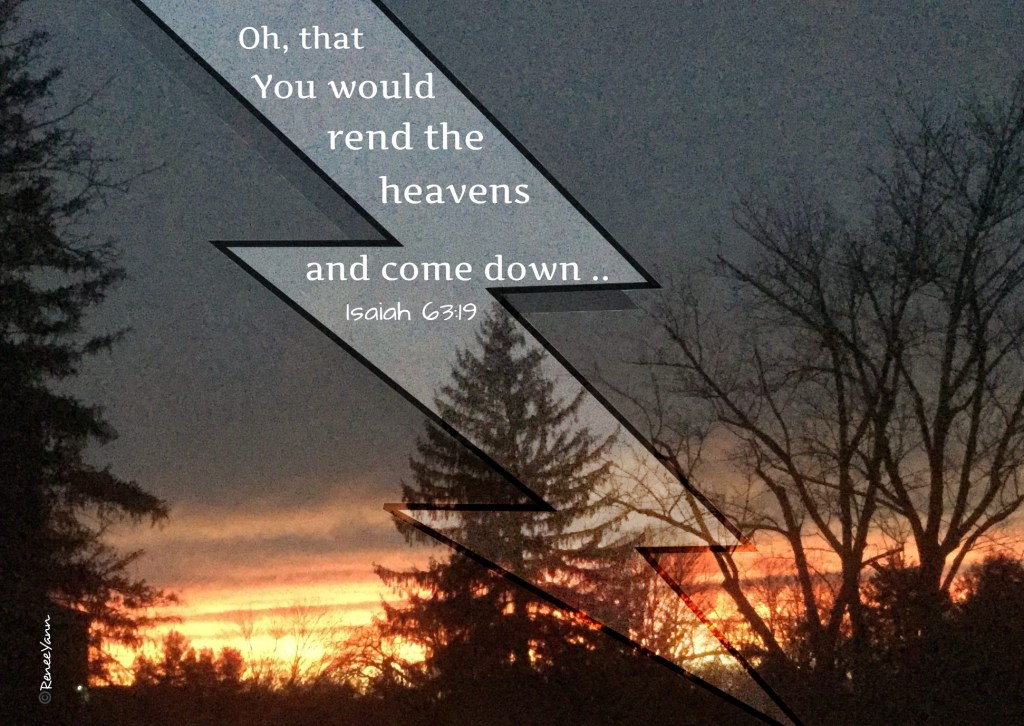
Oh, that you would rend the heavens and come down,
with the mountains quaking before you,
while you wrought awesome deeds we could not hope for,
such as they had not heard of from of old.
No ear has ever heard, no eye ever seen, any God but you
doing such deeds for those who wait for him.
Would that you might meet us doing right,
that we were mindful of you in our ways!


Each one of us can look into our own hearts today, into our own perception of the world, to see where God is most sorely needed. As we pray Isaiah’s plea, we can do so assured by Paul’s blessing that God desires to answer us:

I give thanks to my God always on your account
for the grace of God bestowed on you in Christ Jesus,
that in him you were enriched in every way,
with all discourse and all knowledge,
as the testimony to Christ was confirmed among you,
so that you are not lacking in any spiritual gift
as you wait for the revelation of our Lord Jesus Christ.
He will keep you firm to the end,
irreproachable on the day of our Lord Jesus Christ.
God is faithful,
and by him you were called to fellowship with his Son,
Jesus Christ our Lord.


Poetry: Advent (On a theme by Dietrich Bonhoeffer) – by Pamela Cranston

Look how long
the tired world waited,
locked in its lonely cell,
guilty as a prisoner.
As you can imagine,
it sang and whistled in the dark.
It hoped. It paced and puttered about,
tidying its little piles of inconsequence.
It wept from the weight of ennui
draped like shackles on its wrists.
It raged and wailed against the walls
of its own plight.
But there was nothing
the world could do
to find its freedom.
The door was shut tight.
It could only be opened
from the outside.
Who could believe the latch
would be turned by the flower
of a newborn hand?

Music: Wachet auf! ruft uns die Stimme – J.S. Bach

Wachet auf, ruft uns die Stimme
Wake up, the voice calls us
Der Wächter sehr hoch auf der Zinne,
of the watchmen high up on the battlements,
Wach auf, du Stadt Jerusalem!
wake up, you city of Jerusalem!
Mitternacht heißt diese Stunde;
This hour is called midnight;
Sie rufen uns mit hellem Munde:
they call us with a clear voice:
Wo seid ihr klugen Jungfrauen?
where are you, wise virgins ?
Wohl auf, der Bräutgam kömmt;
Get up, the bridegroom comes;
Steht auf, die Lampen nehmt! Alleluja!
Stand up, take your lamps! Hallelujah!
Macht euch bereit
Make yourselves ready
Zu der Hochzeit,
for the wedding,
Ihr müsset ihm entgegen gehn!
you must go to meet him!

Longing for God

Thirty-second Sunday in Ordinary Time
November 12, 2023

Today’s Readings:

https://bible.usccb.org/bible/readings/111223.cfm


Today, in God’s Lavish Mercy, we pray with Psalm 63, a prayer of deep longing and faithful intimacy. 

The psalm is complemented by the lyrical passage from the Book of Wisdom which immediately reminded me of my favorite verse for the Christmas season:

For while gentle silence enveloped all things,
and night had now run half its swift course,
Wisdom’s all-powerful Word leapt down from heaven, 
from the royal throne,
into the midst of the shadowed land.

Wisdom 18: 14-15

Using delicate feminine images, our first reading from Wisdom describes the God for whom we long – a God who longs for us with infinite eagerness:

Resplendent and unfading is Wisdom,
and she is readily perceived by those who love her,
and found by those who seek her.
She hastens to make herself known in anticipation of their desire –

Wisdom 6: 12-13

This reading forms a sort of dance with our Psalm – the first describing God’s desire, the second describing ours:

O God, you are my God whom I seek;
for you my flesh pines and my soul thirsts
like the earth, parched, lifeless and without water.

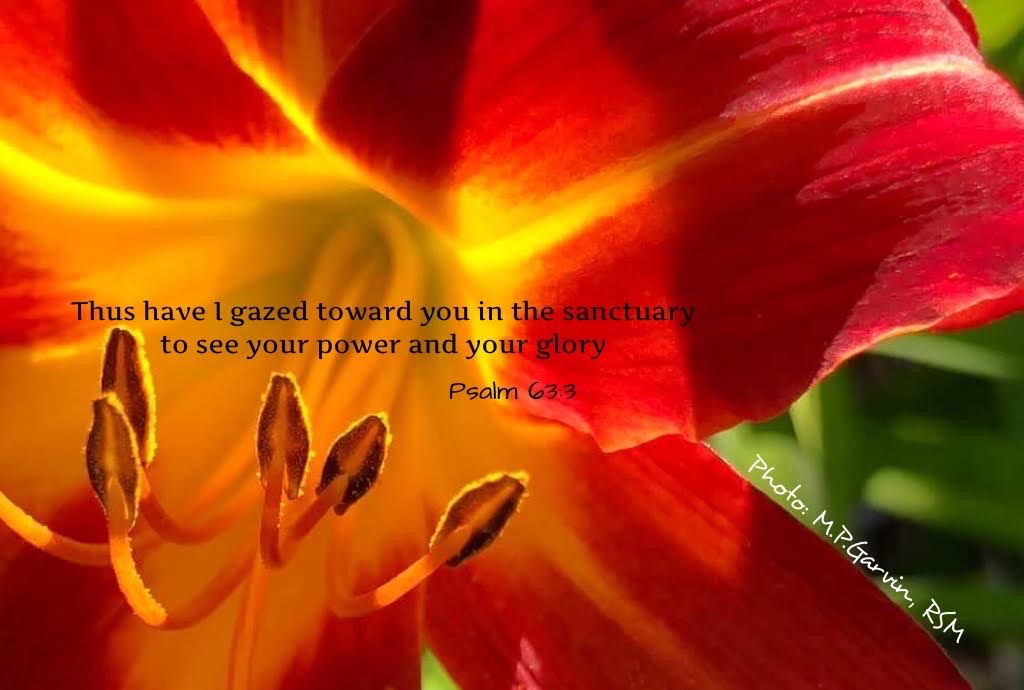
Thus have I gazed toward you in the sanctuary
to see your power and your glory,
For your kindness is a greater good than life;
my lips shall glorify you.

Psalm 63: 2-4

Our reading assures us that God readily meets our gaze:

Whoever watches for Wisdom at dawn shall not be disappointed,
for they shall find her sitting by their heart’s gate.
For taking thought of wisdom is the perfection of prudence,
and whoever for her sake keeps vigil
shall quickly be free from care;
because she makes her own rounds, seeking those worthy of her,
and graciously appears to them in the ways,
and meets them with all solicitude.

Wisdom 6:14-16

In our prayer today, let us open our deepest hearts to this Wisdom God who seeks us. Let our thirsty souls be satisfied in that loving Sacred Bliss.

Thus will I bless you while I live;
lifting up my hands, I will call upon your name.
As with the riches of a banquet shall my soul be satisfied,
and with exultant lips my mouth shall praise you.

Psalm 63: 5-6

Poetry: Our beautiful Psalm 63 for today is a poem beyond comparison. You might enjoy Rev. Christine Robinson‘s interpretation:

My soul thirsts for you, O God
As my dehydrated body craves water.
But I can’t see you.
I often lose touch with your loving kindness
My longing for you is the only real evidence I have
that you are really here.
Still, I will seek You
Still, I will do Your work
Still, I will remember You from my bed,
when I meditate before I sleep
and when I wake in the night.
You have been my helper
I have taken refuge in the shadow of your wings.
Dispatch my fears, O God
help me find my center in You.
And I will rejoice.

Music: I Long for You, O Lord – The Dameans

I long for you, O Lord
With all my soul, I thirst for You.

God, my God, you I seek 
for You my soul is thirsting,
Like a dry and weary land,
my spirit longs for You.

I have sought for Presence, Lord
to see your power and your glory.
Lord, your love means more than life.
I shall sing your praise.

Thus will I bless you while I live,
and I will call your name, O Lord.
As with the riches of a feast
shall my soul be satisfied.

Through the night, I remember You
for You have been my Savior.
In the shadow of your wings,
I will shout for joy.

Welcome, November!

I love this beautiful poem, The Shepherd’s Calendar by John Clare. Placing myself in its lovely artistic images, I have a grateful and deep appreciation of Earth and of her changing seasons. I like to pray with the poem in the spirit of Laudato Si, praising God for the beauty of Creation.

It’s a bit long, so you might just want to come back to it several times throughout the month, taking just one small stanza that seems to fit you day or mood.

Click the little white arrow in the bar below for accompanying music as you pray. You can re-click any number of times you wish.
To see each of the ten slides at your own pace, click the very small arrowhead > to the right of the slide.

November blessings to all of you, dear readers.


The Door is Actually Open…

Thursday of the Twenty-seventh Week in Ordinary Time
October 12, 2023

Today’s Readings:

https://bible.usccb.org/bible/readings/101223.cfm


Today, in God’s Lavish Mercy, both our readings are replete with images regarding how we earn or access our heavenly reward.

Malachi presents us with the image of a record book wherein the names of the just are recorded:

Then they who fear the LORD spoke with one another,
and the LORD listened attentively;
And a record book was written before him
of those who fear the LORD and trust in his name.
And they shall be mine, says the LORD of hosts,
my own special possession, on the day I take action.
And I will have compassion on them,
as a man has compassion on his son who serves him.

Malachi 3: 16-17

It’s an image that has stuck with people throughout the centuries. Kind of reminds you of Santa Claus, doesn’t it – “making a list, checking it twice. Gonna find out who’s naughty and nice.” We’ve all seen depictions of St. Peter, at the “pearly gates”, checking that Book for someone who seems to have forgotten their reservation!


Such images illustrate our natural desire to understand the afterlife and its relationship to our moral choices. And guess what! Forget it! We are never going to comprehend or control that dynamic, because God isn’t Santa Claus, doesn’t have a little black book, and there are no gates in heaven.


In our Gospel today, Jesus tells us the only thing we can be sure of – that God is our Friend and desires to be one with us in the Holy Spirit.

If you then, who are wicked,
know how to give good gifts to your children,
how much more will the Father in heaven give the Holy Spirit
to those who ask him?”

Luke 11:13

And Jesus says it’s not all that hard – just ask, seek, and knock. Of course, it matters what we are asking, seeking, and knocking FOR. It must be FOR deeper intimacy with God lived out in a grateful and generous life. This kind of holy relationship eradicates any need to manufacture worries about a record book or locked gates.

I tell you, ask and you will receive;
seek and you will find;
knock and the door will be opened to you.
For everyone who asks, receives;
and the one who seeks, finds;
and to the one who knocks, the door will be opened.

Luke 11: 9-10

Poetry: You, Neighbor God – Rainer Maria Rilke

You, neighbor God, if sometimes in the night
I rouse you with loud knocking, I do so
only because I seldom hear you breathe
and know: you are alone.
And should you need a drink, no one is there
to reach it to you, groping in the dark.
Always I hearken. Give but a small sign.
I am quite near.
Between us there is but a narrow wall,
and by sheer chance; for it would take
merely a call from your lips or from mine
to break it down,
and that without a sound.
The wall is builded of your images.
They stand before you hiding you like names.
And when the light within me blazes high
that in my inmost soul I know you by,
the radiance is squandered on their frames.
And then my senses, which too soon grow lame,
exiled from you, must go their homeless ways.

Music: God Hears Our Prayers – Mandy Lining

I think this song is very beautiful in its simplicity. I hope you like it.

Prayer

Wednesday of the Twenty-seventh Week in Ordinary Time
October 11, 2023

Today’s Readings:

https://bible.usccb.org/bible/readings/101123.cfm


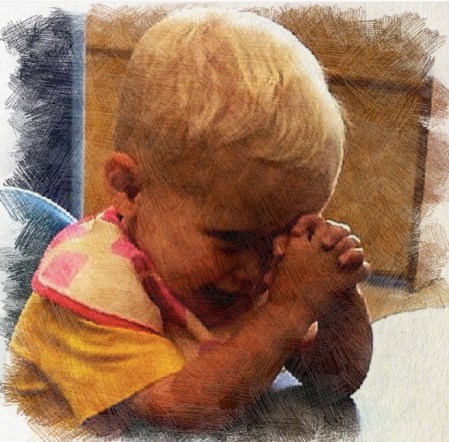
Ollie praying

Today, in God’s Lavish Mercy, Jesus teaches his disciples how to pray. His prayer is simple and direct, like talking to your best friend over a morning cup of coffee.

What about us? How do we pray?

Most of our first learned prayers are a lot like Jesus’s simple Our Father. We praise God, giving thanks, and asking for what we need.

Then we grow up and get sophisticated. We may begin to “say” or read prayers rather than use our own words. While such a practice can deepen our understanding of prayer, it places a layer between us and our conversation with God.

Sometimes others lead our prayer in the community of faith. This too can enrich us as we are inspired by a shared faith. But, sorry to say, at other times such prayer, indifferently led, can leave us empty and even frustrated. The whole process can be a little like trying to have a private conversation in an elevator full of noisy people.


Just as Jesus often went off in solitude to pray, this kind of prayer is our most intimate time with God – a time when God allows us to know God and ourselves in a deeper way. This sacred time alone with God may be spent in words, song, or the silence that speaks beyond words.

It is a time to be with the Beloved as we would be with our dearest, most faithful companion. We rest in the field of our experiences, letting them flow over God’s heart in tenderness. We listen with the ear of absolute trust to the secrets God tells us in the quiet.


When we become deeply accustomed to this type of intimate prayer, it transforms our self-understanding. Our every thought, word, and action is in the Presence of God. It is God Who hears our joys, sorrows, fears, and inspirations rising up in our hearts even before we hear them ourselves. It is God Who holds us at the center of our lives in communion with all Creation. It is God Who breathes grace into our human moments in acts of mercy, joy, charity, and justice.

Father, hallowed be your name,
your Kingdom come.
Give us each day our daily bread
and forgive us our sins
for we ourselves forgive everyone in debt to us,
and do not subject us to the final test.

Luke 11:2-4

Poetry: Praying – Mary Oliver

It doesn’t have to be
the blue iris, it could be
weeds in a vacant lot, or a few
small stones; just
pay attention, then patch

a few words together and don’t try
to make them elaborate, this isn’t
a contest but the doorway

into thanks, and a silence in which
another voice may speak.

Our Father – Leontyne Price

Pray for One Another

Friday of the Twenty-sixth Week in Ordinary Time
October 6, 2023

Today’s Readings:

https://bible.usccb.org/bible/readings/100623.cfm


Baruch Writing Jeremiah’s Prophecies – Gustave Doré


Today, in God’s Lavish Mercy (and tomorrow) we have a few words from Baruch – and he is not a happy camper. Baruch, the scribe for the prophet Jeremiah, did his own little bit of writing reflecting on the situation of the Jews exiled in Babylon.

The Book of Baruch takes the form of a letter from the captives to the high priest who remained in Jerusalem after the exile. The writer asks for prayers for the exiled community and sends money to support that request. He voices the people’s acknowledgment that their suffering is a result of their own sin. He even composes the prayers that he wishes to be said in Jerusalem:

Justice is with the Lord, our God;
and we today are flushed with shame,
we men of Judah and citizens of Jerusalem,
that we, with our kings and rulers
and priests and prophets, and with our ancestors,
have sinned in the Lord’s sight and disobeyed him.

Baruch 1:15-18

When I was growing up, we had a practice in my family very similar to that described in Baruch. When confusing troubles arose for the family, Mom would appeal to either of two sources for supportive prayer: The Shrine of Sainte-Anne-de-Beaupré in Canada or the “Pink Sisters” (The Holy Spirit Adoration Sisters) on Green Street in Philadelphia. I have written to the Pink Sisters myself on a few spiritually catastrophic occasions. A Sister always writes back with sustaining wisdom and the affirmation of prayer.

Remembering all this reminds me that it is so important to pray for one another! Doing so creates an invisible, almost magnetic connection that helps sustain us in times of doubt, suffering, loss, and sadness. It also helps the pray-er to affirm membership in a company of believers – all of us “just walking each other home.”(Ram Dass)


This is exactly what Baruch was doing for the Babylonian exiles:

  • reminding them of their true home in God
  • reconnecting them to a community from which they had been severed
  • voicing their suffering
  • showing them a path to repentance, hope, and restoration.

At those “exile times” in our lives, when we are somewhere on the fragile edge of faith and endurance, as our Psalm today reminds us, prayer refocuses us on God rather than ourselves. Trusting the glorious name of God, we slowly open to a Light we may not have seen because our own shadow was in the way.

Help us, O God our savior,
because of the glory of your name;
Deliver us and pardon our sins
for your name’s sake.

Psalm 79:9

Poetry: A Prayer – May Sarton

Help us to be the always hopeful
gardeners of the spirit
who know that without darkness
nothing comes to birth
as without light
nothing flowers.

Music: Anthem – Leonard Cohen

Come Away Awhile

Memorial of Saint Alphonsus Liguori, Bishop and Doctor of the Church
Tuesday of the Seventeenth Week in Ordinary Time
August 1, 2023

Today’s Readings:

https://bible.usccb.org/bible/readings/080123.cfm


Today, in God’s Lavish Mercy, Moses goes on a rigorous forty day retreat:

So Moses stayed there with the LORD for forty days and forty nights,
without eating any food or drinking any water,
and he wrote on the tablets the words of the covenant,
the ten commandments.

Exodus 33:28

The purpose of this intense retreat was for Moses to codify God’s law in his own heart. He is to be a witness and leader for God among the people. It was a law of relationship, written in stone for the people, but written in fire for Moses. If God’s intentions are not embedded in Moses’s own heart, his ministry will fail.

In our Gospel, the disciples go on a kind of retreat too. The crowds have been dismissed, and Jesus’s close friends sit down with him for an in-depth instruction in the meaning of his parables. They want to understand the mind and heart of Christ so that they can pattern their own on his Word.


A good retreat is like a spiritual spa experience. It can provide us with rest, clarity, nourishment, and stabilization. And good retreat direction, either through a spiritual guide or through the discipline of solitude, is invaluable to such a pursuit.

But while we can’t be on a formal retreat every day of our lives, we still need a daily “coming away” with God to center our spirits and to keep alive the holy fire within them.


Today might be a good day to evaluate those processes in our lives. Are they working for us? Or might our prayer and reflection time have become so routine as to lose its snap. Have we let life’s concerns slip into our solitude to the point of no longer hearing God’s whisperings? Or have we even truncated that time to meet those ever-expanding concerns?

We may feel so overwhelmed by life that we think we don’t have time for deep prayer. That’s like saying we don’t have time to breathe! If we don’t make the time for both of them, we will die. It’s that simple.


Sixty years ago, my Novice Director gave me a wonderful book. I return to it frequently to consider the spiritual discipline of my life. Here are two excerpts which seem to have bearing on today’s reflection and might inspire your considerations today:

When silence takes possession of you; when far from the racket of the human highway the sacred fire flames up in the stillness; when peace, which is the tranquillity of order, puts order in your thoughts, feelings, and investigations, you are in the supreme disposition for learning; you can bring your materials together; you can create; you are definitely at your working point; it is not the moment to dwell on wretched trifles, to half live while time runs by, and to sell heaven for nothings.


Retirement (retreat) is the laboratory of the spirit; interior solitude and silence are its two wings. All great works were prepared in the desert, including the redemption of the world

A.D. Sertillanges, The Intellectual Life: Its Spirit, Conditions, Methods

Poetry: The Stolen Child – William Butler Yeats
Using his love for Celtic lore and fantasy, Yeats imagines a return to innocence at the hands of magical creatures, the faeries. With imagery rich in natural wonder, the reader is invited to “come away” from a world impossible to understand, and to be restored in spiritual truth. Sounds like a retreat to me!

Where dips the rocky highland
Of Sleuth Wood in the lake,
There lies a leafy island
Where flapping herons wake
The drowsy water rats;
There we've hid our faery vats,
Full of berrys
And of reddest stolen cherries.
Come away, O human child!
To the waters and the wild
With a faery, hand in hand,
For the world's more full of weeping than you can understand.
Where the wave of moonlight glosses
The dim gray sands with light,
Far off by furthest Rosses
We foot it all the night,
Weaving olden dances
Mingling hands and mingling glances
Till the moon has taken flight;
To and fro we leap
And chase the frothy bubbles,
While the world is full of troubles
And anxious in its sleep.
Come away, O human child!
To the waters and the wild
With a faery, hand in hand,
For the world's more full of weeping than you can understand.
Where the wandering water gushes
From the hills above Glen-Car,
In pools among the rushes
That scarce could bathe a star,
We seek for slumbering trout
And whispering in their ears
Give them unquiet dreams;
Leaning softly out
From ferns that drop their tears
Over the young streams.
Come away, O human child!
To the waters and the wild
With a faery, hand in hand,
For the world's more full of weeping than you can understand.
Away with us he's going,
The solemn-eyed:
He'll hear no more the lowing
Of the calves on the warm hillside
Or the kettle on the hob
Sing peace into his breast,
Or see the brown mice bob
Round and round the oatmeal chest.
For he comes, the human child,
To the waters and the wild
With a faery, hand in hand,
For the world's more full of weeping 
than he can understand.

Music: Inner Peace – Hennie Bekker

Little Things Mean a Lot

Memorial of Saint Ignatius of Loyola, Priest
Monday of the Seventeenth Week in Ordinary Time
July 31, 2023

Today’s Readings:

https://bible.usccb.org/bible/readings/073123.cfm


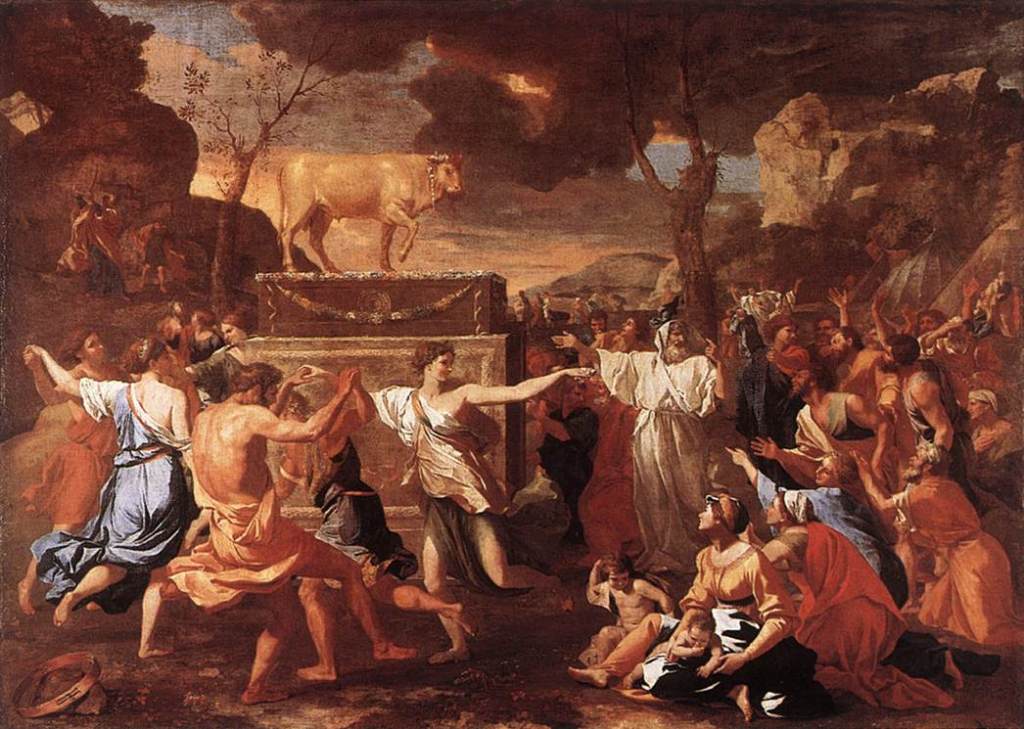
The Adoration of the Golden Calf – Nicholas Poussin

Today, in God’s Lavish Mercy, Aaron, brother of Moses, gets an “F” as a substitute teacher. While Moses is on the mountain negotiating with God for Israel’s future, Aaron caves to the people’s demands and assists them in creating an idol – the infamous “golden calf”.

As Walter Brueggemann says, “All it takes is a little gold to make a god”:

All you need in order to make a god is a measure of the substance that is most valuable in the community, in this case gold…and a mold that can shape the gold. The mold readily available to Aaron is a calf, well, better a “bull” – a symbol and embodiment of virility and fertility, the strength, power, and capacity to generate new life! All you need to make a god is a little gold and a pattern of vitality and fertility that bespeaks self-sufficiency,

Walter Brueggemann – from a Sunday sermon delivered in 2020

Moses was on the mountain for forty days. In his absence, and with God’s silence, the people became frightened. They felt powerless. In that powerlessness, they had a choice: to believe that God would be true to God’s word, or to construct an alternate god of their own design, one that made them feel powerful again. They made the wrong choice.


Praying with this passage today, we might ask ourselves what we do when circumstances render us powerless. What do we do when God seems silent and the supports we have trusted disappear or fail? What do we do when there seems to be no answer to our prayers?

And what is the substance, as Bruegemann notes, most valued in my various communities – the substance most likely to be turned to an idol: reputation, status, resources, influence, political power, physical strength or appearance?

Do we make the mistake of thinking things like this: My power rests in my money, or my looks, or my family name, or my business success, or my intelligence, or my intimidating reputation?

When it comes to the fundamental needs of our lives, none of these things can empower us. Every one of them can fail or disappear. Our only true power lies in God’s unfailing love for us and will for our good. That power is always with us but can be accessed only through faith.


Our Gospel tells us that all one needs is a little faith to ground oneself in the power of God’s love and fidelity..

Jesus proposed a parable to the crowds.
“The Kingdom of heaven is like a mustard seed
that a person took and sowed in a field.
It is the smallest of all the seeds,
yet when full-grown it is the largest of plants.
It becomes a large bush,
and the birds of the sky come and dwell in its branches.”

Matthew 13:31-32

I saw a great graphic on Facebook the other day. It pictured an open hand reaching out with a small speck on the index finger. The caption read:

I have a mustard seed,
and I’m not afraid to use it.


In the absence of a malleable, obeisant god, Israel mistakes their wealth for their god. They mold it into a figure that appears to restore their control over their lives. But they end up with only a clump of unresponsive metal.

God is not a divine butler waiting at the doorway for our next command. The ever-presnt Holy One is sometimes thickly veiled within the circumstances of our lives. It takes faith to stay in relationship with our often silent, but nonetheless abiding God.

Our Gospel tells us that if we have even the smallest seed of that faith, it will root in us and sustain us. And even the smallest measure of “holy yeast” will ferment to the point that others will find in us the inspiration to believe.


Poetry: The Golden Calf by John Newton, (1725 – 1807) who was an English evangelical Anglican cleric and slavery abolitionist. He had previously been a captain of slave ships and an investor in the slave trade. He served as a sailor in the Royal Navy (after forced recruitment) and was himself enslaved for a time in West Africa. He is noted for being author of the hymns Amazing Grace and Glorious Things of Thee Are Spoken.

When Israel heard the fiery law,
From Sinai's top proclaimed;
Their hearts seemed full of holy awe,
Their stubborn spirits tamed.
Yet, as forgetting all they knew,
Ere forty days were past;
With blazing Sinai still in view,
A molten calf they cast.
Yea, Aaron, God's anointed priest,
Who on the mount had been
He durst prepare the idol-beast,
And lead them on to sin.
Lord, what is man! and what are we,
To recompense thee thus!
In their offence our own we see,
Their story points at us.
From Sinai we have heard thee speak,
And from mount Calv'ry too;
And yet to idols oft we seek,
While thou art in our view.
Some golden calf, or golden dream,
Some fancied creature-good,
Presumes to share the heart with him,
Who bought the whole with blood.
Lord, save us from our golden calves,
Our sin with grief we own;
We would no more be thine by halves,
But live to thee alone.

Music: Amazing Grace