Psalm 105: God at the Center

Saturday of the Twenty-seventh Week in Ordinary Time

October 10, 2020


Today, in God’s Lavish Mercy, we pray with Psalm 105, a recounting of the marvelous works God has done from the Abrahamic covenant to the Exodus.

Sing to God, sing praise,
proclaim all God’s wondrous deeds.
Glory in the Holy Name;
rejoice, O hearts that seek the LORD!

Psalm 105: 2-3

Our psalm today enjoins us to remember God’s faithful mercy to us and to praise God as we remember.

Such sacred “remembering” is an act of radical faith which, first, recognizes God as the Center of our life, and second, acts from that radical awareness.


The word “obedience”, so commonly misconstrued as subservience, is another way of describing this radical faith which hears, listens, acknowledges, responds and centers itself on the voice of God. The word “obedience” comes from the same root as the word “listen”.

This freely-given and continually deepened obedience allows us to hear and discern the loving truth God weaves through our lives.

The counter-world of the Psalms contradicts our closely held world of amnesia and mediates to us a world of lively remembering….
… In Psalm 105, a long recital of the great deeds climaxes, “in order that they might keep his statutes and observe his laws” (v. 45). The purpose of remembering is thus to evoke a contemporary practice of obedience in the wake of the memory. The implied negative is that when the inventory of miracles is forgotten, there will be no contemporary obedience .

Walter Brueggemann, From Whom No Secrets Are Hid

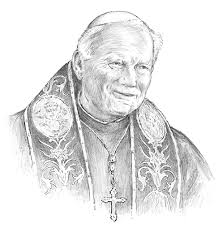
In the encyclical Fratelli Tutti, Pope Francis points out how this obedience, (this holy remembering, listening and acting), is tied to the course of human affairs. Francis quotes JPII here:

In this regard, I wish to cite the following memorable statement: “If there is no transcendent truth, in obedience to which the human person achieves full identity, then there is no sure principle for guaranteeing just relations between people. Their self-interest as a class, group or nation would inevitably set them in opposition to one another. If one does not acknowledge transcendent truth, then the force of power takes over, and each person tends to make full use of the means at their disposal in order to impose personal interests or opinion, with no regard for the rights of others… The root of modern totalitarianism is to be found in the denial of the transcendent dignity of the human person who, as the visible image of the invisible God, is therefore by very nature the subject of rights that no one may violate – no individual, group, class, nation or state.

St. John Paul II, Encyclical Letter Centesimus Annus (1 May 1991)

Rootedness in this “remembering obedience” begins with each person’s own sincere prayer. With the psalmist, let us remember God’s loving fidelity to us and, in grateful response, live that Love faithfully into our conflicted world:

Look to the LORD’s strength;
seek to serve the Lord constantly.
Recall the wondrous deeds that God has wrought,
the signs, and the graces God has spoken in your life.

Psalm 105: 4-5

Poem: Called to Become – Edwina Gateley

You are called to become
A perfect creation.
No one else is called to become
Who you are called to be.
It does not matter
How short or tall
Or thick-set or slow
You may be.
It does not matter
Whether you sparkle with life
Or are as silent as a still pool.
Whether you sing your song aloud
Or weep alone in darkness.
It does not matter
Whether you feel loved and admired
Or unloved and alone
For you are called to become
A perfect creation.
No one's shadow
Should cloud your becoming.
No one's light
Should dispel your spark.
For the Lord delights in you.
Jealously looks upon you
And encourages with gentle joy
Every movement of the Spirit
Within you.
Unique and loved you stand.
Beautiful or stunted in your growth
But never without hope and life.
For you are called to become
A perfect creation.
This becoming may be
Gentle or harsh.
Subtle or violent.
But it never ceases.
Never pauses or hesitates.
Only is—
Creative force—
Calling you
Calling you to become
A perfect creation.

Music: Psalm 105 – Give Thanks – Sean Dayton
Psalm 111: Make It Personal

Friday of the Twenty-seventh Week in Ordinary Time

October 9, 2020

Today, in God’s Lavish Mercy, we pray with Psalm 111, an elegant and simple hymn of praise to God.

Wikipedia says that the psalm praises God for a few specific things:

  • God’s great works v.2
  • God’s enduring Righteousness v.3
  • God’s grace and compassion v.4
  • God’d provision v.5
  • Truth and Justice v.7
  • Redemption for God’s people v.9
  • Granting of wisdom to those who revere God v.10

As I pray this psalm this morning, I will thank and praise God for these things. But I also want to be more personal in my gratitude, to thank God for the elegant Divine Presence in my life and in our world.

  • How blessed are we even to have been born, let alone loved, sanctified, and redeemed by God!
  • How blessed are we to know God and to seek the depths of God in our lives!
  • How blessed are we to share our moment in time with other beloveds of God who enrich and challenge us!
  • How blessed are we to be enlivened with the exquisite grace of God’s own life, and to know that our eternity will be the fulfillment of that grace!

Poem: Grace by Wendell Berry

Music: Arioso, Cantata 156 – Johann Sebastian Bach played by Susanne Beer

Our Lady of the Rosary

Memorial of Our Lady of the Rosary

October 7, 2020

Today, in God’s Lavish Mercy, we pray with Psalm 117. Since it is also the Memorial of Our Lady of the Holy Rosary, I’ll refer you to a previous post on Psalm 117.


For today, the Feast of the Holy Rosary, we may wish to focus on that venerable prayer which had its origins in the very early Church. In fact, those early versions of a rosary are connected to the Psalms:

Prayers with beads like the rosary may have begun as a practice by the laity to imitate the Christian monasticism of the Liturgy of the Hours during the course of which the monastics prayed the 150 Psalms daily. As many of the laity could not read, they substituted 150 repetitions of the Our Father for the Psalms, sometimes using a cord with knots on it to keep an accurate count.
(The Catholic Encyclopedia)


The shape of the rosary as we pray it today emerged more clearly in the 13th century as Marian devotion blossomed in the Church. The tendency of that devotion was to place Mary, and other saints, between us and God. They, having already gained heaven, were deemed to have intercessory power we lacked. So praying the rosary became an “asking prayer” rather than a meditation on the whole of Christ’s life. In many ways, our relationship with Mary also took on a sentimentalism which lessened her true and unique power as witness and companion in the Communion of Saints.


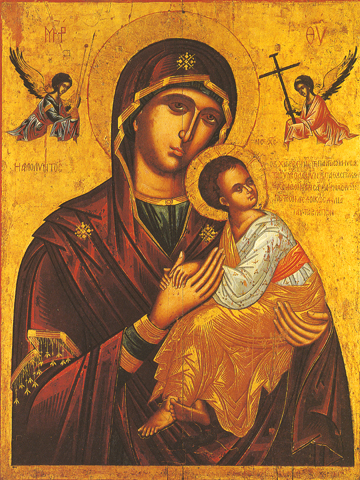
Theotokos of the Passion – 17th century

Today, Marian theology, as well as rosary devotion, looks to a clearer understanding of Mary’s role as participant in the continuing redemptive act of Jesus. Praying with her, in any form, is an opportunity to experience Jesus from her perspective and to apply that grace to our own life and world.

“Remembering Mary as a friend of God and prophet in the communion of saints, a woman who is truly sister to our strivings, allows the power of her life to play in the religious consciousness of the church, encouraging ever-deeper relationship with the living God in whom our spirits rejoice, and allying us with God’s redemptive designs for the hungry, the lowly, and all those who suffer, including in an unforgettable way women with their children in situations of poverty, prejudice, and violence.”

Elizabeth Johnson, CSJ – Truly Our Sister

I try, as I pray the rosary, to imagine Mary within each particular mystery or circumstance of Christ’s life. What did she experience? How did she grow in grace? What is she guiding me toward in my relationship with God?

I also ask Mary to allow those graces and insights to bless and heal not only my life but the life of the world, particularly where there is great pain or suffering for women and children.


In Whom We Live and Move and Have Our Being
~ Denise Levertov
(Reading this poem, we may think of our prayer as a “breathing” enveloped in the Presence of God. The “holy ones”, like Mary, easily ride that breath of prayer. When we pray with them, as in the Rosary, they “rock” us into the silent rhythm of God.)

Photographer: Johannes Plenio
Birds afloat in air's current,
sacred breath?  No, not breath of God,
it seems, but God
the air enveloping the whole
globe of being.
It's we who breathe, in, out, in, in the sacred,
leaves astir, our wings
rising, ruffled -- but only the saints
take flight.  We cower
in cliff-crevice or edge out gingerly
on branches close to the nest.  The wind
marks the passage of holy ones riding
that ocean of air.  Slowly their wake
reaches us, rocks us.
But storms or still, 
numb or poised in attention,
we inhale, exhale, inhale,
encompassed, encompassed.

Music: Beneath Your Compassion (Sub Tuum Praesidium) performed here in Russian by the PaTRAM Institute Singers

The oldest known devotion to Mary can be found in the words of a hymn that is documented to have existed and been sung before the middle of the 3rd century. 

Beneath your compassion,
We take refuge, O Theotokos:
do not despise our petitions in time of trouble;
but rescue us from dangers,
only pure, only blessed one.

Psalm 139: Life Knitter

Tuesday of the Twenty-seventh Week in Ordinary Time

October 6, 2020


Today, in God’s Lavish Mercy, we pray with Psalm 139 with its powerful image of God, the Life Knitter.

This psalm is hauntingly beautiful as it carries us in prayer to the moment of our own incarnation. We are awed by the thought of God touching us into life deep in the darkness of our mother’s womb.


Paul, in our first reading, says that even from that first moment, he was “set apart and called through grace.”

Every one of us receives the same divine mark as Paul. Every one of our lives is known full well in God’s love:

My soul also you knew full well;
nor was my frame unknown to you
When I was made in secret,
when I was fashioned in the depths of the earth.


Praying with this psalm, I am profoundly aware of the “life issues” at the root of U.S. culture and politics which face us in this election. I place myself before my Creator as I grapple with my abhorrence of abortion and my deep commitment to a “whole life” morality.

The document I share below has guided me as I try to faithfully discern the best moral choice in voting. As the document points out, “Faith does not fit into political parties neatly”. Indeed there is currently no party platform that fully and perfectly responds to the moral demands of our faith. Yet that faith requires that we participate in the political process of moving toward such a response.

Faithful voters are presented with a dilemma in the fullest sense of that word, that is, ” a circumstance in which a choice must be made between two or more alternatives that seem equally undesirable.”

Still, it is not enough to abandon our discernment to a single-issue mentality.

Besides considering the whole range of life and justice concerns, we must calculate the moral character of those we choose to govern and set national policy:

  • their honesty, compassion, decency, respect, toward all people; 
  • their capacity for mutuality, dialogue, and peace-building; 
  • their “economics morality”, (i.e. who shares in the basic rights necessary for a decent life)
  • their vision of democracy, human rights, and international power
  • their compatibility with the total legacy of Catholic social teaching

As we pray with Psalm 139 today, let us bring our concerns and hopes to God and ask for inspiration and courage.

Click below for the voting discernment document Equally Sacred Priorities


Poem: Invocation by Everett Hoagland

(Originality from Philadelphia, PA, Hoagland was Poet Laureate of New Bedford, MA 1994-1998. He is Professor Emeritus at UMass Dartmouth.)

Architect of icebergs, snowflakes,
crystals, rainbows, sand grains, dust motes, atoms.

Mason whose tools are glaciers, rain, rivers, ocean.

Chemist who made blood
of seawater, bone of minerals in stone, milk

of love. Whatever

You are, I know this,
Spinner, You are everywhere, in All The Ever-
Changing Above, whirling around us.

Yes, in the loose strands,
in the rough weave of the common

cloth threaded with our DNA on hubbed, spoked
Spinning Wheel that is this world, solar system, galaxy,

universe.

Help us to see ourselves in all creation,
and all creation in ourselves, ourselves in one another.

Remind those of us who like connections
made with similes, metaphors, symbols
all of us are, everything is
already connected.

Remind us as oceans go, so go we. As the air goes, so go we.
As other life forms on Earth go, so go we.

As our planet goes, so go we. Great Poet,
who inspired In The Beginning was The Word . . . ,

edit our thought so our ethics are our politics,
and our actions the afterlives of our words.”

Music: I Cannot Hide from You

Psalm 119: A Living, Tender Love

Saturday of the Twenty-sixth Week in Ordinary Time

October 3, 2020


Today, in God’s Lavish Mercy, we pray with Psalm 119 – the longest psalm, as you might remember from one of my seven previous reflections on this rich piece of scripture.

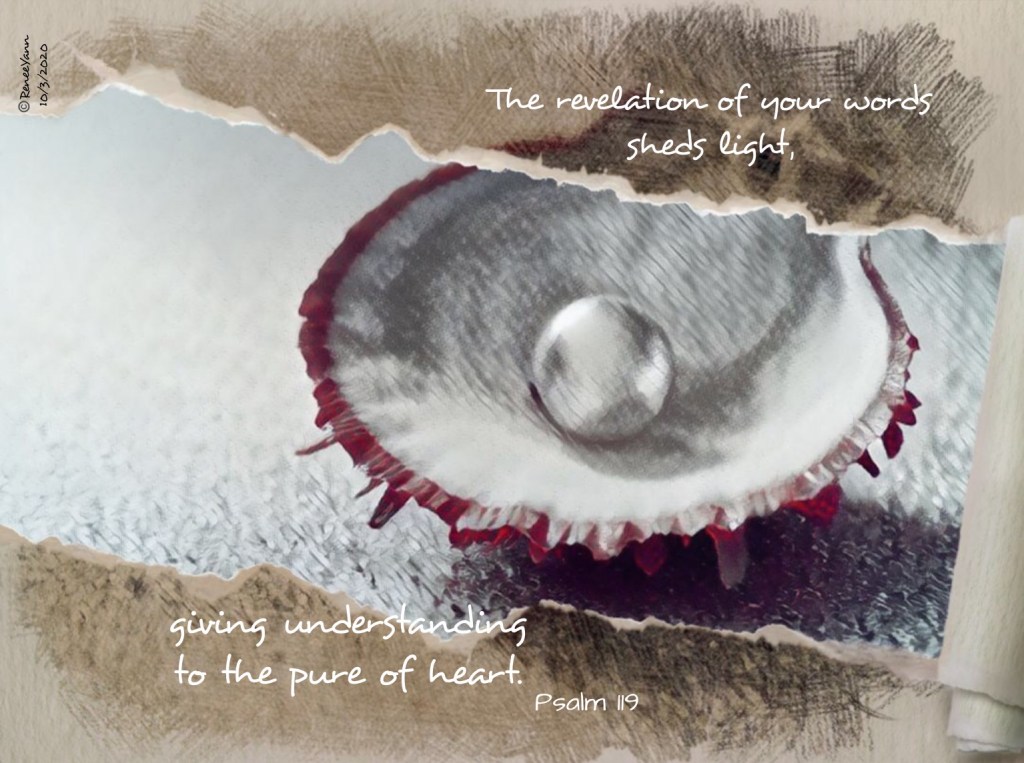
From that wealth, we pluck this one pearl today:

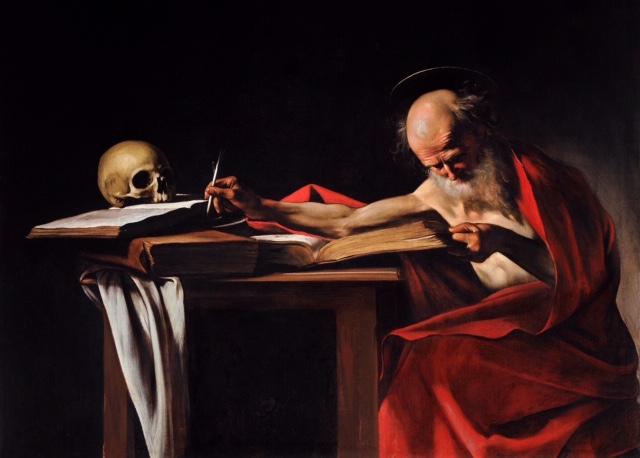
I focus on this phrase to bring our attention to a beautiful document issued by Pope Francis on September 30th, the feast of St. Jerome: APOSTOLIC LETTER – SCRIPTURAE SACRAE AFFECTUS (Devotion to Sacred Scripture)

In this letter, our Holy Father describes scriptural devotion as “a living and tender love”. As we pray the scriptures each day, we ask that Love to form and instruct our hearts.

Lord, let your face shine on me.
Teach me wisdom and knowledge,
for in your commands I trust.

Pope Francis’s letter is an interesting exposition on the life and spirituality of Jerome sixteen hundred years after his death. I enjoyed reading it. But what I benefitted from most was the Pope’s encouragement to school our own hearts in a passion and pursuit of scripture. We can all learn from Francis’s words such as these:

This present anniversary can be seen as a summons to love what Jerome loved, to rediscover his writings and to let ourselves be touched by his robust spirituality, which can be described in essence as a restless and impassioned desire for a greater knowledge of the God who chose to reveal himself. 

How can we not heed, in our day, the advice that Jerome unceasingly gave to his contemporaries: “Read the divine Scriptures constantly; never let the sacred volume fall from your hand”?

A radiant example of this is the Virgin Mary, evoked by Jerome above all as Virgin and Mother, but also as a model of prayerful reading of the Scriptures. Mary pondered these things in her heart (cf. Lk 2:19.51) “because she was a holy woman, had read the sacred Scriptures, knew the prophets, and recalled that the angel Gabriel had said to her the same things that the prophets had foretold… 

She looked at her newborn child, her only son, lying in the manger and crying. What she saw was, in fact, the Son of God; she compared what she saw with all that she had read and heard”. Let us, then, entrust ourselves to Our Lady who, more than anyone, can teach us how to read, meditate, contemplate and pray to God, who tirelessly makes himself present in our lives.

Music: Word of God Speak – Mercy Me

Psalm 139: Pray with the Angels

Memorial of the Holy Guardian Angels

October 2, 2020


Today, in God’s Lavish Mercy, we pray with Psalm 139, one of the most beautiful psalms. It is a perfect choice for the feast of the Guardian Angels, those magnificent beings who carry God’s Presence to us in every situation of our lives.

Where can I go from your spirit?
From your presence where can I flee?
If I go up to the heavens, you are there;
if I sink to the nether world, you are present there.

If I take the wings of the dawn,
if I settle at the farthest limits of the sea,
Even there your hand shall guide me,
and your right hand hold me fast.

Angels are woven throughout the scriptures. They are mentioned nearly 300 times. I found this website so interesting. I enjoyed going over the stories, some of which I had never noticed before.


But today, what we celebrate is that each one of us has our own Guardian Angel. We might think of that Being as a friend, a guide, a protector, a bridge to the Divine, an inspirer.

Maybe the only angels we ever think about are chubby little cherubs on Christmas cards. The cultural tendency to represent angels in that way diminishes the real power of these mighty and loving beings to inspire and guide us. Today might be a day to rethink our relationship with our Guardian Angels.

Poem: Touched by an Angel by Maya Angelou 

We, unaccustomed to courage
exiles from delight
live coiled in shells of loneliness
until love leaves its high holy temple
and comes into our sight
to liberate us into life.
Love arrives
and in its train come ecstasies
old memories of pleasure
ancient histories of pain.
Yet if we are bold,
love strikes away the chains of fear
from our souls.
We are weaned from our timidity
In the flush of love's light
we dare be brave
And suddenly we see
that love costs all we are
and will ever be.
Yet it is only love
which sets us free

Music: Angel’s Serenade – Gaetano Braga

Psalm 27: Seek God’s Face

Memorial of Saint Thérèse of the Child Jesus, Virgin and Doctor of the Church

October 1, 2020

Today, in God’s Lavish Mercy, we pray with Psalm 27 – and gosh, did I need it!

I believe that I shall see the bounty of the LORD
in the land of the living.
Wait for the LORD with courage;
be stouthearted, and wait for the LORD.

I woke up this morning still half sick from watching last night’s “debate”. I fully agree with this estimation from Jon Meacham:


“No hyperbole: The incumbent’s behavior this evening
is the lowest moment in the history of the presidency
since Andrew Johnson’s racist state papers.”


(Jon Meacham, the 2009 Pulitzer Prize for Biography for American Lion: Andrew Jackson in the White House. Meacham holds the Carolyn T. and Robert M. Rogers Endowed Chair in American Presidency at Vanderbilt University)


I care about how my country’s leadership has degenerated. I care about how that collapse affects all of our lives especially poor, sick, and marginalized persons. It is painful to witness a situation where leadership suffers from an egregious forfeiture of responsibility and care for anything but its own self-interests.

It’s very hard to find prayer’s central clarity
when a dysfunctional world spins around us.
I asked myself today,:
“Can Psalm 27 help me?
Can the Little Flower shed some light for me?”.


Psalm 27 is a prayer that moves from relentless hope to deeply rooted faith. It is a remedy I crave.

Hear my voice, LORD, when I call;
have mercy on me and answer me.
“Come,” says my heart, “seek God’s face”;
your face, LORD, do I seek!


Walter Brueggemann places great emphasis on verse 27:3 and the particular word “though”….

Though an army encamp against me,
my heart does not fear;
Though war be waged against me,
even then do I trust.

Bruggemann says this:

I suggest that the psalm pivots in verse 3 on the word “though,” which is an act of defiance. It is a bold and brave “nevertheless, notwithstanding”…
… This “though” is a well-grounded, adamant refusal to participate in the anxiety that is all around.


St. Thérèse of Lisieux wasn’t into “politics” as we commonly define the term. But her life in the abbey presented a good deal of human “politics” which challenged her spiritual growth. Here are a few quotes that I plan to pray with today to invite their blessings on my own anxieties, and to listen for where they might call me to hope, trust and faith, as well as productive, not fretful, action. You might like to do the same.

My whole strength lies in prayer and sacrifice, these are my invincible arms; they can move hearts far better than words, I know it by experience. 
― The Little Way for Everyone Day: Thoughts from Thérèse of Lisieux

Joy is not found in the things which surround us, but lives only in the soul. 
― The Story of a Soul: The Autobiography of St. Thérèse of Lisieux

It is wrong to pass one’s time in fretting, instead of sleeping on the Heart of Jesus. 
― ibid.


In place of a poem today, this tidbit about Psalm 27 from Pope John Paul II:

The faithful know that being consistent creates ostracism and even provokes 
contempt and hostility in a society that often chooses to live under the banner 
of personal prestige, ostentatious success, wealth, unbridled enjoyment. 
They are not alone, however, and preserve a surprising interior peace in their hearts because, as the marvellous “antiphon” that opens the Psalm says, 
“the Lord is light and salvation… the stronghold of life” (cf. Ps 27: 1) of the just. 
He continuously repeats: “Whom shall I fear?”, “Of whom shall I be afraid?”, 
“My heart shall not fear”, “Yet I will trust” (cf. vv. 1, 3).
JOHN PAUL II- GENERAL AUDIENCE
Wednesday, 21 April 2004

Music: The Lord is My Light and My Salvation – Haas and Haugen 

Refrain: The Lord is my light and my salvation, of whom shall I be afraid?

The Lord is my light and my help; whom should I fear?The Lord is the stronghold of my life; before whom should I shrink?

There is one thing I ask of the Lord; for this I long;
to live in the house of the Lord all the days of my life.

I believe I shall see the goodness of the Lord, in the land of the living;
hope in him and take heart, hope in the Lord!

Psalm 88: Outlook Gloomy

Memorial of Saint Jerome, Priest and Doctor of the Church

September 30, 2020

Today, in God’s Lavish Mercy, we pray with Psalm 88. It’s supposed to be a gloomy, rainy day around here where I live, and Psalm 88 isn’t going to help! It is the desperate prayer of one who hears no answer from God:

But I, O LORD, cry out to you;
with my morning prayer I wait upon you.
Why, O LORD, do you reject me;
why hide from me your face?


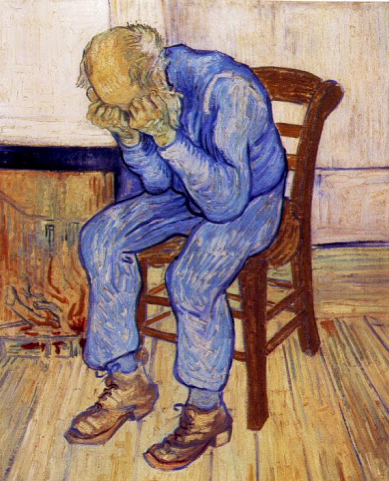
Sorrowful Man – Vincent Van Gogh

According to Martin Marty, a professor of church history at the University of Chicago,
Psalm 88 is “a wintry landscape of unrelieved bleakness.”
Psalm 88 ends by saying:
You have taken my companions and loved ones from me; 
the darkness is my closest friend.
Indeed, in Hebrew the last word of the psalm is “darkness”.
~ from Wikipedia


Also from Wikipedia:

J.M.Neale and R.F. Littledale, writing in the 19th century, find that Psalm 88 “stands alone in all the Psalter for the unrelieved gloom, the hopeless sorrow of its tone. Even the very saddest of the others, and the Lamentations themselves, admit some variations of key, some strains of hopefulness; here only all is darkness to the close.”


Gratefully, I have seldom been in the place of this psalm … but that doesn’t mean never. Many of you, I imagine, could say the same.

So what do we do when life, by our choices or despite them, finds us irrevocably caught in spiritual darkness? What happens to us when we think God isn’t listening to our prayer, or maybe that there was never any God in the first place?

St. John of the Cross says this:

Live in faith and hope,
though it be in darkness,
for in this darkness God protects the soul.
Cast your care upon God
for you are His and He will not forget you.
Do not think that He is leaving you alone,
for that would be to wrong Him.

John’s further writings show us that this darkness, rather than alienate John from God, was the source of unparalleled union with God.

May we be blessed in the same way.🙏


One dark night, 
Kindled in love with yearnings—oh, happy chance!— 
I went forth without being observed, 
My house being now at rest.
In darkness and secure, 
By the secret ladder, disguised—oh, happy chance!—
In darkness and in concealment, 
My house being now at rest.
In the happy night, 
In secret, when none saw me,
Nor I beheld aught, 
Without light or guide, save that which burned in my heart.
This light guided me 
More surely than the light of noonday
To the place where he (well I knew who!) was awaiting me— 
A place where none appeared.
Oh, night that guided me, 
Oh, night more lovely than the dawn,
Oh, night that joined Beloved with lover, 
Lover transformed in the Beloved!
~ John of the Cross

Poetry: Sorrow – Renee Yann, RSM

You must be alone
    with sorrow
    before you can leave it,
    or it will crush you
    like a dark, heavy rock.

    You must drive into
    the hollow of its face,
    under the ledges
    it projects against you.
    Feel its cold granite
    pressed to your grain.

    In time,
    it will allow your turning
    to rest your back
    within its curve.

    Only then,
    you will be free to leave it,
    walking lightly once again
    on yielding earth.

    When you return, it will be freely,
    on a pilgrimage,
    to touch the name you carved once
    in your heart’s anguish.

Music: Holy Darkness – John Michael Talbot

Psalm 138: Heart Waves

Feast of Saints  Michael, Gabriel, and Raphael, archangels

September 29, 2020

Today, in God’s Lavish Mercy, we pray with Psalm 138, a lilting hymn of praise to God.

I will give thanks to you, O LORD, with all my heart,
for you have heard the words of my mouth;
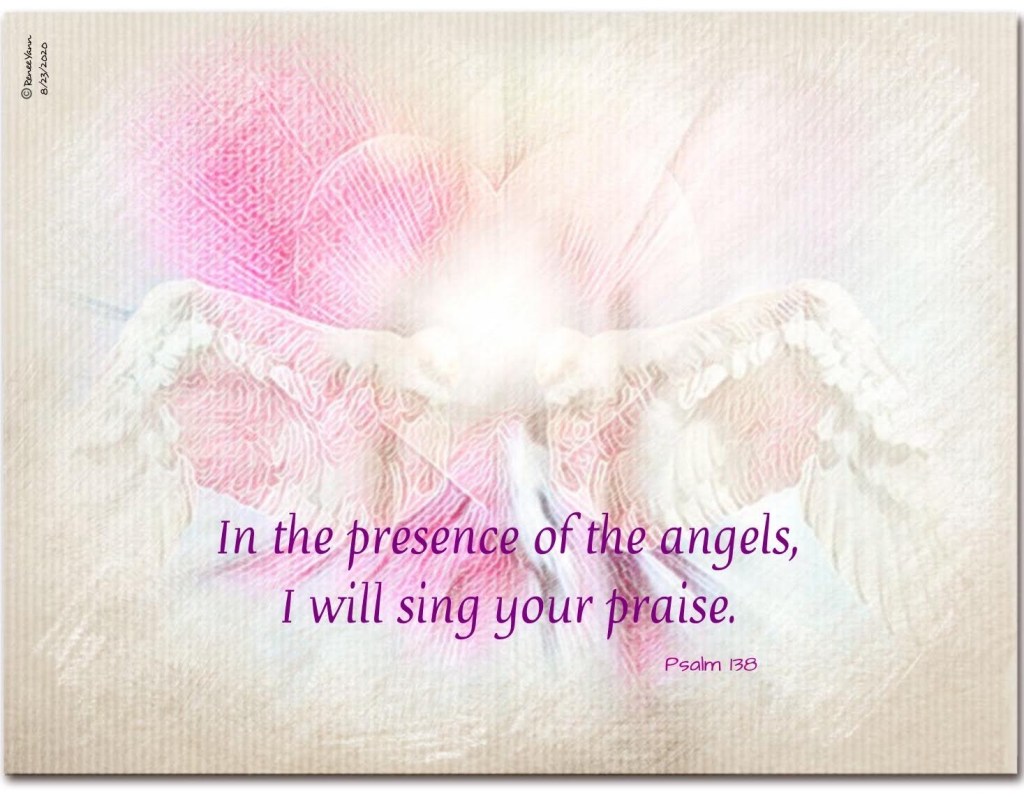
in the presence of the angels I will sing your praise;
I will worship at your holy temple
and give thanks to your name.


From the time I grew up in my beloved parish of St. Michael’s Church, I have always loved this feast and its prayers and readings. The thought of angels as our friends and champions was very much a part of our early education.

St. John’s vision, as recounted in our readings from Revelation and Daniel today, was depicted in a huge mural at the church’s side altar. And, as most parishes in those pre-Vatican II times, we said the prayer to St. Michael at the end of every Latin Mass.


So Michael, who has no body, no gender, and never held a sword, has been my friend for many, many years. And over that long friendship, I have come to know Michael very differently.

The Michael I know now is the Breath of God, very much like me, but breathed into a different form of beauty. God lives in the angels the way God lives in music, nature, color, emotion, poetry, and virtue. No form can fully hold such a Spirit. It permeates, embraces and uplifts that which it meets in love.

The angels’ songs are beyond our human hearing, but not beyond our understanding. They sound like those deep heart waves that we can never express – the love too deep for words, the sorrow beyond tears, that mingling with nature that silences us, the irrational but invincible hope, the faith that cannot be broken.

It is within those heart waves that I have come to know Michael who sings with and for me to our beautiful God.


Prayer to St. Michael:

written, in Latin, by Pope Leo XIII. Below is the prayer as it was prayed in Ireland, as quoted in James Joyce’s Ulysses. We used this translation too in my very Irish parish.🙏❤️

St Michael the Archangel, defend us in battle, 
be our protection against the wickedness and snares of the devil; 
may God rebuke him, we humbly pray; 
and do thou, O Prince of the heavenly host, 
by the power of God, cast into hell Satan 
and all the evil spirits who prowl through the world 
seeking the ruin of souls. Amen.”

Music:  Confitebor tibi, Domine – Psalm 138 by Josef Rheinberger

Latin text
Confitebor tibi, Domine, in toto corde meo.
Retribue servo tuo, ut vivam et custodiam sermones tuos.
Vivifica me secundum verbum tuum, Domine

English translation
I will praise thee, O Lord, with my whole heart,
O do well unto thy servant, that I may live, and keep thy word:
Quicken me according to thy word, O Lord

Psalm 17: A Re-visit

Monday of the Twenty-sixth Sunday in Ordinary Time

September 28, 2020

Today, in God’s Lavish Mercy, we again meet Psalm 17, so …

But a new poem and song for your prayer today:

Poetry: Anxious One – Ranier Maria Rilke

I am, O Anxious One. Don't you hear my voice
surging forth with all my earthly feelings?
They yearn so high, that they have sprouted wings
and whitely fly in circles round your face.
My soul, dressed in silence, rises up
and stands alone before you: can't you see?
don't you know that my prayer is growing ripe
upon your vision as upon a tree?
If you are the dreamer, I am what you dream.
But when you want to wake, I am your wish,
and I grow strong with all magnificence
and turn myself into a star's vast silence
above the strange and distant city, Time. 

Music: Hear My Prayer by Moses Hogan, sung by Callie Day, noted for her amazing polyoctive range. And the accompanist is pretty remarkable too!

O Lord, please hear my prayer; In the morning when I rise.
—It’s your servant bound for glory. O dear Lord, please hear my prayer.
O Lord, please hear my prayer. Keep me safe within your arms.
—It’s your servant bound for glory. O dear Lord, please hear my prayer.
When my work on earth is done, And you come to take me home.
—Just to know I’m bound for glory; And to hear You say, “Well done!”
Done with sin and sorrow. Have mercy. Mercy.