Holy Innocents

December 28, 2021

Today, in Mercy, we are lifted to Light by John’s sacred words in our first reading:

Beloved:
This is the message that we have heard from Jesus Christ
and proclaim to you:
God is light, and in God there is no darkness at all.

1 John 1:5

Simply hearing it, we long to abide in that whole and healing Light.


But then we read our Gospel, among the saddest accounts in all of Scripture – the slaughter of the Holy Innocents. Their needless deaths come at the hands of a power-crazed and fearful man.  So hungry for his own aggrandizement, he tries to assure it by killing a generation of children.

It sounds impossible, doesn’t it, that anyone could be so hardened by evil? It sounds impossible that good people would execute this order of a mad man! It sounds impossible that human beings could be so blind to the sanctity of another’s life!


Dear friends, we must confront our own blindness. We must look into the eyes of our 21st century children – the border children, the victims of school shootings, the children of Yemen, Syria, Afghanistan … the children of war, violence, drugs and poverty.

We must hear the cry of God, their Mother, and choose legislators and leaders who will honor life; who will shape global policies and relationships recognizing the common life we share in God – who will make true pro-life choices regarding gun control, arms sales, and an economy of endless war.

Our attitudes, our advocacy and our votes will either condemn or exonerate us when that Great Light ultimately reveals our hearts. When a society’s children become the victims of its indefensible corruption, we must say “Enough!” and act on our word.


Poetry: Holy Innocents by Christina Rossetti – 1830-1894
We might offer this wish and prayer for all the world’s children.


Sleep, little Baby, sleep;
The holy Angels love thee,
And guard thy bed, and keep
A blessed watch above thee.
No spirit can come near
Nor evil beast to harm thee:
Sleep, Sweet, devoid of fear
Where nothing need alarm thee.

The Love which doth not sleep,
The eternal Arms surround thee:
The Shepherd of the sheep
In perfect love hath found thee.
Sleep through the holy night,
Christ-kept from snare and sorrow,
Until thou wake to light
And love and warmth to-morrow.


Music: The Mediaeval Baebes – Coventry Carol

The “Coventry Carol” is an English Christmas Carol dating from the 16th century. The carol was traditionally performed in Coventry, England as part of a mystery play called “The Pageant of the Shearmen and Tailors”. The play depicts the Christmas story from chapter two in the Matthew’s Gospel. The carol itself refers to the massacre of the Holy Innocents in which Herod ordered all male infants under the age of two in Bethlehem to be killed, and takes the form of a lullaby sung by mothers of the doomed children.
(Information from Wikipedia)

Lullay, Thou little tiny child
By, by, lully, lullay.
Lullay, Thou little tiny Child.
By, by, lully, lullay.
O sisters, too, how may we do,
For to preserve this day;
This poor Youngling for whom we sing,
By, by, lully, lullay.
Herod the King, in his raging,
Charged he hath this day;
His men of might, in his own sight,
All children young, to slay.
Then woe is me, poor Child, for Thee,
And ever mourn and say;
For Thy parting, nor say nor sing,
By, by, lully, lullay.

Sacred Tears

November 18, 2021
Thursday of the Thirty-third Week in Ordinary Time

Today, in God’s Lavish Mercy, we pray with Psalm 50, “a prophetic imagining of God’s judgement on the Israelites”. (Wikipedia)

Our first reading from the Book of Maccabees introduces us to Mattathias, revered leader of the Jews in the city of Modein. He violently refuses the Greek Seleucid command to worship their gods, thus initiating the Maccabean Revolt. The wars lasted nearly a decade. Final victory is commemorated in the Feast of Hanukkah:

The Jewish festival of Hanukkah celebrates the re-dedication of the Temple following Judah Maccabee’s (Mattathias’s son)victory over the Seleucids. According to tradition, victorious Maccabees could find only a small jug of oil that had remained pure and uncontaminated by virtue of a seal, and although it contained only enough oil to sustain the Menorah for one day, it miraculously lasted for eight days, by which time further oil could be procured. (Wikipedia)

Our first reading is really describing the beginning of civil and intercultural wars by which dedicated Jews sought to establish both their religion and their nation. Core to their motivation was the desire to be in relationship with their one God according to their own custom and law.


In our Gospel, Jesus has come as the full manifestation of that One God. He has invited the Jewish people to a new and complete relationship with God, but they have resisted.

Now, as he nears his final fate in Jerusalem, Jesus realizes that his dream for the People will not be fully realized. They will experience a destruction like the one once feared by Mattathias. The reality causes Jesus to weep.

Are the passages only about the Jews, their religion and their history?

For us, these passages are about choosing a faithful,
evolving relationship with God
– a relationship that will demand truth,
action and at times suffering
as we pursue ever deeper understanding
of God’s Presence in our lives.

Our world and its culture place many godless choices before us, choices that could make Jesus weep because of the suffering they cause others. These choices are not as easy to identify as they were in the time of Mattathias. They don’t come dressed as a pagan soldier ready to quash our resistance.

They come in the large subtleties of politics, economics, human rights, global relationships. These choices show themselves in the small exercise of our respect, care, and reverence for all Creation. But they do come to us in every moment and they demand our witness.

Jesus wants the new Kingdom to rise in us when we open our hearts to his Word. It is an ongoing and daily Resurrection. Let’s pray for the courage for it!


Poetry: The World Is Too Much with Us – William Wordsworth

Wordsworth wrote this poem during the Industrial Revolution when he felt the complexities of the world were inhibiting our appreciation of the sacredness of nature.

The world is too much with us; late and soon,
Getting and spending, we lay waste our powers;—
Little we see in Nature that is ours;
We have given our hearts away, a sordid boon!
This Sea that bares her bosom to the moon;
The winds that will be howling at all hours,
And are up-gathered now like sleeping flowers;
For this, for everything, we are out of tune;
It moves us not. Great God! I’d rather be
A Pagan suckled in a creed outworn;
So might I, standing on this pleasant lea,
Have glimpses that would make me less forlorn;
Have sight of Proteus rising from the sea;
Or hear old Triton blow his wreathèd horn.

Music:  When Jesus Wept – William Billings

One of the most well-known of the early American canons, originally appeared in the New England Psalm Singer. It was written in 1770 by William Billings, a self-taught singing-school teacher and composer who served as choir leader at Old South Church in Boston.

(Lyrics below)

When Jesus wept, the falling tear
In Mercy flowed beyond all bound;
When Jesus groaned at rambling fear
Seized all the guilty world around.

Per a valued friend:

There is a statue in Oklahoma City called “Jesus Wept.”  It is on the grounds of St. Joseph Church in the city – which is right across from where the Oklahoma City Federal Building had been located.  The people of the parish wanted to erect the statue on their grounds because the memorial on the federal property couldn’t be religious.  It is a very moving statue.

Confident Hope

Wednesday, November 4, 2021
Memorial of St. Charles Borromeo

Today, in God’s Lavish Mercy, we pray with Psalm 27:


Our scripture passages are all about confidence in our salvation.

Do you have that confidence?
Do you ever wonder if you’re going to get to heaven?
Maybe even worry about it a little?


If so, today’s readings are for you.

Paul tells the faithful:

For if we live, we live for the Lord,
and if we die, we die for the Lord;
so then, whether we live or die, we are the Lord’s.

And Jesus, using the symbol of a lost sheep, counsels the critical Pharisees:

I tell you, in just the same way
there will be more joy in heaven over one sinner who repents
than over ninety-nine righteous people
who have no need of repentance.

Key to both readings is the call to a repentant, Christian life.


Our beautiful Responsorial Psalm captures the joy of the repentant sinner, the very ones for whom Christ died. It’s a beautiful psalm. We might want to just slowly relish it in our prayer today.

R. I believe that I shall see the good things of the Lord in the land of the living.

The LORD is my light and my salvation;
whom should I fear?
The LORD is my life’s refuge;
of whom should I be afraid?

R. I believe that I shall see the good things of the Lord in the land of the living.

One thing I ask of the LORD;
this I seek:
To dwell in the house of the LORD
all the days of my life,
That I may gaze on the loveliness of the LORD
and contemplate his temple.

R. I believe that I shall see the good things of the Lord in the land of the living.

I believe that I shall see the bounty of the LORD
in the land of the living.
Wait for the LORD with courage;
be stouthearted, and wait for the LORD.

R. I believe that I shall see the good things of the Lord in the land of the living.


We might want to turn toward
the searching Shepherd of today’s Gospel
while praying this Psalm of repentance and faith.


Poetry: The Shepherd Boy Sings in the Valley of Humiliation – John Bunyan (1628–1688), a Christian writer and preacher, most famous for The Pilgrim’s Progress.

He that is down needs fear no fall,
He that is low, no pride;
He that is humble ever shall
Have God to be his guide.

I am content with what I have,
Little be it or much:
And, Lord, contentment still I crave,
Because Thou savest such.

Fullness to such a burden is
That go on pilgrimage:
Here little, and hereafter bliss,
Is best from age to age.


Music:  In the Land of the Living – Eric Becker

Zap?

October 23, 2021
Saturday of the Twenty-ninth Week in Ordinary Time

Today, in God’s Lavish Mercy, we pray with Psalm 24 in which the psalmist expresses the heart’s deep longing for God:

Who can ascend the mountain of the LORD?
    or who may stand in that holy place?
The one whose hands are sinless, whose heart is clean,
    who desires not what is vain.
Who shall receive a blessing from the LORD,
    a reward from God the savior.
Such is the race that seeks for God,
    that seeks the face of the God of Jacob.

Psalm 24: 5-6

But achieving those sinless hands and clean heart is not always an easy task. It takes a life focused on faith and rooted in love.

Jesus talks about that focus in today’s Gospel.

Jesus gives us a parable which, at first, appears to say, “Get your act together fast, or God might zap you.” From Jesus’s words, we can assume that some public disasters have recently occurred. Those in the gathered crowd are unnerved by these events.

Jesus uses that nervousness to talk about repentance. He tells the people that tragedy can make us wake up to the fact that life is fragile and fleeting. That awareness should make us want to use our time on earth well, to give glory to God.

The repentance Jesus encourages is not just a contrition, or turning from sin. It is an opening of the soul’s eyes to see our lives and circumstances as God sees them.

Is God going to zap us if we don’t have that kind of repentance? No, I think not.

God is always Mercy …
always, always Mercy.

With the parable of the fruitless fig tree, Jesus assures us that God is with us, giving us every grace and opportunity to bear spiritual fruit. God is patient and nurturing. But, in every human life, there is a limit to the time we have to respond.


Poetry: The Facts of Life – Pádraig Ó Tuama

That you were born
and you will die.

That you will sometimes love enough
and sometimes not.

That you will lie
if only to yourself.

That you will get tired.

That you will learn most from the situations
you did not choose.

That there will be some things that move you
more than you can say.

That you will live
that you must be loved.

That you will avoid questions most urgently in need of
your attention.

That you began as the fusion of a sperm and an egg
of two people who once were strangers
and may well still be.

That life isn’t fair.
That life is sometimes good
and sometimes better than good.

That life is often not so good.

That life is real
and if you can survive it, well,
survive it well
with love
and art
and meaning given
where meaning’s scarce.

That you will learn to live with regret.
That you will learn to live with respect.

That the structures that constrict you
may not be permanently constricting.

That you will probably be okay.

That you must accept change
before you die
but you will die anyway.

So you might as well live
and you might as well love.
You might as well love.


Music: Calm the Soul – Poor Clares Galway

Promise Remembered

Saturday of the Twenty-eighth Week in Ordinary Time
October 16, 2021

Today, in God’s Lavish Mercy, we pray with Psalm 105, a recounting of the marvelous works God has done from the Abrahamic covenant to the Exodus. Indeed, our psalm celebrates God”s faithfulness to Abraham and to all generations, even us!

God remembers forever the sacred covenant
    which God made binding for a thousand generations –

Psalm 105:8

In our reading from Romans, Paul preaches about that Covenantal Promise. The text is a little deep, and I had to dig a bit to get my inspiration. But there are gems in these dense words!

It was not through the law
that the promise was made to Abraham and his descendants
that he would inherit the world,
but through the righteousness that comes from faith.

This is a spiritually freeing passage. It assures us that God is with us through our faith, not through the perfection with which we keep laws and rules.


Our Gospel reinforces the message:

Everyone who speaks a word against the Son of Man will be forgiven,
but the one who blasphemes against the Holy Spirit
will not be forgiven

… the proverbial “bad apple”!

The passage is a little scary when first read, because we all hope we haven’t done anything to offend the Holy Spirit. But I think what Jesus is telling his listeners is this:

If a person criticizes or rejects my life and teaching, forgiveness is still possible when they come to their senses and repent. It’s like cutting the bad spot out of an otherwise good apple.

But if a person chooses to live a life which blasphemes (mocks, dismisses) the Spirit of life, love, mercy and peace, that person can never be forgiven — because they can never repent. They will be rotten to the core.


So the advice of Paul and Jesus boils down to this. Befriend the Holy Spirit by your life of faithful choices. Listen to the Spirit’s inspiration. Help others to do the same. And do not worry when you make a few mistakes. God stands by the promise to be with us always.


Poetry: The Promise Written by Rumi
Translated and read by Fatemeh Keshavarz

(Remember when reading that, for the Sufi mystic poets, everything was about God. Modern users often apply these poetic sentiments to human relationships, but they were not composed in that light.)

When pain arrives side by side with your love
I promise not to flee
When you ask me for my life
I promise not to fight

I am holding a cup in my hand
By God if you do not come
Till the end of time
I promise not to pour out the wine
Nor to drink a sip

Your bright face is my day
Your dark curls bring the night
If you do not let me near you
I promise not to go to sleep…nor rise

Your magnificence has made me a wonder
Your charm has taught me the way of love
I am the progeny of Abraham
I’ll find my way through fire

Please, let me drink water from the jug
This love is not a short-lived fancy
It is the daily prayer, the year-after-year fast
I live it, like an act of worship, till the end of my life

But then, a tree
Blessed not with fruits of your bounty
Will be dry wood for fire
Even if it drinks the ocean

On the wings of the Friend, fly o my heart!
Fly and look upward
For high on the peak of presence
Earthlings like you will not be let in

Others praise God at the time of affliction
You stay awake day and night
Steady, watchful like the wheel of the firmament

Time to stop speaking of the Friend
Jealousy won’t let me scatter the perfume to the wind


Music: Spirit of the Living God – Divine Hymns

Thursday of the Eighteenth Week in Ordinary Time

Thursday, August 5, 2021

Today, in God’s Lavish Mercy, we pray with Psalm 95. 

This psalm and our other readings today are filled with rocks. So that seems to be the symbol speaking to us today.

Photo by Pixabay on Pexels.com

Psalm 95 is a summons to rejoice, but laced within it are stern reminders to remember and repent.

Oh, that today you would hear his voice:
    “Harden not your hearts as at Meribah,
    as in the day of Massah in the desert,
Where your forebearers tested me;
    they tested me though they had seen my works.”

Psalm 95: 8-9

The rock referred to in the psalm is the one Moses struck to release the waters. It is a contentious episode where the Israelites test God and Moses wavers in his faith.

These are the waters of Meribah,
where the children of Israel contended against the Lord,
and where the LORD’s sanctity was revealed among them.

Numbers 20:13

On the other hand, the rock in our Gospel passage refers to the strength and stability Peter receives and which will endure through the ages.

And so I say to you, you are Peter,
and upon this rock I will build my Church,
and the gates of the netherworld shall not prevail against it.

Matthew 16:18
Latin inscription on dome of St. Peter’s Basilica in Rome – ” Tu es Petrus — You are Peter and upon this rock…”

So the “rock”, like any symbol, takes its meaning and relevance from the circumstances which surround it. 

This is true as well  for the “rocks” we meet in our own lives. Some are sources of strength, some nearly insurmountable obstacles.  Some are a test, some a consolation.

Praying with today’s psalm and other readings, we might take the time to reflect on our current or past “rocks”. 

May we realize and gratefully remember how God gives life-giving water even from these seemingly unyielding sources.


Poetry: Sorrow – Renee Yann, RSM

You must be alone
    with sorrow
    before you can leave it,
    or it will crush you
    like a black, heavy rock.

    You must drive into
    the hollow of its face,
    under the ledges
    it projects against you.
    Feel its cold granite
    pressed to your grain.

    In time,
    it will allow your turning
    to rest your back
    within its curve.

    Only then,
    you will be free to leave it,
    walking lightly once again
    on yielding earth.

    When you return, it will be freely,
    on a pilgrimage,
    to touch the name you carved once
    with the anguish of your heart.

Music: Rock of Ages

“Rock of Ages” is a popular Christian hymn written by the Reformed Anglican minister, the Reverend Augustus Toplady, in 1763 and first published in The Gospel Magazine in 1775.

Traditionally, it is held that Toplady drew his inspiration from an incident in the gorge of Burrington Combe in the Mendip Hills in England. Toplady, a preacher in the nearby village of Blagdon, was traveling along the gorge when he was caught in a storm. Finding shelter in a gap in the gorge, he was struck by the title and scribbled down the initial lyrics. The fissure that is believed to have sheltered Toplady (51.3254°N 2.7532°W) is now marked as the “Rock of Ages”, both on the rock itself and on some maps.

Psalm 7: Stressed!

Saturday of the Fourth Week of Lent

March 20, 2021

Today, in God’s Lavish Mercy, we pray with Psalm 7 in which the psalmist’s weakness is laid before the Lord’s strength. The very first verse sets the tone:


A plaintive song of David, which he sang to the LORD…
LORD my God, in you I trusted;
save me; rescue me from all who pursue me

Psalm 7:1-2


At times in our lives most of us feel “pursued” by some inimical force … financial worries, relationship concerns, family upsets, health challenges, work problems, the deficits of aging …. and on and on.
Life is challenging to say the least!


David felt that kind of stress too and asked the Lord to do something about it:

Do me justice, O LORD, because I am just,
    and because of the innocence that is mine.
Let the malice of the wicked come to an end,
    but sustain the just,
    O searcher of heart and soul, O just God.

Psalm 7: 9-10

David seems to be claiming God’s favor because of his own innocence and justice. Actually, though, reading the entire psalm, we get a wider picture. 

David realizes that his soul’s equanimity must be grounded in a just and reverent life. Given that, he will be able to meet life’s stresses with peace and trust in God.

A shield before me is God,
    who saves the upright of heart;
A just judge is God,
    Who is not angry with us.

Psalm 7: 11-12

We can learn a lot from David’s plaintive song.😉


Poetry: No, my life is not this precipitous hour -Rainer Maria Rilke

No, my life is not this precipitous hour
through which you see me passing at a run.
I stand before my background like a tree.
Of all my many mouths I am but one,
and that which soonest chooses to be dumb.
I am the rest between two notes
which, struck together, sound discordantly,
because death’s note would claim a higher key.
But in the dark pause, trembling, the notes meet,
harmonious.
………………… And the song continues sweet.

Music: The Lord is My Strength and My Shield – Hosanna Music

Psalm 103: #BeLike

Saturday of the Second Week of Lent

March 6, 2021


Today, in God’s Lavish Mercy, we pray with Psalm 103, an effusive canticle on God’s unbounded Mercy.

Bless the LORD, O my soul;
    and all my being, bless his holy name.
Bless the LORD, O my soul,
    and forget not all his benefits.
He pardons all your iniquities,
    he heals all your ills.
He redeems your life from destruction,
    he crowns you with kindness and compassion.

Psalm 103:1-4

A sufficient prayer today would be to thank God for our experiences of this overflowing mercy. But our Gospel tells us there is more to it. There is a response required of us.


If you’re into social media like Facebook or Twitter, you may have noticed the popular meme “BeLike”.  (A meme is an idea, behavior, or style that becomes a fad and spreads by means of imitation from person to person within a culture, often carrying a symbolic meaning.) Here is an example of the  #BeLike meme posted by the NJ State Police.


If our psalmist and evangelist were writing a meme for today’s readings, it might look like this:


That’s the message.
I’m spending my prayer time with just that today.


Poetry: The Prodigal’s Mother Speaks to God by Allison Frank

When he returned a second time,
the straps of his sandals broken,
his robe stained with wine,

it was not as easy to forgive.

By then his father
was long gone himself,
leaving me with my other son, the sullen one
whose anger is the instrument he tunes
from good morning on.

I know.

There’s no room for a man
in the womb.

But when I saw my youngest coming from far off,
so small he seemed, a kid
unsteady on its legs.

She-goat
what will you do? I thought,
remembering when he learned to walk.

Shape shifter! It’s like looking through water—
the heat bends, it blurs everything: brush, precipice.

A shambles between us.

Music: Father, I Have Sinned – Eugene O’Reilly

Psalm 50: Clean It Up!

Tuesday of the Second Week of Lent

March 2, 2021


Today, in God’s Lavish Mercy, we pray with Psalm 50 which Wikipedia describes as “a prophetic imagining of God’s judgement on the Israelites”.


It’s a rainy day here, after a foggy yesterday. A cheery psalm this morning would have been nice…. but, well it’s Lent.

Why do you recite my statutes,
    and profess my covenant with your mouth,
Though you hate discipline
    and cast my words behind you?

Psalm 50: 16-17

The psalm is a divine rebuke. It shouts, “Wake up! You’re missing the point!”

Psalm 50 calls us to examine the failures in love that we might bury under routine. It demands that we look under the surface of our daily practice for the depths of grace and transformation that we might be overlooking.


We can get pretty comfortable with our beliefs, our judgements, our attitudes, our habits. Left unexamined, these can deteriorate into prejudices and indifferences, into bigotry and self-righteousness, into betrayals of mercy.

Today’s Gospel gives us a perfect description of what happens to us when we fail to discern the “hardening of our spiritual arteries”. We get Pharisaical! Here’s what Jesus says about pharisees:

… they preach but they do not practice.
They tie up heavy burdens hard to carry
and lay them on people’s shoulders,
but they will not lift a finger to move them.
All their works are performed to be seen.
They widen their phylacteries and lengthen their tassels.
They love places of honor at banquets, seats of honor in synagogues,
greetings in marketplaces, and the salutation ‘Rabbi.’

Matthew 23:4-7

Let’s learn humble, contrite self-examination by sincerely praying Psalm 50:

Those who offer praise as a sacrifice glorify me;
    and to those who go the right way 
    I will show the salvation of God.

Psalm 50: 23

Our first reading from Isaiah sums it up:

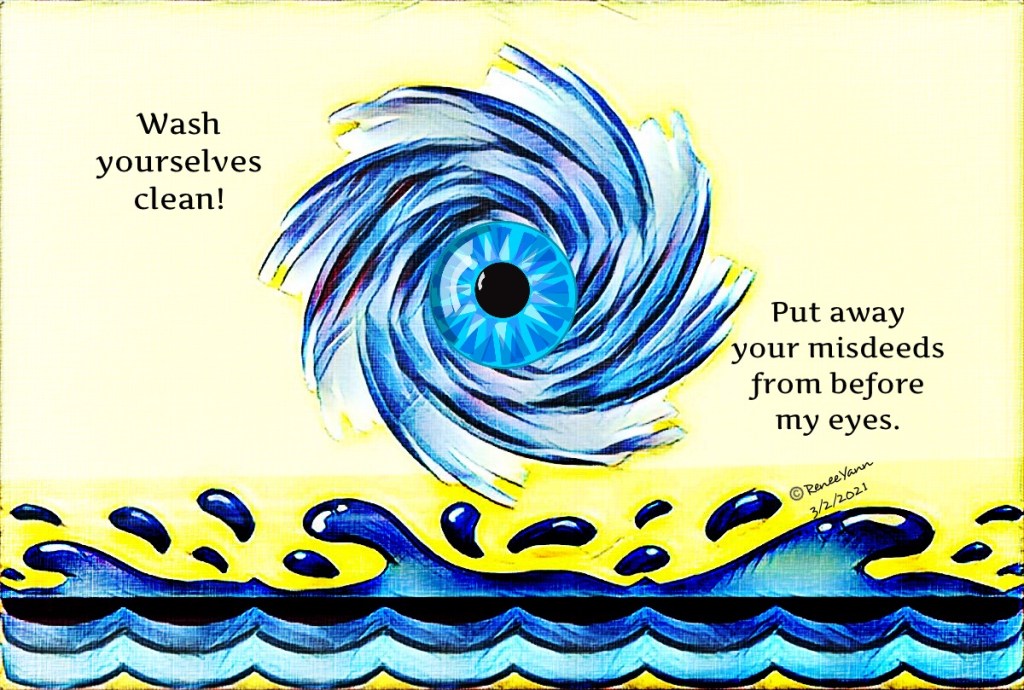
Wash yourselves clean!
Put away your misdeeds from before my eyes;
    cease doing evil; learn to do good.
Make justice your aim: redress the wronged,
    hear the orphan’s plea, defend the widow.

Isaiah 1:16-17

Poetry: God must give us a renewed mind (from Vale Millies) by Hadewijch. She was mystic of the 13th century
English version by Mother Columba Hart, Original Language Dutch

God must give us a renewed mind
     For nobler and freer love,
To make us so new in our life
     That Love may bless us
And renew, with new taste,
     Those to whom she can give new fulness;
Love is the new and powerful recompense
     Of those whose life renews itself for Love alone.
— Ay, vale, vale, millies — (farewell, farewell, a million times)
     That renewing of new Love
— Si dixero, non satis est — (If I can speak, it is not enough)
     Which renewal will newly experience.


Music: Psalm 50

Psalm 51: In Accord with Your Merciful Love

Friday after Ash Wednesday

February 19, 2021


Today, in God’s Lavish Mercy, we pray with Psalm 51, that magnificent penitential psalm which is one of only seven among the 150. The psalm, set between two readings that do with fasting, suggests that what we should “fast” from is sin.

Some interpreters attribute the psalm to David, deeply repentant after his treacherous acts toward Uriah and Bathsheba. Others say that this was a subsequent assignation because the psalm so fit the incident.


Whatever the case, Psalm 51 gives of us a picture of someone profoundly aware of failure in faithfulness to God – not just a sin against another human being, but against God.

For I acknowledge my offense,
    and my sin is before me always:
“Against you only have I sinned,
    and done what is evil in your sight.”

Psalm 51:5-6

Still, coupled with this aching repentance
is the absolute conviction
of God’s superseding Mercy.

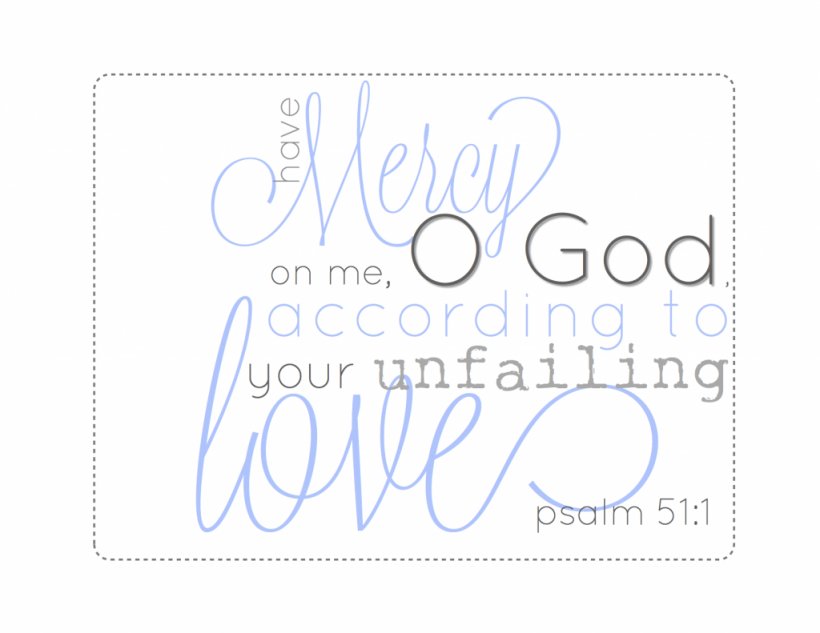
Have mercy on me, O God, in your goodness;
    in the greatness of your compassion wipe out my offense.
Thoroughly wash me from my guilt
    and of my sin cleanse me.

Psalm 51: 3-4

The psalmist has a large, lyrical notion in mind:
that God should take the scattered, chaotic, failed self that he is,
and out of it form a new, restored self.
The movement from failed self to restored self
is a gift asked of God in confidence.

Walter Brueggemann: From Whom No Secrets Are Hid


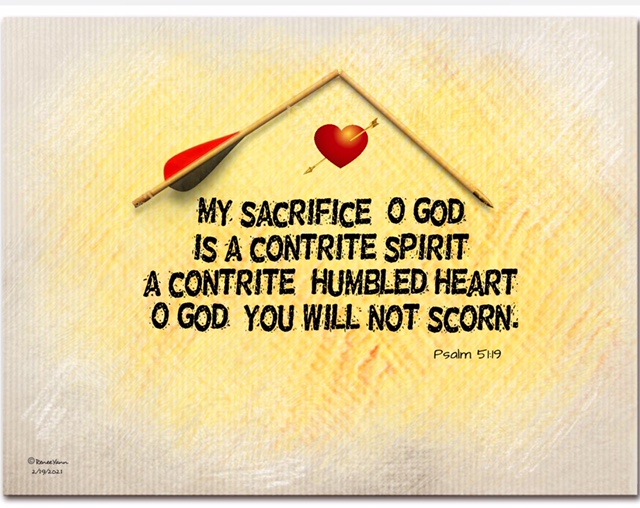
Praying with this psalm, the symbol of an arrow came to mind. You might have noticed the symbol recently on Valentines Day, used to describe the power of love to engage the heart.


But if the arrow is broken, how will it be made whole again?

Lord, you will open my lips;
and my mouth will proclaim your praise.
For you do not desire sacrifice or I would give it;
a burnt offering you would not accept.
My sacrifice, O God, is a contrite spirit;
a contrite, humbled heart, O God, you will not scorn.

Psalm 51:17-19

On this Lenten journey,
may we bring contrite hearts
– our “broken arrows” – 
to God,
asking to recognize our failures in love
and to repent sincerely of them.


Poetry: Possible Answers to Prayer by Scott Cairns

Your petitions—though they continue to bear
just the one signature—have been duly recorded.
Your anxieties—despite their constant,
relatively narrow scope and inadvertent
entertainment value—nonetheless serve
to bring your person vividly to mind.
Your repentance—all but obscured beneath
a burgeoning, yellow fog of frankly more
conspicuous resentment—is sufficient.
Your intermittent concern for the sick,
the suffering, the needy poor is sometimes
recognizable to me, if not to them.
Your angers, your zeal, your lipsmackingly
righteous indignation toward the many
whose habits and sympathies offend you—         
these must burn away before you’ll apprehend
how near I am, with what fervor I adore
precisely these, the several who rouse your passions.

Music: Broken Arrow – Let God turn your whole world around in this song by Rod Stewart

Who else is gonna bring you a broken arrow
Who else is gonna bring you a bottle of rain
There he goes moving across the water
There he goes turning my whole world around

Do you feel what I feel
Can we make it so that's part of the deal
I gotta hold you in these arms of steel
Lay your heart on the line this time

I want to breathe when you breathe
When you whisper like that hot summer breeze
Count the beads of sweat that cover me
Didn't you show me a sign this time

Who else is gonna bring you a broken arrow
Who else is gonna bring you a bottle of rain
There he goes moving across the water
There he goes turning my whole world around, around

Do you feel what I feel
Ah can you see what I see
Can you cut behind the mystery
I will meet you by the witness tree
Leave the whole world behind

I want to come when you call
I'll get to you if I have to crawl
They can't hold me with these iron walls
We got mountains to climb, to climb

Who else is gonna bring you a broken arrow
Who else is gonna bring you a bottle of rain
There he goes moving across the water
There he goes turning my whole world around
Turning my whole world around