Today, in Mercy, Paul again shows his great admiration for the commitment of the Thessalonians:
You have no need for anyone to write you about fraternal charity…
( in other words, you already live it.)
Don’t we all wish that line could be written, without reservation, to us?
In our Gospel, Jesus tells us the familiar parable of the talents which shows what God would look for in order to say as much to us.
On the surface this story looks like one about material goods or personal capabilities – about how we use our individual gifts to further God’s reign. Certainly that is one valuable interpretation.
But think about the talents in the story. They did not belong to the servants. They belonged to the master.
This parable is about God’s talents, God’s nature, and how we either frustrate or facilitate their effectiveness in God’s Creation.
We are the means by which God is present in the world.
God invests God’s own heartin us – Unconditional Love, Lavish Mercy, Infinite Hope, the Perfection of Compassion, Sacred Accompaniment, Abiding Fidelity.
If we tender these divine “talents” to others with care and generosity, we become good and faithful reflections of God’s own presence.
What about the poor soul who buried the talents under his own fear and small-mindedness? Sad, right? But that self-protective, parsimonious little burier hides in all of us.
We know the blockades we put up against God’s Grace. Let us look sincerely at them today, asking to be worthy of the trust invested in us to multiply God’s grace in the world.
Today, in Mercy,in our reading from Judges, we meet two guys who are polar opposites of each other: Jotham and Abimelech.
Jotham was the youngest of the 70 sons of Gideon (yes, 70 – not a typo. Makes one think of The King and I.) Abimelech is his half-brother, son of Gideon’s Shechemite concubine.
To put the story in a nutshell, Jotham is the goodie and Abimelech is the baddie. Abimelech, lusting to be king, engages his Shechemite family to kill the 70 sons of Gideon. Only Jotham survives. So in our reading, Jothamprophesies by parable, warning the people that they have made a serious mistake in allowing Abimelech to grasp the kingship.
Praying with this reading, we may realize that some things never change. Human beings still jockey for political power and economic domination. Nations still slaughter and suppress other nations in that pursuit. Some leaders still commandeer control by deception and pretense. The voting populace still allows itself to be hoodwinked by tyrants in disguise.
Jotham doesn’t accept the old adage that religion and politics don’t mix (or however they may have phrased it in his day). He says true leadership must grow from the good faith of both leaders and followers. He says, in parable form, that leaders must be willing to set their own pursuits aside for the good of the people. Otherwise, an avaricious fire burns up the heart of the people.
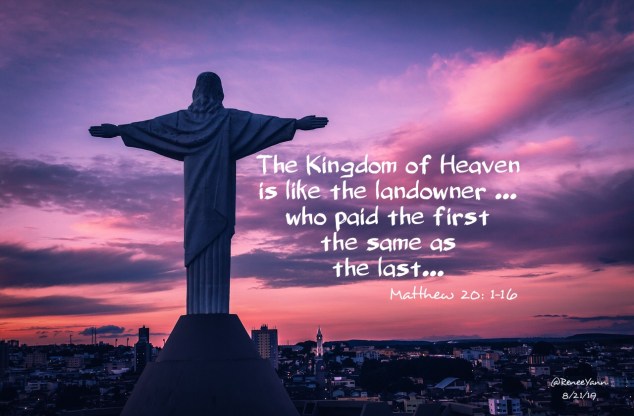
The landowner in Matthew’s Gospel is a leader in the pattern of God. He administers his charge in such a way that all find benefit. His methods are contradictory and irrational to anyone who fails to see the universal creaturehood of the human family. He reigns from mercy not merit, because he knows that all have full merit in God.
Certainly, my prayer leads me to consider how these principles affect my own leadership responsibilities whether within family, community, workplace, or world.
I am also led to consider how I must respond, just as Jotham did, to any leader or administration that stands in contradiction to these principles.
Faith and morality not only mix with politics, they are its core. Bereft of these, politics becomes nothing but a power game in which the poorest and weakest are the chips.
But, in this Gospel parable, Jesus says his “game” is just the opposite. At his table, the first shall be last and the last first.
These readings have much to offer us as we daily try to right our hearts with the God of infinite mercy.
Music: There’s a Wideness in God’s Mercy – written by Frederick Faber in 1862
Rendered here by Nate Macy
Today in Mercy, on this feast of St. Bernard, the liturgy offers us a little bit more of the Books of Judges. The reading for today is about Gideon, warrior judge, who delivered the Israelites from the oppression of the Midianites.
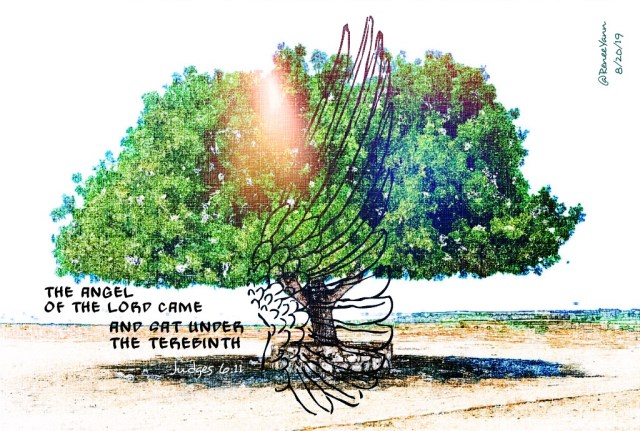
What the heck is a “terebinth” anyway? – a small southern European tree of the cashew family that was formerly a source of turpentine.
For me, these passages about wars and deliverers create conflict. Believing in Christ’s message of peace and mutual love, we have a spiritual abhorrence for war and a resistance to taking sides in confusing civil conflicts.
But as our wonderful retreat guide last week (Clare D’Auria, OSF) told us, with the Scriptures, as with writings from cultures not our own, we have to “get under the language” to find the deeper spiritual meanings.
Here’s what I find “under the language” of Gideon’s story.
A person unafraid of transparencywith God:
The angel of the LORD came and sat under the terebinth. Gideon said to the Lord, “My Lord, if the LORD is with us, why has all this happened to us?
A person open toGod’s Presencein his ordinary daily circumstances:
The angel of the LORD came and sat under the terebinth
… where Gideon was beating out wheat
A person who is unaware of God’s astounding power within him:
The LORD turned to him and said, “Go with the strength you have and save Israel from the power of Midian. It is I who send you.” But Gideon answered him, “Please, my lord, how can I save Israel?
A person whose faith continued to be shaky even in the presence of God:
Gideon answered the Lord, “If I find favor with you, give me a sign that you are speaking with me.
A person awestruck by God’s willingness to be personally present to him:
“Alas, Lord GOD, that I have seen the angel of the LORD face to face!”
A person who responds to God in loving worship and visible witness:
The LORD answered him, “Be calm, do not fear. You shall not die.” So Gideon built there an altar to the LORD and called it Yahweh-shalom.
God visits each one of us in our daily experiences. We want to be transparent with God in both our joys and sorrows, our needs and our abundance. We want to give over to God our hesitancies and fears as we respond wholeheartedly to God’s invitation to grace. By the witness of our faith and good works, we want to give God praise for being in our lives – under our terebinth.
Under the language, I found a lot of Gideon in myself. You?
Music: In honor of the great St. Bernard of Clairvaux, please enjoy this beautiful him attributed to him – Jesu, Dulcis Memoria (translation below)
The sweet memory of Jesus
Giving true joy to the heart:
But more than honey and all things
His sweet presence.
Nothing more delightful is sung,
Nothing more pleasing heard,
Nothing sweeter thought,
Than Jesus, the Son of God.
O Jesus, hope of the penitent,
How gracious you are to those who ask
How good to those who seek you;
But what [are you] to those who find?
No tongue may tell,
No letter express;
He who has experience of it can believe
What it is to love Jesus.
O Jesus, may you be our joy,
You who are our future reward.
May our glory be in you
Throughout all eternity.
Amen
Today, in Mercy, our readings are about possessions – in every sense of that word.
In today’s reading from Judges, the first of a few this week, we see Israel in the years between entering the Promised Land to the rise of Saul as king. During these four hundred years, a series of judges tries to keep Israel on track with God. It is a frustrating assignment!
As today’s passage describes, the Israelites get caught in an endlessly repeating cycle:
worship false gods
get zapped by true God
feel really bad, say sorry
be forgiven
repeat cycle
Hmm! I’ve seen this pattern somewhere before. Oh, yeah! It’s just like the one describing all my good intentions that never quite materialized!
Many of us can identify with the rich young man in the Gospel. We want to take our relationship with God up a notch. We would like to be better, holier people. But we may also, like the young man, like the ancient Israelites, be caught in a cycle of behaviors and choices which inhibit us.
Jesus tells this young man to get rid of his possessions, freeing him to really follow Jesus.
What possesses us, holding us back from that radical following?
It is not always material goods. They are easy to identify and dispatch. It is our tightly held and hidden illusions, resentments, prejudices, assumptions, entitlements, fears, jealousies, disappointments, angers. These are the heavy chains that cling to us as we try to move deeper into God.
May we be inspired by Matthew’s young man to recognize and break through the cycles that bind us by hearing God’s invitation to wholeness – an invitation always deep within our life circumstances.
(Republishing last year’s reading. I’m on retreat and trying to keep my time empty. Praying for all my dear followers.)
Many of us grew up in households where we were surrounded by a strong devotional faith. I am happy to be one of those people. These simple, sacramental practices awakened and engaged my young faith and offered me a visible means to respond to its stirrings. These practices also gave my parents and grandparents the tools to teach me to love and trust God, Mary, the saints, and my Guardian Angel.
I remember with gratitude the many parameters of that deep devotion which accompanied our fundamental practice of a sacramental and liturgical life.
Our home had a crucifix in every room to remind us of God’s Presence
Over the main door was the statue of the Infant of Prague and the first Christmas card we had received depicting the Three Kings to bless us on our journeys.
All year, Dad’s fedora sported a tiny piece of straw tucked into its plaid band. He had plucked it from the parish Christmas crèche, near to St. Joseph who was his patron.
During a really violent thunderstorm, we might get a sprinkling from Mom’s holy water flask kept for especially taxing situations.
And, maybe because we live not too far from the east coast, we had one special summer practice. We went into the ocean on the Feast of the Assumption, believing that, through the water, Mary offered us special healing and graces on that day.
I can still picture young boys helping their elderly grandparents into the shallow surf. I remember mothers and fathers marking their children’s brows with a briny Sign of the Cross. There was a humble, human reverence and trust in these actions that blesses me still.
While that August 15th ritual, like similar devotions, might seem superstitious and even hokey to some today, the memory of it remains with me as a testament to the simple faith and deep love of God’s people for our Blessed Mother.
It was just such devotion and faith, expressed over centuries by the faithful, that moved Pius XII to declare the dogma of the Assumption:
“We pronounce, declare, and define it to be a divinely revealed dogma: that the Immaculate Mother of God, the ever Virgin Mary, having completed the course of her earthly life, was assumed body and soul into heavenly glory.”
(MUNIFICENTISSIMUS DEUS 44)
On November 1, 1950, Pope Pius XII defined the dogma of the Assumption in the Apostolic Constitution Munificentissimus Deus(The Most Bountiful God). The world at that time was still healing from the horrors of World War II. The Pope himself, no doubt, was wounded beyond description by what he had witnessed. One can hear his deep pain as he begins his letter by saying:
“Now, just like the present age, our pontificate is weighed down by ever so many cares, anxieties, and troubles, by reason of very severe calamities that have taken place and by reason of the fact that many have strayed away from truth and virtue. Nevertheless, we are greatly consoled to see that, while the Catholic faith is being professed publicly and vigorously, piety toward the Virgin Mother of God is flourishing and daily growing more fervent, and that almost everywhere on earth it is showing indications of a better and holier life.”
This belief is complementary to the dogma of the Immaculate Conception defined by Pope Pius IX in 1854. These two articles of faith embrace the totality of Mary’s life which was uniquely blessed among all humans. Mary gives us, in our humanity, both a model of and a supportive invitation to holiness.
Marie T. Farrell, RSM presents a scholarly and insightful essay on the Assumption here. Her work gives us a rich understanding of the theological layers within this teaching.
Sister Marie closes her essay with these words: Mary assumed into heaven and Spiritualised in her whole personhood is a prophetic symbol of hope for us all. In his Resurrection-Ascension, Jesus has shown the way to eternal life. In the mystery of Assumption, the Church sees Mary as the first disciple of many to be graced with a future already opened by Christ, one that defies comprehension for ‘…no eye has seen, nor ear heard, nor the human heart conceived, what God has prepared for those who love him…(1 Cor 2: 9)
Musical Reflection with Song below: Prayer of Pure Love ~ Letty Hammock and Sue K. Riley
Today, in Mercy, our readings are peopled with individuals of all ages.
Deuteronomy gives us Moses at 120 years, when time forces him to admit:
“I am now one hundred and twenty years old and am no longer able to move about freely; besides, the LORD has told me that I shall not cross this Jordan.
We also have Joshua, vigorous and on the doorstep of his career:
Then Moses summoned Joshua and in the presence of all Israel said to him, “Be brave and steadfast, for you must bring this people into the land which the LORD swore to their fathers he would give them.
The Gospel brings us Jesus near the untimely end of his young life, and the disciples growing into their apostolic maturity.
And then we have the picture of the humble little child who is “the greatest in the Kingdom of Heaven”.
Every one of them, young or old, is seeking God in the circumstances of their lives.
What about you, dear friends, how is the mystery of God unfolding in your life today?As summer gently and slowly leans toward autumn, let the passing days teach us that each season brings its own graces.
Today, in Mercy, we have a few slightly complex readings. But, as with all Sunday lectionary choices, they are strung together by a single theme.
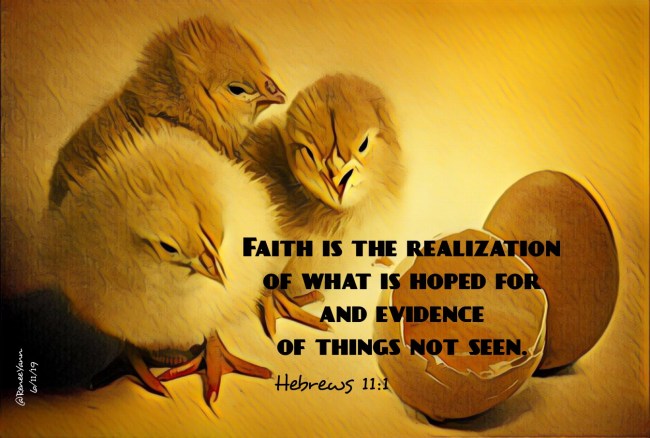
Upon first reading, we might think that theme is FAITH since the word is mentioned at least eight times. And, indeed, “faith” is the foundation of these readings – the faith of Abraham, Isaac, Jacob, the Desert Jews, the disciples, and the new Christian community.
It is the testimony of this ancient and enduring faith that encourages us to be ready, as Jesus says in today’s Gospel:
Do not be afraid any longer, little flock, for your Father is pleased to give you the kingdom.
This phrase of Jesus reveals another, deeper, theme: courageous hope.
How awesome that God, in covenant with God’s People, could keep alive – for 400 years- the hope of salvation! How miraculous that these ordinary farmers, milkmaids, herdsman, and shepherds could sustain their hope through numerous generations!
Today’s readings are sending us this message:
Be courageous! You are the Bearer of Hope
to this generation!
It may seem in our world, and in our individual lives, that God tarries beyond tolerance in answering our hope – for peace, civility, equality, security, goodness.But we must remember that with God there is no time. God is already responding within the long fidelity of our hope. (Our clocks and Apple watches just are obscuring our view. 😉)
That faithful hope creates the space for charity. And charity is the human face of Divine Love already Abiding.
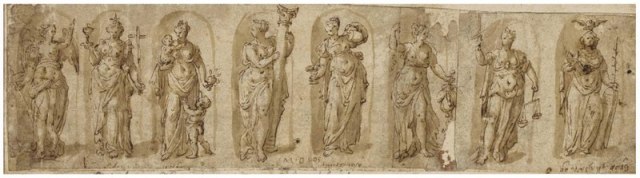
Faith, Hope, and Charity – the theological virtues (Remember that from your Baltimore Catechism?).
The Theological and Cardinal Virtues with Wisdom: Hope, Faith, Charity, Fortitude, Temperance, Liberality, Justice and Sapientia by Maarten de Vos (1532-1603)
These virtues are the foundation of the spiritual life. Contemporary theology ties these irrevocably to the virtue of justice – the seeking of right relationship in all Creation.
Anselm Min, Professor of Religion at Claremont Graduate University, has edited a powerful book on this subject. (Unfortunately, now out print and thus hugely expensive). One reviewer of the book, Lameck Banda, Professor at Justo Mwale University in Lusaka, Zambia, offers this insight into Min’s collection:
“The running thread throughout this book is that, whichever way the contemporary culture may seek to view and treat faith, hope, and love, the ultimate goal of these virtues is to radically and comprehensively address issues which tend to undermine the agenda of justice.”
That summary in itself gave me a lot to think and pray about. I hope it inspires you as well. God bless your Sunday!
Music: Hymn of Hope from The Secret Garden by Rolf Lovland
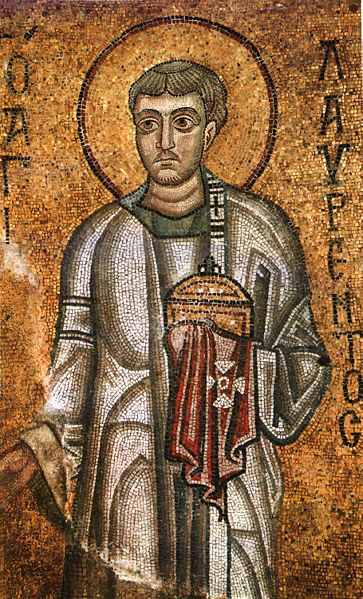
Saint Lawrence. Mosaic from the Saint Sophia Cathedral in Kiev.
Today, in Mercy, we celebrate the feast of St. Lawrence who is noted for his love for those who were poor. Legend has it that Lawrence was demanded, before his martyrdom, to turn over the Church’s riches to the emperor Valerian. Instead, he distributed all the resources among the poor. Lawrence then gathered all these people, presenting them before Valerian with these words:
Behold in these poor persons the treasures which I promised to show you – these are the true treasures of the Church.
Lawrence was likely inspired by readings like today’s. In Corinthians, Paul encourages us to be cheerful givers. He says this delights God, the Giver of Divine Abundance, whom we are imitating.
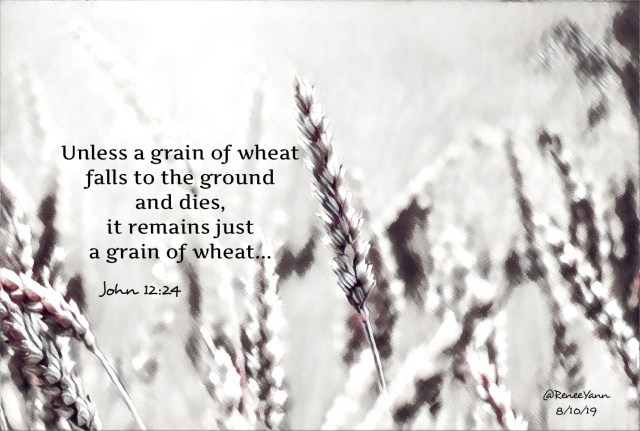
In our reading from John, Jesus says that only in dying to ourselves do we live – the ultimate generosity. He says that only by doing this can we truly follow him.
While these readings are clear and simple, they are so profound that we can hardly take in their message. What they ask of us is daunting! The encouragement Jesus gives us to respond to his challenge is this:
The Father will honor whoever serves me.
St. Lawrence believed and lived this promise. What about us?
Music: Before the Bread – Elizabeth Alexander
We all want our lives to be full and complete – to be “bread”. But there are many steps before the grain of wheat becomes bread, as captured in this elegantacapella canon.
Today, in Mercy, we have the first of a few readings from the Book of Deuteronomy. In today’s passage, Moses gives the first of three speeches to the community. These speeches are a sort of manifesto a family patriarch might give before he dies, framing the family history and code to direct coming generations.
The reading falls on a most appropriate day for me.
Today would be my Dad’s 104th birthday.
The occasion invites me to recount all the blessings
given to him, me, and our family.
When we, as people of faith, step back from our lives in reverence, we realize God’s immense goodness to us. Moses encourages his people to do just such stepping back:
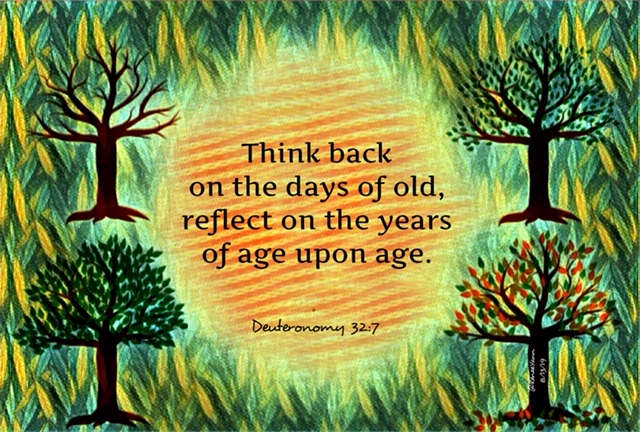
Ask now of the days of old, before your time, ever since God created man upon the earth; ask from one end of the sky to the other: Did anything so great ever happen before?
We might ask ourselves the same thing.
How has God been with me and my family through our lifetimes, and through the generations that preceded us?
In both our lights and darknesses, how has God continually called us to relationship?
How have we revealed God’s voice to one another by our love, honesty, support, patient accompaniment, generous correction and forgiveness?
How have these gifts to one another allowed us to become gifts to the larger world?
What am I passing on to the next generation of the fidelity and sacrifice which has blessed me?
When I think of my Dad, there are so many symbols that show how he answered those questions with his life. They aren’t big manifestos like those of Moses. Instead:
a frayed prayer book that I watched him finger daily
an old receipt for my bicycle bought in incremental payments he could barely afford
his sincere distress one Assumption Day when he had forgotten to go to Mass
his steadfast attempt to work even when illness weakened him and his humble trust in God when that weakness appeared to triumph
a treasured conversation about his hope for heaven
the appreciation now, in my maturity, of his thousand quiet acts of faith and love
All of us might spend some time in gratitude for the legacy of faith and love we have received. No family is perfect, and the grace may come to us in clarity or in disguise. But it comes.
There are fractures and tears in every family. There were some even in Moses’ “family” and Moses himself! And we cannot magically heal them all. But God asks us to remember that God abides with us even in any fragmentation. Just as the poet Leonard Cohen sings:
There is a crack in everything. That’s how the light gets in.
If what we remember in our family history are weaknesses, how have they made us stronger? If what we remember are strengths, how have they made us more generous? In either case, how have we heard God’s voice in our story? How have we let the Light in?
As Moses tells his people:
This is why you must now know, and fix in your heart, that the LORD is God
in the heavens above and on earth below, and that there is no other.
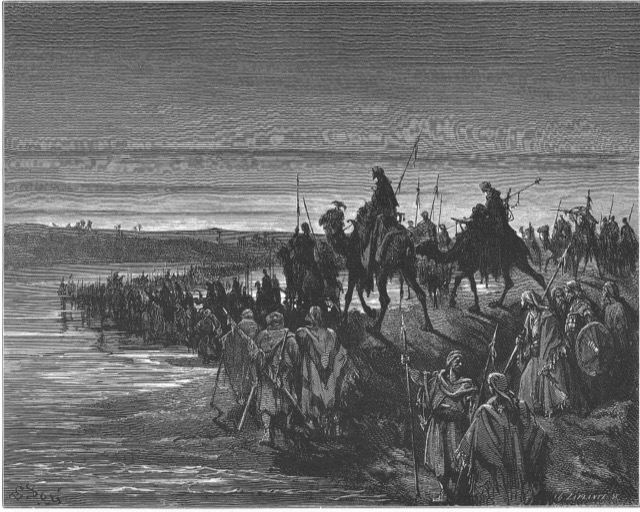
Today, in Mercy, our reading from Numbers is about trust versus fear.The Israelites have finally made it to the front door of the Promised Land. But they hesitate to go in. They get Moses to bargain with God to allow scouts to go ahead of them, checking out the lay of the land. These scouts return with a mixed report: arable land, but ferocious current residents! The community freezes in fear, refusing to go farther.
The Israelites Cross the Jordan River by Gustave Doré 1832-1883
So what’s this all about for us? Is it wrong for us to be deliberate about our decisions, reversing them when the situation becomes threatening? No, of course not. So what’s the difference here in our Numbers community?
At this moment in Israel’s history, God has made clear what is expected of them. They are in covenant with God – “all in” to follow God’s plan for their lives. God has demonstrated his commitment to them in numerous ways, and forgiven earlier disloyalties.
The question before them now is have they given God their whole hearts.
Or will this be a sham covenant in which they pick and choose when they will be for God and when they will be just for themselves?
The life of deep spiritual commitment to God is not always smooth. We get really mixed up sometimes in our self-concerns and fears. Many years ago, one of my eighth grade students asked me this: what if there really is no God and you’ve wasted your life believing there was?
It was quite a question, and I’ll bet you want to know my answer.
I said that I wouldn’t change a thing about how I have chosen to live my life. Trusting God and giving my life to him has given me a freedom beyond the limits of this world. Even if, at the end, her doubt proved true, I would have had a blessed and joyous life.
The fact is that we, just like those Israelites standing on the edge of Canaan, don’t know what will happen to us if we trust God. Life and the future is an intimidating open border that challenges our faith and resolve.
But if we constantly hedge our self-gift to God, we will never be capable of receiving the fullness of God’s gift in return.
Today, let’s pray for the trust to step over into God’s country by our acts of faith, hope, love, mercy, generosity, truthfulness, hospitality and courage.
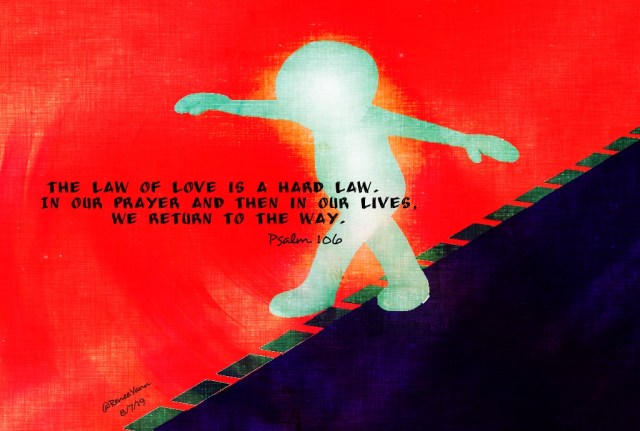
This beautiful reinterpretation of today’s Responsorial Psalm may inspire you as it did me. It is from the website of Christine Robinson, a Unitarian Universalist minister: Click here for Psalm renderings
Psalm 106: Returning “Give thanks to God, who is good
whose mercy endures forever.”
We stand in awe of an infinity
which we cannot begin to comprehend
We set ourselves to live in tune with the universe—
that we may be glad with the gladness of people of faith.
Yes, time and time again we have gone astray,
We have despoiled this beautiful, wonderful world
dealt unjustly with our compadres
The law of love is a hard law.
In our prayer and then in our lives,
we return to the Way.









 Lavish Mercy