Today, in Mercy, Jesus teaches us about faith with the simple parable of the mustard seed. Many of us have never seen a mustard seed — just mustard! 😀 So the short video below is helpful.
The Mustard Tree
Sometimes we feel that our faith is that small, don’t we?
We have so many questions about why evil exists in the world.
We wonder the classic question: Why do bad things happen to good people?
The religious foundation of our faith might be shaken by scandals within the Church, and the selfish hard-hearted ness of some who proclaim to be Christian.
Sometimes we just feel empty and disconnected from God.
Jesus tells us today to think of the tiniest seed, easily overlooked in the big garden. He says our faith is like that seed. By one small prayer, one small turning toward God, that seed will take root again in us and grow.
Music:Faith of a Mustard Seed ~ byTwo Or More. (if you need a little “ Wake Up”!)
Today, in Mercy, we hear from Jeremiah, a “sock-it-to-‘em” prophet. He lived in a disastrous time for Judah, and had to deliver some difficult challenges to the people. Today’s passage is called the Temple Sermon. It confronts his listeners with the fact that there is a big difference between their professed faith and their daily practice. In other words, they are living a lie.
The people seem to think that no matter how idolatrous or immoral their choices are, the Temple building will protect them from God’s anger. It’s a mentality that might remind us of the film “The Godfather”, where the mafioso kill and cheat all week but always fulfill their sacramental obligations.
God tells Jeremiah to go stand at the Temple gate and tell the people that their fake piety won’t work. Instead they are to:
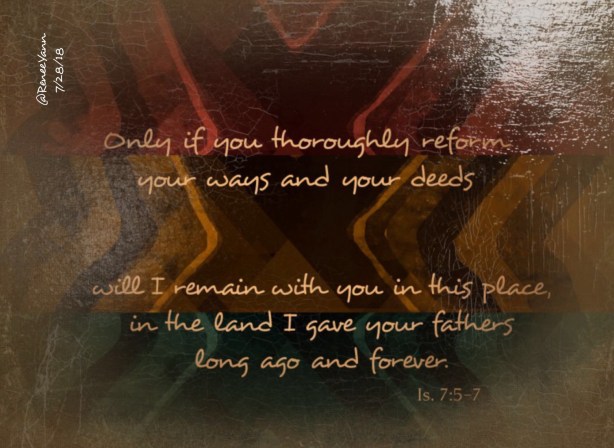
thoroughly reform their ways and deeds
deal justly with their neighbor
no longer oppress the resident alien, the orphan, and the widow
no longer shed innocent blood in this place (cease human sacrifice)
or follow strange gods to their own harm
Otherwise, Jeremiah says, they risk losing God because God will not live in a desecrated Temple.
The message to us that comes wrapped in the ancient words of Jeremiah?
Examine your life.
Is our faith sincere, proven by our practices?
Do we give others not only the benefit of the doubt, but also the benefit of our kindness?
Do we support and foster immigrants, orphans, widows … in other words the vulnerable?
Do we stand against the suffering of innocents caused by war and unjust policy?
Do we resist the “gods” competing for our souls — all the destructive isms and addictions of our time?
Otherwise, Jeremiah says, we risk losing God because God will not live in a heart-temple that is desecrated.
Today, in Mercy, we begin about a two-week cycle of readings from Jeremiah and Matthew. Hand-in-hand, these call us to repentance, then show us the way to holiness.
Today, we think about Matthew. These readings are parts of the Third Discourse of his Gospel. It is sometimes referred to as the Discourse of Secrets because in it, Jesus teaches in riddles or parables.
Today’s parable is a familiar one – the sower and the seed. The image would have resonated easily with Jesus’s agrarian audience – and the green-thumbed among us! “Sow your seed on good soil or it will bear no harvest.”
Good soil doesn’t just happen. It takes work and vigilance to prepare a garden patch. This is the core of Jesus’ message – this is the secret of heaven:
Clear the rocks
Loosen clumped resistances
Feed and nurture
Check constantly for invasive weeds
So today, let’s:
Check our hearts for anything that blocks our openness to the Spirit
Examine any crippling prejudices we might be holding on to
Be sure we are feeding our souls with good spiritual reading and quiet reflection
Be aware of anything that pulls us away from kindness, truth, and love
Music: Planting Seeds : A Song of Life by Empty Hands Music
Today, in Mercy, our readings gather us into the arms of the Good Shepherd.
This beautiful image, which is beloved to us even in our highly urbanized society, certainly held even greater meaning to the early Christians. They understood, from experience, the utter self-donation of a shepherd to his flock. The shepherd needed his sheep in order to live, just as they needed him. Their lives were critically interdependent.
In a sense, the shepherd became one with the sheep. From sunrise to sunset, and even through the night, he led them to food, water, and rest. He protected them as they slept, by laying his own body across the sheep gate.
In our own time, a more familiar image might be that of a horse-whisperer, someone who through natural sensitivity and studious training, is able to understand and communicate with animals. Rather than “breaking” a horse, as seen in old westerns, the horse-whisper leads them to trust by listening and responding to them through body-language.
As we pray with the image of the Good Shepherd today, we might imagine Jesus as our “Soul-Whisperer”. Jesus stands beside us in the vast, open loneliness of life, which sometimes tries to “break” us. But we are never alone. He is listening. As he opens our life before us, let us trust and follow him. He has made our welfare his own by becoming one of us.
Music: The Lonely Shepherd
( Tap the center of the picture below to hear the song.)
Today, in Mercy, Matthew describes Jesus as He begins to experience a mortal resistance to his message. Jesus slowly realizes that some listening to him are full of hate, fear, and deception. His response reflects the counsel he himself offered earlier in his ministry: offer the evil one no resistance.
Jesus does not respond to evil or sin. He confronts it. He stands firm against it. But Jesus does not stoop to argument, violence, or any other form of engagement which would legitimize evil. He will not step into the trap evil always sets for its prey. When we fight evil with evil’s own weapons, we have already lost.
In today’s Gospel, Jesus simply walks away. We can feel his sadness. His offer of eternal love and grace has fallen on recalcitrant hearts. He sees that these hearts are lost to God.
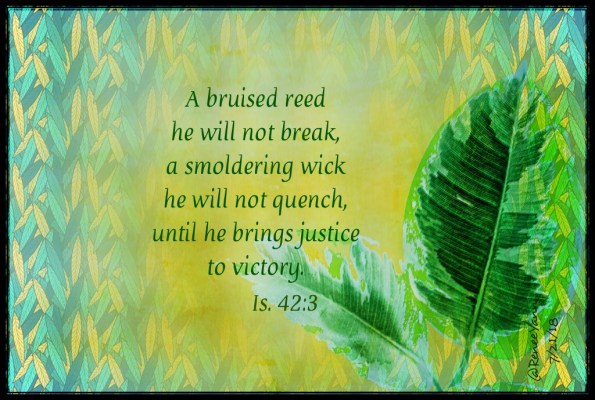
Instead, Jesus gathers around him the humble and wounded, the ones whose hearts have been softened by suffering and shadows. He gently comforts them, heals them, and leads them to a new Light. They are the bruised reeds which he does not break. They are like smoldering wicks which he tenderly rekindles with his Word.
Let us place our own bruises and flickering lights in his presence today. Let us gather the world’s hurts and darknesses in our prayer. We give ourselves to the gentle love of Jesus.
I remember this morning a beloved prayer of my youth. Some of you may remember too: The Prayer before the Crucifix
Look down upon me, good and gentle Jesus, While before Thy face I humbly kneel And with burning soul, pray and beseech Thee, To fix deep in my heart, Lively sentiments of faith, hope and charity, True contrition for my sins And a firm purpose of amendment. While I contemplate with great love and tender pity, Thy five most precious wounds, Pondering over them within me, And calling to mind the words that David, Thy prophet, said of Thee , my Jesus, “They have pierced My hands and feet, They have numbered all my bones.”
Music: My Heart Longs for a Touch
(To hear music, tap the center of the picture below.)
Today, in Mercy, Jesus thanks his Father for revealing the mysteries of heaven to the “childlike”. The original Greek word means “babies”, “ones who cannot speak”.
One response to this reading is to strive for a childlike faith – open, simple and trusting. But that is not easy. We are sophisticated persons living in a complex world. Many of us having difficulty reclaiming the single-mindedness of children in our thought processes.
And yet, in terms of spiritual matters, perhaps we are not all that mature. St. Paul attested to the spiritual immaturity of the early Christians in passages like these:
Brothers and sisters, I could not address you as people who live by the Spirit but as people who are still worldly—mere infants in Christ. I gave you milk to drink, not solid food; for you were not yet able to receive it. Indeed, even now you are not yet able… (1 Corinthians 3:1-2)
For everyone who partakes only of milk is not accustomed to the word of righteousness, for he is an infant. For though by this time you ought to be teachers, you have need again for someone to teach you the elementary principles of the mysteries of God, and you have come to need milk and not solid food. (Hebrews 5:12-13)
So, returning to today’s Gospel, what might we conclude? The ways of God are infinitely beyond our comprehension. Still, we question and parse them as if they were problems to be solved rather than mysteries to be absorbed. Our prayer becomes filled with “Why” instead of “Yes”.
When our faith becomes confused or restless, we must return like a colicky child to our all-wise and loving God, trusting that we will be soothed. In God’s embrace, we will be led deeper in faith, not by sophisticated analysis, but by the simplicity of absolute love.
Today, in Mercy, on this Feast of Our Lady of Mount Carmel, we consider our devotion to Mary, the Mother of Jesus.
Devotion is the honor we we offer Mary and the saints, hoping to imitate their holiness in our own lives. Devotion differs from adoration, which is the prayer we offer to God alone.
Some question the role or efficacy of devotion in our spiritual lives, feeling that the spiritual life is a relationship specifically to God. But for those of us who believe in the Communion of Saints, the power “mentorship” from the saints is unquestionable.
Devotions also play a key role in the early development of our faith. My own faith received abundant nourishment from my mother’s devotion to the Miraculous Medal, and my father’s unending novena to St. Joseph. Even now, in my mature years, I still return to these two devotions when faced with a critical concern.
Like so many of you, my own young mastering of the Rosary gave me a loving awareness of the evolving life of Christ. And a host of beloved prayers deepened my love of God, including the Prayer before the Crucifix and St. Patrick’s Breastplate. You may want to remember your own favorite devotions – some which you may still use in times of difficulty or uncertainty.
Sacred objects can also support our developing faith – a precious medal, a special statue, a scapular, or a relic. Contemporary religious practice is less focused on these supports, but their value as simple devotional tools is abundantly proven.
What is important to remember is that the value of these devotions and sacramentals lies in their ability to lead us to relationship with God, not in any“magic” they themselves possess.
For those of us with a special devotion to Our Lady of Mount Carmel, (the Sisters of Mercy included), this is a day to ask Mary’s maternal favor on our lives and world. Picture yourself wrapped in her loving mantle, your deepest needs receive by her maternal heart.
Departure from the Music today – a short reflection on Our Lady of Mt. Carmel and the Carmelite Order.
Today, in Mercy, on this feast of St. Benedict, we pray with the words of Psalm 105:
Seek always the face of the Lord.
One of the fundamental questions a spiritual director might ask us when we share our life experiences is this: “Where is God in this for you?” It is a steadying question which we can ask ourselves as we try to navigate our life challenges.
We can trust that God is somewhere in every situation, either encouraging us to go forward or to retreat — in either case, calling us toward the Divine and Loving Will. As we deepen in our habits of prayer, grateful quiet, and merciful practice, we begin to see God more clearly in everything.
St. Benedict prayed for this kind of vision. May we share in his prayer.
“Almighty God, give me wisdom to perceive You, intelligence to understand You, diligence to seek You, patience to wait for You, eyes to behold You, a heart to meditate upon You and life to proclaim You, through the power of the Spirit of our Lord Jesus Christ. Amen.”
Music: I Can See – Steve Green
This song shares the experience of the Emmaus disciples as their eyes were opened and the saw Jesus walking with them along their life’s road.
Today, in Mercy, Jesus cures a demoniac who is mute.
In Jesus’ time, the connection between ordinary disease and demonical possession was quickly drawn – perhaps too quickly. As we read some of the Gospel cures, our modern understanding recognizes epilepsy, glaucoma, cataracts and mental illness in the people Jesus touched and healed. But two thousand years ago, these conditions were assigned to demons.
This doesn’t mean demons don’t exist. Remember the Gerasene miracle where Jesus cast demons into pigs who then threw themselves into the sea? Dramatic evidence that demons are real!
Demons are real in our world too, embodiments of the evil that is always competing for control of Creation, that is always resisting the supremacy of Goodness and Love.
These demons masquerade in various costumes of power, prestige and pleasure. But they are all eventually exposed as addictive, self-consuming and destructive.
How dangerous and deceptive these demons are! The word itself comes from the same Greek root as the word “genius”. And they do have a genius for rendering us:
blind to narcissistic motivations
crazed with exaggerated self-importance
crippled by deceptive rhetoric
mute in the face of systemic evil
deaf to the cries of the suffering
dead to the power of transforming Mercy in our own souls
Even as you read this list, faces and moments of history and current events are flashing before your eyes. Circumstances in your own life, family and work suggest themselves. Bring these to your transforming prayer today. The touch of Jesus can deliver us from such demons. We pray for that touch in our own hearts and in our world.
Today, in Mercy, our readings bring us Hosea, the poet-prophet who lived eight centuries before Jesus.Although his warnings to Israel are stern, Hosea was, at heart, a lover – just as he imagined God to be.
Hosea tells us his personal story of marrying an adulterous wife, forgiving her, and welcoming her back to his love. He uses his own experience to challenge Israel, the “adulterous”, idolatrous beloved of God.
Hosea’s passionate poetry gives us the language and imagery of intense intimacy with God, a God who “allures”, “espouses”, and calls himself “husband”. It is the language of an unbreakable devotion and covenant.
This imagery can enrich our prayer and help us to deepen our realization of how much God loves us. God loves us as a parent would, as a friend would, as a lover would, as a spouse would. Still, God loves us beyond all these, beyond our human comprehension.
Any human love will always remain between two distinct beings. But Divine Love created us and lives within us. We are the very Breath of God Who, in loving us, loves the Divine Self into being.
In our prayer today, what a joy to surrender ourselves to this Amazing Love!








 Lavish Mercy