I hear the whisperings of many: “Terror on every side! Denounce! let us denounce him!” All those who were my friends are on the watch for any misstep of mine.
Jeremiah 20:10
Oh, the deadly power of a fragile whisper! Its insidious influence seeps into souls, germinates, and grows into fictional suggestions, untested prejudices, and effective shunning by the “in” set.
Whispers are the emanations of fear – we may fear what is different, what we cannot control, what challenges us, what actually exposes pretense in us.
Jeremiah and Jesus encountered the ugly entanglement of such whispers. But they were not trapped because they believed.
Today, in God’s Lavish Mercy: We pray their prayer for ourselves and for all who suffer the persecution of “whisperings”.
The LORD is with me, like a mighty champion: my persecutors will stumble, they will not triumph. O LORD of hosts, you who test the just, who probe mind and heart, Let me witness the recompense you take on them, for to You I have entrusted my cause.
Poetry: A Word – Emily Dickinson
A word is dead
When it is said,
Some say.
I say it just
Begins to live
That day.
Music: from Handel’s Messiah: He trusted in God that He would deliver him
I will maintain my covenant with you and your descendants after you throughout the ages as an everlasting pact, to be your God and the God of your descendants after you.
Genesis 17:7
Genesis describes the sacred covenant God shares with us. In our Gospel, Jesus asserts the eternal nature of that covenant, made real in our lives by keeping his Word.
God’s promise of eternal love was made to us as well as to Abraham. In every moment, God says to us, “I am yours.” In every moment. we are called to respond, “Yes, Lord, and I am Yours as well.”
Poetry: from The Book of Hours – Rainer Maria Rilkë
Although, as from a prison walled with hate,
each from his own self labors to be free,
the world yet holds a wonder, and how great!
ALL LIFE IS LIVED: now this comes home to me.
But who, then, lives it? Things that patiently
stand there, like some unfingered melody
that sleeps within a harp as day is going?
Is it the winds, across the waters blowing,
is it the branches, beckoning each to each,
is it the flowers, weaving fragrances,
the aging alleys that reach out endlessly?
Is it the warm beasts, moving to and fro,
is it the birds, strange as they sail from view?
This life — who really lives it? God, do you?
Music: My God, I Am Yours – Suscipe of Catherine McAuley
My God, I am yours for time and eternity. Teach me to cast myself entirely into the arms of your loving Providence with a lively, unlimited confidence in your compassionate, tender pity. Grant, O most merciful Redeemer, That whatever you ordain or permit may be acceptable to me. Take from my heart all painful anxiety; let nothing sadden me but sin, nothing delight me but the hope of coming to the possession of You my God and my all, in your everlasting kingdom.
Jesus said to those Jews who believed in him, “If you remain in my word, you will truly be my disciples, and you will know the truth, and the truth will set you free.”
John 8:31
In our first reading, Shadrach, Meshach, and Abednego are examples of absolute trust in God. Their story is intended to assure the Jews in Babylonian captivity that God would deliver them.
In our Gospel, Jesus assures his followers that they too will be delivered from life’s tests if they trust fully in His Word.
Today, in God’s Lavish Mercy:
Let’s pray to deepen in our trust that God is with us always. Let’s sink the anchor of our faith, hope, and love into Christ’s promise. The more we can do this, the more we will be freed to love God, ourselves, and others with the fullness of Gospel love.
Poetry: Avowal – Denise Levertov
As swimmers dare
to lie face to the sky
and water bears them,
as hawks rest upon air
and air sustains them,
so would I learn to attain
freefall, and float
into Creator Spirit’s deep embrace,
knowing no effort earns
that all-surrounding grace.
Music: How Beautiful Is Your Love – The Commons/Josh Blakesley
oh how beautiful is your love for me. oh what joy is mine in this mystery. i will not fear the dark here in the presence of your heart. oh how beautiful is your love.
oh how wonderful is your offering. lamb laid down for me on compassion’s tree. how could i turn away from the mercy of your face? oh how wonderful is your love.
Jesus, Jesus, oh how beautiful is your love. Jesus, Jesus, oh how beautiful is your love.
so miraculous is your sacrifice. body broken here that i might have life. take everything i own, let me be yours alone. so miraculous is your love.
Jesus, Jesus, oh how beautiful is your love. Jesus, Jesus, oh how beautiful is your love.
Ah, Equinox! Today our Earth will put away her winter jewels – her cold snow pearls and glistening ice diamonds stored until distant December. With them, she lays aside her cool reserve, the stark elegance of silhouetted trees against a white landscape. She says, “I have finished my silent retreat”.
Instead, Lady Earth unveils her costume jewelry – that improbable mix of pinks, purples, greens and yellows. Even though this morning in Philadelphia, she wraps them in a shimmering chill, we know it hides a riotous, tumbling April.
Every year we wonder if those bare trees and barren hillsides will ever green again. But they do! Spring is the act of “Great Forgiveness”. It is the time when Nature mirrors the Infinite Mercy of her Creator and says, “Fear not, Sweet Earth. I am deeper than your cold. My resilience has redeemed us both for another chance at life”.
We human beings, too, are capable of such resilience. I remember my mother’s infinite patience with an annoying neighbor whose seemingly innocent conversation harbored veiled references to her economic superiority. Little wintry comments like, “It’s a shame you didn’t choose a Hoover. It would make your life so much easier!” Even as a child, I was nettled almost beyond tolerance by her chilly comparisons.
But my mother, who was no push-over and who did not suffer fools gladly, was patient and faithful. She would tell me that Mary never had the love of family and friends that we enjoyed. She helped me understand that sometimes people can’t help showing the December within their hearts if they have never been kindled by another’s kindness. My mother wanted me to live from the “Great Forgiveness” that can warm any cold, indifference, or careless judgment.
At one point when I was still very young, my mother became quite ill and after a long hospitalization, returned home for an extended recuperation. During that time, Mary came every day to cook for our large, working family. Weekly, she cleaned our house with the same decrepit vacuum she had earlier criticized. Without a word, Mary challenged me to learn another lesson about the nature of fidelity and true friendship and the opportunity to give it voice without words.
Years later, I read a quote that captured these lessons: “Always be kind. We never know the battles someone else may be fighting.” These are lessons I remember with gratitude today in this equinox of another “Great Forgiveness”. It is a largesse we can imitate if we simply remember the mercies we have received from the hand of our forgiving God.
The LORD spoke to Nathan and said: “Go, tell my servant David, ‘When your time comes and you rest with your ancestors, I will raise up your heir after you, sprung from your loins, and I will make his kingdom firm. It is he who shall build a house for my name. And I will make his royal throne firm forever. I will be a father to him, and he shall be a son to me. Your house and your kingdom shall endure forever before me; your throne shall stand firm forever.’”
2 Samuel 7: 2-5;12-14;16
Today’s genealogies establish Jesus as the Messianic Heir promised to the House of David. Joseph is the link in that promise.
We have so little factual knowledge of Joseph, yet so much prayerful devotion to him. Gospel tidbits from Matthew and Luke help us imagine a holy and tender man who loved Christ into his divinely missioned adulthood. We imagine Joseph’s simple and faithful life as the carpenter-provider for the Holy Family, and his peaceful death in the embrace of Mary and Jesus.
Today, in God’s Lavish Mercy:
Wherever we are in our own lives, Joseph’s life can bring us inspiration and strength. Asking his guidance, we pray today for:
those making major life decisions
engaged couples learning to love and support one another
parents as they work to raise their children well
refugee parents protecting their families
workers struggling daily to provide for their families
the men in our lives who have nurtured, loved, and taught us
religious women and men in communities devoted to St. Joseph
those who are dying that they may have comfort and peace
Poetry: Prayer to St. Joseph – Cameron Belle
St. Joseph, patron saint of the unexpected,
How freely you stepped into the unknown
With your unwavering yes.

St. Joseph, dreamer of dreams,
How attuned your heart was, waking or sleeping,
To the promptings of angels.

St. Joseph, nurturing father,
How openly you accepted your unconventional family,
Lighting the way for us, too, to embrace all.

St. Joseph, there is still so much we don’t know about you,
But maybe that is your gift to us,
That we may see in the father of Jesus a mystery
That sanctifies the hidden and untold in our own lives.
May we, too, live our days in the holy shadow of your son.
One day, while the elders were waiting for the right moment, she entered the garden as usual, with two maids only. Susanna decided to bathe, for the weather was warm. Nobody else was there except the two elders, who had hidden themselves and were watching her. “Bring me oil and soap,” she said to the maids, “and shut the garden doors while I bathe.”
Daniel 13:15-18
“Let the one among you who is without sin be the first to throw a stone at her.” Again he bent down and wrote on the ground. And in response, they went away one by one, beginning with the elders. So he was left alone with the woman before him. Then Jesus straightened up and said to her, “Woman, where are they?
John 8: 7-10
We encounter so much in life that is hidden – motives, ambitions, agendas, pasts, judgments, reactions. We hide these things for all kinds of reasons. The lustful elders hid their actions for fear of discovery and condemnation. The Gospel stone throwers hid their pasts to exonerate themselves by judgment of another.
Today, in God’s Lavish Mercy:
We are reminded that with God nothing is hidden. And nothing needs to be. We can place our lusts, false judgments, and any other shadow-laden weaknesses in God’s Light because that Light is Forgiveness and Healing. That Light will free us to become forgivers and healers ourselves.
Poetry: Peter Quince at the Clavier – Wallace Stevens
Wallace Steven’s poem and Handel’s oratorio indicate the extent to which the tale of Susanna has been culturally interpreted down through the ages.
Just as my fingers on these keys
Make music, so the selfsame sounds
On my spirit make a music, too.

Music is feeling, then, not sound;
And thus it is that what I feel,
Here in this room, desiring you,
Thinking of your blue-shadowed silk,
Is music. It is like the strain
Waked in the elders by Susanna:
Of a green evening, clear and warm,
She bathed in her still garden, while
The red-eyed elders, watching, felt
The basses of their beings throb
In witching chords, and their thin blood
Pulse pizzicati of Hosanna.
II
In the green water, clear and warm,
Susanna lay.
She searched
The touch of springs,
And found
Concealed imaginings.
She sighed,
For so much melody.
Upon the bank, she stood
In the cool
Of spent emotions.
She felt, among the leaves,
The dew
Of old devotions.
She walked upon the grass,
Still quavering.
The winds were like her maids,
On timid feet,
Fetching her woven scarves,
Yet wavering.
A breath upon her hand
Muted the night.
She turned—
A cymbal crashed,
And roaring horns.
III
Soon, with a noise like tambourines,
Came her attendant Byzantines.
They wondered why Susanna cried
Against the elders by her side;
And as they whispered, the refrain
Was like a willow swept by rain.
Anon, their lamps' uplifted flame
Revealed Susanna and her shame.
And then, the simpering Byzantines
Fled, with a noise like tambourines.
IV
Beauty is momentary in the mind—
The fitful tracing of a portal;
But in the flesh it is immortal.
The body dies; the body's beauty lives.
So evenings die, in their green going,
A wave, interminably flowing.
So gardens die, their meek breath scenting
The cowl of winter, done repenting.
So maidens die, to the auroral
Celebration of a maiden's choral.
Susanna's music touched the bawdy strings
Of those white elders; but, escaping,
Left only Death's ironic scraping.
Now, in its immortality, it plays
On the clear viol of her memory,
And makes a constant sacrament of praise.
Music: Guilt trembling spoke my doom – George Frideric Handel
Susanna is an oratorio by George Frideric Handel. Handel composed the music in the summer of 1748 and premiered the work the next season at Covent Garden theatre, London, on 10 February 1749. (Lyrics below.)
Guilt trembling spoke my doom, And vice her joy display’d, Till truth dispell’d the gloom And came to virtue’s aid. Kind Heav’n, my pray’rs receive, They’re due alone to thee, Oppression’s left to grieve, And innocence is free.
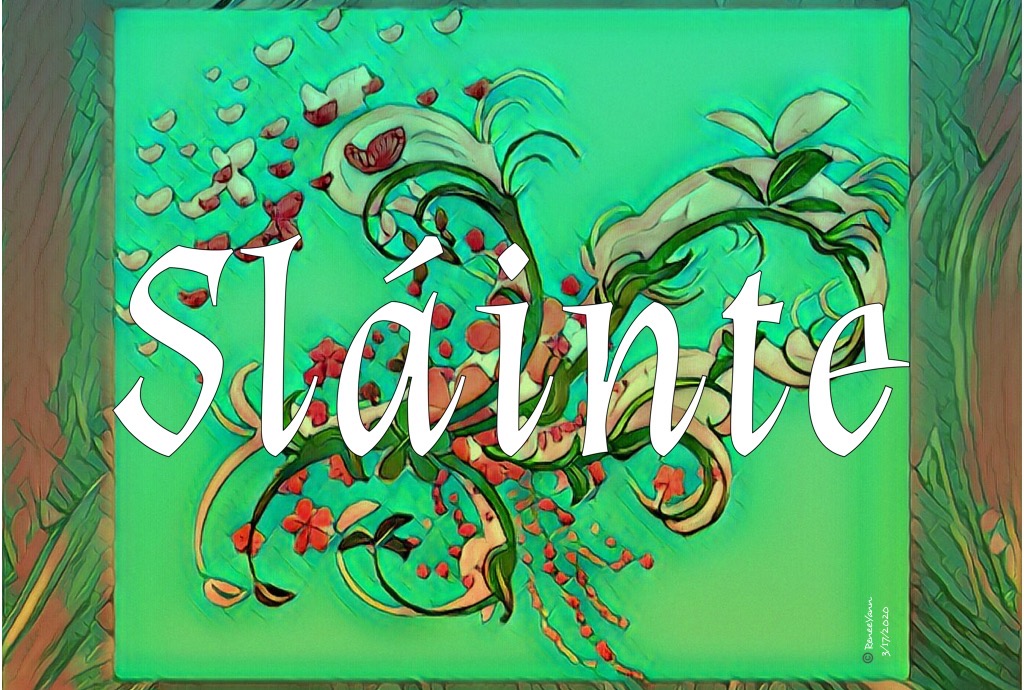
Sláinte means “health” in Irish and Scottish Gaelic
Our dear St. Patrick, on this glorious feast, gives us the perfect prayer to strengthen and direct our hearts. We pray in gratitude for all our ancestors on whose shoulders we stand.
I arise today
Through the strength of heaven;
Light of the sun,
Splendor of fire,
Speed of lightning,
Swiftness of the wind,
Depth of the sea,
Stability of the earth,
Firmness of the rock.
I arise today
Through God’s strength to pilot me;
God’s might to uphold me,
God’s wisdom to guide me,
God’s eye to look before me,
God’s ear to hear me,
God’s word to speak for me,
God’s hand to guard me,
God’s way to lie before me,
God’s shield to protect me,
God’s hosts to save me
Afar and anear,
Alone or in a mulitude.
Christ shield me today
Against wounding
Christ with me, Christ before me, Christ behind me,
Christ in me, Christ beneath me, Christ above me,
Christ on my right, Christ on my left,
Christ when I lie down, Christ when I sit down,
Christ in the heart of everyone who thinks of me,
Christ in the mouth of everyone who speaks of me,
Christ in the eye that sees me,
Christ in the ear that hears me.
I arise today
Through the mighty strength
Of the Lord of creation
There were people of all ages Gathered round the gable wall Poor and humble men and women Little children that you would call We are gathered here before you And our hearts are just the same Filled with joy at such a vision As we praise your name
Golden Rose, Queen of Ireland All my cares and troubles cease As I kneel with love before you Lady of Knock, my Queen of Peace
Oh, your message is unspoken But the truth in silence lies So I gaze upon your vision And the truth I try to find Here I stand, with John the teacher And with Joseph at your side And I see the lamb of God On the altar glorified
Golden Rose, Queen of Ireland All my cares and troubles cease As we kneel with love before you Lady of Knock, my Queen of Peace
And the lamb will conquer And the woman clothed in the sun Will shine her light on everyone And the lamb will conquer And the woman clothed in the sun Will shine her light on everyone
Golden Rose, Queen of Ireland All our cares and troubles cease As we kneel with love before you Lady of Knock, my Queen of Peace Lady of Knock, my Queen of Peace
I will place my law within them and write it upon their hearts; I will be their God, and they shall be my people. No longer will they have need to teach their friends and relatives how to know the LORD. All, from least to greatest, shall know me, says the LORD, for I will forgive their evildoing and remember their sin no more.
Jeremiah 31: 33-34
My Uncle Joe was full of life – a little wildness, a little wisdom, and a lot of love. Only seventeen years older than I, he was more like my older brother. His mother, my grandmother, died when I was almost three and he was twenty. One night months later, after partying with his buddies, he came home with a big tattoo on his upper arm something like this:
There is a whole psychology around why people get tattoos, but I think it boils down to expressing something that’s otherwise inexpressible. The tattoo was Joe’s way of holding on to someone who had anchored his life.
Today, in God’s Lavish Mercy:
In our first reading, Jeremiah kind of tells us that if God had tattoos, our name would be one of them. We are inscribed on God’s heart in an inexpressible covenant of love. Let’s live so that, if our hearts became visible, God’s Name would be clearly etched there as well.
Poetry: I carry your heart – e.e.cummings
i carry your heart with me (I carry it in
my heart) i am never without it (anywhere
i go you go, my dear ;and whatever is done
by only me is your doing, my darling)
i fear
no fate (for you are my fate, my sweet) I want
no world (for beautiful you are my world, my true)
and it’s you are whatever a moon has always meant
and whatever a sun will always sing is you
here is the deepest secret nobody knows
(here is the root of the root and the bud of the bud
and the sky of the sky of a tree called life; which grows
higher than soul can hope or mind can hide)
and this is the wonder that’s keeping the stars apart
Yet I, like a trusting lamb led to slaughter, had not realized that they were hatching plots against me: “Let us destroy the tree in its vigor; let us cut him off from the land of the living, so that his name will be spoken no more.”
Jeremiah 11:19
“Plot” can be an ugly word – a sinister trap woven in the darkness of fear and ignorance. Such plotters are befuddled by innocence, freedom, honesty, and goodness. Without these virtues themselves, they have no tools to meet challenges with sincerity and trust..
In our readings, we see darkened souls interweaving their fears to trap both Jeremiah and Jesus. It’s a picture of “conspiracy theories” in Biblical times!
In our current culture, we see people design elaborate arguments to justify war, rioting, oppression, weaponry, economic excess, and all the many “isms” that trap others in their vulnerability.
Lent is not just a remembrance of things past. It is a living participation in the Paschal Mystery as Christ experiences it in our times. We must ask ourselves if we ever stand with, or even silently near, the “plotters”.
Poem: The Second Crucifixion – Richard Le Gallienne (1866 – 1947)
LOUD mockers in the roaring street
  Say Christ is crucified again:
Twice pierced His gospel-bearing feet,
  Twice broken His great heart in vain.

I hear, and to myself I smile,
For Christ talks with me all the while.

No angel now to roll the stone
  From off His unawaking sleep,
In vain shall Mary watch alone,
  In vain the soldiers vigil keep.

Yet while they deem my Lord is dead
My eyes are on His shining head.

Ah! never more shall Mary hear
  That voice exceeding sweet and low
Within the garden calling clear:
  Her Lord is gone, and she must go.

Yet all the while my Lord I meet
In every London lane and street.

Poor Lazarus shall wait in vain,
  And Bartimæus still go blind;
The healing hem shall ne'er again
  Be touch'd by suffering humankind.

Yet all the while I see them rest,
The poor and outcast, on His breast.

No more unto the stubborn heart
  With gentle knocking shall He plead,
No more the mystic pity start,
  For Christ twice dead is dead indeed.

So in the street I hear men say,
Yet Christ is with me all the day.
The wicked said among themselves… “Let us condemn him to a shameful death; for according to his own words, God will take care of him.” These were their thoughts, but they erred; for their wickedness blinded them, and they knew not the hidden counsels of God; neither did they count on a recompense of holiness nor discern the innocent souls’ reward.
Wisdom 2: 20-22
In our readings, the Holy One meets the opposition of those who plot against him. They rationalize their persecutions, proclaiming them as acts of justice. They expect their victim to crumble under the pressure of their judgments. What they do not expect is a return of goodness, gentleness, and forgiveness – a recompense of holiness. They do not expect the great contradiction of the Cross, and they are incapable of comprehending it.
Today, in God’s Lavish Mercy:
As Lent deepens, and we come closer to the shadows of Calvary, we are summoned into the sufferings of Jesus to test our own understanding of this Great Contradiction.
What does Christ teach us about payback, unforgiveness, revenge, violence, and war – the popular “recompenses” of our culture to any resistance or injury we encounter?
What might a “recompense of holiness” look like in my life when I meet gracelessness in another person or situation?
How might it transform our belligerent culture if we modeled our behaviors on the holiness of Jesus?
Poetry: Peace-making Is Hard …. – Daniel Berrigan, SJ
hard almost as war.
the difference being
one we can stake life upon
and limb and thought and love.
I stake this poem out
dead man to a dead stick
to tempt an Easter chance—
if faith may be
truth, our evil chance
penultimate at last,
not last. We are not lost.
When these lines gathered
of no resource at all
serenity and strength,
it dawned on me
a man stood on his nails,
an ash like dew, a sweat
smelling of death and life.
Our evil Friday fled,
the blind face gently turned
another way. Toward Life.










 Lavish Mercy